Showing posts with label sewers. Show all posts

Thursday, September 9, 2021

Rat salad

https://cdn.cms.prod.nypr.digital/original_images/pjimage_1.jpg 

Gothamist

Neal Phillip was biking through Canarsie Park on Saturday when something stopped him in his tracks: nearly a dozen bloated rat corpses, lying belly-up on a stretch of sand overlooking Jamaica Bay.

“When I saw the first one, I thought it was strange. Then I started seeing them all over the place,” recalled Philip, a professor of environmental science at Bronx Community College. “Seeing them dead like that wasn’t very pleasant.”

In recent days, similar displays of mass rodent death have appeared elsewhere in the five boroughs, a grim outcome of the floods brought by Tropical Storm Ida. Experts believe that hundreds of thousands of rats may have perished in the deluge, amounting to one of the largest vermin depopulation events in decades.

“With this particular storm, any rats that were in the sewers were either crushed by the current or were swept out into the rivers,” said Bobby Corrigan, a longtime pest control expert and former ​​rodentologist for the NYC Department of Health. “I can’t imagine they would’ve survived.”

While there are no reliable counts of New York City’s rats, estimates typically start in the many millions. A significant portion live in the subways and sewers, both of which were swiftly inundated during last week’s historic rainfall.

Thursday, June 10, 2021

Sewer celebration

https://qns.com/wp-content/uploads/2021/06/rochdaleinfrastructure_2018_06_22_q01_z.jpg 

QNS

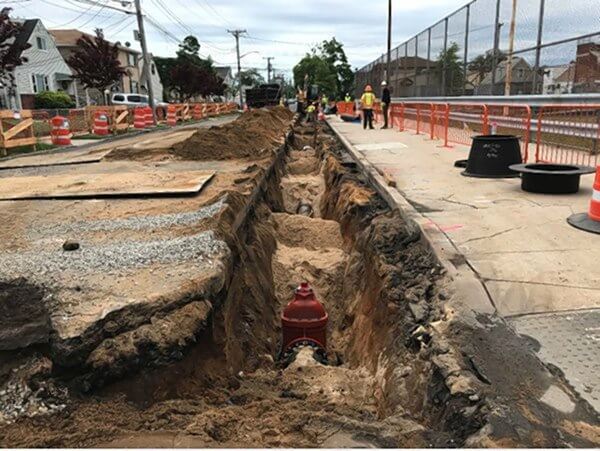
Southeast Queens leaders are hailing the completion of a $20.5 million sewers and water main project that upgraded infrastructure in Hollis and Queens Village.

The city announced the construction that started in March 2019 has been finished five months ahead of schedule.

“As a homeowner in southeast Queens, I understand the anguish of local residents who experience constant flooding of their basements,” Councilman I. Daneek Miller said. “Back in 2016, I worked with now-Queens Borough President Donovan Richards to secure $1.9 billion if funding for flood remediation infrastructure, which includes an unprecedented online portal that provides oversight of the initiative. Thanks in part to our advocacy and the cooperation of local residents, I am pleased that this project has been completed under budget and ahead of schedule.

“We look forward to the continued work to end the tremendous suffering many homeowners have had to endure over the last several decades,” Miller said.

Work occurred on 20 individual blocks to replace more than one mile of water mains, some of which were installed before World War II.

“These improvements are a significant investment in the future of Hollis and Queens Village, and their early completion greatly benefits the hard-working families of these vibrant neighborhoods,” Richards said. “This work underscores the city’s strong commitment to alleviate chronic flooding and addressing the other chronic infrastructure problems in southeast Queens.”

Friday, December 4, 2020

Looking for COVID in all the crappiest places


THE CITY 

 As the COVID-19 positivity rate rises across the five boroughs, city scientists are working to get the lowdown on the virus, straight from New Yorkers’ poop.

Unlike many municipalities, New York is testing wastewater for the coronavirus in an effort to trace — and stop — the spread. But experts on sewage monitoring say the city could be using the technology to do more to contain the virus.

Microbiologists working for the city’s Department of Environmental Protection test samples taken twice a week by DEP staff at 14 wastewater treatment plants.

At the plant at Newtown Creek in Greenpoint, Brooklyn, the largest facility by volume in the city, sampling means walking down four stories to large concrete basins that open to a river of raw sewage.

From there, a worker lowers two empty bottles — held securely inside a contraption made of cut PVC pipe, heavy bolts and a long rope — into the smelly stream, waits for them to fill and hoists them back out to deliver to the DEP’s on-site laboratory.

Still, some experts emphasize those samples are mere drops taken from a waste ocean. Each of New York’s treatment plants treat sewage from more people than the entirety of many smaller cities.

DEP Commissioner Vincent Sapienza noted the Newtown Creek plant collects the waste of about a million New Yorkers. Even the city’s smallest facilities handle “a couple hundred thousand,” he told THE CITY.

 “The data we collect isn’t that granular. We can’t say it’s a specific neighborhood or a specific block where things may be happening,” he said. “Right now, we’re using the data, sharing it with the health department to say, ‘Hey, there may be something there.’”

At that point, the DEP data hopefully points the health experts in the right direction to then use results from individual COVID tests to further monitor the virus, he added.

Saturday, December 14, 2019

NYC Department Of Environmental Protection debuted new sewer infrastructure in Southeast Queens a few days before South Ozone Park homes got deluged with dung water


QNS


After breaking ground in the community of Brookville in southeast Queens earlier this year marking the beginning of an $84 million infrastructure upgrade project, the New York City Department of Environmental Protection (DEP) announced on Nov. 26 the installation of new storm box sewers to help alleviate flooding. 

DEP Commissioner Vincent Sapienza joined with the Department of Design and Construction’s (DDC) Deputy Commissioner for Infrastructure Eric Macfarlane and Councilman Donovan Richards to review the progress of the project that includes the installation of 9-foot-by-5-foot storm box sewers. 

“To date, 1,650 feet of storm sewers, 2,500 feet of sanitary sewers and 11,800 feet of water mains have been installed,” the DDC said in a statement to QNS. “Additionally, 25 hydrants were replaced and seven additional fire hydrants were installed as well.” 

The project, which is funded by DEP and managed by DDC, is anticipated to be completed in the summer 2021. The large box sewer will form one of the major spines for Mayor Bill de Blasio’s $1.9 billion buildout of the drainage system throughout southeast Queens. 
It was a much-needed development for the area which has historically flooded even with the slightest bit of rain, Richards said. 

“This is one of 55 projects that are slated for southeast Queens over the course of the next decade or two, and these are projects that have been on the books for a very long time, like many other projects in southeast Queens,” said Richards, former chairman of the Environmental Protection Committee, who lobbied for infrastructure investment in the community. 

Going by what happened on Thanksgiving weekend, it looks like this upgrade didn't make it to South Ozone Park yet.


Saturday, August 18, 2018

City allocates additional $8M for Middle Village sewer project

From the NY Post:

The city has finally earmarked $8 million to fix ­aging sewer lines in Middle Village, Queens, that have caused fecal flooding in residents’ basements — a day ­after The Post revealed how the repairs had been promised for a decade.

“My God, I can’t believe it,” said longtime resident Vito Cascione, 60, whose 1985 Cadillac Fleetwood Brougham was flooded with sewer water during a recent heavy storm.

“The Post’s article really raised eyebrows and a lot of questions, so hopefully we can get this resolved once and for all,” Cascione said.

The 74th Street and Penelope Avenue sewer project, which was first proposed in 2007, sat unfinished for nine months after contractors dug up contaminated soil at the site and needed the extra dough to safely excavate it.

City Hall confirmed to The Post Friday afternoon the money has been allocated and will be processed through the comptroller’s office “soon.”

A spokesperson for the Department of Design and Construction expects work to resume “by the end of the year.” The contractor in charge of the project said about another year of work is still needed.

Wednesday, June 20, 2018

CAC's working on 32nd Ave...

The great work that CAC has done in Woodside and Middle Village is now in Flushing, just south of Bowne Park.
They sure have a lot of crap out on the street.
Anyone want to place a bet on when the work actually gets done and how much it will end up costing? People have been kind of quiet about this one.

Friday, April 20, 2018

Contractor dumped lead contaminated soil near Middle Village school

Photo by Christopher Barca/Queens Chronicle
From the Queens Chronicle:

A $22 million sewer main project in Middle Village that was nearing completion suddenly stalled in December, and no one in the community knew exactly why.

There was some talk among area leaders that workers were transferred to another job site or that they had various problems digging into the ground.

But on Tuesday, Councilman Bob Holden (D-Middle Village) said the real reason for the project’s halting was much scarier.

“The Department of Design and Construction sent four representatives to my office on Friday and they told me the project stopped because of contaminants in the soil,” Holden said. “I asked one gentleman what were the contaminents in the soil.

“He said high levels of lead.”

As if that wasn’t a big enough issue, the lawmaker said that problematic soil that had been excavated during the Penelope Avenue sewer work is sitting in a yard leased by CAC Industries — the project contractor — across the street from PS/IS 128, a K-8 school in Middle Village.

The massive mounds of dirt had been sitting uncovered at the site, possibly for months, as a tarp wasn’t placed over them until this week.

And at both a press conference and Community Education Council District 24’s monthly meeting on Tuesday, Holden said the person who spoke about the high lead levels — a senior DDC project manager based in the immediate area — was contradicted by his colleagues over how dangerous the soil was and if it was covered.

The lawmaker added he visited the site last Friday and noticed the massive mound of soil was uncovered. But on Monday, he claimed, DDC Acting Commissioner Ana Barrio falsely told him it had been covered the entire time and that the agency project manager “misspoke” regarding lead levels.

Tuesday, March 13, 2018

Here's where they want you to hold onto your poop

From QNS:

The next time it rains, the city’s Department of Environmental Protection (DEP) wants Queens residents to wait until it stops before doing the dishes, taking a shower or flushing a toilet.

The appropriately titled “Wait…” pilot program is expanding throughout western Queens, the DEP announced on Monday. Participating homeowners and tenants are sent text messages alerting them that the Newtown Creek and Bowery Bay Wastewater Treatment plants are near capacity — and that they should minimize their water use in order to prevent sewer overflows from spilling into already polluted waterways such as the Newtown Creek and Flushing Creek.

The pilot program area of Queens covers all neighborhoods north of the Jackie Robinson Parkway and west of the Van Wyck Expressway, as well as portions of Kew Gardens Hills and Briarwood.

According to advocates, the Wait Program is geared at educating the public about where their dirty water winds up after going down the drain. Wastewater produced whenever someone washes clothes or dishes, or even flushes a toilet, travels into the city’s vast underground sewer system, destined for one of many sewage treatment plants for cleanup and processing.

But in a heavy rain event, not all of the storm runoff and wastewater winds up in the sewage treatment plants. When the plants hit capacity, excess wastewater is expelled through combined sewer overflows into waterways across the city. About 90 percent of the overflow is comprised of storm runoff, and the rest is household wastewater containing detergents, chemicals and raw sewage.


Hey, how about limiting the building in these boroughs until the city gets a handle on how much waste they produce?

Tuesday, December 19, 2017

Middle Village residents blocked from their own driveways


From CBS 2:

Viewers called CBS2 with complaints, saying they’re parked in on their own driveways or parked out of their street in Middle Village due to a sewer project going on during the holidays.

Residents say their nerves are frayed.

The city’s Department of Design and Construction gave the green light to a $22 million capital sewer replacement project following decades of flooding on streets build over the landfill there.

The massive dig is taking years and the contractor has been on 74th Street since September.

“It’s major,” homeowner Gemma Cullen said. “You can’t get in the driveway. They block you in, you can’t get out.”

Parking tickets are a whopping $115.

“How can the residents here have company over for the holidays,” homeowner Jane Del Rosa said. “They can’t park anywhere.”

The contractor and the city have asked for patience and say the project is on target. Queens community board five is acting as a watchdog.

Wednesday, October 18, 2017

Fresh Meadows concerned about oversized day care center

From the Queens Chronicle:

About 75 concerned Fresh Meadows residents, many of whom are senior citizens, on Tuesday vehemently opposed the construction of Great Sunshine Daycare on 67th Avenue and 172nd Street saying, despite the center’s name, the site will cast a dark cloud over the suburban neighborhood’s already busy intersection, just one block from PS 173’s playground, and steps from MS 216.

Resident Cliff Hamburger — who presented at a town hall meeting held to discuss concerns about the proposed development — explained potential traffic congestion.

“You can’t unload a school bus in less than a minute,” Hamburger said at the meeting in PS 173’s auditorium.

The drop-off route for the day care will follow the already congested 67th Avenue, and exit from 72nd Street.

“[Or], the mother will have to drop off a toddler, take the child in, get him/her settled, resulting in idling engines,” Hamburger said, adding that staff will need “street parking, weekly deliveries and garbage collection.

“The DOT has agreed to finally conduct a traffic study,” Hamburger added. “So pending that, there is a stop-work order in place for the facility.”

The facility will be equipped with nine classrooms for approximately 290 students, and 30 staff members. It’s also proposed to have 11 parking spaces on the ground floor, one elevator and two staircases.

Rob Agnello, another presenter, discussed sewer capabilities for the facility, which currently only has one at 36 inches in diameter.

Saturday, October 14, 2017

Cosmetic repairs on Calamus Avenue

The Department of Design and Construction is offering to fix sidewalk cracks on Calamus Avenue resulting from a 4-year long sewer installation project.
Meanwhile, people have damaged homes and foundations...

Perhaps Ms. Crowley or Comptroller Stringer can get the City to offer a bigger bone than this. (Sorry I am in a comical mood this morning.)

Wednesday, August 2, 2017

Downtown Flushing is more chaotic than ever


From NBC:

Downtown Flushing — already teeming with people and vehicles on sidewalks and streets — has become all the more chaotic amid simultaneous work on sidewalks and a sinkhole.

Two major construction projects are happening in the vicinity of Main Street and Kissena Boulevard. Nearly two dozen bus lines roll through the bustling area.

The city is making emergency sewer repairs to fix the sinkhole. The DEP showed up last week, and with no notice, brought a backhoe and jackhammer to fix the mess. The result: absolute gridlock.

Flushing Councilman Peter Koo said he called the commissioner of the city’s Department of Environmental Protection. That call, and others, convinced the DEP to switch gears within 24 hours. Now the repair work is being done overnight when streets are less busy.

Amid the effort to fix the sinkhole, crews are working on widening the area’s sidewalks. The result has been a dizzying mishmash of bodies, vehicles, signs, detours and construction cones.

Saturday, July 29, 2017

Is Calamus Avenue water safe to drink?

From the Queens Tribune:

Ben Geremia, a 60-year resident of the street, said that, in 2015, he saw that the city Department of Design and Construction’s contractor, CAC Industries Inc., had installed a red rubber hose as a temporary water supply for his home.

Geremia took a photo of the rubber hose, found the manufacturer and called to ask for its use. According to Geremia, the manufacturer does not recommend the hose for use of drinking water. He noted that a few days later, he spoke with CAC’s foreman and had the hose removed from his house.

Then, a clear hose was installed a few days later and Geremia once again consulted the hose’s manufacturer to discover that it was also used for non-potable water. Eventually, his home received the correct temporary hose.

Two years later, he was astonished to discover that CAC Inc. was uncovering red hoses buried in the ground and supplying water to his neighbors.

He points out that he was the only one who complained and [although he has no evidence], he is worried that his neighbors are not getting quality drinking water.

Friday, July 28, 2017

Catastrophe on Calamus

From the Queens Chronicle:

Stringer explained during the walk that the contract between the DDC and CAC Industries, the contractor doing the work, indemnifies the city from being directly sued by residents.
Instead, those impacted by the work are advised to go through their insurance company and that of CAC Industries.

Representatives for Stringer told the Chronicle on Monday that it is standard for the city to be indemnified from lawsuits while it works with an outside contractor who has its own insurance.
Juniper Park Civic Association President Bob Holden — who is running against Crowley in September’s Democratic primary — said in a Monday interview the city’s lack of accountability in situations like these “stinks to high heaven.”

“People have gone through years of hell,” Holden said. “They shouldn’t have to go through their insurance companies to get satisfaction here.

“Why does the city continue to hire these guys? Do they not have many good contractors or do good contractors not want to do business with the city?” he continued. “Are they putting less-qualified contractors into neighborhoods that are working class? Would this be allowed in Manhattan?

In a June letter sent to Calamus Avenue residents, Crowley advised filing a claim with DDC and Stringer’s office, as well as referring to one’s own homeowner’s insurance policy to see if there’s a time frame for filing claims.


...A little more than a week later...

From the Queens Chronicle:

Wu and Guillen were two of a number of residents along the block who tried to file claims with their homeowners insurance companies.

They’ve all been unsuccessful, however. Guillen said she was told that losses stemming from “earth movement” are not covered.

Councilwoman Elizabeth Crowley (D-Glendale) and a spokesman for city Comptroller Scott Stringer said residents with damage to their property should report it to CAC as soon as possible.

“The company contracted with the city on this project is responsible for fixing any and all damages,” Crowley said in a statement. “All homeowners should document and report their damages to both the company and the city.”

CAC did not immediately respond to a request for comment by press time.


Does anyone here know what the hell they are doing or care that these people's homes were damaged by a city contractor?

Thursday, July 6, 2017

How NYC protects the environment

From Brooklyn Daily:

The state has approved a permit for the city to pour up to 7.2 million gallons of contaminated groundwater into Coney Island Creek every day for up to two years while the city upgrades sewer and water mains in Coney’s west end.

The permit allows the city to overlook nearly a dozen heavy metals found in the water because only small amounts were discovered in the creek, and state officials say locals have nothing to fear because Coney creek flows into Gravesend Bay, which will dilute the pollutants. But with millions of gallons gushing into the inlet each day for years, experts and locals fear that the contaminates could amass to dangerous levels, and aren’t buying the state’s argument that being connected to a large body of water will mitigate the risks.

The project being run by the Economic Development Corporation will upgrade aging water mains and storm and sanitary sewers in an area bounded by W. 17th and W. 22nd streets from Neptune Avenue to the Boardwalk. Shovels are expected to hit the ground this summer and the project will last for roughly two years — with an embargo on Surf Avenue construction from May 15 to Sept. 15 so as not to clash with the swell of beach-goers, according to city records.

But to keep the construction site dry, the city applied for a State Pollutant Discharge Elimination System permit to “dewater” contaminated groundwater from several sites by pumping it into Coney Island Creek — where people swim, students routinely wade for city-run education programs, and some congregations use the waters for religious rites such as baptisms.

Saturday, May 13, 2017

Contractors abandon Centreville sewer project

Joanne Cutitto
From the Queens Chronicle:

Workers at the Albert Road sewer project in the Centreville section of Ozone Park have not been spotted on site for close to a month, because they’ve been pulled for another job elsewhere.

While some area residents joked they’re enjoying the peace and quiet, they’re also fuming because the neighborhood has been left a mess by the workers there.

“People now have to live with the mess for a longer term than they should have to,” said Ozone Park Civic Association Howie Kamph. “It’s not fair to the residents.”

A Chronicle reporter on Monday saw streets ripped up and uneven, water mains exposed to the elements, and cones — which looked to be covering a pothole — left in the middle of the street.

“It looks like a third-world country,” said resident Joanne Cutitto. “It’s like there’s no pride in their workmanship.”

The Department of Design and Construction did not respond to multiple requests for comment on this story — including if they’re chasing down the contractor, Maspeth Supply, to finish the taxpayer-funded work in the time laid out in the contract.

A person answering the phones at Maspeth Supply — which, according to city records, has received hundreds of millions of dollars in city contracts for water main and sewer work — said to send an email to the company’s owner, which was not responded to by press time.

Wednesday, March 22, 2017

Smells like crap at Pomonok

From PIX11:

Janice Rodriguez says the smell inside the Pomonok Houses where she lives with her children is unbearable.

"It's smells like raw sewage in our lobby, in our elevator, in our hallways, and even inside our homes," said Rodriguez.

Rodriguez says she worries for the dozens of families who live inside the city complex, including her grandchildren.

PIX11 news reached out to the New York City Housing Authority.

A spokesperson says,"This situation is unacceptable and our residents deserve better. This morning, the clogged sewer line was cleared and the area was disinfected.”

Saturday, February 25, 2017

Calamus calamity

From QNS:

Maspeth and Woodside residents have been angered over months of delays in the reconstruction of sewers under Calamus Avenue and 69th Street — and they were even more upset on Thursday night, when they learned the project’s completion is still 15 months away.

Nearly 50 concerned residents of the effected neighborhoods filled the parish hall of St. Mary’s of Winfield on Thursday night to hear why the Calamus Avenue Sewer Project — which has left Calamus Avenue and the surrounding areas a virtual mine field of potholes and craters, detoured the Q47 bus for nearly three years, and been a headache for anyone trying to commute in the area — has yet to move forward.

Ali Mallick, assistant commissioner for the Department of Design and Construction (DDC) North Queens Construction, clarified what documents weren’t accurate and why that was such a major problem for the project. The delays have pushed back the projected completion of the project to May of 2018.

“When I took over about a year ago, I found out that this project was dead, nothing was happening on the project,” Mallick said. “And there were problems with the design due to some unforeseen conditions in the ground because the drawings that we had did not match what was in the ground, so we had to do a major redesign with the work.”

Understanding the communities’ frustrations, Mallick and the DDC are looking at ways to work with the contractor to have the workers expand their work day and even work on some weekends to hopefully expedite the construction process and get the job done before the end of this year.

Other members of the DDC, Department of Transportation (DOT), and the Department of Environmental Protection Agency (EPA) were on hand to listen and respond to the residents’ concerns.

Noticeably absent from the meeting was a representative from the MTA. Several of the local elected officials reached out to the MTA, alerting them of the meeting and asking them to send a representative.

Tuesday, January 24, 2017

City admits that overdevelopment to blame for sewer problems

From the Daily News:

The city Department of Environmental Protection sends repair teams to that block — and other spots with scores of complaints — but the flooding persists, residents say.

****All told, four of the five spots with the most 311 complaints are in Queens, where city officials say commercial and residential development outpaced the buildout of critical support infrastructure, including catch basins and storm sewers.****

Seeking to fix the longstanding watery mess, the de Blasio administration has set aside $1.7 billion over the next 10 years to build out the city’s storm sewer system.

The planned “sewer buildout” will “resolve longstanding flooding conditions that affect over 400,000 city residents in southeast Queens,” First Deputy Mayor Anthony Shorris told reporters in April 2015.

Monday, January 9, 2017

Grease in pipes in an ongoing problem

From Crains:

Some section of the city's 7,500 miles of sewer lines gets blocked virtually every day, and discarded cooking oil is the reason 60% of the time. But in parts of Queens, that grease is the culprit in nearly 80% of all sewer backups, a problem that is especially acute near Kennedy Airport.

Experts say one reason Queens' sewers get blocked so often is that a lot of food is prepared in the city's most diverse borough, where residents, who hail from 120 different countries, might not be familiar with the best grease-handling practices.

In an effort to educate the public on the ills of grease dumping, last year the city enlisted interns from the Summer Youth Employment Program to knock on neighborhood doors as part of its Cease the Grease campaign. The teenagers visited more than 50,000 Queens households and 1,000 restaurants to remind people that used cooking oil and fat should be sealed in nonrecyclable containers and thrown out with the rest of the trash, not poured down the sink.

But grease has been blocking big city sewers practically since the pipes were laid. In 1859, a Brooklyn sewer commissioner observed that "melted grease is very objectionable." Two years ago in London, an 11-ton mound of congealed fat was extracted from a sewer, requiring more than $600,000 in repairs.

Grease causes sewer backups all over the city, but they most commonly occur in certain Queens neighborhoods including South Jamaica and St. Albans, where more than 4,800 complaints were made in the past five years, an average of nearly three per day. The city received almost 15,000 reports of greasy sewer clogs during that time, according to 311 call logs—numbers that suggest one-third of the most mucked-up city sewers are located in neighborhoods that house less than 5% of New York's 8.5 million residents.

Although some of those sewer problems can be linked to the vast amounts of cooking oil used in preparing dishes such as deviled fish, a deep-fried delicacy on the menu at many Sri Lankan restaurants in southeastern Queens, experts say the chronic backups mostly reflect the area's history and geography.

Sewer pipes in southeastern Queens tend to be 10 inches in diameter, Adamski said—less than half the typical size in other boroughs—because they were installed decades ago, when the area was relatively undeveloped. Southeastern Queens is also a flood basin, so its streets and basements are vulnerable to sewer backups after even modest rainfalls. The problem's origins go back to the 1940s, when a natural drainage area was paved over to build runways for JFK. Moreover, the area's groundwater table has steadily risen during the past decade or so. Climate change is a factor, and so is the fact that the city no longer pumps the ground wells that once provided the area's drinking water.