Showing posts with label nycha. Show all posts

Tuesday, February 6, 2024

NYCHAGATE

https://pbs.twimg.com/media/GFqq4F2XkAYXStP?format=png&name=small

 NY Post

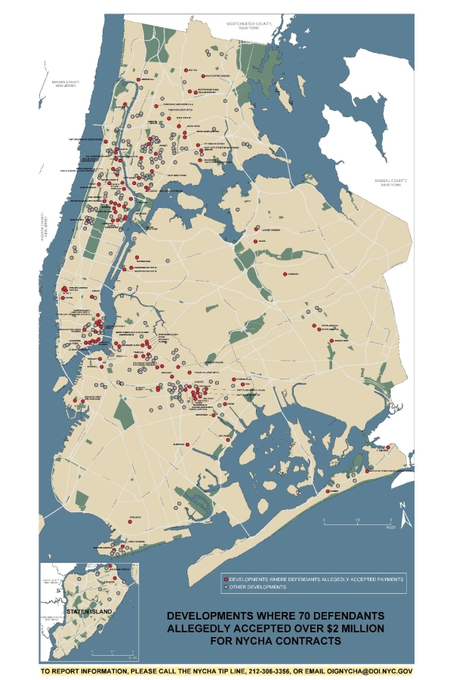
Seventy current and former NYCHA workers were charged Tuesday in a 10-year, $2 million “classic pay-for-play” corruption scheme involving the largest number of federal bribery raps brought in a single day in Department of Justice history.  

Some of the kickbacks to the rogue workers hit well over six figures — and several of the heftiest charges were slapped against a 47-year-old female employee accused of helping an unnamed co-conspirator extort contractors in exchange for work with the agency, court documents claim.

“Babe[,] could you put a company through for someone? All you would need to do is sign the documents as the approved and get anyone to sign as the requestor,” the co-conspirator messaged Angela Williams on Feb. 3, 2022, according to the papers. 

“That has been my side hustle…lol 1k per,” the unidentified person added of the scheme.

The avalanche of bribery and extortion crimes occurred in about a third of the 335 developments in the New York Housing Authority — the country’s biggest public housing agency — when the suspects demanded cash in exchange for lucrative construction, maintenance and no-bid contracts, officials said.

The defendants, all of whom were working for NYCHA at the time, sought between 10% and 20% of the contracts’ values – or kickbacks of between $500 and $2,000 – though some asked for higher amounts, authorities said.

 In total, the dozens of rogue workers received more than $2 million in bribes involving $13 million in contracts between 2013 and 2023, officials said.


Friday, September 16, 2022

Mayor Adams demotes NYCHA commissioner following poisoned water results at Jacob Riis Houses


Politics NY 

A major shakeup is coming to the leadership structure of the city’s public housing authority.

Mayor Eric Adams’ office announced Thursday the New York City Housing Authority’s (NYCHA) current chair and CEO Greg Russ will step back as the authority’s chief executive, following an arsenic contamination scare at the Jacob Riis Houses on Manhattan’s Lower East Side.

Russ will stay on as chair, according to a release, as the roles of CEO and chair that have typically been held by one person are split into two separate jobs. The authority’s general counsel Lisa Bova-Hiatt will serve as interim chief executive until they find a permanent replacement.

“We cannot wait any longer to make transformational changes so NYCHA can provide safe, high-quality homes for New Yorkers,” Adams said. “I am determined to work with my partners in government to identify the right leaders and the right structure for NYCHA to deliver on our promises to public housing residents. I want to thank Lisa Bova-Hiatt for her dedicated service to our city and for stepping up at this critical time to put NYCHA on the right path.”

The news comes after a rough couple of weeks for the embattled public housing authority. Nearly two weeks ago, NYCHA and the mayor’s office told Jacob Riis residents their tap water had tested positive for arsenic and advised residents not to drink or cook with the water for nearly a week.

But late last week, the city reversed course, sharing that the lab who’s tests yielded the positive arsenic results – Environmental Monitoring and Technologies – retracted those results and released revised results that were negative for the toxic substance. A day later, Adams announced the water at Jacob Riis was safe to drink and cook with again, posting a video of himself and city Department of Health and Mental Hygiene (DOHMH) Commissioner Dr. Ashwin Vasan drinking cups of water from the development’s taps.

Adams’ office says it wasn’t notified about the positive arsenic test until several days after NYCHA was aware of the results. During an unrelated press conference Monday, Adams said the delay in notifying his office was “unacceptable” and hinted at the leadership change announced Thursday.

“We were notified on Friday, they were notified on Monday, it’s unacceptable,” Adams told reporters. “And so we know there’s new leadership that’s about to take place at NYCHA and we’re looking at exactly what happened here.”


Wednesday, May 25, 2022

The deliberately forgotten woman of NYCHA


The headline is fixed. This is what NYCHA did instead of making the apartment accessible for a low income earning citizen or family

Friday, March 11, 2022

Adams initiates more affordable "green" housing developments for Southeast Queens


QNS

The mayor and New York City Council Speaker Adrienne Adams — both of whom grew up in the area — celebrated the completion of a $50 million project delivering more than six miles of new sewers and water mains to alleviate flooding of homes and streets in Rochdale under budget. They also kicked off the construction of “Habitat Net Zero,” a project that will turn 13 dilapidated homes previously owned by the NYC Housing Authority (NYCHA) into 16 green homes for affordable homeownership. 

“This community represented the promise of a better life for my family, and I am going to keep that promise for generations of New Yorkers,” Adams said during a press conference outside of a dilapidated house at 126-01 116th Ave. in south Jamaica that will be transformed by Habitat for Humanity. “The government has ignored this community for too long, denying them their fair share of investments and services — that ends in my administration. These projects will make life better for the residents of southeast Queens today and those who will be able to move here in the future, and I’m proud to say that this is just the beginning.”

For far too long, southeast Queens has endured systemic disinvestment and neglect, resulting in widening disparities that persist today, Council Speaker Adams said. 

“With the completion of the $49.3 million water infrastructure project in Rochdale and the start of construction for Habitat Net Zero — a project to deliver new affordable homeownership opportunities — our communities are seeing the investments and improvements that we have always deserved,” the speaker said.

The New York City Department of Environmental Protection (DEP), New York City Department of Transportation (DOT), and New York City Department of Design and Construction (DDC) completed the $49.3 million project under budget, bringing more than six miles of new sewers and water mains to Rochdale — improving street conditions, alleviating flooding, and upgrading infrastructure, while staying $5.7 million under budget. Work began in March 2018 and took place on 78 individual blocks.

 “Ever since the residential development of southeast Queens more than 50 years ago, neighbors have worried about any threat of rain in the forecast, because there were no catch basins or sewers built to drain the roadways, resulting in chronic flooding and property damage,” said Meera Joshi, deputy mayor for operations. “With a commitment of $2.5 billion for a comprehensive drainage system, we are now correcting that past failure block by block.” 

Affordable huh? We shall see...

Monday, February 7, 2022

Judge calls NYCHA a criminal landlord...then he vanished


NY Daily News

That was the message from a Queens Housing Court judge outraged by the agency’s failure to provide hot water to as many as 300 tenants in a Rockaway apartment building since November, the Daily News has learned.

“If this was a private small landlord he [the landlord] would be in jail by now,” Judge Kimon Thermos said during a Jan. 20 hearing. “He would have been in jail by now and the fines would have been $500 per day, per apartment. So he would have been in jail and he would have been losing his building too.”

As a city-run agency, the New York City Housing Authority is not eligible for the same penalties as a private landlord who neglects its properties and tenants.

“Why is your crime shielded this way?” Thermos asked a NYCHA lawyer. “NYCHA is dropping the ball big time here.”

Tenants in Carleton Manor say NYCHA did little for months to fix the water problem that makes taking a shower a major undertaking. Dozens of tenants have filed a petition in Housing Court seeking to force NYCHA to make repairs at the 174-unit building on Beach Channel Dr. and Beach 74th St. in Arverne.

“This is the dead of winter,” said Alisha Robinson, 42. “We need this corrected. We need some attention on fixing this.”

“It doesn’t make any sense to me,” she said. “I have to go to a hotel to take a decent shower.”


The legal fight began Nov. 29, when one tenant, Shaniya Callender, filed a petition to get the water problem fixed. That yielded no progress, so on Dec. 28, 45 tenants signed a petition threatening housing court action if no repairs were made by Jan. 10.

That deadline came and went, so the tenants took NYCHA to court. At the Jan. 20 hearing, Judge Thermos was outraged that NYCHA’s work on the building was being overseen by an unlicensed plumber.

The judge said he was considering issuing a subpoena demanding NYCHA Chairman Gregory Russ appear in court. But before he could, Thermos was replaced on the case by a different judge, for unclear reasons.


Wednesday, November 24, 2021

NYC Council approves Gowanus luxury public housing rezoning after leveraging NYCHA repairs and also the blood bank tower upzoning

  https://s12.therealdeal.com/trd/up/2021/11/main_NY_Gowanus-rezoning-NEW-705x439.png

The Real Deal

The City Council both bucked and abided tradition Tuesday with the approval of a life sciences expansion on the Upper East Side and a sweeping rezoning in Brooklyn.

Lawmakers voted to rezone Gowanus to allow mixed-use buildings in an 82-block area largely restricted to manufacturing use. City officials estimate that the change will enable the construction of more than 8,500 apartments, 3,000 of which would be set aside for low- and moderate-income New Yorkers.

As part of the proposal, City Hall has agreed to pay an estimated $200 million for repairs at two New York City Housing Authority complexes, Gowanus Houses and Wyckoff Gardens. Local Council members Brad Lander and Stephen Levin had said they would not support the rezoning unless the city committed to at least $132 million.

The city is also pledging $174 million in sewer upgrades and will require new development to meet new stormwater rules aimed at stemming sewage overflows into the infamously polluted Gowanus Canal, where a cleanup that was fiercely debated during the Bloomberg administration is underway.

The City Council also greenlit plans for a larger headquarters for the New York Blood Center at 310 East 67th Street. The proposal was approved despite objections from Council member Ben Kallos, who represents the area, and marked the first time since 2009 that the City Council has flouted member deference, or the tradition of voting with the local member on land use decisions.

The vote came after Council leaders reached a deal to reduce the height of the blood center building from 334 feet to 218 feet (233 with mechanical equipment). The project, which is being developed by Longfellow Real Estate Partners, would serve as an expanded headquarters for the New York Blood Center as well as office and lab space for other life science companies.

Kallos objected to the scale of the project and has called on the developer to reduce the height even further. The de Blasio administration, City Council leaders and Manhattan officials negotiated a deal without Kallos because they did not trust that he would reach an agreement that met their goals for the site.

On the Council floor ahead of the vote, Kallos said approval would send the message that “local council members don’t matter anymore” and would serve as a “blueprint for deep-pocketed developers to get whatever they want.”

Wednesday, August 18, 2021

Queensbridge tenants draw up class action suit against NYCHA for purposeful neglect

A crumbling bathroom in an apartment at the Queensbridge Houses.
 

 NY Daily News

 Fed-up tenants of the Queensbridge Houses sued the New York City Housing Authority on Tuesday, citing hazardous conditions in the nation’s largest public housing complex and what they describe as illegal harassment.

Pamela Wheeler, 72, and Marilyn Keller, 58, are among 11 plaintiffs named in two lawsuits — one representing residents of the complex’s northern section, the other representing its southern section — filed in Queens Housing Court.

The suits come after years — and for some residents, decades — of complaints about quality-of-life issues in their homes, including asbestos, lead, mold, severe leaking and flooding, vermin, and other biohazards.

“I am tired of living with mice, roaches, waterbugs, lack of heat, holes in my walls and sink, waterlogged and rotting cabinets, and many more repair issues that are a threat to my health and safety and an affront to my dignity,” said Wheeler at a press conference.

Keller, abreast cancer survivor who suffers chronic health issues, described exposed electrical wiring, a broken radiator, rotted kitchen cabinets, and a broken door in her apartment she said frequently gets jammed.

 Her calls to NYCHA rarely, if ever, result in action, Keller says.

“Any type of repairs that need to be done in my house — I have to wait forever to get them done,” said Keller. “I put the ticket in. Then NYCHA calls me back to tell me the date they are coming.

“So, I prepare for the appointment, take everything out of the closet and cabinets, and ask for the day off work. But then they never come. They are a bunch of no-shows.”

The plaintiffs further allege the city’s trouble-plagued housing authority declines to make repairs in the hope that the Queensbridge Houses can be handed over to “private entities who would receive federal money in exchange for their agreement to keep the units affordable” under federal housing regulations and laws.

The “private entities” could be for-profit companies, or new government entities, the lawsuit says. In any case, the lawsuit says, it’s not clear that handing the project to new public or private managers “will benefit low-income renters more than it will harm them.”

So they don't care much about the new basketball court de Blasio's NYPD built there?

Saturday, August 14, 2021

NYPD fully funds NYCHA basketball courts with drug money


CBS New York 

 From drug money to basketball courts — this year, the NYPD is doing something different with the assets seized from drug dealers.

CBS2’s Ali Bauman got an exclusive look at how police are re-investing some of their funds.

Queensbridge Houses have a brand new basketball court.

“What do you think of the new court?” Bauman asked 10-year-old Troy Evans.

“It’s fire!” Troy said.

But back in June, the court was unrecognizable.

“The ground’s cracked, weeds coming up, the rim is off the side, and one of the residents said, ‘What do you think the message is to the people who live here?'” said Chauncey Parker, NYPD deputy commissioner for community partnerships.

The housing authority doesn’t exactly have the budget to spruce them up.

“We really rely on our city partners for this type of investment,” said Sideya Sherman, NYCHA‘s executive vice president of community engagement and partnerships.

So this summer, the NYPD is renovating basketball courts at 15 city housing developments.

“This is their playground. These basketball courts is their playground,” said Deputy Inspector Luis Colon, with housing bureau special projects.

Colon is overseeing the project.

“From a kid that grew up in the Bronx, in the south Bronx, and actually grew up in one of the housing developments in the Bronx, I think it’s important that we do improve community relations,” he said.

Wednesday, August 11, 2021

NYCHA recidivist malfeasance continues with private sector developers


THE CITY  

 Last fall, city Housing Authority carpenters performing work at a public housing complex in Washington Heights made a disturbing discovery inside a tenant’s bathroom: black splotches flowering on what appeared to be a newly installed drop ceiling.

When they removed the ceiling, they found a thick coating of toxic black mold festering in the rafters behind it and covering the backside of the sheetrock.

A subsequent investigation revealed that a contractor had put up drywall over mold and water leaks in multiple apartments at the development. The examination found open mold and leak repair requests in 45 apartments — fixes the contractor had failed to address.

Another problem: The contractor who performed the inadequate work was affiliated with the private-sector developer that was about to take over management of the public housing development under a controversial program NYCHA is relying on known as Rental Assistance Demonstration — aka, RAD.

Behind the scenes, the alleged mold cover-up set off alarm bells. An investigation by THE CITY confirmed NYCHA officials quietly altered the authority’s protocols on all RAD transitions going forward, ratcheting up oversight of all properties that convert ,to private management under the program.

From now on, NYCHA said it would ensure that developers preparing a building for RAD conversion use only mold-resistant sheetrock. The developers will be provided with an apartment’s mold history — and NYCHA will follow up to make sure open repair requests are addressed.

“Due to this investigation, NYCHA has instituted better controls to protect against any confusion surrounding (RAD) conversions,” NYCHA management wrote in response to THE CITY’s questions about the mold issue.

NYCHA has made no public announcement about any of this, and it’s easy to see why: RAD has become a hot-button issue confronting the Housing Authority as it attempts to redress a history of negligence and remedy unsafe and unhealthy living conditions that have plagued many of its 400,000 tenants for decades.


Tuesday, July 27, 2021

NYCHA community rejects de Blasio's blueprint for displacement

 https://images.squarespace-cdn.com/content/v1/5b9ffe0f1137a680c2c08250/1627333291606-S3N0NUL5FX5BU8E7MOM8/qb+lennihan.jpeg?format=750w

Queens Eagle

New York City Housing Authority residents and advocates released a letter Monday in opposition to a scheduled public comment period on a plan to reform NYCHA that the groups say has already been shut down by the community.

The public comment period for the Draft Significant Amendment is slated to open July 27, but advocates say that the proposed plan is based on the Blueprint Plan, which was withdrawn following opposition. The groups added that the public comment period was rushed and that residents are largely unaware of the details of the plan or now face barriers to participating in the hearing.

“It is disrespectful to NYCHA tenants and stakeholders, and does not show a faithful or genuine interest in tenant feedback or democratic participation by NYCHA,” organizers wrote.

The letter was signed by Save Section 9, Justice For All Coalition CAAAV Organizing Asian Communities, Sunrise NYC, Ojala Threads Inc., New York Communities for Change, Holmes-Isaac Coalition, Gun Hill Houses, St. Mary's Park Houses E.Roosevelt Resident Council and Brooklyn West Council of Presidents.

Save Section 9 Co-lead organizer Ramona Ferreyra, a resident of Mitchel Houses in the Bronx, said that organizers only heard about the hearing after learning of an email sent to local elected officials “so the average tenant doesn't know.”

“It's a sham,” she said. “For the last year we have made it clear we do not support Blueprint.”

“When the plan was born… we communicated to the federal monitor that we would not accept it; obviously the federal monitor and NYCHA leadership continued to ignore tenants and undermine our ability to participate in what should be a democratic process,” Ferreyra added. “They're ignoring the process, ignoring our right to participate in the process and most infuriating is that since December at every stage of the plan we said no.”

In addition to alleging limited access for technologically-challenged residents who would otherwise participate, they say that instead of drawing a plan that faced significant opposition, the housing authority should prioritize resident input — which they have allegedly failed to do.

Thursday, July 15, 2021

NYCHA residents give green light to green energy hub

 https://images.squarespace-cdn.com/content/v1/5b9ffe0f1137a680c2c08250/1626216810241-Y1F5CQ02JYOQIWEEM147/ap%2Bqueensbridge+%281%29.jpeg?format=750w

 Queens Eagle

 Over 1,000 residents from Western Queens NYCHA developments and leaders of the NYCHA branch of the NAACP endorsed a project that would bring renewable energy from upstate through the Ravenswood Generating Station on Monday.

The Catskills Renewable Connector is in the last phase of review by the New York State Energy Research and Development Authority as part of an initiative to ease the city’s reliance on fossil fuel energy.

“Environmental justice is a civil rights issue,” said Lynn Spivey, president of the NAACP-NYCHA branch. “For generations, communities of color have been forced to live next to toxic plants – poisoning the air they breathe, spreading illness and asthma, and limiting the spaces where their children can play.”

“Now is the time for justice,” she added. “This proposal, this moment, is our opportunity to come together and create healthy, sustainable communities for everyone.”

The 1,200 MegaWatt project would transform the fossil fuel-powered plant into a conduit for renewable energy, slashing the city’s carbon emissions equivalent to taking nearly 400,000 cars off the road, according to Ravenswood Generating owners Rise Light and Power.

If the proposal is selected by NYSERDA, it would lower carbon dioxide emissions by 15 percent in New York City and by 10 percent across the state by 2030 through the delivery of wind and solar power.

In addition to CO2, fossil fuel-powered plants emit other greenhouse gases and particulate matter which contribute to air pollution — a problem residents of the neighborhood dubbed “asthma alley” are eager to remedy.

Sunday, May 23, 2021

Senator Schumer and Rep. Torres looking to double federal funding to fund public housing

 https://www.bxtimes.com/wp-content/uploads/2021/05/E1dY39PXsAAcdzM-1200x675.jpg

 Bronx Times

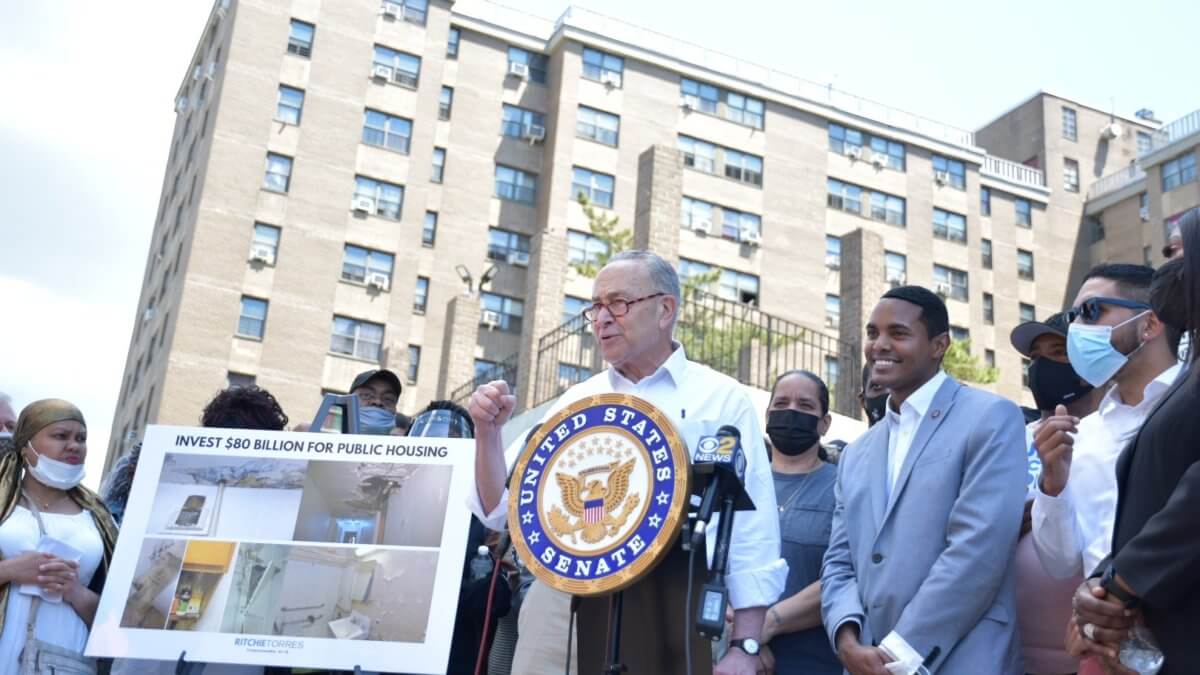
 Senator Charles Schumer and Congressman Ritchie Torres unveiled a push over the weekend for an $80-plus billion dollar investment in federal public housing funds via the just-proposed American Jobs Plan.

Schumer and Torres said after decades of disinvestment, bad management and federal neglect, NYCHA and its residents face a “now-or-never moment” to secure critically-needed investments via the American Jobs Plan.

The lawmakers said the administration’s plan calls for $40 billion dollars for the whole nation, but that number is not enough given the needs of public housing properties across the country, particularly in New York. Schumer and Torres said they are going to fight to double down on that proposal to ensure that it is at least $80 billion dollars.

“As a product of NYCHA, the subject of public and affordable housing is deeply personal to me,” Torres said. “Investing in and repairing public housing means investing in hard working families. While the American Jobs Plan proposes to invest $40 billion in public housing, that simply is not enough and will not cover all the capital repairs needed in public housing nationwide. We need to double that commitment in order to address the public housing repair backlog. Together with my House and Senate colleagues we will continue to push the Biden Administration to make significant investments in NYCHA and public housing authorities across the country.”

The American Jobs Plan called on Congress to invest $40 billion to improve the infrastructure of the public housing system in America. The funding “will address critical life-safety concerns, mitigate imminent hazards to residents, and undertake energy efficiency measures, which will significantly reduce ongoing operating expenses. The improvements will disproportionately benefit women, people of color, and people with disabilities.”

Saturday, May 8, 2021

NY Senate bill is a firestarter


 QNS

Two key figures in the western Queens NYCHA community have joined a coalition of leading business organizations and consumer product safety advocates who are warning that a proposed ban on flame retardants in New York state could increase fire-induced deaths, injury and property damage and further ravage an already struggling economy.

The ban would prohibit the sale of a broad range of products for use in residential settings that contain some of the most commonly used fire retardants, products that provide an important layer of protection by helping to stop or delay the onset and spread of fires, providing additional life-saving time to escape a fire, according to the American Chemistry Council.

“The threat of fires is something we live with every day as public housing residents,” Astoria Houses Tenant Association President Claudia Coger said. “It is deeply troubling that lawmakers would consider taking action that could make it easier for fires to spread and even more difficult for residents to escape in a life-or-death situation.”

If enacted, the ban would impact a broad range of fire retardant substances found in everyday household items — including computers, televisions, mobile phones, video game consoles, children’s toys, electronics used for infants, exercise equipment such as stationary bikes and treadmills, couches and mattresses — which would become fuel for fires across the five boroughs. Research has demonstrated that fire death rates are higher in states with larger percentages of people who are African-American, lower-income and smokers, and have less formal education.

Fire safety is also a critical issue for senior citizens. Older adults continue to experience a disproportionate share of fire deaths. Although adults aged 65 and over are only 16 percent of the U.S. population, National Fire Protection Association (NFPA) data shows that individuals 65 and over make up 33 percent of fire deaths. According to U.S. Census Bureau projections, by 2060, the number of individuals ages 65 or older is expected to be 95 million — nearly double the amount in 2017. Of the 114 civilian home fire fatalities in New York in 2020, 43 were older adults.

Friday, April 23, 2021

Mother kills her twin babies in Woodside Houses

  https://qns.com/wp-content/uploads/2021/04/Photo-Apr-22-7-07-17-PM-2048x1536-1-1200x900.jpg

QNS

Two infants were found dead inside a Woodside apartment on Thursday afternoon, and detectives are now questioning their 23-year-old mother.

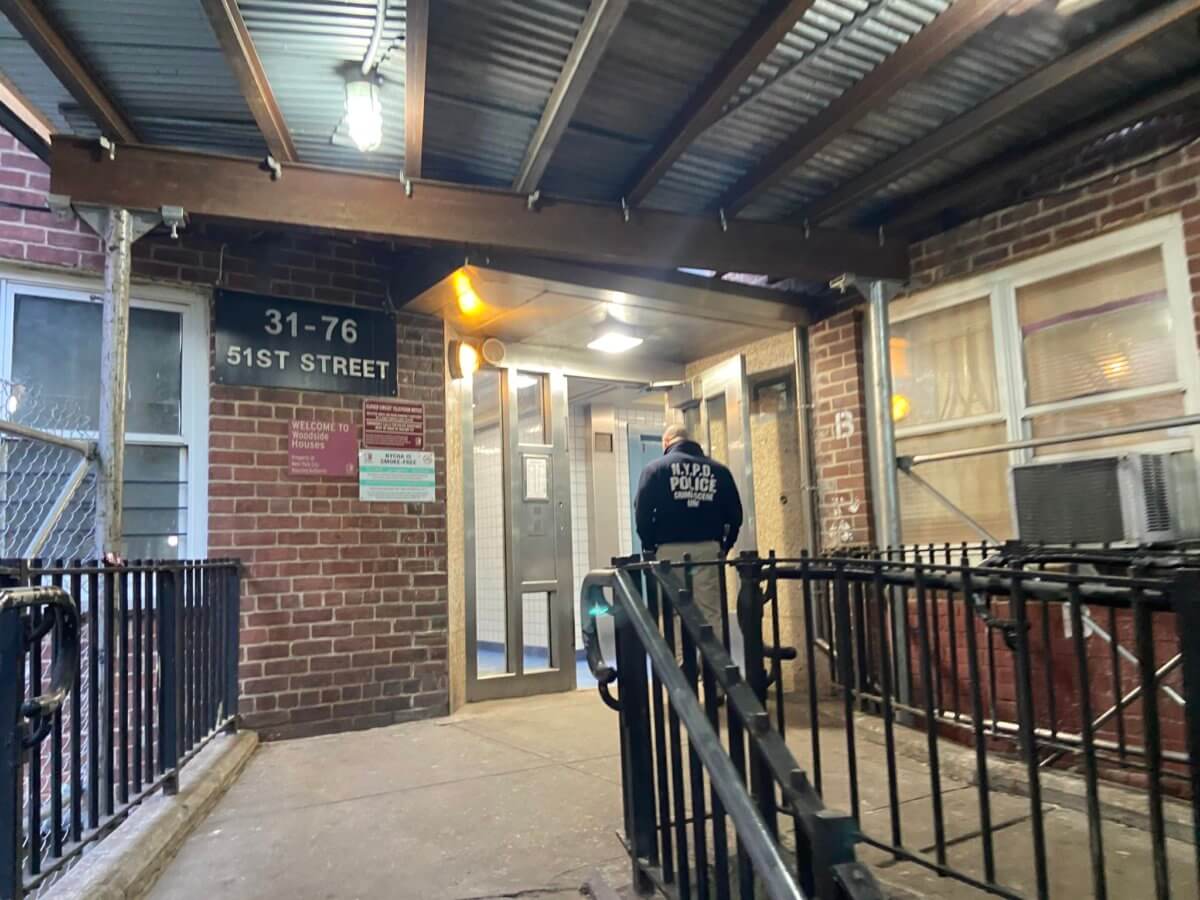
Police made the horrific discovery while responding with FDNY units to a wellness check called in at about 3:10 p.m. on April 22 at the Woodside Houses, located at 31-76 51st St.

According to Chief of Housing David Barrere, the officers from NYPD Public Service Area 9 met with concerned family members and knocked on the door to the mother’s fifth-floor apartment. Once they got inside, he said, they encountered a nightmarish scene.

Barrere said one of the infants, believed to be six weeks old, was found lifeless inside a crib with trauma to their body. The officers then asked about a second baby inside the home, and the mother pointed them toward a sink.

“Officers discovered a second child under the sink area, wrapped in a blanket, who was also unconscious and unresponsive,” Barrere said.

Responding EMS units pronounced both babies dead at the scene. The Medical Examiner’s office will conduct autopsies to determine the cause of their deaths.

Police immediately took the mother into custody for further questioning. Barrere said that officers also recovered a knife at the scene.

According to Barrere, one of the mother’s relatives called 911 on Thursday out of concern for her children. He did not go into details as to what prompted such concern.

Based on a preliminary investigation, police determined that the mother does not have a prior criminal record. The status of the children’s father remains unknown at this time.

Tuesday, April 6, 2021

Predatory slumlord swindled city housing agencies for 8 years

https://thumbs.imagekind.com/3827731_650/Mister-Vulture-HardHeaded-Landlord-of-Government_art.jpg?v=1492498780

QNS 

A Far Rockaway man was charged for defrauding government rental assistance programs by renting out dilapidated apartments he did not own to families in need, prosecutors announced Tuesday.

Paul Fishbein, 47, faces wire and mail fraud charges for allegedly falsely claiming to be the owner and landlord of 20 rental properties, mostly in the Bronx, while collecting government subsidies and evicting tenants over the course of eight years, according to the Southern District of New York.

“As alleged, Paul Fishbein not only took advantage of New Yorkers in need, he also defrauded city and federal government programs designed to help these very people,” U.S. Attorney Audrey Strauss said. “Fishbein allegedly lied about ownership of residential properties, fraudulently took rent subsidies and other benefits from those government housing programs, and often evicted tenants without cause from housing that was substandard in any event. Now Paul Fishbein is in custody and facing serious federal charges for his alleged fraud and exploitation.”

According to a complaint unsealed in Manhattan federal court Tuesday, Fishbein allegedly lied about owning the properties beginning in 2013 based on forged deeds. He then allegedly rented the properties to homeless and low- to moderate-income families through rental assistance programs operated by three city agencies — NYCHA, the Human Resources Administration and Housing Preservation & Development — and collected money, including federal funds, as the purported owner and landlord of the properties.

The complaint estimates Fishbein defrauded the three city agencies out of about $1.5 million, including more than $270,000 in federal funds. In addition to taking payments, Fishbein allegedly faked using a broker to rent out the properties and kept certain broker’s fees for himself that the HRA issued as payment.

Fishbein is also accused of faking financial eligibility for Medicaid since at least 2014, the complaint says. He allegedly told the HRA he worked at a company where his total income was about $150 a week — or $600 a month — when he in actuality made hundreds of thousands of dollars every year. Prosecutors allege Fishbein received nearly $50,000 in Medicaid benefits to which he was not entitled to as part of his scheme.

Sunday, January 24, 2021

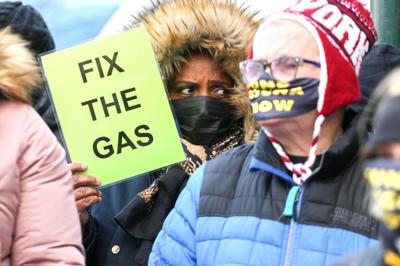
Slumlord NYCHA deprives tenants of gas. Again.


More NYCHA tenants lack gas for cooking 1 

Queens Chronicle

Annie CottonMorris, who heads the tenants association at the 71-year-old Woodside Houses, lives just a block from the nearest deli but it takes her two hours to buy a newspaper these days.

“That’s how many people stop me now to talk about what’s wrong with their apartments,” she told an outdoor rally of angry Woodside Houses residents Tuesday.

The latest complaint sweeping the city-owned housing complex is a utility outage that has left 12 apartments without gas.

Some tenants have been cooking on hot plates since last November, CottonMorris said.

Six units were fixed last week, said the New York City Housing Authority, which manages the 1,350-unit complex.

Six other apartments are due for repairs starting this weekend, a NYCHA spokesman said.

“While we understand gas service interruptions are inconvenient, we also want to ensure our residents’ safety as we work to restore service as quickly as possible,” the agency said in an emailed statement.

The complex of 20 six-story buildings straddles Broadway between 49th and 51st streets and has had its fair share of problems.

At the height of last month’s snowstorm, the heat and hot water failed throughout the 22-acre complex for several hours.

Some 40 tenants — joined by an equal number of residents of other NYCHA projects, many with similar breakdowns — called the rally to dramatize what they said were other, more longstanding deficiencies.

“I’ve lived here for 30 years,” said Marie Richardson. “When I moved here, it was a paradise. Now, I pay $2,000 a month rent and I have no gas.”

Other tenants complained of water being turned off late at night, mold, broken doors and bathroom fixtures, mounting trash and vermin.

“You can see the mice play tag on the scaffolding,” said one angry tenant.

“This is an ongoing situation,” Tomasina Reyes, another resident, told the rally. “It just doesn’t stop.”

Wednesday, December 23, 2020

Bad RAD exonerates NYCHA from filing repairs


 THE CITY

 One by one, the nation’s biggest public housing authority is turning over management of tens of thousands of its 175,000 apartments to the private sector.

And with every apartment that goes into private hands, long-awaited repairs are deemed “closed” — even though the fixes haven’t taken place, a housing advocacy group charged in court papers filed this week.

Instead, tenants are instructed to tell the development’s new management team about what work needs to be done. NYCHA officials — who have struggled for years to reduce a massive repair request backlog that recently hit a record 475,000 — then get to take those jobs off the books.

This bureaucratic sleight of hand is taking place under an Obama-era program called Rental Assistance Demonstration (RAD) in which NYCHA turns building management over to a private company while retaining ownership of the property. To date, 9,500 units have been converted, with another 12,000 to follow in the next few months.

 All told, NYCHA plans to transfer 62,000 apartments into RAD and a local version of the program called Permanent Affordability Commitment Together (PACT) by the time the transformation is complete.

This set-up allows NYCHA to raise money via up-front fees from developers, who are charged with upgrading and maintaining the complexes. The developers pocket the tenants’ rent going forward and must ensure living conditions are safe.

Sunday, December 13, 2020

Astoria Houses residents can cook hot meals again after 3 month outage


 Queens Eagle

Cooking gas was finally restored for residents of the Astoria Houses Thursday, after a nearly three-month outage left them unable to use their stoves or ovens. 

Nearly 50 units in the NYCHA apartment complex were left without gas beginning September 23, forcing them to rely on hot plates, takeout or support from the local community.

State Sen. Michael Gianaris introduced legislation in October to reduce the rent for public housing tenants who lose their utilities, including gas. 

“While I am pleased these residents now have service restored, this whole episode represents an unacceptable failure from NYCHA. Rent-paying tenants deserve better,” Gianaris said.

NYCHA said workers cut the main gas valve due to a leak. The repair process took weeks to complete because it required multiple steps further complicated by the COVID-19 pandemic, a NYCHA spokesperson told the Eagle in October. 

Friday, December 4, 2020

The tide is nigh for endangered affordable housing

https://images.squarespace-cdn.com/content/v1/5b9ffe0f1137a680c2c08250/1607017928204-LT0VC11EQQUGH0321VIQ/ke17ZwdGBToddI8pDm48kPZoFzfdH-BtuMfavJKf2H9Zw-zPPgdn4jUwVcJE1ZvWQUxwkmyExglNqGp0IvTJZamWLI2zvYWH8K3-s_4yszcp2ryTI0HqTOaaUohrI8PI6uq3lIRrTFlZLAXXG0jAbzUCoswZ2f3i4aYUGxdW5WAKMshLAGzx4R3EDFOm1kBS/flood.jpeg?format=750w


Queens Eagle 

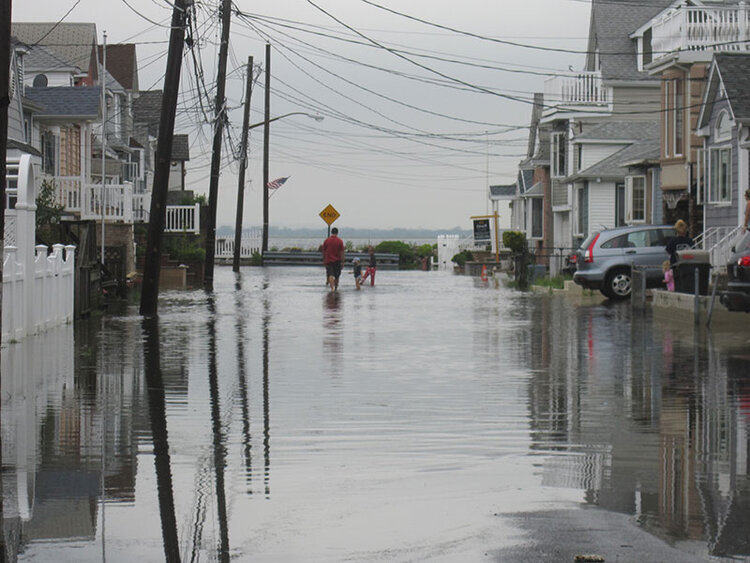
Tenants in nearly 1,800 subsidized housing units in Queens could be displaced as a result of rising sea levels over the next 30 years, according to the first nationwide analysis of the climate crisis’ impact on affordable housing. Nearly all of the impacted units are located in the eastern portion of the Rockaway Peninsula, including Far Rockaway and Arverne.

The peer-reviewed study published by the organization IOPScience found that flooding will render more NYCHA, Section 8 and other subsidized homes unlivable in New York City than any other city in the country by 2050.  

Authors Maya Buchanan, Scott Kulp, Lara Cushing, Rachel Morello-Frosch, Todd Nedwick and Benjamin Strauss refer to these subsidized units as “affordable housing” as they consider the impact of rising sea levels on 20 vulnerable coastal cities including Boston and Miami Beach.

“The frequency of coastal floods around the United States has risen sharply over the last few decades, and rising seas point to further future acceleration,” they write. “Residents of low-lying affordable housing, who tend to be low-income persons living in old and poor quality structures, are especially vulnerable.“

An interactive map published alongside the report shows the specific communities facing the greatest risk, with nearly all the units concentrated in Far Rockaway and Arverne. The two neighborhoods have a high number of NYCHA and Section 8 units compared to other waterfront neighborhoods of Southeast Queens and the Rockaways.

A city plan to rezone coastal communities for greater resiliency highlights the dangerous impact on Broad Channel, Howard Beach and the neighborhoods around Flushing Bay, as well. All are expected to fall below the floodplain by 2050.
 

 The IOPScience report anticipates factors 30 years in the future, but New York City already has among the highest number of units vulnerable to flooding at least once a year, the authors write.

At least 1,373 subsidized units are vulnerable right now, a total that represents less than 1 percent of the city’s current affordable housing stock, according to the paper by Climate Central and the National Housing Trust. 

“Climate-change-driven sea level rise will continue to amplify coastal flooding in the coming decades,” the report states.. “As community resilience investments are made, complementary policies may be needed to protect against the displacement (and potential homelessness) of residents.”