Showing posts with label Southeast Queens. Show all posts

Thursday, June 5, 2025

Police got their back

 https://images.squarespace-cdn.com/content/v1/5b9ffe0f1137a680c2c08250/f07eb7c9-4b21-4a86-ac1f-fee9981a9346/116+Pct+1.jpg?format=2500w

 Queens Eagle

It took four decades, but residents of Southeast Queens and the elected officials who represent them say their neighborhoods are finally getting the policing they deserve.

NYPD officials and elected officials said last week that since the new 116th Precinct finally opened in December to police the neighborhoods of Springfield Gardens, Brookville, Laurelton, and Rosedale, response times in adjacent precincts are down and the new cops are beginning to address long-time local complaints.

Speaking before the City Council on Thursday, Police Commissioner Jessica Tisch said that response times in the two precincts that used to split the area now covered by the 116th are significantly down.

“We have seen great results, I would say, in terms of the decrease in response times since that command opened up,” Tisch said. “We are pleased with what we are seeing in terms of the trends in response times.”

In the 105th Precinct, response times have been cut by more than half. Before the 116th opened, 105th Precinct cops took an average of 21 minutes and three seconds to respond. Now, it takes them, on average, eight minutes and 38 seconds.

Response times for the 113th Precinct have also decreased by a little over four minutes, down from 20 minutes and 48 seconds to 16 minutes and 19 seconds on average.

The new precinct is staffed by 199 people, including two captains, seven lieutenants, 20 sergeants, 147 police officers and detectives and 23 civilians.

The Eagle reached out to the NYPD for response times for 116th Precinct and whether or not those staffing levels are expected to grow. The NYPD’s press office referred the Eagle back to Tisch’s Thursday comments, which did not answer the questions.

Tisch on Thursday was asked about the 116th during a City Council budget hearing by the local councilmember, Selvana Brooks-Powers, who is happy with the results the precinct has brought so far.

“Response times [being] down is something that's significant,” she told the Eagle. “That's an area that the community, for many years, complained about. At times, there were people who would call my office and feel like calling the precinct was a waste of time because of how long it would take. I don't hear those complaints right now…the data around it supports what we're feeling on the ground.”

Before the 116th opened, the 105th and 113th split the large chunk of Southeast Queens, meaning cops were travelling large distances to respond to calls.

“If there was a big situation happening in the southern part of the community, they would have to get there from the far end of their confines,” Brooks-Powers said. “But right now, this is a precinct that's within our community, so naturally they're going to be able to respond much more quickly.”

Brooks-Powers said she is happy with the community and policing efforts from the new precinct, as well as the management of the station from its inaugural commanding officer, Jean Beauvoir.

“They've been also taking steps to be more community oriented,” she said. “I've seen firsthand the work that they've done to really combat a lot of the double parking that we experience along the Merritt Boulevard corridor, in particular.”


Sunday, May 14, 2023

Transportation Alternatives message to Southeast Queens residents: you'll pay congestion pricing and like it

Southeast Queens population is predominantly people of color and immigrants who rely on cars to get around New York City for work, chores and leisure. Danny Harris says the quiet part out loud about the inherent racism and discriminatory nature of the congestion pricing tax and apparently he does not want them coming to his borough of Manhattan anymore without paying admission.

Monday, November 14, 2022

Southeast Queens is still the election dealmaker and dealbreaker

https://nypost.com/wp-content/uploads/sites/2/2022/11/overwhelming-support-from-black-voters-propelled-hochul-over-zeldin-6.jpg?quality=75&strip=all&w=744

NY Post

Democrat Kathy Hochul has black voters to thank for saving her job as governor against hard-charging Republican challenger Lee Zeldin, an election results analysis shows.

While Zeldin’s law and order campaign made inroads with once blue-leaning Asian, Jewish and Latino voters, black voters were Hochul’s firewall in southeast Queens, central Brooklyn, Harlem and parts of the Bronx, the analysis found.

Hochul garnered a staggering 90% or more votes in many of the city’s predominantly Afro-American and Afro-Caribbean districts — the same working and middle class voters who propelled Mayor Eric Adams last year.

“Oh, absolutely. Oh, definitely the black community elected Kathy Hochul governor,” said state Assemblywoman Inez Dickens. In Dickens’ 70th Assembly District, residents delivered 27,968 votes for Hochul, and just 2,287 for Zeldin.

According to Dickens, Zeldin is too closely associated with former President Donald Trump for black voters — and isn’t seen as a moderate in the mold of former three-term GOP Gov. George Pataki. Trump endorsed Zeldin just weeks before the Nov. 8 election.

“If Zeldin was a Pataki Republican, he would have done better,” the Harlem political veteran said. “He was considered a Trumper by black voters. That was a very, very big part of it.”

Sunday, June 5, 2022

MTA plans to kill two bus routes in the name of transit equity

Queens Chronicle

Two bus redesign Zoom meetings held last Thursday and Monday included proposals for changes to several lines throughout East and Southeast Queens. The meetings were among the last in a series held by the MTA and focused on Community Districts 12 and 13.

The Q1 bus had major proposed changes that were relayed by Tori Winters, the principal transportation planner for the MTA. The bus route currently starts in Queens Village on Springfield Boulevard and Jamaica Avenue and ends at the 165th Bus Terminal in Jamaica, though some buses leave the terminal and end at Bellerose at Braddock and Jamaica avenues, instead of returning back to Queens Village.

The proposed new route would start at Bellerose, eliminating the main starting point in Queens Village and all but one Springfield Boulevard stop (Springfield Boulevard and Hillside Avenue) and 12 stops on Hillside Avenue, but it would take over the Q6 route and extend to the JFK Cargo Plaza in South Ozone Park by skipping the terminal and going through Downtown Jamaica and then down Sutphin Boulevard. The route would keep the 179th Street and Hillside Avenue F-train stop and it would also pass by the E, J, Z train stop on Jamaica Avenue and the Jamaica Long Island Rail Road on Archer Avenue. The proposal would more than double the weekday peak service frequency of the bus from 10 minutes to 4 minutes, and nearly double the off-peak frequency from 15 to 8 minutes.

“We will be replacing the two routes with one higher-frequency route,” Winters said about the Q1 in a slideshow presentation. “Local service along Springfield Boulevard will be provided by the proposed Q78. The Rockaway Boulevard segment of the existing Q6 would now be served by the proposed Q7.”

The proposed Q45 would take over the Q36 route and the Hillside Avenue portions of the Q1 that would be axed and start at the Little Neck LIRR. The route would conclude in Jamaica on Archer Avenue and Sutphin Boulevard, expanding its train service connections to the E, J and Z lines, the Long Island Rail Road and AirTrain similar to the Q1.

The Q75 is a newly proposed route that would go from Jamaica to Queensborough Community College via 188th Street and Horace Harding Expressway, replacing the Union Turnpike to Jamaica Avenue stops along the Q17 and taking over the Q30’s primary role as a route to the Bayside school. The Q31 bus would pick up the Q30 line’s Utopia Parkway stops.

The suggested Q82 would replace the Q36 service along Hillside Avenue and combine with sections of the existing Q110 that goes along Hempstead Avenue to get to the UBS Arena in Elmont. Instead of servicing 212th Place in Queens Village, the route will serve Hollis Court Boulevard, and any existing Q36 stops east of 213th Street would be picked up by the Q57.

“The new Q82 route would mostly run nonstop alongside Hillside Ave.,” said Winters. “The service will no longer provide a route to Jamaica Ave., as the existing Q36 does.”

Buses with suggested minor changes include the Q44, which would maintain most of its route in Jamaica on Merrick Boulevard and Archer Avenue, but instead of concluding its route at the Bronx Zoo, it would go to Fordham Avenue Plaza at Fordham University; the Q43 in Jamaica, which would make less frequent stops as it extends farther out to Long Island Jewish Medical Center in Glen Oaks; and the Q2, which would maintain its route though shifts in where it would stop between the 165th Street Bus Terminal and Elmont were proposed.

Thursday, July 15, 2021

Never underestimate Southeast Queens

 https://projects.thecity.nyc/2021_06_campaign-trail/assets/ai2html-output/adams-large.jpg 

THE CITY

 The mayoral candidates blazed their campaign trails with fervor in the final weeks before the primary election, shedding masks, embracing voters and hoping their non-Zoom facetime would pay off.

THE CITY traced the top four Democratic candidates’ whereabouts between April 1 and June 22, using public schedules released by their campaigns and social media posts.

The result provided insight into each candidate’s strategy to vye for New Yorkers’ votes — and offered hints on where priorities may be for primary winner Eric Adams, who is likely to become the city’s 110th chief executive due to the overwhelming Democratic voter enrollment.

Unlike his rivals, Adams didn’t spend much time campaigning in Brownstone Brooklyn or the Upper West Side, areas with perennial high voter turnout for Democrats. Instead the 60-year-old former cop frequently campaigned in Upper Manhattan, The Bronx and southeast Queens — home to significant numbers of Black and Latino working-class New Yorkers. 

“There’s a finite amount of time that you can have a candidate out there campaigning and any campaign will tell you you need to focus that time and energy on your base and your core constituency for a winning coalition,” said Evan Thies, Adams’ campaign spokesperson. “You also follow that plan based on the message of your campaign and the type of voter you’re attempting to appeal to.”

It’s a strategy that paid off.

In Assembly districts, including Queens Village and Laurelton, where Adams showed up much more often than other candidates, six out of 10 in-person voters ranked him in the top spot. 

 Thies said Adams’ campaign messaging on public safety and affordability resonated across neighborhood lines, speaking directly to the concerns of working-class New Yorkers.

“All of these things matter in a very real way to lower-income and middle-income, working-class communities and they’re going to respond to that message a lot more than wealthier communities,” Thies said.

As a seasoned politician and former activist cop, Adams entered the campaign with significant name recognition. But the campaign still relied on some high-powered surrogates with deep ties to their community to help boost Adams.

In Upper Manhattan, Adams was frequently flanked by Rep. Adriano Espaillat and Councilmember Ydanis Rodriguez, two local elected officials who represent a burgeoning Dominican diaspora in Washington Heights and Inwood. Bronx Borough President Ruben Diaz Jr. was also often by Adams’ side, joining him as he greeted voters.

Unlike his competitors, who largely ignored southeastern Queens, Adams made frequent stops in the area, particularly toward the tail-end of the campaign.

Adams grew up in South Jamaica, and voters in the area are exactly the type of constituency he was hoping to attract: Black homeowners who “are active in civic life and deeply concerned about public safety and motivated in this election by serious concern about the decline of the city,” Thies said.

Wednesday, June 30, 2021

There's nowhere to cool off in Southside Queens


Patch

  New York City is under a heat advisory for the next few days, but the city has allocated fewer resources to helping some of Queens' most vulnerable residents stay cool in their neighborhoods.

In response to forecasts that the city will feel hotter than 100 degrees through Tuesday or Wednesday, the Office of Emergency Management (OEM) has opened hundreds of cooling centers throughout the five boroughs — but, many areas of Queens with residents that are at high risk for dying during extreme heat events don't have access to a cooling center in their neighborhood.

As of Monday there was not a cooling center in the southeastern Queens neighborhoods of Hollis, St. Albans, Springfield Gardens, Laurelton, Cambria Heights, or Queens Village — all of which are among the areas where residents have the highest or second-highest risk of heat injury or death, according to the Department of Health.

When Patch reached out to the OEM with questions about these disparities the agency said in a written statement that "many sites that served as cooling centers in previous seasons remain closed due to COVID-19 pandemic but should be open in the coming weeks to New Yorkers," likely alluding to Queens Public Library branches, which usually operate as cooling centers, but are not right now.

The agency also said that New Yorkers can access outdoor cooling options like showers and drinking fountains, many of which "are located in neighborhoods across New York City that may not have traditional cooling centers available at this time."

Thursday, June 10, 2021

Sewer celebration

https://qns.com/wp-content/uploads/2021/06/rochdaleinfrastructure_2018_06_22_q01_z.jpg 

QNS

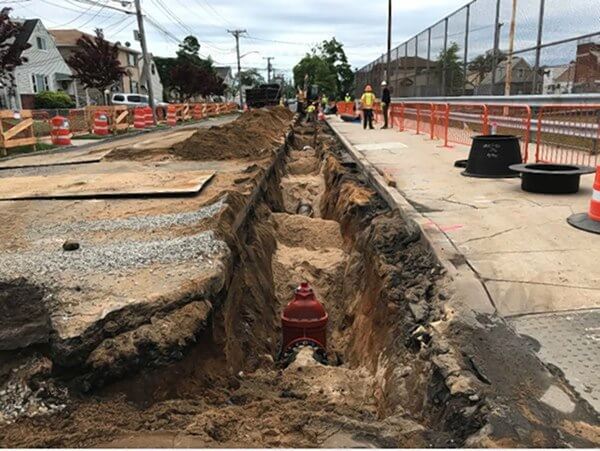
Southeast Queens leaders are hailing the completion of a $20.5 million sewers and water main project that upgraded infrastructure in Hollis and Queens Village.

The city announced the construction that started in March 2019 has been finished five months ahead of schedule.

“As a homeowner in southeast Queens, I understand the anguish of local residents who experience constant flooding of their basements,” Councilman I. Daneek Miller said. “Back in 2016, I worked with now-Queens Borough President Donovan Richards to secure $1.9 billion if funding for flood remediation infrastructure, which includes an unprecedented online portal that provides oversight of the initiative. Thanks in part to our advocacy and the cooperation of local residents, I am pleased that this project has been completed under budget and ahead of schedule.

“We look forward to the continued work to end the tremendous suffering many homeowners have had to endure over the last several decades,” Miller said.

Work occurred on 20 individual blocks to replace more than one mile of water mains, some of which were installed before World War II.

“These improvements are a significant investment in the future of Hollis and Queens Village, and their early completion greatly benefits the hard-working families of these vibrant neighborhoods,” Richards said. “This work underscores the city’s strong commitment to alleviate chronic flooding and addressing the other chronic infrastructure problems in southeast Queens.”

Wednesday, April 21, 2021

de Blasio restores funding to build new NYPD station in Southeast Queens and patrols to stop vagrancy in Midtown


QNS

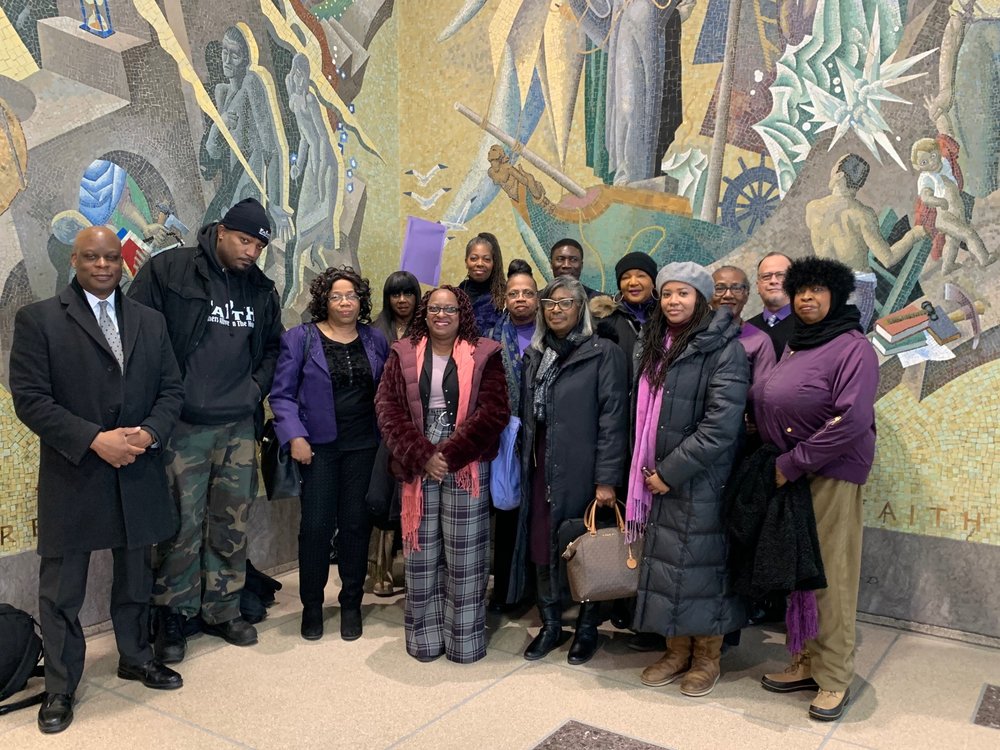
After 40 years of advocacy and hard work, southeast Queens residents can rejoice as Mayor Bill de Blasio announced on Tuesday, April 20, that funding for the new 116th Precinct and community center has been restored to the city’s capital budget. 

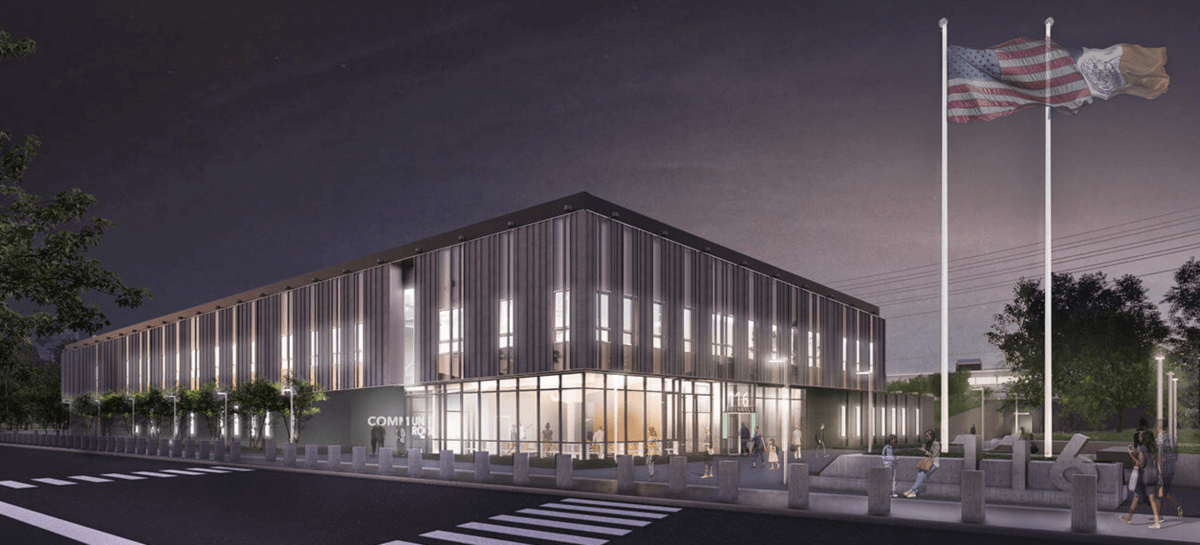
The long-awaited 116th Precinct and community center — that will serve the neighborhoods of Rosedale, Springfield Gardens, Brookville, Laurelton and the southern portion of Cambria Heights— will be fully funded, according to de Blasio, as he unveiled his Safe Summer NYC initiative during a press conference. 

“These are things that the community has said will improve the quality of life and will allow the community to literally get what they need. This fight has been going on for decades, and once and for all, we will be able to provide the support for the community in southeast Queens,” de Blasio said. 

Plans for the precinct include a street plaza and a community center with a food pantry to help feed families amid the pandemic. Southeast Queens community leaders commended the mayor for addressing the issue by restoring funding to the capital budget. 

Referencing the struggle that started in the 1970s for the creation of a new police precinct amid public safety concerns, Congressman Gregory Meeks said it is “indeed a day of celebration” for the residents of southeast Queens.

“We want this new police precinct to be a part of this community and that’s why it was essential to have a community center attached to it. We will have that inter-exchange and engagement so that we can work closely together,” said Meeks, who created the 116th Precinct Task Force when he was elected to the state Assembly in 1992. 

Newly elected Council member Selvena Brooks-Powers said the announcement is a “major victory” for her district’s civic organizations that have fought for equity, city resources and calls for the creation of a new precinct. 

“This group has spent countless hours fighting for much needed and deserved equity. They have dedicated many hours towards strategizing and organizing around the need for a new precinct that would help to reduce response times,” Brooks-Powers said. 

For Brooks-Powers, the creation of the 116th Precinct represents more than merely a station house — it represents equity and also a step toward a more progressive and inclusive approach to community safety, she said. 

The 116th Precinct was approved by Community Board 13 in October 2018. In its 2019 statement of community district needs and budget requests, the board cited youth and children’s services as one of its three most pressing needs, citing the fact that “there is no community center in QCB 13 for our young people to socialize and exercise.” The Roy Wilkins Recreation Center will not fulfill that need, as it’s located with Community Board 12’s district. 

The neighborhoods that would have been covered by the 116th Precinct are currently being policed by the 105th Precinct — the fifth largest precinct in the city, covering 354 miles of roadway — which has set up a satellite office on North Conduit Avenue next to the Rosedale Long Island Rail Road station. The satellite precinct has been in operation at a limited capacity since 2007.

The 105th Precinct posed consistent challenges to fully serving neighborhoods in the southern half of its jurisdiction, according to Brooks-Powers. This resulted in long-standing disparities, response times and safety of families in the district. 

“The new 116th Precinct requested by the community since the 1970s was designed and slated to remedy this gap. It has been a long time coming to this point — a lot of frustration and loss of funding in last year’s budget,” Brooks-Powers said. 

NY Post

Mayor Bill de Blasio finally realized that defunding the police didn’t work out as he hoped — and has now ordered the NYPD to make Midtown Manhattan safe again so workers will come back after more than a year of pandemic lockdowns.

At least 80 uniformed officers and supervisors are expected to flood the area within the next two weeks after being redeployed from around the city to combat violent vagrants and other safety issues, sources familiar with the plan told The Post.

An NYPD deputy inspector will be in charge of the newly created “Business Improvement Unit,” which will be based out of the Midtown South Precinct, sources said.

The plan didn’t originate from the NYPD but was developed in response to a series of recent meetings the mayor held at City Hall with his staff and police brass, sources said.

It followed months of pleading by business leaders and others for the mayor to crack down on criminals and vagrants running amok around Penn Station and elsewhere.

As an example of the long-festering problem, a Vornado Realty maintenance worker said there’s “a whole crew” of vagrants who lie on the sidewalk near 34th Street and Eighth Avenue “every morning.”

 “The people come out of the stations shocked. You can see in their faces, they can’t believe what they see,” the workers said.

“I am finding vomit, feces, needles. There is no one here controlling them.”

Recently, the situation has raised concerns that it will keep people who’ve been working from home due to the coronavirus pandemic from returning to their offices.

“They are afraid for their safety walking from the train to work, and they are afraid to ride the train,” one source said.

A Midtown office supervisor said that without a dramatic turnaround, it could cost the city “hundreds of millions of dollars” in business.

“There are too many random assaults by people wandering through the street,” a source said. “The attacks are being done by people who were just dumped in Midtown with no one providing any services.”

A real estate industry source summed it up: “We need action.”

 Under the NYPD’s plan, the redeployed cops will be assigned to foot posts across Midtown and accompany workers from the Department of Homeless Services and the Department of Consumer and Worker Protection when they go out into the field, sources said.

“The mayor and the local politicians didn’t want the police to deal with the homeless and peddlers but now that their plan failed miserably, the mayor is asking the police to help clean up the mess they created,” a Manhattan cop said.

Another source said, “The mayor’s plan failed and privately he realizes it.”

Paul Dimino, third-generation owner of the Sea Breeze Fish Market on Ninth Avenue, called de Blasio “an idiot.”


Monday, December 21, 2020

The replacements for District 31 council seat


Queens Eagle 

Thirteen candidates filed petitions before a Wednesday night deadline to run in the February special election to replace former Councilmember Donovan Richards.

Richards vacated his seat in Southeast Queens’ Council District 31 when he took office as Queens Borough President earlier this month, triggering the special contest on Feb. 23. The election will be the second test of New York City’s new ranked-choice voting system following another special in Council District 24 Feb. 2. 

Veteran government strategist and communications professional Selvena Brooks-Powers was the first candidate to submit her petition signatures, followed by attorney Bradley Jared Berfas.

Berfas lists an address in Cedarhurst, a Long Island town that is not in the district, not in Queens and not in New York City. He did not respond to requests for comment.

The other candidates include Richards’ chief of staff Manny Silva, home healthcare training school founder Nancy Martinez and Jewish community leader Pesach Osina, who lost to Richards by 70 votes in a 2013 special election.

LaToya Benjamin, the economic director for James Sanders and assistant school superintendent Shawn Rux are also running.

As are Democratic District Leader Rev. Sherwyn James, filmmaker Perri Pierre and special needs advocate Nicole Lee.

Also in the mix: Republican Joseph Kasper, a perennial candidate for judgeships in Queens who temporarily ran for Council in District 30 as placeholder before giving up the GOP ballot line to Robert Holden in 2017.

Public school teacher Latanya Collins and Kevin Carter round out the field.

Only three candidates filed their campaigns before the July 15 financial disclosure deadline. Silva led the early fundraising with $7,425, followed by Benjamin with $3,421 and Brooks-Powers with $100.

The district is separated into two geographic areas: the Southeast Queens communities of Laurelton, Rosedale and Springfield Gardens, and the eastern Rockaway Peninsula neighborhoods of Arverne, Edgemere and Far Rockaway. 

More than two-thirds of the residents are Black, 16 percent are Hispanic, and 11 percent are white, according to U.S. Census data. There is also a large Orthodox Jewish community in Far Rockaway that voted as a bloc for Osina in 2013.

Friday, October 30, 2020

Southeast Queens is at the bottom of available COVID-19 testing sites

South Queens has the least COVID testing 1

Queens Chronicle 

When Gov. Cuomo designated Ozone Park as a yellow zone, it served as a warning sign to the borough that the virus was traveling into the area south of Forest Park.

But while positivity rates of the yellow zone in the whole Central Queens area have stayed relatively low — hovering below 3 percent for the past seven days — another problem has revealed itself, which precedes the recent rash of positive cases.

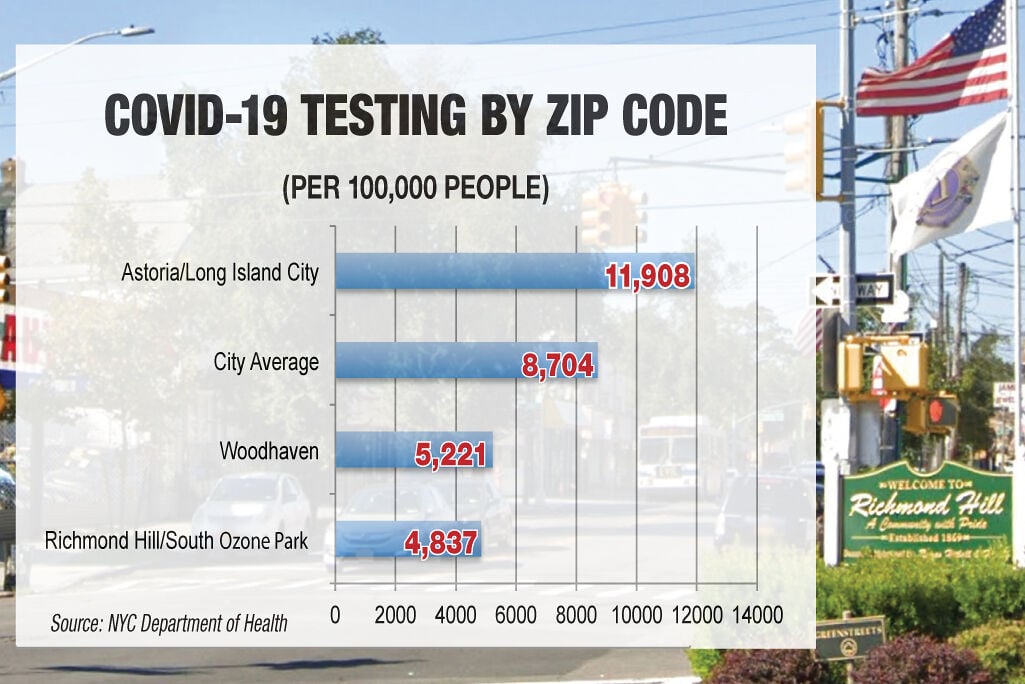
South Queens has exceedingly low rates of COVID testing. Five neighboring ZIP codes in South Queens are among the 10 areas with the lowest rates of COVID testing in the whole city. Lawmakers and community leaders say their efforts to set up more sites in the area have met bureaucratic resistance.

“This is nothing new,” said Councilwoman Adrienne Adams (D-Jamaica). “The whole phenomenon around the lack of testing in Southeast Queens has gone on since the onset of the pandemic.”

The absolute lowest amount of testing per 100,000 people in the city is bound by a ZIP code bisecting Richmond Hill and South Ozone Park, stretching mostly over Adams’ district. Only 4,837 per 100,000 people have been tested there – nearly half of the city’s average rate of testing per ZIP code.

The next lowest ZIP code covers most of Woodhaven, just a little farther north. The rates of testing in ZIP codes stretching over South Ozone Park, Ozone Park and South Jamaica are not far behind.

While still below the citywide average, Howard Beach’s test rates are not as low as the aforementioned neighborhoods.

None of that information surprised Felicia Singh, a neighborhood advocate and District 32 City Council candidate, who has been calling for more and longer-lasting testing sites in the area for more than three weeks.

“I told [NYC Health + Hospitals, the mayor and governor] that COVID would travel here and sadly I was right,” Singh tweeted.

When she saw lines wrapping around the two-week rapid testing site at the Ozone Park Library on its final day on Oct. 2, Singh filled out a request for a city-run site on the border of the neighborhood and East New York. It was not approved, even though at the time the number of confirmed positive cases per 100,000 people had skyrocketed 650 percent over the two-week period, according to the city’s data.

“Still, getting the testing sites for all of our districts has been a battle,” Adams told the Chronicle over the phone. “We’ve still got communities of color slighted when it comes to testing. There is a lot of bureaucracy that astounds when it comes to maneuvering through this.”


Saturday, December 14, 2019

NYC Department Of Environmental Protection debuted new sewer infrastructure in Southeast Queens a few days before South Ozone Park homes got deluged with dung water


QNS


After breaking ground in the community of Brookville in southeast Queens earlier this year marking the beginning of an $84 million infrastructure upgrade project, the New York City Department of Environmental Protection (DEP) announced on Nov. 26 the installation of new storm box sewers to help alleviate flooding. 

DEP Commissioner Vincent Sapienza joined with the Department of Design and Construction’s (DDC) Deputy Commissioner for Infrastructure Eric Macfarlane and Councilman Donovan Richards to review the progress of the project that includes the installation of 9-foot-by-5-foot storm box sewers. 

“To date, 1,650 feet of storm sewers, 2,500 feet of sanitary sewers and 11,800 feet of water mains have been installed,” the DDC said in a statement to QNS. “Additionally, 25 hydrants were replaced and seven additional fire hydrants were installed as well.” 

The project, which is funded by DEP and managed by DDC, is anticipated to be completed in the summer 2021. The large box sewer will form one of the major spines for Mayor Bill de Blasio’s $1.9 billion buildout of the drainage system throughout southeast Queens. 
It was a much-needed development for the area which has historically flooded even with the slightest bit of rain, Richards said. 

“This is one of 55 projects that are slated for southeast Queens over the course of the next decade or two, and these are projects that have been on the books for a very long time, like many other projects in southeast Queens,” said Richards, former chairman of the Environmental Protection Committee, who lobbied for infrastructure investment in the community. 

Going by what happened on Thanksgiving weekend, it looks like this upgrade didn't make it to South Ozone Park yet.


Saturday, November 16, 2019

9-year-old girl asks Mayor de Blasio why he can't do his job right

https://thenypost.files.wordpress.com/2019/11/de-blasio-town-hall2.jpg?quality=90&strip=all&w=1024     


A precocious 9-year-old and the aunt of a teen killed by a stray bullet grilled Mayor Bill de Blasio about crime, homelessness and public transit at a Queens town hall Wednesday.

Amaryllis Greene, 9, drew applause and laughter from the audience of over 400 people assembled at Austin Martin High School in Jamaica, Queens, when she asked the mayor a list of questions including, “Why is the MTA never on time?”

The fourth-grader, who attends a Montessori school, also quizzed Hizzoner about delays on the Q43 bus line, homelessness on the trains and NYPD leadership.

With all due respect, why was Mr. Benjamin Tucker not selected as police commissioner,” Greene asked about the NYPD’s first deputy commissioner who was passed over for the job in favor of his colleague, Chief of Detectives Dermot Shea.

De Blasio complimented the youngster, asking if he could call her “future council member,” then answered her questions.

He reminded her that the state, not the city, controls the MTA but promised improvements with funding from congestion pricing. He pledged to address vagrants on the subways by putting more outreach workers underground and explained that he “made the decision that Chief Shea was the right person to lead” the NYPD.

Outside the event, Greene told reporters she was unimpressed with the mayor’s answers and that she wanted to hear more about how he’d help get homeless people back on their feet.

I really, and I mean REALLY liked how that brilliant little girl used that line "with all due respect", because that line is only used when respect is obligatory than when it's actually deserved.

I also really like how this kid knows more about how to run a city and serve its citizens than that corrupt doofus does.


Thursday, October 17, 2019

Shootings rise in Southeast Queens and there is only one hospital to treat the victims


THE CITY

 During the first 2020 presidential debate in June, then-candidate Mayor Bill de Blasio touted New York City’s drop in crime. But even as the number of shootings has dramatically decreased across the city over the past decade, a troubling trend has emerged: The proportion of people dying from gunshots has been rising in some pockets.

Data obtained from the New York Police Department and analyzed by The Trace/Measure of America/THE CITY shows this problem has been most severe in Queens.

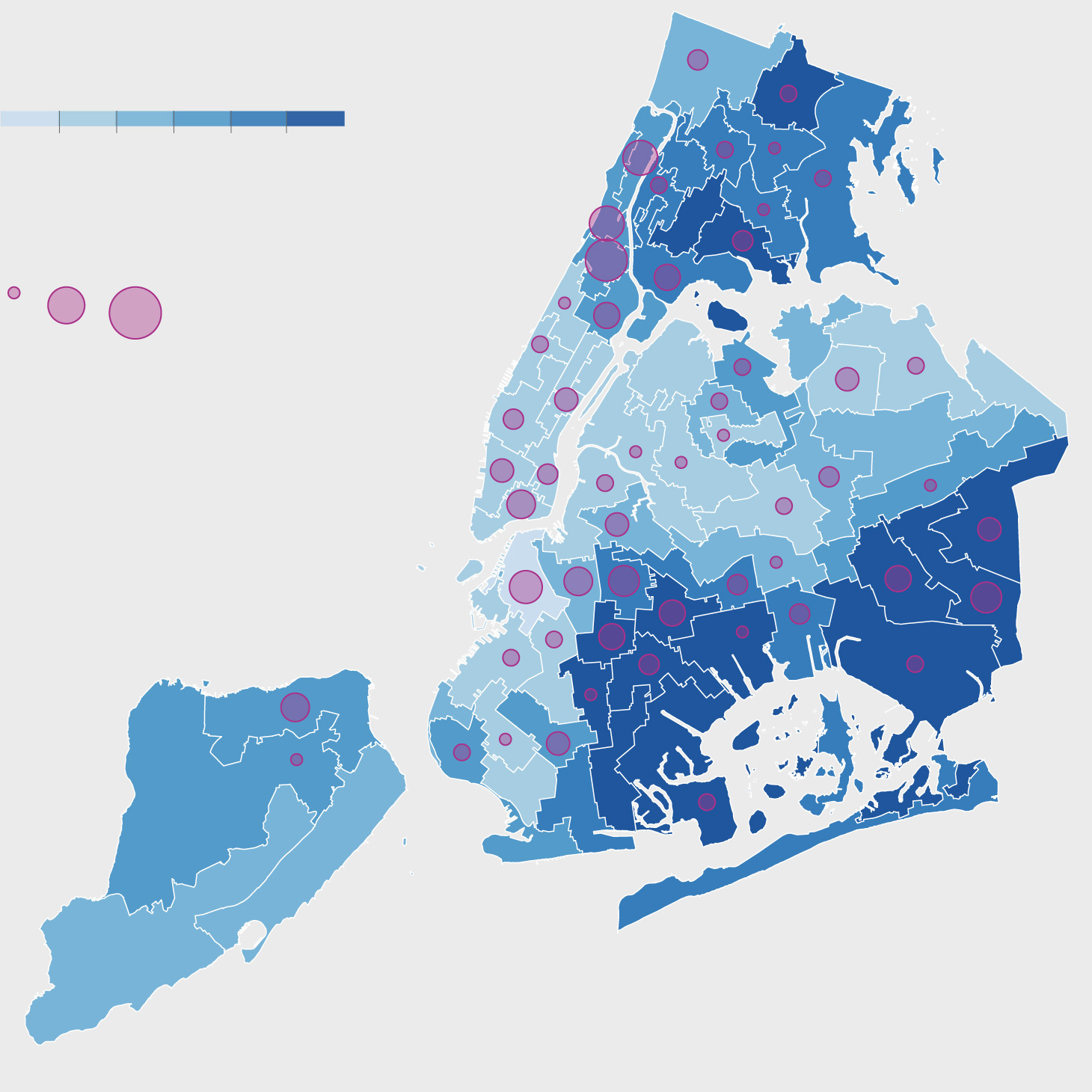
We mapped the 12,000-plus shootings recorded by the NYPD between 2010 and October 2018, and our analysis found that the further away someone was from a Level I or II trauma center when they were shot, the more likely they were to die.

Nowhere fared worse than neighborhoods in southern Queens, particularly those below Hillside Avenue, where more residents live further than three miles from a trauma center than anywhere else in the city.

There used to be more trauma coverage in the borough. But in February 2009, two hospitals closed, and one of them contained a Level I trauma center.

In the following two years, the gunshot fatality rate in Queens jumped from under 16% to more than 23%. That put the borough’s gunshot fatality rate 30% higher than in the rest of the city.
Since then, every year except for 2016, the death rate from gunshots in Queens has been higher than in the city as a whole.

 “How well your trauma system works, and how good your care is across the country is a big mosaic, and where you are will determine your outcomes,” said Dr. Robert Winchell, the former chair of the trauma systems committee for the American College of Surgeons.

Today, most areas of New York City have access to multiple trauma centers while southern Queens has only one: Jamaica Hospital Medical Center. But financial documents, audits and state reports indicate the facility is ailing.

The hospital was in the red 12 of the 13 years between 2005 and 2017. It finished that year with a deficit of more than $66 million, according to IRS filings and an independent audit.

“I’m not sure how you keep the doors open with that,” said Winchell, who is also chief of New York-Presbyterian/Weill Cornell Medical Center’s trauma division.

I'm not sure you can either when the city would rather spend $11,000,000,000 on tower jails.


Wednesday, August 7, 2019

St. Albans residents demand Billie Holiday monument to be placed in Addesleigh Park, Chirlane McCray wants it by Queens Borough Hall


http://inthesetimes.com/images/made/images/backpg_033-billie-holiday-theredlist.web_850_598.jpg


Jamaica Patch

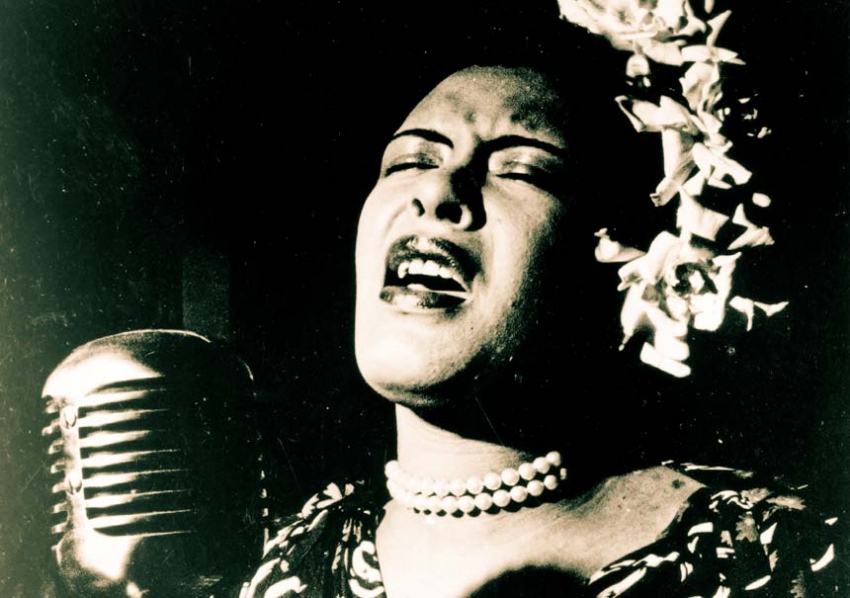
 First Lady Chirlane McCray in March made a much-heralded announcement: The city would build a monument to jazz singer Billie Holiday, one of four new statues honoring trailblazing women.

It was a first step in eliminating the gender disparity in city monuments. Of the 150 statues in New York, just five depict women.


But some residents in Southeast Queens felt slighted.


The Billie Holiday monument, the city announced, would rise by Queens Borough Hall in Kew Gardens — and that didn't seem right, they thought.

"She's a major part of our neighborhood," Southeast Queens resident Amir Abbady told Patch. "The statue should belong in the neighborhood she's from."
 
Abbady, who chairs Queens Community Board 12's parks committee, is championing an effort to bring the Billie Holiday monument to the Addisleigh Park Historic District, where the pioneering jazz artist once lived.


"Our Southeast Queens community would benefit from a statue of this successful black woman for cultural heritage purposes," Queens Community Board 12 Chair Rene Hill wrote in an email to Patch.


Jeff Gotlieb, president of the Central Queens Historical Association, suggests that the city instead put the monument in St. Albans Park. The park is just blocks away from Holiday's former home on 
Linden Boulevard.


The city hasn't yet decided on the exact site for Billie Holiday's monument, but a spokesperson for the city's cultural affairs department said they are focusing on the area by Queens Borough Hall, calling it the "most appropriate" location.

Guess what monument used to be at that "most appropriate" location...

 http://2sei0v2s93y31n9ndy1lrzmh-wpengine.netdna-ssl.com/wp-content/uploads/2016/05/800px-CivicVirtueStatueKewGardens2007.jpg

The Statue of Civic Virtue.

Like the statue, civic virtue in your city ceases to exist or literally thrown in a graveyard.

There is a demented cult in de Blasio's administration, and it's being led by his co-mayor wife. 


Friday, June 14, 2019

Southeast Queens towns still being underestimated in elections

https://images.squarespace-cdn.com/content/v1/5b9ffe0f1137a680c2c08250/1559931339161-MN6RWTQ2EZV63IR19XYN/ke17ZwdGBToddI8pDm48kDHPSfPanjkWqhH6pl6g5ph7gQa3H78H3Y0txjaiv_0fDoOvxcdMmMKkDsyUqMSsMWxHk725yiiHCCLfrh8O1z4YTzHvnKhyp6Da-NYroOW3ZGjoBKy3azqku80C789l0mwONMR1ELp49Lyc52iWr5dNb1QJw9casjKdtTg1_-y4jz4ptJBmI9gQmbjSQnNGng/image-asset.jpeg?format=1000w
Queens Eagle


The predominantly black neighborhoods of Southeast Queens comprise one of the country’s largest and most reliable Democratic strongholds.

The region is rich with engaged and informed voters who head to the polls in high numbers, and yet, neighborhoods like St. Albans, Cambria Heights and Hollis are often ignored by local election-watchers — and candidates themselves.

Local leaders and organizers say that is the case again in the wide-open, seven-candidate Democratic Primary to replace the late Richard Brown for Queens district attorney.
“We’re used to it,” said Donnie Whitehead, a local activist who has endorsed Mina Malik for Queens 

District Attorney. Whitehead and his wife JoAnn Whitehead co-founded the organization CommUnity 1st alongside organizer Oster Bryan. “Black folks have been voting Democratic for the past 60 years only to see the Democratic Party ignore black voters.”

“If they don’t spend time here during their campaigns, then when they get into office, forget about it,” Whitehead continued.

The influential organizers gained notoriety when they rallied behind Barack Obama in the 2008 New York Democratic primary and helped deliver the 5th Congressional District for the future president, even though party leadership had backed Hillary Clinton.

Southeast Queens elected officials with deep ties to the Queens Democratic Party have lined up behind Borough President Melinda Katz, who has a campaign office in Rochdale. U.S. Rep. Gregory Meeks, the county party chairperson; Assemblymember Alicia Hyndman; and Councilmembers Adrienne Adams and Donovan Richards are among the dozens of elected officials who have endorsed Katz.

Whitehead said they don’t necessarily represent the perspective of everyday voters.
“That has nothing to do with what people are thinking on the ground,” Whitehead said.

One of the overlooked factors in Bernie Sanders losing the NY primary to Hillary Clinton back in 2016 is that he didn't stop by there and Hillary did by going to a baptist church.

Wednesday, April 17, 2019

Foreclosure stats remain the highest in Southeast Queens

Queens Chronicle


More than a decade after the mortgage bubble burst in the United States, Queens continues to be ground zero for foreclosures in the city.

In its latest report, PropertyShark, a website that chronicles residential and commercial real estate in major U.S. markets, said the borough’s numbers were up for the first quarter of 2019.


The report, written by Robert Demeter, states that first-time foreclosures in the city totaled 870 from Jan. 1 through the end of March, a decrease of five percent over the first three months of 2018.


But in Queens, the borough had 315 new foreclosures to begin 2019, a 4-percent increase over the 303 in the first quarter of 2018, and a 25 percent hike from the 252 registered in the final quarter of 2018, which includes October, November and December.


“The 11434 zip code encompassing Jamaica, South Jamaica, Rochdale and St. Albans neighborhoods had the most foreclosures in the borough: 28,” according to the report.