
Name this band, wrong answers only of course
Showing posts with label corey johnson. Show all posts
Showing posts with label corey johnson. Show all posts
Friday, December 17, 2021


Saturday, December 4, 2021


Wednesday, September 29, 2021
Royal tweed services

The waste hauler set to benefit from a proposed exemption to the Big Apple’s stringent caps on trash hauling employed the son of the lawmaker who led the fight to create the loophole, The Post has learned.
The company, Royal Waste Services, hired Councilman I. Daneek Miller’s son in August 2017 and he remained on the company’s payroll through at least 2019, according to records the company filed with city officials at the time.
That means that Miller’s son, Coron, was employed by Royal Waste as the lawmaker led the effort in 2018 to kill legislation that initially imposed the caps and for at least one of the years that Miller, himself, says he worked to weaken the reforms.
Those efforts controversially culminated in July when Council Speaker Corey Johnson fast-tracked Miller’s legislation, which would have lifted the caps for haulers in his Queens district for four years — before reversing course amid allegations of favor-trading.
Good government advocates called for the city’s ethics watchdogs — including the Conflict of Interest Board — to probe the connections between Miller and Royal.
“There’s enough here to warrant an investigation by COIB and the Department of Investigation,” said John Kaehny, the executive director of good government group Reinvent Albany.
In response to questions, Miller (D-Queens) said that his son left the company “more a year ago,” but could not provide an exact date. He denied that Coron’s employment had any bearing on his repeatedly efforts to undo the 2018 hauling caps.
Friday, September 24, 2021
Cojo the derelict

New York City Council Speaker Corey Johnson wouldn’t say how much time he spent on Cape Cod over the summer as he defended his job performance amid findings that lawmakers posted their least productive summer in two decades.
“I was spending some time with my family this summer and I hadn’t seen my mother since before the pandemic,” Johnson said in his first public remarks about The Post’s story since it published Tuesday. “I’m not ashamed of me taking some personal time, while at the same time the Council was continuing the hard work.”
The Post revealed this summer has been the Council’s least productive in two decades — with committees and its other bodies meeting or scheduled to meet just 61 times between July 1 and September 30.
That’s the lowest number over the three-month period since 2003, an analysis of Council records shows.
It’s also a dramatic drop in the meetings and hearings when compared to the numbers posted in the summers of 2017, 2018 and 2019 — and even a decline from the number during the pandemic-ravaged summer of 2020.
The decline was especially notable this summer as the Council failed to hold an oversight hearing on the reopening of schools until Sept. 1, days before students returned to classrooms; and didn’t hold an oversight hearing on the crisis at the Rikers Island lockup until Sept. 15.
A half-dozen Council insiders and observers pinned the plummet in productivity on Johnson’s trips to Provincetown, Massachusetts, a summer hot spot renowned for its art galleries and beaches.
Friday, July 30, 2021
Daneek Miller and Speaker Cojo wants Southeast Queens to continue breathing garbage air
:format(webp):no_upscale()/cdn.vox-cdn.com/uploads/chorus_asset/file/22747074/jamaica_waste_transfer.jpg)
Three years after the City Council passed a Waste Equity Law sharply reducing trash trucked to waste transfer stations in environmentally hard-hit neighborhoods, one lawmaker is pressing to roll back the change in his own district.
Councilmember I. Daneek Miller (D-Queens) is the sole sponsor of a bill that would lift the restrictions for transfer stations that deliver plans to ship out trash by rail — including in Queens Community District 12. The measure is scheduled for a pair of votes Thursday, while a key committee chair is out of the country.
While the existing law already exempts facilities that rely on rail as an alternative to long-haul trucks, Miller’s bill would fast-track the exception, lifting the restrictions for facilities that intend to begin using garbage trains soon, giving them four years to follow through.
“We want to make sure that there’s provisions in place where companies want to do the right thing,” Miller told THE CITY.
Among the trash station operators in the area, along the Long Island Rail Road tracks, are Royal Waste Services, Regal Recycling Company and American Recycling Co.
Not so fast, say Miller constituents who advocated for the Waste Equity Law’s passage.
They say that living alongside the waste stations in southeast Queens is a daily experience of environmental racism, with garbage trucks constantly rumbling down the streets and exhaust leaving them gasping for air.
Air reeks near the stations, they say, forcing them inside their homes and away from Liberty Park. A group of community leaders has even begun legal proceedings against two waste stations on Liberty Avenue in Jamaica.
“Clean air is something that we have to ask for on top of everything else,” said Oster Bryan, 41, chair of the St. Albans Civic Association, who held a sign with the slogan “We literally can’t breathe” at a Tuesday rally outside Miller’s office.
“We shouldn’t have to ask for that.”
City records show that waste stations based in Southeast Queens have lobbied Miller and other elected officials for years over legislation.
Most recently, Royal Waste Services paid a lobbyist to target Miller and Reynoso to amend the Waste Equity Bill. American Recycling spent more than $19,000 in total this year to lobby Miller and Reynoso, along with Councilmembers James Gennaro in Queens and Justin Brannan in Brooklyn.
Four years for stations to export by rail means four more years of keeping the windows closed and never entering the park, said Caroll Forbes, 74, who lives across the street from the stations on Liberty Avenue. She said she doesn’t recall the last time she set foot in Liberty Park.
“I can’t open my windows,” Forbes said, adding that her nine grandchildren were asthmatic when they lived in the neighborhood.
City Council Speaker Corey Johnson shelved legislation Thursday that would lift the trash truck caps as questions mounted over the bill, which environmentalists said would benefit a politically connected southeast Queens carting company.
The term-limited Johnson pulled the measure just an hour before sources said a vote was scheduled to take place.
It was a dramatic about-face after he fast-tracked the bill, despite it having just one sponsor, the area’s equally termed-out local Councilman, I. Daneek Miller (D-Queens).
Johnson also made his now-reversed decision to move the bill even though Sanitation Committee chairman, Councilman Antonio Reynoso (D-Brooklyn), is out of the country.
This confirms Reynoso will continue Adams record of unaccountability in the borough president's office. Hope you gentrifiers are glad who you voted for.
Anyway...
Council insiders pointed to Miller’s endorsement of Johnson’s failed Comptroller bid as a likely explanation for the decision to move the bill despite significant initial pushback.
Johnson strongly disputed the charges Thursday when he was pressed repeatedly by The Post about the timeline of events.
“What you are saying, there is no truth, there is no merit. Zero,” he said.
His remarks came after a slew of statements by activists and Council insiders to the Post laying out their concerns.
“That’s the obvious connection — that Daneek endorsed Corey,” said Jen Guiterrez, the Democratic nominee to succeed Reynoso on the Council. “There’s just no other logic – there’s so many bills being waited on to be heard, and this is the bill? This is the one you want to prioritize?”
Tuesday, July 6, 2021
Boss Cojo's binge, purge and splurge city budget

The Independence Day celebration started early for many New York activists and groups seeking taxpayer funding — thanks to the seasoned pork stuffed into the record-spending, $98.7 billion city budget just approved by Mayor Bill de Blasio and the City Council.
Awash with nearly $16 billion in federal coronavirus relief funds, a lame-duck de Blasio and many-term limited Council members rammed more discretionary funding into virtually every nook and cranny of the budget, documents reviewed by The Post reveal.
Council members have the authority to steer millions of dollars to pet programs — and boy, did they ever, likely saddling the next administration and New Yorkers with a yawning deficit.
The amount of funding spent via council initiatives exploded from $376 million last year to $516 million this year — a 37 percent increase, according to city budget documents. The overall increase is even up 13 percent over the $454 million spent in the pre-pandemic Fiscal Year 2020.
Some of the money seems to be burning a hole in people’s pockets,” said Andrew Rein, executive director of the Citizens Budget Commission.
Rein said that in general the mayor and council “are not spending the federal money wisely and strategically” and are leaving the next mayor and council with a projected $5 billion budget gap.
The budget documents show that Speaker Corey Johnson, in particular, is leaving the council with a bang.
The funding under Johnson’s direct control — the Speaker’s Initiatives to Address Citywide Needs — skyrocketed from $6.79 million last year to $34.65 million in the Fiscal Year 2022 budget the council passed on June 30. That’s a 410-percent increase.
The boost in spending surfaced after critics privately grumbled that Johnson used his power over the budget as a slush fund to leverage support in his run for city comptroller, a position that is intended to serve as a fiscal watchdog for the city.
And the boost wasn’t merely making up for cuts in spending during the pandemic last year. Two years ago, the Speaker’s Fund spent $12.8 million — so, it’s still up 170 percent from pre-pandemic spending.
“This dramatic increase in Corey Johnson’s use of taxpayer dollars to benefit his campaign is another example of corruption. Once again, Corey uses the budget to favor those who support him and to punish those who question him,” said Michelle Caruso-Cabrera, a rival in the Democratic primary for comptroller.
“Another reason why I insisted on more transparency in the budget process, before the primary when the speaker was using the budget to buy votes.”
Thursday, July 1, 2021
The Blaz and Cojo approves irresponsible reserves deprived city budget plan
/cdn.vox-cdn.com/uploads/chorus_image/image/69527017/063021_budget_1.0.jpg)
Mayor Bill de Blasio and Council Speaker Corey Johnson announced a nearly $100 billion budget deal Wednesday that boosts spending by $10 billion, restores pandemic cuts, increases education funding and even puts $1 billion in a new rainy-day fund.
But for all the self-congratulations at a City Hall news conference, budget experts, comptrollers and advocates for a range of causes assailed the plan as unsustainable — saying it will leave billions in budget deficits for the next mayor.
Critics also pointed to $1 billion in federal aid earmarked for recurring expenditures like the expansion of Pre-K and no effort to wring substantial savings from poorly performing programs or the municipal labor force.
“This is a missed opportunity when you have so many resources to restructure government to be sustainable in 2024 and 2025 and to stabilize the city’s finances,” said Andrew Rein, president of the non-partisan Citizens Budget Commission.
City Comptroller Scott Stringer, a defeated candidate for mayor, criticized the use of federal money for Pre-K and called for more reserves. State Comptroller Thomas DiNapoli said revenues must be identified to pay for new and expanded programs. And Councilmember Brad Lander, who is battling Johnson to succeed Stringer, voted against the budget, saying it lacks transparency on the use of the federal aid.
“I favor expanding Pre-K, but you have to do it with a plan to pay for it in the long run,” Lander said. “Rolling back on cutting the workforce through attrition and counting on $1 billion in labor savings you have been promising for three years is not a real plan.”
Lander is a douchebag, but it's fair to say that it would be better if he's comptroller than super shady big spender Cojo.
Tuesday, June 22, 2021

Sunday, June 20, 2021
NYC's feckless officials finally help NYC's homeless services...workers

With homelessness one of the most pressing issues in the 2021 mayoral race, it’s more important than ever that those on the street have somewhere safe to sleep. Oftentimes, that means a non-profit shelter. Yet many of the private security officers who work at these shelters are paid so little they can barely afford health insurance – and are even in danger of homelessness themselves.
Now the New York City Council and Mayor Bill DeBlasio are moving to change this, committing 40.5 million dollars to ensure that these essential workers are paid fair, livable wages.
“For over 4,000 working families – their lives are going to change, this year,” said Mayor DeBlasio at a press conference this afternoon. A group of working people, each wearing union shirts, stood behind him. “You can’t ask someone to help solve one of the most challenging problems in society, but not give them enough to put food on their tables, or pay their rent, or take care of their families.”
His description was borne out by a number of speakers. Homeless shelters can be rife with violence; yet many security officers are paid minimum wage, barely enough to sustain an individual, let alone a family. “We cannot afford to live in the city we work,” said Shaquille Sheppard, a private shelter security officer who himself grew up in-and-out of shelters. “Private security jobs are poverty jobs.” Kyle Bragg, president of Local 32BJ, a chapter of the Service Employees International Union, substantiated this, saying that, “while helping the City’s most vulnerable, many of these workers struggle to afford things themselves,” and, “may even find themselves homeless.”
Mayor de Blasio, who promised to end the tale of two cities, and City Council Speaker Corey Johnson and his Democrat majority City Council Cronies waited 8 years to finally do something about the homeless crisis by finally allocate funding for a long overdue wage hike for security guards. Sure there’s nothing wrong with wanting to give the people more money especially when tasked to supervise the city’s notoriously violent and decrepit homeless shelters. But there are a bunch of conflicting problems with this.
First, why haven’t the non-profit providers of these city shelters who are already receiving city funding already gave these security guards the living wages they needed?
Thursday, May 27, 2021
As city council's about to raise rent voucher caps to help the homeless, The Blaz prefers to keep them unhoused

Odds are that a bill to raise the value of rental vouchers for homeless New Yorkers will pass the City Council Thursday afternoon.
The measure would beef up the city’s Family Homelessness & Eviction Prevention Supplement or FHEPS voucher to match the higher rates guaranteed by the federal Section 8 program.
The legislation is championed by City Council Speaker Corey Johnson and has 40 sponsors — six more members than Johnson would need to override a veto by Mayor Bill de Blasio, who raised a red flag on the bill this week. Landlord and tenant groups support it.
In an interview with NY 1’s Errol Louis Monday night, de Blasio acknowledged he had opposed bumping the price of city vouchers in the past because he wants the state to match the raise.
In March, de Blasio sent a letter to Gov. Andrew Cuomo asking him to increase state FHEPS vouchers to federal fair-market rates, so he might do the same for the city’s subsidies.
De Blasio said if the city alone lifted limits, landlords might discriminate against apartment seekers bearing state FHEPS vouchers.
State budget proposals had included $2.3 million for such a raise, plus $200 million for a new voucher program sponsored by Sen. Brian Kavanagh, but both were dropped from the final budget this spring.
The mayor, who has never vetoed a bill — largely because the council rarely passes legislation he opposes — told NY 1 he thinks there’s a good chance the state will get on board with the raise.
“Look, I think we can get this all pulled together, get the state to act, the city to act and get everything aligned in a process to help more homeless folks,” the mayor said.
Wednesday, March 24, 2021
Paul Graziano calls out Deputy Mayor Vicki Been during protest against Planning Together
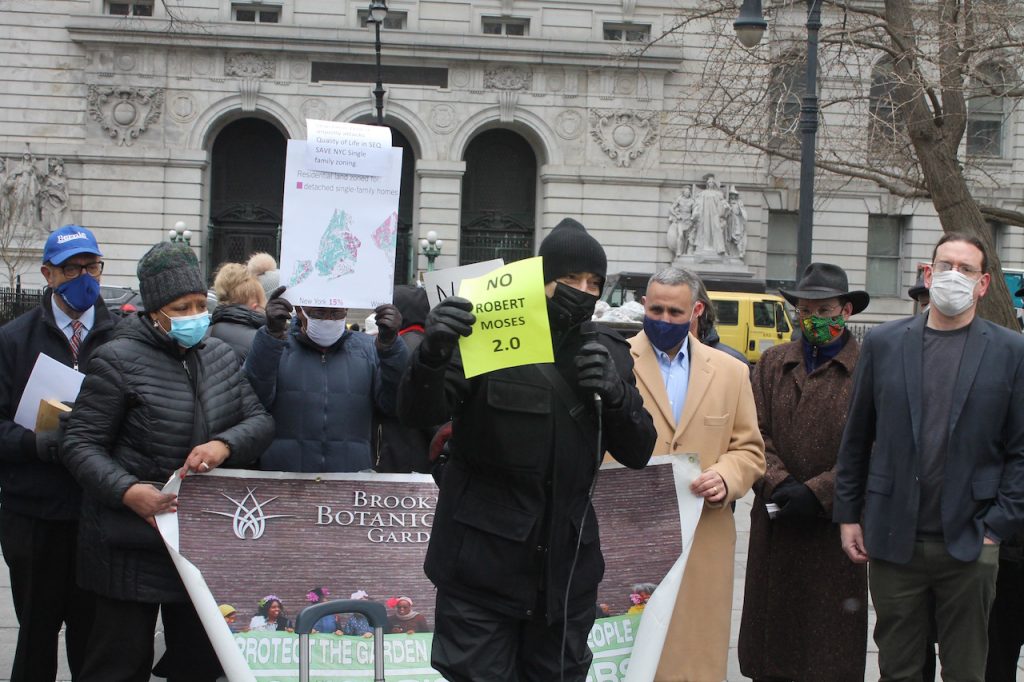
Activists slammed Corey Johnson’s long-range planning bill as a “Trojan horse” for developers at a rally outside City Hall on Tuesday.
The temperature was freezing but passions were heated as speaker after speaker blasted the bill, Intro 2186, the City Council speaker and Mayor de Blasio at the press conference, organized by the Citywide People’s Land Use Alliance.
They derided the 10-year comprehensive planning initiative as “top-down” and “one-size-fits all.” They charged that it would cut the community out of the process and legally empower an unaccountable “director” to ram through district planning schemes — if necessary, over the objections of community boards and local councilmembers.
Most chilling to them was the fact that Intro 2186 would force mandatory upzonings every decade for every single community board in the city — in short, codifying an unstoppable development juggernaut.
Dozens of organizations supported the rally, from East River Park Action, Bowery Alliance of Neighbors, the Soho Alliance and the Seaport Coalition to Preserve BAM’s Historic District, Voice of Gowanus, Inwood Preservation and Stop Sunnyside Yards.
Alicia Boyd of the Movement to Protect the People, which is fighting a development project that threatens the Brooklyn Botanic Garden, said the citywide plan is being spun as something that will help low-income black and brown people, when, in reality, it will mainly lead to an explosion of luxury development.
“This bill is being presented as an equalizer,” she railed. “Mandatory Inclusionary Housing is a failure. It’s a Trojan horse! This is not an anti-racist plan. This is not an anti-displacement plan. This is a displacement plan. We are tired of the scams [about] affordable housing.”
Paul Graziano, a Queens native and planning consultant, has played a role in helping contextually rezone much of Queens to keep overdevelopment in check.
“It’s been three months since Corey Johnson dropped this bombshell,” he told the rally. “This bill is not a comprehensive planning bill. It’s a comprehensive overdevelopment bill. It’s a comprehensive real estate bill. I have gone through this bill with a fine-tooth comb.”
In short, Graziano said, rezonings make the “speculative value” of property go up.
The Mandatory Inclusionary Housing included in the rezonings is a “scam,” he said.
“M.I.H. has not worked,” he said, “because there is no deep affordability. And it’s set up as a real estate program.”
Graziano blasted Vicki Been, de Blasio’s deputy mayor of housing and economic development, calling her the engineer of the current upzonings. He said a report Been headed at New York University’s Furman Center for Real Estate and Urban Policy has been used “to justify upzonings for the last eight years.”
“Eighty percent of her data is wrong,” Graziano said. “You’ve got this administration running this phony agenda and you’ve got “Planning Together” looking to lock it in for 10 years. This horrendous bill…will lock it in.
“Planning Together” is a report, released in December, on which Intro 2186 was based.
Thursday, March 11, 2021
Murder suspect escapes from Rikers Island as City Council finds the time to make it a public space

City officials began taking steps Monday for Rikers Island to become a public space by 2026 — synchronizing with the Mayor’s borough based jail plan that would leave the island vacant in the same year.
A uniform land use review procedure was filed on Dec. 2 that would reclassify the Bronx island as a public space, rather than a jail facility, according to a statement from City Hall.
The ULURP at hand will “officially prohibit the incarceration of individuals there after Dec. 31, 2026,” though it doesn’t address what the future holds for Rikers Island.
“The proposed mapping action does not lead to any new development or construction on its own,” that statement noted, adding that any future plans – such as housing development, green energy facilities or the prospect of expanding LaGuardia Airport —will require a new planning and public review process, including a separate approval for and environmental review.
The announcement came after the city began the procedure of closing facilities on Rikers Island along with the Brooklyn Detention Center in preparation for the new and upcoming jail plan.
“We are moving away from the failed policies of mass incarceration and showing the world that Rikers days are numbered,” said Council Speaker Corey Johnson, adding that the remapping of Rikers “shows our deep commitment to closing” all of the jails there.
De Blasio reiterated Johnson’s sentiment: “We’re charting a new course forward for the island and the people of New York City.”
Police are searching for a suspected murderer who was mistakenly released from Rikers Island because of a paperwork error.
Christopher Buggs, 26, was awaiting trial in a 2018 murder when he was released on an unrelated case.
In the unrelated case, he was sentenced to 30 days of time served for criminal contempt.
He's accused of killing 55-year-old Ernest Brownlee outside a bodega in Bedford-Stuyvesant.
Brownlee was apparently a career criminal who killed two men in the 1980s.
The Correction Department says it is conducting a full investigation into how Buggs was released.
"We
are aware of this incident and a full investigation into how this
happened is underway. Right now we are working with our law enforcement
partners to return this individual to custody," Deputy Commissioner of
Public Information Peter Thorne said.
"This is being fully
investigated right now. We are going to put additional safeguards in
place to make sure this never happens again. it's very frustrating. It
was based on a court order, but it was apparently one case that this
inmate had connected to him, but there were other charges obviously as
well that should have meant he remained incarcerated. So we are going to
get a full review of this immediately, make whatever changes we have
to. In the meantime, we have a high level of confidence that he will be
re-apprehended shortly," Mayor Bill de Blasio said.
The Blaz has such a talent with words.
You might say he has the best words.
Monday, March 1, 2021
ROFLOFL: Cojo is running for comptroller
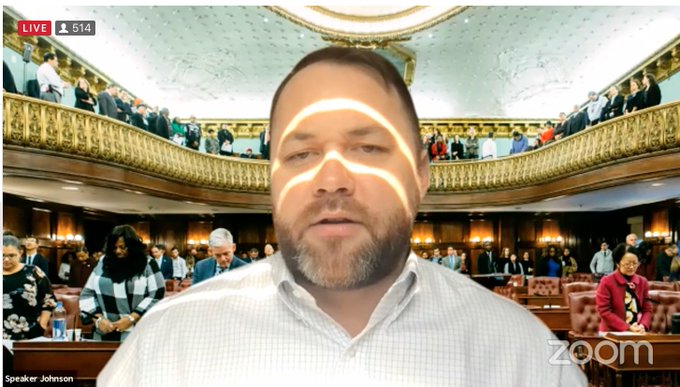
Council Speaker Corey Johnson is throwing his hat in the ring to run for city comptroller, The Post has learned.
Johnson declined to run for mayor last fall after saying he was struggling with depression amid the coronavirus pandemic.
But he has printed up petitions to gather voter signatures to qualify for ballot status to run in the Democratic primary for comptroller, sources said.
The time for circulating petitions begins on Tuesday and runs through March 25.
Johnson, 38, is also for the first time appearing as a candidate at a comptroller’s forum sponsored by the Jim Owles Liberal LGBT Democratic Club on Saturday — a sure sign that he’s running.
Other candidates invited to attend include Harlem state Senator Brian Benjamin, Brooklyn Councilman Brad Lander and Queens Assemblyman Mark Weprin.
“We are privileged to be the first organization in the city to host Council Speaker Johnson, a prospective candidate, along with Senator Benjamin, Council Member Lander, and Assembly Member Weprin,” Jim Owles club president Allen Roskoff said in a statement announcing the forum.
Roskoff told The Post Sunday night, “If Corey is appearing, he is a candidate.”
While mulling his bid for comptroller, Johnson has been taking on-line classes with Columbia University to earn his college degree.
Brooklyn state Sen. Kevin and Michelle Caruso Cabrera, two other Democratic candidates for comptroller, were not invited to the Saturday forum.
The winner of the race will replace Comptroller Scott Stringer, who is term-limited and considered a leading candidate for mayor.
CoJo in a tizzy over perceived bill "misinterpretation"
By this point during the Planning Together hearing, Corey Johnson had grown very frustrated at how cool, calm and collected Marisa Lago was under fire. You can tell because he jumps in the middle of her answering Adrienne Adams' question and goes on a diatribe. Not once, but twice!
If this bill was so great, it wouldn't be misinterpreted.
It's a bit paternalistic for carpetbagging white men like Corey (Massachusetts) and Brad Lander (Missouri) to be informing everyone else that they know exactly what's in their best interest and it involves a bill they simply must pass in their waning days in the Council while they are campaigning for higher office.
Check out Adams' attitude toward the end as well. Tomorrow, we'll delve further into her unenviable predicament. It involves a tweeding dilemma.
If this bill was so great, it wouldn't be misinterpreted.
It's a bit paternalistic for carpetbagging white men like Corey (Massachusetts) and Brad Lander (Missouri) to be informing everyone else that they know exactly what's in their best interest and it involves a bill they simply must pass in their waning days in the Council while they are campaigning for higher office.
Check out Adams' attitude toward the end as well. Tomorrow, we'll delve further into her unenviable predicament. It involves a tweeding dilemma.
Friday, February 26, 2021
Caption Cojo
I'll start...

Tuesday, February 23, 2021
De Blasio opposed to ridiculously expensive Planning Together

Monday, February 22, 2021
24 hours till City Council committee hearing on Planning Together and 9 reasons why to kill it

In 1961, Jane Jacobs, author of “The Death and Life of Great American Cities,” called city planning “a pseudo-science” that had “arisen on a foundation of nonsense.”
Jacobs argued for an end to gigantic plans that relied on “catastrophic money” and “centralized processes” and “standardized solutions.” All that, she argued, just created “dead places” — like today’s Hudson Yards.
More recently, Sam Stein, in his book “Capital City: Gentrification and the Real Estate State,” chastised planners for serving the interest of Big Real Estate rather than the public good.
It is true that for all their talk of serving the public good, planners do appear to dislike citizens. For one, they are trained to think of citizens as generic NIMBYs standing in the way of their ideas. Moreover, as a profession, they tend to overly admire Robert Moses, the man who imposed his will on New York City in a way that was top-down, cruel and racist — not to mention plain destructive.
Moses’ defenders always respond, “At least he got something done,” and argue for more central planning power, skirting the issue of whether better plans might have been made in another way.
These issues have returned anew with the announcement of a proposed planning law that City Council Speaker Corey Johnson is promoting. The law is a very bad one. Citizens should definitely object to it, and stop this law before the city puts a new Robert Moses into power.
The purpose of the law is, to quote from it: “to prioritize population growth, where applicable, in areas that have high access to opportunity and low risk for displacement.”
“High opportunity,” “amenity rich” and “well-resourced” are code words among planners for overdeveloped neighborhoods in the historic core of the city — Manhattan south of 125th St., Downtown Brooklyn, Brownstone Brooklyn around Prospect Park and the East River. (See Vicki Been’s report “Where We Live.”)
These are high-density, overdeveloped, often historic places with lots of subways, good schools, good parks, good grocery stores and short commutes to Midtown and the Financial District.
Oddly, these areas are also places where Big Real Estate profits are highest and where most of the new development since 2010 has already been built. Why then is the planning law so laser-focussed on driving growth to the already denser parts of the city, before the planning is even conducted? Why does a new all-powerful Director get to assign housing targets based on this high-opportunity theory? The law has planning exactly backwards.
We are supposed to use planning to figure out and debate where to put people (a.k.a. “density”) and infrastructure, not to do end runs around communities and drive new density to predetermined areas of the city!
Here are nine things wrong with the proposed “comprehensive planning” law:
1.) It fails to address the elephant in the room: the revolving door between Big Real Estate and government, thus undermining the legitimacy of the process. Big Real Estate has already captured many of the land-use regulatory agencies of the city; it thus imposes its vision upon us through its people who run the Department of City Planning, the Economic Development Corporation and the Board of Standards and Appeals. See, for example, my op-ed “Fox Guarding the Henhouse at City Planning.”
2.) The proposed law presupposes that the only way to deal with high housing prices is to obsessively build hyper-dense (and tall) near transit, which is what we have already been doing, based on a discredited trickle-down housing-supply theory. It’s a planning approach arising from a bad theory.
3.) It presupposes that the only way to deal with displacement risk is to build like crazy when, in fact, displacement risk needs to be managed in the first instance through legislation. Universal rent stabilization and the Good Cause Eviction Act would largely solve most of the displacement problem. Incremental building of more public-social housing units at the low end of the market would deal with the rest.
4.) It imposes Soviet-style housing targets on “low risk for displacement” neighborhoods, without having had binding public policy discussion about the upper limits or lower bounds of density. What kind of city do we want and how should we spread the benefits and burdens of density? The law presupposes that density can be infinite.
5.) The legislation presumes the scientific legitimacy of a dubious “index of displacement risk” that gets coded into law. This is just not credible. Such indices are built on a host of assumptions and not valid. Displacement risk is a political phenomenon as much as a market one.
6.) Also, the planning law ignores key questions for public debate. For example, when are we too dense to have a livable city? When are we not dense enough? How should density be distributed? Should it be distributed more evenly, like peanut butter on a slice of bread, or all piled up in the historic core? And who should decide these questions, the Director or the citizens of the city? All this is simply ignored, even though these questions are the very heart of planning!
7.) At no point can neighborhoods, residents, taxpayers and citizens vote on any plans at any time. There is no voting, no referenda, no democracy. In other words, the proposed law is profoundly anti-democratic.
8.) Under the proposed law, the housing targets for each neighborhood rely on a bad theory that Big Real Estate loves: New population growth should be targeted to existing “high-opportunity” areas. That’s an invitation for selective overdevelopment, leaving the historic parts of our city vulnerable to more demolition while ignoring the investment needs of currently “low opportunity” neighborhoods.
There is also this troubling fact: Residents of low-amenity neighborhoods have clearly said they don’t want to move. (See the city report “Where We Live.”) They want their existing neighborhoods to have amenities every bit as good as the neighborhoods in the core. They just don’t want to be gentrified out — or, rather, displaced.
9.) The law strengthens an already king-like mayor and recreates a too-powerful Robert Moses figure in the form of “The Director.” Citizens would not be able to reject this person.
 Procedurally, here’s how the planning system would work: The mayor
would appoint a Robert Moses-like figure called “The Director.” The
Director would produce research reports on a lot of topics, all required
by the new law — which is O.K. Trouble arises when the Director is told
by law to create housing targets (Soviet-style) for how much new
housing each neighborhood (in high-opportunity/low-displacement areas)
must produce.
Procedurally, here’s how the planning system would work: The mayor
would appoint a Robert Moses-like figure called “The Director.” The
Director would produce research reports on a lot of topics, all required
by the new law — which is O.K. Trouble arises when the Director is told
by law to create housing targets (Soviet-style) for how much new
housing each neighborhood (in high-opportunity/low-displacement areas)
must produce.
The Director would create three scenarios for each neighborhood to accommodate their assigned housing targets. The City Council would pick one of the scenarios. If they said, “None of the above,” the Director would then pick a scenario for them. The scenarios would get bundled into a “comprehensive” 10-year plan for the entire city, approved by the City Council to become law.
Developers would have to convince the Director that a new development was consistent with the plan. If it was, they could avoid public review, citizen outcry or deference to the local councilmember for the particular project. A few public hearings are built into the process, but they are just advisory white noise, like they are today. Citizens and taxpayers never get to vote on the plan.
While this procedure sounds plausible for things like roads, schools, transit, parks, trash disposal, libraries, sewage treatment and tunnels, this plan is not really about those things. It’s really about requiring each neighborhood to fill those assigned housing targets.
The law creates new committees to work with the Director, with trivial, advisory roles. For example, the mayor, borough presidents and the City Council would appoint a 13-member “long-term planning steering committee” made up of demographically diverse “experts.” Their role would be to give advice to the Director — who could ignore it. The steering committee would also appoint five borough committees, which would provide borough-specific feedback at various points in the planning process. Their advice would also just be white noise. Community boards would do nothing different than what they do now.
You can sign up to testify in person or submit written testimony here.

Friday, February 19, 2021
Developers licking their chops over CoJo's housing plan
From the Real Deal:
Riiiight, we elect representatives who vote on rezonings on our behalf. Unfortunately what Planning Together does is remove them, as well as community boards and the borough president, from the equation. Let's continue:
Wealthy NIMBYs? I think you'd better take a closer look at who signed the letter.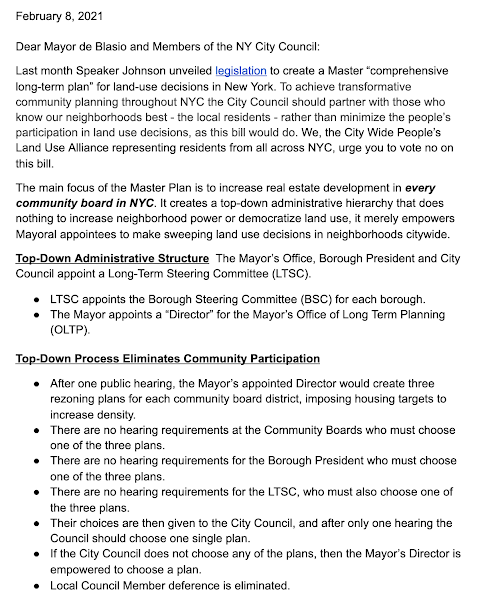
 I think MTOPP, Fight for NYCHA and the Flushing Workers Center and others on the list would be surprised to find out that they represent wealthy neighborhoods.
When they have to misrepresent who you are, it means they are up to no good.
Predictably, a coalition of the city’s leading NIMBY groups blasted the City Council speaker’s proposal Thursday as a “top-down approach that would leave communities with even less democratic control over massive city rezonings” than they have now.
Well, yes. That is exactly the point.
Not to be anal, but this is not a direct democracy. It’s a republic. We elect leaders, who in turn run the government. We don’t let people with pitchforks decide what can be built where.
Riiiight, we elect representatives who vote on rezonings on our behalf. Unfortunately what Planning Together does is remove them, as well as community boards and the borough president, from the equation. Let's continue:
New York’s lone YIMBY group, Open New York, thinks Johnson’s plan should go further because “it fails to address longstanding practices that allow wealthier neighborhoods to block new housing and shunt demand elsewhere,” said board member Will Thomas.
He was disgusted but hardly surprised by the letter from the anti-development groups including Village Preservation, Voice of Gowanus, Stop Sunnyside Yards, Soho Alliance and the Coalition to Protect Chinatown and the Lower East Side.
“We encourage legislators interested in more equitable city planning to ignore complaints by wealthy NIMBYs who are primarily interested in protecting the status quo,” Thomas said.
Wealthy NIMBYs? I think you'd better take a closer look at who signed the letter.


When they have to misrepresent who you are, it means they are up to no good.
Thursday, February 18, 2021
Community Boards overwhelmingly against "Planning Together"

Land use advocate Paul Graziano continued his Queens lobbying crusade against the City Council speaker’s proposed comprehensive planning bill in Community Board 9 on Tuesday night.
Graziano, a zoning specialist and staunch opponent of the ambitious land use legislation created by Council Speaker Corey Johnson (D-Manhattan), presented at a special meeting of the board’s Executive and Land Use committees.
Graziano has been making the rounds of community boards arguing against the plan. So far boards 8, 11 and 13 have all voted against the proposal. On Tuesday, CB 9 nearly unanimously joined the group of boards opposing the bill.
Hey folks, because Corey Johnson cares so much about the voices of People of Color, he scheduled his hearing on this bill the same day as the Special Election for Council District 31! What a guy! Here's the letter of oppositiont that CB8 sent to the Speaker. It's a doozy!
Planning Together - Letter From CB8Q by queenscrapper on Scribd
Subscribe to:
Posts (Atom)


