Showing posts with label Department of Housing and Preservation. Show all posts

Sunday, October 20, 2024

Luxury public housing tower development in Ridgewood is still in a coma

  https://qns.com/wp-content/uploads/2024/10/hero.jpg?resize=1025,1200


QNS

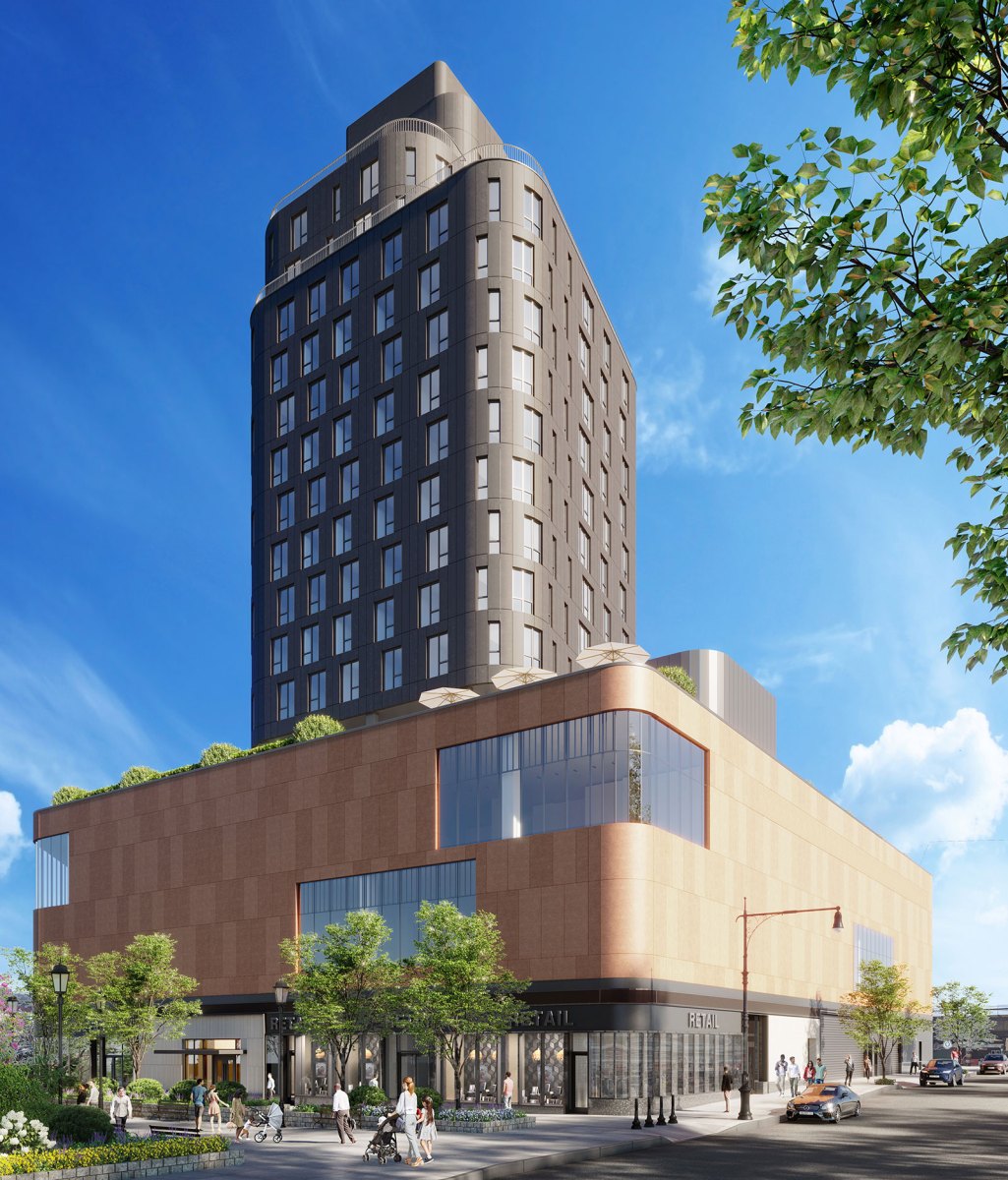
Construction has been put on hold for a 17-story mixed-use building at 3-50 St. Nicholas Ave. in Ridgewood.

Known as The Ridgewood, this tower will be the tallest structure in Ridgewood. It will cover 284,000 square feet. In addition to 97,000 of that square footage being dedicated to retail space, including two large stores and other amenities, The Ridgewood will have 133 rental apartments, with plans to set 30% of them aside for affordable housing. A community facility was also planned to be included as part of this structure.

Delays have previously plagued the construction process of The Ridgewood. A fatal accident on the construction site in April 2022 led to multiple stop work orders as a result of unsafe working conditions. While the developers of the building had initially hoped to complete the project in the winter of 2023, the stop work orders delayed construction for multiple months. It was not until December 2022 that the building was finally topped out. The latest construction delay likely means that the project will not be done before the end of 2024.

Prior to the most recent pause, the facade was partially enclosed. Progress had been further along in the exterior, at the podium. Current features of the podium include a red metal envelope and broad stretches of glass with black mullions. The main southern elevation is close to being completed, but the northern face is still mostly exposed, with metal frames currently in place to support the installation of paneling. A tall sidewalk shed is blocking the view of the tall sidewalk shed.


Wednesday, December 13, 2023

The Habitat For Humanity Horror Has A Habitat


 Impunity City

It's a miracle on 126th St.  Looks like Santa Claus came to Queens early and visited The Habitat For Humanity Horror affordable housing grave and dropped a house on this corner after over a year and a half of utter negligence and indifference by the Mayors Office and district elected officials who appeared here celebrating themselves when this "Your Home NYC" program and Mayor Adams "Get Stuff Done" sloganeering campaign started.

Or maybe it was from my intrepid reporting that compelled the Mayors Office and it's (Luxury Public) Housing, Preservation and (Over)Development Department into quickly expediting the development of this new house on this lot that was negligibly forgotten and abandoned by the city and let it turn into a ungodly apocalyptic dump on a residential street corner. To signify what a disgraceful embarrassment this is, this housing went up a month after I posted this on here and "X" and it came at the beginning of Mayor Adams machete austerity budget cuts in every municipality (except DOT but that's another fucked up story).

It also got built right when Rosalyn Carter died, who co-founded Habitat for Humanity with her husband former President Jimmy Carter, so maybe they got a couple of phone calls to get this stuff done to paraphrase New York City's troubled current mayor. Here's the sign where the Habitat for Humanity logo once was, the brand got peeled off after being hung up for hundreds of days in the elements.

Lets look at the layout and "bones" of this affordable home.


Wednesday, November 29, 2023

The CIty Of Yes will pay big money for more little housing

Efectos especiales

 NY Post

The City of New York is getting behind the tiny-house movement big time.

In an effort to create more affordable housing, a few lucky borough homeowners will be granted hundreds of thousands of dollars to construct accessory dwelling units, or ADUs, on their properties.

Last Tuesday, the New York City Department of Housing Preservation & Development announced the launch of its Plus One ADU pilot program, which will fund the creation of additional living space for growing and multigenerational families. 

The program will provide up to $395,000 in financing to a maximum of 15 single-family landlords so they can build ADUs “such as backyard cottages, garage studios, attached in-law suites, basement apartments, and attic space conversions” on their land, according to a press release.

By helping existing residents expand their square footage, the city hopes to help seniors “spend their retirement years in their chosen neighborhood,” enable in-laws to move in with young families, make space for children returning from college and otherwise help ease the current real estate crisis without “significantly changing existing neighborhoods.” 

Other program targets include “seniors who need space for a caregiver, a multigenerational household who want separate living spaces, or young parents with a little one on the way,” Mayor Eric Adams added in the release. 

The money for the program comes from a $2.6 million state grant for “crafting community-centered solutions to encourage low- and middle-income homeowners to create or upgrade good quality, safe accessory dwelling units.” The city plans to put in almost as much of its own money, the state’s Homes and Community Renewal Commissioner RuthAnne Visnauskas explained. 

“ADUs financed through the program will become safe, habitable and potentially rent-restricted units that will help homeowners generate additional income and support long-term homeowner and neighborhood stability,” the press release noted.

Thursday, January 5, 2023

NYC Housing Department opens up lottery for luxury public housing condos

NY YIMBY

The affordable housing lottery has launched for The Jackson, a five-story mixed-use building at 35-64 85th Street in Jackson Heights, Queens. Designed by Angelo Ng + Anthony Ng Architects Studio and developed by Kelly’s Properties, the structure yields 40 residences. Available on NYC Housing Connect are 12 units for residents at 130 percent of the area median income (AMI), ranging in eligible income from $74,435 to $187,330.

 At 130 percent of the AMI, there are two studios with a monthly rent of $2,171 for incomes ranging from $74,435 to $138,840; five one-bedrooms with a monthly rent of $2,327 for incomes ranging from $79,783 to $156,130; and five two-bedrooms with a monthly rent of $2,791 for incomes ranging from $95,692 to $187,330.

Usually it's proper journalistic procedure to show the header photo from the source article but the photo here I feel sums this up better. Because this aesthetically looks like a basement apartment.

Friday, November 11, 2022

City converts hospital into luxury public housing building with 125 apartments dedicated to renters making over $120,000

 https://bloximages.chicago2.vip.townnews.com/qchron.com/content/tncms/assets/v3/editorial/4/a7/4a77db6f-19fb-550d-9a62-fb7a516bde1d/636d26436b6f4.image.jpg?resize=750%2C563

 Queens Chronicle

The city is taking steps to address healthcare in ways that go beyond a trip to the doctor’s office.

Mayor Adams and NYC Health + Hospitals announced the “Housing for Health” initiative at the T Building in Jamaica Hills last Thursday. The building, located on the campus of NYC Health + Hospitals/Queens, is a former tuberculosis hospital that has been converted into a 200-unit apartment building, with 75 units dedicated to supportive housing for patients of the hospital system who had been experiencing homelessness.

Residents started moving into the building over the summer. The other 125 units are dedicated for those with incomes from 60 percent to 80 percent of the area median income, which is $120,100 for a three-person family in New York City in 2022.

The initiative is four-pronged, with NYC Health + Hospitals pledging to counsel and help eligible patients find and apply for affordable supportive housing and dedicate respite beds to medically frail patients no longer in need of hospitalization but still in need of medical care, in addition to converting unused hospital land to affordable housing developments and funding social services at the sites.

Services at the T Building are handled by the Brooklyn-based nonprofit CAMBA and funded through a former Mayor de Blasio-developed supportive housing initiative.

Sunday, July 17, 2022

City Council approves Edgemere overdevelopment


City Limits
 

 The City Council voted Thursday to rezone a 166-acre swath of Edgemere, approving a plan first proposed by the de Blasio administration that could add more than 1,200 new housing units and improve resiliency in a Queens neighborhood at severe risk of flooding.

The land use plan, part of a broader initiative known as Resilient Edgemere, encompasses the area bound by Beach 35th Street and Beach 50th Street and will change zoning rules to increase density in some areas, limit development in others and raise the shoreline along Jamaica Bay. Resilient Edgemere also includes efforts to develop housing on city-owned parcels, elevate homes, improve parks and infrastructure and designate 16 acres as open space to be used for coastal protection.

The Council specifically approved five applications submitted by the city’s Department of Housing and Preservation and Development (HPD) to amend the zoning and allow for new development with mandatory inclusionary housing (MIH) affordability rules, which force developers to cap rents on a portion of their units for low- and middle-income New Yorkers. Around 530 new units will be affordable under MIH, according to HPD, and 35 percent of those affordable units will be up for sale, not rent. The plan would further a Community Land Trust on up to eight acres of city-owned land.

Resilient Edgemere establishes two special coastal risk districts, which HPD defines as “currently at exceptional risk from flooding and may face greater risk in the future.”

Councilmember Selvena Brooks-Powers, who represents Edgemere and other neighborhoods in the eastern portion of the Rockaway Peninsula, said the changes will allow for more affordable homes in the waterfront neighborhood, while shoring up the region against rising sea levels and storm-related flooding.

“Edgemere will benefit from vital affordable homeownership opportunities, infrastructure investments and protection from a changing climate,” Brooks-Powers said. “Rockaway has seen a surge of new development in recent years, but that development has not been accompanied by a commensurate investment in local infrastructure.”

Brooks-Powers inherited the project from her predecessor, Donovan Richards, who was elected Queens borough president in 2020 and told City Limits he was pleased that the Council voted to approve the rezoning after seven years of planning and community engagement. Richards recommended the plan in his advisory role in March but urged the city to foster affordable home ownership opportunities in response to community demands.

“There is tremendous promise in the Resilient Edgemere Community Plan,” Richards said, adding that he would focus on ensuring that developers and the city adhere to local hiring and MWBE commitments.

Under the changes, which now await Mayor Eric Adams’ signature, most of the area north of Beach Channel Drive would be zoned for one- and two-family homes, while the stretch between Rockaway Beach Boulevard and Edgemere Avenue would allow for taller, mixed-used buildings. City-owned vacant land next to the Edgemere Houses would be converted to open space, as would much of the land abutting the Jamaica Bay.

In a statement following the vote, Adams hailed the plan as “an important step forward for residents of Edgemere, the Rockaways, and the entire city.”

Wednesday, May 25, 2022

Sprawling (alleged) affordable housing development approved in Far Rockaway


QNS 

The city’s plan to rezone a portion of the Rockaway peninsula in order to transform neglected publicly owned vacant lots into affordable housing, retail, amenities and open spaces, while mitigating flood risk and growing the coastal ecology was unanimously passed by the City Planning Commission on May 11.

The city’s Housing Preservation and Development initiative which would place eight acres into a community land trust, which was set in motion in 2015, will now head to the City Council in the next step of the public review process.

“The City Planning Commission’s unanimous support of the Resilient Edgemere Community Plan conveys its strength and marks an important step forward,” HPD Press Secretary William Fowler said. “We are grateful to the Edgemere community, the local elected officials, and partners across city government for their continued input as we look forward to building a more resilient future for this neighborhood.”

The proposed land-use changes will bring more than 1,200 much-needed affordable homes, including more homeownership opportunities to Edgemere, which was inundated by the flood surge from Superstorm Sandy nearly a decade ago.

“On top of ongoing work from the federal government to help make this neighborhood more resilient, the city is also dedicated to protecting it from flooding and storm events,” City Planning Commission Chairman Dan Garodnick said. “The creation here of a Special Coastal Risk District will limit development along Edgemere’s low-lying Jamaica Bay shoreline, which is a really high-risk area that experienced significant damage from Superstorm Sandy. We are taking lessons learned from that tragic event and putting them into action to create a more resilient and protected neighborhood on the Rockaway Peninsula.”

Wednesday, March 24, 2021

Paul Graziano calls out Deputy Mayor Vicki Been during protest against Planning Together


The Village Sun

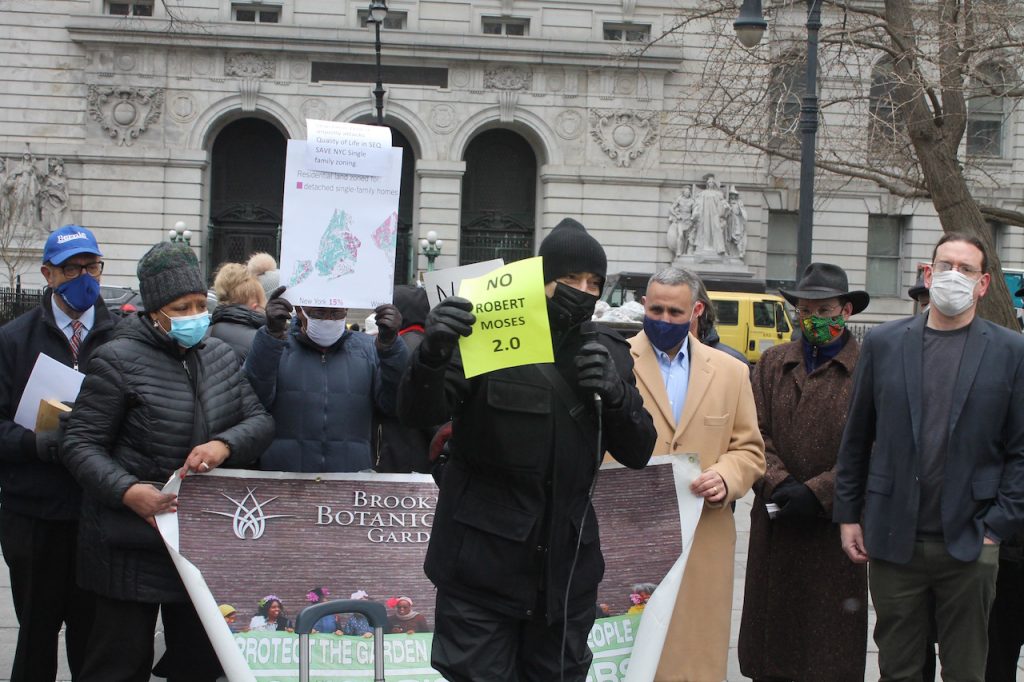
  Activists slammed Corey Johnson’s long-range planning bill as a “Trojan horse” for developers at a rally outside City Hall on Tuesday.

The temperature was freezing but passions were heated as speaker after speaker blasted the bill, Intro 2186, the City Council speaker and Mayor de Blasio at the press conference, organized by the Citywide People’s Land Use Alliance.

They derided the 10-year comprehensive planning initiative as “top-down” and “one-size-fits all.” They charged that it would cut the community out of the process and legally empower an unaccountable “director” to ram through district planning schemes — if necessary, over the objections of community boards and local councilmembers.

Most chilling to them was the fact that Intro 2186 would force mandatory upzonings every decade for every single community board in the city — in short, codifying an unstoppable development juggernaut.

Dozens of organizations supported the rally, from East River Park Action, Bowery Alliance of Neighbors, the Soho Alliance and the Seaport Coalition to Preserve BAM’s Historic District, Voice of Gowanus, Inwood Preservation and Stop Sunnyside Yards.

Alicia Boyd of the Movement to Protect the People, which is fighting a development project that threatens the Brooklyn Botanic Garden, said the citywide plan is being spun as something that will help low-income black and brown people, when, in reality, it will mainly lead to an explosion of luxury development.

“This bill is being presented as an equalizer,” she railed. “Mandatory Inclusionary Housing is a failure. It’s a Trojan horse! This is not an anti-racist plan. This is not an anti-displacement plan. This is a displacement plan. We are tired of the scams [about] affordable housing.”

Paul Graziano, a Queens native and planning consultant, has played a role in helping contextually rezone much of Queens to keep overdevelopment in check.

“It’s been three months since Corey Johnson dropped this bombshell,” he told the rally. “This bill is not a comprehensive planning bill. It’s a comprehensive overdevelopment bill. It’s a comprehensive real estate bill. I have gone through this bill with a fine-tooth comb.”

In short, Graziano said, rezonings make the “speculative value” of property go up.

The Mandatory Inclusionary Housing included in the rezonings is a “scam,” he said.

“M.I.H. has not worked,” he said, “because there is no deep affordability. And it’s set up as a real estate program.”

 Graziano blasted Vicki Been, de Blasio’s deputy mayor of housing and economic development, calling her the engineer of the current upzonings. He said a report Been headed at New York University’s Furman Center for Real Estate and Urban Policy has been used “to justify upzonings for the last eight years.”

“Eighty percent of her data is wrong,” Graziano said. “You’ve got this administration running this phony agenda and you’ve got “Planning Together” looking to lock it in for 10 years. This horrendous bill…will lock it in.

“Planning Together” is a report, released in December, on which Intro 2186 was based.


Wednesday, February 10, 2021

de Blasio's HPD incompetence gives greedy developer millions of dollars in subsidies he won't give back

  https://external-content.duckduckgo.com/iu/?u=https%3A%2F%2Ftse4.mm.bing.net%2Fth%3Fid%3DOIP.fTsVK0CF8OWGXvFAGPX5bwHaFV%26pid%3DApi&f=1

NY Post

A city bureaucrat made a $6 million mistake in preparing documents for a deal with a developer — and it could jack up the intended rents on more than 100 “affordable” apartments, one of Mayor de Blasio’s signature issues.

The city included the wrong document in an agreement with a developer on a massive, $386 million waterfront development in Brooklyn, according to court records. And now he has a legal loophole he can drive a truck through.

Developer David Bistricer, who is building 770 apartments in three towers on Commercial Street in Greenpoint, has allegedly refused to let the clerical error be corrected, forcing the city to file a Manhattan Supreme Court lawsuit to fix it.

The project, part of a building boom in Greenpoint, was announced nearly a decade ago but only recently broke ground.

The city claims it negotiated the inclusion of 200 permanent affordable housing units in exchange for $2 million in taxpayer cash and $8 million worth of air rights from a city-owned plot adjacent to Bistricer’s Waterview at Greenpoint LLC site. The developer is slated to build Box Street Park on the plot, which is currently used by the MTA.

The deal was supposed to give the city housing with “deeper affordability,” and allowed Waterview to more than double the square footage. That increased affordability is “valued at more than $6 million,” the city said in its legal filing.

 As the city and Waterview hashed out final details of the agreement in May, a staffer with the Department of Housing and Preservation Development included an incorrect list of affordable rents and qualifying incomes to be offered to tenants.

For example, the city intended for at least 10 of the affordable units to rent for as little as $732 to $1,067 depending on size. But the lowest rent listed in the faulty document is $1,529, court records show.

Eligible incomes also drastically changed. The city wanted incomes ranging from $40,000 and up for a family of three to qualify. The lowest eligible earnings for a family of three listed on the erroneous paperwork is about $81,000.

If the mistake goes uncorrected, “134 of the 200 affordable housing units would be offered at different (and significantly higher) rents with different (and significantly higher) income restrictions,” the city claims.

 Possibly the biggest joke about this scandal is that the greedhead got away with only offering 10 apartments for lower income earners (and not specifically low income earners)