Showing posts with label budget. Show all posts

Tuesday, December 3, 2024

Judgement day coming for the City Of Yes

 https://qns.com/wp-content/uploads/2024/11/IMG_4074.jpeg?resize=1200,900

Queens Chronicle 


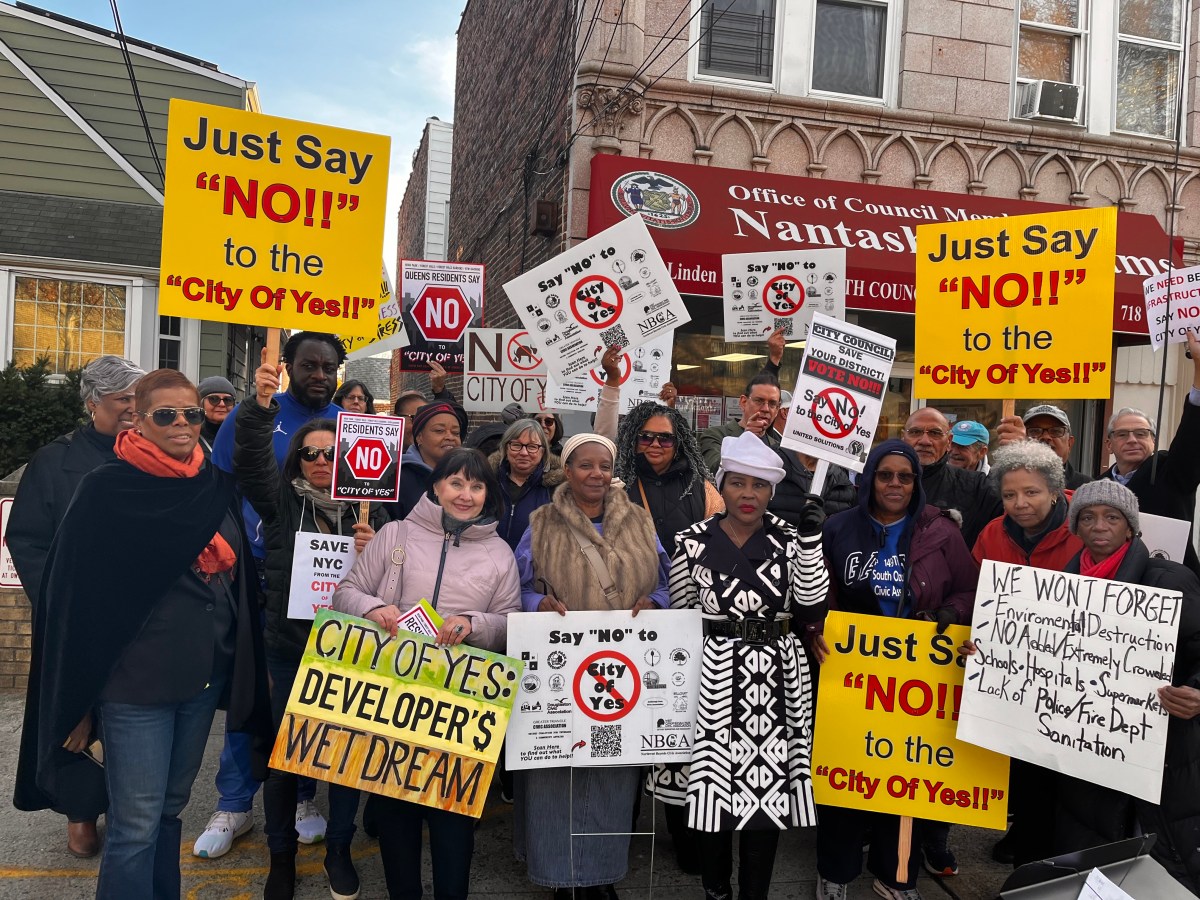
Queens residents and presidents of local civic associations gathered with activist Paul Graziano outside the office of Councilwoman Nantasha Williams (D-St. Albans) on Monday to protest next Thursday’s City of Yes vote and announce their intentions to sue the city should it go through.

The City Council is expected to vote on Dec. 5 to approve the City of Yes for Housing Opportunity text amendment, the last third of the City of Yes agenda. The amendment would ease regulations to allow accessory dwelling units, more high-density housing, greater building heights and much more, detailed in the 1,400 pages of text.

Warren Schreiber, the president of the Queens Civic Congress, told the Queens Chronicle that the civic associations would file an Article 78 class action lawsuit against the city to stop it from implementing the rezoning program on the basis that the action would be “arbitrary and capricious.”

“An Article 78 [is] what you bring against a government entity when you think that they’ve made a wrong decision,” Schreiber said.

Schreiber added that the opponents have yet to decide who would be the plaintiffs, although the Queens Civic Congress would certainly be one, and they have yet to contact a lawyer. When asked how it would be funded, he said they were looking at a GoFundMe. Schreiber said they would at least be looking for the judge to issue an injunction while the suit plays out.

“Everybody seems to understand the importance and they understand that it’s urgent that we move forward as soon as possible,” Schreiber said.

During Monday’s rally, Schreiber and others took shots at city officials for making supposed backroom deals to get the City of Yes through the Council.

“When the City Council plays ‘Let’s Make a Deal,’ they do it behind closed doors, in secret,” Schreiber joked.

“Speaker [Adrienne] Adams and [Chair of the City Planning Commission] Dan Garodnick, both attended the Somos lobbyist convention in Puerto Rico and they met behind closed doors,” Schreiber added, referring to the tropical getaway attended by many in the New York political scene every year. “Nobody knows what they said to each other.”

Claudia Valentino, a magazine editor and Forest Hills resident of 40 years, told the Queens Chronicle that overdevelopment that could happen under City of Yes would do “nothing but cause damage and take community review away.”

“The moment you start digging up driveways to try to put ADUs in backyards, garages and so on, you will endanger the foundations of the houses,” Valentino said. “It will cause a whole world of problems with our ancient sewer and electrical grid.”

For Aracelia Cook, the president of the 149th South Ozone Park Civic Association, infrastructure was also a top concern, citing the catastrophic 2019 Southeast Queens sewer pipe collapse.

“Now all of a sudden they throw in, ‘Oh, we’re going to give X amount of billions of dollars for infrastructure,’” Cook said. “Where did that come from? You should give that to people anyway, regardless of whether they are going to vote for the City of Yes or not.”

Graziano, an urban planning consultant who has been making his rounds across the city rallying against the City of Yes, compared the newest amendments to the housing opportunity section of the program to treating a gunshot patient.

“When you have a patient that’s been shot by six bullets — it doesn’t matter if they got shot by five, the patient is still gonna die,” Graziano said, referring to the Council’s modifications to the bill.

Graziano was particularly peeved by the $5 billion City for All budget, which has been set aside “to address the city’s housing crisis,” according to City Council Speaker Adrienne Adams (D-Jamaica).

“This is not $5 billion in a bank account that they’re waiting to tap to give to all of these things,” Graziano said. “This is our tax dollars.”


 QNS

As the City Council’s voting deadline on the City of Yes for Housing Opportunity steadily approaches, residents, civic groups, and local elected officials throughout Queens have voiced their stance on the monumental rezoning proposal. 

The City Council is expected to hold a final vote on Dec. 5 regarding the City of Yes, which was approved with modifications by two influential council committees on Nov. 21 following a hearing. 

The changes included modifying the proposed elimination of parking mandates for new residential developments and adding restrictions on where accessory dwelling units can be built. Additionally, Mayor Adams’ administration announced a $5 billion commitment to fund the City Council’s housing plan, City for All, earlier this month. 

The City for All Housing Plan’s points include mandating affordable housing in large transit-oriented and town-centered developments, allocating increased funding to the city’s housing programs, and increasing support for tenants’ rights.

In Southeast Queens, a steady coalition of residents and civic leaders have protested for months against the rezoning initiative, which aims to bring a little more housing in every neighborhood. 

The organizing against the plan started earlier this year. In May, Alicia Spears, a Cambria Heights homeowner, held a packed town hall meeting at Cambria Heights Library. More than 500 Southeast Queens residents came together, voicing concerns that their single-family and two-family zoned neighborhoods would become unrecognizable in the near future if higher-density housing developments—as well as accessory dwelling units—are permitted. 

Other vocal nay-sayers include Paul Graziano, a Flushing resident and urban planner who has long opposed the City of Yes for Housing initiative, and Reverend Carlene Thorbs, Chair of Community Board 12 and organizer of recent ‘Say No to City of Yes’ rallies held in South Jamaica. Two weeks ago, Graziano, Thorbs, and Spears hosted another rally in St. Albans, urging their elected officials to vote no this December.

The organizers led their most recent rally on Monday, Nov. 25, in front of Council Member Nantasha William’s office, located at 172-12 Linden Blvd.  Much of Monday’s rally centered around homeowners reiterating concerns about the City of Yes.

Graziano and Warren Schreiber, president of the Queens Civic Congress, said that if the plan passes on Dec. 5, they would pursue legal action. ” We will be filing a lawsuit… it’s happening,” Graziano said.

Schreiber expanded more, sharing that they would file the lawsuit under Article 78, which allows citizens to appeal decisions made by government agencies or officials to the New York State Supreme Court. “The first step would be an injunction until the Article 78, the lawsuit, could be heard,” Schreiber said.  Schreiber said that he wants to ask the court for an injunction as soon as possible. “We’re still working on its logistics and how it’s going to be funded,” Schreiber said.


Thursday, April 27, 2023

Mayor Adams announces little ugly city budget while the big ugly state budget remains in limbo

City & State

New York City Mayor Eric Adams unveiled a $106.7 billion budget proposal for fiscal year 2024 on Wednesday – the largest in city history – backing off, in small part, from some of the 4% agency cuts he’s stressed as necessary. The proposal reflects few, if any, direct service cuts, while adjusting spending estimates downward to hedge for future “storm clouds ahead” like ongoing costs associated with the influx of asylum-seekers, according to Adams. The proposal also includes a limited slate of new spending proposals to, as Adams put it, improve the city’s sustainability and resilience, strengthen mental health resources, uplift “working people,” and bolster the college to workforce pipeline. 

“We had to make tough choices in this budget. We had to negotiate competing needs. We realize that not everyone will be happy, but that is OK,” Adams said from City Hall Wednesday afternoon. 

Here are some of the top numbers you need to know to understand the city’s finances.

$106.7 billion – The size of the proposed expense budget, which is the largest ever. The total spending increased $4 billion dollars since the preliminary budget, which landed at $102.7 billion in January. The actual adopted budget last June was $101 billion… but the city is now expecting to actually spend $108.9 billion through the end of fiscal year 2023. 

$4.2 billion, $6 billion, $7 billion – The respective budget gaps in fiscal years 2025, 2026 and 2027. While Adams presented a balanced budget for the current fiscal year and the upcoming fiscal year 2024, hefty budget gaps remain in the outyear due in part to increased pay for city workers under new labor contracts. Fiscal watchdogs have warned that these budget gaps necessitate caution in New York City’s current spending plans.

$1.6 billion – The total savings achieved between fiscal years 2023 and 2024 through the latest Program to Eliminate the Gap, according to City Hall. Adams said that these cuts were accomplished without any layoffs or service reductions – but with some savings achieved by taking vacant jobs off the rolls, it’s unclear how the city will maintain previous levels of service. 

$4.3 billion – The amount of money that the city anticipates spending on providing shelter, food, clothing and other services to asylum-seekers through the end of fiscal year 2024. This is a figure that Adams has pointed to repeatedly in recent weeks as one of the big reasons that cuts are necessary. While the city will likely receive $1 billion in aid from the state, and predicts getting $600 million from the federal government, that total would only cover under 40% of the city’s projected costs. 

Over 57,000 people – The latest estimate of how many asylum-seekers have arrived in New York City in the past year. Some 35,000 are currently in city shelters, City Hall says.

70,000 people – How many asylum-seekers City Hall anticipates will be in the city’s care by June 2024.

$16 billion – The total anticipated cost of agreements with the city’s remaining unionized workforces that have yet to strike deals, over the next five years. The city has already reached agreements with District Council 37 and the Police Benevolent Association, which will likely set the economic framework for ongoing negotiations with the United Federation of Teachers and other labor groups. 

26 days – How late the state budget is past the April 1 deadline – and counting. Adams is releasing its executive budget without final numbers from the state, which funds about 17% of the city budget. “We may have to go back,” to create new estimates after it’s finalized, Adams said, “and our budget mod is going to reflect that.”

50% – Of working-age households in New York City don’t make incomes that cover their basic needs like housing, food, transportation and health care, according to a report sponsored by the United Way of New York City and the Fund for the City of New York. While the jarring figure is not included in Adams’ budget proposal, its recent release adds gravity to the negotiations over proposed cuts to programs and services.

$23.2 million – The cost of expanding the Department of Sanitation’s voluntary curbside composting program to all five boroughs by 2024. While Adams mostly focused on savings, this was one of a few new, relatively low-cost initiatives added to the budget. 

$27 million – Baseline funding allocated to continue the expansion of the Behavioral Health Emergency Assistance Response Division, or B-HEARD pilot program into the rest of the Bronx as well as other high-need neighborhoods throughout the city. The program, aimed at changing how the city responds to mental health emergencies by dispatching social workers and paramedics to people in crisis, is currently operating in a handful of neighborhoods. 

 Might as well leave this here since our Mayor is being all frugal...

NY Post 

The NYPD commissioner in charge of employee relations is having a difficult time — with her employee relations. 

More than 10 cops working under Deputy Commissioner Lisa White — who’s in charge of officer morale in the 35,000 uniformed member force — have either transferred or asked to be transferred out of her office because of her off-the-wall shenanigans, including claiming there are ghosts in her office and that workers are bugging her phone, police sources told The Post. 

The final straw for one of them, a detective assigned to drive her in a department-assigned Ford SUV, came when White, 61, ordered the cop to turn on the lights and sirens because she was late for work.

When the detective refused, White ordered her out, hopped into the driver’s seat and took over, barreling from her Crown Heights apartment to One Police Plaza in lower Manhattan like a bat out of hell, the sources said.

“She told the driver to pull over and she went behind the wheel and almost got in like f–king five accidents,” a police source said. “It was so bad that the driver … said, ‘I can’t do this anymore. Now she’s putting my life at risk.’”

The detective-driver was one of “multiple” officers who have requested to transfer out of White’s unit — even some cops White brought to the unit with her — since Mayor Adams appointed her in May 2022, insiders said.  

“There’s been a large turnover in that office and more people are requesting to go,” the source said.

Bizarrely, the deputy commissioner has accused employees of “planting bugs in her office, bugs in her phone” and “all sorts of crazy stuff,” the source said.

She once accused them of releasing “confidential information” when someone gave out her schedule.

She’s also told employees “there’s ghosts in her office,” a second police source said.

Some of her higher ups want White out because of her antics, but she has close personal ties to Adams, the sources said.


Thursday, February 2, 2023

Kathy Clown's budget plan for the MTA is based on payroll taxes and funding speculations

THE CITY 

Gov. Kathy Hochul presents her fiscal year 2024 executive budget proposal in the Red Room at the state Capitol.

Mike Groll/Office of Gov. Kathy Hochul

Gov. Kathy Hochul unveiled a $227 billion budget Wednesday that has something for everyone, and something almost everyone will dislike — especially the progressives who dominate the Democratic majorities in Albany.

The plan increases spending across the board but puts much of the $8 billion in unexpected tax revenue from the current year into reserves and tries to convince legislators that economic headwinds are likely to bring revenue growth to a halt.

Hochul proposes to bail out the Metropolitan Transportation Authority with an increase in payroll taxes paid by employers in the New York City commuter region (the city and suburbs that Metro-North and LIRR cover) and licensing fees to be paid by new gambling casinos in the city. She’s also demanding $500 million more per year from the city, while offering $300 million in new state aid.

She also urges raising the state’s minimum wage, currently $15 an hour in most of New York, by indexing it to inflation, and seeks to extend an expiring increase in corporate taxes for three years — but ignored proposals from progressive and tenant groups for big increases in state spending.

Acting Budget Director Sandra L. Beattie said caution is needed to deal with the grim forecast for the coming fiscal year, which begins April 1.

“Tax collections are expected to peak in the current year and fall in fiscal 2024, and we are harvesting the gains to prepare for the uncertainties ahead,” Beattie warned.

The entire budget includes both state revenues and federal aid, with state-funded programs increasing by 2.4%, or $327 million, from this year’s budget, and would be balanced.

It puts half the unexpected revenue increase into the state’s major reserve funds, and another $1 billion into a debt reserve fund. The rainy-day funds will reach 15% of spending in the next fiscal year — two years earlier than the governor had previously proposed.

At the same time, the budget reduces expected revenues for fiscal 2025-2027 by almost $20 billion, opening gaps in those future budgets to $22 billion. Leading fiscal experts warn of the risks of increased spending, as Hochul’s proposal goes to state lawmakers angling to increase spending.

“The governor’s proposal usually sets the floor in negotiations with the legislature,” said Andrew Rein, president of the nonprofit Citizens Budget Commission. “All New York State leaders should focus not just on today, but on protecting generations of New Yorkers from a future downturn and self-made fiscal crises arising from unaffordable spending or counter-productive taxes.”

The MTA bailout plan, designed to close an expected $3 billion budget deficit in 2025, illustrates the governor’s on-the-one-hand, on-the-other-hand-strategy.

Both the Riders Alliance and the Permanent Citizens Advisory Committee to the MTA hailed the governor’s proposals to boost transit funding. But while city Comptroller Brad Lander praised the tax increase and diversion of casino revenues, he also strongly objected to the request for an additional $500 million in city aid to the agency. 

Mayor Eric Adams said he intended to study the implications of the budget.

In an emailed statement, Adams said, “While we are reviewing the details of Governor Hochul’s budget proposal, it is clear that there are many victories worth celebrating, particularly in the areas of [addressing] serious mental illnesses, addressing our housing crisis, and strengthening the entire ecosystem of public safety.

“There are also areas of uncertainty that will require deeper review,” he said.


Sunday, February 20, 2022

Governor Kathy Clown plays herself, abandons ADU plan

  10 Facts About '3rd Rock From The Sun' Direct From The Big ...

Newsday

  Gov. Kathy Hochul has pulled her budget proposal to require local governments to accept an expansion of apartments and backyard cottages in single-family neighborhoods as a way to combat a statewide crisis in affordable housing, Newsday has learned.

Hochul had proposed the expansion of "accessory dwelling units" in her January budget proposal to the legislature. Since then, however, there has been strong opposition by mostly Republican officials from local governments on Long Island and by some Democrats, including Rep. Tom Suozzi and Long Island state senators. Suozzi (D-Glen Cove) is challenging Hochul for the Democratic nomination for governor.

Opponents argued that Hochul’s proposal would harm suburban neighborhoods by worsening parking problems and straining local services, including sewer and water facilities, while eliminating local control of zoning.

"Since my days in local government, I have believed strongly in the importance of consensus-building and listening to communities and my fellow policymakers," said Hochul, a former Erie County clerk and a suburban councilwoman, in a statement.

 I have heard real concerns about the proposed approach on accessory dwelling units," she said. "I understand that my colleagues in the State Senate believe a different set of tools is needed, even if they agree with the goal of supporting the growth of this kind of housing. So I am submitting a 30-day amendment to my budget legislation that removes requirements on localities in order to facilitate a conversation about how we build consensus around solutions."

"I am glad she removed this radical policy from the budget, but she should have never added it in the first place, " Suozzi said.

Thursday, July 1, 2021

The Blaz and Cojo approves irresponsible reserves deprived city budget plan

Mayor Bill de Blasio and Council Speaker Corey Johnson shake hands at City Hall on a budget deal, June 30, 2021. 

THE CITY 


Mayor Bill de Blasio and Council Speaker Corey Johnson announced a nearly $100 billion budget deal Wednesday that boosts spending by $10 billion, restores pandemic cuts, increases education funding and even puts $1 billion in a new rainy-day fund.

But for all the self-congratulations at a City Hall news conference, budget experts, comptrollers and advocates for a range of causes assailed the plan as unsustainable — saying it will leave billions in budget deficits for the next mayor.

Critics also pointed to $1 billion in federal aid earmarked for recurring expenditures like the expansion of Pre-K and no effort to wring substantial savings from poorly performing programs or the municipal labor force.

“This is a missed opportunity when you have so many resources to restructure government to be sustainable in 2024 and 2025 and to stabilize the city’s finances,” said Andrew Rein, president of the non-partisan Citizens Budget Commission.

 City Comptroller Scott Stringer, a defeated candidate for mayor, criticized the use of federal money for Pre-K and called for more reserves. State Comptroller Thomas DiNapoli said revenues must be identified to pay for new and expanded programs. And Councilmember Brad Lander, who is battling Johnson to succeed Stringer, voted against the budget, saying it lacks transparency on the use of the federal aid.

“I favor expanding Pre-K, but you have to do it with a plan to pay for it in the long run,” Lander said. “Rolling back on cutting the workforce through attrition and counting on $1 billion in labor savings you have been promising for three years is not a real plan.”

Lander is a douchebag, but it's fair to say that it would be better if he's comptroller than super shady big spender Cojo.


Tuesday, February 23, 2021

De Blasio opposed to ridiculously expensive Planning Together

From the Daily News: The de Blasio administration is opposing a City Council proposal to simplify the process for future development, saying legislation from Council Speaker Corey Johnson would be way too expensive. The bill...would cost the city about half a billion dollars per decade, the administration estimates — and that at a time of shrinking tax revenues due to the coronavirus outbreak. In the administration’s reading of the bill, every community district in the city would have to undergo assessments of three different development scenarios every 10 years. With an average “environmental impact assessment” costing $2.5 million to carry out, and the city having 59 community districts, that comes to about $450 million per decade, according to the administration. It also estimates the cost of staffing the undertaking would add another $50 million, not counting costs to the Office of Management and Budget. De Blasio officials including Planning Commissioner Marissa Lago are expected to testify against Johnson’s bill on Wednesday.

Monday, August 17, 2020

Beware of Cojo


https://wwwcache.wral.com/asset/news/national_world/national/2018/06/16/17632461/10dd5bbe-9a5c-4c58-8879-0dd4e1920411-DMID1-5f4x9jqja-1688x1125.jpg

NY Daily News


NYC Council members who voted against this year’s budget — which activists decried as failing to go far enough on police reform — got the short end of the stick on funding for their districts from Council Speaker Corey Johnson, the Daily News has found.

The 17 “no” votes each received an average of seven times less discretionary and capital funding from Johnson than 30 “yes” votes.

The more than $300 million in cash, which is buried in budget documents, goes to everything from local nonprofits to school auditoriums and is seen as a way for the speaker to reward allies and punish foes.

As the controversial budget passed at the end of June, Johnson took an apologetic tone. He noted shortcomings in answering demands that arose from recent anti-police-brutality protests sparked by the May 25 death of Black Minneapolis man George Floyd at the hands of a white police officer.

“To everyone who is disappointed that we did not go farther ... I am disappointed, as well,” he said. 

“But this budget process involves the mayor, who was not budging more than what we got, and 49 other Council members currently, many of whom were not open or supportive to the kind of cuts that I was pushing for.”

However, members who voted in favor of the budget received the biggest allocations from Johnson.
Councilwoman Adrienne Adams (D-Queens) got $21,697,000; Councilman Mark Treyger (D-Brooklyn), $18,395,000; and Council Majority Leader Laurie Cumbo (D-Brooklyn), $16,025,000.

The rebels, many of whose stances were known as Johnson’s office finalized the budget in the days before the vote, received far less. Councilman Jimmy Van Bramer (D-Queens) got $736,000; Councilwomen Carlina Rivera (D-Manhattan) and Helen Rosenthal (D-Manhattan), $225,000 each; and Councilman Brad Lander (D-Brooklyn), $125,000. Councilman Carlos Menchaca (D-Brooklyn) got a big fat zero from Johnson, though his name was on one line item shared with Councilman Antonio Reynoso (D-Brooklyn).

Monday, February 24, 2020

City Council's tunnel visions for the BQE


  https://external-content.duckduckgo.com/iu/?u=https%3A%2F%2Fthenypost.files.wordpress.com%2F2018%2F09%2F180920-bqe-wealthy-residents.jpg%3Fquality%3D90%26strip%3Dall%26w%3D618%26h%3D410%26crop%3D1&f=1&nofb=1


NY Daily News/MSN

 New York City officials on Monday pitched an $11 billion tunnel to keep cars off a crumbling stretch of the Brooklyn-Queens Expressway.

A consulting firm hired by the City Council last year floated the tunnel idea as an alternative to the city Department of Transportation’s previous plan to fix the dilapidated road, which would have cost $4 billion to repair and to build a temporary highway above the beloved Brooklyn Heights Promenade during construction.

The tunnel would stretch 3 miles from the Gowanus Expressway where it meets the Prospect 

Expressway to the BQE’s south Williamsburg trench near Bedford Ave. It’s modeled after similar projects in other U.S. cities, such as Boston’s 1.5-mile “Big Dig” tunnel that ended up costing the city $22 billion.

The Council’s consultant also recommended another $3.2 billion idea pitched by architecture firm Bjarke Ingels Group last year to build a park atop a new capped six-lane highway adjacent to the promenade.

Council Speaker Corey Johnson called the rebuilding of the highway a “once-in-a-lifetime opportunity,” but declined to endorse either pitch.

If the city goes with the tunnel option, it would cost more than the estimated $7.2 billion price tag for the first two phases of the Second Ave. subway, which hopes to extend the Q line to East Harlem over the next decade.

The tunnel, which the consultant said would take seven to 10 years to construct, would cost about 35% more. The MTA expects the first two phases of the Second Ave. subway will draw an additional 290,000 daily riders, while the Council’s consultant said the proposed tunnel would be used by some 153,000 vehicles a day.

The BQE tunnel idea was met with skepticism by other Council members, who questioned the city’s ability to build large-scale projects.

“We haven’t been able to build anything on this scale since the ’60s,” said Councilman Joseph Borelli (R-S.I.). “I am less concerned about the price tag than I am over whether a future mayor will have the intestinal fortitude to see it through.”

The DOT is in the middle of an environmental review process for all of the proposals to fix the BQE that is expected to drag on for at least another year.


Friday, January 3, 2020

Cuomo passes $51,500,000,000 MTA capital plan despite de Blasio no-show


The MTA’s $51.5 billion capital plan was approved without oversight from the city Wednesday — after Gov. Andrew Cuomo refused to convene a review panel amid a spat with Mayor Bill de Blasio.

The deadline for the Capital Program Review Board to review the hefty five-year construction budget ended at the stroke of midnight, meaning the MTA can officially begin allocating funding for the plan with no questions asked.

Cuomo refused to convene the four-person panel — consisting of one appointee apiece from Cuomo’s office, de Blasio’s and both chambers of the state Legislature — unless the mayor appeared in person, insisting the decision was too monumental to be given to a proxy.

But de Blasio, who wanted budget aide Sherif Soliman to represent City Hall’s interests, declined, ceding the city’s veto power over the massive infrastructure plan.

The MTA’s board — which is dominated by Cuomo appointees — green-lit the plan in September.


Thursday, August 15, 2019

Asswipe Mayor de Blasio overspends on city toilet paper


https://ichef.bbci.co.uk/news/720/cpsprodpb/10433/production/_106111666_gettyimages-157681994.jpg

NY Daily News


New York City is literally flushing millions down the toilet.

The city has spent at least $8.8 million on cheap toilet paper since June 2013 – and the costs are piling up under Mayor de Blasio.

Around $1.58 million was wasted on toilet paper last fiscal year, a 12% bump since 2014, according to records obtained by The Daily News. Last month alone, the city bought $126,000 worth of toilet paper rolls.

The city uses about four million rolls every year, buying only cheap, single-ply toilet paper, according to the Citywide Administrative Services. An average of $1.45 million was spent on potty paper annually over the last few years.

That’s about 35 cents a roll.

DCAS dumps the rolls in all municipal buildings, including City Hall, police precincts, parks and firehouses.

"It’s a waste of money,” one Democratic councilman, who asked not be name in order to cover his behind, quipped. “Taxpayers are watching their money flushed down the toilet.”
 
Another councilman tried to perfume the issue slightly.
 
 “It seems like a lot of money for toilet paper, but at least we now have a solution for all the crap coming out of City Hall,” Councilman Joseph Borelli (R-Staten Island) said.

Wednesday, February 14, 2018

MTA funding going to upstate bobsled track


From NBC:

Winter athletes and their neighbors in the Adirondack Mountains have long praised Albany for funneling subsidies to the upstate Olympic Training Facility. But last year some downstate lawmakers criticized Gov. Andrew Cuomo for diverting almost $5 million from the 2016 MTA budget to the Olympic Regional Development Authority (ORDA), the quasi-state agency that manages Lake Placid’s Olympic venues.

“The MTA is supposed to be for the mass transit system here in New York City and its surrounding suburbs, and yet millions of dollars were going upstate to finance a ski resort,” said state Sen. Michael Gianaris (D-Astoria). “It struck a lot of us as odd, especially at a time when the MTA is in a desperate situation. The trains are breaking down. They’re not running on time. Delays are increasing by the day.”

At the time, the Cuomo administration defended sending the $5 million payment to ORDA, saying it was a routine way of reimbursing the state for money the MTA owed to Albany. It’s also worth noting, $5 million is a tiny fraction of the nearly $7 billion Albany sends to the MTA annually.

Still, the cash transfer has given birth to a simple question: should any money intended for the downstate subway tracks go to help fund an upstate bobsled track?

Tuesday, February 6, 2018

Partying like it's 1975

From Crains:

Mayor Bill de Blasio portrays his preliminary $89 billion budget as a fiscally responsible plan to make the city a fairer place—his No. 1 priority—and to meet the demands of the city’s growth (the very first chart in his budget summary shows the increase in the city’s population, which reached 8.5 million in 2016).

He certainly has spent a lot of money in pursuit of those goals.

The $89 billion figure represents an increase of $16.5 billion from the last Bloomberg budget, according to figures from the Citizens Budget Commission that adjust the numbers for the rollover of surpluses, intergovernment transfers and reserves. The percentage increase is 22.7%, which is more than double the rate of inflation during the period. If he had merely kept pace with inflation, the budget would be a little over $80 billion—a big difference.

The Citizens Budget Commission and others have criticized the mayor for not protecting the city from the three major threats it faces: the prospect of significant budget cuts from the federal government, which sends the city something on the order of $7 billion a year; the potential loss of millionaire taxpayers to other states because of the impact of the Republican tax bill; and the fact that the city’s amazing economic boom, which next month will set a modern record for its length, will come to an end sooner rather than later.

Saturday, February 3, 2018

BDB wants basement apartments legalized

From Crains:

Mayor Bill de Blasio managed to include one new proposal in the preliminary budget he released on Thursday—a pilot program to bring illegal basement apartments above-board.

The mayor revealed his latest plan to tally more living spaces toward his affordable-housing goals during a press conference at City Hall. It calls for the city to expend $5.7 million to bring existing underground apartments in Brooklyn’s East New York section up to code while keeping their rents below market rate.

“We’ve got to keep looking for new ways still to create and preserve affordable housing,” the mayor said. “We have to prove the model first, and we’re going to do that in East New York.”

The mayor estimated that the program, if successful in the impoverished enclave, could let him take credit for creating or preserving 5,000 more apartments citywide. This would appear to encompass about 11% of the current number of basement units, which a 2002 survey put at 45,000 across the five boroughs.


The number one reason landlords install illegal apartments in their basements/cellars is greed. They want the extra tax free income. Another legal unit could mean a change in income tax bracket and the DOF tax assessment also changes. I'm all for people living in safer environments, but this initiative does not jibe with the reasons why illegal apartments exist.

Wednesday, January 17, 2018

Cuomo wants lots of new taxes

From Crain's:

Gov. Andrew Cuomo called for an array of new revenues to close the state’s $4 billion budget hole on Tuesday while sketching his spending plan for the coming fiscal year.

The governor asserted that Albany could reap $750 million from sales of health care nonprofits to private entities, $140 million from a new tax on health insurers, $170 million from an opioid surcharge, $300 million through a one-year suspension of certain corporate tax credits and $318 million through an internet sales tax.

The 2017 federal tax legislation eliminated the state and local tax deductions, which let New Yorkers report less on their returns to the Internal Revenue Service. Cuomo reiterated his earlier calls to restructure New York’s tax system by replacing the income tax with a payroll tax—eliminating the excise on employees for money earned, and putting the burden instead on employers for wages paid.

This idea won a swift and bitter rebuke from a top small-business trade group.

The governor again teased a congestion pricing plan that would fund the moribund subway system through a new charge on cars entering the Manhattan business district. He offered few new details other than insisting that he would not impose tolls on the four city-owned East River bridges, but promised a full proposal later in the week.

Friday, June 9, 2017

Does this group deserve taxpayer cash?

From the Daily News:

A scandal-scarred Queens nonprofit is getting $69,000 in taxpayer cash from City Council pols doling out member items, budget records released Monday show.

The Sports and Arts in Schools Foundation was picked for the grants as part of more than $60 million the Council is giving out to favored nonprofits in the $85.2 billion city budget set to pass later this week.

The Council’s discretionary spending adds up to $61.5 million — a $1.7 million spike since last year.

The Daily News reported the foundation — which has been represented by powerful lobbying firm Constantinople & Vallone — got $1.88 million in city contracts in the past year despite a string of criminal charges against employees, city probes and bad performance evaluations.

The group has twice been penalized for losing a child on a field trip, and is currently being investigated for payroll discrepancies and conflicts of interest.

Sports and Arts is set to receive 12 new grants, ranging from $3,000 to $10,000, from 12 different Council members, according to the budget documents.

Thursday, June 8, 2017

BIG budget approved early

From Crains:

The City Council approved an early $85.2 billion budget for its 2018 fiscal year Tuesday, the last under term-limited Speaker Melissa Mark-Viverito.

The council added funding for summer jobs and a property tax exemption for veterans to Mayor Bill de Blasio's fiscal agenda but for the most part avoided the elaborate "budget dance" that involved the proposed removal and subsequent restoration of certain expenditures, a practice Blasio vowed to end. It was the earliest budget the council has delivered in 20 years, according to City Councilman Fernando Cabrera, D-Bronx.

But while the mayor and speaker declined a dance, they stepped into the ring on the issue of legal help for immigrants. The council added a provision ensuring universal representation regardless of criminal history; the mayor wants certain immigrants blocked from services.

Wednesday, April 12, 2017

Brooklyn residents want stable saved


From CBS 2:

Kensington Stables has been around since 1930. It currently has 32 horses, most of which are available to the general public.

But the stables might not make it. The owner declared bankruptcy in February and put it up for auction.

That’s when city leaders stepped in, helping to call off the bankruptcy sale.

“I used this location years ago, and we would like to allocate our capital resources to help,” Brooklyn Borough President Eric Adams said. “And we did that. We switched over $500,000 from the previous administration, gave it to the Department of Parks.”

City Councilman Brad Lander also reallocated more than $1 million for toward the city buying the stables. Others have also chipped in, trying to come close to the $2 million price tag.

Adams said he’s aware there are private buyers interested and had a message for them.

“The problem becomes when you want to take away the stable and build expensive condominiums,” he said.


_______________________________________________________

Obviously, this is not located in Queens or the electeds would not only laugh at the notion of saving it but would work with whoever is eyeing it to make sure it gets destroyed - probably for a fake affordable housing project.

Tuesday, January 31, 2017

Bill gets an unfriendly welcome in Albany


From CBS 2:

Mayor Bill de Blasio traveled to Albany Monday, where lawmakers turned his annual budget hearing into a fiery showdown.

As CBS2 Political Reporter Marcia Kramer reported, the mayor defended himself against questions surrounding his performance.

De Blasio was on a charm offensive on steroid as he shook hands and exchanged hugs and kisses at the start of his annual attempt to get funding from Albany. But it did not take long before he found himself on the ropes – with two grand jury investigations front and center.

“What should be of grave concern to every single person in this room is the two sitting grand juries; is the $11 million you’re asking the taxpayers to pay for representation for you and your administration’s legal fees,” said state Sen. Terrence Murphy (R-Shrub Oak).

Murphy was questioning why de Blasio deserves a three-year extension of mayoral control of the schools.

Tuesday, December 20, 2016

EDC picked a real winner in Staten Island

From the NY Post:

The cost of the New York Wheel project on Staten Island is nearing $600 million, more than $300 million over its original estimate.

The opening of the 630-foot Ferris wheel on the St. George waterfront, initially slated for early next year, is now scheduled for 2018.

Problems getting funding for what is expected to be the world’s tallest Ferris wheel and a major tourist attraction contributed to the delays, said a source familiar with the project.

Wednesday, December 7, 2016

City & Feds overspent on Sandy recovery

From the Wall Street Journal:

New York City will use millions of dollars from its capital budget to fully fund dozens of storm-protection projects that were expected to be paid for by federal Sandy money, officials say.

Superstorm Sandy did an estimated $19 billion in damage and the city received a $4.2 billion federal grant to help rebuild from the October 2012 storm. The city initially planned to use more than $500 million of that amount on projects such as raising shorelines and rebuilding critical infrastructure.

Instead, the city ended up using the half-billion dollars in federal resiliency funds to pay for cost overruns in its Build Back Program, which fixes, elevates and rebuilds homes damaged in the storm.

The city is tapping the its more than $14.5 billion-a-year capital budget to fill the gap. The capital budget is used to fund long-term infrastructure projects.