Showing posts with label Staten Island. Show all posts

Tuesday, July 12, 2022

The Department of Transportation Alternatives commissioner promotes bike lanes during presser about car crash that killed 3 teenagers

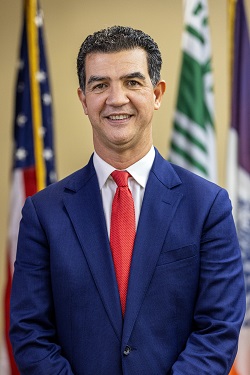
 Portrait of NYC DOT Commissioner Ydanis Rodriguez. He is wearing a blue suit with a white shirt and red tie.


NY Post 

City Transportation Commissioner Ydanis Rodriguez shamelessly exploited a visit to the scene of a deadly Staten Island crash to tout unrelated local new bike lanes Monday and should apologize, a local pol says.

“Our DOT commissioner just showed up for a photo op at the site of last night’s horrific accident, which tragically claimed the lives of three teenagers, to announce that DOT will be installing bike lanes and turning lanes over a half a mile away,” City Councilman Joe Borelli (R-South Shore) fumed in a Facebook post.

Borelli blasted Rodriguez’s visit as nothing but “shameless exploitation” and accused him of staging “a photo up” over the controversial planned bike lanes on Hylan Boulevard between Satterlee Street and Page Avenue.

Borelli said the bike-lane proposal, which the city Department of Transportation unveiled in June, “was strongly opposed by the community board, elected officials, and residents in community surveys.”

He noted that there are already bike lanes at the intersection where teenage siblings Fernanda Gil and Jesie Gil and 15-year-old pal Ashley Rodriguez died when the car they were in collided with another vehicle Sunday night. 

The accident had nothing to do with bicycles.

“This is the most shameless exploitation I have ever seen by a city official to push through an unpopular agenda he had long sought to see through,” Borelli wrote.

“In other words, when he heard of this accident, he decided it was a good moment to push more miles of bike lanes. He should resign.”


Sunday, January 9, 2022

This is deBlastopia


 Impunity City

 The Blaz era is finally and mercifully over but his contribution to the New Bad Days will go down in history as the greatest regression of New York City in 50 years and will surely continue to plague this town for years to come.


Sunday, July 4, 2021

New Bad Days: The Boroughs Are Bleeding


Impunity City

 New Yorkers are vaccinated in record numbers. The Summer of NYC is here; there’s no better time to visit, and we’ll continue to cheer on our city’s recovery”

                                                        Deputy Press Secretary for Bill de Blasio, Mitch Schwartz

Here we go again, Mitch. Stupid asshole.

 In Mount Eden, a man chased another man with a gun on the sidewalk in a gang related attack. While being goaded by his fellow gangbangers to slay him in broad daylight, the gunman’s target ran directly into a 13-year-old girl and a 5-year-old boy as they were about to enter a bodega to buy candy as he tried to find a place to hide and then he fell on top of them, causing them to fall on the pavement with him. Then the gunman circled around and stood over the man and the two kids and shot at him 12 times while trying to shoot around the children as if he was doing heart surgery. Then he ran away and got on the back of a scooter and rode away with an accomplice after he emptied his clip. The gangbanger managed to hit his target on both legs and plugged him on the back. The victim was brought to a hospital by his allies in a stolen car with temp plates.


In Times Square, a man with a gun ran down the sidewalk and shot at a group of men and missed, causing the bullet to ricochet off a building wall and hit a man in the arm who was standing outside of a hotel with his wife and relatives.

Because the unwitting victim is a Marine and the son of a retired military officer/intelligence official and being that it was the second shooting incident in less than a month in the Square, The Blaz and Chief Harrison wasted no time and decided to “flood the zone” with another deployment of 50 cops in the biggest and most precious tourist attraction in the world. 

Despite the bigger and redundant police presence, tourists are cognizant of the predominant crime wave and even more wary of walking on the streets in the vicinity. Although if there’s any consolation for the Blaz, some tourists seem to find the disturbing rise of violent criminal activity as a new novelty attraction.


Monday, April 5, 2021

New Bad Days 83: The Ides Of March bring more violent hate towards Asians and gun, gang and subway violence to NYC

 https://nypost.com/wp-content/uploads/sites/2/2021/03/queens-shooting-inside-apartment-building-473.jpg?quality=90&strip=all&w=915 

Impunity City

 Has de Blasio, Speaker Cojo and the NY Council fauxgressive cronies ever given the thought that the reason Rikers is making C.O.’s work triple shifts is because solitary confinement has been cancelled and the only way to tamp down violence and keep order is to keep C.O.’s on duty for every minute and second that way they can justify these new supposed progressive policies? Even though it’s clearly not working? Even Jeff Bezos lets his Amazon FFC employees go home.

And while this FUBAR management is going on at Rikers, where is the NYC Jails Commissioner? Whose conspicuous absence after de Blasio put her on medical leave following the release of a fugitive killer that’s still on the loose has made her virtually unobtainable for comment?

Thursday, December 10, 2020

Cuomo blames Staten Island, but data says something else

From AMNY:

Not for lack of political willpower, Staten Island has come to represent 25% of all COVID-19 deaths in New York City amid the second wave of the pandemic, even though the borough represents just 5% of the city's population. Governor Andrew Cuomo, during a Wednesday press conference, emphasized the political nature of this reality as a direct result of misdirection from local leaders taking opposition to guidelines from the Centers for Disease Control and Prevention, which have influenced some of the measures put in place by the state limiting dining and other activities.

Okay, now here's the actual data from NYCDOH's site as of yesterday.
Looks like a total of 20 COVID deaths per day in the entire city.
Bronx has about 3 deaths per day, Brooklyn has 4.
Manhattan has about 2 deaths per day, Queens and Staten Island have 4.

So it's been a while since I had 3rd grade math, but how does Staten Island have 1/4 of the deaths in NYC when 4/20 is not 25%?

Isn't 20 deaths a day relatively small compared to where we were back in April?

Now, let's do hospitalizations.
This doesn't really look all that skewed.

On 12/1, the city had 4088 new cases, while Staten Island had 342. This translates to ~8% of infections. Two other boroughs have roughly the same number of deaths that SI does but a lot more cases. If the death rate on SI is worse than anywhere else, the reasons probably have more to do with the overall health of the population and the quality of the care there than "if only they had worn masks!"

So, why are you reading all of this here rather than in the paid media who investigates nothing Cuomo says?

Tuesday, April 14, 2020

10,000 again in corrected tally by the city of coronavirus caused deaths in the five boroughs


NY Daily News

More than 10,000 people have died in New York City due to coronavirus, under a revised count that factors in “probable” cases that were previously excluded from the grim toll, the Health Department revealed Tuesday.

The new count includes 6,589 deaths of people who had tested positive for COVID-19, along with 3,778 individuals whose death certificates listed the virus as their cause of death even though there was no known test for them — making a total of 10,367 deaths as of Monday.

The mayor’s office did not immediately answer a request for comment about the revised numbers, which came as the city has struggled to disseminate vital information about the outbreak.

At a Tuesday morning press conference, Mayor de Blasio said some newly available data suggested potential improvement in the devastating outbreak.

City hospitals admitted 326 patients with suspected coronavirus symptoms on Sunday, down from 383 the day before, de Blasio said.

But there was a slight uptick in people sent to intensive care, and a higher percentage of people tested positive for the dreaded virus — 59.6% of those tested got positive results on Sunday, up from 58.1% on Saturday.

“Every day, we have to win that battle to prove that we can reduce the spread of this virus, get those indicators to go down in unison over a longer period of time,” de Blasio told reporters. “And then we'll be in a position to talk about our next steps.”

Wednesday, April 1, 2020

de Blasio's crack coronavirus squad put out another vague contagion map


The zip codes with the most cases are colored deep purple and there is a big window of the amount of cases and the tabulations don't even start at the following number (112 should be 113 and so on). Even during a crisis, the city still can't help being easily subjected to ridicule.


Update: The NY Post corrected the glaring errors and confirmed the effects the pandemic has had on lower income working class residents.

 https://thenypost.files.wordpress.com/2020/04/coronavirus-testing-nyc-zipcodes-new.jpg?quality=90&strip=all&w=915

A new city map showing confirmed coronavirus cases based on patient address by ZIP code suggests the poorest New Yorkers are being hardest hit by the pandemic.


Wealthier parts of the city, including much of Manhattan, waterfront sections of Queens and brownstone Brooklyn, have the fewest number of coronavirus cases, according to the map released by the city Department of Health.


A stark example of the wealth gap is the Rockaway section of Queens. The richest part of the peninsula that incorporates Belle Harbor where homes sell for over $1 million has at least 112 cases while Far Rockaway with its public housing complexes has up to 947 cases.


Data scientist Michael Donnelly, who’s been crunching the city’s coronavirus numbers since the start of the outbreak, noted the new map tracks with earlier MTA turnstile data.


Those maps showed ridership plummeting in Manhattan stations in mid-March, while New Yorkers from the outer reaches of the outer boroughs continued commuting.


“Over time we start to see the effect of the fact that Manhattan and the inner zip codes of Queens and Brooklyn have a lower positive rate because they were able to bend the curve before the outer boroughs,” Donnelly said.


Neighborhoods with fewer than 200 cases — like Park Slope, Brooklyn and Greenwich Village in Manhattan — count many white-collar professionals who can telecommute as residents.


“I think the clear next step there, is if that’s true, then there’s a real socio-economic inequality, inequity in the fact that these ZIP codes, which also tend to skew lower socio-economic, are also going to be the ones who are harder hit by this pandemic,” Donnelly said.

 “Broad strokes, those tend to be the wage workers, emergency service workers that are exposing themselves more and more over time,” Donnelly said.


Many front-line workers, from grocery store clerks to EMTs, live in the outer boroughs. Their jobs require them to use the subways while the majority of New Yorkers stay home.

Looks like there might be a need for a general strike to stop this contagion from spreading even more.

And at this moment as I am typing this, de Blasio's Department of Health still hasn't fixed those numerical errors.


Amazon fires worker after he organized a walkout protesting unsafe work conditions from coronavirus cases inside the warehouse

FOX News

Amazon has fired a worker at its Staten Island, N.Y., warehouse after he helped organize a walkout over the company's coronavirus responses, alleging he put others at risk.

Christian Smalls had demanded that the Jeff Bezos-led company close its Staten Island fulfillment center for a deep cleaning after a worker tested positive for COVID-19 in mid-March. Smalls, along with allegedly more than 100 workers walked off the job at approximately 12:30 p.m. Monday, the New York Post reported.

"There's 10 cases confirmed here and the media only knows about one," Smalls told the news outlet. 

"They have to shut this down. That's all we want."

“Somebody needs to be held accountable,” Smalls added in his interview with the Post. “I saw people get sick every single day. I’ve sent people home with different symptoms, dizziness, vomiting, blood-shot eyes, puffy eyes. I’ve seen it all.”

In a statement obtained by Fox News, an Amazon spokesman said Smalls was terminated because he violated several terms of his employment.

"Mr. Smalls received multiple warnings for violating social distancing guidelines and putting the safety of others at risk," the spokesman said. "He was also found to have had close contact with a diagnosed associate with a confirmed case of COVID-19 and was asked to remain home with pay for 14 days, which is a measure we’re taking at sites around the world. Despite that instruction to stay home with pay, he came onsite today, March 30, further putting the teams at risk. This is unacceptable and we have terminated his employment as a result of these multiple safety issues."

Amazon also disputed that 100 workers walked out. The spokesman said 15 people participated in the demonstration, adding that their employees are "heroes fighting for their communities."

They are calling them heroes. Like they are soldiers in a battle to fulfill prime orders.

Let's hear from an actual one.

Jacobin

Christian Smalls, from Newark, New Jersey, is a thirty-one-year-old assistant manager at the Staten Island Amazon warehouse. The facility, called JFK8, employs nearly five thousand people — and more with each passing week, as mass layoffs send workers onto the job market and Amazon puts them to work delivering packages to those staying home during the economic shutdown.

What’s going on at your workplace?

CS: It’s horrendous. Let me just start from the beginning.

Before we had any confirmed cases in my building, I had pretty much foreseen what was going to happen. I’ve been with the company five years. I opened up every major building in the Tristate — in New York, New Jersey and Connecticut. This is my third building over the course of those five years. 

I’ve been with this building since it opened almost two years ago.
So at or around the beginning of March, we had some managers that returned back from Seattle. Seattle is where Amazon has its headquarters, and it was one of the first hot spots in America for the coronavirus outbreak. One of the managers came back, and shortly after that she left because she was sick.

From that point forward, it was just a domino effect. Supervisors were calling out sick. My colleagues were calling out sick. I was sending associates home left and right because they were sick.

Three weeks ago, I took a stand and brought it up to leadership. Like, “Hey, there’s something wrong here. We need to shut this building down and quarantine everyone for two weeks with pay.” They didn’t listen. At that point, I walked out. I said, “I’m not gonna sit here and watch people get sick and y’all do nothing about it.”

I’ve been unpaid ever since, and I’ve been fighting behind scenes. I’ve been calling the health department and the CDC. I’ve sent out numerous emails to the press. I’m trying the best I can to build awareness of this situation.

So fast forward to this week, I decided to go back to work one day to see how things were shaping up, see if they made any safety changes. As soon I got there, around 8:30 in the morning, I ran into my colleague. She looked horrible. Bloodshot red eyes, all puffy. I said, “What are you doing here? You look sick.” She informed me that she went and got tested last night for the coronavirus.

I said, “Wait, you got tested for the coronavirus and they allowed you to come back in the building?” We all know you don’t get the test unless you’re showing severe symptoms. So I sent her home.
Less than an hour later, we had a small managers’ meeting and they informed us that we have one confirmed case. That wasn’t the person I’d run into, she was confirmed later. Instead it was a confirmed case of a person who had started to feel sick the week before. I found this out a little after eleven in the morning, and I was out the door by twelve. On my way out the door, I told as many people as I could to go home.

At this point, I’ve heard of at least seven people who have tested positive.


Why are sick people coming into work?


CS: Because Amazon is not offering paid sick leave. They’re offering unlimited unpaid time off, which is ridiculous because people shouldn’t be forced to sit at home without getting paid for choosing to be safe in quarantine. Since I’ve been off the job, I’ve been taking money out of my 401k just to get by. I shouldn’t have to do that.
 
The way the policy works is that you only get paid quarantine if you get tested and it comes back positive. But we know you can’t even get a test unless you’re really sick, and even then it takes a while to get the results. So you get people who are obviously sick as a dog coming into work.
 
My colleague I told you about before, she’d been to work for the last eight days in a row. There are about 150 people in that department daily. She’d been in contact with the whole entire department. I sent her home on Tuesday and she tested positive on Wednesday.
She’d been in contact with so many people, and the only person they ended up giving quarantine to was me.


Wait, you haven’t tested positive for the virus. Why did they quarantine you?


CS: Because I’m being rebellious right now. I’ve been coming to the building, bringing groups of ten or twenty people to the general manager’s office to voice our concerns. They decided to cut off the head of the snake. They quarantined me as of yesterday. So I’m getting paid now, but I don’t even care about the money. At this point I’m just trying to organize. I’m just doing what I feel is right.


I’m looking at a quote from an Amazon spokesperson who says, “We are following all guidelines from local health officials and are taking extreme measures to ensure the safety of employees at our site.” Is that true?


CS: That’s absolutely false. These spokespeople that they have talking to the press are sugarcoating everything. They don’t know a damn thing about what’s going on in these buildings. They’re even downplaying the number of positive cases confirmed.
 
Everything the company is doing is reactive, not proactive. The tables were still together two weeks ago. They just started separating them when I brought it up to their attention. Now they want to start taking temperatures at the door. The virus has been in the building for weeks, and now you want to take temperatures?
 
What is the purpose? What is it that we’re doing that’s worth the risk? Jeff Bezos is saying we’re like the Red Cross, but we still have a large amount of inventory that is being sold to the public that is non-essential. Even on essential items, if we’re all carrying the virus while we’re handling all these packages, I’m not really sure we’re helping people. We’re touching metal, plastic, and cardboard all day long, all things we know the virus can survive on, and shipping out packages to thousands and thousands of people.
 
Jeff Bezos says we’re helping the community. We’re keeping business going, but that’s all. We’re putting our lives on the line for that. My job description says have a high school diploma and lift fifty pounds. It doesn’t say risk my life working during a pandemic.
 
I always thought Jeff Bezos was a good CEO up until this point. He dropped the ball. These Amazon buildings need to be shut down immediately. We have almost 5,000 people at JFK8. You do the math. If they don’t shut it down, this is the epicenter of the next coronavirus wave right here.


Saturday, March 28, 2020

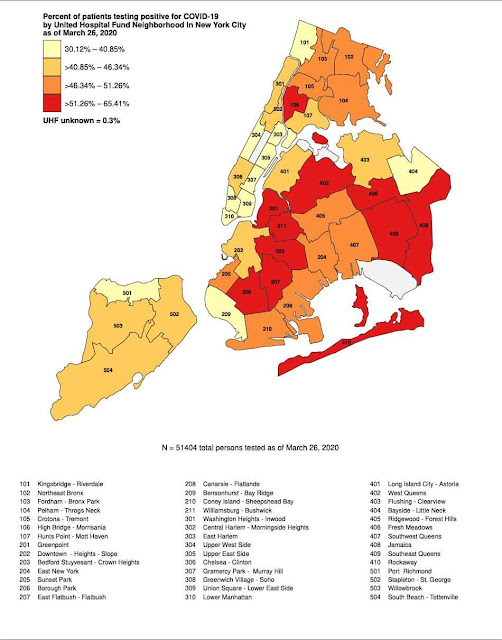
Coronavirus map shows the poorest New Yorkers are getting infected the most


https://blogger.googleusercontent.com/img/b/R29vZ2xl/AVvXsEjPBxRFRXbFwNHTKqONTGFkItpuPyceSJOlKlF4XLFe57NuK9Bxp2p1b7Au2g8GvqZIxy7Puw4J_lBF-bgpaYwIQfUVJs8JrpKv36CVDP0u4BbGyZKNeTJgGWw8KCoFSj-MzXutaPZ8pxQ/s640/covidmap.jpg


NY Daily News

A city map suggests what many New Yorkers already suspected: Coronavirus is hitting the poorest neighborhoods hardest.

The map shows the biggest share of people testing positive for the deadly virus are in a swathe of the city’s poorer neighborhoods, which stretches in a boomerang shape from central Brooklyn through Queens and out to the Rockaways.

A chunk of the South Bronx is also being slammed with more than half the patients testing positive.
Well-heeled neighborhoods like Riverdale, Bayside, Bay Ridge and most of Manhattan are faring relatively much better, with less than 40% testing positive for COVID-19.

Anti-poverty advocates say that the findings likely reflect the fact that poor and working-class people have been far less able to abide by social-distancing rules.

They are also less likely to have jobs that allow them to work remotely like better-off New Yorkers.

Friday, March 27, 2020

The five borough map of COVID-19 positive patients is out, and it's still hazardously vague


Patch

 Residents of United Hospital Fund Neighborhood zone 408 who tested positive for COVID-19 make up between 51.26 and 65.41 percent of the region's population to receive tests.
Get it? Yeah, neither do we.

The Health Department released Friday a difficult-to-interpret map of novel coronavirus cases in New York City, one day after a Wall Street Journal reporter called out Mayor Bill de Blasio for a lack of transparency.

"You have to release more detailed data on cases and deaths," Katie Honan told de Blasio. "It's negligent that you're not ... please, everyone has to get this data."

De Blasio lashed back at Honan, "If you believe it's your role to editorialize in the middle of your question, that's your right as an American."

"I don't believe that not only is it not negligent," he said. "I would say to you it's the exact opposite."

Yet less than 24 hours later, a new map appeared on the Department of Health's COVID-19 that tracks the percentage of patients testing positive by neighborhood.

Neighborhoods are designated by numbers instead of name — 408 is Jamaica, Queens, by the way — and the percentages are not connected to population data but to those tested.

The number of people tested per zone? Not included.

The population for zone? Not included.

Some New Yorkers were baffled.

"Anyone from NYC area who can parse this heat map of Covid-19?" asked Twitter user @_mzishi_.
Others were not.

"Map is pretty clear," tweeted Devin Balkind. "It's showing that the administration has no interest in transparency."

Since my role is also to editorialize, as an American I would like to say again that Bill de Blasio is a bastard. 

Tuesday, January 28, 2020

Build It Back is broke

NY1

 Last summer, several contractors told NY1 they were owed millions of dollars by the city's Hurricane Recovery Program build it back, and weren't getting paid because the program was out of money.

The city responded saying that was categorically false.

But now the de Blasio administration is doing an about face, seeking $92 million dollars to close out the beleaguered program.

"It's a shame that last year they felt the need to say everything is good when obviously it wasn't,” said Roque Schipilliti, a contractor for Build It Back.

Roque Schipilliti is one of the nearly two dozen contractors believed to be waiting for payment with debts first reported last summer by NY1.

Build It Back had blamed the late payments on the lengthy audits required before cutting final checks to contractors.

But in seeking new funds this week, Build It Back says the additional cash will be used in part, to pay contractors and close out construction permits.

"We were misled. Something wasn't right, and if there's new funding, you connect the dots. You have new funding; now you're paying. So that must have been the issue, right?" said Schipilliti.
Build It Back once hailed the rebuilding work at MaryLou Barcia's home as a success story. Mayor de Blasio visited four years ago to celebrate its completion.

But she says she's had to spend $25,000 of her own money since then to fix faulty work done under the city program,

And the contractor hired by Build It Back placed a lien on her home because he still hasn't been paid by the city.

"Where did that money go? It should have been there! Not now you're begging for money all over. That don't seem right," said Marylou Barcia, a Build It Back participant.

This isn't the first time Build It Back has asked for more money.

In 2016, the city requested and received an additional $500 million in an attempt to complete its recovery work.

That brought the total cost of the troubled program to $2.2 billion.

A little more than half of the additional $92 million needed would come from the U.S. department of housing and urban development; the rest from city taxpayers.

In addition to paying contractors, the money would be used to buy properties damaged by Sandy, and to build 37 flood-resistant homes on acquired lots in Staten Island, Brooklyn and Queens.


Sunday, December 1, 2019

Staten Island Amazon warehouse workers demand fulfillment benefits, services and safety provisions

NY Post

Workers at Amazon’s Staten Island packing facility say Jeff Bezos deserves a lump of coal in his stocking for running roughshod over them, especially during the busy holiday season.

Over a hundred Amazon workers and their supporters gathered outside the facility on Monday to protest working conditions that they say only worsen as the e-tailing giant gears up to deliver a rush of packages ahead of Christmas and Hanukkah.

The workers, who gathered outside the warehouse around 5:30 p.m., carried signs, chanted slogans and demanded a manager emerge from the building to accept a petition signed by 600 people — and addressed to Amazon chief executive Bezos, tied for richest man in the world with Bill Gates.

Their petition demands longer work breaks and more dedicated MTA buses to the far-flung facility. It also protests newly released injury data showing that the rate of worker injury at the facility is three times higher than similar warehouse work.

“It has become clear that our safety is a secondary concern in your eyes, lagging far behind line speed,” the petition said. “There are only weak plans in place to prevent more pain, more injuries, and more deaths as we enter the hardest time of the year,” the letter said.

Amazon’s eyebrow-raising injury rates at the warehouse, which opened in 2018, where released Monday by labor advocacy group Make the Road New York based on Amazon’s own submissions to the Occupational Safety and Health Administration. Among the injuries reported were sprains and strains from pushing, pulling and lifting machinery and merchandise.

And because the facility is kept at an overly warm temperature, workers sometimes pass out from overheating, said Frank Kearl, staff attorney for Make the Road.

“There are serious structural problems in the way that facility is operating,” Kearl said.

Wednesday, July 17, 2019

Three towns in Staten Island got blacked out from Con Ed substation fire

https://proxy.duckduckgo.com/iu/?u=http%3A%2F%2Ffarm4.staticflickr.com%2F3280%2F5848400383_2b256afdbd_z.jpg&f=1
NY Post


Power outages hit Staten Island Tuesday evening when a fire erupted at a Con Edison substation — just days after mass outages hit tens of thousands of customers on the West Side of Manhattan, officials said.

About 2,000 Con Edison customers in New Dorp, Grant City and Oakwood lost power after the fire at the facility on Railroad Avenue soon after 6 p.m., a Con Ed spokesperson said.

The outages are scattered across about a five-mile radius of the substation and are expected to last until about 2 a.m., the spokesperson said, adding that two generators were working to reinforce the system.

The cause of the fire is under investigation, but it is not believed to be related to the heat, he said.

Sunday, June 9, 2019

Traffic circles the city placed on intersections has not curbed speeding


PIX News

 Residents said traffic circles the city added to slow down speeding cars in their neighborhood are not working— and now they have video to prove it.

The circles along Greeley Avenue were put in to slow traffic down in 2017 after a series of bad crashes three years ago. It was done against the wishes of many community members, including the local councilman, who wanted to see stop signs instead.
 
Bill Troeller has lived on Greeley Avenue for 21 years. The incident that wrecked his car and fence was caught on video. Both drivers involved said the traffic circle both cars went though prior to the crash did nothing to slow either down.

“The guy who was hit flew into my car, knocked it back about six feet, and the other guy ended up in my front lawn,” Troeller recounted.


 Neighbor Brian Wissert said the circle effectively made turning onto the road more dangerous. 

However, most importantly, many still see cars continue to whip right around the roundabouts every day.
 
Meanwhile, the city has slowly begun using roundabout more and more to calm traffic— including in the Bronx.
 
In an open records request, the City DOT said the circles have reduced crashes by 27% along Greeley. Troeller say he hasn’t noticed a difference. He said people were out of control before the roundabouts, sometimes running into his fence then, and he said they are obviously still speeding now.

 Maybe the DOT should put stunt ramps on corners facing the intersection. Yee-haw!

Sunday, March 31, 2019

Another report on how unaffordable it is to buy a home in New York City


Patch

Many New Yorkers may dream of buying a home, whether it's a Brooklyn Heights brownstone or an almost suburban house in eastern Queens. But a new report suggests housing is unaffordable for the typical worker in all five boroughs.

In the report published Thursday, ATTOM Data Solutions crunched housing and wage numbers for 473 of the nation's more than 3,000 counties nationwide. It determined affordability by assuming a 28 percent maximum "front-end" debt-to-income ratio. That means a buyer purchasing an affordable home would not be spending more than 28 percent of their income on house payments including insurance, mortgage and property taxes.

Every New York City borough is considered unaffordable, meaning median home prices in the first quarter of this year were too expensive for average wage earners. That was the case in 71 percent of the counties that were analyzed.

 The city's highest shares of income needed to purchase a median home were seen in Brooklyn and Manhattan, where a buyer needs 115.9 and 115 percent of the average annual earnings, respectively, the report shows.

Things weren't as bad — though still pretty dismal — on Staten Island, where the costs of buying a home eats up 72.4 percent of the average annual wages of $51,337, according to the report.


ATTOM's affordability index took median home prices from public sales deed data. Average wage figures came from the U.S. Bureau of Labor Statistics. In all, 231 million people live in the counties analyzed by the company.

 Here's what the researchers found for each New York City borough.
Manhattan
  • Affordability index (Under 100 is less affordable than historic average): 76
  • Median sales price: $1,862,500
  • Year over year annualized wage growth: 6.8 percent
  • Year over year median home price growth: 33 percent
Brooklyn
  • Affordability index (Under 100 is less affordable than historic average): 92
  • Median sales price: $760,000
  • Year over year annualized wage growth: 5.8 percent
  • Year over year median home price growth: 0 percent
Queens
  • Affordability index (Under 100 is less affordable than historic average): 91
  • Median sales price: $630,000
  • Year over year annualized wage growth: 6.9 percent
  • Year over year median home price growth: 7.7 percent
The Bronx
  • Affordability index (Under 100 is less affordable than historic average): 91
  • Median sales price: $445,000
  • Year over year annualized wage growth: 5.7 percent
  • Year over year median home price growth: 11 percent
Staten Island
  • Affordability index (Under 100 is less affordable than historic average): 101
  • Median sales price: $490,000
  • Year over year annualized wage growth: 7.3 percent
  • Year over year median home price growth: 1 percent

Wednesday, October 24, 2018

The wheel no one wanted

From Curbed:

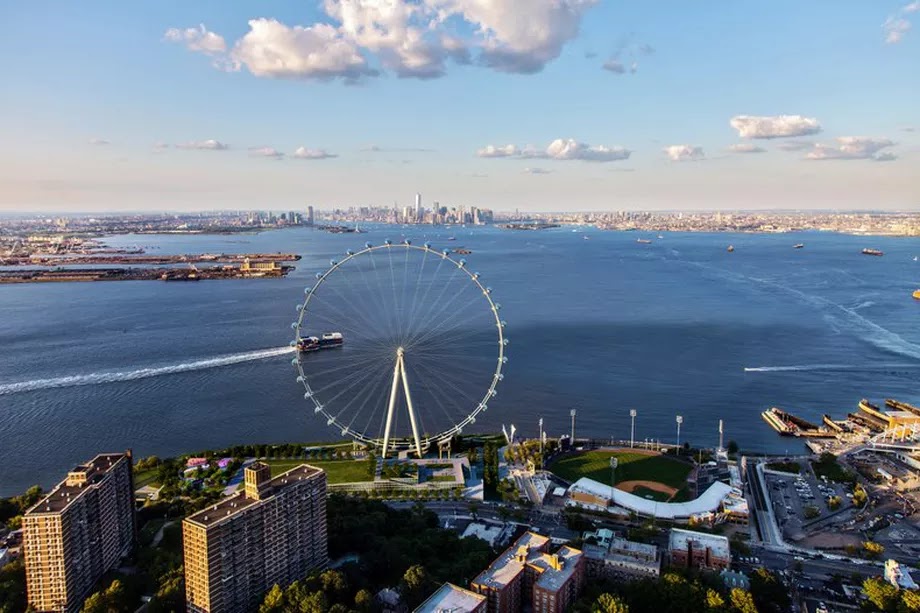
Developers behind Staten Island’s ambitious New York Wheel have officially pulled the plug on the project, ending months of speculation about its future. Staten Island Advance broke the news of the development, which is a startling turn of events for a project that was once touted to usher a renaissance for the North Shore section of Staten Island.

For over a year now, the observation wheel project has been beset by infighting, construction woes, and more recently, legal troubles. The developer, New York Wheel LLC, was battling its former contractor Mammoet-Starneth on ownership of some of the Wheel’s parts, and last month a court granted the developers an extension to hire a new contractor and show that it had enough funds to procure those parts.

However, two of the lead investors in the development—Lloyd Goldman and Jeffrey Feil—later expressed skepticism about the project moving forward without significant city funding. Both mayor de Blasio and the city’s Economic Development Corporation had previously stated that project didn’t seem like a sound investment for city funds.

Thursday, September 13, 2018

Brooklyn & Staten Island buildings collapse

From NBC 4:

Emergency crews are sifting through rubble in search of any possible victims after a wall collapse in Brooklyn, authorities say.

Fire officials got a call about the collapse at the one-story building on 39th Street in Sunset Park around 1:45 p.m. It's not clear what caused the collapse, nor was it immediately clear if anyone had been inside at the time.

Crews are searching the rubble to be sure no one was caught; the FDNY tweeted photos that showed more than a dozen firefighters at the scene.


From PIX11:

A home partially collapsed in Staten Island early Wednesday, causing neighboring homes to be evacuated, fire officials said.

Authorities received a call at about 5:13 a.m. after a three-story home partially collapsed at 109 Sherman Ave. in St. George.

The three floors collapsed onto the first floor of the vacant home, according to fire chief Phil Solimeo.

Following the incident, two neighboring houses have been evacuated, said authorities.

Sunday, August 26, 2018

Bill would require market feasibility study before hotel building


From SI Live:

After plans surfaced for two boutique hotels on Port Richmond Avenue, Senator Diane Savino (D-Staten Island/Brooklyn) has introduced legislation to combat the increasing number of hotels across the city in neighborhoods that don't have a market need.

The recent outcry against hotels planned for Port Richmond on Staten Island inspired the bill to ensure there is a need for hotels before they are approved.

"It's clear that the city has failed New Yorkers with its indiscretion when it comes to allowing hotels and motels in areas that simply don't need them," said Savino.

The main concern within the Port Richmond community is that the hotels would not generate legitimate business, instead being turned into de facto homeless shelters.

Her legislation would require business owners perform a market feasibility study to ensure that there is a need for a hotel in a specific neighborhood. If the owner can't show that there is a market for the hotel, they wouldn't receive approval to build.

Friday, February 2, 2018

Inspectors faked asbestos reports


From PIX11:

Seventeen city inspectors were arrested for allegedly exposing workers to a construction substance that can be deadly, and all for one motivation — cash.

"It’s about people putting their own financial gain ahead of the well-being and safety of New Yorkers," said Staten Island District Attorney Michael McMahon.

After two years of ground work and undercover sting operations Thursday, the Department of Investigation released their report and 17 certified asbestos inspectors were arrested.

"The going rate is between $250 and $800 per inspect," said Department of Investigation Commissioner Mark Peters. "So if you do what I think one person did, that’s a million dollars."

They worked in Queens, Staten Island and Manhattan buildings, including a hotel. In some cases they conducted no asbestos inspections at all. Other times they concealed that asbestos had been found.