
Thursday, September 19, 2024
Jay Varma: Scamdemic Wizard


Thursday, July 21, 2022
Governor Kathy Clown made Contractor Gadget a multi-millionaire

One New York City family, led by entrepreneur Charlie Tebele, has donated nearly $300,000 to Gov. Kathy Hochul’s campaign.
Records also show that since December, Tebele's company was paid $637 million in taxpayer funds to provide the state Department of Health — an agency controlled by Hochul — with at-home COVID-19 test kits. The huge expenditure was made without the agency conducting competitive bidding.
Tebele is the longtime owner of Digital Gadgets LLC, a New Jersey-based wholesaler of hoverboards and other electronic devices that sells its wares to companies like the home shopping network QVC. When the COVID-19 pandemic struck in 2020, the company pivoted to supplying medical equipment, and began landing major government contracts in New York. Though Digital Gadgets has not always delivered as promised, it has continued to reap major government payments, while the family has kept donating heavily to select politicians.
The $637 million from the Department of Health began on Dec. 30, and the agency made 239 separate payments through March 25 to Tebele's company, according to state Comptroller Tom DiNapoli's OpenBookNY website.
The website, however, provides no record of a formal contract being signed between Digital Gadgets and the Department of Health. Jennifer Freeman, a spokeswoman for DiNapoli's office, said that no such contract existed: The Department of Health entered into "purchase orders" instead with the company, she said.
"These purchase orders did not come to (DiNapoli's office) for review and approval," Freeman said.
On Nov. 26, Hochul had signed an executive order declaring a new COVID-19 state of emergency and suspending certain aspects of state finance law. The order suspended competitive bidding for certain contracts as well as the normal contract review and approval process conducted by DiNapoli's office, which oversees state government spending.
As the pandemic has subsided and surged, Hochul has
extended the executive order on a monthly basis; its current expiration
date is Aug. 13.
Sunday, July 3, 2022
Kathy Clown extends outdoor dining lifeline
Assemblymember Patricia Fahy announced that Gov. Kathy Hochul signed legislation extending the use of municipal space for outdoor dining to continue helping New York’s restaurant industry recover from the devastating effects of the COVID-19 pandemic.
Previous legislation signed in July of 2021 extended this program for one additional year. The legislation signed extends the outdoor dining program for three additional years, preventing the need for continual renewal. A survey conducted in January 2022 by the New York State restaurant industry found that 74% of operators report sales volume in 2021 was lower than it was in 2019. Additionally, 55% of restaurant operators have reduced hours of operation on days they opened and 40% are closed on days they would normally be open, limiting sales.
“Outdoor dining utilizing sidewalks and street space has become a financial lifeline for New York’s restaurants during the global COVID-19 pandemic,” said Fahy, D- Albany. “Not only has it helped hundreds of small, locally owned businesses remain in business, it’s also proved a popular boon to our local economies and ‘Main Streets.’ I was proud to sponsor this legislation to help allow those restaurants to continue utilizing outdoor spaces for another three years to help keep their doors open, and I commend Governor Hochul for signing legislation extending New York’s ‘open streets.'”
“I am so pleased the Governor signed this legislation in time for
people to enjoy dining out this summer,” said Assemblymember Carrie
Woerner. “The measure was originally intended to be a short-term assist
for restaurants in New York during the very trying previous years.
However, a happy consequence was learning that people enjoy the
transformation of busy streets into places for al fresco dining. While
the food service sector is still making adjustments to the way they
operate in the wake of the extreme disruptions of the pandemic, this
bill will give them three additional years to refine utilizing outdoors
spaces as they come back to full time operation.”
Thursday, March 24, 2022
Governor Kathy bails out Mario's son's machinators on the two year anniversary of the edict for nursing homes to treat COVID-19 patients

Gov. Kathy Hochul is seeking to spend up to $5 million in taxpayer money to pay the legal bills of dozens of current and former state employees who got caught up in the sexual harassment scandal that forced ex-Gov Andrew Cuomo from office, The Post has learned.
The move could benefit Cuomo cronies who stayed loyal to the disgraced ex-governor to the very end of his scandal-scarred tenure — including former aide Melissa DeRosa.
But DeRosa, when reached by phone Wednesday night, said, “I am not seeking reimbursement for either the nursing-homes investigation or the attorney general’s sexual-harassment investigation.”
But, she added, it was “appropriate” for the other public employees to get reimbursement for outside counsel at the advice of the state.
Hochul has been discussing the matter with Comptroller Thomas DiNapoli and Attorney General Letitia James, sources familiar with the matter said.
Sources said Hochul has been working to determine what, if any, legal avenues exist that would allow the state to cover the bills.
The governor’s office expects law firms representing about 30 current and former chamber employees to apply for any such reimbursement estimated to be up to $5 million, a source said.
Lawmakers and advocates commemorated the more than 15,000 nursing home deaths in New York amid the COVID-19 pandemic on Wednesday, as they pitched a measure to get to the bottom of the missteps made under disgraced ex-Gov. Andrew Cuomo that caused the fatalities in elder-care facilities.
During a press conference in Albany, an ideologically diverse coalition rallied behind a bill to designate March 25 as “We Care Remembrance Day,” and another to create a body tasked with studying the effects of the COVID-19 pandemic response on deaths in nursing homes.
Friday marks exactly two years since the state Department of Health under then-commissioner Howard Zucker implemented a directive that required nursing homes to readmit residents who tested positive for the coronavirus.
“It wasn’t just an executive order — it was a declaration of eldercide in the state of New York,” charged Assemblyman Ron Kim (D-Queens), a fierce Cuomo critic whose uncle died in April 2020 of COVID-19 in a Flushing nursing home.
“This executive order was one of the biggest mistakes in the history of the state of New York,” Kim said.
The infamous state Department of Health order, rescinded under public pressure on May 10, 2020, forced sickened seniors into facilities housing those most vulnerable to COVID-19 and increased the death toll among residents of them, according to a New York State Bar Association report.
Thursday, March 17, 2022
de Blasio let security contract balloon at hotel shelter for inmates during the pandemic
:format(webp)/cdn.vox-cdn.com/uploads/chorus_image/image/70618144/030222_queens_homeless_hotel_1.0.jpg)
In the early months of the COVID pandemic, as the virus spread like wildfire through New York City, the de Blasio administration began placing inmates released from Rikers and state prisons into hotels.
The point was to keep them safe — and to curb the spread of the virus. But did City Hall implement adequate safeguards to protect the released inmates from non-COVID dangers?
One former inmate THE CITY spoke to alleges she was sexually assaulted in August 2020, while staying at a hotel involved in the program, the Wyndham Hotel in Fresh Meadows. She is suing Exodus Transitional Community, the nonprofit group hired by the city to administer hotel placements.
When asked by THE CITY, the Mayor’s Office of Criminal Justice (MOCJ), which oversaw the project, could not definitively identify the firm that provided security at the Wyndham as a subcontractor to Exodus. At times, MOCJ and Exodus pointed to two different firms as the security provider in 2020.
But when reached by THE CITY, executives at these two firms denied that their companies were subcontracted to provide security at the Wyndham. Under law, firms that provide security at city shelters, including hotel placements for inmates, must be properly licensed.
When THE CITY requested documentation that the firm providing security at the hotels had a proper state security guard license, MOCJ provided a license that belongs to one of the firms that denies having anything to do with the ex-inmate placement program.
Records show the no-bid contract signed by the mayor’s office with Exodus to place inmates in hotels grew from $835,000 to $55 million in just 16 months. Under the arrangement with MOCJ, Exodus was not required to report to the city crisis incidents that occurred there, including violent ones like sexual assault.
The Adams administration recently awarded Exodus another $40 million contract for “emergency reentry hotel services” that runs through June under a no-bid process. Adams’ team did not respond to THE CITY’s question about the nature of the ongoing emergency.
Upon her release from Rikers Island in June 2020, Latoya Walker, 32, was placed into a Wyndham Hotel in Fresh Meadows, one of six hotels managed by Exodus as part of the inmate release program.
There, Walker alleges, she was sexually assaulted in her room by an Exodus employee who’d been assigned to her as a caseworker. The man was ultimately arrested on sex abuse and other charges. Although the Queens district attorney later dropped the case due to delays in bringing it to trial, Walker has since filed a civil suit against Exodus that is pending.
Walker claims that from the moment she brought in the police, Exodus resisted cooperating, delaying turning over a surveillance camera tape that she says helps corroborate her accusation.
After a detective in the special victims squad was assigned to investigate, Walker said, “Exodus wouldn’t give her the tape. They wouldn’t give her information on (the caseworker)’s employment,” she told THE CITY. “I felt like Exodus was just sticking together. Every time I brought it up as something that was bothering me, they started giving me the brush off.”
The Department of Homeless Services managed a similar effort to place shelter residents in hotels to stifle the spread of COVID-19. But DHS required all providers to report every “critical incident,” such as assaults, at the hotels where the homeless were placed. The inmate hotel program had no such requirement.
Exodus’ founder, Medina, refused to answer any of THE CITY’s questions, including whether he reported Walker’s allegations to MOCJ. The mayor’s office also declined to say whether they were aware of the incident, other than to say the hotel ex-inmate program had no incident reporting requirements.
Thursday, January 6, 2022
Real estate firm and big bank swaggers back at Adams
A lawsuit has been filed in federal court challenging New York City’s sweeping mandate requiring nearly all private-sector businesses to ban unvaccinated employees from the workplace, asserting that the city’s attempt to control the coronavirus pandemic deprives tens of thousands of businesses from pursuing their livelihoods.
The lawsuit filed Tuesday contends businesses like Cornerstone Realty, a Staten Island real estate firm that is the only named plaintiff in the case, are being unduly forced to fire unvaccinated workers and asserts the city’s vaccination edict lacks mechanisms for businesses to appeal.
“This case is not about vaccines, but about an employer’s right to be heard,” the lawsuit states.
The edict was one of two-term Mayor Bill de Blasio’s final acts before relinquishing his office at the end of the year. He set a Dec. 27 deadline for virtually all private sector businesses — roughly 184,000 businesses that employ hundreds of thousands of people — to require workers to show proof that they have received at least one dose of a COVID-19 vaccine. Businesses face fines of at least $1,000 for noncompliance.
The city’s new mayor, Eric Adams, has been in his job for less than a week but must immediately confront myriad challenges posed by COVID-19, including the latest surge that has spiked the number of infections to record levels.
It remains to be seen how Adams will respond to those challenges and what measures put in place by his predecessor he might keep or jettison as he formulates his own pandemic policies. Before taking office, Adams affirmed his support for the vaccine mandate, as well as de Blasio’s insistence on keeping schools open.
While acknowledging the turmoil the pandemic has wrought on small businesses, Adams made no mention of the mandate in his remarks during a visit Tuesday to a struggling small business in Manhattan, where he signed an executive order that he said would “slash red tape, reduce needless fines and penalties,” and would “bring relief to our heartbroken entrepreneurs.”
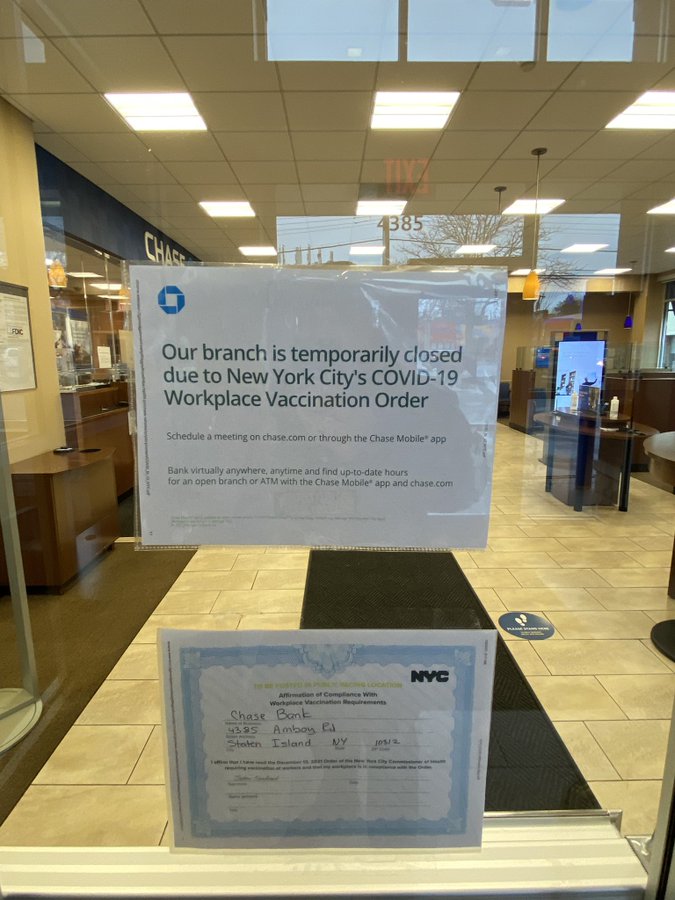
Chase Bank has shuttered more than three dozen branches in the Big Apple as the mega-bank struggles with staff shortages and vaccine mandates amid a surge in Omicron.
While the COVID variant has shelved many JP Morgan Chase employees, at least one local pol blamed the bank closures on “prohibitive” city and state mandates that require private-sector workers to be vaccinated before they can show up for a day at the office.
“It doesn’t give business an opportunity to open the front door,” City Councilman Joe Borelli, a Staten Island Republican, told The Post.
“If we want to re-populate our offices in New York, this mandate is a prohibition on many of those people coming back,” Borelli said.
Borelli also took to Twitter Wednesday to make his point, posting a photo of the laminated signs that adorn many closed branches.
“I don’t think the mandates are working in #nyc,” he wrote.
“Our branch is temporarily closed due to New York City’s COVID-19 Workplace Vaccination Order,” the sign on the door of one branch reads.
Friday, December 10, 2021
de Blasio's pay to play and pandemic secrets and lies
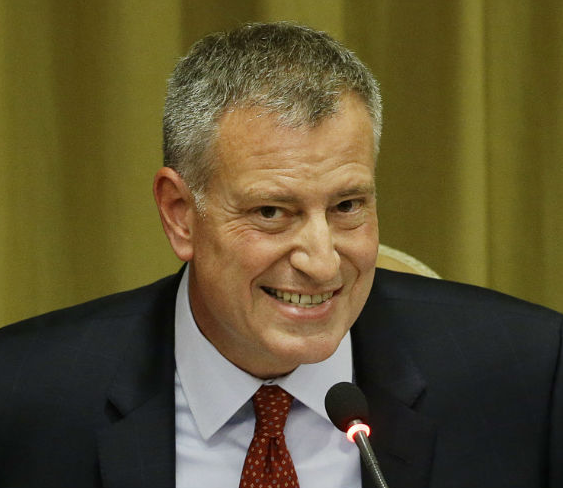
Mayor Bill de Blasio violated ethics rules twice by hitting up real estate industry players for donations to a nonprofit he created to boost pet projects, a city board found — but he got away with just warning letters.
City Hall released the two letters Wednesday from the Conflicts of Interest Board, dating from 2014 and 2018, after losing a protracted legal battle with The New York Times to shield the missives from public view.
It was a Department of Investigation report obtained by THE CITY in April 2019 that initially revealed the mayor had solicited funds from donors who had business pending with his administration.
The ethics letters concern the Campaign for One New York, a group that raised over $4 million between 2014 and 2016 to tout such initiatives as pre-K and affordable housing — and promote de Blasio himself as he sought to influence the 2016 Democratic presidential primary.
The records reveal for the first time that the conflicts board cited de Blasio just six months into his administration, in July 2014, for violating ethics rules by personally soliciting $150,000 in donations from people or entities with business before the city.
Not even seven months after receiving the 2014 warning, he kept making similar fundraising calls — asking for donations from two additional developers and James Capalino, a lobbyist who had helped buoy his campaign for mayor, according to the 2018 warning letter.
Both violations occurred after the board had advised de Blasio’s campaign lawyer just after the mayor’s January 2014 inauguration that solicitations of that nature are prohibited by the city’s charter.
The conflicts board noted in 2018 that the mayor also failed to provide a disclaimer to potential donors that their donations wouldn’t influence any city decisions.
“By soliciting these three donations from firms with business pending or about to be pending before executive agencies, and providing no disclaimers, you not only disregarded the Board’s repeated written advice, but created the very appearance of coercion and improper access to you and your staff that the Board’s advice sought to help you avoid,” the September 2018 letter says.
Despite the stern wording of the letter, it concludes that because the mayor’s nonprofit was disbanded in March 2016 — and because City Council passed legislation further regulating donations to city-affiliated nonprofits — that no discipline was warranted other than the warning.
As COVID-19 ravaged New York in March 2020, officials at the city Department of Health and Mental Hygiene began plotting out where the virus was striking hardest across the five boroughs.
A map of fatalities, broken down by ZIP code, was ready to go online in the first week of April as New York neared the expected peak of deaths, according to people familiar with the matter and to emails reviewed by THE CITY.
“I think that the reality of this scenario is we need to be transparent to the highest level,” one top health department doctor wrote in an April 5, 2020, email, two days before coronavirus fatalities reached their apex.
But City Hall did not approve public release of neighborhood-level death data until May 18. New York City saw 12,923 confirmed and 3,399 probable deaths from the coronavirus between April 5 and May 18, 2020.
The emails provide a window into Mayor Bill de Blasio’s management of pandemic information in the harrowing early weeks of the COVID crisis — a glimpse revealed at a moment when his Department of Health once again demands the trust of New Yorkers as new variants, including Omicron, spread.
On Monday, the mayor announced a broad vaccine mandate for all private-sector employees — calling the move a “pre-emptive strike” against another possible wave of infections.
“We can talk about all the other tools and we will, but vaccination is the central weapon in this war against COVID,” he said.
“It’s the one thing that has worked every single time across the board on a strategic level. It’s the reason New York City is back in so many ways.”
Nearly 35,000 New Yorkers have died of COVID-19 since the first death was confirmed in early March 2020.
When New York faced its first COVID wave that spring, longtime city health department staffers believed it was vital to release information about where people were dying — even with caveats of imperfect data and a rapidly changing situation, according to people familiar with the matter and to the emails reviewed by THE CITY.
But information languished after being approved by the health department, which couldn’t publish anything without City Hall’s OK, those familiar with the matter said.
City Hall officials, though, blamed the delay in releasing the granular fatality data on a split within the health department, where, they said, some officials contended that ZIP code-level maps could create a stigma in hard-hit communities and a false sense of safety in other neighborhoods.
At that point, the virus was surging: Hundreds of New Yorkers a day were dying of COVID-19, with 815 people succumbing on April 7 — the deadliest day for the city during the pandemic’s so far 21-month toll.
Using borough-level fatality data then available, THE CITY had revealed on April 3, 2020, that Bronx residents were dying at a rate double that of the city, spurring calls for focused help and resources. When the city’s first fatality map was finally released on May 18, 2020, it showed that COVID largely slammed poor neighborhoods hardest.
Meanwhile, Dr. Oxiris Barbot, then the health commissioner, was battling behind the scenes with de Blasio over the city’s response to the unprecedented health crisis. De Blasio also clashed frequently with then-Gov. Andrew Cuomo.
Danielle Filson, a spokesperson for de Blasio, responded to THE CITY’s inquiries with a statement:
“City Hall swiftly delivered critical information to New Yorkers, and did so with accuracy and integrity,” she said. “We led the nation in our response to the pandemic — holding daily press conferences while setting up a testing and vaccine infrastructure that has kept New York City safe.”
Saturday, November 27, 2021
Governor Kathy brings the pandemic back to where it started based on speculation
 |
Here we go again.
Gov. Kathy Hochul signed an executive order Friday to postpone elective hospital surgeries — something that hasn’t been done since the worst of the initial coronavirus outbreak last year.
Hochul said she made the move to deal with staffing shortages and boost bed capacity amid an anticipated “spike” in new cases and the emergence of the new Omicron variant in South Africa. The strain is named after a letter of the Greek alphabet.
“We’ve taken extraordinary action to prevent the spread of COVID-19 and combat this pandemic. However, we continue to see warning signs of spikes this upcoming winter, and while the new Omicron variant has yet to be detected in New York State, it’s coming,” Hochul said.
“In preparation, I am announcing urgent steps today to expand hospital capacity and help ensure our hospital systems can tackle any challenges posed by the pandemic as we head into the winter months. The vaccine remains one of our greatest weapons in fighting the pandemic, and I encourage every New Yorker to get vaccinated, and get the booster if you’re fully vaccinated.”
The edict curbing non-essential surgeries will kick in for hospitals with a limited capacity — defined as at or below 10 percent of available staffed bed capacity.
The new protocols will take effect on Friday, Dec. 3, and will be re-evaluated based on the latest COVID-19 data on Jan. 15.
Maybe Kath can ask Uncle Joe to send another battleship hospital to the Intrepid dock. Maybe we'll use it this time.
Friday, November 12, 2021
World's below average borough
The U.S. economy only grew by 2 percent in the third quarter of 2021, the federal Commerce Department reported Oct. 28. The crawl marks the smallest gain in a year, when the country began its slow economic recovery from the pandemic.
Tom Grech of the Queens Chamber of Commerce doesn’t have equivalent numbers for the borough, but if he had to estimate, he’d say Queens’ margin of growth is even smaller than the country’s.
“I would think it’s below the national average,” he told the Chronicle Nov. 4. “It’s more difficult than ever to get things done in New York City and Queens. Everyone’s gone through a hellish 18 to 20 months. It’s a hard environment.”
The QCC president doesn’t expect the city to be back to “normal” until spring 2022. On a scale of one to 10 — 10 being totally recovered — Grech would put Queens at a seven.
“The thing that’s holding our companies back from doing well is the inability to hire people,” Grech continued. “There’s been an inflation in wages. It’s harder than ever for people to go back to work. Small businesses live and die on a small margin.”
He also said strict rules and regulations from even before the pandemic are hindering businesses, such as limitations on overtime. But speaking two days after Election Day, Grech said he’s been greatly encouraged by Eric Adams’ win in the mayoral race and hopes there will be an overhaul in the favor of small business owners.
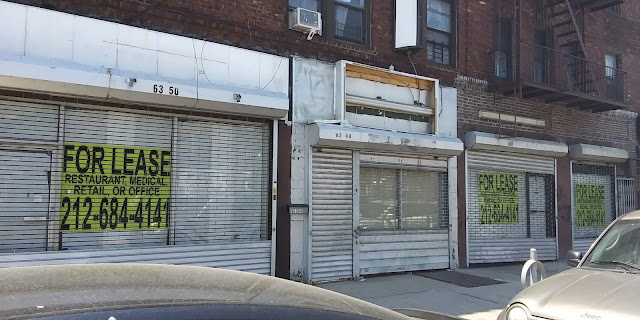
Despite the slow recovery, Grech did say there has been a great number of new businesses cropping up around the borough and filling the vacancies left behind by those that the pandemic put out of business. Last May, he had estimated that 1,000 of Queens’ 6,000 restaurants had closed for good, but he’s finding that a fair number have been replaced by new ones.
Myrtle Avenue Business Improvement District Executive Director Ted Renz places its vacancy rate at 7 percent, which is the same as it had been pre-pandemic. The Ridgewood strip lost between 25 and 30 businesses during the pandemic, most of them being retail clothing stores, he said, but gained back the same number of new businesses.
Just because the vacancy rate mirrors the BID’s pre-pandemic one does not necessarily mean Myrtle Avenue is back to normal though, Renz asserted.
Tuesday, November 2, 2021

Wednesday, October 20, 2021
Dave Chokshi's health department offices are COVID traps

About 1,000 New York City Health Department employees have signed a letter blasting the agency’s return-to-office guidelines, accusing it of failing to communicate internal COVID-19 cases and not following a “science-informed” approach, including masking and social distancing.
“It’s a huge contradiction because we’re the Health Department,” one agency worker told The Post.
“We, of all agencies, are falling short of implementing an evidence-based and science-informed return-to-office process.”
“We’re not just whiny people who want to sit at home in sweatpants on our laptops,” a second DOH employee said.
“We are all so committed and dedicated to public health, and so hardworking. But we want scientific evidence explaining why it’s safe to go back to the office.”
Their eight-page Oct. 1 letter to DOH Commissioner Dave Chokshi says the agency’s Queens headquarters lacks onsite COVID-19 testing and sufficient supplies of hand soap and sanitizer.
“We’ve continuously found hand sanitizing stations empty on the 11th floor and a lack of hand soap available at 11th-floor kitchen sinks, despite having placed several service requests,” the fed-up public health workers wrote in the letter, which was obtained by The Post.
In addition, not all employees are adhering to mask rules — and instead of having supervisors enforce them, workers are asked to “police each other,” which creates uncomfortable situations, according to the letter.
The open cubicle setting at Long Island City headquarters also doesn’t allow for social distancing because desks are closer than six feet apart, a third DOH worker told The Post.
The letter requests agency officials “regularly provide information about our actual risks at the worksite, based on available evidence,” including the number of staff infected with COVID-19 and the “date of diagnosis at different DOHMH worksites.”
“Be transparent with actual details on airflow, expected transmission rate in our workplace settings, the rationale for removing the physical distancing requirement, and why it is considered safe to have us eat at our desks,” it says.
The exasperated agency workers also want to know why the commissioner didn’t question the mayor’s decision to force all 300,000 city workers back to their desks full-time starting Sept. 13 if it isn’t safe.
They note that Chokshi told them during an internal town hall meeting in August that productivity hadn’t suffered from remote work during the pandemic — despite the mayor saying that municipal workers don’t get as much done at home.
The Health Department has led the city’s response to the pandemic that’s sickened over 1 million New Yorkers and killed nearly 35,000 residents.
This exchange during a very overlooked zoom briefing about the Key to NYC revealed DOH officials flouting these guidelines.
Here's some more proof of @NYCHealthCommr's negligence and dereliction. During a #KeyToNYC zoom hearing, a citizen asked about the DOH officials flaunting of pandemic guidelines and the DOH rep suddenly bailed and the @NYCDoITT commish disregarded it and said it was irrelevant pic.twitter.com/yipNCVbOcX
— This is JQ LLC (@ImpunityCity) October 20, 2021
Governor Kathy's ethics czar is fine with Cuomo's pandemic profiteering

Martin Levine, JCOPE’s deputy general and then co-executive director, last year approved Cuomo’s profit-making book contract.
Cuomo agreed that state government resources would not be used to prepare the book under the ethics agreement with JCOPE.
“I move to void the opinion of the deputy general counsel [Martin Levine] acting in the capacity as acting co-executive director approving Gov. Cuomo’s publishing activity on the ground that there was a failure of required concurrence by the other acting co-executive director,” Lavine, who was appointed by Senate Minority Leader Rob Ortt (R-Lockport).
Lavine was referring to Monica Stamm, the legal counsel, who was then the co-executive director because CEO executive director Setha Agata resigned.
An amendment to the motion said the book deal was approved based on “material facts that were omitted” or “misrepresentations.”
The defeated motion also would have given Cuomo, who is no longer in office, 20 days to re-apply for JCOPE’s blessing.
JCOPE last month also voted to allow Cuomo to keep the profits from his book, “American Crisis: Leadership Lessons from the COVID-19 Pandemic.”
Sunday, September 26, 2021
Thursday, September 2, 2021
The blowback blight and anarchy from NYC's Open Restaurants Law
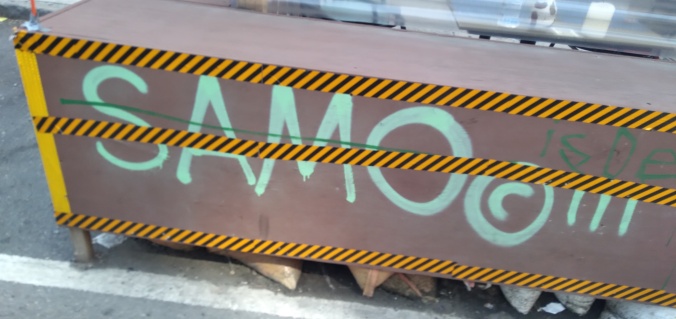
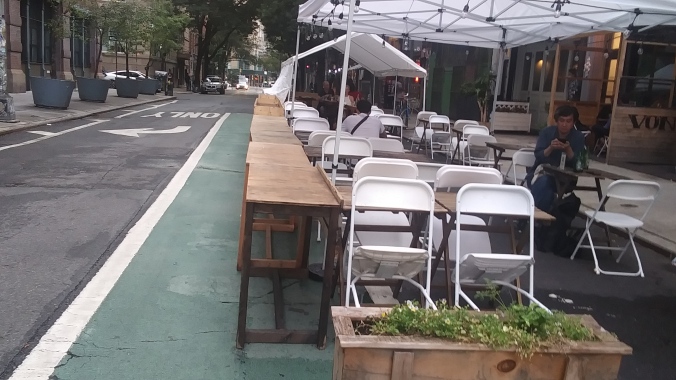
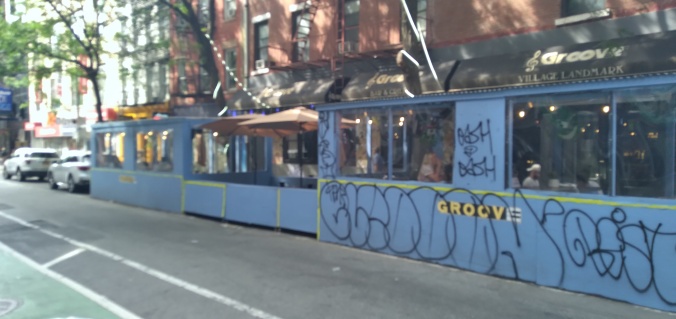
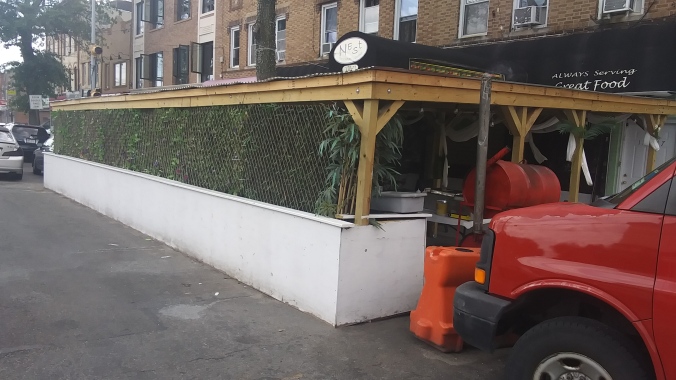
Since eating indoors was still a major risk of contagion for months on end last year, City Council and Mayor de Blasio addressed the existential threat the virus had on the dining and drinking industry and started the Open Restaurants initiative which lifted restrictions and eased regulations for restaurants to build sheds on the street curbs so patrons can come back and dine again outside of their establishments. Despite usurping parking spaces from residents, these businesses were able to recoup some losses and were able to make money again. The city also integrated this program with the Open Streets initiative to “re-imagine” public streets initially centered on cycling and pedestrian commuting by evolving them to plazas with the intent to foster community activity and keeping vehicular traffic out (both initiatives annoyingly prodded by bike zealot/car abolitionist lobby Transportation Alternatives). With the sheds on the asphalt, restaurants were able to extend their businesses by placing tables on the street, enabling to serve more customers. At the time it was logical and necessary.
Even though this was enacted for emergency purposes to keep businesses thriving in a still near dead city (with more prodding from agent of the city TransAlt weaponizing this program to banish cars) the City Council Cronies and The Blaz decided to make restaurant outdoor sheds permanent, which was buoyed by a bill written by the State Senate and signed by Mario’s Son Governor Cuomo. Now even though restaurants are under the regulatory purview of the Department of Health, the Blaz left the responsibility of monitoring the street sheds under the Department Of Buildings. If this isn’t bizarre enough, the Department of Transportation seems are wholly left out of this even though the streets are officially under their purview. And as expected with the Blaz and the Council Cronies, they conjure these laws without considering the ramifications of them as some restaurants and even non-food related establishments opportunistically took advantage of the bureaucratic fugazi of NYC’s Open Restaurants and Streets policy.




Monday, August 16, 2021
Tuesday, July 20, 2021
The Blaz goes full anti-mask

Mayor de Blasio balked at the idea of reinstating an indoor face mask mandate in the city on Monday even though COVID-19 infections are ticking back up. Instead, he called for more vaccination efforts throughout the five boroughs.
“Masks have value, unquestionably, but masks are not going at the root of the problem. Vaccination is,” the mayor said during a live-streamed press briefing. “So we do not intend a mask mandate. We do intend to double down on vaccination.”
Over the weekend, some local public health experts and lawmakers began calling for a resumption of indoor mask wearing for all New Yorkers — regardless of vaccination status — citing a slow but steady rise in coronavirus infections driven by the Delta variant.
But de Blasio said in his briefing that it would be “a disservice” to heed those calls and argued all focus should instead be on boosting vaccinations.
“Let’s address the problem by getting more people vaccinated and going right at it, and knocking down this variant,” he said from City Hall. “You know, a mask doesn’t arrest the progress of the variant — vaccination does. So we’re gonna go where the real impact is. That’s the bottom line.”
Democratic Manhattan Councilmember Mark Levine, who chairs the City Council’s Health Committee, took issue with de Blasio’s argument and said an indoor face mask mandate could safeguard New York against a major COVID-19 outbreak while the vaccination campaign continues.
Wednesday, June 16, 2021
de Blasio is about to kick homeless people out of hotels where they were sheltered in place during the pandemic...which is still continuing

New York City Mayor Bill de Blasio said Wednesday that it is time to
move homeless residents who have been housed in hotels during the
coronavirus pandemic back to shelters, pending action from the state.
"Everything
is ready to go," de Blasio said. "Obviously, the situation is greatly
improved. All of our planning is in place. We know exactly what shelters
we are going to bring people back to. We are ready to go. What we need
is authorization from the state of New York."
When the pandemic started, the city moved more than 12,000 homeless people out of crowded shelters and into more than 60 hotels to keep them safe and socially distanced.
However, concerned neighbors have said that while the city fixed one
problem, it created another -- including huge quality of life issues in
the surrounding neighborhoods.
De Blasio said the city asked for authorization from the state on May 18 but has not yet received it.
"We
have not yet gotten that sign off from the state of New York," he said.
"Obviously given yesterdays announcement, in particular, it is time to
get that clear signoff from the state to move forward."
Taxpayers have been footing the bill of roughly $1 million per night to house the homeless.
The CDC is now calling the Delta variant, which was first detected in India, a "variant of concern."
The new label raises the profile of the variant significantly. Before, the agency marked the variant as one "of interest."
An
alarming rise in infections attributed to the strain inside the U.S. is
a warning to communities with low vaccination rates, and recent
estimates are that 10% of infections in the U.S. are caused by the Delta
variant - a more than 60% increase in this month alone.
CDC
reserves the label for variants when there is "evidence of an increase
in transmissibility, more severe disease, significant reduction in
neutralization by antibodies generated during previous infection or
vaccination, reduced effectiveness of treatments or vaccines, or
diagnostic detection failures."
The good news is that the
vaccines have been shown to be effective against the variant, but much
of the population remains ineligible for the vaccine and people who are
immunocompromised also remain at risk.
Saturday, May 29, 2021
Memorial Day parades still suspended under pandemic guidelines
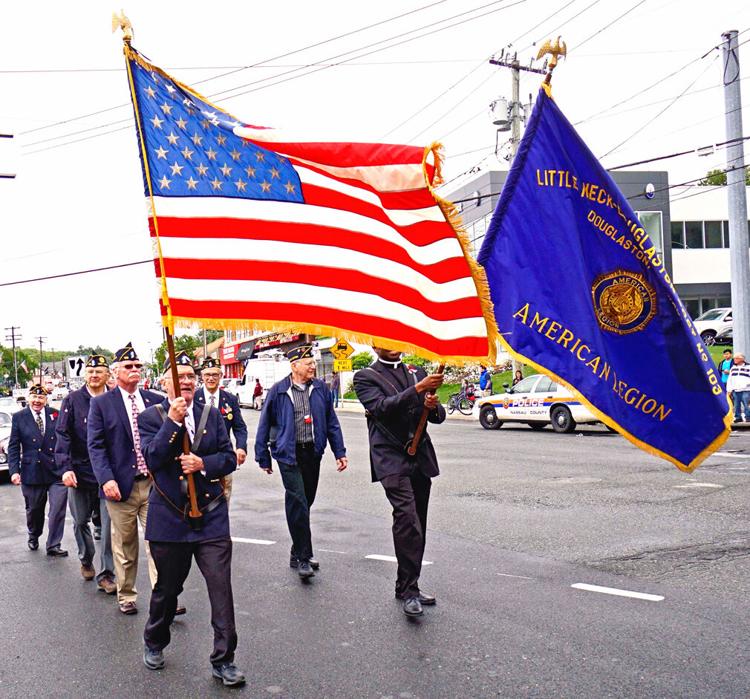
While the customary Memorial Day parades will once again be sidelined this year, residents of Queens still will honor those who have fallen in service to the country.
Bayside
The Bayside Hills Civic Association will host its annual ceremony at 9:30 a.m. on Saturday, May 29 at Bell Boulevard Mall and 53rd Avenue.
Elmhurst
The office of Queens District Attorney Melinda Katz will livestream a memorial ceremony and wreath laying from the Queens Vietnam Veterans Memorial in Elmhurst Park beginning at 11 a.m. today, May 27.
Honorees will include LTC. (Ret.) Blossom Ferguson, a veteran of Operation Desert Storm; Vietnam veteran Paul Feddern; and Mariam Sanni-Adigun of the Marine Corps Reserve who served in Operation Enduring Freedom.
The ceremony will be livestreamed at queensda.org/livestream.
Laurelton
The 32nd annual Laurelton Memorial Day Service will take place at 9:30 a.m. on Monday, May 31, at Veterans Memorial Triangle, located at 225th Street and North Conduit Avenue.
Little Neck-Douglaston
Founded in 1927 and the largest such event in the country, the Little Neck-Douglaston parade this year will be replaced on Monday, May 31, with an interfaith service at 10 a.m. at Little Neck Community Church, located at 46-16 Little Neck Parkway.
It will be followed by a wreath-laying ceremony at St. Anastasia’s parking lot at the corner of Northern Boulevard and Alameda Avenue.
Information for those who cannot attend the ceremonies in person but would like to view them via Zoom is available online on the parade’s official website at lndmemorialday.org.
Maspeth
The United Veterans and Fraternal Organizations of Maspeth will lay wreaths at four sites on Saturday, May 29, beginning at 10 a.m. at the Queens Vietnam Veterans Memorial at 79th Street and Grand Avenue.
Participants will proceed to the Garlinge Memorial Triangle at 72nd Place and Grand Avenue; Maspeth Memorial Square at 69th Street and Grand Avenue near Maspeth Federal Savings; and Mount Olivet Cemetery at 6540 Grand Ave.
Forest Hills
American Legion Continental Post #1424 will have its annual memorial ceremony at noon on Sunday, May 30 at Remsen Cemetery on Trotting Course Lane, where members of the Remsen family who were killed in the Revolutionary War now rest.
College Point
The College Point Memorial Day Parade Committee will host a car parade beginning at 2 p.m. on Sunday, May 30.
The lineup will begin at 1:30 p.m. on 28th Avenue between College Point Boulevard and Ulmer Street, near the Police Academy. The caravan then will proceed to Hermon A. MacNeil Park on Poppenhusen Avenue.
Queens Village
American Legion Post 301 and the Queens Village Civic Association will have a wreath -aying ceremony at 11 a.m. on Monday, May 31 at Veteran Plaza at the intersection of Jamaica Avenue and Springfield Boulevard.
Rosedale
The Rosedale Civic Association will host a memorial service at 12:30 p.m. on Monday, May 31, at the Veterans and Vietnam Veterans memorial monuments, which are located at separate sites at the intersection of Francis Lewis Boulevard and Sunrise Highway.
VVA Chapter 32
Members of Vietnam Veterans of America Chapter 32 will visit three monuments to their fallen brethren on Sunday, May 30.
The first will be at 9:30 a.m. at Nine Heroes Plaza located at Broadway, 41st Avenue and 76th Street in Elmhurst.
That will be followed at 10:15 a.m. at 57th Street and Woodside Avenue in Woodside near St. Sebastian’s Church. The final stop will be at the memorial on 108th Street in Corona near the Long Island Expressway.
Chapter 32 also will be participating in District Attorney Katz’s ceremony in Elmhurst on May 27.
Whitestone
Whitestone will host a ceremony at 11 a.m. on Monday, May 31 at Veterans Field at Harvey Park, located at 15th Drive and 149th Street.
Thursday, April 29, 2021
Corona residents can't find the spare time or a convenient place to get vaccines

The New York City where the streets buzz with people enjoying freedoms newly found after the COVID vaccine is worlds away from the exhausted streets of Corona, Queens, a year after the coronavirus first devastated the neighborhood.
Corona’s streets are crowded, too — but largely with vendors selling what they can to survive, music blaring to compete with the roar of No. 7 trains passing overhead along Roosevelt Avenue.
Fewer people are vaccinated here than almost anywhere else in the city — a pattern driven not by reluctance, say neighborhood health providers, but the inability of many people to break from the grind to get the shots.
Below the 103 Street-Corona Plaza station, dozens of vendors gather daily to sell tacos, grilled meats, elotes, masks, artisanal jewelry, fruits and vegetables along the sidewalk. At the center of the plaza, a COVID testing van promises quick results.
The plaza didn’t always look like this, locals say.
Pre-pandemic, about a dozen or so vendors plied food and wares and around Corona Plaza, said Carina Kaufman-Guttierez, the deputy director of the advocacy group the Street Vendor Project. That number has ballooned to nearly 90 vendors who rotate in and out of the area, many of them newcomers who lost their jobs because of the pandemic and are working without a highly coveted and difficult to obtain permit.
Among them: Liliana Sánchez, who lost her job last spring when the Upper West Side restaurant where she worked closed. The 35-year-old began selling freshly squeezed orange juice starting at dawn in Corona Plaza last May, with her 11- and 13-year old children in tow.
“When this neighborhood had the most infections we didn’t leave the house for almost two months,” Sánchez told THE CITY in Spanish. “But then our savings ran out. It’s difficult to remember that — our savings were finished.”
“We didn’t have food in our house,” she added as tears welled in her eyes, fogging her glasses. “We had to stand on lines for hours and hours at food pantries. We waited on line at a church pantry that was 15 blocks long. Not everyone was going to get food and we would get whatever we could because there wasn’t any other recourse— there is no work.”
“I had to do it for my kids. I would go looking for food but there wasn’t enough.”
Wednesday, April 28, 2021
Liquor in the front, face masks in the rear

Governor Andrew Cuomo announced on Wednesday that a pair of pandemic restrictions affecting New York restaurants and bars will end next month: the midnight food and beverage curfew will be lifted for outdoor dining beginning May 17th and for indoor dining beginning May 31st. In addition, seating at bars will be allowed again in NYC starting May 3rd.
Cuomo said in a statement that this was a result of New Yorkers getting vaccinated and complying with pandemic guidelines.
"Everything we've been doing is working—all the arrows are pointing in the right direction and now we're able to increase economic activity even more," Cuomo said. "Lifting these restrictions for restaurants, bars and catering companies will allow these businesses that have been devastated by the pandemic to begin to recover as we return to a new normal in a post-pandemic world."
Cuomo also announced that the 1 a.m. curfew for catered events (where attendees have provided proof of vaccination status or a recent negative COVID-19 test result) will be lifted beginning May 17th, with the curfew for all catered events set to be lifted May 31st. Catered events will also be able to resume at residences beginning May 3rd.
“New York City’s restaurants and bars have been financially devastated by COVID-19 restrictions and it’s great news that the state will finally undo the barstool ban and lift the arbitrary midnight curfew," said Andrew Rigie, the executive director of the NYC Hospitality Alliance. "These outdated policies made it too difficult for too many small business owners and workers to support themselves and their families, and were a grave inconvenience to customers. Lifting these restrictions is an important step forward for restaurants and bars across New York City, and we will continue working with the state to safely and completely reopen our hospitality industry, bring back jobs and sustain vital small businesses.”
That isn't all: another Cuomo executive order that required restaurants and bars to serve food with alcohol is expected to be repealed by the NY State Senate and Assembly on Wednesday.
“Good
riddance. Governor Cuomo never explained why this rule made New Yorkers
any safer from COVID-19, and it’s great to see the Legislature easing
the burden on struggling bars and restaurants. Face masks and social
distancing are what stop the spread – not chips and salsa,” said Mitch
Schwartz, spokesperson for the mayor's office.


