Showing posts with label storm. Show all posts

Saturday, September 30, 2023

Mayor Party Hardy Means Tardy

  https://lede-admin.hellgatenyc.com/wp-content/uploads/sites/43/2023/09/Adams929.jpg?w=1200&q=75

Hellgate NYC

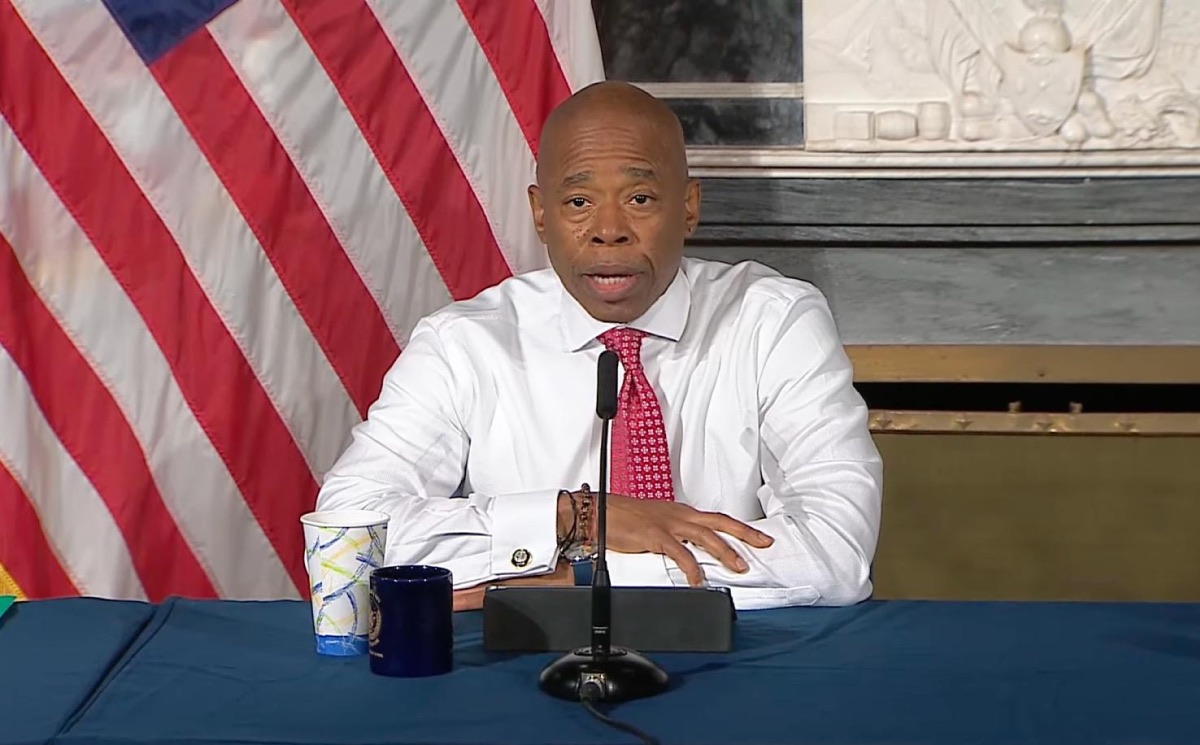
Ten hours after the National Weather Service issued a flash flood warning, five hours after the heavy rain began to fall across New York City, three hours after social media platforms began to be deluged with photos and videos of floodwaters stranding vehicles and commuters, 90 minutes after the MTA essentially told riders the trains were all too broken to be of any use, and 40 minutes after the press conference was supposed to start, Mayor Eric Adams spoke to New Yorkers for the first time about the flooding that continues to pummel the city that is under his control.

"We're ready, and you should be as well, to be prepared for this moment," Adams said.

What took him so long?

The mayor—flanked by a coffee mug and a tall paper cup, his voice sounding markedly more craggy and halting than usual (Adams had a "birthday fundraiser" in Inwood on Thursday night)—told reporters that he didn't need to be the first official to address New Yorkers about the flooding, because his deputies had already done so, in the form of sending out some Notify NYC alerts, appearing on 1010 WINS and Fox Weather on Thursday, and forwarding a press release to reporters at 11:08 p.m. on Thursday night. (Some of those deputies, including Deputy Mayor for Communications Fabien Levy, who earns an annual salary of $250,000, went even further, and snippily alerted reporters to all the alerting that had previously occurred.)

"Leadership is not only the mayor," Adams said. "It is all of those that are placed in those positions, and that is what you saw."

At the start of the presser, Adams said that he "got a firsthand look at the impact of the rainfall and what it is doing moving around the city," but later revealed that this was a little bit of serendipitous multitasking. On Friday morning, he had actually gone to a wake for a retired NYPD officer, and had driven back home through East New York, Canarsie, and Sheepshead Bay. 

Just six families had been successfully evacuated from flooded basement homes so far, according to Levy, but with two to four more inches of rain on the way, where could New Yorkers who live in basements go if their homes flooded? Where was the "higher ground" that NotifyNYC told basement apartment-dwellers to seek? The mayor didn't say, though he assured everyone that was being taken care of.

"We will have sites for those who can't go with family and friends, we will always provide shelter for those in need and we will navigate that," Adams said.

Zach Iscol, head of the mayor's Emergency Management division, assured New Yorkers they were "monitoring continuously," and "in very active response mode right now," but the evidence provided for that was simply more assurances.

"We're taking this extremely, extremely seriously," Iscol said.

For an event featuring the mayor, Governor Kathy Hochul, the head of the MTA Janno Lieber, and many leaders of City agencies, not a whole lot was revealed at this press conference. Despite the chaos on the street, everyone had convened to convince New Yorkers they were doing their jobs, and that the system is working, more or less. After the mayor thanked the governor, the governor thanked the mayor. "Mayor, you've been fantastic," Hochul said.

What about migrants staying in tent structures? No major leaks or flooding have been reported, Levy said.


Friday, August 3, 2018

Area may have been hit with a tornado


From CBS 2:

Queens residents are waking up to storm damage Friday after severe weather moved through the area.

After 10 p.m. Thursday, the National Weather Service issued a tornado warning for Queens, the Bronx and northern Nassau County and some College Point residents reported seeing funnel clouds, CBS2’s Jenna DeAngelis reported.

It’s still not clear if a tornado did in fact touch down, but severe thunderstorms did roll through the area, knocking down trees and power lines.

A two-mile stretch of College Point to Whitestone took the brunt of the damage, however there have reports elsewhere. In Jackson Heights, pictures of downed trees were taken near 86th Street and Roosevelt Avenue.

Sunday, July 15, 2018

Damaged sidewalks remain after 4 months


From CBS 2:

The huge slabs of concrete look like they belong at a construction site. Instead, the slabs are at the corner of 32nd Avenue and 168th Street in North Flushing.

Residents say the sidewalk has been destroyed since March when the city removed the trees damaged by winter storms, but never fixed the sidewalk.


Friday, January 5, 2018

Congratulations on making it through!

If you're reading this, you're still alive!

Wednesday, July 5, 2017

Hamilton Beach, Broad Channel rezoned

From the Queens Chronicle:

The City Council on June 21 unanimously approved a rezoning of Hamilton Beach and Broad Channel, which permits the construction of single-family homes on most lots in the coastal neighborhoods.

The initiatives were pushed through by Councilman Eric Ulrich (R-Ozone Park), who urged the City Planning Commission to approve the plans at its June 7 meeting — even though the panel had more time to review them.

The rezonings will take effect once signed by the City Clerk — which could happen in the coming days.

Under the rezoning, future residential developments in Hamilton Beach and Broad Channel will be limited to one-family houses, with the possibility of two-family homes only on lots wider than 40 feet in the former area.

In Broad Channel, new developments would be single-family only and the construction of community facilities with sleeping accommodations would be prohibited.

The new rules would also prohibit the construction of semidetached multifamily housing in both communities.

Larger homes are often less storm-resilient and out of character in the low-lying, shoreline neighborhoods.

Wednesday, March 15, 2017

Far Rockaway houses are a do-over


From NBC:

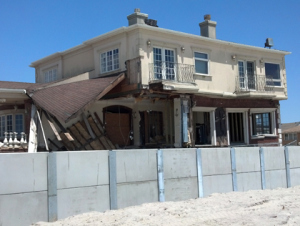
Two luxury houses under construction in Queens collapsed on Tuesday, with witnesses suggesting wind gusts from a raging Nor'easter could be to blame.

The houses were in the 700 block of Jarvis Ave in the Far Rockaway section. The FDNY tweeted that all searches were negative for injuries and the situation was under control.

Twisted metal framing and snapped wood gave testament to just how strong the wind was, with gusts of more than 40 MPH striking parts of the tri-state.

A neighbor told News 4 New York that the houses had been under construction for more than a year.

Sunday, February 16, 2014

Better park protection at Spring Creek


From the Queens Tribune:

City officials presented a project that aims to better protect Howard Beach from future weather events like Superstorm Sandy.

Representatives from the Dept. of Environmental Conservation attended last week’s Community Board 10 meeting to discuss the Spring Creek Hazard Mitigation Project for the first time.

During Sandy, flood waters from the storm’s surge engulfed coastal areas in Queens and throughout the City, including Howard Beach and Hamilton Beach.

The project would provide those areas with better storm protection by renovating Spring Creek Park, which is adjacent to 165th and 161st Avenues and 83rd and 78th Streets in Howard Beach. The renovation will boost up the inland protection for neighborhoods adjacent to residents’ homes, create a larger buffer between the park’s grassland and wetland and restore much of its natural habitat.

The DEC representatives touted the project as the first nature-based storm resiliency plan.

“There’s a whole new school of thought involving around how we use nature to protect us from future storms,” said Venetia Lannon, regional director of the DEC’s Region 2 office, which covers the five boroughs. “We have the ability to prove that at Spring Creek Park.”

Following the presentation, some CB10 members raised some concerns about the project, concentrated on how that area of Howard Beach would be affected by the project and how the “old” side of Howard Beach also needs to be protected from future storms.

Thursday, July 11, 2013

City jacking up streets of Broad Channel


From the NY Times:

“We do not care about budgets; we are taxpaying people,” said John Heaphy, 69, a lifelong resident of the area, Broad Channel, Queens, which is built on a marsh that juts into the bay. “From the lowest politician to the governor’s office, we’ve been begging, please help us.”

Now, the city is doing just that, budgeting $22 million to try to save the neighborhood by installing bulkheads and by raising streets and sidewalks by three feet.

The Broad Channel project offers a preview of the infrastructure outlays that Mayor Michael R. Bloomberg is envisioning as part of a new $20 billion plan to protect the city’s 520 miles of coast over the next decade from rising sea levels.

But the project also raises fundamental questions about whether, in an era of extreme weather, the government should come to the aid of neighborhoods that are trying to fend off inevitably rising waters.

Broad Channel’s vulnerability was exposed in October during Hurricane Sandy, which toppled homes into the bay, some of which still lie in ruins along the beach. Yet the situation here is far worse than in some other neighborhoods damaged in the hurricane because Broad Channel suffers flooding from the tides and heavy rain, not just from storm surges.

Thursday, June 20, 2013

Walls for Rockaway

From CBS New York:

Reinforcements are going up along a stretch of the Rockaways that was decimated by superstorm Sandy.

The storm barrier of more than 7,500 bags filled with 20,000 tons of sand will stretch from Beach 55th Street to Beach 149th Street when the dune construction project begins next month.

At the end of Beach 133rd Street in the Belle Harbor section of Far Rockaway, a four-foot concrete wall is already being built.

Wednesday, April 17, 2013

Hurry and develop more of Arverne before the next storm!


From Curbed:

Several competitions and exhibitions have cropped up focused on rebuilding and sustainable design in the wake of Hurricane Sandy. The latest, unveiled at the Center for Architecture today, came together in less than two months and involves a long-stalled site in a "distressed and somewhat ignored" area, in the developer's words, of the Rockaway Peninsula. The more-than-80-acre site in question, Arverne East, was designated for development by L & M Development Partners, Triangle Equities, and the Bluestone Organization seven years ago, but the financial crisis brought the plans grinding to a halt. Following the storm, the developers are ready to resume work, but the old site plan no longer applies. Instead, the developers (and a bunch of other partners listed on the competition site) are seeking input from architects, engineers, interested members of the community, and pretty much anyone else in a two phase competition. The full details and competition brief are available on the official website.

Regardless of who wins, the ultimate site plan will need to be mixed-use, sustainable, "storm-resilient," and mixed-income.


You really gotta love it when the mayor is encouraging more coastal development at the same time that the governor is paying people to leave the waterfront.

It's also interesting when the Curbed comments read like Queens Crap comments.

Monday, January 28, 2013

Stormproofing our electric system

From the Queens Courier:

If a Sandy-esque storm were to come in the future, power company Consolidated Edison (Con Ed) wants to be prepared.

The electric company recently submitted plans that detail major investments to protect “critical equipment and customers from devastating storms” like Sandy, according to a Con Ed statement.

Long-term projects such as putting flood-proof equipment in low-lying areas, building higher flood walls around facilities, reinforcing overhead equipment and putting overhead lines underground to limit outages were proposed so that in the case that the Greater New York area is struck by another storm, Con Ed customers will be that much more protected.

However, the plans do not come without a price, and Con Ed estimates that price to be about $1 billion, which could be acquired through 2016, partly through federal funding. Also, Con Ed itself has committed $250 million to spend this year and next year on storm protection measures.

To provide the remaining initial funding for this storm-protection effort, Con Ed proposed one-year delivery rates for electric, gas and steam services. This would raise a Con Ed customer’s electric bill only by 3.3 percent and gas by 1.3 percent. Due to fuel cost saving efforts, steam bills would decrease.

Wednesday, December 19, 2012

City Council introduces flood mitigation bill


From Crains:

The City Council on Tuesday proposed legislation to improve the city’s ability to withstand powerful storms like Hurricane Sandy. The package of bills would raise elevation requirements for new or substantially renovated buildings—including health care facilities—as well as boilers and other critical equipment in flood zones.

The legislation is to be introduced during the council’s main monthly meeting. A series of oversight hearings have been scheduled before more than 20 council committees over seven weeks. Substantially renovated means upgrades that amount to 50% or more of a property’s value, a City Council spokesman said.

According to a press release released by the office of council Speaker Christine Quinn, the bills would:

Study the feasibility of relocating power lines underground. The council Committee on Consumer Affairs will examine a bill that would require the mayor’s Office of Long Term Planning and Sustainability to conduct a study over the next six months on the feasibility of placing power lines underground. The study will review recent power outages in the city and include a list of areas that would most benefit by burying power lines.

Adopt new flood elevation maps. Legislation would adopt the new FEMA flood advisory maps, expected to be released this week. The maps would expand the areas that must adhere to flood-proofing requirements in the city’s building code.

Impose new flood-proofing requirements for buildings in vulnerable areas. Legislation would alter the city’s building code to raise elevation requirements for future buildings in flood zones as well as their boilers and other critical equipment. The bill would also establish more restrictive flood construction standards for buildings in coastal A-zones, which are areas that may be flooded by coastal waves.

Adopt more stringent codes for health care facilities.

Sunday, December 2, 2012

Is this in our future?


From the Daily News:

Picture an 80-foot rock barrier rising from the Atlantic Ocean, stretching for 5 miles from Breezy Point, Queens, to Sandy Hook, N.J. — and topped with a new highway.

Or a 1,700-foot wall spanning the Arthur Kill, featuring a pedestrian walkway, a bike path, hydroelectric power and a system of locks for passing ships.

Or maybe a towering structure in the shadow of the Verrazano Bridge, with the Statue of Liberty as a backdrop, complete with twin 640-foot gates.

In post-Sandy New York, plans to harness New York Harbor and its surrounding waterways with such multibillion-dollar projects almost instantly turned more tangible than theoretical.

In the search for answers, it’s now like Robert Moses is battling King Poseidon in the globally-warmed waters around the nation’s largest city.

Proponents suggest the barriers — already successful in Russia’s St. Petersburg and across the flood-prone Netherlands — could prevent a disaster repeat.

Count City Council President Christine Quinn among that group. She’s proposed a $16 billion storm surge barrier as part of a possible plan to safeguard the city.

Count Mayor Bloomberg among the skeptics. After Sandy, he noted that “you can’t build a wall up to the sky.”

But you can build one to lessen the impact the next time a hurricane hits town, engineers and experts say — and the city has already endured two in as many years.

Tuesday, November 20, 2012

Rethinking rebuilding


From NBC News:

Federal projects intended to help protect New York and New Jersey towns from hurricanes and coastal flooding have languished – many unfunded -- for decades, the I-Team has learned.

The stalled projects, often approved by Congress as far back as the 1980s and 90s, were intended to study the feasibility of manmade barriers like seawalls, marshlands or large sand dunes to protect coastal areas on Staten Island as well as the Rockaways, Long Island and the Jersey shore.

One such study, aimed at making recommendations for flood barriers along the south shore of Staten Island, remains unfinished even though it was commissioned in 1993.

The south shore of Staten Island was the scene of some of the worst damage caused by Sandy.

"This system is broken. It needs to be fixed. It needs to be overhauled,” said U.S. Rep. Michael Grimm. “Something gets approved and then it gets lost. It's almost like putting it in a bottomless pit and it never gets done."


From The Indypendent:

Sandy has triggered a public debate about how to protect the city in the future given the growing consensus that powerful storms and sea level rise are inevitable. But who will be protected? And who will pay?

Gov. Andrew Cuomo thinks New York City needs floodgates. Mayor Michael Bloomberg thinks other drastic measures have to be taken. Both of them have joined the chorus linking Sandy’s devastation with global climate change. But neither of them has suggested he would stray from government’s long tradition of protecting big real estate interests and abandoning those living at the margins, such as the tenants in the public housing projects of the Rockaways, Coney Island and Red Hook.

There needs to be a more equitable strategy going forward that forces the powerful real estate giants in Manhattan to pay the steep price of fortifying their luxury enclaves and puts public funds into protecting the most vulnerable working people.

The Cuomo and Bloomberg proposals are examples of short-term thinking dressed up in green rhetoric. They fail to look deeply at the long-term sustainability of the city. They obscure the basic questions of who benefits and who pays. If the chief beneficiaries of expensive dikes and other greening measures are downtown and waterfront property owners, why shouldn’t they foot their fair share of the bill? If the captains of the growth machine took the risk with their capital, why should government have to bail them out?

On the other hand, if the city and state administrations seriously want to address climate change, they might begin to limit development in flood-prone areas instead of promoting it. They could also put more money into preserving and retrofitting the city’s housing stock, especially public housing and homes in vulnerable areas, instead of wasting money to protect lavish new developments.


From the NY Times:

Across the nation, tens of billions of tax dollars have been spent on subsidizing coastal reconstruction in the aftermath of storms, usually with little consideration of whether it actually makes sense to keep rebuilding in disaster-prone areas. If history is any guide, a large fraction of the federal money allotted to New York, New Jersey and other states recovering from Hurricane Sandy — an amount that could exceed $30 billion — will be used the same way.

Tax money will go toward putting things back as they were, essentially duplicating the vulnerability that existed before the hurricane.


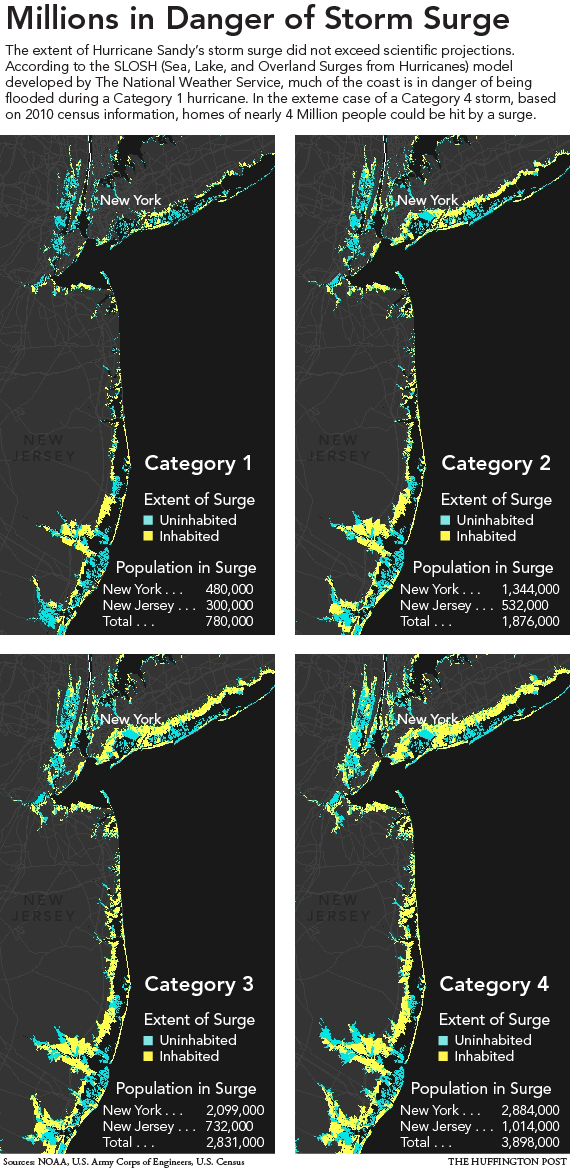
From the Huffington Post:

Given the size and power of the storm, much of the damage from the surge was inevitable. But perhaps not all. Some of the damage along low-lying coastal areas was the result of years of poor land-use decisions and the more immediate neglect of emergency preparations as Sandy gathered force, according to experts and a review of government data and independent studies.

Authorities in New York and New Jersey simply allowed heavy development of at-risk coastal areas to continue largely unabated in recent decades, even as the potential for a massive storm surge in the region became increasingly clear.

In the end, a pell-mell, decades-long rush to throw up housing and businesses along fragile and vulnerable coastlines trumped commonsense concerns about the wisdom of placing hundreds of thousands of closely huddled people in the path of potential cataclysms.


And of course we have the real estate industry's damage control piece in the NY Times:

Mr. Romski said that a heavy-duty, sophisticated drainage system, designed to handle flood surges, was instrumental in mitigating flooding. The system — which features underground chambers, wide street mains and storm drains on each house property — connects to large sewer mains that the developer installed in public streets that they rebuilt around the project site, as part of an agreement with the city, Mr. Romski said. Also helpful was a natural buffer of sand and beach grass that was maintained near the boardwalk. It also helped that much of the boardwalk in front of the project stayed intact to break the roaring surf, unlike the long stretch west of 88th Street that was obliterated.

So what he is actually saying is that they were just lucky that the boardwalk stayed intact in that section and bore the brunt of the surge. They may not be so lucky next time.

And the Daily News:

Rosemary Scanlon, dean of New York University’s Schack Institute of Real Estate, said the market will rebound.

“The fears were widespread that people would move out of New York” after 9/11, she said. “It didn’t happen.”

But buildings — especially in Zone A — will need to be constructed differently, she said. Boilers and electrical equipment may need to be moved to higher floors, generators may become standard and towers may now be built further from the shore.

“Building on the waterfront was considered to be a great idea until the storm came,” she said.

Daniel Kessler, spokesman for 350.org, a climate change awareness group, said with rising global temperatures and sea levels, building in flood-prone areas isn’t a “very smart thing to do.”


Actually, building on the waterfront was always considered risky. We were warned. We didn't listen. Zone B areas flooded as well as Zone A. Wake up, people.

Wednesday, November 7, 2012

Evacuations ordered prior to weaker impending storm


From Eyewitness News:

New York City is closing all of its parks, playgrounds and beaches starting at noon Wednesday as a weather precaution.

Mayor Michael Bloomberg made the announcement at a briefing Tuesday.

Also, hundreds of nursing home residents in New York City's storm-battered Rockaways section are being evacuated ahead of a storm expected to bring more bad weather to the region.

State and city health officials said Tuesday that three nursing homes and an adult care center in the coastal community were being emptied of residents and staff.
More than 620 people live in the four facilities. None of those nursing homes had been evacuated for Superstorm Sandy.

Wednesday's nor'easter isn't expected to be nearly as bad, but health officials say the homes are already running on emergency generators. They are worried about first responders in the neighborhood being stretched too thin.


From NY1:

State Health Commissioner Nirav Shah and City Health Commissioner Tom Farley ordered the evacuations of the 181 residents of Park Nursing Home, 91 residents of Ocean Promenade Nursing Center, 180 residents of Peninsula Center for Extended Care and Rehabilitation and 173 residents of Surfside Manor Home for Adults.

Surges of three to four feet are expected in the area, which could damage the four facilities' generators, according to the State Department of Health.

A total of six facilities in coastal Brooklyn and 19 facilities in coastal Queens have been evacuated.

Sunday, October 28, 2012

How badly will he handle this one?

From the NY Post:

Hurricane Sandy will morph into a “Frankenstorm” that will likely dump 5 inches or more of rain — and possibly snow — on the city and cause $1 billion in damage on its path up the coast, forecasters said yesterday.

Chances the Category 2 storm would shear off to the northeast into the Atlantic fell sharply as meteorologists said it was much likelier to turn northwest, into land.

That translates to a 90 percent chance the New Jersey-to-New England coast will get steady gale-force winds, heavy rain and flooding.

The hurricane last night was responsible for at least 22 deaths across the Caribbean.

Worsening the situation is that Sandy is expected to collide with an early winter storm — arctic air from the north — and create a crisis like the “Perfect Storm” of 1991, when Hurricane Grace turned into a nor’easter and killed 13 people from Oct. 26 to Halloween.

Add to that the effect of a full moon Monday and you get even higher high tides to aggravate a storm surge.

Forecasters said they couldn’t recall anything like it.


From the NY Observer:

Mayor Bloomberg and the MTA are preparing for the maelstrom that could descend upon the city should the Frankenstorm indeed become the perfect one and dump unholy mayhem on the New York in the coming days.

At a conference of transportation planners hosted by the mayor’s streets czar Janette Sadik-Khan, Mayor Bloomberg joked that the assembled wonks, who had traveled from across the country and the world to debate bike lanes and traffic signalization, that they had better beat a fast retreat.

“You want to be out of here before this big storm, which everybody is panicking about, hits us,” Mayor Bloomberg said while delivering the closing keynote speech to end the three-day conference. He said it could hit “Sunday, Monday, Tuesday or Wednesday depending on which broadcast you are tuned into, and we’ve got to decide whether to pull all the subway trains out of low-lying areas, pull the buses out. Of course you can’t evacuate people and you can’t have schools open if you can’t have buses. Or if the storm doesn’t hit, god forbid, and you’ve wasted all this money.”


Meteorologist Jim Cantore has the latest from New York City, including a statement from the NYC mayor on Hurricane Sandy's storm surge that may be inconsistent with the message from many weather experts.

Friday, August 31, 2012

Sad state of Riis Bathhouse


From the NY Times:

With its octagonal brick towers rising above the beach, the sprawling bathhouse at Jacob Riis Park in the Rockaways has, since opening in 1932, served as a monument to Art Deco design, grand public works and populist fun. Lately, however, it has become a symbol of something else: public frustration.

Renovation work began in the 1990s on the bathhouse, which is part of the federal Gateway National Recreation Area. Nearly $20 million was spent on asbestos removal, electrical upgrades, window replacements, new elevators and facade work. Politicians predicted that the bathhouse would be a fitting centerpiece of Jacob Riis Park, which is nicknamed the People’s Beach, while beachgoers envisioned cafes and souvenir shops, hot showers and community space.

But the work was never finished, and today the 40,000-square-foot bathhouse appears all but abandoned. Its large oceanfront bays are boarded up with plywood; its giant courtyard houses piles of sand, weeds and several derelict lifeguard stands, two of them toppled over.

Officials of Gateway, which is part of the National Park Service, say that the bathhouse suffered a one-two punch. First, the money meant for the restoration did not go as far as they had planned. The bathhouse complex actually comprises four buildings; while the entry pavilion on the inland side is finished, the beach pavilion still needs major work. Then came Tropical Storm Irene, which smashed a series of large doors protecting the interior — the ones now covered in plywood — and dumped four feet of sand on the ground floor.

Friday, September 2, 2011

Future storms may bring much bigger problems

From the Huffington Post:

[Jeff Masters, a meteorologist with the leading forecasting service Weather Underground] and other experts warn that the city may not be as lucky next time. As the warming climate brings higher rainfall and raises the sea level, they say, ever more pressure will fall on America's aging infrastructure.

And U.S. facilities are not ready for these stronger storms. In its most recent "report card" assessing the nation's infrastructure -- everything from the resilience of the power transmission and distribution systems to the integrity of crucial water and sewer networks -- the American Society for Civil Engineers was unequivocal: These critical facilities are often woefully underfunded, aging and in some cases nearing failure.

The organization gave the nation a grade of D overall and estimated that some $2.2 trillion over five years was needed to bring that up to a B.


Well there's your stimulus package.