Tuesday, July 19, 2022

The party's over for the Blaz


Politico 

Former Mayor Bill de Blasio is done running.

In a Tuesday tweet, the Park Slope resident — who represented the neighborhood on the City Council and served as the city public advocate before moving into Gracie Mansion — announced he was dropping out of a crowded congressional race to represent Lower Manhattan and parts of Brooklyn.

The move, he noted, also marked his end in electoral politics. De Blasio ran for president in 2019 and more recently toyed with a run for governor before launching a bid for the 10th Congressional District, an open seat created this year in the state’s chaotic redistricting process.

“It’s clear the people of #NY10 are looking for another option and I respect that,” de Blasio tweeted. “Time for me to leave electoral politics and focus on other ways to serve. I am really grateful for all the people I met, the stories I heard and the many good souls who helped out.”

Campaign adviser Neal Kwatra said in an interview that while the former mayor received great feedback while interacting with voters, public polls and internal research showed a narrow path for de Blasio to win.

“There was a cognitive dissonance with what we were seeing on the campaign trail and in the streets and what we were finding in the research,” he said.

De Blasio ended his eighth-year tenure in City Hall with low polling numbers, especially among the type of white liberals in brownstone Brooklyn that represent a key voting bloc within the 10th District.

The former mayor raised nearly $500,000 during his short-lived congressional run — with many former staffers chipping in — and as of the end of June had spent just over $60,000, leaving him sitting on a serious pot of cash. The former mayor and some of the past campaign committees he is associated with have outstanding tabs, though it was unclear if he could use any of the federal contributions to pay off those bills.

Monday, July 18, 2022

Kathy Clown and Mayor Swagger agree on Penn Station real estate land grab deal

https://assets.bwbx.io/images/users/iqjWHBFdfxIU/iTGpfcUDP0ZQ/v1/-1x-1.jpg

AP 

 A funding agreement was reached for the multibillion-dollar redevelopment of New York’s aging Penn Station, the country’s busiest rail hub.

Gov. Kathy Hochul and Mayor Eric Adams announced details of the deal Monday.

The plan would create new commercial and residential buildings around the station, with those building’s developers getting to make payments in lieu of taxes for a period of 40 to 45 years. The amount collected in excess of existing property taxes would be applied to the project.

That money would contribute more than $1 billion to pay for improvements to streets, sidewalks and other public spaces, as well as 50% of the improvements to transit infrastructure including underground concourses and subway entrances.

“This agreement brings us one step closer to a beautiful, modern station worthy of New York with vibrant open space, lively streetscapes, and better, more seamless connections to local transit,” Hochul said in a statement.

The reconstruction of the station and the first phase of the improvements to public spaces is expected to cost roughly $8 billion. Hochul’s vision is a scaled-down version of earlier plans announced by her predecessor, fellow Democrat Andrew Cuomo.

A recent study commissioned by Reinvent Albany, a state government watchdog group, estimated that the payments in lieu of taxes would amount to about $4 billion, a number that assumed a southern expansion of the station to accommodate more tracks when a new Hudson River tunnel is built several years from now. That expansion, which is in initial discussions, is projected to cost an additional $13 billion.

The plan has provoked criticism from neighborhood groups who contend it will destroy a vibrant area and displace residents and businesses.

Samuel Turvey, chairperson of RethinkNYC, a transportation and land use advocacy group, said the plan is misguided because it fails to turn Penn Station into a through-running facility where trains would pass through to other areas of the city, rather than turning around and returning to their origin or sitting in rail yards.

Turvey called the plan “a very ugly replacement theory where local residents, small businesses and historic structures are being cast to the winds with the help of the state and city.”

The Real Deal 

City and state officials have come to terms on paying for the renovation and expansion of Penn Station — some of it, anyway.

Gov. Kathy Hochul and Mayor Eric Adams announced on Monday an agreement over how the city will collect property taxes from the 18 million square feet of construction planned on sites surrounding the station.

As expected, the city will continue to collect the property taxes it receives now on the development sites, increasing by 3 percent each year. It will also get payments in lieu of taxes, or PILOTs, from the developers of each of the 10 future towers; the mechanism allows money to be directed to a specific purpose, in this case Penn Station work, rather than go into the general fund.

The property owners will not pay traditional property taxes on the increased value of the land for an extended period of time. The city will not collect the full property taxes on these sites until the agreed-upon contributions to the project are met or after 80 years, at the latest.

The PILOTs will cover 12.5 percent of the estimated $7 billion cost of renovating Penn, and of the possible expansion of the station, reportedly a $12 billion project. The payments will fully offset the cost of public realm improvements, such as street and sidewalk work, and will take care of 50 percent of the expense of transit work, including underground concourses and new subway entrances.

Adams called the deal a “win-win” for New Yorkers.

The announcement does not include many details on the expected value of the PILOTs, nor how they will be distributed between the renovation and expansion. It also does not specify how much the state expects to make from the sale of development rights in the neighborhood.

State officials released a copy of the financial framework late Monday afternoon. Opponents have complained that the project’s finances lack transparency.

Elizabeth Marcello, a research analyst with Reinvent Albany, a watchdog group that has been critical of the state’s plans for Penn, said the announcement further blurs the lines between the expansion and renovation of the station.

“There’s still a lot of glaring questions we don’t have answers to,” she said.


Boulevard from hell.

Sunday, July 17, 2022

Economic morbidity takes Manhattan

 https://thecity.brightspotcdn.com/dims4/default/a63d78c/2147483647/strip/true/crop/1674x806+0+0/resize/1674x806!/format/webp/quality/90/?url=https%3A%2F%2Fcdn.vox-cdn.com%2Fthumbor%2FA4wuVyvrKEFDZ155UWd4zGxwB1E%3D%2F0x0%3A1674x806%2F1674x806%2Ffilters%3Afocal%28837x403%3A838x404%29%2Fcdn.vox-cdn.com%2Fuploads%2Fchorus_asset%2Ffile%2F23844119%2FScreen_Shot_2022_07_14_at_7.17.00_PM.png

THE CITY

 Simply put, the rents are too damn high,” said Jason Hairston, explaining on Thursday why he’d closed his popular 14th St. eatery, The Nugget Spot, in September of 2020. 

“I was on the way,” Hairston recalled. “I had spent money on a logo and redesigning my store. I was getting ready to open another location in Columbus Circle [in the new Turnstyle Underground Market] and to be in Citifield for the 2020 season. I’d been open for seven years and I was getting ready, getting my sauce made, my flour made — things were lining up and falling into place and then we had to shut our doors.”

In a business with thin margins to begin with — and uncertainty about how long the pandemic, and the city’s shutdown, would last — “there was no way I was going to make money,” said Hairston, a lifelong New Yorker who’s now living in New Jersey while consulting for a Korean hot dog franchise.

“The only reason I would be there would be to support my landlord,” he added.

 The Nugget Spot was one of the 4,040 private establishments the city lost between the fourth quarter of 2019 and the fourth quarter of 2021, according to a new report from New York City Comptroller Brad Lander, as huge losses in Manhattan wiped out gains in Brooklyn. Over the same two-year pandemic stretch, “jobs in New York City fell by approximately 295,000, or 7 percent,” as THE CITY previously reported.

 he rare citywide drop in the number of private establishments since 2019 — including a loss of 2,023 retail locations along with 2,482 private household employers, as families let go of on-the-books nannies and maids during the pandemic — was easily the biggest recorded at least since the feds implemented their current counting system in 1990. 

Since then, the number had steadily gone up except during the recession in the early 1990s and the years just after the 9/11 attacks. 

Manhattan’s share of the city’s private establishments dropped below 50% for the first time, according to Lander’s report, as Brooklyn gained 1,267 over the same period — continuing a 30-year growth trend in which the borough has surged from 17.8% of the city’s total in 1990 to 24.4% in 2021. (The Bronx gained 109 private establishments and Staten Island eight between 2019 and 2021, while Queens lost 158.)

30,000

  https://nypost.com/wp-content/uploads/sites/2/2022/07/schoolsbudget.jpg?quality=75&strip=all

NY Post

New York City public schools are on track to lose close to 30,000 students by this fall, according to new city data.

Projections from the Office of Student Enrollment, shared with The Post Friday, showed the city Department of Education expects to enroll roughly 28,100 fewer students this fall, and another 2,300 students by the end of the school year.

The figures account for students in all geographic district schools — but do not include those enrolled in charter schools, schools for kids with disabilities, and other nontraditional public programs.

“Here’s what’s happening with the Department of Education,” Mayor Eric Adams said at an unrelated event this week.

“We have a massive hemorrhaging of students — massive hemorrhaging. We’re in a very dangerous place in the number of students that we are dropping,” he said.

By the end of next school year, the largest school district in the nation expects to serve a student population of just 760,439 children, the data show.

The second largest public school system — the Los Angeles Unified School District — enrolls over 600,000 students in kindergarten through twelfth grade, according to its website.

The DOE on Friday doubled down on School Chancellor David Banks’ focus on responding to students’ needs and making families feel heard to stem the tide.

Roughly 120,000 students have fled the public school system over the last five years, according to the DOE.

Officials also pointed to national trends of decreased enrollment, attributing that to diminished birthrates, a lack of affordability, and relocations during the pandemic.

Adding that those problems can’t be solved in half of a year, they were optimistic about plans so far and in the works to lure families back to the public school system.


City Council approves Edgemere overdevelopment


City Limits
 

 The City Council voted Thursday to rezone a 166-acre swath of Edgemere, approving a plan first proposed by the de Blasio administration that could add more than 1,200 new housing units and improve resiliency in a Queens neighborhood at severe risk of flooding.

The land use plan, part of a broader initiative known as Resilient Edgemere, encompasses the area bound by Beach 35th Street and Beach 50th Street and will change zoning rules to increase density in some areas, limit development in others and raise the shoreline along Jamaica Bay. Resilient Edgemere also includes efforts to develop housing on city-owned parcels, elevate homes, improve parks and infrastructure and designate 16 acres as open space to be used for coastal protection.

The Council specifically approved five applications submitted by the city’s Department of Housing and Preservation and Development (HPD) to amend the zoning and allow for new development with mandatory inclusionary housing (MIH) affordability rules, which force developers to cap rents on a portion of their units for low- and middle-income New Yorkers. Around 530 new units will be affordable under MIH, according to HPD, and 35 percent of those affordable units will be up for sale, not rent. The plan would further a Community Land Trust on up to eight acres of city-owned land.

Resilient Edgemere establishes two special coastal risk districts, which HPD defines as “currently at exceptional risk from flooding and may face greater risk in the future.”

Councilmember Selvena Brooks-Powers, who represents Edgemere and other neighborhoods in the eastern portion of the Rockaway Peninsula, said the changes will allow for more affordable homes in the waterfront neighborhood, while shoring up the region against rising sea levels and storm-related flooding.

“Edgemere will benefit from vital affordable homeownership opportunities, infrastructure investments and protection from a changing climate,” Brooks-Powers said. “Rockaway has seen a surge of new development in recent years, but that development has not been accompanied by a commensurate investment in local infrastructure.”

Brooks-Powers inherited the project from her predecessor, Donovan Richards, who was elected Queens borough president in 2020 and told City Limits he was pleased that the Council voted to approve the rezoning after seven years of planning and community engagement. Richards recommended the plan in his advisory role in March but urged the city to foster affordable home ownership opportunities in response to community demands.

“There is tremendous promise in the Resilient Edgemere Community Plan,” Richards said, adding that he would focus on ensuring that developers and the city adhere to local hiring and MWBE commitments.

Under the changes, which now await Mayor Eric Adams’ signature, most of the area north of Beach Channel Drive would be zoned for one- and two-family homes, while the stretch between Rockaway Beach Boulevard and Edgemere Avenue would allow for taller, mixed-used buildings. City-owned vacant land next to the Edgemere Houses would be converted to open space, as would much of the land abutting the Jamaica Bay.

In a statement following the vote, Adams hailed the plan as “an important step forward for residents of Edgemere, the Rockaways, and the entire city.”

Saturday, July 16, 2022

Progressive cat fight campaigning

https://queenspost.com/wp-content/uploads/2022/06/kristennomiki.jpg

Queens Post 


Tensions are running high between the campaigns of two progressive candidates who are both running to represent the District 59 seat in the state senate.

Nomiki Konst and Kristen Gonzalez—both left leaning candidates in the race to represent western Queens, north Brooklyn and parts of Manhattan—have been waging a war of words on social media.

Gonzalez has leveled claims that Konst is racist, while Konst has accused Gonzalez’s campaign of harassment, intimidation and inciting violence.

The animus between the two campaigns began the moment that Konst announced on June 1 that she was running.

Konst, a well-known progressive who ran for NYC public advocate in 2019, was criticized from the get-go since Gonzalez had announced months prior that she was running for state senate. Gonzalez had already received the backing of scores of high-profile progressives—including the NYC-DSA, the Working Families Party, and Rep. Alexandria Ocasio-Cortez—and that there were fears that Konst would jeopardize her campaign.

Konst faced an avalanche of criticism on Twitter when she announced.

“This is so selfish and wasteful. We have a Latina socialist running in the district who has a track record in this particular community & has a winning coalition of endorsements & she’s up against a machine hack. Don’t split the vote! And for what?!” posted Elana Levin, whose tweet got 320 likes and reflected the sentiments of DSA supporters.

Many of Gonzalez’s followers—as well as DSA members–believe that Konst’s campaign will help candidates such as Elizabeth Crowley, who is also vying for the seat, win the Aug 23 primary. Other candidates in the primary include Mike Corbett and Francoise Olivas. All five candidates have a following.

The tension heated up online on July 10, when Gonzalez took to Twitter and accused Konst of racism for “twice sarcastically saying to my face Welcome to Astoria.”

Gonzalez, who was raised in Elmhurst and is the child of Puerto Rican and Colombian parents, viewed this as a “dog whistle,” implying that she was an outsider and was without community support.

Konst, who says she has lived in Astoria since 2015 but hails from Arizona, said that she was baffled by Gonzalez’ tweets saying that she welcomed Gonzalez to Astoria on two occasions–once at a candidate forum held in the Astoria and another time at a polling site in Astoria on election day.

She said that on both occasions she didn’t speak with any ill-will and noted that she has welcomed other candidates to the neighborhood without incident.

Konst, of Greek heritage, said that when candidate forums have been held in other parts of the district candidates welcomed her there.

“This was her literally just creating controversy right before the filing so she could raise money,” Konst said. “It was personally offensive, and it was also grotesque.”

Construction site dirt mountain a hell on earth for Forest Hills residents


PIX 11 News 

 Residents of a Queens co-op building told PIX11 News it’s a neverending battle against dirt and dust. The culprit — a massive mound of dirt located on an ongoing construction site.

After six years, they said they’ve had enough.

“I want my life back,” resident Collette Smith said. “My neighbors deserve their lives back. Enough is enough.”

The construction vehicles at the site, located near the Van Wyck and Grand Central parkways, kick up debris in the yard, which causes dust to travel into nearby apartments. The residue is found on multiple surfaces throughout their homes.

“I don’t need to be breathing this stuff,” Connie Hemingway said. “I want to extend my life, not shorten it.”

Friday, July 15, 2022

Ferry barely good fare hike


THE CITY 

The base fare of the New York City Ferry will go up to $4 a ride — with new discounts for seniors and Fair Fare program participants — as the city tries to make its program financially “sustainable,” officials said. 

The hike and new pricing structure comes as the city’s Economic Development Corporation had begun pumping more tax-payer money each year into the system, which launched in 2017 under then-Mayor Bill de Blasio.

The tack change also comes a week after Comptroller Brad Lander released an audit — spurred in part on THE CITY’s reporting — that found the system spent almost double the amount it originally said on subsidies to keep it afloat.

Under the new price system, set to launch Sept. 12, the base fare of $2.75 will go up to $4.

New Yorkers over the age of 65, those with disabilities, and participants in the Fair Fares program — which offers half-priced rides within the MTA system for low-income commuters — will get a discounted price of $1.35 per ticket, officials announced. 

Public housing residents within a mile of a ferry dock will also get two free boat rides a month.

“Getting around New York City shouldn’t feel like you’re running a 5K. Wherever you live in the five boroughs, we want you to have choices, and our vision for the NYC Ferry helps provide New Yorkers with those choices,” Mayor Eric Adams said at the announcement near the Astoria dock on Thursday. 

He said his administration’s “Ferry Forward” plan would be “built on the three pillars of equity, accessibility, and fiscal sustainability.” 

The $4 base fare will “offset the cost of everyday New Yorkers who need to take the system,” Adams said. 

There will also be discounted 10-pack rides at $27.50 to retain regular commuters who ride the ferry the most.

Finally, but there's still one thing they overlooked, the free Hornblower shuttle buses that the NYC Ferry provides. How about another fare for those? 

Jamaica bus lines study is FUBAR


Queens Chronicle

The Chronicle has obtained a letter in which eight elected officials who represent Jamaica or neighboring areas call on the city Department of Transportation to end its intended year-long study of how bus lanes are affecting Jamaica Avenue.

The letter to DOT Commissioner Ydanis Rodriguez and Queens Borough Commissioner Nicole Garcia, dated July 8, says businesses are being harmed and that residents are complaining about a lack of accessibility along the popular commercial and retail shopping corridor.

It was sent on the letterhead of Queens Borough President Donovan Richards, but also was signed by Council Speaker Adrienne Adams (D-Jamaica), Councilmembers Selvena Brooks-Powers (D-Laurelton) and Nantasha Williams (D-St. Albans); state Sens. Leroy Comrie (D-St. Albans) and James Sanders Jr. (D-South Ozone Park); and Assemblymembers Alicia Hyndman (D-Springfield Gardens) and Khaleel Anderson (South Ozone Park).

“The DOT has expressed to the community the need for a year-long study to best determine the impact of the bus lanes on Jamaica Avenue,” the letter states. “However, we believe a six-month study is enough to give the DOT sufficient ability to understand the impact these bus lanes have had on businesses and everyday residents in Jamaica.”

The elected officials want the study to be concluded and the results published by the end of summer.

Numerous businesses have complained to the Chronicle since the start of the year about how the bus lanes and lack of traffic have hammered their bottom lines.

The July 8 letter’s language on that topic was diplomatic but unmistakably clear.

“Downtown Jamaica has been subject to a major transportation shift as the community has continued to grow and revitalize,” it states. “While we understand the need for improved bus service, the Jamaica Avenue bus lanes have had a significant and damaging effect on businesses along the corridor. Our offices have also received several complaints from local residents about a lack of accessibility along Jamaica Avenue.”

The signatories also would like the DOT to install signs along Jamaica Avenue with more clear and concise language to help individuals better understand the rules for things like parking, loading areas and standing zones.

The Wild Ones Redux


Queens Chronicle

Despite a push from Mayor Adams to address the ongoing issue of ATVs, dirt bikes and other unlicensed vehicles taking over the streets in packs, videos have continued to circulate and complaints to be aired, especially after this past weekend, as traffic again was thwarted by the brigades.

Councilwoman Joann Ariola (R-Ozone Park) said it has been “three Sundays of absolute terror,” as the collection of unlicensed off-roaders bombard the streets of Rockaway, Broad Channel, Howard Beach, Woodhaven, Ozone Park and even the boardwalks.

She said a combination of 300 to 500 motorcycles, ATVs, dirt bikes and more fly through at high speeds, jump curbs and terrorize neighborhoods.

And the problem, she said, affects the greater Queens County.

Their route, she said, seems to be from the Marine Parkway Bridge, along the Rockaway Peninsula, over the Cross Bay and Addabbo bridges and through Howard Beach and Woodhaven.

Videos shared to social media show the packs blatantly disregarding traffic rules and halting the flow.

Some even take to Facebook to warn others, like one user who posted in the Howard Beach Dads group on Sunday warning Howard Beach residents to stay off Cross Bay Boulevard at that time because what she said looked like over 100 ATVs and dirt bikes were “flying through and driving recklessly” in Broad Channel. She called the scene “unnerving.”

Phyllis Inserillo, co-president of the Howard Beach Lindenwood Civic Association and Ariola’s chief of staff, said she was caught in the middle of it on Sunday while trying to turn onto Cross Bay.

“I had the green light to go,” she said. “They had no care in the world. They were giving me the finger ... cursing me out like I was doing something wrong. I could not believe it.”

Then she watched as a woman leaving Cold Stone Creamery got knocked right over on the sidewalk by the motorists, launching ice cream everywhere.

At the end of June, the NYPD and Adams announced in a press conference that nearly 100 of the vehicles had been seized and were crushed and he laid out a summer plan that included appointing patrol borough inspectors to map motorbike ride-outs, hosting weekly strategy sessions, utilizing field intelligence officers to identify storage and meeting spots and analyzing 311 complaints.

Wednesday, July 13, 2022

2,000 for a frickin' studio


Queens Post

The average price paid to nab a studio in Queens in June was over $2,000 per month, with the average for a one bedroom hitting $2,500 for the first time on record, according to a new report by the real estate firm M.N.S.

The average price paid for a studio was $2,045, up 12 percent from June 2021, according to the report. The average for a one bedroom was $2,500, up 16 percent from a year earlier, and the average cost of a two bedroom was $3,322, representing a 23 percent jump year-over-year.

Rental prices increased across the borough, although they skyrocketed in Astoria, Long Island City, Forest Hills and Jamaica, the report revealed. The report did not provide a breakdown for Sunnyside or Woodside.

The average price paid to snag an apartment in Astoria last month was up 32 percent compared to June 2021. In Long Island City, the average rent was up 28 percent from 12 months prior, while in Jamaica and Forest Hills it was up 21 percent and 16 percent respectively.

In Astoria apartments of all sizes saw lofty increases — although it was most notable with the bigger units.

The average rent for a studio apartment in Astoria in June was $2,211. This figure was up 26 percent — from $1,760 — one year prior.

One-bedroom apartments in the neighborhood saw a 28 increase — with the June average being $2,553, up from $1,989 in June 2021.

The average rent to get into a two-bedroom apartment in Astoria was $3,249, up a whopping 41 percent from 12 months prior. The average two-bedroom went for $2,307 in June 2021.

The red-hot Long Island City rental market shows no signs of cooling down.

The average price paid for a studio apartment in Long Island City in June 2022 was $3,144, up 24 percent from a year ago; a one-bedroom fetched $3,970, up 31 percent from 12 months earlier; while a two-bedroom went for $5,463, up 28 percent.

Jackson Heights fire damaged apartment building was captured by the Bloods


THE CITY

Members of the Bloods gang took over a Brooklyn-based fire clean-up company, using violence and extortion to profit off damaged buildings and inferno victims, federal prosecutors allege.

Their targets included a Queens apartment building where a 2021 blaze displaced nearly 500 people in Jackson Heights. Dozens of former tenants at that address have asserted their belongings were burglarized, as reported by THE CITY in March. 

In an indictment late last month, the U.S. Attorney for the Southern District of New York alleged gang members first gained control of First Response Cleaning Corp. in 2019, and then used the company — which secures and cleans up buildings after blazes — to extort competitors and muscle the industry with violence and threats.

The fire company has worked on buildings across New York City.

Tenants there told THE CITY that residents had been barred from entering the building but later found jewelry, money and other valuables missing from their apartments when they were allowed a virtual tour via video conference. 

The owners of the Jackson Heights building, Kedex Properties, hired First Response with a $24 million contract to clean up the building, the Queens Chronicle reported last year.

Kedex did not respond to calls for comment.

While the feds in their indictment called the alleged racket a “criminal enterprise,” none of the charges include burglary or theft of items from buildings.

Andrew Sokolof Diaz, is a resident of Jackson Heights building and president of the 89th Street Tenants Unidos Association, said that First Response presented themselves as both a security company and a fire restoration company, and prevented tenants from entering their homes.

“It was just a bad vibe,” he said. “It seemed like something was going on — from the behavior with some of the tenants from just the first night. They were very harsh and menacing with us.”


Tuesday, July 12, 2022

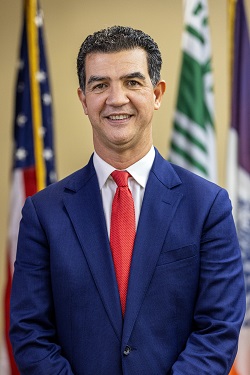
The Department of Transportation Alternatives commissioner promotes bike lanes during presser about car crash that killed 3 teenagers

 Portrait of NYC DOT Commissioner Ydanis Rodriguez. He is wearing a blue suit with a white shirt and red tie.


NY Post 

City Transportation Commissioner Ydanis Rodriguez shamelessly exploited a visit to the scene of a deadly Staten Island crash to tout unrelated local new bike lanes Monday and should apologize, a local pol says.

“Our DOT commissioner just showed up for a photo op at the site of last night’s horrific accident, which tragically claimed the lives of three teenagers, to announce that DOT will be installing bike lanes and turning lanes over a half a mile away,” City Councilman Joe Borelli (R-South Shore) fumed in a Facebook post.

Borelli blasted Rodriguez’s visit as nothing but “shameless exploitation” and accused him of staging “a photo up” over the controversial planned bike lanes on Hylan Boulevard between Satterlee Street and Page Avenue.

Borelli said the bike-lane proposal, which the city Department of Transportation unveiled in June, “was strongly opposed by the community board, elected officials, and residents in community surveys.”

He noted that there are already bike lanes at the intersection where teenage siblings Fernanda Gil and Jesie Gil and 15-year-old pal Ashley Rodriguez died when the car they were in collided with another vehicle Sunday night. 

The accident had nothing to do with bicycles.

“This is the most shameless exploitation I have ever seen by a city official to push through an unpopular agenda he had long sought to see through,” Borelli wrote.

“In other words, when he heard of this accident, he decided it was a good moment to push more miles of bike lanes. He should resign.”


Nursing home magnate buys future hotel in LIC


 The Real Deal

A hotel to become a Staybridge Suites in Long Island City now belongs to a nursing home operator who has been active in New York City dealmaking.

Centers Health Care’s Daryl Hagler bought the property at 38-59 11th Street where the unopened 240-key hotel stands for $63 million from an entity called 559 Development LLC, according to city records filed Monday.

Centers Health Care declined to comment. It wasn’t immediately clear who controls the entity that sold the property. The seller of 38-59 11th Street paid $6.2 million for the site in 2013, according to city property records.

The hotel was complete at the time of its sale, said Josh Zegen of Madison Realty Capital, which lent developer Teddy Li $46 million in 2019 to help finish the 183,000-square-foot hotel and community facility. Construction had begun in 2018.

It’s unclear when the 24-floor Staybridge Suites will open. IHG Hotels & Resorts, Staybridge’s parent company, did not comment by press time.

 Hagler has been involved in several deals across New York City in recent months. In May he purchased the nearby 100,000-square-foot former DeNobili cigar factory at 35-11 9th Street in Astoria and its 6,000-square-foot parking lot for $26.4 million from real estate investor Bruce Brickman.


Sunday, July 10, 2022

Cops shoot armed man down following his tirade against Adams and Hochul

Police on scene

NY Post 

NYPD officers shot and killed a Queens man who was threatening to kill the governor and other top officials, saying he was going to “blow up” the world Saturday evening, cops and sources said.

Police arrived at 205-17 116th Ave. in Cambria Heights shortly after 6 p.m. after they received multiple threatening 911 calls from the man, identified by sources as Raul Hardy.

Hardy, 60, said he would “change the government” by assassinating New York Gov. Kathy Hochul and the “PD Chief,” and also threatened to “blow up” the world, according to police and law enforcement sources.

“He clearly stated that he was going to blow the head off of the first police officers that he saw,” NYPD Chief of Patrol Jeffrey Maddrey said at a news conference at the scene.

“A short time later he made another 911 call and he basically reiterated the same thing.”

A large group of uniformed officers responded to the call, parked down the street and walked to Hardy’s house with guns drawn, Maddrey said.

Saturday, July 9, 2022

The Department Of Transportation Alternatives will never compromise

https://queenspost.com/wp-content/uploads/2022/07/Garcia.jpg

Queens Post

Council Member Bob Holden is calling for the firing of Queens DOT Commissioner Nicole Garcia arguing that she fails to listen to the concerns of residents and shows contempt for local civic organizations.

Holden’s call for Garcia’s ousting comes at a time when the DOT is working on installing 52 Citi Bike stations in Middle Village and Maspeth, both neighborhoods he represents.

The council member has been critical of the agency for not properly notifying his constituents about the Middle Village/Maspeth plan, and then failing to work with civic groups—such as Juniper Park Civic Association (JPCA) —in terms of where the stations should be installed.

The JPCA, which has embraced the Citi Bike expansion, has been calling on the DOT to place the stations on sidewalks—as opposed to on the street—as a means to preserve parking spaces. Christina Wilkinson, secretary of the association, put together a detailed plan as to where the proposed street stations could be moved to avoid the loss of parking.

The DOT rejected these calls last month, prompting criticism from Holden. (click for JPCA proposal and DOT response)

“Garcia’s Queens DOT shows nothing but contempt for local civic organizations in middle-class neighborhoods, particularly in their refusal to seriously consider requests regarding Citi Bike installations,” Holden said.

The councilmember argues that the Queens DOT is not sincere when it says it wants community feedback.

Holden said that many neighborhoods in Queens desperately need parking spaces and have little use for renting bicycles, including seniors, families with children and the disabled.

“Lyft’s Citi Bike agenda lacks any regard for those New Yorkers and has no interest in inclusivity. The DOT should stand up for these New Yorkers and stop doing Lyft’s bidding. One of the great things about living in New York City, particularly in Queens, is that every neighborhood has its own character. The Queens DOT denies this unique diversity by forcing a one-size fits all approach to bike stations across the city.”

He said it’s time for the Queens DOT to turn a page and advocate for its residents. He said the agency also has a history of denying requests for stop signs, speed bumps and other traffic safety measures in his district that would keep his constituents safe.

“The Queens DOT can only move our borough toward a safer future with a new commissioner who will listen to community feedback and respond swiftly to the needs of Queens taxpayers.”

Garcia’s Queens DOT makes a dog and pony show out of asking for community input and then throws it in the gutter. Lyft’s Citi Bike program continues to gobble up parking spaces badly needed by hardworking New Yorkers, like a giant corporate PAC MAN who refuses to hear the reasonable requests of middle-class neighborhoods in favor of the fanatical anti-car movement and a corporation with a vested interest in getting New Yorkers to give up owning cars.”

Swimming banned in Riis Park because of shore erosion


The Wave

Bay 1, a section of Riis Park Beach will be closed to swimming access, which is anticipated to be the case for the remainder of the season. 

“Beach erosion has created unsafe conditions along the Bay 1 waters and eastern beach, exposing deteriorating wooden groins and other structures. The exposed structures could be dangerous to swimmers. The closures will be adjusted as necessary but is anticipated to remain in place for the rest of the summer,” the National Parks Department said in a Statement. 

Bay 1, the beach closest to Neponsit, is a highly trafficked beach, and is also an NYC LBGTQ historic sight, as it is considered as a safe haven for that community.

“We want to make sure that our visitors are able to enjoy this space safely. The hazards are not always visible, especially at high tide, which is why swimming is not allowed in Bay 1,” said Jen Nersesian, Gateway superintendent. “We know how important this area is to the LGBTQ+ community of NYC and are pursuing long-term options so that this beach can be enjoyed for many summers to come.”

Sanitation ASP miracle workers


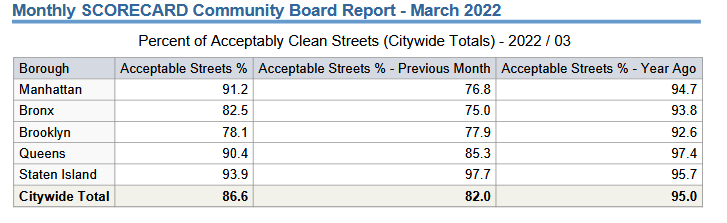
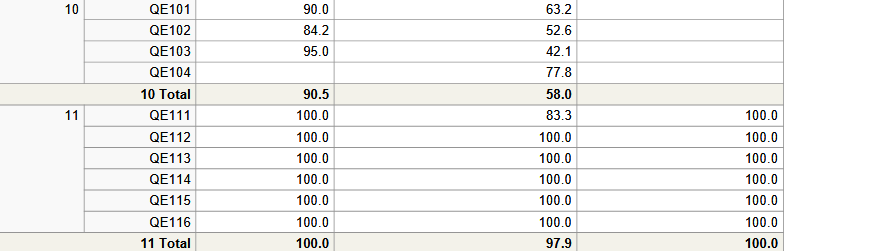
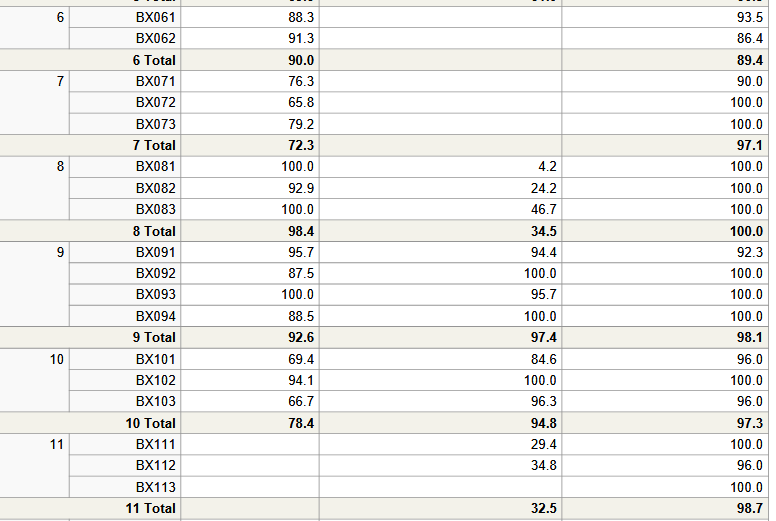
Attached is the data that DSNY is using to justify bringing back 4 day a week alternate sides.

How could it be possible that CB5 went from 100% clean streets in January to 30% clean streets in February?

How does CB11 consistently have 100% of its streets clean?


 Has anyone in govt ever questioned this data? It seems to be flawed.


What obviously hasn't been questioned by government and the clueless morons mocking citizens with their juked data and asinine tik tok video is the huge role restaurant shanties play in the pollution on the city streets. At least you can move a car.


Friday, July 8, 2022

The Blaz's expensive lies


THE CITY 

Last fall the city Department of Investigation released a damning report declaring that then-Mayor Bill de Blasio needed to reimburse the taxpayers $320,000 for the cost of bringing his NYPD detail along during his quixotic and ultimately failed quest for the White House.

At the time, the mayor questioned DOI’s findings, claimed there were “inaccuracies” in the report, and insisted he was simply following the advice of the NYPD. He also maintained he had “never received any contradictory guidance” on the use of the detail.

But a day before he announced his bid for the White House, he did receive explicit advice from the Conflicts of Interest Board (COIB) informing him in no uncertain terms that he must pay back the city for the use of the detail on the campaign trail.

The clarity of this instruction is revealed in a May 15, 2019 letter obtained by THE CITY via the Freedom of Information Law, signed by then-COIB Chairperson Richard Briffault to de Blasio’s City Hall counsel, Kapil Longani.

Briffault’s advice on how to avoid violating city conflict rules is unambiguous:

“The City may pay for only the salary and/or overtime of the NYPD personnel on such a campaign trip,” Briffault wrote. “All other costs associated with such personal campaign travel — including but not limited to airfare, rental cars, overnight accommodations, meals and other reasonable incidental expenses — must not be borne by the City. Rather these costs must be paid for or reimbursed by the Mayor’s campaign committee.”

In explaining his decision to de Blasio, Briffault noted federal campaign finance rules would require a federal candidate to repay a government for the use of governmental resources as part of a campaign. De Blasio is currently one of more than a dozen candidates running for Congress in the 10th Congressional District.

Three years after receiving COIB’s letter, the former mayor has yet to pay a dime.

De Blasio did not respond to a voice message left by THE CITY early Thursday asking about the straightforward declaration from COIB and his decision to disregard it. Neal Kwatra, a spokesperson for his congressional campaign, followed up later in an email to say he’d need more time to research the issue before answering.

THE CITY

Former Mayor Bill de Blasio’s signature NYC Ferry took taxpayers for a pricey ride when city economic development officials underreported its costs by nearly a quarter of a billion dollars, City Comptroller Brad Lander said Wednesday.

Lander accused the city of “playing hide the ball” on ferry finances and criticized the economics and oversight of the watery transportation network, which launched under de Blasio in 2017 and promised heavily subsidized $2.75-per-ride trips from piers in all five boroughs.

The comptroller’s report says the Economic Development Corporation rang up $758 million in ferry-related costs from July 2015 through the end of last year — but only reported $534 million in expenses in its audited financial statements and other records.

“This is a very substantial financial underreporting and mismanagement,” Lander said while standing near Pier 11 in Lower Manhattan. “$250 million of underreporting raises a lot of questions and those questions should be asked.”

Auditors found that the city’s actual subsidy on each ferry trip rose to nearly double the $6.60-per-trip subsidy that the de Blasio administration originally projected. The city subsidy amounted to $12.88 for Fiscal Year 2021, according to the report, not the $8.59 that was originally reported.

“It is a premium service, like express buses and it is also a tourist commodity,” Andrew Rein, president of the Citizens Budget Commission, told THE CITY. “We should be pricing the ferries accordingly and that should be able to reduce that subsidy.”

The comptroller’s report follows a series of stories in THE CITY about NYC Ferry, including one in January that revealed how de Blasio’s budget office supplied a $23.2 million infusion for the service before he left City Hall at the end of 2021 — after the service had previously been funded by the EDC.

“The ferry system was eating the EDC budget,” said Rein, whose nonprofit organization detailed in a 2019 report how subsidies for NYC Ferry are among the highest in the country for comparable ferry networks.

Lander’s report calls into question the purchase of new boats — something THE CITY flagged in April 2019 — as well as the $2.75 fare that de Blasio insisted on for the privately operated ferry trips. The price of an NYC Ferry trip is considerably lower than one on similar services in San Francisco and Boston.

On the San Francisco Bay Ferry, for example, fares are determined by three different zones, with the priciest zoned trip set at $11.25 for a paper ticket or $9.00 for rides paid for through mobile devices or the Clipper fare-payment system. 

De Blasio, in a statement through a spokesperson for his campaign for Congress, said he could not comment on Lander’s report because he had yet to fully review it.

Wednesday, July 6, 2022

Big Trouble in Little Guyana II


 Impunity City

 Another broad daylight crime happened again in Little Guyana on bustling Liberty Avenue.

 Last time it was a brawl on a street corner back on the first day of the Spring that involved a man resorting to taking out a meat cleaver to settle it, which led to cops ultimately ending the tussle by drawing guns on him.

 This time it was an attempted robbery of a cell phone store that recently opened. Which led to a massive response by the NYPD and crowds of cellphone correspondents and lookie-loos.


Tuesday, July 5, 2022

Board Of Education caught wasting school and PPE supplies

Brad Lander steered a half a billion dollars towards his lobbyist wife's clientele of NPGs

 https://www.nydailynews.com/resizer/a6PCCGnEfyLDcdr4VpPk4CVURbg=/1440x0/filters:format(jpg):quality(70)/cloudfront-us-east-1.images.arcpublishing.com/tronc/O2SOIINI65FW5KGQL6DAQC7OFI.JPG

NY Daily News

Since Brad Lander took over as the city’s fiscal watchdog in January, his comptroller’s office has approved nearly $550 million in contracts with nonprofit organizations that are members of an umbrella organization his wife oversees, a Daily News analysis of city contracts shows.

Lander’s wife, Meg Barnette, is the president and CEO of Nonprofit New York, which serves as a lobbyist and as an advocate for about 900 member nonprofits across the city.

Nonprofit New York is one of the key entities behind a push to ensure nonprofits that do business with the city are paid in a timely manner. Barnette serves on a joint task force focused on the issue that was formed by Lander and Mayor Adams.

More than 35 organizations that count themselves as members of Nonprofit New York have contracts that Lander’s office has reviewed and signed off on since he became comptroller in January, records show.

According to a News analysis of those records cross-checked against the group’s online list of members, those contracts add up to at least $544 million in city business.

The relationships between the umbrella group Barnette oversees, the nonprofits it represents and her husband, the comptroller, raise the question of whether the web of connections represents a conflict of interest or could be construed as one.

Nonprofit New York’s primary stated goal is “member-building,” and one of its main revenue sources is membership dues, according to the group’s website.

Richard Briffault, the former chairman of the city’s Conflicts of Interest Board, said that to avoid the appearance of a conflict, Lander should disclose the connections between his wife’s nonprofit and its members publicly and institute an internal policy laying out how he would recuse himself in matters related to Nonprofit New York’s clients.

“It would be wise policy to say, in effect, I’m going to recuse from anything involving these entities,” said Briffault, now a professor at Columbia University Law School. “It would certainly be good of him to make clear he is going to recuse from anything having to do with them.”

A former comptroller’s office official agreed based on the “optics alone.”

“It plants a seed of doubt,” the source said. “It doesn’t exactly instill public trust.”

Monday, July 4, 2022

Caption proud American Bill de Blasio


 Yeesh, look at that puss. The Blaz is clearly annoyed to be marching in this parade, which happened to take place during his farcical presidential campaign in Iowa. This is exactly what that 100-year-old veteran above was talking about.

This photo is cropped from a campaign tweet of his. Funny how it doesn't show him marching with other people and this is the only picture of him his staffers can find of him waving old glory, which is why this looks so weird.

Thoughts about America at 246.

Sunday, July 3, 2022

Kathy Clown extends outdoor dining lifeline


The Saratogian

Assemblymember Patricia Fahy announced that Gov. Kathy Hochul signed legislation extending the use of municipal space for outdoor dining to continue helping New York’s restaurant industry recover from the devastating effects of the COVID-19 pandemic.

Previous legislation signed in July of 2021 extended this program for one additional year. The legislation signed extends the outdoor dining program for three additional years, preventing the need for continual renewal. A survey conducted in January 2022 by the New York State restaurant industry found that 74% of operators report sales volume in 2021 was lower than it was in 2019. Additionally, 55% of restaurant operators have reduced hours of operation on days they opened and 40% are closed on days they would normally be open, limiting sales.

“Outdoor dining utilizing sidewalks and street space has become a financial lifeline for New York’s restaurants during the global COVID-19 pandemic,” said Fahy, D- Albany. “Not only has it helped hundreds of small, locally owned businesses remain in business, it’s also proved a popular boon to our local economies and ‘Main Streets.’ I was proud to sponsor this legislation to help allow those restaurants to continue utilizing outdoor spaces for another three years to help keep their doors open, and I commend Governor Hochul for signing legislation extending New York’s ‘open streets.'”

“I am so pleased the Governor signed this legislation in time for people to enjoy dining out this summer,” said Assemblymember Carrie Woerner. “The measure was originally intended to be a short-term assist for restaurants in New York during the very trying previous years. However, a happy consequence was learning that people enjoy the transformation of busy streets into places for al fresco dining.  While the food service sector is still making adjustments to the way they operate in the wake of the extreme disruptions of the pandemic, this bill will give them three additional years to refine utilizing outdoors spaces as they come back to full time operation.”


Rockaway boardwalk stained with graffiti

 https://assets1.cbsnewsstatic.com/hub/i/r/2022/06/29/61d35d8a-efb8-4844-84b6-52b77294f6f8/thumbnail/1200x630/70a148c3b1ddb608312637e3b76a24a7/rockaway-boardwalk-graffiti.jpg

 CBS New York

 Vandals went wild with spray paint over the weekend on a large section of the Rockaway boardwalk, and that had residents demanding an immediate cleanup.

On Wednesday, city crews were out in force with power washers, and as CBS2's Carolyn Gusoff reported, they're promising a swift response to graffiti on the newly built boardwalk.

Far Rockaway resident Michael Blomquist sees the Rockaway boardwalk as his escape to natural beauty, but on Saturday he came upon gasp-worthy ugliness.

"I've never seen that much graffiti in one place, and this is such an important place for us, for the community," Blomquist said.

He and others took to social media to share a community outcry -- to not let what happened stand as the new normal on a five-mile boardwalk just rebuilt after Superstorm Sandy.

Graffiti tags, at least 100 of them, with profanity, were sprayed across the entire width of the concrete boardwalk, from Beach 54th Street to 55th Street.

"Someone else will say, 'That's a good idea,' and every block will be marked up like that," Far Rockaway resident Methun Singh said. "They hurt the whole family, the neighborhood, everybody who lives here."

"I don't know what they were thinking. Some people just don't like to see things looking nice," resident Helen Jackson added.

City officials say this was a job for a special detail, and on Wednesday morning sent in the big guns -- its borough-wide graffiti removal squad.

"This was a whole block of the boardwalk with spray paint, so it's that much more visible, that much more obnoxious, and that much more problematic and troublesome," NYC Parks administrator Eric Peterson said.

The quick and complete cleanup sends the message that graffiti will not be tolerated.

"If you know your work is going to be erased immediately, hopefully you'll be less inclined to do the graffiti and damage the park,"  Peterson said.

Not GSD


NY Post

It’s the late show, from City Hall!

A portal offering proactive public access to NYC government records has been inundated with late notices scolding agencies for failing to file reports on crime stats, infectious disease updates, and notifications about multi-million-dollar project cost jumps, the Post has learned.

The 762 late notices filed so far in 2022 are more than double the late filings during the same period in 2021, a spike the Department of Records has attributed to a “system flaw.”  

The findings are “disturbing,” and pose a “tremendous disservice” that leaves the public “in the dark,” said Paul Wolf, president of the New York Coalition for Open Government.

Late notices make up a staggering 29% of the total 2022 Department of Records filings. In 2020, its 632 late notices made up 15% of total filings. The agency filed 374 late notices during the first half of 2021, representing just 12% of total filings for that period, and filed just two additional late notices in the second half of 2021.

Saturday, July 2, 2022

Cambria Heights houses make history


Queens Post

Two residential areas in southeast Queens were designated historic districts yesterday by the New York City Landmarks Preservation Commission.

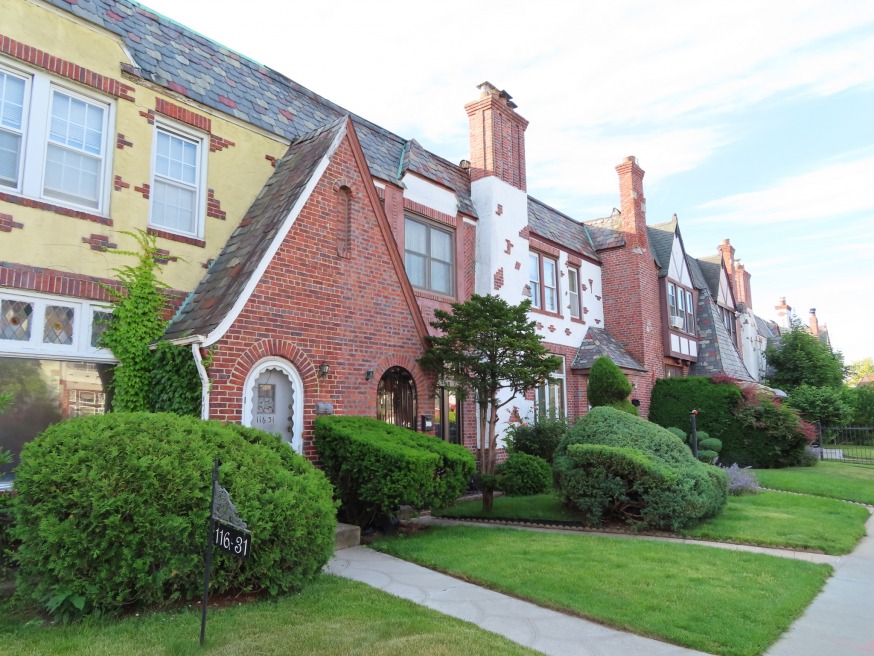
The commission created two separate historic districts—the Cambria Heights-222nd Street district and the Cambria Heights-227th district. Both areas, which consist of Tudor-style houses, have traditionally been occupied by the African American and Afro-Caribbean communities.

The districts contain row houses built in 1931 that are remarkably intact along two blocks, according to the commission. The Cambria Heights – 222nd Street Historic District contains 46 row houses between 115th Road and 116th Avenue and the Cambria Heights – 227th Street Historic District, which is five blocks away, contains 50 houses between 116th Avenue and Linden Boulevard.

“The designation of these two historic districts, the first in Cambria Heights, was a priority for me and fits within LPC’s equity framework, as we seek to increase designations in communities not well represented by landmarks, and to better tell the story of all New Yorkers,” said Landmarks Preservation Commission Chair Sarah Carroll.

The 222nd and 227th Street Historic Districts, according to the commission, consist of two cohesive and intact groups of Storybook-style row houses incorporating Tudor-style elements.

The Storybook style is primarily associated with California, where it flourished as a small-house style in the 1920s—influenced by fantasy architecture and movie backdrops. Storybook features of the 227th Street houses include half timbering, diamond-pane windows and stucco with brick and stone accents, as well as whimsical red, blue, and green slate shingles.

The 222nd Street houses feature Tudor-arched window openings, brightly colored terra-cotta roofs and windows, brick facades with random stone accents, and whimsically decorated chimneys with patterned brick and stucco panels. The design of the row houses gives the street a “stage-set” quality consistent with the Storybook style, of a Hollywood backdrop or fairytale illustration come to life.

Initially, residents of both 222nd and 227th Streets consisted of mainly white middle-class families. Black families began moving to Cambria Heights by the 1950s and the makeup of the community began to change.

By the 1980s, immigrant families from Caribbean countries such as Jamaica, Haiti, Trinidad and Tobago, Guyana, and Barbados moved to the area. Today, Cambria Heights remains one of several prosperous predominantly Black residential communities in Southeastern Queens.

“These homes are significant not only because of their appearance but also because of what they represent to the communities…that the American Dream was within reach,” said Mayor Eric Adams.

Friday, July 1, 2022

The Corona Extreme Makeover

Remember when I wrote about the Corona Horror house last year? Crappy even posted sarcastically about it on social media.


Well get a load of it now.


Looks like the buyer (or buyers, LLC cough cough) decided to add a patio balcony and put up a fancy new gate too.