Showing posts with label Landmarks Preservation Commission. Show all posts

Wednesday, December 14, 2022

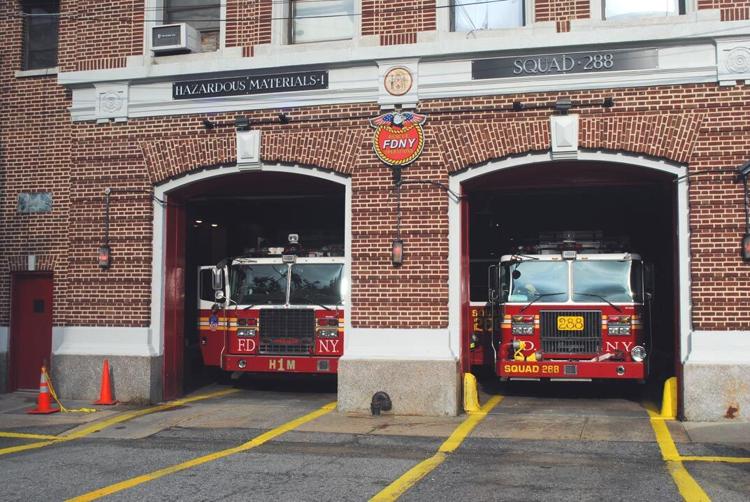
Maspeth firehouse about to get landmark status

https://bloximages.chicago2.vip.townnews.com/qchron.com/content/tncms/assets/v3/editorial/9/77/97726565-ca64-547f-95ba-91aaec77bc94/639213062fbfc.image.jpg?resize=750%2C502

Queens Chronicle 

In Maspeth, residents are seemingly as protective of their firefighters as New York’s Bravest are of them.

For more than a decade, residents and community leaders have been attempting to get the 68th Street firehouse, built in 1914, to be recognized by the city’s Landmarks Preservation Commission in honor not only of its architectural importance, but its place in American history.

Nineteen firefighters assigned to the station were killed responding to the attacks on the Twin Towers on 9/11, the highest toll at any firehouse in a city that lost 343.

In a letter to Councilman Bob Holden (D-Maspeth) dated Nov. 25, LPC Chairwoman Sarah Carroll said the commission will take up the case again in a new round of evaluations of city firehouses.

Squad 288 lost Lt. Ronald Kerwin and firefighters Peter Brennan, Ronnie Gies, Joseph Hunter, Jonathan Ielpi, Adam Rand, Brian Sweeney and Timothy Welty.

Hazmat 1 lost firefighters Dennis Carey, Martin Demeo, Thomas Gardner, John Giordano, Jonathan Hohmann, Dennis Scauso and Kevin Smith; Battalion Chief John Fanning, Capts. Thomas Moody and Patrick Waters; and Lt. John Crisci.

In the past, proponents of landmark status have been told that the building itself is not architecturally remarkable; and that for consideration of historical events such as the Sept. 11 attacks, rules and regulations call for the passage of 30 years.

When Holden found that he could not move the issue through legislation — it would take action from the mayor — the councilman wrote to Mayor Adams back in October, urging him to direct the LPC to act.

“Considering the building itself is historic and the personnel played such a significant role on one of the most historic days in United States, I ask that the LPC awards landmark status immediately,” Holden wrote in the letter dated Oct. 3.

The councilman pointed out further that residents and civic and elected officials from the area are just about unanimous in their support of the measure.

“On September 11th each year, large crowds still gather at the Firehouse to remember all those who lost their lives on this day. Families of the deceased bring young children who never met their deceased relatives. The firehouse still plays a role in the lives of everyone who lost a loved one that day.

“By landmarking the Maspeth Firehouse, the city will be acknowledging the sacrifice of uncommon heroes and a historic building that has stood for over a century. Landmark status would be a positive message to the next generation of New Yorkers that our city truly ‘Never Forgets.’”


Saturday, July 2, 2022

Cambria Heights houses make history


Queens Post

Two residential areas in southeast Queens were designated historic districts yesterday by the New York City Landmarks Preservation Commission.

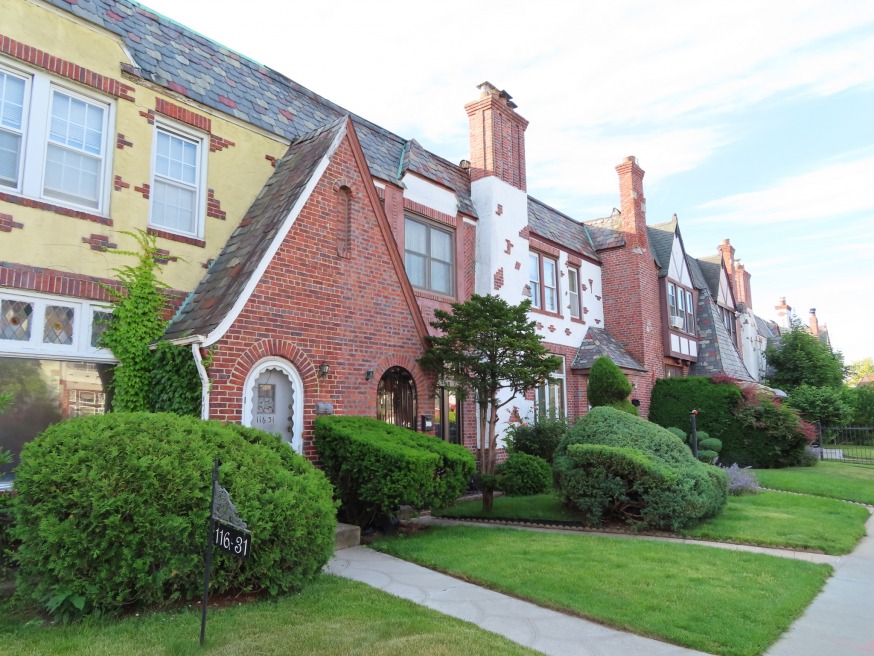
The commission created two separate historic districts—the Cambria Heights-222nd Street district and the Cambria Heights-227th district. Both areas, which consist of Tudor-style houses, have traditionally been occupied by the African American and Afro-Caribbean communities.

The districts contain row houses built in 1931 that are remarkably intact along two blocks, according to the commission. The Cambria Heights – 222nd Street Historic District contains 46 row houses between 115th Road and 116th Avenue and the Cambria Heights – 227th Street Historic District, which is five blocks away, contains 50 houses between 116th Avenue and Linden Boulevard.

“The designation of these two historic districts, the first in Cambria Heights, was a priority for me and fits within LPC’s equity framework, as we seek to increase designations in communities not well represented by landmarks, and to better tell the story of all New Yorkers,” said Landmarks Preservation Commission Chair Sarah Carroll.

The 222nd and 227th Street Historic Districts, according to the commission, consist of two cohesive and intact groups of Storybook-style row houses incorporating Tudor-style elements.

The Storybook style is primarily associated with California, where it flourished as a small-house style in the 1920s—influenced by fantasy architecture and movie backdrops. Storybook features of the 227th Street houses include half timbering, diamond-pane windows and stucco with brick and stone accents, as well as whimsical red, blue, and green slate shingles.

The 222nd Street houses feature Tudor-arched window openings, brightly colored terra-cotta roofs and windows, brick facades with random stone accents, and whimsically decorated chimneys with patterned brick and stucco panels. The design of the row houses gives the street a “stage-set” quality consistent with the Storybook style, of a Hollywood backdrop or fairytale illustration come to life.

Initially, residents of both 222nd and 227th Streets consisted of mainly white middle-class families. Black families began moving to Cambria Heights by the 1950s and the makeup of the community began to change.

By the 1980s, immigrant families from Caribbean countries such as Jamaica, Haiti, Trinidad and Tobago, Guyana, and Barbados moved to the area. Today, Cambria Heights remains one of several prosperous predominantly Black residential communities in Southeastern Queens.

“These homes are significant not only because of their appearance but also because of what they represent to the communities…that the American Dream was within reach,” said Mayor Eric Adams.

Sunday, June 27, 2021

Giant Grand Central tower proposal gets a push back from architecture expert

 https://nypost.com/wp-content/uploads/sites/2/2021/06/court-exibit3.jpg?quality=90&strip=all&w=1024 

NY Post

 An 82-year-old preservationist is single-handedly waging war against a 1,645-foot mega-tower that’s set to go up next to Grand Central — claiming the behemoth building would mar the “heart of New York.”

Christabel Gough, the secretary of the Society for the Architecture of the City, filed suit in Manhattan Supreme Court Wednesday seeking to stop the project at 175 Park Avenue, which the complaint says would “completely overwhelm and resign to utter insignificance the grandeur of Grand Central.”

“I came here with my grandfather when I was a small child,” Gough told The Post.

“This is the heart of New York and it should be protected. Why do we have a landmarks law if not to protect buildings like Grand Central?”

Developed by RXR Realty and TF Cornerstone, the proposed building would be more than five times the size of the 26-story Grand Hyatt hotel its replacing on East 42nd Street.

In her suit, Gough marvels over the transportation hub that she says she “regularly frequents” to enjoy its “beauty, historic and architectural eminence and cultural significance.”

She is accusing the city’s Landmark Preservation Commission of issuing an advisory opinion, instead of greenlighting the 83-story structure with a formal opinion, which is legally required and entails a higher bar for approval.

The LPC should have required the MTA, as the owner of Grand Central, to file an application for a “certificate of appropriateness” for the project — since it will alter the terminal and its viaduct, the court papers say.

But instead, the LPC allowed the MTA to merely file a request for a “report and recommendation” — a more relaxed and non-binding standard for project proposals, the filing alleges.

The LPC issued that report and recommendation in February.

Tuesday, February 18, 2020

Landmarks Preservation Commission has spent over $60,000,000 on new office space that's still not done


THE CITY

It took nine months and $8 million to build a two-story library near Van Cortlandt Park in The Bronx last year.

Meanwhile, a project to repair office space and construct a hearing room for the city Landmarks Preservation Commission’s new home has ballooned to an estimated $62 million — and the completion date has been delayed four years.

The budgeted cost has jumped by $33 million since 2016 due to structural problems discovered inside the historic Postal Telegraph Building in Lower Manhattan, according to records from the city’s Department of Design and Construction (DDC).

The expected bill dwarfs the commission’s $7.2 million annual operating budget.

“DDC has to get better with rolling with scope changes,” said Jonathan Bowles, executive director of the nonprofit Center for an Urban Future.

Near the end of Mike Bloomberg’s mayoral tenure, the commission asked for additional space, noting its staff had grown 35% “to meet demand for the increasing number of permit applications.”

The Landmarks Commission’s move — from the Municipal Building at 1 Centre St. into six floors at the landmarked 253 Broadway, near Murray Street  — was approved by the city’s budget office and the department that oversees office space.

The expanded office space and modern hearing room inside the city-owned building initially was expected to be ready by December 2017, records show. But the project is currently 39% complete and is now set to be finished in Spring 2021, according to DDC.

“A lot of additional work was added since the project was created,” said Ian Michaels, a DDC spokesperson, noting some of the repairs were tied to unavoidable safety measures.

Engineers discovered a leaky roof, asbestos and damaged terra-cotta ceilings, he said. They also cited needs to remove abandoned wiring, repair water damage from old leaks, restore sidewalk vaults and install a new central exhaust line for bathrooms to get up to code.

The issues have led to 119 so-called “work change” orders so far, Michaels said.

Mayor Robert F. Wagner created the Landmarks Preservation Commission in 1965 to protect historic and architecturally significant structures. The agency, comprised of a panel of 11 commissioners supported by a staff of 84, receives around 14,000 applications a year from property owners seeking to make changes to their landmark buildings.