Showing posts with label buildings. Show all posts

Friday, January 19, 2024

Empire State Tombs

Scott Rechler and Jon Wertheim  

60 Minutes

Looking for signs the U.S. economy can continue to stave off a recession? Avert your gaze from commercial real estate. City office buildings are in trouble. For a century, the towers have been propped up by two pillars. One, workers filling the buildings all week. Two, money flowing freely in the form of loans to borrow, buy, and build. Those days are over. As hybrid work hardens from trend to new normal, office occupancy rates have hit all-time lows. Meanwhile interest rates have spiked to historic highs… and now the mortgage comes due: $1.5 trillion in commercial real estate loans expire in the next two years. It's enough to make you rethink the future of cities. We criss-crossed Manhattan, talking to players big and small, about a sector rocked to its foundations.

What is New York City without its skyline? Monuments to commerce, standing proudly shoulder-to-shoulder. More office space than any city in the world. But peek inside all this vertical real estate and there's a fundamental question. Where IS everyone? More than 95 million square feet of New York office space currently unoccupied - the equivalent of 30 Empire State Buildings.

Scott Rechler: This building had a lot of law firms, had some government tenants… 

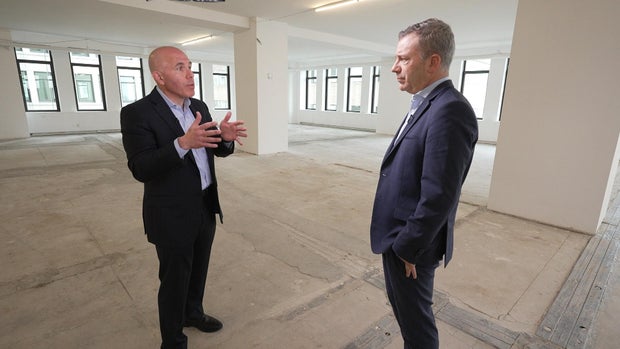
Scott Rechler is CEO of RXR, a New York real estate company with more than $20 billion in holdings. We walked through his property at 61 Broadway, near Wall Street. Every other floor—half the building—lies empty.

Scott Rechler: I think this is an existential moment. You know, I call it crossing the chasm

Jon Wertheim: What's the chasm specifically? 

Scott Rechler: This post-COVID world of higher interest rates, the changing nature of how people work and live. We're not going back to where we were. It's a different world. And it's gonna be turbulent.

It already is. The return to office has stalled out: Fridays are dead. Mondays aren't much busier. As tenants shrink their office footprint, office landlords are confronting the fact that some of their buildings have become obsolete, if not worthless…Ever the pragmatist, Rechler decided not to throw good money after bad at 61 Broadway, and defaulted to his bank on a $240 million loan.

Jon Wertheim: I could see people saying, "that's a lot of money. How did he sleep last night?"

Scott Rechler: We invest a lot of equity. If it works, we make a lot of money. If it doesn't work, the lender-- can take over the building. You gotta face reality, right? Reality's coming your way.

The reality is the price of office buildings is tanking, as much as 40% since the pandemic. Uptown at Columbia Business School, Stijn Van Nieuwerburgh, a professor of real estate, has modeled out the impact of hybrid work on pricing…and calls it a train wreck in slow motion.

Prof. Stijn Van Nieuwerburgh: And this is just the beginning. And the reason it's just the beginning is because there's a lot of office tenants that have not had to make an active space decision yet. "Do I want to renew this space? Do I wanna vacate? Maybe I sign a new lease for half as much space." This is what tenants have been doing for the last three years. So when you take all of those current and future declines of cash flows into account, we end up with about a 40% reduction in the value of these offices.

Consider this office building near Penn Station - one of a handful of sales in the city last fall. Built in 1920 and showing its age, eight empty floors with a 99-cent store on the ground level.

Real estate partners Tony Park and Elad Dror, told us they'd been eyeing that building for years, and, pre-pandemic, offered the owner $80 million. They didn't get very far.

Tony Park: He doesn't answer.

Jon Wertheim: He didn't even answer you guys?

Tony Park: He didn't answer, (laugh) yeah. We didn't have his attention, at all.

Jon Wertheim: So what do you think happened? 

Tony Park: The whole building is now empty.

In September, Park and Dror got the building for less than half their original offer. And they have plans to convert the place.

Jon Wertheim: Did you ever think of just keeping it as an office building? 

Tony Park: No. Never.

Jon Wertheim: You laugh. 

Tony Park: Anything that is not an office.


Friday, June 29, 2018

"Stilt building" loophole to be eliminated

From Crains:

The city is on schedule to regulate so-called excessive mechanical voids by the end of the year, dealing a blow to developers who use a quirk in the building code to boost the height of their luxury apartment towers.

Mechanical voids are essentially floors used to house the heavy equipment that powers a building's systems. However, by raising the ceilings of these spaces to dizzying heights, developers increasingly have been creating hollow pedestals upon which they can stack luxury apartments. Because these upper units can typically command better views than neighboring structures without large voids, they can be sold at premium prices to pay for the additional construction while still boosting profits. An apartment building proposed by Extell Development at 50 W. 66th St., for example, will have only 40 floors, yet it is slated to be 775 feet tall, according to a neighborhood group opposed to the plan.

Saturday, August 19, 2017

Worker dies at Manhattan building project site


From the Daily News:

A 22-year-old construction worker from Yonkers died after falling 20 feet down an elevator shaft while working on a high-profile luxury building, police said.

Jonathan Lupinski fell two stories to the basement at 281 Fifth Ave. at E. 30th St. about 9:40 a.m. He suffered grave head injuries.

“While stripping the elevator shaft, the worker fell to the cellar level,” a Department of Buildings report said.

Medics rushed him to Bellevue Hospital, where he died, officials said.

Wednesday, June 21, 2017

Horrific construction accident in Astoria


From NBC:

A crane dropped a materials load into a renovation site in Queens on Tuesday afternoon, injuring three construction workers, including two critically, fire officials said.

Dozens of firefighters descended on a two-story brownstone on 28th Road, between 31st and 33rd streets, in Astoria just before 4 p.m.

"It was just a big explosion," said Astoria resident Marianna O'Neill. "It was loud and it was long."

A 37-year-old construction worker who managed to get out of the building on his own was transported to a hospital with serious injuries.

A 40-year-old construction worker was seen being pulled from the building on a stretcher shortly after 4 p.m. He or she appeared to be conscious but had critical injuries, officials said.

Around 5:30 p.m., firefighters were still working to free a 28-year-old construction worker who was trapped under "a few thousand pounds of construction materials in the basement of the building," FDNY Commissioner Daniel Nigro said at a press conference, adding that the man's legs were under 1,200-pound beams.

Fire officials said that neither a crane nor a crane boom collapsed. They said a load of materials that had been placed on the roof of the building for renovation collapsed, falling all the way to the ground floor or basement. A large hole could be seen in the roof of the building.

The building is in the process of being converted from a two-family house to a three-family house, according to the Dept. of Buildings database.

Friday, May 5, 2017

City fines at an all time high

From AM-NY:

Fines for parking tickets, litter and other violations reached a record high of $993 billion in the 2016 fiscal year, according to a report released by the city comptroller Wednesday.

Since the 2013 fiscal year, when the city collected $811 million in fines, violations have been increasing, with parking tickets leading the way, according to the report.

In the last fiscal year, the city collected $545 million in ticket revenues. Quality of life violations, such as littering, building fines and noise complaints, were the second biggest category with $184 million in revenues.

Friday, February 17, 2017

Addresses will soon need to be posted

From Crains:

Believe it or not, there is no law requiring New York City landlords to post an address near each building entrance. That is set to change today, 13 years after the bill first came before the City Council.

Manhattan Borough President Gale Brewer first penned the legislation in 2004 to help ensure that firefighters and police were not delayed in responding to emergencies due to unmarked buildings—of which there are many. A 2010 study found that nearly half of all buildings along several Manhattan commercial corridors did not have a building number visible from the street.

"For years, New York City's streets have been like something out of a Harry Potter book, with storefronts and whole buildings that are only easy to find if you already know where they are," Brewer said in a statement announcing the bill, which was expected to pass the council Wednesday before heading to the desk of Mayor Bill de Blasio.

Current regulations require building owners to post an address only at the front entrance—which has complicated efforts by first responders.

The new law, which was introduced by City Councilman Jumaane Williams, requires an address to be posted at any doorway used by pedestrians, and it increases the initial fine to $250 from $25. If a required address is not posted within 30 days, a $50 fine would accrue for each day afterward.

Sunday, January 11, 2015

1000-person yeshiva dorm planned for Glendale

From the Queens Chronicle:

The United Talmudical Seminary at 74-10 88 St. in Glendale has filed an application with the Department of Buildings to construct a four-story, 142,183-square-foot structure containing office space, classrooms and student dormitories on a plot of land adjacent to the facility.

The Brooklyn-based rabbinical school, which opened its Glendale location in 2006 after years of heated opposition from area residents, buses its students in from Williamsburg every day.

The new structure would allow the students to live next to the school, with the busing of students being all but eliminated.

The application has been sent to a plan examiner for analysis. The site is zoned M1-1, a light manufacturing district.

Plans call for the ground floor to contain offices and three classrooms, with the top three floors being set aside for an unannounced number of student dorms.

The Monarch Knitting Machinery Corp. sold the former textile factory to the United Talmudical Seminary for $3.5 million in January 2004, and the DOB shot down plans to build 100 units of housing at the site later that year over zoning regulations.


Hey folks, this is a continuation of one of the earliest stories that was reported on this blog back in 2006. They tried to slip a dorm past DOB and the community back in 2006, and now they are trying to go the legal route, although I don't know if this will pass muster with the zoning. Certain groups in this city seem to always get their way, though, and the city seems hellbent on blockbusting Glendale lately, so be prepared for 1000 students to inundate the quiet manufacturing area and further overtax city services.

Saturday, January 10, 2015

New year, new building rules

From the Queens Chronicle:

A revision of the New York City building codes sent dozens of architects scurrying to file applications with the Department of Buildings just before the new regulations went into effect New Year’s Eve.

In order to have permits and other construction plans reviewed under the 2008 Construction Codes, developers had to send in their applications by Dec. 30, with all filings submitted on or after Dec. 31 being scrutinized under the 2014 iteration of the city’s regulations.

Hundreds of architects from across the city flooded the DOB with filings in the days leading up to the changeover, with many of the applications in Queens involving the construction and/or demolition of smaller structures, between one and four stories high.

The change in building codes comes eight years after the previous edition was enacted, with many of the alterations having to do with safety inspections and standards, reorganizing and rearranging passages and new technology,

Requirements in the new codes include the installation of temporary fire hydrants near large construction sites, professionally designed monitoring plans for excavation work, and the banning of scaffolding work in sustained winds 30 mph or stronger.

Thursday, December 25, 2014

More violations for house that went "boom"

From the Queens Chronicle:

A Thanksgiving Day explosion at a South Ozone Park house was caused by the misuse of a stove inside an illegal apartment, according to Fire Department officials.

“The location of the explosion was an illegally renovated setback apartment,” an FDNY spokesman said in an email. “The explosion was caused by misuse of a stove on the premises.”

According to city records released last week, the owner of the house was given two violations by the city Department of Buildings on the day the back of the first floor spontaneously exploded.

The house, located at 107-55 108 St., was illegally altered from a one- or two-family dwelling to accommodate four or more families, DOB records state.

An illegal canopy at the rear of the house was also placed by the homeowner, according to records.

The homeowner, identified by the DOB as Boonness Harrychand, is scheduled for a hearing at the Environmental Control Board, the tribunal body that administers penalties to people who violate DOB regulations, on Jan. 13.

Harrychand did not respond to requests for comments on the violations by press time.

The DOB did not respond to requests for comment on whether or not gas work was done inside the illegal units.

Wednesday, December 10, 2014

Lights out!

From CBS New York:

New York may be the city that never sleeps, but its workers are not always in their offices.

City Councilman Donovan Richards is proposing a bill that would require some unoccupied commercial buildings to go dark, WCBS 880’s Alex Silverman reported.

“The majority of emissions in New York City, 75 percent of them, come from buildings,” Richards said.

Richards said Paris recently passed a similar law.

“They only have 25 percent of the buildings we have, and they’re saving $260 million a year,” the councilman said.

There are currently no restrictions on lighting in New York.


It would also cut down on light pollution (why we can't see the stars at night) and bird strikes.

Saturday, October 18, 2014

DOB fines going unpaid

From the Epoch Times:

Every time someone is ticketed for littering, not shoveling their sidewalks, or any other “quality of life” violation, the city’s Environmental Control Board (ECB) is charged with holding hearings and issuing judgments and fines.

In fiscal year 2014, the 13 agencies issuing these types of tickets sent ECB 567,000 violations.

To date, New York City has $1.48 billion of uncollected debt stemming from these violations. Half of it comes from violations over two years old. About $350 million of that is interest on the uncollected fines.

Council members have been pushing for more efficiency in collecting this debt for years. In 2011 the Independent Budget Office (IBO) had released a report with these numbers at then-council member Gale Brewer’s request.

On Oct. 14, the Finance Committee discussed legislation to require the ECB to start submitting annual reports to the council so there is more transparency in the process.

Elizabeth Brown from IBO testified at the hearing in favor of annual reports, and suggested they be made available online as well.

“In the past IBO has been able to provide snapshots of the city’s unpaid fines. However, regular reporting would add another layer of transparency,” Brown’s testimony states.

In a 2007–2009 report, IBO found that the biggest share of unpaid fines came from violations issued by the Department of Buildings ($200 million).

Tuesday, September 23, 2014

Man with a plan?

From GlobeSt:

Mayor Bill de Blasio has announced that New York City plans to reduce its greenhouse gas emissions by 80% over 2005 levels by 2050. The plan—called One City, Built to Last: Transforming New York City’s Buildings for a Low-Carbon Future—includes the intention to retrofit public and private buildings to dramatically reduce the city’s contributions to climate change while spurring cost savings and creating new jobs.

This effort makes New York the largest city to commit to the 80% reduction by 2050 and charts a long-term path for investment in renewable sources of energy and a total transition from fossil fuels. Nearly three quarters of New York City’s greenhouse gas emissions come from energy used to heat, cool, and power buildings, making building retrofits a central component of any plan to dramatically reduce emissions, according to the Mayor’s office.

Every city-owned building with any significant energy use—approximately 3,000 buildings—will be retrofitted within the next ten years, by 2025, with interim goals along the way. The city also will spur private building owners to invest in efficiency upgrades, setting interim targets and incentives and implementing mandates that trigger if interim reduction targets are not met.

Monday, February 24, 2014

“The monkey’s on my back and I have feces floating around in the basement here"

From the Times Ledger:

After years of flooding problems and spending tens of thousands of dollars to repair his building’s sewer system, a Flushing building owner says his troubles are the city’s fault.

Frank Deutschmann first started experiencing flooding in the basement of his 70-unit residential building, at 40-04 Bowne St., in spring 2008.

“It’s an ongoing struggle,” he said.

The problem cut tenants off from their laundry room and cost Deutschmann a substantial amount of money to repair the building’s boiler as well as other damages. The flooding also caused headaches for some of the eight businesses that are housed on the first floor of the building.

“We had so much merchandise damaged,” said Soo Kim, who owns a pharmacy in the building. “Even when it was not a lot, we still had to stop what we were doing and get all the employees to clean rather than fill prescriptions.”

Deutschmann said he contacted the city Department of Environmental Protection every time the building flooded. He said DEP took action sometimes to clear the main sewer under Roosevelt Avenue, but many times he was told the problem was with the building’s sewer.

A DEP spokesman said the first calls the agency received about this location came in the summer of 2010.

“DEP’s inspections found a buildup of improperly disposed of grease in the sewer line, which can cause backups,” he said.

Saturday, November 2, 2013

Scaffold collapse hurts 3 people

From DNA Info:

Three people were hurt when wind blew down scaffolding near Times Square Friday morning, the FDNY said.

A strong gust blew down pieces of plywood and the frames supporting them near Seventh Avenue and West 40th Street about 10 a.m., an FDNY chief at the scene said.

They were not seriously injured, the FDNY said.

Officials with the Department of Buildings said that the structure was assembled improperly and issued a stop-work order at that address. The building owner 151 West Associates LLC was cited for construction not incompliance of approved plans and safety violations.

A complaint for unsafe scaffolding was reported for the work site, 561 Seventh Ave., last year, but investigators did not issue a violation because the structure was being dismantled when they arrived, according to DOB records.

Friday, October 18, 2013

Building boom 2013

From the Daily News:

Construction this year in New York City is expected to hit pre-bust levels, according to the New York Building Congress, which represents top contractors and construction firms.

The group projects $31.5 billion in construction spending this year, a 14% rise from last year.

It’s the first time the industry has spent more than $30 billion since the crash and the most spending since 2006.


From Crain's:

What could better? A lot actually.

When the numbers are adjusted for inflation, the 2013 total will remain 15% below the 2007 peak in terms of work delivered.

The residential surge is even more problematic because it is based in large part on the construction of those spectacularly tall, thin and expensive apartment towers for the billionaires Mayor Michael Bloomberg loves so much. Just this week, Extell Development and Vornado settled a long-running dispute so they could each build one of those apartments buildings on 57th Street. Extell boss Gary Barnett, sounding like hizzoner, extolled the plan to The New York Times, saying, "This clears the way for the development of two great buildings that will enhance the skyline and contribute greatly to the economy of New York City."

However, the Building Congress report notes that last year New York City produced only 11,000 new housing units from $5.3 billion in residential construction because of the shift in the market to the Extell- and Vornado-type projects. In 2008, the city gained 33,000 units from almost the same amount of money, $5.8 billion.


From the Daily News:

Queens — once known for its Archie Bunker rowhouses and its strong ethnic enclaves — is the next New Thing for developers, a new survey revealed.

When asked where residential growth will be strongest outside Manhattan, roughly 30% of top developers surveyed said Queens. Another 20% specified Long Island City.

The company that conducted the survey wasn’t surprised.

“There is a demand for Queens,” said Martin Brady, a vice president at The Marketing Directors. “The land is cheaper and more available.”

Queens is already popular with urbanites priced out of Manhattan and uber-trendy Brooklyn — and now developers searching for large parcels of available land on the cheap are taking note.

The borough’s close proximity to midtown Manhattan, which can be about a 10 minute train ride in some places, is also a big selling point.

“I call Queens the new Brooklyn,” said real estate appraiser Jonathan Miller. “What you’re seeing is this never-ending search for greater affordability.”

Miller believes northwest Queens, a.k.a. the neighborhoods closest to Manhattan, will benefit the most from the boom.

He envisions more upscale — but not luxury — rental buildings going up in Astoria, Sunnyside, Woodside and Jackson Heights.

Sunday, October 13, 2013

House with illegal gas line goes boom!

Daily News
From the Queens Courier:

Three people are left injured after a house fire in Richmond Hill.

According to the FDNY, a call came in on Saturday at approximately 1:01 a.m. for a fire at 87-40 124th Street. Upon arrival, firefighters found the fire in the basement of the one-story home. The fire was under control by 3:58 a.m.

One person was taken to Nassau University Medical Center with serious burns and two people were taken to Jamaica Hospital with minor burns.

According to the FDNY, the cause of the fire is still under investigation.


Wow, I wonder what could have happened? I'm sure no one had any idea that there was a problem.

Wonder why this was dismissed...

Two-story 6-unit building, eh? Dept of Finance has this listed as a 4-unit building.

Friday, April 12, 2013

Microunits may become the new normal


From Crains:

The Bloomberg administration has taken a small step toward building tiny apartments. The mayor's micro-apartments, officially known as adAPT NYC, were certified by the City Planning Commission on Monday, and will now go through the labyrinthine, half-year-long public approval process.

The milestone is especially significant because the micro-units tweak the zoning code in a number of ways, and having those changes vetted by the community, the commission and the City Council could prove an important test of the project's viability—and possible expansion onto other sites. An expansion is something the administration has been seriously considering, given adAPT NYC's popularity in the development community.

On the one hand, adAPT NYC is seen as an innovative way to provide cheaper—if not necessarily affordable—apartments by making them smaller, and thus cramming more units into a building—mitigating the city's expensive land and construction costs. (Those costs will further be driven down by Monadnock's decision to construct the project using pre-built modular units, the first time the cutting-edge process will be put to use in Manhattan.)

However, some have criticized the project because they fear that, once developers win the right to build smaller units, that will become the norm, further starving space-constrained New Yorkers of living space. When the city launched the micro-apartment competition last year, it called for units ranging in size from 250 square feet to 375 square feet in size.

Saturday, December 15, 2012

What we think


From the NY Post:

Most New York voters favor legalizing marijuana, but by a slim 51-44 majority, according a new poll.

Quinnipiac University found the younger the voters, the higher they are on the idea, with 62 percent of 18- to 29-year-olds favoring legalization.

Meantime homeowners and businesses destroyed by Hurricane Sandy should rebuild to stricter building codes, according to 65 percent of voters - including 68 percent in the city and 67 percent on Long Island, the hardest hit regions.

Eight percent think destroyed structures shouldn't be rebuilt at all, the Dec. 5-10 telephone survey of 1,302 voters found.

While 74 percent say they're concerned about climate change and two thirds expect their community to be hit by a major storm in the next decade, only 45 percent think Sandy actually resulted from climate change.

Wednesday, October 24, 2012

FDNY prioritizes safety inspections

From the NY Post:

Buildings at “high risk” of fires will now be targeted as the FDNY revamps the way it assigns safety inspections, The Post has learned.

The new system will take multiple factors into account when determining the order of inspection, including, among other things, the building’s height and age, type of sprinkler system and fire history, said a high-ranking FDNY source.

Priority would be given to buildings with high numbers of occupants.

Under the current system, inspectors examine structures every other year, with little consideration paid to the specific factors that make a building more vulnerable, the source said.

The change, which follows completion of a Bronx pilot program, will likely be announced next month, when the first crew of officers undergoes training, the source said.

A spokesman for Mayor Bloomberg did not reply to repeated requests for comment. The mayor announced in June 2011 a similar inspection program for illegally converted apartments.