Showing posts with label technology. Show all posts

Thursday, November 9, 2023

NYC Projects Dashboard Confessional

Image

CityLand 

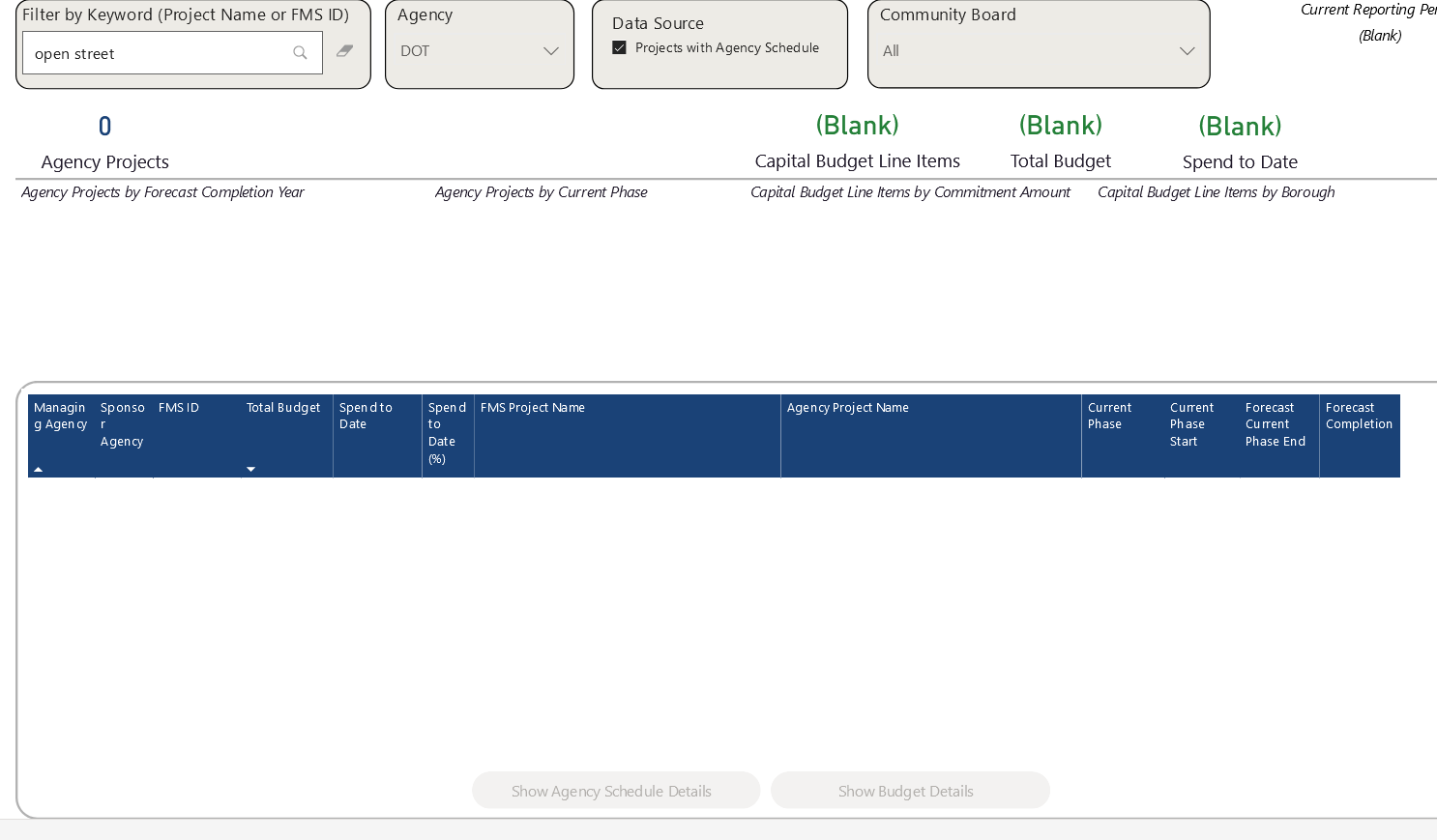
On November 1, 2023, Mayor Eric Adams and Comptroller Brad Lander released a new capital projects tracker that provides New Yorkers a new way to track capital spending. The tracker was mandated by Local Law 37 of 2020, which was sponsored by then-Council Member Lander. 

The tracker provides information about city construction projects including parks, bridges, and sewer infrastructure. The information provided includes data from agency project management systems and budget information including the total cost, the project’s current phase and expected timeline, and other details about the construction. 

The Capital Process Reform Task Force, created through Local Law 37, helped support the creation of the tracker. The task force consisted of city agencies, the Comptroller’s Office, and leaders in the labor and construction industry and minority- and women-owned business enterprises. The tracker was part of the task force’s 39 recommendations announced earlier this year. 

The tracker can be viewed here. Future improvements to the tracker will include refining the website design and adding an interactive map. 

Mayor Adams stated, “I’m a strong believer that if you don’t inspect what you expect, it’s all suspect. With the launch of the capital projects tracker, we’re allowing New Yorkers to inspect what they expect from public infrastructure projects. This tool is more than just data — it’s a testament to our dedication to serving the public with integrity, clarity, and innovation. As we continue to invest in our city’s infrastructure, it’s paramount that our residents have full visibility and trust in our processes.”


Saturday, April 23, 2022

Steal your face

State Sen. James Skoufis

 NY Post

This could put a real dent in the fake ID market.

The New York State Senate is moving forward with proposed legislation that would allow bars and restaurants to use facial recognition or fingerprint scanners to verify someone’s age before they buy alcohol, tobacco or electronic cigarettes.

“This is the new frontier of age verification,” said state Sen. James Skoufis, who is sponsoring the biometrics bill. “It does advance the interests of convenience.”

Skoufis envisions that bars and restaurants could scan fingerprints, faces or retinas of customers who want to be spared the trouble of showing an ID when they return to an establishment in the future. The proposed legislation requires all data to be encrypted and prohibits businesses from selling biometric data to third parties.

“No one’s forced into engaging with this technology, but they would have the choice,” Skoufis said. “There’s no big brother involved.”

Skoufis, who chairs the Investigation and Government Operations Committee, said he expects his committee will advance the proposal to the full Senate Monday. There is currently no sponsor in the Assembly though Skoufis said several members have expressed interest.

State lawmakers are scheduled to adjourn for the year on June 2.

Washington state approved a similar proposal in 2018, which allows spectators at professional sporting events to pass security and buy concessions with their fingerprints.

The legislative language states that the State Liquor Authority and the state Department of Health would be responsible for crafting regulations controlling the recording and maintenance of biometric data, which the bill states must be “stored in a centralized, highly secured, encrypted biometric database.”

Expanding the use of biometrics means privacy risks for New Yorkers, according to Albert Fox Cahn, a visiting fellow at Yale Law School and executive director of the Surveillance Technology Oversight Project. And unlike a credit card number or driver’s license, biometrics canno ever be changed, he added.

“This is a horrifying invitation for identity theft,” he said. “If one bar or restaurant gets hacked, our identities are compromised for the rest of our lives … more biometric data, potentially expands the power of government agencies to track us because this data is just going to be one court order away from being turned into a policing tool.”


Monday, July 12, 2021

Tenants struggling to pay rent are struggling with application online platform


Gothamist

Tenant advocates say the $2.7 billion federally-funded emergency rental assistance program aimed at helping struggling New Yorkers behind on their rent due to the pandemic might not be reaching the residents who need it the most.

New Yorkers started applying for the program on June 1st. The agency in charge of the Emergency Rental Assistance Program (ERAP), the Office of Temporary and Disability Assistance (OTDA), received 119,209 applications by the end of June, with the 91,457 coming from New York City (the agency says some applications might be duplicates).

But advocates say problems with the online application portal could be preventing the lowest-income, immigrants and senior New Yorkers from successfully submitting applications, adding further stress in paying their back rent.

“I fear we will not reach the very communities that the legislation specifically wanted to reach, mainly people under 50% of the area median income, survivors of domestic violence, survivors of sex trafficking and people living with disabilities,” said Jack Newton, director of the public benefits unit at Bronx Legal Services. “I think that will continue to be a problem in the weeks to come.”

Bronx Legal Services is one of 29 non-profits that sent a letter to OTDA earlier this month asking the agency to address the problems people are experiencing: the difficulty of collecting all the necessary documents and uploading them, an issue that has frequently tripped up tenants because applications can’t be saved and resumed; “error” messages that force tenants to exit and restart an application; inadequate translations of the information about the program into other languages; and needing to have an email address to submit an application.

Justin Mason, a spokesperson for OTDA, said they “are addressing any technical issues promptly and as they are encountered,” and are reviewing the letter.

“The agency has undertaken an unprecedented effort to establish partnerships with local governments across the state and welcomes any input we receive from community-based organizations—especially those groups actively involved in helping New Yorkers apply for this critical assistance,” he said.

Timothy Johnson, 59, said he and his partner, who live in a two-bedroom apartment in the Morrisania section of the Bronx with their two daughters, made five unsuccessful attempts in applying for the program. Johnson said their landlord told them they owe $11,000 in back rent (an amount they dispute) from during the pandemic. He has tried to apply on his phone because he doesn’t have access to a computer, but said he ran into issues uploading documents.

“It's confusing,” Johnson said. “It tells you to upload documents and it doesn't tell you which documents to upload. You really have to be computer-savvy to know how to fill this out.”

Landlord groups have also expressed dissatisfaction with the rollout of the program. Jay Martin, the executive director at the Community Housing Improvement Program, which represents 4,000 property owners in the city, said the most successful landlords are the ones who’ve been scheduling 30-minute appointments with tenants in their offices and assigning their staff to assist with applications, which he sees as the state’s failure to establish a user-friendly application process.

“You can go on Amazon, you can order toilet paper and have it at your house in 24 hours,” he said. “But when we're talking about a multi-billion dollar program from the government to help keep people in their homes and to keep the housing market from collapsing, we can't even figure out a way to keep the website from not crashing.”

Thursday, April 15, 2021

NYPD unleashes their own dynomutt in public housing building


NY Post


A viral clip of the NYPD’s new robotic “Digidog” had the internet chasing its tail over whether the dystopian “future” of science fiction has already arrived.

“By the time my kids are old enough to watch Black Mirror it’s going to be a documentary series,” Twitter user @hella_leigh posted Tuesday along with the video, which shows cops ushering around a robo-dog during an arrest at a city housing project.

“I never seen nothing like this before in my life. You seeing this?” asks the woman in the original TikTok video.

“Ooh, that sh-t move better than a dog!” she exclaims. “That’s R2D2!”

An NYPD rep said the clip showed the arrest of 41-year-old Luis Gonzales after police responded to a 911 call regarding a domestic dispute and possible firearm and hostage situation at 344 East 28th Street in Manhattan.

 Impunity City

This is only the beginning. For all we know, there might be more of these fucking droids coming down the pike thanks to President Biden’s stimulus funding and also with protests that are sure to come up during the summer and de Blasio and Shea would want to get more of these little buggers following demonstrators around and grabbing their features and logistics.

 It’s uncertain if the NYPD’s Dynomutt is going to do anything about the widespread crime that is raging from gang warfare and attacks from mentally ill people prone to violence wandering around on the streets. Mostly it’s just another annoying distraction from the troubled recovery for all of us here in New York City, albeit one that will probably fundamentally change how we think about our liberties and the safety the NYPD thinks the citizenry should sacrifice them for. 

Wednesday, May 6, 2020

Governor Cuomo proposes isolation based education system to be run by Prinicipal Bill Gates


Remote learning could replace the practice of a teacher standing in front of a classroom instructing students in the post-coronavirus area, Gov. Andrew Cuomo suggested Tuesday.

Cuomo dropped the bombshell while announcing a partnership with the Gates Foundation to “reimagine” education in the post-COVID era.

“One of the areas we can really learn from is education because the old model of our education system where everyone sits in a classroom is not going to work in the new normal,” the governor said at a press briefing Tuesday at his Manhattan office.


“And you do that all across the city, all across the state, all these buildings, all these physical classrooms,” he said. “Why? With all the technology you have?”

“When we do reopen our schools let’s reimagine them for the future, and to do that we are collaborating with the Bill & Melinda Gates Foundation and exploring smart, innovative education alternatives using all the new technology we have at our disposal.”

What's this "the new normal" shit he keeps bringing up? Obviously to justify then implement privatization of all government departments and services while maintaining a climate and culture of fear and a stranglehold on power. This is dangerous.


Wednesday, November 13, 2019

911 will continue to be a joke for another two years

 https://i.ytimg.com/vi/CPNK0VspQ0M/hqdefault.jpg

NY Post

 
New York’s new 911 text messaging system will finally arrive next summer, two years late and millions over budget, city officials admitted Tuesday.

Eusebio Formoso, the interim commissioner of the Department of Information Technology and Telecommunications, testified to city council members that his agency is “moving ahead” with the project to phase texting into the city’s existing 1980s-era analog 911 system by June 2020.
Officials initially promised to have the system online by “early 2018.”

The program is part of a larger $28 million contract awarded to Motorola subsidiary Vesta Solutions in 2017, which has ballooned to $41 million as the delays built.

The improved technology will help domestic violence victims by allowing battered women and children to get help quietly, without tipping off their attackers.

It would also be welcomed by 208,000 city residents who are deaf or hard-of-hearing, as well as the speech-impaired, who can’t call 911.

The long-overdue option — part of the city’s larger “Next Generation 911” project — is already available in 2,000-plus municipalities and counties across the country.

“Since this interim system is being built to handle the highest 911 call volume in the US, getting the system right is a matter of life and death,” said Formoso.

He added that DoITT “would certainly like to be further along than where we are” but blamed the delays on the “complexity” of the project.

Councilman Robert Holden, who chairs the technology committee, wasn’t buying the excuses.
“Nine New York state counties — including neighboring Rockland and Dutchess counties — have all had text-to-911 since as early as 2013, so it’s kind of weird that New York City doesn’t have [911 texting], considering we have the largest population of people with disabilities,” he said.

Holden also said he’s “puzzled” that the city hasn’t even implemented a “Smart 911” system similar to the one now being used in Nassau County.

Monday, June 3, 2019

de Blasio's Department of Information Technology and Telecommunications; plenty of city money that's in the wrong hands


https://media.tenor.com/images/e503dab3752a48160db9c8c89fd42af1/tenor.gif

NY Daily News


The city’s scandal-scarred tech agency was overcharged millions for an electronic procurement system, according to an investigative watchdog.

Ivalua Inc. was first hired by the Department of Information Technology and Telecommunications in 2016 to come up with a a system that allows 40 city agencies to buy products and services online.

In the years since, the contract has ballooned from $30.5 million to a whopping $46.9 million, the watchdog Checks and Balances Project found. The city has spent $27.5 million on the contract so far.

A similar system made for Dallas, Texas, cost just under $50,000 a year, according to documents obtained by the watchdog and shared with the Daily News.

“It appears new York City taxpayers were ripped off,” said Scott Peterson, executive director of Checks and Balances Project.

 Ivalua, a software company founded in 2000 and headquartered in California, had no prior experience contracting with American governments before it was chosen to build New York’s e-procurement system.

The city said Ivalua had worked with public sector clients in France. After being hired by New York, Ivalua secured more public contracts in Arizona, Ohio and Maryland.

The system Ivalua is constructing is intended to streamline and shorten the city’s procurement process – making it easier for dozens of agencies to buy goods and services from more than 11,000 vendors.

 Two years after the contract began in April 2016, Ivalua’s design still hadn’t been completed, an internal 2018 document obtained by Peterson shows. But the cost for the Procurement and Sourcing 

Solutions Portal – dubbed PASSPort – still went up by $15 million.
Ivalua did not respond to an email seeking comment Friday. Phone calls to the company went unanswered.

The city insisted Ivalua’s product has been a success so far – even through it’s not finished.

Monday, May 20, 2019

7 transit line automated upgrades are done

https://i.pinimg.com/originals/a8/f5/b5/a8f5b5c96086cc5c058cc5bdfbc1d321.jpg
LIC Post


The MTA announced yesterday that it has completed another technological upgrade to the 7 line that it believes will result in faster and more reliable service.

The latest upgrade, called “Automatic Train Operation,” will see trains programmed to a provide optimal cruising speeds, acceleration and braking that will lead to evenly spaced service and smoother, faster trips, according to the MTA.

Operators will continue to instruct the train to depart a station, make sure that tracks are clear throughout the ride, and control emergency braking in the case of obstacles.

The 7 line is now the second train line to have the technology, after the L. All other lines rely on operators to control a train’s acceleration, cruising speed and braking.

“I am tremendously proud and excited to announce that New York City Transit train operators are now running the entire Flushing Line using automatic train operation, which will make trips smoother and faster for all our customers on that line” said NYC Transit President Andy Byford in a statement.

The latest 7-train upgrade comes just months after the completion of the signaling system called Communications Based Train Control (CBTC), which the MTA says has already led to dramatic increases in on-time performance and other metrics associated with good service.

Sunday, March 17, 2019

Hell's Kitchen rent-stabilized tenants experiencing discrimination and landlord intimidation by technology


https://thenypost.files.wordpress.com/2019/03/190316-latch-app.jpg?quality=90&strip=all&w=407

NY Post

 A group of tenants in a Hell’s Kitchen apartment complex say they are being locked out — by technology.

And now they are suing their landlord for the return of their low-tech keys to the front lobby.

“It’s ridiculous that everyone is spending all this money to go to court just to get a key,” said Mary Beth McKenzie, 72, an artist who has lived in the West 45th St. building for nearly five decades. “For 45 years I’ve had a key. And now, we can’t get keys.”

Instead of keys, the building’s owners have installed a new electronic security system called Latch, which requires a smartphone app to access the building’s lobby, where a newly built elevator and the tenants’ mailboxes are located.

McKenzie’s 93-year-old husband has been a virtual shut-in since the new technology was introduced last year because he doesn’t use a cellphone and has difficulty walking up the three flights of stairs to their apartment, she said. Tenants in the complex at 517-525 West 45th St. don’t need to use the lobby to access the stairwells to the buildings, which are between four and five stories each.

McKenzie and some of the other rent-regulated tenants who are suing for the return of their keys say Latch also includes a GPS function that allows the building’s owners to monitor their movements and even their social media.

The app, which is currently in use in more than 1,000 residential buildings in the city, also comes with an 84-page contract which states that any information collected through the Latch system goes to the building owner, the tenants say.

 “It’s a form of harassment,” said McKenzie, whose paintings hang in The Metropolitan Museum of Art and the Smithsonian. “What happens if your phone dies? I don’t want to be stuck on the street and I don’t want to be surveilled.”

 The owners — a limited liability company controlled by Offir Naim and Shai Bernstein — said they installed Latch to provide tenants greater security following a burglary in August 2018, according to court papers. And the GPS function is optional, they said.

  The Latch system also allows tenants to buzz someone, such as a courier, into the building without having to be at home, court papers say.

Yeah, this is a phenomenal idea. Especially with the rise of cellphone, mail and package delivery theft going around.

Thursday, September 15, 2016

Wages not increasing enough to make NYC affordable for most

From Epoch Times:

A shortage of talent for mid-skill jobs in New York City is linked to low wages and an inadequate education system, experts say.

A mid-skill job is one that requires a high school diploma and a post-school certificate, but not necessarily a four-year degree—for example, many technology, health care, and trades jobs.

“Tech in particular, while growing, is not at levels of mid-tier cities like Seattle and Austin due to higher cost of living,” said Jessica Walker, president of the Manhattan Chamber of Commerce, in an email. “So figuring out how people in tech, health care, and business and finance can live with families in NYC and the state is important.”

The shortage of talent prompted job search website Indeed.com to dig into its vast database for answers.

A big problem in New York City is labor market polarization, or “a hollowing out of middle wage jobs,” said Daniel Culbertson, an economist at Indeed.com.

The company separated its job database into 800 different categories, then ran the data through two filters: The first was whether a wage had kept pace with inflation, and the second was whether a wage was higher than the unadjusted median amount for that job in the year 2000.

Only 35 percent of New York City jobs made it through the filters.

The origin of talent shortage lies in the education system, said Allison Armour-Garb, senior fellow at Public Policy Institute of New York State.

In New York City, only 35 percent of high school graduates are college-ready, she said, and at least 50 percent of students have to take at least one remedial class when entering college.

The city spends more than $70 million on remediation classes at CUNY alone, Armour-Garb said. “[We’re] paying millions for material they should have already mastered in high school.”

Saturday, November 14, 2015

MTA bus device may improve pedestrian safety


From NBC:

Surveillance video of several recent MTA bus crashes seem to highlight the danger of blind spots for the bus drivers. But a technology called Rosco Vision's Mobileye Shield Plus, which detects the shape and movement of a person, could be a solution. The MTA is testing the system, which may soon to expand to 100 buses. Andrew Siff got an exclusive look at how it works.

Wednesday, August 5, 2015

Will new technology help avoid collisions?

From the Queens Courier:

Councilman Rory Lancman and Public Advocate Letitia James called for the implementation of collision avoidance technology in city vehicles and showcased the technology in a retrofitted MTA bus.

Collision avoidance technology acts as a bionic eye to alert drivers of impending danger including other vehicles, pedestrians and cyclists. Lancman and James indicated that the technology has demonstrated an ability to increase safety by reducing overall collisions by 60 percent.

Moreover, the elected officials called for local companies such as Rosco Vision Systems of Jamaica, which is headquartered in Lancman’s area in District 24, to help develop the technology for citywide use.

The legislation calls on the city to implement the technology in the vehicles that are most often involved in pedestrian accidents, such as Department of Sanitation collection trucks and NYPD police vehicles.

Monday, July 20, 2015

No left turn GPS option could improve road safety


From CBS New York:

Many people turn to Google for answers, and now two New York City Council members say the technology giant has the answer to making city streets safer.

As CBS2’s Tracee Carrasco reported, members Brad Lander (D-39th) and Ydanis Rodriguez (D-10th) have asked Google maps to include an option for drivers to select a route with reduced left hand turns.

The councilmen believe the request falls in line with the city’s Vision Zero plan to reduce the number of deaths on city streets.

According to the NYPD, so far this year there have been 62 pedestrian fatalities, and 5 bicyclist fatalities. The Department of Transportation’s stats show that approximately 10 percent of all pedestrian fatalities in the last 18 months involve left turns.

Wednesday, June 17, 2015

Roosevelt Island-Cornell tech campus megaproject kicks off

From the Queens Courier:

Construction kicked off Tuesday on the $2 billion Roosevelt Island Cornell Tech campus, which many predict will be a feeder of skilled entrepreneurs for the western Queens technology community.

Mayor Bill de Blasio and his predecessor, Michael Bloomberg, were both in attendance to support the building of the applied sciences campus, which will span 12 acres on Roosevelt Island and house 2,000 graduate students and hundreds of faculty and staff. The first phase of the campus is expected to open in the summer of 2017.

“Mr. Mayor, you remember a phrase from a great American movie, ‘if you build it, they will come’? I think this epitomizes it,” de Blasio said to his predecessor. “I think Mayor Bloomberg’s efforts to create an environment for the tech sector had an extraordinary impact. This is one of the signature elements and we are proud to be building upon that tradition.”

Cornell Tech, which was selected by the city’s Economic Development Corporation over 17 other proposed schools in 2011, has been running out of Google’s Chelsea building since 2013.

Monday, November 3, 2014

Good jobs sit out there unfilled

From Crains:

Thousands of New York City health care and technology jobs that require middle-level skills could be filled if companies embrace an employer-led, sector-based workforce development initiative, according to an analysis by JPMorgan Chase.

The financial powerhouse crunched data on the misalignment of jobs and skills in the two sectors as part of a five-year, $250 million New Skills at Work initiative. Among the findings: About 45% of all open job postings listed in the city between July 2013 and June 2014 were middle-skill jobs in health care and information technology.

Those health care postings go unfilled for more than a month, compared with a few weeks for entry-level positions. Analysts estimated there will be 44,000 new job openings annually for middle-skill workers in the city over the next five years.

The health care and technology sectors both have a strong concentration of high-demand, high-growth, middle-skill occupations. There are about 423,000 health care workers in the city, with a projected 14% growth rate over the next five years. In the technology sector, middle-skill jobs account for 16% of all of middle-skill job postings in the city, or about 8,100 jobs.


Maybe if middle class residents weren't taxed to death and had housing they could afford, they'd fill these jobs faster.

Duh.

Saturday, November 24, 2012

Community Board from hell opposed to development outside their district


From DNA Info:

The construction of the Cornell NYC Tech campus on Roosevelt Island will bring traffic and pollution to Astoria, where the only bridge to the island is located, Astoria Community Board members said during its meeting Tuesday night.

The community board however has little say over the development plans because the project is located within the area of Manhattan Community Board 8.

“They [Manhattan Community Board] are getting a beautiful building and we are getting all the garbage,” said Vinicio Donato, Community Board 1's chairman.

Construction will start in 2014 and the campus will open its doors to the first students in 2017. It will take another 21 years to complete the campus, which will eventually host 2,500 students and sprawl over 2-million square feet.

Astoria Community Board members said they are worried that the university, both during its construction period and once it is operational, will bring too much traffic, pollution and noise to the neighborhood, especially in the area surrounding 36th Avenue where the bridge is located.


When has CB1 ever been against development? Or are the players just upset that they aren't getting a piece of the action for this one?

“We’ve heard all these beautiful stories about the project many times,” said George Stamatiades, a board member. “If you are only expecting a six percent increase in the volume of traffic coming through our community, there won’t be that many people on that island.”

That came from Mr. UPZONING. UPZONING. UPZONING?

Monday, August 13, 2012

New way to report crime

From the Daily News:

A new smartphone app developed by a Brooklyn politician allows New Yorkers to report crimes — without going to the NYPD.

Sen. Eric Adams (D-Brooklyn) plans to unveil an app Sunday that goes around cops, letting users snap a picture of suspected criminal activity or make a voice recording describing what they’ve seen and submit it anonymously. A team of retired law enforcement volunteers will share it with investigators through a private Facebook page.

The program, available as a Google or Apple app or a mobile website, also sends out alerts to users about emergencies.

App developer Garth Naar, owner of Mobile App Depot, added the program makes it easier to send in photos and audio recordings. “This is a great supplement [to call cops], because with 911, of course, you can’t pass on an image or a video,” he said.

Wednesday, May 9, 2012

Where will the sick people go?


From DNA Info:

The tech campus heralded as making New York City even more cutting edge isn't being celebrated by everyone on Roosevelt Island.

Over the next 18 months, roughly 800 patients will have to be relocated from the 9.9-acre complex on the southern end of Roosevelt Island, built in 1939 as the first public hospital devoted to chronic diseases.

City officials had announced in 2010 that the outmoded Goldwater was slated to close but had not released a moving date at that time. The timeline was only announced after selecting the winning tech campus, which expects its first building on the island in 2017.

Few patients know where they're going yet, though the city’s Health and Hospitals Corporation plans to move some to a renovated space in Harlem’s former North General Hospital. Others are going to a new apartment building that will rise on East Harlem's Metropolitan Hospital campus, and more will be scattered across various housing facilities across the city.

Goldwater's sister facility at the northern end of Roosevelt Island, Coler, will still have 800 beds for rehab patients, officials said.

Goldwater is presently home to 476 patients who have suffered spinal-cord injuries, strokes or have degenerative conditions such as cerebral palsy and require care focused on rehabilitation and improving functions for daily living, HHC officials said.

Another 323 are medically fragile patients in need of long-term acute care that can’t be provided at other hospitals. More than 100 of these patients are on ventilators — one of the largest such programs in the country.

For these most serious patients, the former North General hospital will have 201 beds. Another 164 beds will be created there for the rehab patients, HHC officials said.

What will happen to more than 400 other patients is less clear, for now.

Thursday, March 22, 2012

911 bungle & bloat

From the Daily News:

City Hall aides repeatedly bungled supervision of a massive upgrade of the 911 system, even as the project fell years behind schedule and its cost ballooned by as much as $1 billion, an audit has found.

When Mayor Bloomberg launched the 911 project in 2004, he promised a seamless system that would replace antiquated police, fire and EMS call-taking and dispatch functions with 21st century technology. It had a price tag of $1.3 billion and was supposed to be done in three years.

City Hall now concedes the cost has zoomed to at least $2 billion, and Controller John Liu will claim Wednesday that the price tag is closer to $2.3 billion.

Liu will also release an audit that concludes management failures dogged the multiagency project almost from the start. It blames City Hall aides for repeatedly failing to address the problems.

Much like the notorious CityTime payroll project, the 911 upgrade kept devouring astonishing amounts of money while getting delayed.

A new Brooklyn 911 center that was supposed to be finished in 2007 did not become fully operational until late last year. A second emergency center originally scheduled for the same time in the Bronx - as a backup in case of terrorist attack or natural disaster - will not be ready until 2015.