Showing posts with label subsidies. Show all posts

Tuesday, March 29, 2022

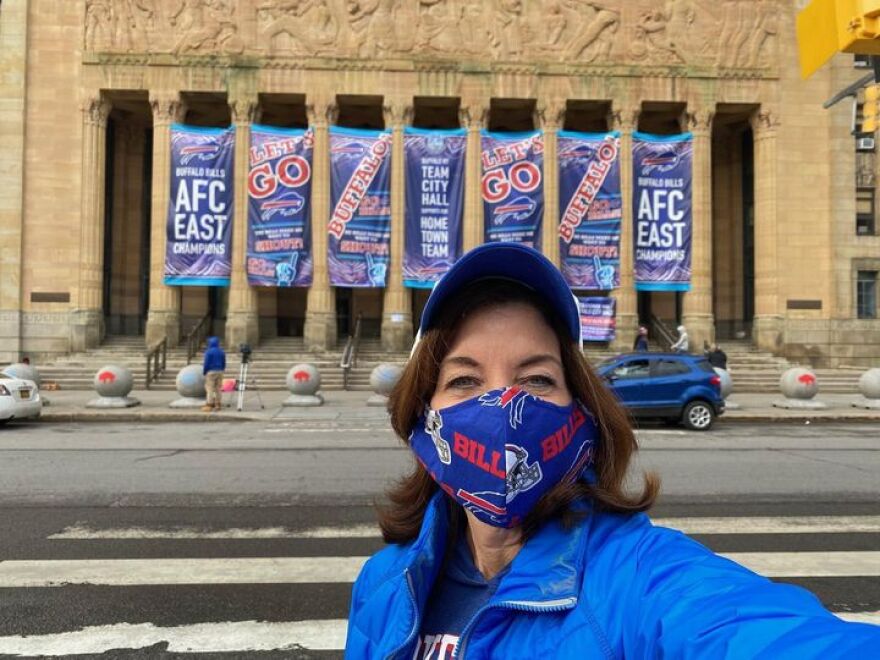
Bills Mafia's goumada

 https://npr.brightspotcdn.com/dims4/default/50b7758/2147483647/strip/true/crop/720x540+0+0/resize/880x660!/quality/90/?url=http%3A%2F%2Fnpr-brightspot.s3.amazonaws.com%2F31%2F37%2F3474c1ae4256af11ff78f3a41d5c%2F248249896-2989934124601120-2705189198884266669-n.jpg

 Times Union

Gov. Kathy Hochul and western Democratic lawmakers on Monday announced a plan to publicly finance about $850 million of a new $1.4 billion stadium in Orchard Park for the Buffalo Bills.

The plan, which includes $600 million from the state and $250 million from Erie County, came out in the final days of state budget negotiations and rankled progressive advocates and left-leaning economists who view it as a poor use of taxpayer dollars at a time when the state is flush with cash from federal aid and there are competing interests for how to spend that money.

The deal would target opening the stadium in 2026 and keep the professional football team there for at least 30 years; if the team received court authorization to leave that location, it would have to pay back all of its public subsidy, according to the governor's office.

Further, the Bills are required to pay any cost overruns during construction, a provision that was not included in the development of other facilities in the state, including Yankees Stadium, which ran at least 30 percent over its budget.

The $850 million public subsidy would be the largest for any NFL facility on record, according to the Associated Press, but the state and Erie County would be paying a smaller share of the construction costs than other taxpayer-funded stadiums. The current facility, Highmark Stadium — which was previously known as Rich Stadium and Ralph Wilson Stadium — opened in 1973 and was buoyed by taxpayers footing nearly three-quarters of the construction costs.


Monday, January 6, 2020

Albany and New York City offered more corporate welfare to Amazon


Marketscreener


State officials offered Amazon.com Inc. almost a billion dollars more of incentives than was previously known to win its second-headquarters contest and were even prepared to pay part of some employees' salaries if the tech company developed a campus in New York.

Documents reviewed by The Wall Street Journal show the scope of what state and local officials initially put on the table as part of the 2017 HQ2 competition, in which more than 200 cities submitted bids to host a facility that Amazon said would house 50,000 jobs.

The company said in November 2018 that sites in Northern Virginia and the Long Island City neighborhood of Queens would split the new headquarters. New York state and city officials agreed to give $3 billion of incentives to the e-commerce giant to hire as many as 40,000 employees.
Facing opposition from some local elected officials, Amazon abandoned its plans for New York on Valentine's Day last year.

The Journal obtained the records through a Freedom of Information Law request to Empire State Development, the state's economic development authority.

The documents show that in its first formal bid to Amazon, in October 2017, the state offered to provide up to $2.5 billion of incentives to the company for a campus in New York. The offer also applied to sites that state and local leaders proposed in the Hudson Valley, Albany, Central New York, Buffalo, Rochester and on Long Island.

The state's initial offer included $1.4 billion of tax credits based on the number of employees hired and $1.1 billion of various grants. That was $800 million more than the ESD agreed to in a memorandum of understanding signed a year later: The state provided $1.2 billion of tax credits and $505 million to reimburse some construction costs. 

Before Long Island City was selected, different New York localities made site-specific incentive offers. Nassau County officials offered $2.2 billion in tax exemptions to build a facility at the Belmont Park.
On top of the state's final $1.7 billion package, New York City ultimately offered Amazon up to $1.3 billion of extra incentives through two programs open to any company.

Officials also presented alternative campus sites, including near the World Trade Center in lower
Manhattan, on the island's West Side near Penn Station and in downtown Brooklyn. The city proposed that Governors Island, a former Coast Guard base between Manhattan and Brooklyn, could serve as an "island retreat" for Amazon employees.

ESD initially proposed to spend $500 million to create a Center for Commercial Innovation near the selected site that would let Amazon partner with various colleges for research relevant to its business. The site would also subsidize job-training programs, according to the proposal, and the state pledged to pay 25% of certain graduates' first-year wages with Amazon to help it achieve workforce diversity.

Wednesday, October 2, 2019

NYC Ferry so white

Gothamist


Riders of Mayor Bill de Blasio's subsidy-soaked ferry system are significantly richer and whiter than their mass transit counterparts, according to new data reluctantly released by the city.

The long-sought figures reveal that 64 percent of ferry riders are white, with a median income ranging between $75,000 and $100,000. By comparison, studies have shown that two-thirds of subway riders and three-quarters of bus riders are people of color, with median incomes at around $40,000 and $29,000, respectively.

The disparities are likely to intensify criticism of the troubled transit project, which will cost New York City taxpayers more than $600 million over the next three years. In order to keep the price of a trip equal to a subway swipe, the system currently benefits from a per-rider subsidy of about $10, set to jump to nearly $25 on some newly-expanded routes, according to an analysis from the Citizen Budget Commission.

Faced with questions over the ballooning price-tag, de Blasio has repeatedly championed the service as an antidote to transit inequality, part of his broader agenda to make New York the "fairest big city." A spokesperson for the Mayor's Office did not respond to inquiries about whether this new breakdown in ridership would force him to reevaluate that position.

 The Economic Development Corporation, the quasi-public agency that operates the system, previously declined to provide data to back up that claim. The results of three previous rider surveys were not made public, and the agency has ignored multiple freedom of information requests sent by 
Gothamist and other media outlets.

 The new demographics were shared with the media in a slideshow marked "not for distribution," which has not yet been posted online. An EDC spokesperson would not say why the slideshow was being withheld from the public.

Is anybody going to factor the $10 subsidy per rider with the free shuttle buses the NYC Ferry provides?


 Update:

NY Post


Mayor Bill de Blasio promised to run the most transparent administration in Big Apple history, but City Hall appears to have violated the state’s open records law by withholding key data about the East River ferry, experts said Wednesday.

In April, The Post demanded the statistics compiled by the Economic Development Corporation about the $637 million NYC Ferry system’s ridership under the state’s Freedom of Information Law — only to be repeatedly rebuffed and told the search for the records was still ongoing.
However, EDC revealed the existence of the data by leaking a presentation summarizing its findings to another newspaper Monday night.

“It violates the Freedom of Information Law,” said John Kaehny, an open-records expert who runs the good-government group Reinvent Albany. “It’s really unacceptable — and particularly lame.”
The Post filed the FOIL request on April 15 asking for “the results of the demographic survey of boat riders, by line and by stop, if available,” as well as for contracts and other related documents.

The agency confirmed it received the records request on April 22 and later released the contract and some supporting paperwork, but never provided the crucial ridership data.
Instead, it claimed in letters dated May 20, July 5, Aug. 2 and Sept. 6 that agency officials were “continuing to search for additional documents.”

However, EDC’s 13-page presentation summary reveals that as it stonewalled The Post and others, it had already conducted at least three surveys of its ridership.

“This is the 4th onboard survey conducted in NYC Ferry’s 2 years of service,” it disclosed on the second page of the presentation.

The document shows that the previous surveys covered summer 2017, winter 2018 and summer 2018. The most recent survey covered in the memo examined ridership from this summer.

“This is really not acceptable conduct by any government agency,” said Susan Lerner, the head of watchdog group Common Cause New York. “The data is subject to FOIL, there is no excuse for playing games.”

 “Certainly the spirit of the law has been violated,” she added. “This sort of game-playing should not be countenanced.”

Recall that Mayor de Blasio broke the "spirit of the law" with his illicit pay to play Campaign For New York PAC he ran in City Hall and still avoided indictments from Attorney General Cy Vance and acting Southern District Attorney that replaced Preet Bharara. So whatever the spirit of the law entails is pretty much dead.


Thursday, January 11, 2018

Torres leading anti-tweeding investigative committee

From the NY Times:

If there was any lingering doubt that Mayor Bill de Blasio’s mostly harmonious relationship with the City Council was about to change, Councilman Ritchie Torres may put that question to rest.

Mr. Torres, a Democrat from the Bronx, has been chosen by the Council’s newly selected speaker, Corey D. Johnson, to be in charge of a new investigations unit that will look into the operation of city agencies.

In an interview, Mr. Torres said that between 10 and 15 professional investigators, possibly including former prosecutors, would be hired and that the committee would use them to conduct its own inquiries.

Among the areas of possible investigative interest, according to Mr. Torres: “The abuse of placards. The use of eminent domain. The disposition of public land. Deed restriction. The disbursement of city subsidies,” he said. “All of it is on the table.”

Tuesday, October 17, 2017

State would make more money off filming if it ended subsidies

From the Village Voice:

When the D.C.-based subsidy watch group Good Jobs First released its analysis recently of the $1.2 billion that New York State hands out in tax breaks to private industries each year, one item stood out: $621 million in subsidies for film and TV shoots that take place in the state. That means every man, woman, and child in New York shells out an average of $31 a year in public money into the coffers of studios and production companies.

...though both the city and state film offices provide data showing that the film industry has grown here since Governor George Pataki instituted the state’s tax credit program in 2004, economic experts aren’t so sure, pointing to other numbers that show that film and TV shoots don’t employ many more people in the state than they did fifteen years ago — and that any gain is nowhere near worth the hundreds of millions of dollars a year that the state pours into it.

And even if a positive impact does exist, New York’s film industry spending may just be a way of treading water: a zero-sum game where states compete to throw increasing amounts of tax money at the same number of jobs. It’s a problem that corporate-subsidy experts in other industries have dubbed “the economic war among the states” — and it serves mostly to funnel money out of public treasuries and into private pockets.

How could one set of numbers show that film tax credits have led to a huge boom in production jobs, while others show little to no effect? One issue is that the state’s audits separately report each job stint, no matter how short, rather than converting to “full-time equivalent” jobs — a tiny footnote in the Camoin study indicates that “if one person is employed part-time for four months, then takes two months off and is hired again for four months that would be counted as two jobs.” As a result, the official state numbers double- or triple-count crew members who work on multiple productions in one year.

Thom says that a study by the California legislature estimated that one-third of production activity in that state would take place in that state with or without subsidies. If the same ratio holds true in New York, then even if the state cut off the subsidy spigot and two-thirds of productions hightailed it to more budget-friendly climes, the state would still collect more than $250 million a year in tax revenues on an expense of zero dollars. With the current program running about a $100 million annual return by the state’s own figures, this implies that New York state would bring in about $150 million a year more in net revenues if it cut off film credits entirely — money it could conceivably then spend on more effective job-creation programs.

Wednesday, June 7, 2017

Public is subsidizing apartments for the well off

From the Daily News:

When David Sans applied for a $722-a-month two-bedroom in a luxury Manhattan apartment tower that includes taxpayer-subsidized affordable units, he claimed a full-time salary of $24,745.

At the time, however, records Sans filed as a registered stockbroker listed him working full-time for securities firms as an investment banker specializing in health care companies.

When he came up for recertification to continue living in his ninth floor low-rent aerie, he now provided a 2012 tax form showing his income had suddenly jumped to $238,000.

The next year, Sans — who added a second job as a top executive at Mount Sinai Hospital three months after snagging his low-income apartment — reported an income of $456,502.

Sans’ sweet housing deal surfaced in an audit released last week by state Controller Thomas DiNapoli that looked at how tenants with six-figure incomes are able to obtain “affordable” apartments subsidized by the public.

DiNapoli found that as of December 2015, 160 tenants living in affordable units in New York City were making $100,000 or more, with eight making $250,000 or more.

Wednesday, March 23, 2016

Here's who voted no

From Politico:

One man yelled they were breaking his arm, while another woman shouted, “We put the mayor in, and he’s destroyed the city!”

After the balcony was cleared, without any arrests, the meeting continued.

One council member after another described Mandatory Inclusionary Housing as historic and legacy-building.

In reality, it is unlikely to have the sweeping impact their rhetoric would suggest.

The Department of City Planning has projected it would be responsible for the creation of 12,000 low- to moderate-income apartments —15 percent of the 80,000 the mayor hopes to create by 2024.

The mayor and his housing officials made clear, particularly when they were pushing back against widespread criticism of the plan last fall, that it is not the primary trigger for low-income housing. Rather, it is the $8.2 billion in subsidies the city has budgeted to spend on rent-regulated apartments over a decade that will be mainly responsible for bringing the mayor’s housing plan to fruition.

The policy will also be hurt by the expiration of the 421-a development tax break, which many builders say is necessary for them to build any affordable housing. Without it, they argue, they will simply forgo the rezonings because it is not financially feasible to create below-market-rate housing without a tax break.

“Without 421-a, mandatory inclusionary is almost meaningless. Without it, the subsidies necessary to get any of the rezoned projects built would basically make them public housing,” one developer who would only speak on background said earlier in the week.

Council members Inez Barron, Jumaane Williams, Joe Borelli, Steve Matteo and Barry Grodenchik all voted against the Mandatory Inclusionary Housing proposal. Council members Barron, Borelli, Andy Cohen, Grodenchik, Matteo and Paul Vallone voted against the Zoning for Quality and Affordability proposal.

Friday, August 7, 2015

BDB allowing developers to double-dip

From Crains:

In a change from last year, the de Blasio administration will let some residential developers double or even triple-dip into subsidy pools by using the same group of affordable apartments to qualify for a variety of programs—a practice it initially pledged to eliminate.

The pivot came to light as details of two housing programs were released in recent weeks. First, in late June the state legislature took a cue from the mayor and passed preliminary reforms to a property tax exemption called 421-a, requiring developers to set aside 25% to 30% of apartments in new buildings as affordable housing.

Then last Friday, the administration discussed the specifics of a new proposal called mandatory inclusionary zoning. The policy, which must be approved by the City Council, would set strict new affordability rules for any property that is rezoned, whether through a neighborhood-wide initiative or an individual property owner's request. In those situations, developers must also set aside up to 30% of all new condo or rental buildings as affordable.

The administration had initially envisioned developers meeting the requirements for these two programs separately, drawing a hard line against “double dipping” into multiple subsidy pools, which it believed limited the creation of low-cost units. In other words, affordable apartments built to satisfy inclusionary zoning requirements couldn’t also be used to meet 421-a benchmarks.

“If you want the tax exemption, you will have to do more," Deputy Mayor for Housing and Economic Development Alicia Glen told Crain’s in September, when the programs were still in their conceptual phases.

But the policies unveiled since then show a different approach.

Thursday, February 26, 2015

How much will Fresh Direct pay back?

From the Queens Courier:

As online grocer FreshDirect is getting ready to pack up and exit Long Island City, the company is listing its massive Queens waterfront facility for sale.

FreshDirect has hired Cushman & Wakefield to sell its facility at 23-30 Borden Ave. ahead of its move to the South Bronx, which was approved last year.


Based on this article, it seems that Fresh Direct is trying to sell before they even have the rest of their subsidies in hand and opposition growing.

They agreed to stay till 2025, and the NYCIDA is supposed to have been monitoring them every year.

Funny how in 1999 in their application to IDA, they claimed more full time jobs than what's currently listed in their NYS ESD application for the $10 million.

So, will FD have to pay back the subsidies they got to fix up that space?

Fresh Direct Inc. f/k/a Gourmet Holdings, LLC
ID: 92407
Awarding Agency: IDA
Address: 23-30 Borden Avenue
Borough: Queens
Block: 68
Lot: 38
Subsidy Program: Industrial Incentive
Start Date: 12/08/1999
End Date: 06/30/2025
Jobs at the start of the deal: -
Jobs projected: 160
Current jobs FTE: 2650
Part-time permanent jobs: 76
Part-time temp. jobs: 0
Full-time permanent jobs: 2612
Full-time temp. jobs: 0
Contract employees: 0
Construction jobs: 0
Health Benefit full-time?: Y
Health Benefit part-time?: N
Percent of employees living in NYC: 78
Total value of subsidy: $5,214,191
Amount used to date: $3,149,480
Recapture amount: $0
Penalty: 0.00
Data source fiscal year: 2013
Bond Issuance: $69473
Value of Energy Benefit FY 11: $0.00
REAP FY 11: $0.00
CEP FY 11: $0.00

Thursday, February 5, 2015

Transit advocates don't want more ferries

From Capital New York:

By de Blasio's estimation, New York City is a water-bound metropolis whose rivers and harbors are underutilized resources. It's a view shared by politicians representing water-proximate neighborhoods from the Rockaways to Red Hook to Brooklyn Heights.

Transit advocates, however, greeted his pronouncements tepidly.

"In the transit community that I am a member of, ferries are looked on as being as helpful as rowboats," said Gene Russianoff, staff attorney at the Straphangers Campaign.

Jeffrey Zupan, a senior fellow for transportation at the Regional Plan Association who's a bit more ferry-positive than Russianoff, said that while it was a good thing to explore how best to further deploy ferries, caution is also in order.

"The idea of running ferry service has always been attractive ever since ferries stopped running, when we built all those bridges and tunnels," Zupan said.

But by his count, since 1986, ferry operators have tried roughly 70 different ferry routes to Manhattan, and only about 20 are still in place.

That's because most ferries move relatively few people and generally require more per-rider government subsidy than subway and bus operations.

In fact, the de Blasio administration made that very argument last year, when it decided to cancel ferry service to the Rockaways because it cost too much per rider.

Thursday, November 20, 2014

Hudson Yards is more than the city bargained for

Dan Doctoroff
From the Daily News:

Wherever you wander along midtown Manhattan’s far West Side, you’ll come across the dusty din of jackhammers, cranes and construction crews lifting new hotels, condos, and office buildings into the sky.

Welcome to Hudson Yards, the 26 acres around the MTA’s West Side railyards that New York’s real estate moguls keep touting as this city’s next great commercial district.

But the slick pitchmen for Hudson Yards rarely mention the scandalous subsidies taxpayers have shelled out the past 10 years for this megaproject.

The city will have paid nearly $650 million in subsidies into Hudson Yards by the end of this fiscal year, according to a review by the city’s Independent Budget Office — and more will be needed in the future.

That’s not exactly how the project was sold when the City Council approved it in January 2005.


It never is. It's always lies.

Saturday, October 4, 2014

A new approach to preventing homelessness


From NBC:

Mayor de Blasio's administration is rolling out some new plans that it hopes will reduce the number of families sleeping in the homeless shelter system. Melissa Russo reports.

Thursday, October 2, 2014

Goldfeder wants SI Ferry charge to subsidize Rockaway ferry

From AMNY:

The Staten Island Ferry's fare-free service is seen as both a critical transportation link that brings transit-starved residents to a paid subway ride and as an unfair freebie to its critics.
Now, there are calls to hit tourists with a $4 fare to fund transportation in the city from Queens advocates trying to keep ferry service in the Rockaways past October.

"Staten Island is already receiving a generous subsidy, while Rockaway is still desperately in need of permanent ferry service and better transportation options," Queens Assemblyman Phil Goldfeder said in a statement.

Just 15% of ferry riders in Staten Island live outside of the city, according to a recent Independent Budget Office analysis of the idea. The city paid an average of $5.75 a passenger this year.

Charging for rides could generate $35.5 million in net revenue over 15 years with a stand-alone fare system; letting riders pay with a MetroCard would generate $67.4 million over the same period if the MTA paid the city for each swipe of an unlimited-ride.

Thursday, August 28, 2014

Fresh Direct really got a sweetheart deal

Very interesting post over at Atlantic Yards Report:

ESD is about to give Fresh Direct a $9 million grant and a $1 million loan to move/expand from Long Island City to the South Bronx.

That's on top of $10.5 million from the New York City Industrial Development Authority and $1 million from the New York State Department of Transportation and $5 million in New Markets Tax Credit Equity.

Add $15 million from the investment fund Brightwood Capital, $40 million in the company itself, and a whopping $84,168,000 in an EB-5 loan.

Unmentioned are previous promises (which may have been adjusted) of $18.9 million in state Excelsior tax credits; $4 million in state energy grants and incentives; up to $1 million in vouchers for the purchase of electric vehicles; about $74 million in city sales tax exemptions, mortgage recording tax deferral, and real estate tax exemptions; $4.9 million in city energy benefits; $1 million capital grant from Bronx Overall Economic Development Corporation; and a $3 million loan and $500,000 capital grant from the Borough President

Let's put aside the strangeness of the city and state subsidizing a cross-borough move based on a perceived threat from New Jersey, an unlikely base for a delivery service that needs quick access to Manhattan.

Or that Fresh Direct is moving after having gotten subsidies to stay in Queens through 2025.

Or that neighbors (see South Bronx Unite) pose some heavy concerns about the project's environmental impacts, and that if the promised job total is not reached, there's no "clawback provision" to recover subsidies. (See Good Jobs New York timeline.)

The really strange thing is the reliance, according to ESD Board Materials (p, 51ff.), on the EB-5 immigrant investor program, in which foreign millionaires, mostly from China, park $500,000 in a purportedly job-creating investment, get green cards for themselves and their families, and later get their money back. (In this case, they're getting a relatively high--for EB-5--rate of 4.5%.)

The developer gets cheap capital. The public is supposed to get 10 jobs for each investor.

According to promotional material supplied almost surely by the New York City Regional Center, the private investment pool set up to market EB-5 investments (and reap fees), the project would not be $166 million in total, but $208 million.

That's not the only misleading part. EB-5 funding is said to make up just 40% of the project, rather than more than 50%.

And Fresh Direct is said to be providing the rest of the funds, which is clearly not true.

Friday, April 18, 2014

Hope for the homeless


From WNYC:

New York City is creating a new rental subsidy to help tackle its unprecedented homelessness crisis.

According to a draft of the proposal obtained by WNYC that the city sent to the Cuomo administration in March, the subsidy would be available to an estimated 1,400 to 2,800 families in which at least one member works full time, 35 hours a week. Currently 13,000 families live in the city’s shelters.

For a two-bedroom apartment that costs $1500 a month, a family could get a subsidy of $1,100. The total cost of the program could be as much as $115 million a year by the fifth year, according to the proposal. The city would have to negotiate with the state on how to split that cost.

The city said it’s still refining the proposal and refused to comment for this story. But advocates say they’re optimistic.

Friday, April 4, 2014

Port Authority as real estate speculators

From the NY Times:

The developer and philanthropist Larry A. Silverstein has cut a striking figure in New York City. He owns the H.M.S. Bounty-size yacht favored by his peers and has dominated the rebuilding of ground zero for a decade.

Along the way, he has internalized a developer’s rule of thumb in New York: Only a rube puts much of his own money at risk.

Billions of dollars in Liberty bonds, insurance money, developer fees: Year after year, Mr. Silverstein has shaken the public tree and benefits have fallen to the ground.

Construction of 4 World Trade Center is completed and it stands about half empty, with commitments from just two tenants: New York City and State. Now Mr. Silverstein wants to complete his 70-something-story 3 World Trade Center. He has found just one prospective tenant for it.

City and state officials, ever helpful, agreed to give that company, GroupM, a $15 million cash subsidy and tax breaks worth about $75 million.

Now Mr. Silverstein wants to shake the tree again. In March, as Charles V. Bagli reported in The New York Times, he asked the Port Authority of New York and New Jersey to guarantee up to $1.2 billion of his construction loans. The authority’s board could vote on the proposal this month.

As chutzpah, this was impressive. As public policy, it was less salutary.

Kenneth Lipper is a board member of the Port Authority, a former deputy mayor under Edward I. Koch, an investment banker and a novelist with a keen eye for currents of power, municipal and financial.

In an interview on Monday, he described how the board had signed off this winter on a capital plan, carefully assigning priority to rebuilt bridges, a new terminal at La Guardia Airport and — Mr. Lipper’s personal favorite — the rebuilding of that corroding pile of metal and concrete that is the Port Authority bus station in Midtown.

Then Mr. Lipper saw the request from Mr. Silverstein.

“Am I in ‘Alice in Wonderland’?” he recalled thinking. “I wanted to get a modern bus terminal built and we’re talking about putting $1.2 billion into a private developer, in which he gets the gain and we take the hit?

“Is it the role of an agency representing taxpayers and toll payers to speculate in real estate?”

Monday, January 7, 2013

Urban farmers?


From the NY Post:

More than 1,500 city residents are getting federal farm subsidies, 374 on the Upper East Side alone.

The recipients include some “farmers” who already have their own well-cultivated money trees, among them Mark F. Rockefeller.

“That should really make people wonder what on earth has happened to the farm program,” said Craig Cox, senior vice president for agriculture and natural resources at the Environmental Working Group, which maintains a national database of farm-subsidy recipients.

“Payments are going to people in Manhattan who simply have invested in farmland and are about as far away from farmers as one could imagine.”

Rockefeller, a fourth-generation member of the family and the younger son of late Vice President Nelson Rockefeller, has gotten $342,634 in taxpayer handouts from 2001 through 2011 for thousands of acres of unused farmland he owns in Bonneville County, Idaho. The payments are made so that he does not farm, to allow the land to return to its natural state.

His subsidy is for conservation purposes. Other subsidies come in the form of disaster payments, which allow farmers to recoup losses from drought, frost, hurricanes or tornadoes, or commodity payments, to regulate the prices for crops such as corn, soybeans and wheat.

Tuesday, January 1, 2013

Judge nixes public payment of defense

From the NY Post:

Here’s a bright bit of news: Crooked Albany pols may be getting only one one shot at having taxpayers cover their legal bills when they’re caught with their hands in the cookie jar.

To be specific, Assemblyman William Boyland Jr. (D-Brooklyn) received the bad news last week: Brooklyn federal Judge Sandra Townes rejected his request that taxpayers pick up the bill for his legal defense in his latest corruption trial.

Townes rightly noted that Boyland — who owns a $460,000 home and earns a $79,500 part-time salary plus a legislator per diem that brings in an additional $17,000 — should be able to afford his own attorney.

Of course, it’s understandable that Boyland would assume that he could get the public to pay for his legal defense in this trial, his second in as many years.

After all, the taxpayers were on the hook in last year’s federal trial — in which he beat a variety of pay-to-play and no-show-job charges.

The Manhattan federal judge who heard that case determined that taxpayers should subsidize Boyland’s defense.

Friday, October 12, 2012

Fool us twice, shame on us...

From the Daily News:

Bronx activists had some advice on Tuesday for Queens: Keep your precious park land and ignore the stadium sweet talk.

Major League Soccer said it’s close to hammering out a deal with the city to build a $300 million stadium on up to 13 acres in Flushing Meadows-Corona Park.

But the plan is reminiscent of a Yankee Stadium land deal that “shortchanged” the Bronx, local activist Mary Blassingame said.

“This is Yankee Stadium all over again,” she said. “They need to fight against it. Parks are for the people ... not for business.”

City officials begged to differ.

“As anyone who’s been to Heritage Field across from Yankee Stadium would say, it’s a stunning example of public space that has been widely celebrated by local residents and parks advocates alike,” said Mayor’s Office spokeswoman Lauren Passalacqua.

Blassingame, a former Bronx Community Board 4 member, was a vocal opponent of the 2005 deal that allowed the Yankees to build a new stadium on 22 acres in Mullaly Park.

The Bronx Bombers promised the new venue would create local jobs and business and the city vowed to replace the green space with new parks elsewhere.

But the area near the stadium is still struggling and it took the city six years to complete the new parks, which are top-of-the-line but scattered, Blassingame said. “We got shortchanged all the way and now it’s going to happen again,” Blassingame predicted.

“The land they’re currently talking about on Flushing River is toxic,” said an elected official who asked not to be named. “So how would that be cleaned up?”

MLS officials said the Queens stadium will be privately financed, unlike Yankee Stadium, which received hundreds of millions of dollars in subsidies.

The Bronx Bombers made similar claims during early negotiations, said Neil DeMause, co-author of “Field of Schemes,” a book on modern stadium deals.

“History makes it reasonable for New Yorkers to look at this proposal with skepticism,” he said.

Monday, July 9, 2012

Developer holds up project for more subsidies


From the Daily News:

Plans for a $35 million South Bronx development have been delayed and could collapse completely because the city and the company building the landmark project are at loggerheads, the Daily News has learned.

Triangle Equities has defaulted on its agreement with the Bloomberg administration to construct two buildings with retail space, office space, a supermarket and a school on city-owned lots in the Hub shopping district.

The Queens-based developer was required to close on the parcels in May but instead asked to renegotiate, putting 200 permanent jobs and 100 construction jobs in jeopardy, according to New York City Economic Development Corporation officials.

Triangle is demanding public subsidies and wants the administration to slash the price of the property from $6.2 million to $2.2 million, EDC officials said.


Isn't it great how the city allows developers to hold it hostage? And why do we feel the need to build malls everywhere?