Showing posts with label light rail. Show all posts

Thursday, January 11, 2024

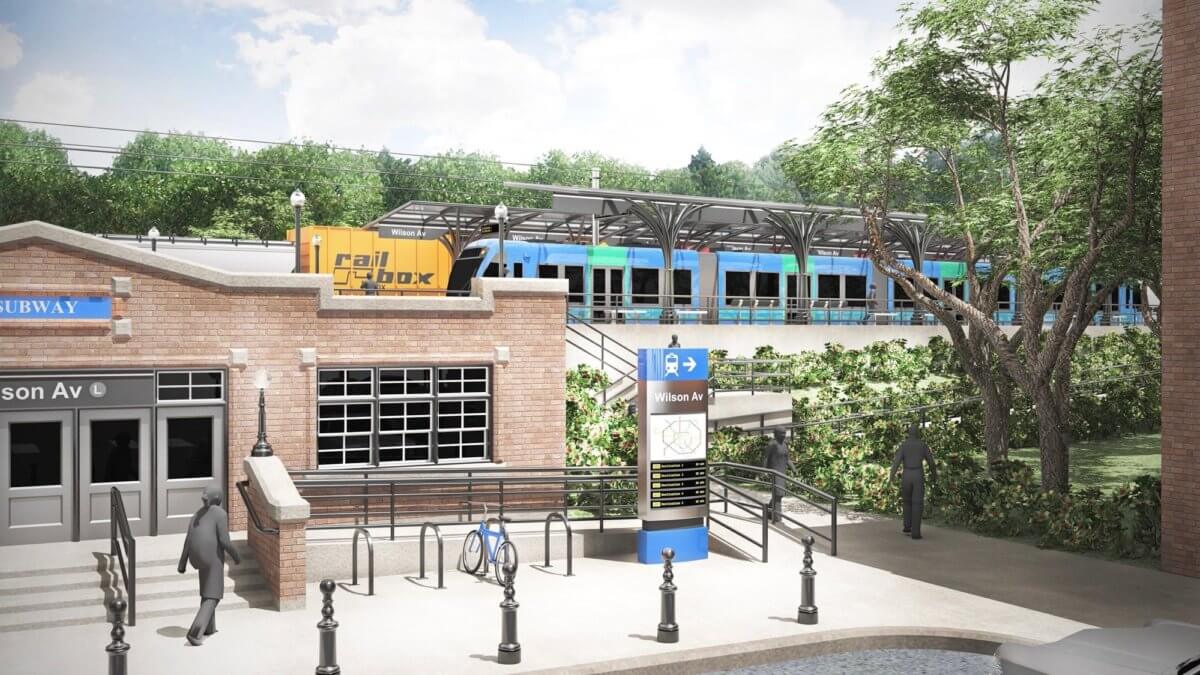
Big Mother Hochul's light rail project makes first baby steps

https://www.amny.com/wp-content/uploads/2022/01/IBX-2-1200x675.jpeg

AMNY  

The proposed Interborough Express (IBX) light rail between Brooklyn and Queens is inching forward, with officials hoping the project can be designed and engineering challenges resolved starting this year, Gov. Kathy Hochul announced on Tuesday.

The governor’s 2024 State of the State policy book, accompanying her big speech to a joint legislative session in Albany Tuesday, notes that the MTA will “initiate formal design and engineering” on the IBX, which aims to convert the underutilized Bay Ridge Branch rail spur, owned by the Long Island Rail Road and currently used by CSX freight rail, into a light rail line between Brooklyn and Queens, sharply reducing commute times between the two boroughs.

The line would run 14 miles between Bay Ridge and Jackson Heights, running through many neighborhoods with few transit options while also connecting to 17 other subway lines. The MTA estimates the line would see 120,000 daily riders by 2045, and cost $5.5 billion to construct.

“The [IBX] represents one of the most impactful infrastructure projects initiated by Gov. Hochul,” the policy book reads, “with the potential to substantially cut down on travel times, reduce congestion, and link nearly 900,000 residents in Brooklyn and Queens to more than 17 transit connections.”

Gov. Hochul announced she would pursue the IBX in her 2022 State of the State address, crystallizing a longtime dream by rail advocates. The proposal was based on a long-floating plan by the Regional Plan Association called the Triboro, which would extend the line further into the Bronx, but the Boogie-Down portion was cut due to conflicts with the MTA’s Penn Access project on the same existing tracks.

The governor in 2022 directed the MTA to commence an environmental review for the project, which she has since described as her “baby,” and in the following year’s State of the State, she said the project would move forward as light rail.

Unlike a subway, a light rail can travel at the street level, and the MTA plans to briefly divert the right-of-way onto Metropolitan Avenue and 69th Street in Middle Village for about 2/3 of a mile before returning to the pre-existing tracks. How the MTA would actually go about doing that is one of the key engineering problems they must get to the bottom of, even before worrying about potential lawsuits from local residents.

Monday, February 5, 2018

Silly train study says what we already knew

Summary of Findings from the Lower Montauk Branch Light Rail Study:

 Initial analysis shows that it would be feasible to develop joint passenger-freight operations on the Branch, allowing for robust transit service while maintaining and upgrading freight operations if desired.

 Approximately 21,000 riders per weekday and 5.8 million riders annually would use the service, assuming a $2.75 fare, a free transfer to MTA Bus or Subway, and relatively frequent service throughout the day. Fare revenues are estimated at $15 million annually, while annual operations and maintenance costs are estimated at $55 million.

 Capital costs while maintaining freight service on the Branch are estimated at $2.2 billion, including substantial upgrades to rail infrastructure (track, signals, communications), new running track in key areas, new freight yard space to clear track for transit operations, transit vehicles, a storage and maintenance yard for transit vehicles, and property acquisition. Eliminating freight service altogether on the Branch – an option not analyzed in this study – would reduce total capital costs to about $1.1 billion. Value Capture financing, using a portion of the increase in property values induced by this new transit service, could potentially fund $300 million in bonds, or roughly 27% of total projected capital costs for passenger-only rail operations on the Branch and 14% of such costs under the analyzed option of both passenger and freight rail operations.

Preliminary Estimate: Projected Bond Support from 5 Key Station Areas ($2017)
Grand Ave./Flushing Ave. $50,000,000
Fresh Pond/Metro Ave. $39,000,000
Metro Mall $59,000,000
80th Street $61,000,000
Woodhaven Blvd. $100,000,000
Total: $309,000,000


Bottom line: Way too expensive + not enough riders = a no go. The mayor actually said this in front of Liz Crowley back at his December 2017 town hall meeting in Glendale. The DOT quietly threw this up on their website, probably because they didn't want to call attention to the fact that their agency and the council member blew $1/2M on this nonsense. The taxpayers' loss is AECOM's gain.

Friday, September 29, 2017

Elizabeth Crowley's light rail exposed as a real estate scheme (again)

If you have a chance to sit down for about 20 minutes and really examine this entire presentation at the link from LTV Squad, it will be worth your time. Highlights presented below:

The need for new transit options is huge. However, I am often extremely disappointed by what passes for transit planning and advocacy these days. Many of the plans being pushed by our elected officials are devoid of facts, or purposely misrepresented with outright lies. These plans are too often not based on actually commuter needs, and are instead only take the considerations of the real estate industry to account. It is easy to see why our politicians are so concerned with pleasing the real estate industry, since many of them are financially supported by deep pocket real estate ‘developers’.

This time two years ago, Ray Cevoli penned a scathing rebuke of Elizabeth Crowley’s initial Lower Montauk transit plan. We had hoped, by simply pointing out many facts, that attention would be paid to actual reality (vs. a vague pie in the sky idea). Looking through the latest presentation on this route, I can see nothing has changed at all. We are two years into talking about this project and no closer to it ever happening in any form.

To illustrate my points, I’ve circled key areas of the presentation in red. Here we see that AECOM is being paid half a million taxpayer dollars to create a study on project. I’m a little confused here. Isn’t this a plan from Crowley’s office? Does she not have staff to do some of this research work? Is she herself adverse to work? I sure hope AECOM’s study considers all the facts, because that’s a lot of money. I could do the job for half the cost in a year.


[AECOM is also the consulting firm helping the city push for the Glendale homeless shelter on Cooper Ave.] - QC
The last statement on the slide is a complete lie: existing air train rail cars can’t use the Lower Montauk line. Again, there is no third rail. Installing one, with a modern signal system, would be a billion dollar project. There’s also the little matter of FRA and ADA regulations, which are being ignored. All of those AirTrain cars would likely have to be replaced. Anyone who knows anything about rail operations knows this. This is not an oversight on Team Crowley’s behalf. They have been working on this for two years now. This statement is a lie. A purposely stated lie.

I’m not sorry to say this: lying to the public is not kosher. It is willful deceit with the intention of achieving a hidden agenda goal. And it is being presented right here, just one slide into this presentation. Once you open the door to lies, it throws every single other piece of information in this presentation into question. Now every line must be analyzed to verify if it is factual or fake news.

Again: we’re talking about an NYC transit project. Everyone knows we need more transit options. There is zero need at all for any lies.

I found this slide interesting – disinvestment? We’re now going down the rabbit hole of evil real estate developers, who make it sound like older houses and buildings automatically means low value, bad for the economy, perhaps even blighted? Look at this map, and then go walk around these neighborhoods. In the residential areas you’ll find homeowners who care about their neighborhoods, maintain and improve upon their homes, and who like their neighborhoods just they way they are. The only purpose for this slide is to target real estate developer, showing them a part of the city that hasn’t see the skyrocketing rents we see in places like Astoria, LIC and Greenpoint.

It’s worth referring back to Ray’s article, where Liz is quoted as saying “there is a lot of underutilized manufacturing which is also threatening us." Again: none of this property is ‘underutilized”. Blue collar jobs are needed to maintain a large city. We need to work to preserve the few industrial zones we have left in NYC.
A footnote here: if you mention the “G” word to transit advocates, they get really bent out of shape. Personally I think it’s lazy to argue against a transit project on the grounds of ‘gentrification’. I wouldn’t even mention this G word if literally this whole (*&(*&^ presentation wasn’t geared towards real estate development. I’m not going to pound on this drum though. As you’ve seen, I have a dozen other red and yellow flags to throw. I’m sticking to those. Don’t be surprised if someone else throws this G flag though – and when they do, the only person to blame here is Team Liz Crowley for opening this door by putting out a presentation that is all about real estate development and not about actual commuters.


We explained what this was about before. Thanks to Joe for really driving the point home and exposing this for what it is. The sad thing is that most voters are dumb, don't read and swallow everything these tweeders throw at them as something positive.

Thursday, September 14, 2017

A more fiscally prudent transportation plan

From Crains:

Rather than spend several hundred million dollars to build a light-rail system which could take a decade or more, why not ask the LIRR to resume service on this corridor? It could run a two-car scoot service reconnecting Long Island City, Glendale and Middle Village with other communities including Richmond Hill and other intermediate stops to Jamaica. The LIRR could use existing equipment, which would afford far earlier implementation of service than light rail. This would provide connections east bound to the J/Z and E subway lines, Kennedy Airport via AirTrain and the LIRR's Jamaica Station. Queens residents traveling to jobs and colleges in Nassau and Suffolk counties would have access to all LIRR branches except the Port Washington line. Ditto for those traveling to the Barclay Center and downtown Brooklyn via the LIRR Atlantic Avenue branch. There would also be connections westbound at either the Hunters Point or Long Island City LIRR stations to the 7 subway line.

Tuesday, June 7, 2016

Queens delegation looks to throw more money down the drain

From the Daily News:

The borough’s City Council delegation, in a letter to the city transportation commissioner, sought funding for a study to run a light rail on a little-used section of Long Island Rail Road track that stretches from Jamaica to Long Island City.

“Existing travel conditions for residents are inconvenient and arduous, and it is vital we take advantage of any opportunity to lift this burden,” Councilwoman Elizabeth Crowley (D-Queens) wrote in a letter signed by 14 of her colleagues.

Crowley told the Daily News that a light rail would give Queens residents a reason to leave the car at home and avoid the crowding on the No. 7 and E lines that now carry riders across the borough.

Crowley said a transportation option would cut travel times for commuters and encourage commercial development in her neck of Queens. She said the light rail could be a transit link from eastern Queens to the Cornell Tech campus on Roosevelt Island.


What we've learned here is that Crowley loves developers...and hasn't looked at a railroad map.

There's also this and this.

Wednesday, May 25, 2016

Installing light rail is a fool's errand

From Forbes:

What would happen if your city, in the name of progress, started giving poorer residents vouchers for landline telephones rather than smartphones? Or if, rather than stocking public libraries with computers, so that people could write emails, your city installed fax machines? You would consider these unnecessary expenditures on outdated technologies. Yet when it comes to public transit, many cities splurge on modes designed for a different time and place—namely light rail.

Rail transit, such as streetcars, widely spurred America’s urban growth during the industrial era, when automobiles hadn’t yet been invented, and settlement patterns were dense. There are still a handful of dense legacy cities—New York City, San Francisco, Boston, Chicago and Washington, DC—that wouldn’t function without passenger rail. But rail isn’t convenient or practical in sprawling cities, although many have built entire systems nonetheless.

These projects have been championed by everyone from environmentalists, to urban density proponents, to business groups like the Chamber of Commerce, and for numerous reasons. Rail, it is thought, will get people out of cars and into transit; will spur infill growth; and will bring a “sense of place” to strategic corridors.

But it doesn’t seem to do any of this, a conclusion drawn by numerous analysts, most notably Randal O’Toole. For decades, he has written in books, blogs, and as a Cato Institute analyst about the fool’s errands of cities trying to reorient themselves around rail. They spend billions on building and maintaining systems, only to find that their cities largely function as they had before, via car use and fragmented development patterns.

For example, transit ridership rates don’t dramatically increase following rail construction, and sometimes they even decline. O’Toole believes the ridership declines result because rail strips funding from buses, which are cheaper and more flexible.

Rail transit’s role as a catalyst for dense development is also highly questionable—some lines have seen little development go up around them, and experienced high vacancy rates in existing buildings. Others have enjoyed adjacent mid- and high-rise growth. But it’s hard to know, in the latter case, whether it was rail that spurred those developments, or some combination of government subsidies for developers, organic migration back into cities, land use deregulation to allow higher densities, or the construction of other nearby public amenities.

Tuesday, October 20, 2015

Transportation geared toward millenials?

From Capital New York:

Councilwoman Elizabeth Crowley thinks her Queens district deserves some of the light rail transit benefits that Jersey City, Hoboken and Bayonne — just across the Hudson River — have been enjoying in recent years.

In order to provide additional public transportation options, Crowley is proposing to use already-existing railroad tracks in her district to build a light rail line between Glendale and Long Island City along the Long Island Rail Road’s Montauk branch.

“It’s a railroad that is in excellent condition that has no rail cars on it, so it’s a waste of track. It has no real use and there is potential for park-and-rides and development around the rail,” Crowley told POLITICO New York.

Joan Byron, policy director at the Pratt Center for Community Development, said the fascination with light rail has a lot to do with perceptions of bus service, which she said works just as well, if not better.

"Poor people and people of color ride the bus," said Byron. "But we want something shiny and new that young white millennials will ride."

Byron said light rail tends to work best in cities that are trying to get people out of their cars and that don't already have lots of mass transit.

"You have to do something really shiny to get them not to drive," she said.


Please concentrate on improving surface transit in your district. It's already here, and it sucks.

Saturday, July 11, 2015

Crowley pushes for light rail, housing in manufacturing areas

From the Queens Courier:

Commuters in Glendale and Middle Village deal with limited public transportation options. Most residents in both communities live a mile or farther away from the nearest subway station, and local bus lines through the area have a reputation for being slow and overcrowded.

City Councilwoman Elizabeth Crowley hopes to change this situation with a plan to introduce light rail service between Glendale and Long Island City on the Long Island Rail Road’s Montauk branch, which currently offers only freight service west of Jamaica. She hopes to pitch the idea to the Department of City Planning in the coming weeks.

In an exclusive interview with the Ridgewood Times on Monday at her district office, Crowley said a new diesel-powered light rail line would address the transportation needs in Glendale and surrounding communities. ***The light rail line could also encourage redevelopment of underutilized industrially zoned areas adjacent to the line for business or residential purposes.***

Crowley doesn’t suggest rebuilding the former Glendale station, but rather creating a new stop at The Shops at Atlas Park, noting that the shopping center—where her district office is also located—could serve as an active park-and-ride option for local residents.

“If we were able to get a rail here, people could potentially use this spot as park-and-ride, or the community around us could take a bus to the train or walk to the train,” Crowley said. “It provides options for public transportation that would effectively get more cars off our streets.”

She also pointed to an area near Flushing Avenue in Maspeth as another potential station site, noting that it’s close to the connecting LIRR Bushwick branch, another freight rail line that Crowley suggested could potentially also accommodate light rail service.


We all know Atlas Park isn't doing well and that Liz's friends, the Argentos, recently opened a soundstage next to Atlas Park. So it's interesting that she admits that she wants to boost their real estate value by building a light rail station there. But I guess she forgot that there are 2 at grade crossings west of Flushing Avenue, which a light rail to LIC would be forced to pass through, including one which just experienced a serious collision this past week due to a malfunctioning signal. And where are all the freight trains on the line going to go? Freight traffic is increasing, not decreasing.