Showing posts with label floodings. Show all posts

Saturday, January 13, 2024

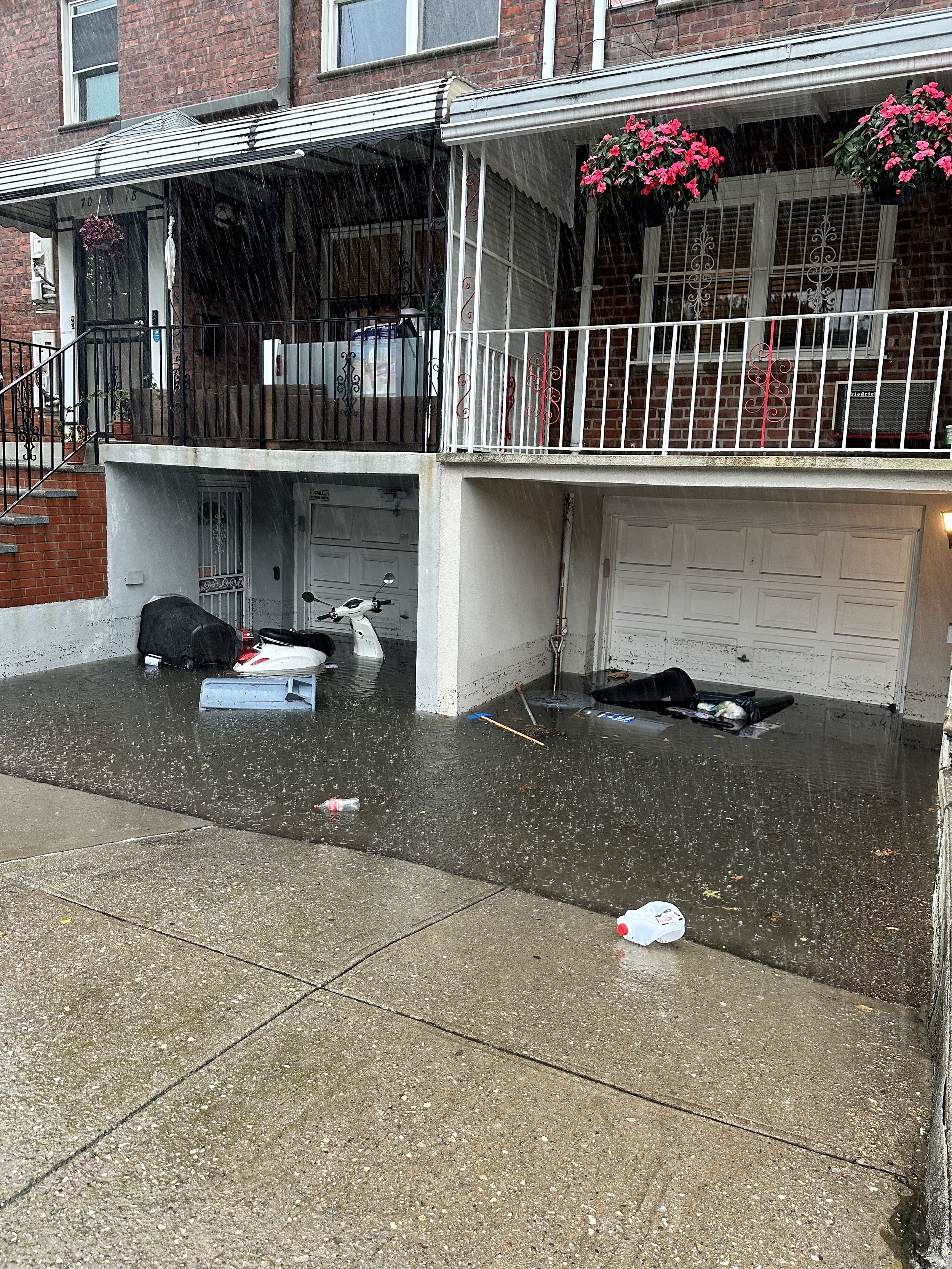
Before and after the flood

https://images.squarespace-cdn.com/content/v1/5b9ffe0f1137a680c2c08250/0a8bd1c7-3ebf-4758-ae5b-7d7b0cbd823b/Driveways+after+water+began+to+recede+-+see+waterline+9-29-23.jpeg?format=2500w

Queens Eagle 

A rainy night means a sleepless night for residents of one section of East Elmhurst. They’d prefer to catch the disaster as it strikes, rather than wake up to it in the morning.

For years, residents of 77th Street and of nearby blocks in East Elmhurst say they’ve struggled with sewer water flooding their basements and apartments, causing them anxiety, health issues and thousands of dollars in damages. Most of the flooding comes after just an average rain, they say.

As climate change brings heavier and more frequent rainfall, locals are looking for solutions, which may not be as straightforward – or as immediate – as they might hope.

“On our block, sewer backup is what impacts all of us,” said Nabil Jamaleddine, an East Elmhurst local and software engineer who has lived in the area since 2017.

Pretty much whenever it rains, locals on 77th Street and surrounding blocks in the neighborhood, stress about sewer surges, which occur when the sewer system and catch basins can’t keep up with the demand brought on by the falling rain.

Heavy rain or a dangerous storm is bad, but just a little bit of rain, Jamaleddine says, can create an immense problem.

“Any amount of sewage in the basement, over a few inches, or even half an inch, is just terrible to deal with,” he said.

The flooding often leads to mold, which becomes a problem in itself. Cleaning the damage caused by the flooding creates more worries due to toxins in the sewer water that find their way into East Elmhurst basements.

Alvaro Cruz, another resident, got an infection in his legs several months after cleaning his basement after Hurricane Ida, which he attests to the dirty water.

“I was in the hospital three times,” he said.

The dangers of the water’s contents usually result in almost everything it touches, including important belongings and family heirlooms, needing to be thrown out.

Draining the basement is just half the battle – wallets are also drained.

“[I’m] just pouring money into this thing just to try to fix it,” said Jamaleddine. “But that thing gets very expensive. A lot of neighbors, they just don't have the funds to do this sort of thing.”

The problems first began to be noticed by residents after Hurricane Ida in 2021, which destroyed basements and flooded areas across the city, leaving 13 dead in the five boroughs, including 11 people from Queens.

The response to tha storm prompted a resurrected conversation on storm readiness, congressional hearings and even a visit from President Joe Biden, who stopped by a flooded block in East Elmhurst.


Sunday, April 3, 2022

Endangered Spaces

Snow geese share the landscape with the A train in Broad Channel. The mix of wild natural features and city infrastructure  makes the area distinctive.

New York Times 

Don Riepe pointed to the line on the wall five and a half feet above his kitchen floor. That was where floodwaters reached during Hurricane Sandy in 2012.

His home, a humble two-story wooden structure, is decorated with nautical maps, horseshoe crabs and assorted maritime paraphernalia. It sits right on Jamaica Bay, with a small dock at the water’s edge, where he moors his 22-foot boat. He has a spectacular view of the east end of the bay with the spires of Manhattan in the distance.

Mr. Riepe, a former manager of the Jamaica Bay Wildlife Refuge, considers himself blessed to be surrounded by nature and still have all the perks of a big city a subway ride away. But he knows his neighbors’ time there may be coming to an end. During his four decades living in the area, Hurricane Sandy was the worst Mr. Riepe has seen; the flooring and all the electrical appliances on the first floor of his house were destroyed. Since then, during lesser storms and even high tides, he moves his computer and furniture upstairs, where he sleeps — and he hopes for the best.

Mr. Riepe is just one of tens of thousands of residents who live on the wild fringes of Queens, in communities like Hamilton Beach, Edgemere and Howard Beach, where the ocean threatens to encroach as sea level rises and coastal storms intensify owing to climate change. It is also the focal point of a major environmental restoration project that aims to protect the area — and in fact the whole city — by returning salt marshes and sand dunes to their natural states. How this will affect the community of Broad Channel (the only inhabited island in Jamaica Bay) remains to be seen.

Already, Mr. Riepe’s neighbors are scrambling to adjust to their new climate-changed reality — moving their cars to higher ground on high-tide days, and in some cases converting their ground floors into garages and shifting their living quarters upstairs and out of harm’s way. One thing that they are not yet prepared to do, however, is move out.


Crains New York 

Flushing Meadows–Corona Park, one of the most frequently flooded green spaces in the city, is getting a comprehensive plan on how best to adapt Queens’ largest park to climate change.

This month a congressional spending bill green-lit a $530,322 grant for the Waterfront Alliance to lead a climate resilience plan for the 897-acre park. Those federal dollars, which Queens Rep. Grace Meng requested from Congress last year, will enable the alliance to develop a road map of infrastructure projects and priorities to stymie prolific park flooding, which is only expected to worsen with increasingly heavy rains and sea level rise.

After heavy rainfall, it’s common for huge puddles to transform park basketball courts and fields into ponds for days. Overflow from both Meadow and Willow lakes frequently engulfs trails, making the park a challenge to navigate. Hurricane Ida laid those challenges bare with torrential rains that flooded the park and overflowed onto the Van Wyck Expressway and Grand Central Parkway, which spurred emergency rescues for drivers trapped on the roads.

That’s nothing compared to what’s on the horizon. Without upgrades, much of the green space, which is a former tidal wetland, could be permanently inundated by 2080, the New York Panel on Climate Change said.

Karen Imas, vice president of programs at the Waterfront Alliance, said the city must ensure the park is “prepared for our climate future.” The best way to do that, she said, is by developing a plan with those who know the park best.

“This is really an opportunity to work hand in hand with the community in and around the park and with city agencies to identify what are the greatest hazards and vulnerabilities, and how they can be addressed,” Imas said. That will likely be through a mix of projects, including wetland restoration, bioswales and revamped sewage infrastructure, she added.


Sunday, October 17, 2021

Woodside homeowner still having issues with FEMA emergency funding after phony consoling by the Blaz

https://nypost.com/wp-content/uploads/sites/2/2021/10/Julia-Nieves2.jpg?quality=90&strip=all&w=744

NY Post 

A Hurricane Ida flooding victim that Mayor Bill de Blasio wrapped his arms around in an emotional scene last month called out Hizzoner on the radio Friday, saying the feds failed to deliver the aid he promised.

“You hugged me and told me that FEMA would take care of everything,” Woodside resident Julia Nieves told de Blasio during his weekly appearance on WNYC’s ‘Brian Lehrer Show’. “Unfortunately, FEMA didn’t give the [$36,000] to anyone in our Woodside homes.”

De Blasio had toured the damage along with U.S. Rep. Alexandria Ocasio-Cortez (D-Queens/The Bronx) and U.S. Senate Majority Leader Chuck Schumer, following days of complaints from locals about City Hall’s lackadaisical preparation and sluggish response to the flooding.

The $36,000 referenced by Nieves is the maximum award available for homeowners through the U.S. government’s disaster relief program — but locals, including Nieves, say they’ve received just a fraction of that amount.

“I can’t replace the water heater, a boiler, replace all the walls,” she added. “You were in my basement and saw what happened to my walls! They had to remove everything because of the mildew and the smell was horrific.”

 Instead, the retiree said on the radio program that she’s been forced to refinance her home to come up with the $11,000 for her new water heater and boiler — and she still needs to buy a new refrigerator, washer and dryer.

“How does this work for everyone in the community of Woodside, Queens who [was] flooded by Ida,” she concluded plaintively — leaving de Blasio on the defensive and promising the city would intervene.

“Julia, look, we’ve got to get you more help, that’s the bottom line,” Hizzoner said. “I saw the destruction in your basement. It’s clearly a lot of money, we’ve got to get you back on your feet.” 

She should also go after Senate Majority Leader Chuck Schumer to find out why FEMA is dragging their feet.