
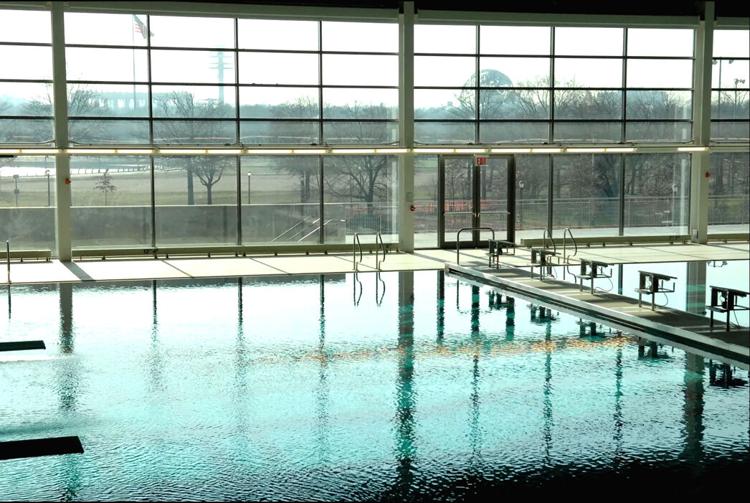
Nearly three years after the Flushing Meadows Corona Aquatic Center’s Olympic-caliber pool closed for what was supposed to be “at least six weeks” for an emergency roof repair, it remains off limits to the public as the Department of Parks and Recreation struggles to repair its unique movable floor.
Parks said in a City Council oversight hearing last December that the pool at the 14-year-old, $67 million facility — built as part of New York City’s unsuccessful bid to host the 2012 Olympics — would reopen by January or February 2022. But while the emergency roof repair was completed in July 2021, the pool remains closed with the department’s site now reporting that the closure is “due to needed repairs to the movable floor” that’s designed to move up and down to accommodate diving as well as swimming.
Whirling machine sounds reverberated from the direction of the pool when THE CITY visited the center on Tuesday as a father rushed in looking for a swim meet for his two children waiting in the car — only to be told he was at the wrong location.
“This part of the building is closed, that’s why we have this thing here,” Ashley Bernal, the facility’s deputy director, told THE CITY as she pointed to a black belt cordoning off a section of the chlorine-scented lobby.
Construction work on the floor began this September. Yet the Parks Department capital project tracker shows the $500,000 fix marked as “0% complete.”
Parks spokesperson Dan Kastanis told THE CITY the department plans to reopen the pool around January 2023, before closing it again for 12 to 18 months starting in the summer of 2024 for a complete reconstruction of its roof along with its HVAC and dehumidification systems. In the meantime, safety netting installed onto the ceiling in early 2020 would remain in place to catch concrete shedding from the roof.
Progress on repairing the movable floor has been slow, one source familiar with the project said, because it’s a custom item that does not exist in any other Parks-run aquatic facility and requires specialized materials that are not widely available. The parts are expected to arrive in December and be installed shortly after, the source said.
More than two years after its transformation began, the 26-block stretch of 34th Avenue between 69th Street and Junction Boulevard in Jackson Heights remains a source of joy to many and angst to others.
The 1.3-mile section of roadway has been part of the city’s Open Streets initiative since May 2020. The longest open street in the Big Apple, it’s considered the “gold standard” of the program. On Oct. 24, the New York City Department of Transportation’s major redesign of the corridor, a project called “Paseo Park,” was officially completed.
The new design includes more “shared streets,” where cars can travel at slow speeds and are directed by diverters and other road treatments, as well as eight traffic-restricted, fully pedestrian plazas. The stretch of the avenue serves as an open street between 7 a.m. and 8 p.m. seven days a week.
“We are very happy with this space and design,” says Jim Burke, co-founder of the 34th Avenue Open Streets Coalition, which had helped bring Open Streets to Jackson Heights and push for subsequent improvements. “And I think it’s a pretty fair compromise.”
Not everyone agrees. Cassandra Langer, a resident of Jackson Heights for the past 35 years, believes both the open street and new design have blighted 34th Avenue and the neighborhood in general. She wants the route returned to a standard, functioning street.
“This new design ignores the needs of the retired elderly population, handicapped people and others,” laments Langer, a community activist who works closely with the Jackson Heights Coops Alliance — which holds an anti-Paseo Park stance. “The changes might have made sense at the beginning of the pandemic, but not anymore.”
Langer stresses that the Paseo Park design negatively impacts parking and the ability to get deliveries, and is “not pragmatic” for older citizens who cannot solely rely on biking or walking to get around. She also points out that barriers aren’t always removed when open-street hours have ended.
“The politicians are not listening to our side or even looking for a compromise,” Langer complains. “They just want a top-down approach. We’re the grassroots taking on the powers that be.”
She said more community meetings about the situation will be held and a lawsuit is possible. And she believes the upcoming winter months “will show how unworkable the Paseo Park design is.”
Jim Burke, unlike Langer, is satisfied with the open-streets format, which he had helped fight to establish. He notes the various family-friendly activities held on 34th Avenue: everything from gardening to arts and crafts to dance classes.
The longtime safe-streets activist also emphasizes that Paseo Park “is a way to get to other thoroughfares without a car,” which is important to many in Jackson Heights. Burke believes the new level of accessibility, along with the chairs and tables peppered throughout the 34th Avenue corridor, is partly responsible for the economic resurgence of some “mom-and-pop stores and vendors” in the area.
In response to those
who criticize Paseo Park for being ill-suited to the needs of older
citizens, Burke cites his mother: “She has been using Access-A-Ride
without an issue.” (Jim Burke's mom lives in Rockaway Beach)
Councilman Shekar Krishnan (D-Jackson Heights), who was instrumental in bringing Paseo Park to the community, is proud to have such a space in his district.
"The 34th Avenue Open Street was designed by DOT, FDNY and NYPD to improve safety and accessibility for our community," Krishnan told the Chronicle. “It is a family-focused oasis on what was once a car-centric corridor, bringing together neighbors of all backgrounds and ages. ” He declined to speculate about future plans.
Really would like to hear what the NYPD and FDNY have to say about their role in the open streets that has impeded accessibility of ambulances, fire engines and patrol cars. And who actually from those departments approved this? This one mile of new fake park land is going to cost us 84 million dollars too, so this dumb experiment is going to leave that Flushing pool high and dry.


