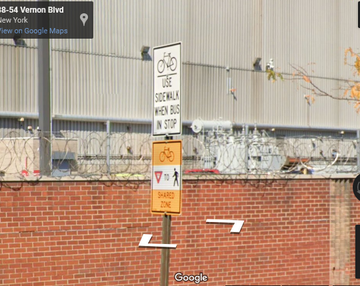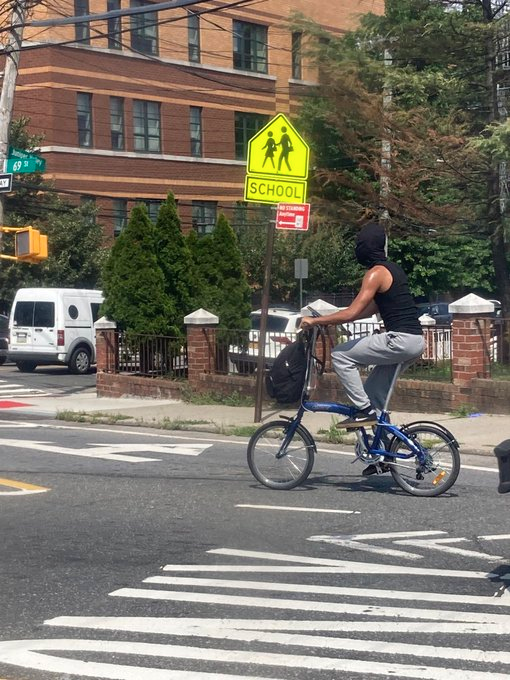
Special double caption day to go with today's heatwave. Wonder why we are seeing so many micro mobility users hiding their faces in the summer.

Special double caption day to go with today's heatwave. Wonder why we are seeing so many micro mobility users hiding their faces in the summer.
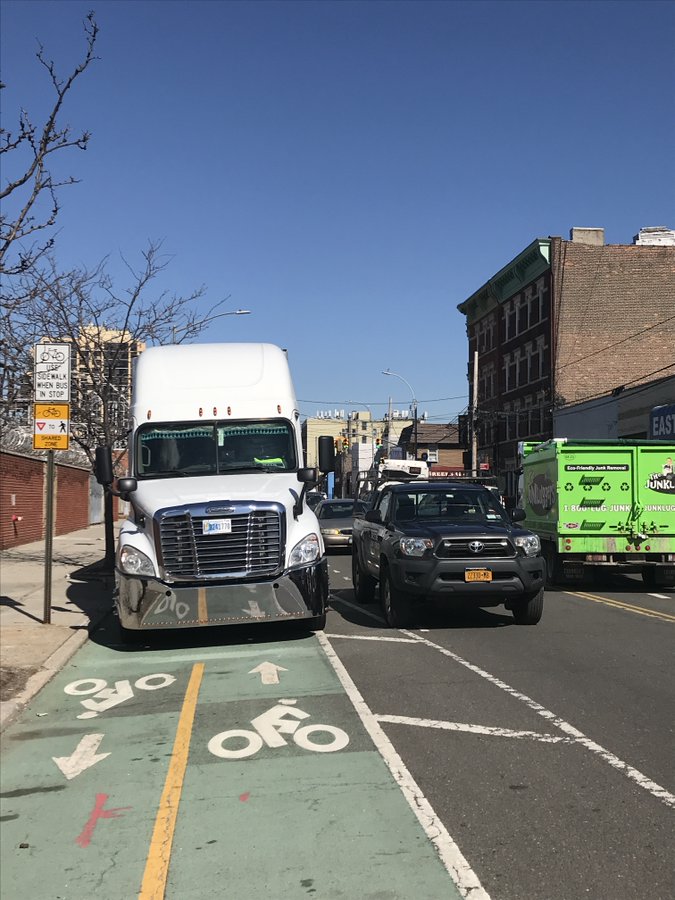
A bike zealot discovered this in Astoria when he went to complain to his fellow bike zealots on the twitter about this big rig parked in the two way bike lane. Apparently, Commissioner Ydanis decided it was good idea for cyclists, ebikers and even unlicensed moped riders to endanger bus commuters lives by giving them more convenience and ensuring their commutes don't get briefly disrupted, instead of putting a yield sign here so non-biking people can get on and off the bus safely (or maybe former dopey interim Commissioner Gutman or even that lady before her, who knows how long it's been there.)
@EmilyAssembly campaigning and doing a book informercial while working for taxpayers
— JQ LLC: I'm creeping death (@ImpunityCity) January 13, 2022
And wouldn't you know it, trivia contest is rigged for urbanish bike zealots to win and you literally have to pay to play it. Surely this won't influence any policy decisions, how de Blasioesque pic.twitter.com/MTExHa7bwU
WARNING, GRAPHIC: 5 boys viciously attacked by gang of 10+ grown men at @ShopAtlasPark. Bikes were stolen. @NYPD104Pct @NYCMayor @QnsBPRichards @CBSNewYork @NY1 @NBCNewYork @ABC7NY @fox5ny @PIX11News @nypost @NYDailyNews pic.twitter.com/s19YRJJSBs
— Juniper Park Civic (@junipercivic) November 1, 2021
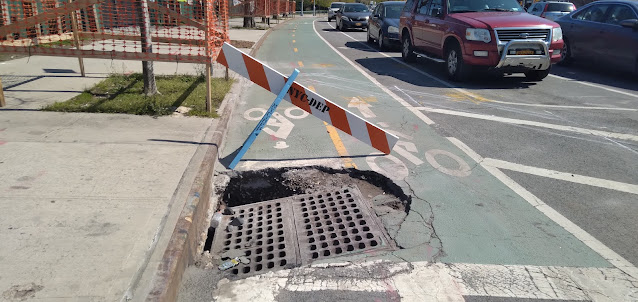
Republican mayoral candidate Curtis Sliwa vowed Thursday to end the city’s “war on vehicles” by removing bike lanes and speed cameras — in stark contrast to transportation policies promoted by his Democratic rival Eric Adams.
“This administration, the de Blasio administration, and clearly Eric Adams, if he’s elected, partner with Bill de Blasio, would want to continue this war on vehicles in the City of New York,” Sliwa said at a campaign stop in Manhattan.
The Guardian Angel founder said his approach to bike lanes would be, “If you’re not using it, you lose it.”
“Have the Department of Transportation put a wire out and let’s look at the analytics. Every hour, how many bicyclists are passing by, whether it’s recreational, for work purposes, whatever. And if you’re using it, you keep it,” Sliwa proposed.
“Perfect example, Queens Boulevard,” he said.
“I can’t tell you how many times we’ve had visitation with my two youngest sons, we’ve gone to Queens Boulevard, small businesses have been crippled because there’s no parking as a result of the bike lane and we sit there for like an hour.
I’ve … barely seen a bicycle going in one direction towards the city or in the direction of Long Island. That would have to be eliminated,” Sliwa said.
While I am passionate about the use of public transit, there’s no better way to experience our city, burn calories, and minimize our carbon footprint than riding a bike. #FBF #bikenyc pic.twitter.com/uepCl4G6Yc
— Eric Adams (@BKBoroHall) August 13, 2021
Because he threw that pathetic pandering campaign tweet as fast as he fixed up his old Brooklyn apt pic.twitter.com/CB5vd7h3i4
— This is JQ LLC (@ImpunityCity) August 14, 2021
Apologies for the "hidden" video but YouTube slapped an age restriction on it because of the language.Police Activity @CitizenApp
Juniper Blvd N Yesterday 6:07:18 PM EDT

This culture of reckless stunt street biking is getting more obnoxious and dumber every day.
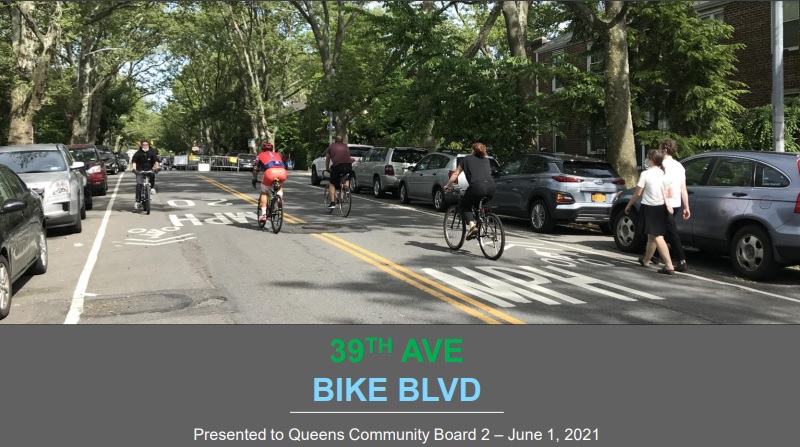
The open street is currently closed to through traffic from 8 a.m. to 8 p.m. on most days. Local traffic, however, is permitted access for parking, deliveries and drop-offs at all hours.
The DOT plans to reduce vehicular traffic on 39th Avenue to prioritize it for cyclist usage by reducing speed limits, diverting cars to other streets and making some cross streets one-way as part of the bike boulevard proposal.
The agency also hopes to connect the bike boulevard to existing bike lanes and signed routes. For instance, workers plan to install shared bike lanes on Barnett Avenue and 43rd Street to connect to the Skillman Avenue bike lane.
The DOT aims to transform the five selected streets into bike boulevards by either November or December this year, Mayor Bill de Blasio previously announced in May.
The agency will first present proposals for each bike boulevard to local lawmakers and community boards like Queens Community Board 2 in the coming weeks.
The Queens CB2 meeting Wednesday starts at 6:30 p.m. on Zoom. It is unclear what time during the meeting the DOT will make its presentation.
Lisa Deller, chairperson of the community board, said the board has yet to weigh in on the plan.
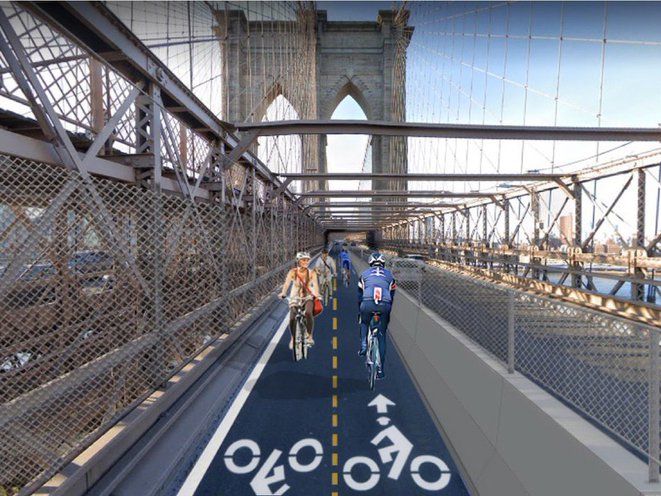
One of the Brooklyn Bridge's car lanes will officially start its transformation into a dedicated bike lane on Monday, June 21st.
The new two-way protected bike path is expected to be completed this fall, at which point the crowded promenade will become pedestrian-only. The plan was previously announced by Mayor Bill de Blasio during his final State of the City address in January.
"The Brooklyn Bridge, one of the nation’s most beloved structures, will this year celebrate its 138th birthday," Department of Transportation Commissioner (and Transportation Alternatives marionette) Hank Gutman said in a statement. "Over that long history, the bridge has changed with the times – as horse-drawn carriages were replaced with trolleys, which were then retired with the advent of car lanes. In the coming months, we are going to transform this bridge we all love once again – this time with new bicycle lanes that invest in the bridge’s more sustainable future."
This isn't going to work. And what will happen when unlicensed motor scooter riders take over the lanes (another thing that de Blasio thinks will solve itself, even after a woman got killed by one of them in a hit-and-run).

The city is pumping the brakes on drivers. Mayor Bill de Blasio will lower the speed limit on 45 miles of streets.
The speed limit along a nearly four-mile stretch of Astoria Boulevard will go from 30 to 25 mph.
“These are not small changes in terms of their potential impact on the safety of New Yorkers,” Department of Transportation Commissioner Henry Gutman told reporters, including CBS2’s Kevin Rincon on Monday.
The city is focused on 10 major roadways where the most accidents happen, places like Woodhaven Boulevard, the Van Wyck service road, and Pelham Parkway in the Bronx.
In Queens, drivers have mixed reactions.
“It’s for the better, honestly, because elderly people walking by, you don’t want to hurt them. You don’t want to feel that guilt because you were rushing to work, or you had road rage,” one person said.
“The traffic has to keep flowing in this area or we’re all going to be stuck. So it could be good, could be bad. I don’t really know,” another driver said.
“Thirty is high speed, but 25 is okay, is low, is too low to drive, but I think it’s safer for the pedestrians,” another added.
Making sure cars go slower in congested areas is the mayor’s goal, as he tries to deal with a growing number of pedestrian deaths.
“It’s clear you have to do something differently when you see that,”
de Blasio said. “In the end, lowering speed limits creates
accountability and saves lives.”
The city will create a “bike boulevard” along 39th Avenue in Sunnyside by the end of the year, Mayor Bill de Blasio announced today.
The avenue is one of five streets across the city that will be transformed into bike boulevards by either November or December this year. The Department of Transportation (DOT) will be creating one “bike boulevard” per borough.
De Blasio shared few details during his press briefing this morning as to what the new initiative involves.
According to a press release from City Hall, the DOT aims to slow down cars and limit traffic volume along bike boulevards “to create low-stress bike infrastructure in a pedestrian-friendly environment.”
De Blasio didn’t name the cross streets along 39th Avenue where the bike boulevard would be created.
The City has already converted a section of 39th Avenue, from 45th Street to Woodside Avenue, to an Open Street, which is closed to through traffic from 8 a.m. to 8 p.m. on most days. Local traffic, however, is permitted access for parking, deliveries and drop-offs at all hours.
“[Bike boulevards are] going to come with a variety of measures to make it a safe environment for bicyclists and connect key bike lanes to each other,” de Blasio said during a morning press conference.
The Department of Transportation will present proposals for each bike boulevard to local lawmakers and community boards in the coming weeks.
De Blasio also announced that the DOT will be creating a new protected bike lane along Northern Boulevard to connect the 34th Avenue Open Street in Jackson Heights to Manhattan via the Queensboro Bridge.
The DOT has already installed “Bike route” signs along Broadway, which connects Northern Boulevard to 34th Avenue.
Update: By the luxury tower enthusiasts at blog Gothamist.
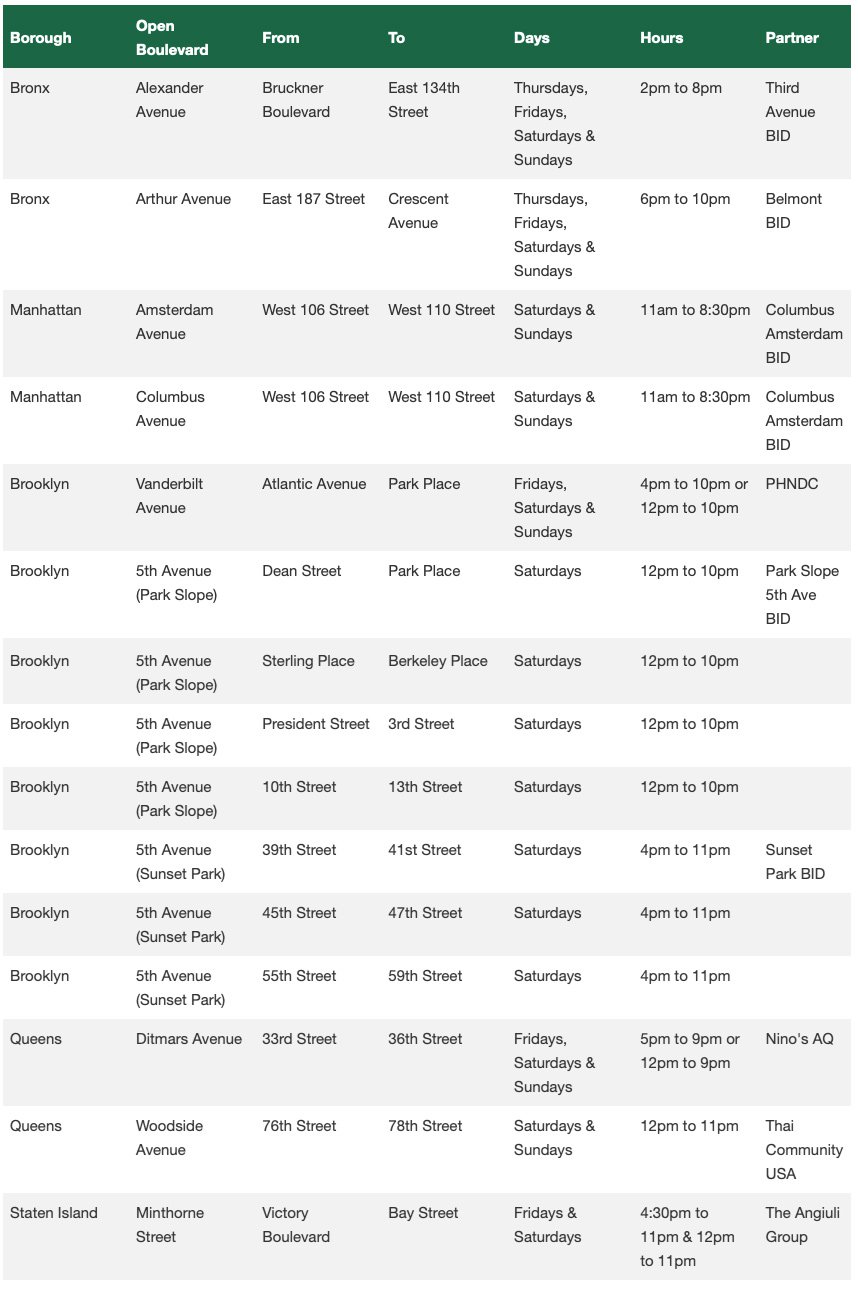
Over the next "few weeks," ten stretches of roadway in New York City will be transformed into Open Boulevards, Mayor Bill de Blasio said Wednesday, bringing outdoor dining, picnic tables, community activities, art, and performances to car-free streets.
The program, which was designed in partnership with the Department of Transportation and NYC & Compnay, the city's official tourism organization, is meant to create destinations for both locals and visitors from out of town.
"This is the kind of thing people are going to love, because all the life and vitality of New York City, all the diversity, all the energy will be on display," the mayor said. "This is going to be the summer of New York City, and Open Boulevards are going to be a great example of a reason people will flock here."
The announcement came after the City Council voted late last week to make the Open Streets program permanent, to put it under the Department of Transportation's control, and to expand the program to neighborhoods that have been underserved by it thus far.
Andrew Rigie, the head of the NYC Hospitality Alliance, applauded the Open Boulevards announcement, adding that the Open Restaurants program thus far has allowed about 100,000 jobs to return.
"I have no doubt when we expand this program through the Open Boulevards program and weave it with beautification and art installations and cultural initiatives and really get communities involved, we build back a more resilient, a more livable city that supports everyone in so many different ways," he said.
Responding to concerns that blocking off traffic on major commercial roads such as Ditmars Boulevard would create a mess off traffic on residential side streets, Jee Mee Kim, the Chief Strategy Officer for the Department of Transportation, said the Open Boulevards locations were selected based on pre-existing Open Streets. But she acknowledged the "underlying tension" about how streets are prioritized.
"The reason why all the Open Boulevards and Open Streets are temporary is that we're trying them out," said Kim. "Hopefully it will be a raring success, and folks will get used to driving around these streets. And I think in the end we're going to see a net benefit for the community and the businesses."
The reason I highlighted this is because de Blasio just might be using money from the federal emergency stimulus funds President Biden gave New York to make these "Open Boulevards" happen.
de Blasio. Doesn't. Care. About. His. Constituents. Especially those who need (and have an absolute right) to drive.

As COVID-wary Brooklynites take up biking en masse to avoid crowded public transportation, a cadre of New York State legislators are looking to open the Verrazzano Bridge and other city spans to pedal-pushers — including by introducing legislation in Albany that would push the Metropolitan Transportation Authority to create cycling spaces on bridges overseen by the state agency.
“Despite the rapid growth of bicycling in New York City over the last decade, the MTA has done little to improve bicycle access at its stations and prohibits cycling on its bridges altogether,” said Bronx state Sen. Alessandra Biaggi in a Monday statement. “As more New Yorkers have turned to cycling and outdoor spaces throughout the pandemic, we must continue to make our communities welcoming to cyclists and pedestrians and encourage residents to use clean forms of transportation.”
The bill, which was simultaneously introduced in the state’s lower chamber by Queens Assemblymember Jessica González-Rojas, would create an advisory committee within the MTA tasked with drawing up a plan for better bike and pedestrian access on the agency’s bridges and public transportation stations.
The potential 13-member panel would be appointed by the governor and legislative leaders, and would also weigh in on the Authority’s capital projects and capital planning.
One southern Brooklyn bike advocate hailed the move as an important first step in getting transit honchos to the table, after years of MTA bigs resisting bike access on the agency’s overpasses.
“For Brooklynites looking to bike over the Verrazzano to Staten Island or the Marine Parkway Bridge to the Rockaways, MTA leadership has been more than indifferent — they’ve been aggressively hostile, using arbitrary and false safety claims to obscure their own failures and last-place status,” said Brian Hedden, a co-founder of the advocacy group Bike South Brooklyn. “This bill will be an important first step in catching the MTA up with its peers, and ending the leadership’s pointless obstruction.”
The organization has lobbied the MTA since 2019 to close one of the Verrazzano Bridge’s 13 car lanes and turn it into a cycling and pedestrian path.

A diverse coalition of more than 80 advocacy groups and nonprofit organizations is asking the next generation of city leaders to imagine what it would take to install 500 more miles of bike lanes, 1,000 miles of year-round open streets, and one block of car-free streets in front of every public school in New York City.
On Monday, the group Transportation Alternatives issued a challenge it calls “NYC 25x25.” The advocacy group is asking the next mayor, city council and borough presidents to commit to converting 25% of streets currently used by vehicles into other purposes, by 2025.
“This is a watershed moment for New York City,” Danny Harris, executive director of Transportation Alternatives, told Gothamist/WNYC. “We need to look at this intersection of COVID, of racial injustice, economic inequities, and ask some serious questions about the future of our city and our budget and we need a new crop of leaders who are willing to look at streets as an asset, instead of a liability.”

The proposals come at a time when the number of candidates running for mayor remains sprawling, and few have distinguished themselves on transportation issues. The debate over how to use street space has intensified during the pandemic after what many consider a successful run of open streets during the pandemic and a boom in cycling, but also a recent uptick in traffic deaths.
Other suggestions from the coalition include adding 19.4 million square feet of bike parking, designated locations on every block long enough for taxis to drop off passengers and for trucks to make deliveries without blocking streets or bike lanes.
The latest proposals have the backing of disparate groups in the city from the tech industry nonprofit Tech:NYC, to the New York Building Congress, and the Institute for Public Architecture.
“Lack of quality transportation options makes it difficult for many of the people in the low-income communities of color we serve to access resources, such as employment, education, good food, and health care, that are needed to be healthy and financially stable,” Tracey Capers, executive vice president and chief program officer at the Bedford Stuyvesant Restoration Corporation, wrote in a statement. Her group works with Citibike to get more bike shares into Bedford-Stuyvesant, Brooklyn.
“Likewise, we support the re-allocation of our public spaces, including the creation of more car-free bus lanes and protected bike lanes, to better serve the majority of our residents, who don’t own cars,” Capers added.
The 127-year old advocacy group the Municipal Arts Society is another organization that backs the expansion of streets for public use. Tara Kelly, the society’s vice president of policy and programs, told Gothamist/ WNYC that her group came up with the idea of pedestrian islands in the early 1900s, calling them “isles of safety.” She said this is just the next generation of smart thinking about how to use city streets.
“This past year in particular has demonstrated that importance, our access to public space for recreation, for protests, for transportation, for getting a bit of sunshine, stepping out of our apartments,” Kelly said.
This will really make all those who bought cars last year tinkled pink at this proposal.


Mayor de Blasio said Thursday that construction will begin this year on a plan to give cyclists and pedestrians their own dedicated lanes on separate sides of the Queensboro-Ed Koch Bridge during his state of the city address.
The plan also calls for the innermost Manhattan-bound lane of the Brooklyn Bridge to a two-way protected bike path, while converting the existing bike-pedestrian crossing to the exclusive use of pedestrians.
“The Brooklyn Bridge and the Queensboro Bridge are iconic and deeply intertwined in the daily lives of countless New Yorkers,” the mayor said in a summary provided by his office. “Now, it’s time to bring them into the 21st century and embrace the future with a radical new plan.
“On the Queensboro Bridge, we will begin construction this year to convert the north outer roadway into a two-way bike-only lane and convert the south outer roadway to a two-way pedestrian-only lane,” de Blasio said.
Construction is not expected to be complete until 2022.
The northern outer lane on the Manhattan-bound side right now is shared by pedestrians and cyclists, and while painted lanes and signs supposedly assign both their separate lanes, it’s pretty much a matter of the honor system.
update:
In the comments, George the Atheist pointed out the moped (with the fake plate) that I caught zipping down the bridge along with bikers and how this might cause a problem if these two way lanes the city is proposing might lead to an escalation of these scofflaws taking advantage of these new amenities. Well, let this here be confirmation of that:
@TransAlt @NYCMayor @BenKallos @JimmyVanBramer @StreetsblogNYC @StreetsPAC @NYCSpeakerCojo
— JQ LLC, Joe Biden is a George H.W. Bush Socialist (@jqllc) January 29, 2021
This is what will be seen on the new bike lanes on the Brooklyn and Queens Bridges
Illegal motorcycle riding
Correction,people riding unregistered and unlicensed motorcycles
fools https://t.co/hTw7o5BWms

The south outer roadway of the Ed Koch-Queensboro Bridge was packed with anything but cars on Sunday as hundreds of cyclists rode free, demonstrating to the city Department of Transportation the aching need to give cyclists and pedestrians more space.
Of 10 lanes total, the bridge reserves nine of them for cars despite the tight pathway for any other form of transportation being packed with users, something that has been exacerbated by the 57 percent spike cycling and 40 percent — according to Transportation Alternatives — on the bridge alone this year due to the pandemic forcing New Yorkers to pick a different way to get around as subways and buses have given the impression of being unsafe.
Jon Orcutt, of Bike New York, told amNewYork Metro that the city was long overdue in facilitating its own encouragement of cycling and the need for extra space on the Queensborough Bridge needed more not than ever since New Yorkers have been taking the government up on that advice.
“We need the city to catch up with us,” Orcutt said. “The city has said for years, we want more New Yorkers on bikes. There are consequences to that, now we have a bike capacity problem on the bridge. The city should respond, the policy is working, more people are using bikes … What’s pulled everyone out on bikes this year has been more space on streets and so bridge is incredibly timely.”
But the city believes there to be one major obstacle to taking cars off the south outer roadway: fences.
DOT has said the barriers on this section of the bridge do not meet the eight-foot standard for pedestrian and cyclist safety, and the cash strapped agency just can eat the cost at this time.
Another problem? DOT says that as long as construction is forcing some traffic to be diverted from the upper roadway, they will need to prioritize as much space as they can for motorists. This work is scheduled to wrap in the fall of 2022, according to DOT.
Maybe the bike lobbyists and zealots should have followed my twitter when I wrote about this back in November.