Tuesday, March 19, 2019

Bill passes to legalize basement apartments which might spur more gentrification


Image result for basement apartment new york

NY Daily News


Marlene Hernandez moved from her two-bedroom apartment in Bushwick to an illegal basement apartment in East New York two years ago out of necessity.

“I simply couldn’t afford Bushwick anymore, I had to go somewhere else,” the 29-year-old single mother of one told the Daily News. “Even if you live with a roommate, you’re paying $1,000, $1,200, to stay in a room. So I figured, why not live in a basement where I can have my own privacy?”

Some 114,000 New Yorkers live in illegal basement apartments, according to the housing advocacy groups Chhaya Community Development Corporation and the Pratt Center for Community Development.

Basement and cellar apartments must meet minimum requirements for light, air, sanitation and exits and be approved by the Department of Buildings.

A bill signed by Mayor Bill de Blasio on March 5 aims to turn illegal basement and cellar apartments into safe, legal, affordable housing, starting with a three-year pilot in East New York and Cypress Hills, Brooklyn.

But the new law has Hernandez worried. She’s paying $1,200 a month for her off-the-books place and argues that New Yorkers in her position may have to keep finding illegal apartments to keep their rent down, or face higher rents for legal apartments.

“My landlord isn’t going to lower my rent,” she said. “What incentive does he have to legalize my apartment?” she said.


The pilot program will provide $12 million in low-interest loans and grants to eligible low- to
middle-income homeowners, living in one- to three-family homes, to convert their basements into legal apartments. If successful, the city would look at expanding the program to other neighborhoods.
A report from the Citizens Housing and Planning Council (CHPC) in 2017 said such a program could add up to 38,000 housing units.

All basement apartments legalized with funds from the grants and loans will have to conform to HPD’s affordable housing rules, which cap rents at 30% of a tenant’s income. Landlords who decide to create legal basement apartments without the city’s help will not have to abide by the income cap.


“If they legalize basement homes, landlords can just take advantage,” Hernandez said. “They know that there are people who are able and willing to pay regular apartment prices for these units.”
Jessica Katz, executive director of CHPC, acknowledged that the pilot’s pathway to legalization opens the door for landlords to raise rents. But, Katz said, the benefits of legalization outweigh the possibility of higher rents.

“There is a risk that the landlords will raise the rent,” Katz said. “We’re trying to find the right balance between bringing up the quality of those apartments and protecting the tenants, but also not scaring off tenants who have in certain ways benefited from the legal gray area that they’re living in.”

If anyone else recalls, this is where Councilman Espinal described these areas which he represents as a guinea pig for this housing plan.

I have a gut feeling that East New York and Cypress Hills are going to become "hot", "hip" and "niche" towns pretty soon.
 

Monday, March 18, 2019

Hudson Yards got twice as much tax subsidies as Amazon and their condos' property taxes are dirt cheap


6 Sq Ft

 The $20 billion, 28-acre Hudson Yards megaproject has been in the news recently as its official March 15 grand opening approaches. The New York Times reports that the nation’s largest residential development has gotten more than a little financial help from the city government to get there. In fact, public records–and a recent study by the New School–reveal that the development has received nearly $6 billion in the form of tax breaks and additional government assistance, twice the controversial $3 billion in incentives held out to Amazon to entice the retail tech giant to bring its second headquarters to Queens.


Where did $6 billion in taxpayer dollars go? Included in that tally were the $2.4 billion spent by the city to bring the 7 subway line to Hudson Yards; $1.2 billion was set aside for four acres of green space within Hudson Yards. The City Council kicked in $359 million to shore up interest payments on bonds when the development fell short of its revenue projections.

The point to be made is that the world’s most successful real estate developers–In this case Related 
 Companies and Oxford Properties Group–are among the biggest beneficiaries of generous government tax breaks, meant to encourage development.

Of the incentives given to the Hudson Yards project, defenders say they’ll reap an enormous benefit to the city in the form of thousands of new jobs created. The subway extension is definitely a boon, and who can argue with parks and improvements at what was for years a jumble of old factories, tenements and a stretch of rail yards once known as “Death Avenue.

But the city was lacking a subway stop on the far west side before the wealthy developers made it happen, and the counter-argument in both the case of Amazon and Hudson Yards is that big businesses with big profits at stake should pay their own way rather than getting government incentives–particularly tax breaks–sorely needed elsewhere.

The New School’s recent analysis, headed by Bridget Fisher and Flávia Leite, focuses on a particularly fortuitous property tax break that developers within the Hudson Yards area benefitted from which has cost the city more than $1 billion so far. This incentive can mean as much as a 40 percent discount for future developers in the area for as long as 20 years.


Sunday, March 17, 2019

Glendale residents raise concerns of soil contamination from Superfund site.


QNS


State agencies briefed the public on Monday about a Glendale superfund site that will have another round of remediations in the near future after the toxic PCE has been determined to be no detriment to public health.

The Department of Environmental Conservation and the Department of Health held a meeting on March 11 in a small room of the North Forest Park library where residents complained that they were not properly notified of the contaminants beneath the soil in their community.

But DEC claimed there was little chance the public could be breathing the chemical since it is deep underground and a study of 10 homes in 2006 showed no sign of PCE in the air – an admittedly small size – but that 30 year project would flush the soil of the contaminant.

“We should have had flyers coming to our house, we should have been informed by you people,” one attendee said. “Nothing.”

This is why there’s nobody here tonight, nobody knows,” another person said, with many attributing QNS for learning about the meeting.

With most of the contamination up to 100 feet below the surface at the deepest parts, DOH does not consider soil vapor intrusion to be an issue for a few reasons: because although the PCE is concentrated in the ground water, there is a layer of clean water between the chemical and the surface; homes are not at risk because the foundations, unless there are crack in the pavement, will seal out the vapors; and there is no risk of people ingesting PCE because the surrounding communities are on the municipal system which is supplied from upstate.

But Robert Nardella, 78, however, maintained concern about his home after the presentation because of the claim by DEC that the underground plume had migrated west at a shallower level and pointed out that some residents may have dug wells on their property over the years as a means to water their lawn or fill above-ground pools to get around water restrictions.

“Why is it being addressed again?” Nardella told QNS. “I was confused as to why this is coming up again when they did everything to minimize our concerns, you know, saying there was no more vapor and that it’s going deeper and deeper into the ground.”


Nardella was also concerned about his home, which was built in the early 1930s which just have wood floors over dirt in the basement, offering no protection from possible soil vapor intrusion.
“There are still many homes next to that site that have dirt over a wood floor, mine included,” Nardella added. “If there are any vapors coming up, I don’t have any protection.”

Councilman Holden's bill for mandatory lead inspection and prevention passes.

Image result for sewer main project middle village queens


 Queens Chronicle

 
Last April, Councilman Bob Holden (D-Middle Village) held a red flag and declared a CAC Industries lot a “red flag site” after learning that a sewer main project in Middle Village was stalled late in 2017 after high levels of lead were found in the soil.

On Wednesday, Int. 1063 passed the City Council, which requires any city development to provide notice to the relevant Council member and community board within five business days of discovering or becoming aware of a hazardous level of lead in soil.


The bill is Holden’s first to pass in the City Council.

“Increased transparency between city agencies and the public is a value that I campaigned on and I’m pleased to see this bill accomplishing that,” he said in a statement.

The soil that had been excavated during the Penelope Avenue sewer work was sitting in a yard leased by CAC Industries across the street from PS/IS 128, a K-8 school. The dirt had been sitting uncovered at the site until a tarp was eventually placed over the mounds.

In April, Holden took aim at the Department of Design and Construction, saying, “If they knew this was contaminated, to leave it uncovered is criminal. To leave it uncovered across from a school is more criminal.”

The discovery about the soil was made after CAC Industries, the project’s contractor, tried to bring the dirt to a dump but management there declined to take it after a visual inspection.

Testing revealed lead levels in the dirt mounds between 300 and 600 parts per million, exceeding the federal limit for bare soil where children play.

Eventually, the soil was removed and relocated to a facility in New Jersey.

 “It is common sense that local officials should be notified of any dangerous contamination so they can help inform and protect their constituents,” Holden said in his statement. “There is no excuse for carelessness that this bill will correct.”

Other bills in the package address lead-based paint hazards, lead testing in water, blood lead screenings, childhood lead poisoning prevention and the availability of lead hazard testing.


Hell's Kitchen rent-stabilized tenants experiencing discrimination and landlord intimidation by technology


https://thenypost.files.wordpress.com/2019/03/190316-latch-app.jpg?quality=90&strip=all&w=407

NY Post

 A group of tenants in a Hell’s Kitchen apartment complex say they are being locked out — by technology.

And now they are suing their landlord for the return of their low-tech keys to the front lobby.

“It’s ridiculous that everyone is spending all this money to go to court just to get a key,” said Mary Beth McKenzie, 72, an artist who has lived in the West 45th St. building for nearly five decades. “For 45 years I’ve had a key. And now, we can’t get keys.”

Instead of keys, the building’s owners have installed a new electronic security system called Latch, which requires a smartphone app to access the building’s lobby, where a newly built elevator and the tenants’ mailboxes are located.

McKenzie’s 93-year-old husband has been a virtual shut-in since the new technology was introduced last year because he doesn’t use a cellphone and has difficulty walking up the three flights of stairs to their apartment, she said. Tenants in the complex at 517-525 West 45th St. don’t need to use the lobby to access the stairwells to the buildings, which are between four and five stories each.

McKenzie and some of the other rent-regulated tenants who are suing for the return of their keys say Latch also includes a GPS function that allows the building’s owners to monitor their movements and even their social media.

The app, which is currently in use in more than 1,000 residential buildings in the city, also comes with an 84-page contract which states that any information collected through the Latch system goes to the building owner, the tenants say.

 “It’s a form of harassment,” said McKenzie, whose paintings hang in The Metropolitan Museum of Art and the Smithsonian. “What happens if your phone dies? I don’t want to be stuck on the street and I don’t want to be surveilled.”

 The owners — a limited liability company controlled by Offir Naim and Shai Bernstein — said they installed Latch to provide tenants greater security following a burglary in August 2018, according to court papers. And the GPS function is optional, they said.

  The Latch system also allows tenants to buzz someone, such as a courier, into the building without having to be at home, court papers say.

Yeah, this is a phenomenal idea. Especially with the rise of cellphone, mail and package delivery theft going around.

Thursday, March 14, 2019

Mayor de Blasio wants 10 billion dollars to save Downtown Manhattan from climate change


NY Daily News


Mayor de Blasio proposed extending the South Street Seaport area by two city blocks into the East River — part of a $10 billion effort to fend off rising sea levels as a result of climate change.


“We had to find something that would work, no matter how expensive or ambitious it was,” de Blasio said Thursday at a press conference downtown.


The plan, part of a resilience study released Thursday, calls for extending the shoreline by a maximum of 500 feet, or two city blocks. The new segment of the shoreline, which would be 20 feet or above current sea levels, would serve as a flood barrier during storms — but it could also be home to buildings, including potential private development, de Blasio acknowledged.


But it will be necessary to keep lower Manhattan from being underwater, he argued -- saying the city’s study had found that by 2100, 20% of the streets in area would experience daily tidal flooding, even in sunny weather.


“This is the existential threat. This is the core issue we all must face as aggressively as humanly possible,” de Blasio said.

 The plan, announced six years after Hurricane Sandy swamped the city, may sound familiar to some New Yorkers — in 2013, Mayor Bloomberg proposed a similar project dubbed “Seaport City.” That plan would have leveraged private development on the new land to pay for the massive expense of building it.


De Blasio said whether the new land would contain private developments depended on whether the federal government would pony up any cash for the plan.

 From the perspective of the City of New York alone, this would be extraordinarily difficult to fund. I think it comes down to simply this: if there’s federal money in play, it probably looks one way, if there’s not federal money in play, we have to get some private money and there has to be some development,” he said.


What happened to the affordable housing plan? What about emergency funding for NYCHA?

The mayor proves yet again where his priorities lie, with the real estate overlords. New development? If all those luxury towers around there are under threat now from accelerating sea level rise, why would you build more "private" development on the new shoreline
If there is a light side to this idiotic proposal, this ten billion dollar defense of luxury real estate from the effects of climate change seems to be inspired not only from de Blasio's obeisance to his biggest donors (obviously still) but from a mentally retarded female character from the classic comedy show Arrested Development.


Wednesday, March 13, 2019

Kew Gardens Community Board rejects de Blasio's tower jail


https://i2.wp.com/correctionalnews.com/wp-content/uploads/2018/08/Feature-Rikers.jpg?resize=800%2C445


The Kew Gardens community board voted unanimously against the plan for a new local jail advancing to the next stage. Queens Community Board 9 voted unanimously Tuesday night to urge the City Planning Commission not to green light the plan for a new jail in Kew Gardens, which would allow the plan to advance to the city's land use review process.

The planning commission must decide by March 25 whether to certify the jail plan as complete and send the plan through the city's land use review process, known as ULURP. The vote Tuesday is largely symbolic, but city rules say the planning commission must explain any decision that goes against community board recommendations.

 
"The City Planning Commission does irreparable harm by starting the ULURP clock," the community board's resolution states. "This proposal, designed without any communication with the affected communities, will quite simply overwhelm and destroy the small historic residential neighborhood of Kew Gardens, and also adversely affect the adjacent community of Briarwood."
A spokesperson for City Council Member Karen Koslowitz, who represents Kew Gardens, declined to comment on the vote.
 Queens BP Melinda Katz finally chimed in:

Queens Borough President Melinda Katz and Bronx Borough President Ruben Diaz Jr. sharply rebuked the mayor's office last week for what they said was a failure to collaborate with the local communities that would house the new jails.

"We are deeply disturbed by the lack of meaningful local engagement on the borough-based jails project to date," Katz and Diaz Jr. wrote in a letter dated March 8. "The process of developing the borough-based jails system must start anew."

"The irony ... of unveiling a citywide plan for 'modern community-based jails' in the absence of community input is not lost on the boroughs," Katz and Diaz Jr. wrote.

 Admin note: The woman who wrote these articles (and the one on Meeks) is Mara Kaufman, the one who got repressed from reporting on this crucial meeting by the mayor's arbitrarily opaque rules

Congressman Gregory Meeks is the new chairman of the Queens Machine


 https://meeks.house.gov/sites/meeks.house.gov/files/styles/congress_home_page_feature_rotator/public/home_page_feature/nmaahc2.jpg?itok=K5IactXa


Patch

 U.S. Representative Gregory Meeks was unanimously elected Monday as the new chairman of the Queens Democratic Party. Meeks succeeds former U.S. Rep. Joe Crowley, who stepped down in February.


Meeks was considered the most likely successor to Crowley, according to a City & State report that broke the news ahead of the Monday election. Crowley left the post after he joined one of the country's top lobbying firms. Meeks, a Crowley ally, is unlikely to spearhead radical changes within the party, City & State reported. He's a vocal opponent of a bill that would raise taxes on Wall Street traders and supported the Amazon HQ2 deal for Long Island City.

In 2013, Meeks was named one of the 13 most corrupt Congress members by the Citizens for Responsibility and Ethics in Washington, a nonprofit that investigates the influence of money in politics. In 2006, Meeks paid a below-market sum for a St. Albans house built by one of his campaign contributors on land owned by another contributor, according to the CREW report. He has also failed to report loans on personal financial disclosure forms, CREW found.

Utterly disgraceful. And they talk about the President and his own sordid corruption and abuse of  power? This political neoliberal gangster has made a productive and lucrative career with his own dirty deeds and wheeling and dealing in his career as an elected official. And Jamaica is still blighted in the two decades since he's "represented" the district.


Tuesday, March 12, 2019

Brooklyn train station inundated with dust from Canarsie Tunnel construction


 bedford-avenue-542https://thenypost.files.wordpress.com/2019/03/bedford-avenue-542.jpg?quality=90&strip=all&w=915


NY Post


“I want to get the f–k out of here,” said Aaron Burnett, 37, who left the station after seeing how bad the dust was. “They need to shut the train completely down. That’s what they said they were going to do anyway. If it’s going to cause health problems, they should close it!”

MTA board members — who are still waiting for an independent consultant on the project to be hired — say they will demand that the agency tell them what is in the dust at the station.

“Is this what riders have to look forward to for 20 months?” said Andrew Albert, an MTA board member who heads the New York City Transit Riders Council. “This is just the beginning.”

An MTA spokesman said in a statement that the platform is safe for all riders. 

 Why does that statement eerily resemble former EPA commissioner Christie Todd Whitman's reassurance that the air quality was safe to breathe at Ground Zero in 2001.


Sunday, March 10, 2019

City approves modular building for affordable housing


https://static1.squarespace.com/static/5b9ffe0f1137a680c2c08250/t/5c80306f104c7b7d7282b838/1551904882784/?format=1000w


Queens Eagle


A proposed 167-apartment development in East New York is one of the first projects using modular construction that the city’s Department of Housing Preservation and Development has selected to finance, the Wall Street Journal reported.

Modular construction refers to the off-site construction of prefabricated, factory-produced units (modules) that are then stacked on top of each other to form a full building. The Build It Back program implemented in Queens and Staten Island after Hurricane Sandy also used modular housing.

The modules will be constructed by FullStack Modular at its factory in the Brooklyn Navy Yard. The proposal was submitted by a development team led by Thorobird Cos. and its local nonprofit partner, Bangladeshi American Community Development & Youth Services.

“Doing modular is a really important, long-term strategy for the city,” said New York City Deputy Mayor Alicia Glen, whose last day on the job was Friday. “We know it saves time, and as it scales up, it will start saving money.”


Astoria Blvd. train station will be out of service for almost a year.

 https://s3-media3.fl.yelpcdn.com/bphoto/EA2sR65oB9MxO1nRC-awvQ/l.jpg


Queens Eagle

The heavily trafficked Astoria Blvd. Station will close for nine months beginning on March 17 so that the MTA can install several ADA-accessible elevators and reconstruct the mezzanine.

The station, which first opened in February 1902, served more than 13,000 Astoria commuters per day in 2017 according to MTA data, but it lacks ADA accessibility. The upcoming renovations include the installation of four elevators to service the station, as well as raising the station’s mezzanine in order to better accommodate street-level truck traffic.

“We’ve been on a steady march of improvement work on the entire Astoria Line to increase reliability and improve safety and the customer experience, and this elevator project is a huge win for our customers,” said MTA New York City Transit President Andy Byford. “Raising the height of the station is also vitally important for our train service and structure as well as the vehicles that use the streets below those elevated tracks.”

District 22 Councilmember Costa Constantinides said the single-subway line neighborhood was long overdue for an ADA-accessible station, after previous Astoria subway station renovations left much to be desired. Currently, none of the neighborhood’s N/W train stations have elevators.

“As someone who catches the train at Astoria Boulevard almost daily, I can tell you this station desperately needs the pending upgrades," Constantinides told the Eagle. "I'm glad to see the MTA finally decided to give in-need Astoria riders elevator access — only after doing vanity upgrades to four other stations when we explicitly requested they become ADA-compliant. As we move forward on the discussion about municipal control of the subway system, I hope future upgrades will account for the needs of the community, so people don't have to trek several blocks just to access an elevator."

Nine months? That is to laugh. Keep an eye on this Astoria, because it took four years to put up one elevator and new staircases at the Lefferts Blvd. station that I chronicled on for two years on Impunity City.

Saturday, March 9, 2019

Ed Magnano and wife convicted of bribery charges


 https://www.longislandpress.com/wp-content/uploads/2016/10/Mangano_Linda-e1552063829939.jpg


NY Post

 
Former Nassau County Executive Edward Mangano and his wife, Linda, have been found guilty at their seven-week corruption retrial on Long Island — and each now faces as much as 20 years prison.

In a late-morning split verdict Friday, a jury found Mangano guilty of accepting hundreds of thousands of dollars in bribes from ex-restaurant owner Harendra Singh in exchange for the once powerful pol’s help in securing more than $20 million in loans.


Ed was cleared of a single count of extortion. He was also cleared of charges that alleged he swung to Singh a lucrative contract to provide bread and rolls to the county jail, and a second contract to feed the county’s emergency workers after Hurricane Sandy.

But he could still go to prison for two decades under the one top-count conviction.
The same jury found Linda guilty of four of the five counts against her: two for obstructing justice and two for making false statements, all to cover up the bribe scheme. Ed was also convicted of a single obstruction charge.

She, too, faces a potential two-decade prison term.
 
The two are maintaining their innocence, and said they will appeal the verdicts in the case, which proved an embarrassment for Mayor de Blasio.

At both this trial and last year’s mistrial, Singh testified under a cooperation agreement that he was a big donor and had the mayor at his beck-and-call.

This may be why the co-mayors went to South Carolina this weekend. Bill took a lot more from Singh and he has also anointed his wife with a plum job running the Advance for New York fund and the funding government void THRIVE mental health program.


Friday, March 8, 2019

Tom Seaver has dementia, retires from public life

https://proxy.duckduckgo.com/iu/?u=https%3A%2F%2Fcdn.vox-cdn.com%2Fthumbor%2F3Vvlm5PE5Iq1RV3cng0ZInEWg90%3D%2F0x279%3A3900x2879%2F1200x800%2Ffilters%3Afocal(0x279%3A3900x2879)%2Fcdn.vox-cdn.com%2Fuploads%2Fchorus_image%2Fimage%2F15216869%2Ftom_seaver_malcolm_emmons-usa_today_sports_usatsi_5356676.0.jpg&f=1


 In tribute to the phenom pitcher, here's the broadcast of Tom Terrific's 19 strikeout game against the San Diego Padres where he struck out 10 batters in a row, a record that still stands.


Thursday, March 7, 2019

More dangerous crap is falling from the elevated tracks again in Woodside


NY Post


A piece of debris from the elevated 7-train tracks crashed down onto a vehicle for the second time in two weeks Wednesday, prompting a Queens lawmaker to blast the MTA for the “public safety threat.”

Councilman Jimmy Van Bramer pointed out the incident on Twitter, firing off a photo of the roughly one-pound, 10-inch wide metal piece of debris and a cracked car windshield on Roosevelt Avenue — just blocks away from where a similar incident occurred last month.

“What the hell is going on here?! For the second time in two weeks a piece of debris has come crashing down on a vehicle Below tracks on Roosevelt Ave., this time at 62nd street,” Van Bramer tweeted.

“The car was occupied and moving,” the pol tweeted. “No one injured but someone is going to get killed here @MTA!”


About a dozen MTA workers using a cherry picker were spotted Wednesday afternoon cutting out chunks of rusted metal from the underside of the main stairwell at the entrance to the Woodside/61st St. Station, where local merchant Esmat Elmarakei, 57, the owner of T-Shirts & More on Roosevelt Avenue, said garbage and debris routinely falls from the tracks.

“It hit the back of my husband’s car and broke his back window a few years ago,” Elmarakei said.

Last month wood from the elevated train tracks crashed into the windshield of a black Chevy Tahoe underneath the tracks on Roosevelt Avenue near the Woodside/61st St. Station.

After that incident, MTA officials promised to inspect all of the city’s elevated train tracks.

“We will begin to inspect the rest of the elevated lines that run through Queens, The Bronx, and Brooklyn to…make sure some anomaly like this doesn’t exist anymore,” the MTA’s Chief Safety Office Patrick Warren told reporters.

 Debris falling in the same area during a busy weekday afternoon ceases to become an anomaly. The MTA should focus their damage control efforts on clearing out their garbage and improving transit service instead of spinning b.s. to the media.

Jimmy really conveys sadness in that picture.


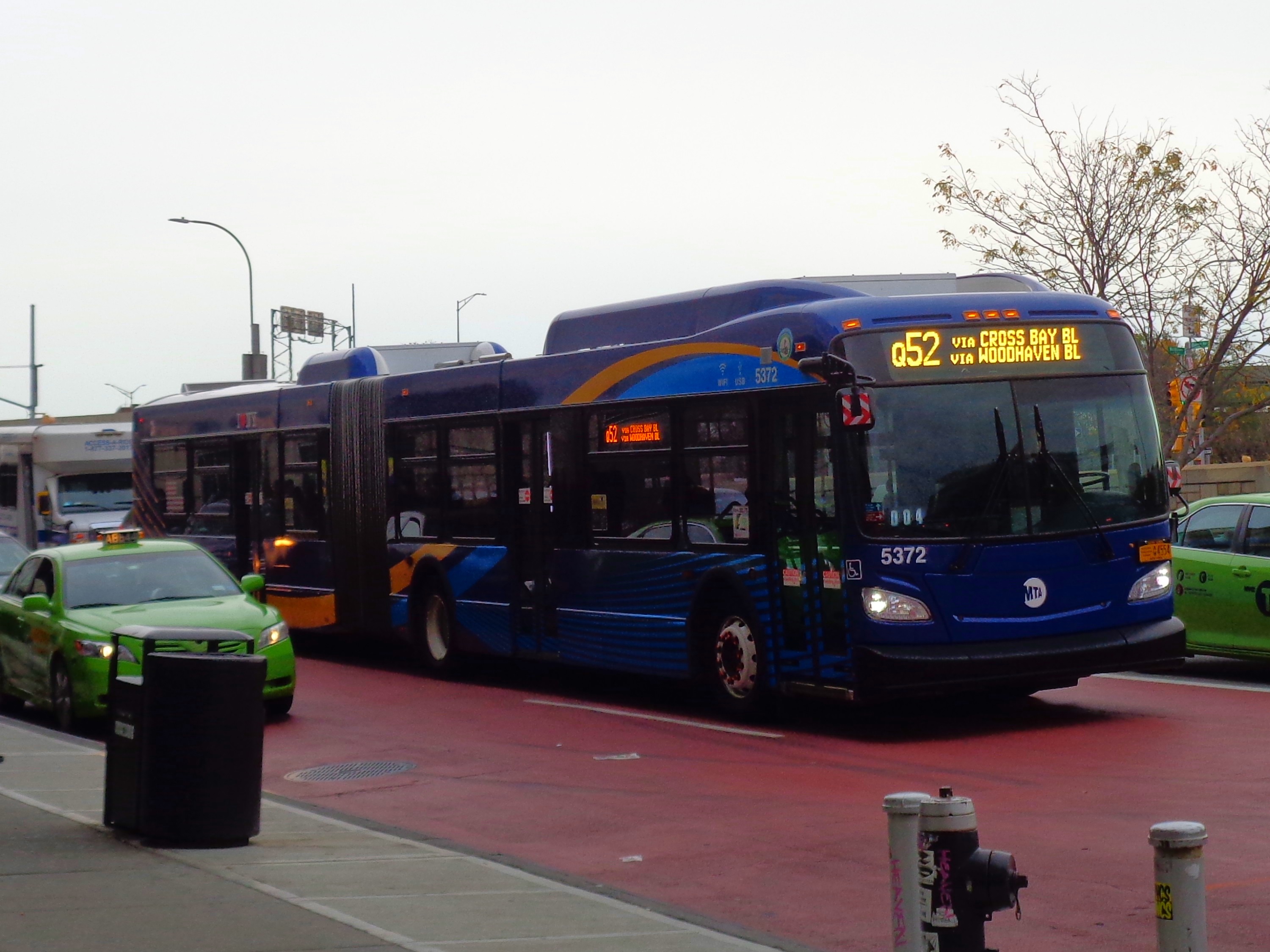
Every bus line in the five boroughs sucks except just one, and it's in Queens!


Image result for new york city bus q52


NY Daily News


Transit advocacy groups released report cards for bus routes across the city Wednesday, and the grades weren’t exactly honor roll material.


Half of all the routes analyzed across the five boroughs received a “D” grade or lower, shining a light on the depressing, delay-ridden commutes that plague the city’s 2 million daily bus riders.


The report also shows breakdowns of bus performance by City Council district— all but five of the 51 across the city received “D” or “F” grades.


“For a long time I’ve felt that the problems on our buses were an ignored second transit crisis in this city,” said City Councilman Mark Levine (D-Manhattan), whose district received an F grade and has an average bus speed of 5 miles per hour. “All the attention goes to the obviously serious problem in our subways.”


Despite the dismal findings, the analysis does show that the Metropolitan Transportation Authority’s bus service is improving slightly. Last year, 30 fewer bus routes received failing grades than in 2017, a statistic advocates largely chalk up to improvements in the way that buses are dispatched.

Just one route detailed in the report received an “A” grade: the Q52 select bus, which travels from Elmhurst to the Rockaways.

Jaqi Cohen of the Straphangers Campaign attributes the route’s success to features like dedicated bus lanes and all-door boarding.


 “We know how this bus got this great grade,” she said. “The simple answer is that it uses solutions that we know could work across the city.”


Wednesday, March 6, 2019

Commissioner O'Neill orders NYPD to tow thirty cars while brazenly violating new placard rules for silly private football game


NY Daily News

Angry upper Manhattan residents accused the NYPD of unsportsmanlike conduct for towing their cars to free up parking for the department’s flag football championship.


The alleged offensive interference with the local motor vehicles came in the hours before Sunday’s NYPD flag football championship contest at Columbia University’s Baker Field.


Police, citing traffic concerns and accessibility for the disabled, towed 30 cars on W. 218th St. between Broadway and Indian Road prior to the law enforcement Super Bowl pitting the 40th Precinct against Midtown South.


But one Inwood resident said most of the newly-created spaces on the west side of Broadway were instead filled by cops going to the game.


“There were mostly civilian cars with placards on their dashboards or notes about the flag football game,” said local man David Thom, 44. “This was removal of cars for personal vehicle parking for officers.”

While the cars were relocated rather than ticketed or taken to a tow pound, it still outraged some locals who emerged to find the police had called an audible on their parking spaces.


“How can they do that?” said Anna Dominguez, 52, who lives in the area but was not towed. “You think you’re gonna leave your car here Sunday and everything is gonna be fine — and then you come back and it’s gone. Just because the NYPD wanted space for a game? They’re taking advantage of their power.”

 Some cops left the notes in the cars to explain why they were illegally parked in crosswalks, in front of hydrants or in no parking zones.


Mayor de Blasio recently vowed a crackdown on placard abuse. But NYPD Commissioner James O’Neill said Tuesday there was no abuse in this case.


“This was a special event,” O’Neill said. “This was the flag football championship. The cars were relocated. Nobody was towed and nobody got a ticket.”


O’Neill did suggest the 34th Precinct could have done a better job getting word out about the towing.


“But there are special events all throughout the city, every day,” O’Neill added.


What a dick. Although he does reveal that the city permits too much privatization of the streets.

Look how many people showed up for this "championship game"


So this is strike one according to the Mayor's new placard violation laws. Right?


Tuesday, March 5, 2019

It's only March, and murders and rapes are up

 https://dailynews.news/wp-content/uploads/2018/11/20181102new-yorknyc-crimeny-metro-targeted-man-gunned-down-brooklyn-home-20181102-story.html_-1024x682.jpg

NY Post


City homicides have spiked nearly 30 percent through the first two months of 2019, leaving the NYPD scrambling to redeploy cops to troubled areas to stanch the bloodshed, the department said Monday in its monthly crime-stats briefing.

Through Sunday, the five boroughs have seen 53 murders this year, a 29.3-percent jump from the 41 slayings logged over the same period in 2018, according to the latest NYPD numbers.

The year’s troubling trend began in January, which saw 22.7 percent more murders than the first month of 2018. The situation grew even worse in February, which registered 24 murders — or 50 percent more than the 16 logged in February 2018.

The homicide hike even gave pause to Mayor de Blasio, who often touts New York as “the safest big city in America.”

“The bad news is, we see some areas of real concern, particularly when it comes to homicide,” Hizzoner said. “We take that very, very seriously.”

Fifteen of this year’s 53 homicides, or 28.3 percent, were gang-related, while a dozen, or 22.6 percent, were classified as domestic, the department said.

Drug deals turned deadly accounted for 9.4 percent.
The remaining 39.7 percent of slayings weren’t placed into a specific category by the NYPD.

 Rapes are up by 18.8 percent — but have been for months in what the NYPD has welcomed as an increased willingness to report sex assaults in the #MeToo era, particularly in domestic situations.
 

“With crime at a record low in New York City, there is still more work to do to ensure that every New Yorker feels safe in their neighborhood,” de Blasio said. 

Safest Big City in America?? More like the new bad days

And where was #MeToo when thousands of rapes were reported in the bad old days?

Only eleven blocks of Rockaway Beach is getting new sand this year


Patch

 A popular strip of Rockaway Beach that was closed off last summer will reopen in time for beach season this year.

The city will reopen 11 blocks of Rockaway Beach between Beach 91st Street and Beach 102nd Street as part of a $7 million project to clean out the East Rockaway Inlet, U.S. Senator Charles Schumer announced Monday.

"Let there be sand – on Rockaway Beach!" Schumer said in a statement. "Kudos to Mayor de Blasio and the Army Corps for working together in a way that provides a critical positive fix for this situation. No one wanted to have another partial beach shutdown again this summer."

The U.S. Army Corps of Engineers will dredge the inlet and use the sand they gather to replenish parts of Rockaway Beach that had eroded, prompting safety concerns ahead of beach season last year.

"Rockaway Beach defines summer in New York City," said Mayor de Blasio. "Reopening this beach means a lot to this community and families all over the city. We've worked months with the Army Corps and our federal partners on a solution to get it done."

Only 7 million dollars. Yet no new jetties or groins that will actually remediate erosion. This is just an incremental, temporary and cheap fix.

Journalist banned from reporting on community meeting about Kew Gardens jail.


Kew Gardens Patch

 Reporters were banned from a heated meeting in Queens about a much-contested plan to build a new jail in Kew Gardens.


Dozens of Queens residents argued Thursday night with Mayor's Office representatives for more than two hours over the proposed jail, which is one of five possibilities to replace the detention center on Rikers Island, attendees later told Patch.

"They don't seem to get the message," Queens resident Sylvia Hack said. "This is the wrong project for the wrong community."


Patch planned to be one of those attendees, but a spokesperson from the Mayor's Office of Criminal Justice refused to allow our reporter entry, saying it was closed to press. Patch reached out to that spokesperson on Monday for comment.

"They aren't public meetings," Eric Phillips, a spokesperson for the mayor, wrote on Twitter. "The general public isn't invited en masse


Several Queens locals expressed their anger that a journalist had been barred from reporting on the plans, which they argue would only worsen mounting congestion near the Queens Criminal Court, Queens Boulevard, the Van Wyck Expressway, Grand Central Parkway and Union Turnpike.

"How did they throw you out? It's a public space," Hack said. "They can't decide any such thing. It's our community center. They had no right to throw you out."

"Something of this scope needs to be a transparent process," added Andrea Crawford, a Kew Gardens resident and member of the jail project's neighborhood advisory committee.
Crawford argued Thursday's meeting, should have been open to the press because local community associations, such as the Community Preservation Committee, had invited others who don't sit on the advisory board.

"It's a demonstration of their trying to prevent light being shed on this very poorly constructed farce that they're engaging the neighborhood," Crawford added.

 "A meeting to gather 'input from Queens residents' certainly should be open to the local press," said Patch editor-in-chief Dennis Robaugh. "The only reason to exclude the press is to limit public debate and discussion on an important neighborhood and city issue."

This is basically government repression against the press (Well, the press they don't want or desire, because some reporters were allowed to come in). Also according to the mayor's spokesperson in a pathetic play on semantics, an attempt to repress the general public despite it's claim on the flyer above feigning to desire input from the community about the tower jail.

Then there is this that Maya Kaufman, the Patch reporter that was bounced out of this public meeting, told me about the "neighborhood" advisory committees that were assembled by the city for this and the three other tower jails planned for the other boroughs using the ruse about community participation and transparency:

"Theoretically the NAC meetings are just open to the chosen group, but in Queens we’re seeing community members try to open up the meetings to the community at large by sharing notices on social media. So, this specific meeting had many not on the NAC."

City Limits (from January 2018)


The city is pursuing a unique path to getting approval for the four new jails that will take over housing detainees and inmates when Rikers Island closes: There is one environmental review, and one Uniform Land-Use Review Procedure, for the four very disparate sites.
That could mean that the voices of each individual neighborhood are less audible than they would be if the city proceeded jail by jail. However, the city has created four Neighborhood Advisory Councils to create a forum for getting community input into the plans for each facility.

 City records are not crystal clear on whether people attending these meetings are NAC members or non-members there to observer or speaker.

These are the individuals selected to advise (or advocate) for the Kew Gardens tower jail:


Jane Stanicki Hour Children Queens
Mary Abbate Queens Community House Queens
Murray Berger Kew Gardens Civic Association Queens
Robin Spigner District Leader Queens
Rosemary Zins Queensborough Community College Queens
Seth Willens Community Board #9 (sitting in for Andrea Crawford) Queens
Sister Tesa Fitzgerald Hour Children Queens
Steve Bell Kew Gardens Civic Association Queens
Sylvia Hack Community Board #9 Queens

You think after the Amazon HQ2 debacle, Mayor de Blasio would have learned a lesson about keeping citizens in the dark about their policies and plans for neighborhoods. But as with the bike lanes and homeless shelters that have been induced on eastern Queens, this has been standard operating procedure.


Monday, March 4, 2019

NYS DOT Kew Gardens Interchange and Urban Forest Denuding in Progress


Greetings Assemblywoman Rozic,

During a drive-by on Friday 1 March 2019 of the Phase 3 NYS DOT Kew Gardens interchange Project  I was absolutely shocked and appalled of what is viewed as the most egregious denuding and wholesale logging operation of recent years in central Queens by NYS DOT of our invaluable urban trees.   The actions of NYS DOT planners and engineers and that of their contractor Halmar is the deliberate elimination from the landscape of hundreds of invaluable large urban trees that have served as a vital buffer between the highly traveled and congested Union Tpke and the Grand Central Parkway (GCP) from the neighboring residents and community- now lost.  More removals of large trees are targeted in forthcoming weeks, eliminating the term "parkway" from the GCP.  I am sure you find this action by DOT similarly shocking.  And you should be shocked, if for anything but for the full range of human health and environmental benefits that these trees once provided and with significant ecological and monetary returns delivered for nearly a century.   
 
 What has occurred here is unacceptable especially at a time that so much is known about the urban tree organism as they exist in densely populated urban areas.  Current tree science has revealed that urban trees are vital to healthy living, improve and enhances quality of life, sequesters vast tonnage of carbon annually, captures harmful particulate matter (PM2.5) from vehicle exhaust etc.  That trees directly deliver these benefits to people, the environment and as habitat and to have been ignored by key players from NYS DOT is a testament that nothing has changed about environmental awareness, sustainability and resiliency in the City of NY or by the State for the Boro of Queens. It is business as usual.  
 

It is hard to imagine that an Environmental Impact and Analysis Statement by Region 11 NYS DOT that would have been required for this project for Queens did not set off alarms about the consequences by the loss of such massive volume of important tree canopy. But classic in its methodology and by indifference NYS DOT has fully ignored the importance of our urban trees, and instead has chosen to plundered what is our only important living natural resource across our urban space.  


A kind request that you inquire with NYS DOT for a copy of their project Environmental Impact Statement specific to the wholesale elimination of all of these public trees within the project footprint and pursue a halt to the ongoing denuding so that alternative design plans are able to reflect effective tree preservation rather than wholesale logging.  There is also legitimate purpose to pursue on behalf of the constituency and their "public trees", a restitution of the full value of the individual trees now removed along with the quantifiable dollar amount of the future benefits and services that those trees are no longer able to deliver.    


Bear in mind, that these large veteran trees can never ever be replaced..

Thank you and I await your reply.  

Carsten W Glaeser Ph.D. 


Councilman Vallone proposes bill to disclose sex offenders sent to homeless shelters.


QNS

 A northeast Queens lawmaker wants the state to pass legislation in a continuing effort to bring transparency to communities with incoming homeless shelters.
Councilman Paul Vallone announced that he would be drafting a resolution calling on the state to pass a law requiring the disclosure of sex offenders housed in homeless shelters.

According to Vallone’s office, registered sex offenders must complete a “long list” of reporting and registration requirements before the community is made aware of their presence. The requirements are even more stringent for “level 3” sex offenders who are considered “high risk” of committing another sex crime.

Current state social services law restricts a social services agency from divulging that a sex offender is being housed in a “transient” or temporary homeless shelter like the one proposed for College Point.

“If the city brings a homeless shelter with over 200 transient men to any community, then those residents must be able to know if there is registered sex offender at that location. The proposed site in College Point, a result of profit hunting and failed policies, continues to show why it is a clear threat to the safety of over 3,000 students and the quality of life of the community at large. Whether you’re placing a registered sex offender in our communities for one year, or even one day, then we have a right to know,” Vallone said.

The state Assembly and Senate passed legislation in 2007 that would have closed loopholes for sex offenders to retain confidentiality when living in temporary shelters, but it was vetoed by then-Governor Eliot Spitzer who cited “privacy and implementation concerns.”

“This is not a privacy issue; it is a safety issue and there is no reason that sex offenders should be living within close proximity to a school,” Vallone said. “The state must expand restrictions on sex offenders living within a few blocks of schools.”

House fire started by lit candle kills a child and injures six other children living in converted apartment in attic.


 queens-fire-homehttps://thenypost.files.wordpress.com/2019/03/queens-fire-home.jpg?quality=90&strip=all&w=915


NY Post


An 8-year-old Queens boy died Sunday when the illegally converted attic apartment were he lived was engulfed in a massive blaze — which also injured six others, including two of the youngster’s brothers, who leaped out a window to escape, officials and neighbors said.

Tighani Jones — who went by “Tiggy” and “Ti – Ti” — was found unresponsive by firefighters who arrived at the blaze at the two-story building on 160th Avenue in Springfield Gardens at 2:28 a.m. to find a deadly inferno.

“The second-floor was fully engulfed in fire when we arrived,” said FDNY Battalion Chief Pat Ginty. “Two children jumped to survive.”

Neighbor Travis Lewis, 18, said he could hear screams from the home.

“Then a burst of fire [came] out of the side of the house. Then glass started breaking cause people jumped out windows around back,” he said.

“The family was running up and down the street screaming. They just escaped… They were bleeding from breaking the glass and jumping out the windows.

“They came to sit here, you can see the blood. I was lost for words.”

A department of buildings inspection said there was an apartment built illegally in the attic where Tighani was found unresponsive.

The building’s owner, who was cited for the construction violations, didn’t respond to a message. The FDNY said a smoke alarm was present but was not working.

Saturday, March 2, 2019

Father and son bankers own half the whorehouses in Flushing


 https://images4.loopnet.com/i2/bmKpMp_rM92XErOKx9A26c_TmeCNJvWFzKtH5VPnSNU/112/image.jpg
 NY Post


A millionaire banker once hailed as a financial savior to Flushing’s Chinese immigrants owns half of the buildings housing alleged brothels on prostitution-plagued 40th Road.


“There is a nucleus and we happen to be at the center of it,” Eugene Morimoto Tsai told The New York Times about his father’s Asia Bank and their burgeoning Queens real-estate business in 2006.
Now the Tsais are at the nucleus of a hooker hotbed.


Four of the eight addresses identified as alleged houses of prostitution by business owners on the block between Prince and Main streets are owned by the 42-year-old and his father, Jentai Tsai, through their Asia Plaza Corp.


Although reps for the Tsais have claimed they did not know what their tenants were up to, large numbers of fines have piled up on their properties.


The bustling commercial district — a stone’s throw from Citi Field and an MTA/LIRR station — is overrun with Asian women propositioning men on the street in plain sight.
 
Councilman Peter Koo and local business owners have called for an NYPD crackdown.
The elder Tsai, Chinese but raised in Taiwan, founded Asia Bank in the 1980s and backed immigrant entrepreneurs who couldn’t secure loans from American banks. Asia Bank later sold for $126 million to Cathay Bank. His son spent part of his career at Goldman Sachs.


But while the pair accumulated rank and wealth, their buildings on 40th Road racked up seamy tenants and violations.

 Also...and holy hand jobs, Batman!:

NY Post 

 Several women busted in the sweeping Florida massage-parlor sting that snagged Patriots owner Robert Kraft came from China to Flushing to get licensed and learn the illicit sex trade, cops say.

Florida police believe workers at the Orchids of Asia Day Spa in Jupiter — where the 77-year-old billionaire allegedly paid for sexual services — and other parlors nailed in the probe are part of a bustling New York-to-South Florida pipeline.

Lan Yun Ma, who ran a parlor in Vero Beach, employed women from the Queens neighborhood and once lived a five-minute walk from its 40th Road red-light district, police said.

She has been charged with human trafficking in the Florida investigation.

Ma also faced trafficking counts in Oxford, Mass., in 2012, when “three Asian females were rescued from indentured sexual servitude,” according to a report.

She previously lived around the corner from the slim strip of 40th Road in Flushing where eight brothels operate and where Post reporters were openly solicited.

Lixia Zhu — who was hit with racketeering and money-laundering counts after a raid at the Therapy Spa in Stuart — got her massage license in Flushing, Lt. Mike Dougherty of the Martin County Sheriff’s office told The Post.

He said at least a half-dozen other women arrested there told cops that they had worked in Flushing.

“The one thing they have in common is home base is in Flushing, New York,” Dougherty said. “It’s the first point these women hit. That’s where they are getting documents.”

First Bezos, now this. Queens, it's where the action is!


City restores incremental "affordable housing" plan following Amazon's termination of HQ2

 https://imgs.6sqft.com/wp-content/uploads/2017/07/31120943/LIC-TF-Cornerstone.jpg

6sqft

The city’s plan to bring a thousand residential units and a mix of industrial space to Long Island City is back on the table after Amazon last month announced it will not open a complex in the neighborhood. James Patchett, the president of the city’s Economic Development Corporation, said during the Crain’s New York Business breakfast on Thursday that the city will forge ahead with its original plan of bringing a mix of businesses and homes to the Queens neighborhood, Gothamist reported.


Three years ago, the city issued a request for proposals for development on two city-owned sites along 44th Drive in Long Island City at a waterfront area known as Anable Basin. In the summer of 2017, officials selected developer TF Cornerstone’s project, which involved constructing a $925 million mixed-use complex across 1.5 million square feet.

According to the Economic Development Corporation, the project was intended to provide 1,000 units of housing (with 25 percent made affordable), 100,000 square feet of light industrial space, 400,000 square feet of commercial space, a new 600-seat school, retail space, and an acre of open space along the waterfront. The plan would require zoning changes in order to move forward.

Friday, March 1, 2019

Governor Andrew Cuomo sends grovelling make up letter to Jeff Bezos.


Just pathetic. And all these people actually were willing to put their names and reputations on this.

What, no mention of Gianaris removal from Public Authorities Control Board?

 "Come back Mr. Bezos! We got rid of Gianaris! Please baby come back!"


In a stunning offer to get the Amazon deal back on track, Governor Andrew Cuomo joined dozens of business leaders, unions, and elected officials who published an open letter in the New York Times asking the retail giant to give the Big Apple a second chance.

Even though Jeff Bezos and co. may have landed a Valentine’s Day sucker punch, Iron Mike Tyson Cuomo isn’t close to throwing in the towel. He’s launched an all out campaign to woo the company back to Long Island City.

“You punch until you hear the bell, and the bell hasn’t sounded,” the governor said. “Until somebody rings the bell, I’m going to keep pushing.”

In addition to personally sweet talking top Amazon officials, Cuomo pledged to side step the elected officials who opposed the deal — primarily State Senator Michael Gianaris (D-12th) and Councilman Jimmy Van Bramer (D-26th), who both represent Long Island City.

“At this point they are irrelevant because there are other ways that the state can get it done, and I told Amazon that,” Cuomo said.

I presume Andrew Amazon told them that in those initial secret meetings and Bezos still abandoned the city and notably the entire HQ2.

Well, well, well. There it is, Queens. The governor doesn't give a shit about the state senator and the city councilman's constituents. Which also happen to be his constituents too. This should show why the subways and highways are the way they are and how they got worse under Mario's arrogant son.

Lobbyist Joe Crowley is holding a St. Patrick's Day fundraiser.

Image result for joe crowley guitar

NY Post


Joe Crowley, the ex-congressman and former Queens Democratic leader who just landed a job at a powerhouse DC lobbying firm, is holding a St. Patrick’s Day campaign fundraiser March 9 as if he’s running for another office.

After losing in a stunning upset to Rep. Alexandria Ocasio-Cortez in last June’s Democratic primary, Crowley created a new state campaign committee called “Joe for NY.”

The move was a head-scratcher, since Crowley lost to Ocasio-Cortez by 15 points in a Bronx-Queens district that he represented for a decade.

The fundraiser is raising even more eyebrows because Crowley last week stepped down as the longtime Queens Democratic Party chairman after taking a job at the lobbying firm Squire, Patton, Boggs — seeming to remove himself from electoral politics.

Tickets to the March 9 Crowley fundraiser at the Globe Tavern in Sunnyside, Queens, are going for $40 to $250.

Crowley’s family resides in Alexandria, Va., though he has kept a house in Woodside, Queens.

Chirlane McCray's crazy, ineffective mental health program has cost the city close to a billion dollars and projected to cost another billion more


De Blasio uses gun violence forum to showcase his wife — again


NY Post

Chirlane McCray’s mental health initiative is on track to spend $1 billion over five years — but city officials can’t provide a detailed breakdown or prove it’s making a positive difference, it was disclosed Wednesday.

The revelations came at a City Council hearing where legislators panned the first lady’s “Thrive” initiative for its slow response time and failure to treat the city’s mentally ill homeless.

I like the fact that money is going toward mental health, but when they say we’re seeing a benefit in all areas, I take exception to that, because I don’t see it everywhere,” Queens Councilman Robert Holden told The Post. “I’m not sure anybody does.”

Under pressure from Holden and fellow members of the council’s mental health committee, Thrive director Susan Herman admitted that the program — budgeted for a total $850 million between fiscal years 2016 and 2019 — will now cost $1 billion every four years.

She said Thrive would receive $250 million a year going forward, including $2 million to cover its 21 office staffers.

Politico

Since its inception in 2015, ThriveNYC — the city's sprawling $850 million initiative to address a variety of mental health issues — has operated without much scrutiny or accountability.

With few public metrics by which to measure its success so far, and the broad strokes used by city officials to describe its operations, the city has offered little insight into how it has assessed Thrive's efficacy since it began.


And because Thrive encompasses a variety of initiatives — some new, some already in existence — across more than a dozen agencies, it is difficult to establish a central, line-item budget delineating how the city is spending taxpayer dollars on the program. 

 Representatives from four advocacy and service organizations said that Thrive does not fund greater access to inpatient treatment or intensive outpatient services for those with serious mental illnesses, further burdening the social safety net.

“Thrive NYC is really best understood as a ‘tale of two cities’ initiative,” said Stephen Eide, a senior fellow at the conservative Manhattan Institute and an expert on homelessness and urban policy. “It’s about trying to give people who are socioeconomically disadvantaged access to the same kind of mental health care that people in upper middle income or affluent communities have enjoyed as a matter of course for a very long time.”

But that kind of programming won’t address institutional problems like homelessness and serious mental illness, which are financial and safety burdens to the city, he said.
I
f we’re not addressing those two problems, then whatever we are doing is lacking,” Eide said.
McCray acknowledged in October 2018 that the city does not often discuss Thrive’s programming for violent individuals due to stigma.

“It promotes that misconception that too many people have, that people who have mental illness or people suffering from substance use disorders are violent, which is not true,” she said at a health care conference. 

The Post also has a biting editorial on Chirlie and Butthead and used my own description of her  anointed position in city hall to excoriate her profligate spending.