
Showing posts with label marshes. Show all posts
Showing posts with label marshes. Show all posts
Thursday, October 27, 2016
Students help the ecosystem of Jamaica Bay
From CBS 2:
It’s a new day for Jamaica Bay. Hundreds of volunteers will spend a week digging in to help shore up the coastline.
As CBS2’s Vanessa Murdock reported, their efforts may make the area more storm-resistant and keep local wildlife thriving.
Over one week, 400 volunteers will shovel the shoreline of the Jamaica Bay Wildlife Refuge to make room for 10,000 native trees and shrubs. They’re plant now to create a more resilient coast in the future.
“Our world is changing, sea level is rising. We’re having increased flooding in areas that were drier than before.” Chief of Resource Stewardship, Gateway National Recreation Area, Patti Rafferty said, “Sandy produced a surge of nearly 8.5-ft in Jamaica Bay – caused big problems for the ecosystem.”
Rafferty said the beach was breached. What was a freshwater source for hundreds of species of birds became brackish. Trees were uprooted, plants died, and invasive species took over.
Now, volunteers – led by the National Park Service, Jamaica Bay Rockaway Parks Conservancy, and the Nature Conservancy are taking it back.
They’re making room for natives like juniper and pitch pine.


Thursday, June 25, 2015
College Point being overdeveloped into oblivion

A sign that reads "Rough Road" at the entrance of a new 36-acre police academy in College Point could serve as a metaphor for the neighborhood, not just as a warning to motorists of the many potholed streets laid across former swampland.
"The more development you add to the community, the harder it is to get in and out," said state Sen. Tony Avella, who represents the area. "It's like putting 10 pounds of potatoes in a 5-pound bag—you can only stretch the bag so much. How much more can the College Point community [accommodate] in terms of traffic and congestion?”
Not much, some residents say. On a peninsula cut off from much of the rest of Queens by the 10-lane Whitestone Expressway and accessible only by car or bus, College Point has long had a reputation as a quiet, almost timeless hamlet across Flushing Bay from LaGuardia Airport.
That began to change four years ago, when the city started construction on the $750 million police training academy in the College Point Corporate Park. (The first class of 800 recruits entered in January.) When completed, the complex will feature indoor shooting ranges, training fields, parking and even a 100,000-square-foot mock-up city for practice simulations.
As many as 5,000 visitors will likely stream in and out each day. Such comings and goings—coupled with a Metropolitan Transportation Authority bus depot across 28th Avenue from the academy, an NYPD vehicle impound lot nearby and several industrial plants—could wreak havoc on an already overtaxed infrastructure that has failed to keep up with the accelerating pace of development in recent years.
Adding to the challenge, the area has begun attracting young professionals and growing families eager to be near thriving Flushing—and to pay College Point's cheaper rents. Song Chen, a 35-year-old lawyer who works in Flushing, said he has seen the neighborhood's population skyrocket since he moved in five years ago. He often drives to work because waiting for overcrowded buses takes longer.
Another draw for both tourists and locals in recent years has been Spa Castle, a glitzy complex of pools, hot tubs, fountains and hydrotherapy baths on 11th Avenue in the northern end of the neighborhood.
Chris Androne, who owns a sheet-metal company nearby, said the traffic from the spa can be horrendous. He complains that it often takes him more than 15 minutes to drive three miles to his home in the more posh precincts of Whitestone to the north. His wife, Angie, who runs a lip-gloss manufacturing business above her husband's firm, said traffic has increased appreciably in the past three years alone.
“It's getting worse and worse,” she said, noting that many single-family homes have been converted to house multiple families.
Monday, October 6, 2014
Local lakes getting some love

It is the largest lake in New York City, a historic salt marsh that was flooded when Flushing Meadows-Corona Park was fashioned from a former ash dump to host the 1939 World’s Fair.
But while years of effort and millions of dollars have gone toward cleaning up the city’s major waterways, like the Hudson and Bronx Rivers, city officials and parks advocates have paid less attention to Meadow Lake and the four dozen other lakes and ponds scattered across the parkland.
And it shows: At Meadow Lake, excessive algae can turn the water a sickly yellowish-green and the shore is lined with phragmites, an invasive reed. Its waters are compromised by runoff from the nearby Grand Central Parkway and Van Wyck Expressway, spent coals from barbecues in the park and even goose droppings.
Now, in a possible model for other city lakes and ponds, the parks department is trying to restore the 70-acre lake to health, or at least mitigate some of the excess nutrients like phosphorous and nitrogen that cause algae blooms and other problems.
Along the eastern bank, a recently completed project expanded the shoreline with native plants that naturally filter runoff, and a bioswale — a long channeled trench — was dug and landscaped to capture runoff before it reaches the lake.
A similar project is under construction on the opposite shore, where on a recent afternoon, mallard ducks swam in a new wetland area, planted with sedges and rushes, whose main purpose is to intercept stormwater runoff from a large parking lot and the Grand Central Parkway beyond.
Another lake in trouble is in Bowne Park, in Flushing, Queens. While it is not listed as having blue-green algae, the lake has become smothered by other kinds of algae in recent summers, and residents have complained.
This past summer, City Councilman Paul Vallone, whose district includes the 12-acre park, allocated $1.45 million toward improving the water quality in the lake, where two fountains provide some aeration. The Queens borough president, Melissa Katz, dedicated another $1 million toward the project.
Saturday, June 22, 2013
The sordid history of the Four Sparrow Marsh project

From the Daily News:
Construction on a project that includes a major car dealership has quietly started on a controversial piece of land in Mill Basin twice tied to scandal-scarred politicians who have tried to help developers buy the land from the city.
In April, the Bloomberg administration announced it had sold the 110,000-square-foot parcel near the Four Sparrow Marsh and the Belt Parkway to Brooklyn auto dealer Lilaahar (Sammy) Bical, owner of Kristal Auto Mall, one of the biggest Cadillac dealers on the East Coast.
Bical was helped in his bid to obtain the land after paying tainted state Sen. John Sampson (D-Canarsie) a $10,000 "retainer fee" to help arrange a sit-down with Bloomberg administration officials, the News reported last month.
Those meetings occurred in early 2012, and this past March the city sold him the land for $4.2 million.
Sampson and his lawyer, Zachary Carter, did not respond to calls seeking comment.
The FBI is investigating whether Sampson broke the law by seeking and receiving retainer fees from Bical, and another businessman, in an unrelated case, who sought his assistance in dealing with the government, sources said.
Originally, the city planned to sell the land to Forest City Ratner to build a mini mall. That plan was scuttled in September 2011 after a Forest City Ratner official was revealed to have asked disgraced former state Sen. Carl Kruger for state funds, according to a criminal complaint.
As part of the new deal, the city also sold Toys R Us the land it currently occupies for $13 million.
The first part of construction, which has just begun, entails carving out a spot for a new parking lot for the toy store, which park advocates charge is being built on protected marsh land. The expanded car dealership will later be built on the old Toys R Us parking lot, city officials said.
Conservation groups and park advocates plan to sue to block the city's sale of the land on the grounds that it lacked proper state approval.
Sunday, February 17, 2013
They want out

From the Daily News:
On the far end of Staten Island, on a vulnerable patch of marshland, a collection of modest bungalows was hit so hard by Hurricane Sandy that the entire neighborhood is getting ready to pack up and leave.
Eighty percent of the 183 homeowners in a six-block section of Oakwood Beach have banded together to ask Gov. Cuomo to buy them out — all of them at once.
The state will use federal funds and offer 100% of the home’s prestorm value, plus a 5% bonus for acting as a group — a sweetener meant to encourage conversion of larger swaths of land.
It’s modeled on a similar federal program that has slightly stricter requirements. A Cuomo aide said the state and city are asking the feds to approve $200 million for buyouts for all five boroughs.
In fact, the neighborhood has suffered a Job-like history, walloped by a 1992 nor’easter, incinerated by a 2008 fire in the marsh, then drowned by Hurricane Irene in 2011.
Sunday, February 10, 2013
If you build it, it will sink
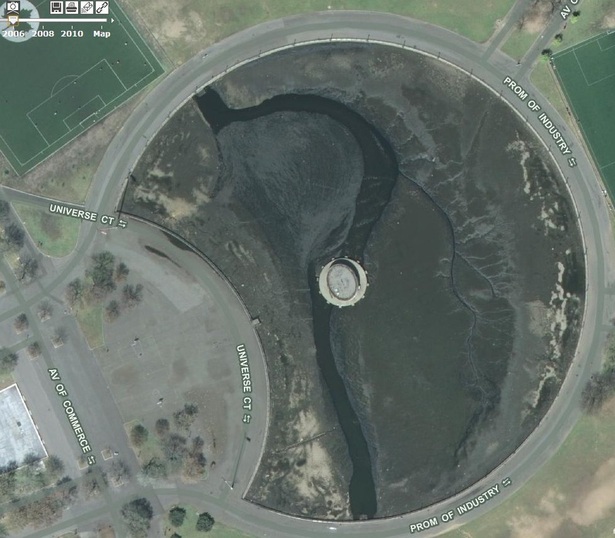
Save FMCP uncovered this image - on the city's own website - that shows there is a marsh underneath the Pool of Industry, where Major League Soccer wants to build a stadium. If they weren't serious about this proposal, it would be comical. And even more comical/pathetic/embarrassing is the fact that there are actually elected officials that think this is a fantastic idea.
Monday, January 7, 2013
No good deed goes unpunished

From the NY Times:
Once home to colonial estates and a Cuban sugar importer, then a public beach, a railroad float yard, a city landfill during the Bronx’s burning years, an illegal dumping ground tied to the mob, a proposed power plant and a jail, Oak Point, which Mr. Smith developed, now features a $60 million warehouse supplying food to bodegas and restaurants.
For three months the waterfront on the 28-acre site was also home to a wetland with verdant slopes and grassy marshes. Paradise in the Bronx.
And then it was all lost: two years of planning, nine months of work, $1.5 million and three acres of wetlands washed away in a matter of hours by Hurricane Sandy’s 13-foot storm surge. What remain are a few patches of marsh grass, a Charlie Brown-like evergreen and one lonely, weedy mound just below a concrete wall.
Based on what survived, Mr. Smith advocates rebuilding by integrating, or layering, hard and soft materials.
He has a wider vision, though, beyond the waterfront, for his remaining 13 acres. He plans a three-level “food campus” for a wholesale farmers’ market for New York State growers, a rooftop greenhouse, a kitchen incubator and public space overlooking the water. In December, Oak Point’s second phase (projected at $80 million) received a $400,000 economic development grant from Gov. Andrew M. Cuomo.
Tuesday, December 4, 2012
Developing Flushing Meadows would be an ecological nightmare

From the Daily News:
Because Bloomberg understands climate change so well, it is baffling that his administration has signed on to development plans for Flushing Meadows that are alarming — the construction of new stadiums, roads, parking lots and a massive mall in the park.
These construction projects will substantially increase the percentage of impervious surface cover (materials that do not absorb water) in the park as green spaces are converted to structures (stadiums and malls) and concrete roads, parking lots and walkways. Any gains against pollution runoff and flooding in the Meadow and Willow Lake watershed will be damaged by these developments, and storm runoff into Flushing Bay will likely increase.
Such development will also further damage Flushing Meadows’ historical role as a marshy buffer against storm surge and coastal flooding, placing residents and businesses located near Flushing Meadows in a more vulnerable position during extreme weather events. Do the developers of the soccer stadium have plans to address the potential damage from flooding to surrounding neighborhoods wrought by their work?
Flushing Meadows-Corona Park is no stranger to bold plans that usher in major changes. However, these new developments resemble the worst excesses of Robert Moses rather than his success in originally creating the park. True boldness requires further protective wetland restoration in the park.
Saturday, July 23, 2011
Nastier mosquitos around now
 From the Wall Street Journal:
The Asian tiger mosquito, named for its distinctive black-and-white striped body, is a relatively new species to the U.S. that is more vicious, harder to kill and, unlike most native mosquitoes, bites during the daytime. It also prefers large cities over rural or marshy areas—thus earning the nickname among entomologists as "the urban mosquito."
"Part of the reason it is called 'tiger' is also because it is very aggressive," says Dina Fonseca, an associate professor of entomology at Rutgers University. "You can try and swat it all you want, but once it's on you, it doesn't let go. Even if it goes away, it will be back for a bite."
Dr. Fonseca is leading a U.S. Department of Agriculture effort to develop a cost-effective method to control the Asian tiger mosquito (Aedes albopictus) population. The university is currently focusing on using larvacides, which render larvae incapable of growing into adults.
Since urban areas tend to be warmer—often by 5 to 10 degrees—than rural areas, cities are seeing tiger mosquitoes earlier and sticking around longer, often into October.
Sunday, January 30, 2011
Mike replacing marsh with mall
 From the Wave:
If developers have their way and the city can cut a deal with environmental naysayers, Rockaway residents may one day have a new shopping destination just north of the Gil Hodges Marine Parkway Bridge in Brooklyn.
The plan is to transform a 15-acre swath of land near Four Sparrow Marsh in Mill Basin, Brooklyn, into a car dealership and retail center. The land lies just south of the present Toys R Us store and just north of the Belt Parkway interchange. It is also just north of the Four Sparrow Marsh, the habitat for many species of birds, some of them on the protected species list, environmentalists say.
Because of the proximity of the marsh, the plan has drawn criticism from local conservation groups.
While members of that area’s community board have warmed to the idea of a new retail center, some conservation groups are worried about the environmental impact of the proposed project on Four Sparrow Marsh.
The plan calls for a 110,000-square foot Cadillac dealership to be built next to Toys R Us on Flatbush Avenue. The project is scheduled to begin the city’s land use process this spring. Developer Forest City Ratner Cos. will oversee the project, breaking ground in 2014.
There are currently two proposals for the retail center. One would allow Forest City Ratner to erect two buildings for a total of 138,000 square feet of retail space for multiple tenants. The other calls for a single 127,000-squarefoot building with one tenant.
At issue is the 67-acre Four Sparrow Marsh, which is currently a nature preserve and the nesting site of several threatened species of birds, like the seaside sparrow. The project could hurt the amount and quality of water in the basin, said New York City Audubon’s Phillips. It could also disrupt the nesting of several species of birds, he said.
The plan “does try to buffer the development site from the natural area. However the buffers are pretty small and we think they are inadequate,” he said.
Under the proposed plan, Four Sparrow Marsh would also become officially mapped parkland overseen by the city’s Department of Parks and Recreation. It would remain off limits to the public as a nature preserve.
God knows we have too much nature in this city and not enough Bruce Ratner projects! Thank you, Mayor Bloomberg, for this wonderful project in line with your PlaNYC 2030 goals. Just like this one.
Monday, May 31, 2010
Betting on a bivalve
 From the Gotham Gazette:
The largest urban wildlife preserve in the United States sits adjacent to Kennedy Airport, near the high-rise apartments of Starrett City and the Rockaway housing projects. Home to the peregrine falcon, the loggerhead sea turtle, the short-eared owl, the area -- Jamaica Bay -- at the intersection of Queens, Brooklyn and Long Island, serves as a stopover for 20 percent of American bird species on their annual migration along the East Coast.
For years, though, this estuary, a shallow marsh where fresh and saltwater meet, has been vanishing into the toxic waters of the New York City harbor, losing an estimated 33 acres annually to deterioration, nitrogen buildup and rising sea levels. Spanning some 16,000 acres about a century ago, the salt march islands have shrunk to a mere 800 acres. Thought not nearly as dramatic as the environmental catastrophe now confronting the Louisiana coast, the threat to Jamaica Bay could completely destroy the marsh by 2024, decimating the home for an abundance of rare and endangered plants and animals.
Now, the federal state and city governments, prodded by citizen's groups, have stepped up their efforts to preserve the area. This year, government and private groups collaborated to update the Jamaica Bay Watershed Protection Plan to try to avert disaster in the urban refuge. Whether government will keep its commitment and whether its actions can reverse the decades of deterioration remains to be seen.
Oyster gardening is still in the beginnings stages of a two-year experiment that will determine whether they will benefit the bay's condition. The next several years will be critical to see if the oysters can once again thrive in the estuary as part of a recovering environment and if the marshes can once again shelter and nourish an authentic mix of native New Yorkers.
Sunday, May 23, 2010
DEP planting marsh grass
 From the Times Ledger:
The city began a new organic operation to help save the wetlands in Jamaica Bay last Thursday that they hope will stop the deterioration of the marshlands at the heart of the problem.
Cas Halloway, commissioner for the city Department of Environmental Protection, announced the second phase of the agency’s Eelgrass Restoration Project designed to add 1,000 new plants to the ecosystem. The plants not only provide a safe habitat for birds and fish, but also help reduce the excess nitrogen in the bay’s water supply and stop the saltwater marshlands from degrading.
“Restoring eelgrass to Jamaica Bay is another important step in our efforts to improve this invaluable natural resource,” Holloway said in a statement. “This program, if successful, will mark the first time in nearly 100 years that eelgrass is able to survive in Jamaica Bay.”
The eelgrass will be planted at three locations near Jamaica Bay — Breezy Point, the Breezy Point Yacht Club and Dubos Point — and will be protected by special fencing, poles and sandbags, according to the commissioner. The DEP will hold biweekly monitoring efforts to track the progress of the plants and make notes on how it grows and thrives in the ecosystem.
Thursday, April 29, 2010
Rebuilding Jamaica Bay
 From the NY Times:
For more than a decade, workers using giant digging machines have scooped up enormous mounds of rock, clay, sand and silt from the waters around New York to deepen the shipping channels to accommodate giant cargo vessels that will navigate the widened Panama Canal starting in the middle of the decade.
The dredging has produced millions of cubic yards of muck.
“What do you do with all that stuff?” said Col. John R. Boulé II, commander of the New York District of the Army Corps of Engineers, which is overseeing the dredging. “Some of it we’re using to restore the islands in Jamaica Bay.” Recalling the lush “Mannahatta” that Henry Hudson encountered when he sailed into New York Harbor 400 years ago, Colonel Boulé added: “We want to put a little more of 1609 back into 2010.”
The Army Corps of Engineers and the National Park Service are the primary partners in a collaboration of city, state and federal environmental, parks and port agencies and private partners to revitalize what is known as the Hudson-Raritan Estuary, focusing primarily on Upper and Lower New York Bay. Eventually, oyster beds will be restored to serve as living water filters, and shellfish may someday be harvested commercially again.
Jamaica Bay is part of the park service’s Gateway National Recreation Area, which spans the harbor and will be expanded by hundreds of acres when the city’s former Fountain and Pennsylvania Avenue landfills in Brooklyn, recently forested with 35,000 trees, are incorporated as parkland in a few years.
Subscribe to:
Posts (Atom)


