Community Board 9 is calling on newly elected City Council members to revisit plans for the proposed closing of Rikers Island and the switch to borough-based jails.
“We figured that now, with 26 new City Council members, that it would be time to hopefully bring to their attention what our feelings are,” Community Board 9 President Kenichi Wilson told the Chronicle.
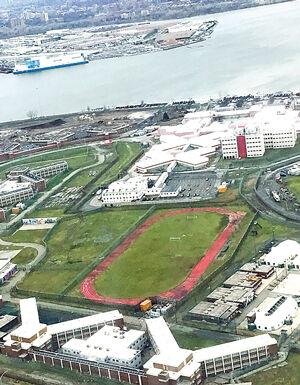
The group is supporting a revised plan from Bialosky New York, an architectural firm based out of Manhattan, which calls for a completely new, more “humane” and cost-effective complex to be built on the existing island.
The plan was originally presented at a 2019 press conference in Chinatown held in opposition to the proposed jail there.
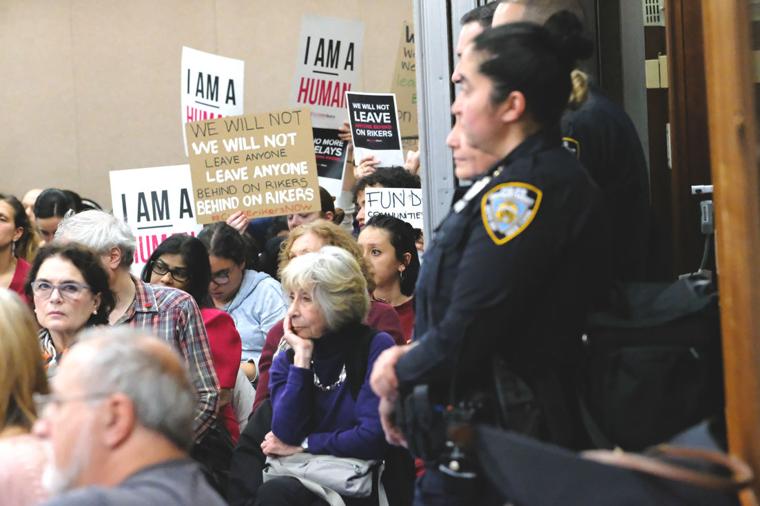
Rallies at that same site resumed on Feb. 6 as Lower Manhattan residents gathered to protest the destruction of the current jail there for a new and bigger site.
Around the same time, Community Board 9’s land use chair, Sylvia Hack, was working to track the original proposal down and the board received a “new and improved version,” CB 9 District Manager James McClelland said.
In early February, Wilson sent a letter to elected officials in the area.
“The proposed borough-based jails are towers offering no outdoor recreation spaces for the incarcerated and, should there be a reason to empty a tower building, no viable plan exists to safely evacuate nearly a thousand detainees plus security and support staff,” he wrote.
“If we are concerned about the incarcerated population and the possibility of really helping them with the reasons that landed them in jail, then we should seriously look at this new, alternative option to four huge monoliths constructed in densely populated areas of the city,” the letter continues.
The plan of transitioning from Rikers to borough-based jails, begun under former Mayor Bill de Blasio, calls for the Queens location to be erected in place of the old lockup near Queens Borough Hall in Kew Gardens.
The Adams administration’s plan for Rikers remains unclear.
The plan for a “reconceived Rikers” includes outdoor space, gyms, art, music and science programs and skills-training programs. Another focus is to create low-rise buildings instead of the current towering structures.
According to Wilson’s letter, the plan would almost halve the price of building four new jails and prevent the “environmental and negative impacts” on surrounding communities.”