Showing posts with label nyu. Show all posts

Tuesday, March 8, 2016

Landmarked areas are as dense as non-landmarked areas

NYU Furman Center Historic Districts Brief by crainsnewyork


From Crains:

Landmark districts in New York City are just as dense at nearby areas that are not designated historic, according to a study released Monday.

The NYU Furman Center for Real Estate and Urban Policy found that about 3.5% of the city's properties are protected by the landmarks law. Properties with such a designation require approval from the Landmarks Preservation Commission before an owner can make alterations.

Though landmarked areas had far fewer rent-regulated apartments than the rest of the city, they were built up to roughly the same density than adjacent neighborhoods, according to the report.

Wednesday, January 8, 2014

Judge's decision on NYU expansion puts Willets Point project into question

From the Daily News:

New York University's $6 billion expansion plan all-but-collapsed Tuesday when a Manhattan judge ruled that construction cannot start unless the state legislature agrees that three tiny strips of city parkland can be used for the project.

“The legislature will never go for that,” Randy Mastro, the lawyer for the opponents, predicted Tuesday night as New York University officials mulled Manhattan Supreme Court Justice Donna Mills’ 78-page decision.

Mills rejected all the other arguments of the opponents — who included Greenwich Village celebrity residents like Matthew Broderick — but she agreed that they were right about the misuse of three tiny strips of land used as parks.

City lawyers had contended that they didn't need the legislature's permission to give the parkland to NYU because the strips were not dedicated parkland and are still on city maps as streets.

But opponents said these strips have been treated as official parks by the city for decades; they have used as parks by area residents; and they are on city websites as parks tended by the Parks Department.

“Land can become parkland ‘either through express provision such as restrictions in a deed or legislative enactment, or by implied acts, such as continued use of the parcel as park,’” Mills wrote.

“Land may become parkland by implication even...where the land remains mapped for another purpose, as here,” she added, ruling that for the city to give the property to NYU without the legislature's approval would violate the ‘public trust doctrine.’


So parkland is parkland? What an original concept! So this most likely means that the former site of Shea Stadium will be considered parkland. Tee hee!

Monday, November 18, 2013

Worker dies at NYU construction site

From Metro:

A construction worker is dead after falling from scaffolding on the sixth floor of a New York University building on Friday, police said.

Jamie Sillart, 56, of Bergenfield, N.J., was working on the façade of NYU’s Languages and Literature Building at 19 University Place when he slipped and fell from his perch around 11:30 a.m. He landed on the adjacent rooftop of the NYU Cantor Film Center at 269 Greene Street, police said.

Sillart, who was working for D.P. Consulting Corp., was taken to Bellevue Hospital where he was pronounced dead.

Thursday, December 9, 2010

Community protests NYU expansion

From NY1:

More than a hundred Greenwich Village residents and a half-dozen elected officials huddled around the Fiorello LaGuardia statue Sunday to protest NYU's plans to expand its campus in the Village.

"We believe very strongly that NYU must finally learn to coexist, not overwhelm this community," said Manhattan Borough President Scott Stringer

Two weeks ago, members of Manhattan's Community Board 2 passed a resolution opposing the university development proposal called "NYU 2031." Part of that plan called for the university to put up new buildings in the Village on seven strips of city-owned land totaling more than two acres.

Residents insist that part of the plan be scrapped because they would like to see the Parks Department turn the strips into permanent parkland.

"It's being used as public land now. It has been since the 60s when these spaces were first created," said Community Board 2 Member Jo Hamilton. "There's no reason why it shouldn't officially become parkland. We shouldn't be moving Mr. Fiorello LaGuardia in order to have an NYU building there."

Wednesday, August 18, 2010

More lobbying shenanigans

From the NY Post:

Why lobby others when you can lobby yourself?

Two part-time city commissioners who work fulltime as lobbyists are paid tens of thousands of dollars by clients who stand to gain from the commissions on which their conflicted lobbyists serve.

Landmarks Preservation Commissioner Margery Perlmutter is on New York University's payroll to lobby for the school's large-scale expansion -- which first needs a green light from Perlmutter's commission, according to lobbying records.

Meanwhile, Taxi and Limousine Commissioner Harry Giannoulis is the president of a lobbying firm that represents an alternative-energy group that wants vehicles to run on biodiesel.

Perlmutter and two of her colleagues at the Bryan Cave lobby firm have been paid more than $42,000 by NYU to lobby the Landmarks Commission and seven other agencies for approval to build in the heart of Greenwich Village. Among its plans is a 385-foot skyscraper.

Perlmutter plans to recuse herself from the commission's vote, a source said.

Since joining the unpaid commission four years ago, Perlmutter has gained a reputation as pro-preservation and critical of high-rise projects like NYU's.

The city's Conflicts of Interest Board warned Perlmutter in 2006 to steer clear of landmark matters in her day job as a lawyer and lobbyist at Bryan Cave -- and not to share in her firm's profits from lobbying her commission.

Perlmutter told The Post there was no conflict because she claims her work for NYU is limited to the parts of the plan that don't require approval from her commission.

"There are many components -- it's a huge project -- and I'm not involved in the landmarks component," she said.

Giannoulis of the TLC lobbies for the National Biodiesel Board.

He declined to comment.

A source said the biodiesel group hired Giannoulis' Parkside Group to track heating-oil legislation, and that Parkside doesn't work on the biodiesel board's transportation agenda.

Saturday, April 3, 2010

Trepidation over NYU plan

From the NY Post:

As NYU prepares to unveil an enormous plan to vastly expand its campus in Greenwich Village, longtime residents are warning the university to tread lightly while carving up their neighborhood's last bits of open space and quaint streetscapes.

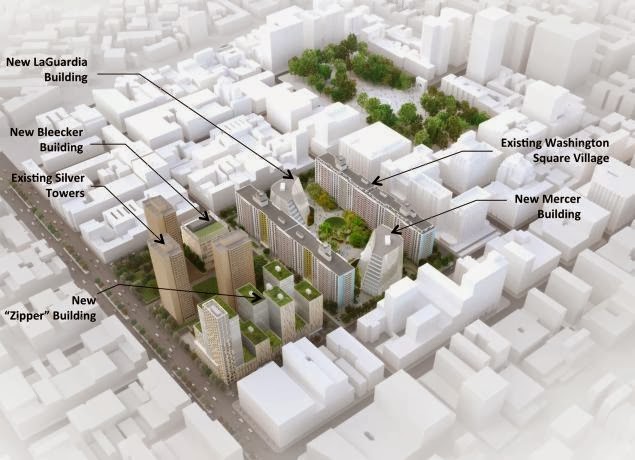
Much of the development would be shoehorned into two "super blocks" between Mercer Street and La Guardia Place, north of Houston Street, where tall towers were permitted in the 1960s in exchange for setting aside a large swath of green space.

Non-NYU residents expect that the university's expansion plan, to be made public in three weeks, will chew up large parts of the open space to create up to 3 million square feet of new space for college facilities.

NYU officials have promised to retain much of the space by putting some buildings underground, while improving public areas.


Uh huh...yes, I'm sure everything they do is aimed toward making the community a better place.

Saturday, March 27, 2010

NYU expanding...again

NEW YORK (AP) -- New York University is proposing a massive expansion over the next 20 years.

The proposal calls for a new tower on Bleecker Street and 3 million square feet of new offices, dormitories and classrooms in the Greenwich Village area. It also includes a new engineering school in Brooklyn and a satellite campus on Governors Island.

The projects, which would expand NYU's physical plant by 40 percent, still need approval from city agencies.

They've already been met with concern from some neighbors and preservationists worried about overwhelming the historic area.

NYU says it needs to expand to accommodate a growing student body and compete with other universities.

The plan will be formally introduced at a series of events in April.

Friday, March 26, 2010

Queens upzoned more than the other boroughs

From the NY Times:

Amanda M. Burden, the city’s planning director since 2002, said the city’s approach to zoning was based on a “finely grained” process of listening to the needs of separate communities and neighborhoods. “We respond to communities where the threat is the greatest to the neighborhood fabric,” she said. “We upzone where it’s sustainable, and where reinvestment is needed.”

Mitchell L. Moss, a professor of urban policy and planning at New York University who has been an informal adviser to Mayor Michael R. Bloomberg, said that for decades, the city had been zoned for too many people, and that it was overdue for the kind of adjustment pursued by the Bloomberg administration. Ms. Burden “has done more to reshape the city than anything Robert Moses ever did,” he said.

Whether or not that is true, the Furman Center report starts to paint a picture of significant change, finding that city planners were, in many cases, successful in their goal of creating housing within half a mile of existing transportation hubs. In other places, though, zoning regulations that restricted new building have taken “capacity away from communities well served by transit,” the report says.

Most of the new residential capacity was created in Queens, followed by Manhattan and then Brooklyn. In the Bronx, rezoning measures that affected more than 18 percent of the borough added virtually no residential capacity, the report found.


No kidding! Queens has long been the place to dump more people on top of an infrastructure from the early 1900s.