
From the NY Post:
The state is designating the Columbus monument at Columbus Circle as a landmark — in case the city tries to move it in the future.
The New York State Board of Historic Preservation voted unanimously on Sept. 20 to place the statue in the state and national registers for its historic and cultural significance.
The action was not publicized.
Gov. Cuomo is expected to announce the designation at the Columbus Citizens Foundation dinner Saturday night and the news will be celebrated at the monument on Sunday — ahead of Monday’s Columbus Day Parade.
The 76-foot beaux arts monument was designed by Italian sculptor Gaetano Russo and it’s his only sculptural art work in America.
Showing posts with label national register. Show all posts
Showing posts with label national register. Show all posts
Monday, October 8, 2018


Tuesday, February 6, 2018
Civic leader says historic districts should be protected from noise

The LaGuardia Airport committee meeting at the Adria Hotel in Bayside on Jan. 25 brought one civic leader’s report that the Federal Aviation Administration may have overlooked rules pertaining to historic districts when creating flight patterns over northeast Queens.
Maria Becce, retired vice president of the Broadway-Flushing Homeowners Association and current member, said she had corresponded with officials in Washington about a 1966 law protecting historic places and Native American reservations from environmental impacts of airplane noise.
The Broadway-Flushing Historic District, established in 2006, protects the integrity of about 1,300 buildings on the National Register of Historic Places that have stood for more than a century. The neighborhood now sits below the NextGen flight pattern, enacted in 2012, particularly the TNNIS climb for commercial aircraft departing from LaGuardia.
According to a letter issued in November from the Advisory Council on Historic Preservation, part of the Office of Federal Agency Programs, to Katherine Andrus, the FAA’s federal preservation officer, stating the agency had issued a categorical exclusion, or CATEX, under the Historic Preservation Act which the FAA seemed to falsely believe gave it immunity from complying with Section 106, which calls for additional studies pertaining to historic districts, the letter stated.
Saturday, November 11, 2017
Strange choice for historic list
From the Queens Chronicle:
Gov. Cuomo last Friday named the Spear & Co. Factory, located just south of the Woodhaven-Ozone Park border, one of 21 properties he’s suggesting be added to the state and national registers of historic places — but if you ask area historian Ed Wendell about the place, he couldn’t tell you much.
“This is the first I’m hearing anything about the building,” said Wendell, who has studied the history of Woodhaven and some Ozone Park buildings.
The building, located at 94-15 100 St., was once home to Regal Spear Co., which produced hats, and the Columbia Wax Products Co., a national manufacturer of novelty candles.
A report compiled by Gregory Dietrich Preservation Consulting, a group that assists individuals and entities in getting buildings landmarked, states the building’s history and architecture make it eligible for historic status.
Friday, February 10, 2017
Ridgewood Reservoir nominated for National Register
From Save Ridgewood Reservoir:
NYC H2O has applied to the State and National Historic Registers for the Ridgewood Reservoir. You can write a letter of support and address it to the State Historic Preservation Office. Here's a link to a suggested letter.
New York State Division for Historic Preservation
Peebles Island State Park
P.O. Box 189
Waterford, NY 12188-0189
NYC H2O has applied to the State and National Historic Registers for the Ridgewood Reservoir. You can write a letter of support and address it to the State Historic Preservation Office. Here's a link to a suggested letter.
New York State Division for Historic Preservation
Peebles Island State Park
P.O. Box 189
Waterford, NY 12188-0189
Ridgewood Reservoir Nomination by ridgewoodreservoir on Scribd
Monday, June 27, 2016
Garden City: It's not Queens
From CBS 2:
The Victorian gem in Garden City is listed on the National Register of Historic Places, but that designation does not protect it from the wrecking ball.
“To lose this type of history to Garden City would be a shame,” said Michael Raab of the Nassau County Office of Housing and Community Development. “It is one of the Stewart homes.”
For months, there were no takers for the 133-year-old home. The Garden City Historical Society was devastated at the thought of losing it, and caught the attention of Nassau County Executive Ed Mangano.
Mangano asked Raab to begin pulling together volunteers, and dozens came aboard to offer to donate their time and services.
“It is a heartwarming project to be able to help a potential veteran in need of housing,” said Michael Pfeiffer of the Nassau County Habitat for Humanity.
If the plan works, expert volunteers will actually lift the house, put it on hydraulic flatbeds, and slowly roll it to Mitchell Field.
Thursday, July 30, 2015
Why the hell is this 18th century church in Elmhurst not landmarked?
 |
| Jim Henderson/Wikipedia |
It was built in 1735 and is the oldest surviving Anglican building in the City of New York.
In all likelihood, it will be necessary to tear down the Old Parish Hall to make the property attractive to developers.
The property is on the national register, but does NOT have landmark status by the city, and could be torn down. The building is probably one of the oldest buildings standing in Elmhurst, and one of a few historical buildings left in Elmhurst." - anonymous
Ok, so if the Landmarks Conservancy and the state paid for a full restoration, then why has this building not been designated, Ms. Mary Beth Betts?
Saturday, September 27, 2014
Former Elks Lodge added to National Register

Governor Andrew M. Cuomo announced on September 22 that the New York State Board for Historic Preservation recommended adding 22 properties, resources and districts to the State and National Registers of Historic Places.
One of the locations is here in Queens. The Benevolent and Protective Order of Elks, Lodge Number 878 on Queens Boulevard in Elmhurst is on the list. The 1923 building is a distinctive architectural example of a 20th-century fraternal organization building designed in the Italian Renaissance Revival style.
Tuesday, January 28, 2014
Slave burial ground in Bronx being recognized
 From NY 1:
Little historians working on a school project helped uncover an African slave burial ground.
It started last year, when their teachers discovered the photo seen at left while working with the department of education's Teaching American History project that focuses on teaching local history to kids.
"There's an image that said, 'Slave burial ground' in the Bronx, but that was all the information we had on it," said Brian Carllin, director of the Teaching American History Project.
They turned to the Huntington Free Library for help. Its president, Thomas Casey, immediately recognized the photo and offered some insight.
"The U.S. census, the first one we have is 1790, and we find from the 1790 reports that, in fact, about one-third the population were slaves," Casey said.
They were slaves who belonged to the Hunts, Leggettes, the Tiffanys, families that owned large portions of land in the 17th-century Bronx.
The white landowners were buried in a fenced-off cemetery preserved in Drake Park, while the rest of the park was built over the burial ground for their slaves.
Elected officials and community members are now calling for official recognition of the land where the slaves are interred.
"Make sure that we put this site, we put this African-American burial ground on the site of the state historic registry," said state Senator Jeff Klein, whose district covers parts of the Bronx and Westchester.
Those involved say that even a sidewalk in the park could be hallowed ground. They believe that the burial ground stretches throughout much of this area, and they want to see the people buried here memorialized.
Legislators say they won't stop with recognition on the state registry and hope to have the burial ground recognized as a national historic site, too.
This is quite similar to the East Harlem MTA depot site.
But then there's Elmhurst, where no elected officials give a shit about a slave burial ground being destroyed by a condo project, and learning about its history is certainly not part of any school project.
Saturday, March 16, 2013
A crap above: Brooklyn edition

From The View From Wyckoff Heights:
Despite the history of blockbusting, arson, vandalism, and neglect, many Bushwick tenements have survived relatively intact. But with growing demand for real estate in north Bushwick and south Ridgewood along the L train line, how will historic buildings fare at the hands of developers?
Very few of these buildings - which date to the late 1800’s and early 1900’s - are landmarked (and only in Ridgewood). There are several National Historic Districts (mostly in Ridgewood) but they do not afford protection, only incentives for preservation.
Some old-timers refer to parts of north Bushwick along the borough line as “Ridgewood Brooklyn”, but despite the architectural similarities developers and investors currently seem to be favoring buildings on the Brooklyn side, where most residential blocks are zoned R6 and have excess FAR. The Queens side by contrast is zoned R6B, which has a lower FAR and mandatory Quality Housing regulations that promote preservation of the streetscape.
204 Starr Street, a three-story six-family building between Wyckoff and Irving, sold in September 2012 for $773,000 to a SSH Realty Management of Williamsburg. The new owner has removed the cornice and is constructing a rooftop addition.
DOB records last week showed job applications for interior renovation but not a vertical enlargement, and noted a prior violation for work without a permit. I contacted the architect who responded that he was not aware that the cornice had been removed, and that its removal and the rooftop addition were not his design. Emails sent to the owner seeking more information were not returned, but a PAA was filed the next day for the 4th floor addition.

Just down the block is 390 Stanhope St, a 2-1/2 story three-family building, also part of the Cypress Avenue West National Historic District. The property sold last year to a DUMBO-based developer for $475,000.
The new owner has expressed plans to buy out the tenants and add two additional stories, but to date nothing has been filed with the Department of Buildings.
Monday, May 17, 2010
Demolition by neglect at the Navy Yard
 From the NY Times:
FOR three years, some of the most powerful forces in New York real estate — including the federal and city governments, developers, preservationists and community advocates — have fought over the fate of a cluster of historically significant turn-of-the-last-century houses known as Admiral’s Row in the Brooklyn Navy Yard.
Last month, the parties finally arrived at a compromise that seemed to strike a balance between preservation and development, in a $60 million project that would add a large supermarket to an underserved neighborhood, while also salvaging some buildings of deep architectural and cultural significance.
And now the delicate compromise, having been reached, is under threat. The federal government agreed to sell the city the land to develop as long as it met certain conditions. Because the timber shed and the homes on the site are eligible for placement on the National Register of Historic Places, the government required that the shed and one of the homes be restored and useable. Last month, after protracted debate, negotiators accepted a proposal from PA Developers of Manhattan to build a supermarket — serving the 15,000 residents who live in three public housing projects bordering the yards — along with new retail stores and an additional 125,000 square feet of industrial space.
But after the bid was accepted, Kristin Leahy, the cultural resources manager for the National Guard Bureau, the federal agency that controls the site, said engineers had found that the historic structures, particularly the timber shed, might be beyond repair. “We hired these engineers with tools to stabilize the buildings,” she said, “and that is when they came back and said we had a problem.”
One proposal at a subsequent meeting last month was to deconstruct the building and then incorporate the salvaged pieces into a new structure. But Mr. Herrera of the Landmarks Conservancy said that deconstruction was another word for demolition.
“What I don’t like is this attitude of ‘We can’t save it,’ without even really trying,” he said. “What we are really disappointed in is that during this whole process, nothing has been done to protect the buildings.”
Ms. Leahy said she could not explain why federal authorities had let the property basically decay for decades, except to cite confusion over issues of ownership and control.
Wednesday, March 17, 2010
Historic designation can be profitable (despite rumors to the contrary)
 From the Daily News:
Designed in 1913 by Cass Gilbert, the architect of Manhattan’s famous Woolworth Building and the man known as the world’s first skyscraper builder, 184 Kent was the waterfront warehouse for Austin, Nichols & Co., then the United States’ largest grocer and distributor of Wild Turkey bourbon. They moved to Williamsburg from the lower East Side for waterfront access to boats delivering and shipping products.
The six-story 425,000-square-foot building was one of the soundest warehouses ever built. Gilbert designed more ornate courthouses and treasury buildings of the same material, but 184 Kent was a pared-down version of its stately counterparts. Its integrity is in its simplicity.
It isn’t just history that makes this project one of the city’s most intriguing rentals in recent memory. The construction, landmark issue and marketing strategy were methodically thought out to ensure this building got as much care as possible.
After some early controversy caused by the previous owners, who evicted long-term tenants and lobbied the city council to have the New York City Landmark Commission’s decision to protect the building overturned (owners wanted to build a seven-story glass box on top for a condominium conversion), Halpern’s group bought out the owners and secured 184 Kent as a rental. Immediately, JMH went through a nine-month process of having the building federally landmarked, allowing him tax credits on the rehab.
“We would not have been able to do this project economically without the landmark approval,” he says. “It meant saving us 25 cents for every dollar spent on refurbishing.”
Tuesday, January 19, 2010
Garden City gem may face wrecking ball
 From the NY Times:
A storybook magic hangs about St. Paul’s School, a 130-year-old brick palace that seems caught in an evil spell, inching toward a tragic end while ripping this affluent Long Island suburb apart.
The school stands four stories tall, all red brick, spires and gargoyles, topped by a pitched slate roof and lined with windows hugged by keystones. It looks like the kind of place young Jane Eyres or Harry Potters might race through, and thousands of students did, from the early 1880s until it closed in 1991.
But now, nearly two decades after Garden City bought St. Paul’s and its surrounding athletic fields, the village is considering tearing it down. An environmental review of the proposed demolition is under way, with a vote on whether to pay for it expected in the coming months.
The proposal is not a result of a lack of affection for the High Victorian Gothic behemoth, which is listed on the National Register of Historic Places — the village illuminates St. Paul’s at night with spotlights, and dressed it with an outsize Christmas wreath. The people of Garden City just cannot agree what to do with it.
Preservationists say the imbroglio underscores just how vulnerable old buildings can be in the suburbs. Individual municipalities hold the primary power in designating landmarks — the federal and state governments play a limited role — and St. Paul’s has virtually no protection because Garden City has no landmark ordinances.
Friday, September 18, 2009
Pavilion now on the state register
 From the Daily News:
The New York State Pavilion, a crumbling yet iconic relic of the 1964 World's Fair in Queens, won approval Tuesday as a state landmark.
The designation opens it to desperately needed rehab grants.
In what historians hailed as a major step toward saving a long-neglected symbol of Queens, the state Board for Historic Preservation voted unanimously to add the concrete-and-steel behemoth to the state Register of Historic Places.
The board also nominated the iconic structure in Flushing Meadows-Corona Park as a national landmark, citing how it "continues to convey the essence of the experience of visitors to the fair."
Both state and federal designations would allow the city, which owns the pavilion and is studying its structural stability, to apply for grants to spruce it up.
It also allows the city to demolish it, but let's not mention that. It's funny how all these news stories wrote their stories as though it was landmarked by the state and therefore protected from demolition.
Wednesday, August 19, 2009
Pavilion may be placed on the National Register
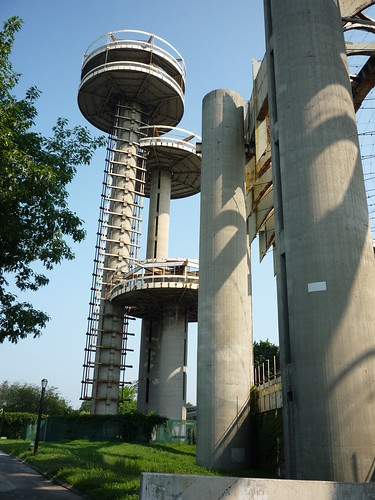
The 1964-65 NY World’s Fair NYS Pavilion will be heard by the NYS Review Board for possible inclusion on the NYS & National Registers of Historic Places on September 15, 2009. People interested in sending in comments are encouraged to do so by mailing them to:
Virginia Bartos
Historic Preservation Field Services Bureau
New York State Office of Parks, Recreation and Historic Preservation
Peebles Island
P.O. Box 189
Waterford, NY 12188-0189
Comments must be received by September 14th.
Subscribe to:
Posts (Atom)


