Showing posts with label artificial turf. Show all posts

Saturday, September 26, 2015

Crumb rubber fields still haven't been replaced

From the Times Ledger:

The city installed more than 200 synthetic turf athletic fields that contain a substance known as crumb rubber, linked by some to certain types of cancer, in the past couple decades. But since putting a halt to the installation of these fields in 2008, the city said it has no intention of removing them until they need to be replaced from wear.

Made from ground-up car tires, crumb rubber can contain up to seven carcinogenic chemical compounds, according to the nonprofit health organization Environmental and Human Health Inc.

New York City Parks Advocates President Geoffrey Croft said there have been growing concerns around the country that excessive play on crumb rubber fields is linked to cancer.

While some are tracking cancer clusters in cities across the country trying to find a link, there has been much industry-sponsored counter-research suggesting data on exposure to the chemicals in the turf were insufficient to link attribution to cancer.

Queens has 35 crumb rubber fields.

The city Department of Parks and Recreation said it continues to monitor conditions at all of its fields regularly. If conditions of any particular field merit replacement, the department said it would go about its standard capital process to do so.

Thursday, May 21, 2015

Artificial turf may cause childhood cancer


From CBS 2:

CBS2 first reported last January on concerns over artificial turf playing fields being a potential danger to kids.

Now in a CBS2 investigation, Carolyn Gusoff has found these fields may be linked to a growing number of cancer cases in young athletes.

Experts said the bad things in question include a number of chemicals.

“We know some of these chemicals do cause cancer,” said Dr. Robert Cohen of Northwestern Medicine.

Now, the issue is building steam — from New Jersey to Long Island and even New York City, where there are hundreds of similar fields.

“These are many years that children are playing on this surface, and they’re growing up on this surface, and now, we’re seeing throughout the country these cancer clusters,” said New York City Parks Advocates President Geoffrey Croft.

Croft said he has been petitioning the city to remove the 200-plus crumb rubber fields currently in local parks.

But the Synthetic Turf Council, which represents the companies that make the fields, insists the substance is safe. They cited 60 studies.

One of the studies cited was conducted by the Environmental Protection Agency, which examined four crumb rubber fields in 2009 and found that harmful chemicals were “below levels of concern.”

But Long Island U.S. Rep. Steve Israel (D-N.Y.) said the EPA study is in adequate.

“Common sense tells us that four fields is not an adequate sample in an entire country,” he said.

Israel insisted that the agency should do more testing.

“The only way we’re going to know whether these fields are truly safe or unsafe is for the EPA to get its act together, and update the study, and let the American people know so that they can make their own judgments,” Israel said.

In a statement, the EPA acknowledged its original study was limited, and that more testing needs to be done. But the agency did not commit to doing it.

Monday, November 10, 2014

The Grover Cleveland Athletic Field has seen better days


Several months ago, I walked past the Grover Cleveland Athletic Field at DeKalb & Seneca Aves in Ridgewood and noticed that the field had been ripped up. I figured it was in the middle of a capital project or regular maintenance. But lo and behold, all this time later, the artificial turf is still a mess and there's now real grass growing in the dirt sections of the field. I don't know what's up here, but it's a hot mess. The aerial shot of the property is hard on the eyes as well.

Saturday, October 11, 2014

Artificial turf may be unhealthy

From the Daily News:

It may be time to take a closer look at the artificial turf your kids play on.

An NBC News investigation into the fake grass raises the possibility that it leads to cancer, especially those of the blood.

Seattle soccer coach Amy Griffin has made a list of 38 U.S. soccer players who have been diagnosed with cancer, 34 of them goalies who have constant contact with artificial turf. Though no research has said the material causes the disease, Griffin believes the black crumbs made of synthetic fibers and old tire bits that get kicked up by regular play can get into players' bodies and be carcinogenic. Turf fields can get hotter than outside temperatures, too, causing concern that byproducts can seep into the air.

"I've coached for 26, 27 years," she told NBC News. "My first 15 years, I never heard anything about this. All of a sudden it seems to be a stream of kids (getting sick)."

The fake grass isn't just on soccer fields — it's also the surface for thousands of playgrounds, schools, parks and stadiums throughout the country. Officials like that it's cheaper than grass to maintain and can hold up year-round.

NBC's investigation did not come to a definitive conclusion that the material was safe, but did add fuel to the fire.

The Synthetic Turf Council, however, says that the evidence so far says it's perfectly fine.


Meanwhile, Forbes reports that the cost of maintaining artificial turf is actually higher than maintaining natural grass and purported cost savings are all a big scam.

Friday, September 21, 2012

Defective artificial turf not replaced for 6 years


How many people have gotten hurt? How many settlements has the City paid out?

Tuesday, May 10, 2011

Parks Commissioner finds splendor in the grass

From the Daily News (no link):

Parks Commissioner Adrian Benepe and Queens Borough President Helen Marshall will cut the ribbon tomorrow on a new cricket field in Baisley Pond Park.

The natural grass field directs runoff water to an environmentally friendly drainage system of planted bioswales, or landscape elements that remove silt and pollution from water.

Parks officials said the new system allows for the planting of native trees, shrubs and wildflowers. - Nick Hirshon


Interesting. I thought we couldn't have grass sports fields anymore because they suffer too much wear and tear and are too troublesome to maintain. In fact, the commissioner sang a different tune to the NY Times in 2009:

Mr. Benepe also challenged the notion that artificial turf runs counter to the mayor’s vision of a leafier, greener New York, noting that a field made of recycled materials could be more environmentally friendly than grass, which requires pesticides, herbicides, aeration and millions of gallons of water.

“The so-called natural field leaves a large carbon footprint,” Mr. Benepe said. “You won’t find a lawn in nature.”


But now grass fields are environmentally friendly? Hmmm. This is one flip-flop I welcome. It's a shame you had to put the plastic shit in so many parks before you came to your senses. And we'll be expecting the same type of fields in all our parks from now on. What's good enough for Baisley Pond Park should be good enough for the rest of the city.

Photo from NY Times.

Monday, August 30, 2010

Synthetic turf being re-examined

From City Limits:

As a result of these myriad issues, it has become readily apparent that we must take a cautious approach with the issue of synthetic turf, one that ensures that in cases where synthetic turf is to be used, that the scientific and health communities are looking at these materials and evaluating their safety and effectiveness.

Along these lines, I have been proud to have been the lead sponsor of Int. 123-A (now Local Law 19 of 2010), which was passed unanimously by the City Council and signed into law by the mayor. This law will require two things: first, it will require that the Department of Health be consulted on decisions related to the installation of synthetic turf fields and all new surface materials that have not been previously used in New York City parks. Second, it requires the formation of an advisory committee that will meet over the next three years, and give input and recommend new technologies for synthetic turf fields and other surface materials. This advisory committee will be made up of individuals from a number of areas of expertise, from health professionals to users of the athletic fields. Up until now, there has been little formal consultation between the Parks Department and stakeholders prior to the installation of synthetic turf fields. This law will ensure that there will be a deliberate and careful approach prior to the installation of synthetic turf fields.


Friday, August 27, 2010

Fake grass not all it's cracked up to be

From City Limits:

Over the past 12 years New York City has borrowed an estimated $300 million to put 204 artificial-turf fields at parks, schools and playgrounds. An additional 52 fields are on the drawing board.

The reasons behind this buying binge have been many, ranging from the battle against obesity to an alleged cost savings on field maintenance. Artificial turf is part of PlaNYC, Mayor Michael Bloomberg's blueprint for an environmentally friendly future. Yet a City Limits investigation has found that overuse and chronic neglect has run turf ragged years ahead of schedule; price comparisons generally favor natural grass, even in the long term; and the health risks of turf—largely dismissed by the city after the destruction of one artificial field for high lead levels in late 2008—are much broader and deeper than previously reported.

After years of rejecting health concerns, the city recently agreed to switch materials and to set up new protocols for testing artificial turf, but the backroom negotiations that brought these concessions actually kept more threatening information from seeing the light of day. It’s not clear that the new testing regime will eliminate the health risks, and the issues of cost and durability have not been addressed.

Documents we've obtained indicate that the city's regimen for testing the fields to make sure they don't contain dangerous levels of chemicals is not as rigorous as the public has been told. If new federal standards for lead were applied to turf fields in city parks, several would be forced to shut down.

Relentlessly pitched as a financial boon, plastic grass has turned into a pricey time bomb. As more fields hit the end of their useful lives, the city faces the prospect—and increased expense—of reconstructing them.

The price of new turf fields to replace the current, damaged ones is rising. And installing a new turf field requires the expensive task of disposing off the old one—meaning the shift to turf may have been a costly gamble.

In a random survey of 56 artificial fields this summer, City Limits discovered 25, or 46 percent, in serious state of disrepair, with gaps, tears and holes forming obvious trip hazards. At least 14 fields had minor damage, but without fixes, their defects are sure to grow worse.

How did an administration that prides itself on financial acumen dive headlong into a heavy investment in an untested material? And why has it remained steadfastly committed to buying more artificial turf?

Wednesday, July 7, 2010

Artificial turf fields falling apart at the seams

From the Daily News:

Maybe artificial turf fields aren't all they're cracked up to be.

Nearly half of the synthetic fields surveyed in a new report are so worn they failed to make the grade - even though city officials have long trumpeted turf over grass for being easier and cheaper to maintain.

"Clearly more maintenance needs to be done," said Cheryl Huber, deputy director of New Yorkers for Parks, which released the study last week.

Of the 40 fields and playgrounds with artificial turf surveyed by the group over the past two summers, 19 were slapped with grades of D or F - mostly for having dangerous holes, loose seams and worn-out plastic blades.

Among the worst spots was Sternberg Park in Williamsburg, Brooklyn, where investigators found problems as far back as 2008 - just three years after the turf was installed, the group said.

"It's all torn up - home plate, the pitcher's mound. The situation's the same all over the field," said Ernesto Noble, 65, a retired school bus driver, who was warming up before a baseball game last week. "They need to send somebody to fix this place."

Nearby, pals Josh Diaz, 20, and Brian Montijo, 20, said the holes and torn seams were dangerous.

"It comes undone, it gets ripped up," said Diaz, as Montijo pointed out a gaping hole to the left of home plate. "I don't play as hard on this."

Wagner Playground in East Harlem - where investigators also spotted loose turf seams, missing or detached turf and worn away blades - failed two years in a row. It, too, was installed in 2005.

Monday, June 21, 2010

Ridgewood park goes "green"

This was the scene last week at Grover Cleveland Park in Ridgewood. They laying down artificial turf on what once was much more durable concrete. Why? I don't know. Someone apparently wanted a contract.
The pellets used in this field spilled out into the street. In summer months, when the field is used the most, it will be too hot to play on.

At least the illegal vendor problem from summers past has been temporarily resolved.

Monday, March 29, 2010

Rolling up the green carpet

From the Daily News:

The New York City Soccer Officials Association is boycotting four of nine fields at Flushing Meadows-Corona Park because of gaping tears in artificial turf, holes full of standing water and dangerous divots in the ground.

"We refuse to referee games on those fields," said Alan Wharton, president of the association. "It's a liability issue for us."

The group officiates Public School Athletic League games, as well as private school, college and club games. Without the referees, games cannot be scheduled on fields 1, 4, 5 or 6, leaving just four open for the northern Queens teams that compete at the park. The ninth field is a nonregulation- size children's field.

"They are not playable," said Bob Sprance, varsity girls coach at Forest Hills High School. "They must be repaired before somebody gets seriously hurt."

Fields 1 and 5 are artificial turf, and each has several tears and ripped seams. The other two are dirt fields and are littered with bottle caps, glass and rocks.

"I go out with giant cones to mark the spots that the girls need to be aware of," said Keith Horan, varsity coach at the High School for Arts and Business in Corona. "It's plain dangerous."

His school is one of several that practice and play games there because it doesn't have its own field. The park fields are often filled from dawn to dusk.

The Parks Department has not received a complaint from the NYCSOA, said Queens Parks Commissioner Dorothy Lewandowski. She said it could cost up to $500,000 to replace a synthetic field, depending on its size.

"Even though you try to regulate play through permits, there's such a demand for soccer in that area," she said, adding that there are 42 leagues with permits to play in the park - all of which agree to not wear metal spikes.

Wednesday, January 20, 2010

Turf plan for park causes delays, higher costs

From A Walk in the Park:

A city plan to rebuild one of The Bronx's biggest sports fields has morphed into a money pit for taxpayers, according to the New York Post.

Workers renovating Harris Field in Bedford Park recently uncovered contaminated soil under the playing surfaces, helping push the anticipated cost to nearly $14 million, city officials told The Post.

The price tag for the renovation had already gone from the $6.6 million announced in 2007 to $8.7 million, records show.

Now the Parks Department is confirming that it has to add another $5.2 million for cleanup because of the high levels of lead unearthed while workers were preparing to install drainage-system tanks needed to restore the popular park's six playing fields.

The original playing fields at the park were grass, but the city plans to cover two with synthetic turf.

A Parks Department official wishing to remain anonymous said that contamination wouldn't be an issue if all the fields were going to be grass but that replacing two with turf requires digging deeper to install the drainage tanks. Karp says this is untrue.

The project's long delays are crippling a popular Little League that plays there.


Yeah, but somebody's friend is getting a fat contract out of all this. So it's all good.

Monday, January 18, 2010

On a tear at Elmhurst Park

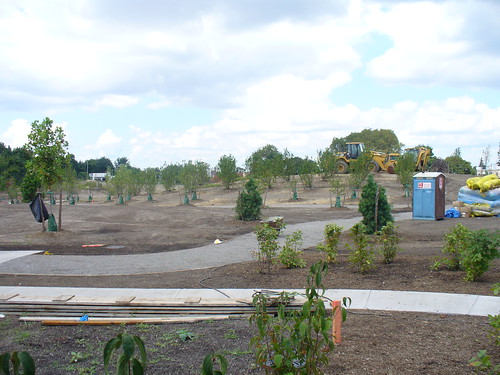
Back in September 2008, the future Elmhurst Park (former gas tanks site) was starting to look inviting.

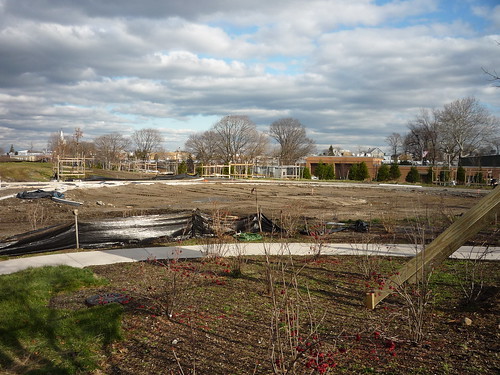
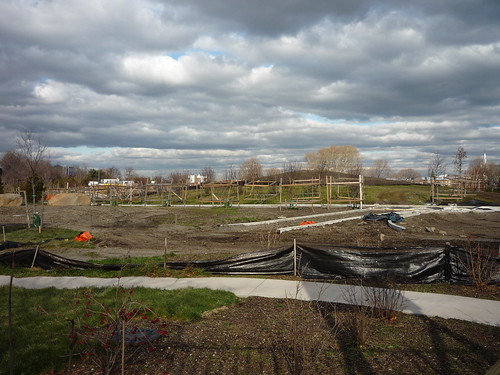
Now phase 2 is underway, and it looks like this:

(Click for larger photo)
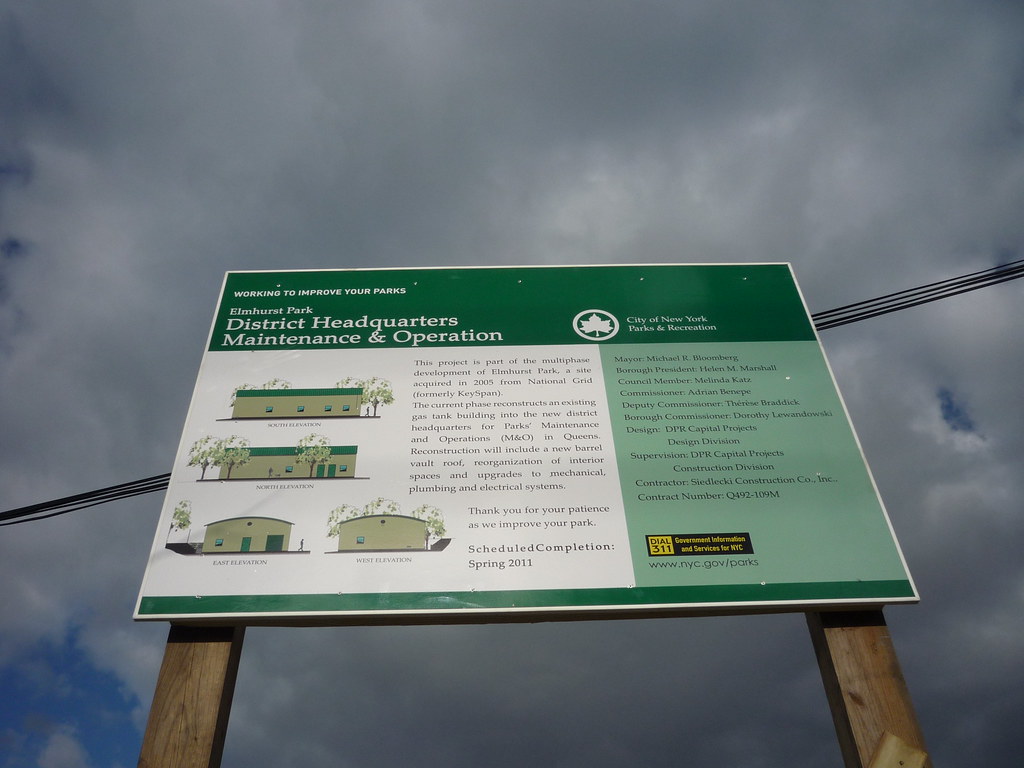
Here's the funny thing..."phase 2" was supposed to be the result of community input after phase 1 was completed, but no one can remember any meetings or surveys held by the Parks Dept in 2008 or 2009 that asked for residents' opinions about what they wanted there. Parks just decided to put a maintenance HQ and artificial turf there. Who needs meetings? This is just what we always wanted!

Tuesday, December 1, 2009

Concern over artificial turf at Hunters Point South

From the Times Ledger:

The blueprint for Hunters Point South’s waterfront park was unveiled to the public last Thursday to mostly positive reviews, although plans for an artificial turf common area were met with skepticism.

The 10-acre park is also slated to include dog runs for both large and small canines, a children’s playground, hard-surface ball courts, a canopied pavilion area with staff offices and a concession kitchen, sloped picnic areas, running paths, a raised beach area and a small boat launch at the extreme south end of the park.

The plan now comes up for a vote at next month’s Community Board 2 meeting.

But Long Island City resident Peter Johnson asked if the Parks Department had considered the environmental impact of droppings from the seagulls he believed the turf would attract.

“It’s going to be an area of warmth,” he said, warning that artificial turf cannot absorb and break down the birds’ fecal matter like natural grass. “They’re going to be perching there.”

Charles McKinney, design chief for the Parks Department, said they would have to wash the turf regularly. The agency is switching to turf for active recreation fields because grass is too expensive to maintain in heavily trafficked areas.

Tom Paino, an architect and advocate for controlled development, complimented the Parks Department on the design but also urged the agency to use grass for the common area.

“The new products still produce VOC’s,” he said, referring to the gasses released by the turf materials.

Paino also warned about the heat from the turf being in direct sunlight. “This green, this common space will be unusable during the summer months,” he said.


Question: How do you wash artificial grass? Do you shampoo it like a carpet?

Sunday, November 1, 2009

Court rules against football team

From the NY Post:

The Queens Falcons football team’s drive to return to their home field failed because they fumbled on the opening play, a judge ruled today.

Queens Supreme Court Justice Lawrence Cullen said since the Falcons couldn’t prove they had applied to play in Juniper Valley Park, he was forced to let the ruling on the field stand – the Falcons will have to play their games on the artificial turf fields that the Parks Department assigned them.

"My hands are tied. I’m bound by the law," Cullen said as he punted the Falcons’ bid to regain their old turf in Middle Village.


From the Daily News:

Cullen's decision to toss out the Falcons' lawsuit means they'll have to play their last few games on nearby artificial turf fields.

The city wants the team confined to turf fields, arguing that the pounding and grinding of football cleats do irreparable damage to grass.

Longtime Falcons coach Tim Cavanaugh said the judge made a bad call and insisted the league applied for permits online as they've done for two decades.

"How do you file for a permit for 23 years and then suddenly forget to file?" Cavanaugh said. "It wouldn't make sense."

Cavanaugh claims artificial turf leaches dangerous toxins and has caused high ankle sprains for some of the league's 225 boys, ages 7 to 16.


Too bad you don't play soccer. Because Parks allows those teams to play wherever they want, including on the fields they are banning you from. And if you played Irish football, Bloomberg would direct the city to seek 6 acres of space for you. Learn how to play a tweeder sport and you'll get more respect.

I'm sorry you were forced off the field over which the 9/11 memorial banner honoring your coach, Stephen Hoffman, hangs.

Sunday, September 20, 2009

Parks boots local team from Juniper Valley Park

From the Daily News:

The Queens Falcons say the Parks Department is trying to push the budding athletes out of Juniper Valley Park and onto artificial turf far from the home of 225 players.

[Coach Tim Cavanaugh] scoffed at the idea that a move to other fields is good for the kids, saying the artificial surfaces might contain toxins.

"Used tires are used to fill these fields - the same tires that gather petroleum, chemicals and toxins from the road," Cavanaugh said in a recent letter.

He also said that youth soccer programs regularly stomp across the Juniper Valley outfield grass in cleats for their matches.

Before the Parks Department rejected the Falcons' permit request last month, the program had been given permission to play at Juniper Valley for 20 years, the suit claims.

If the Falcons are banned from the dirt there, they might have to cancel the upcoming football schedule because nearby turf fields don't have lights or enough parking for games, the suit says.

The field at Juniper Valley has an emotional hold on the players and coaches.

A memorial banner there pays tribute to Greg Hoffman's brother, Stephen, who died in the Sept. 11 attacks.

"We want to play on grass fields that honor Stephen Hoffman," Cavanaugh said.

Friday, August 21, 2009

Artificial turf costs more than planned because of heat

From the Daily News:

During last week's sweltering temps, the turf reached temperatures in excess of 150 degrees, according to an infrared thermometer wielded by Geoff Croft, head of NYC Park Advocates and a longtime critic of the city's efforts to replace the parkland given to the Yankees for their new stadium.

For comparison, Croft measured the temperature of a patch of natural grass near the park on the same day and found it to be only 84 degrees.

Temperatures don't have to get into the 90s for the turf to overheat. Croft recorded similar readings of higher than 147 degrees on cloudy days when the air temperature never got higher than the low 80s.

"We understand that this is the one drawback of these turf fields," said city Parks Commissioner Adrian Benepe, "and we're doing all we can to address it."

The city spent an extra $160,000 to use a green-colored crumb rubber fill, which stays cooler than cheaper fill made of recycled tires. The new park will also feature three misting devices designed to cool parkgoers at the push of a button.

Tuesday, December 23, 2008

Manhattan turf field shut down due to lead


Lead in turf shuts East Harlem field
By Frank Lombardi
DAILY NEWS CITY HALL BUREAU

An East Harlem soccer field has been closed after elevated lead levels were detected in the synthetic turf installed five years ago, park officials said Monday.

The exact cause of the lead contamination at Thomas Jefferson Park, at First Ave. and E. 113th St., is not known, according to Parks Commissioner Adrian Benepe.

But Geoffrey Croft, a park advocate and frequent critic, blamed the lead contamination on the city's use of a type of synthetic turf that includes a cushion of pulverized tires, known as crumb-rubber infill.

The field was fenced in and closed Wednesday, although a running track around it remains open. The field will be reopened when the turf is removed and replaced.

"Health effects from previous exposures are unlikely," said Assistant Commissioner Nancy Clark.

Park officials said they began testing Thomas Jefferson Park's fields after two similar fields were closed this year in Newark. Tests on five other fields with the same product came back negative.

Monday, December 8, 2008

Vallone funds fake turf field


Peter Vallone, Jr. is just giddy that he was able to fund, with $4M taxpayer dollars, a fake turf field in Astoria. Maybe he can also fund an ambulance to take kids to the hospital in July when they're passing out from heat stroke...

New Athletic Field Opens In Astoria

Wednesday, August 20, 2008

Residents concerned about King Park's turf

When it comes to artificial turf, parkgoers at Rufus King Park in Jamaica wish the city had kept it real.

At the 89th Ave. and 150th St. park, there's much talk about the new $1.7 million renovation that included artificial turf made of synthetic grass and recycled-tire rubber crumbs on the athletic field - and whether that is the best option.

"It's, like, natural. I'd prefer to play on it," said Tony Aniagba, 17, about natural grass, as he sat on the even, bright green artificial field.

Hydia Cohen, 17, liked real grass because "it's good for the air and trees."

Parents, too, feel that the turf should have been tested before being put into use.

"The testing should be done before they put it down," said Queens dad Kareem Palmer.


Parkgoers not all convinced by the city's safety claims with artificial grass

But Department of Parks and Recreation Commissioner Adrian Benepe said there are drawbacks to both surfaces.

"From what we understand, from what the Health Department has told us, from what the experts have told us, there is no reason to be concerned about this. The greater risk, really, is kids not getting exercise in the fight against childhood obesity," said Benepe.

According to Benepe, natural fields require expensive, constant preservation with seasonal use.

Artificial grass can be used year round, intensively, with less overall expense for maintenance and a greener, attractive look, he said.

"The main event with the synthetic turf fields is allowing children, adults, athletes to get the maximum amount of use of the field," said Benepe.

In the meantime, the synthetic fields will be left as is - but Benepe promised "if we find that there is a public health risk, we'll take the necessary steps after that."


What a great policy!