Showing posts with label prosecutorial misconduct. Show all posts

Tuesday, January 14, 2020

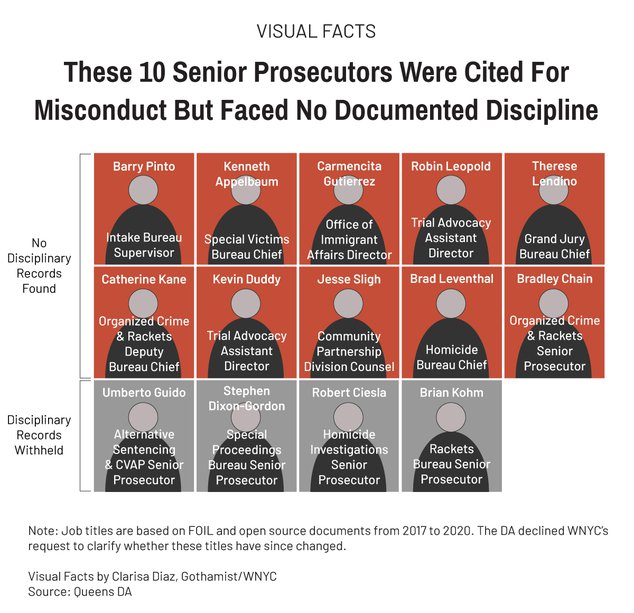
Queens prosecutors got promoted despite repeated trial misconduct


 Infographic showing Queens prosecutors' issues

Gothamist asks in their headline if Katz will keep them in charge. On the Queens D.A. website under divisions and bureaus you get this:

 When you click press releases you get this:

When you click photos, you get this:

  So who the hell knows who's there. Transparency, the Queens Machine way

Tuesday, April 9, 2013

No consequences for prosecutorial misconduct


From NBC New York:

The investigative journalists at ProPublica conducted a review of 30 cases where convictions were tossed out and a state or federal court found evidence a defendant's rights were violated.

Out of those 30 cases, only one prosecutor was seriously disciplined. In one, a prosecutor accused of misconduct was promoted after his conviction was thrown out.

Wednesday, February 6, 2013

You have the right to remain silent

From the Huffington Post:

A New York appeals court ruled last week that Queens prosecutors' violated the constitution through their interrogation program, which identified people without counsel to interrogate before reading them their Miranda rights. The Brennan Center filed an amicus brief in March of last year on behalf of the defendants, arguing that the interrogation program violated constitutional rights set forth in the Fourth and Fifth Amendments.

Through this program, the Queens District Attorney (DA) tried to exploit people in their final moments without an attorney. Choosing only indigent defendants, prosecutors would take suspects in for interrogation and read them a script just before arraignment (their first court appearance where they are assigned counsel). The script prosecutors read to people contained statements such as "This will be your only opportunity to speak with me before you go to court on these charges," "If there is something you would like us to investigate concerning this incident, you must tell us now so we can look into it," and "If you have an alibi, give me as much information as you can, including the names of the people you were with."

Importantly, prosecutors read the statements to the suspects before they were Mirandized. In other words, people were not told until after the statement that they had the right to remain silent, their statements would be used against them in court, and they had a right to an attorney.

Wednesday, August 15, 2012

Brown's crew a bunch of screwups

From the NY Times:

Prosecutorial misconduct has become a legal sore in plain sight. Marvin Schechter, a defense lawyer and chairman of the criminal justice section of the New York State Bar Association, wrote a column recently stating that misconduct stood revealed not as a trickle but as a polluted river.

He blamed district attorneys who valued conviction rates and tough-guy images over adherence to the rights of the accused. “Assistant district attorneys do not emerge from law school with a genetic disposition” to hide vital material, he wrote. “Instead this is something which is learned and taught.”

Prosecutors loosened howls of indignation. Prominent prosecutorial sorts have written letters in the past month and intimated they will no longer serve on committees if such calumnies stand.

Harrumph and all that.

AS Mr. Rudin noted in his filing, in 70 known cases of prosecutorial mistakes and misbehavior in Queens over about a decade, the district attorney, Richard A. Brown, has disciplined just one lawyer.


And when he doesn't want to, he doesn't investigate.

Friday, March 23, 2012

Are Brown's tactics low down?

From the Village Voice:

​If you get arrested in Queens, you might get interrogated before being arraigned or meeting with a lawyer -- a practice which the New York Civil Liberties Union has decried as "unconstitutional" and "unethical" in a legal brief filed today against the borough's District Attorney.

The NYCLU claims that Queens D.A. Richard Brown's program, in operation since 2007, unfairly targets those who are too poor to find a lawyer.

Here's what happens, according to the civil rights group: when a person is jailed because of a cop's testimony, the constitution and state law require: "that a judge quickly determine whether the arrest was valid, appoint an attorney, and determine the conditions of release so the person can return to work, home, and family pending the disposition of the criminal case."

In Queens, wealthier suspects who retain an attorney do get the green light to proceed to court for this hearing.

If you are indigent, however, you get put into a room "just next door" to the court, where a prosecutor interrogates you, the NYCLU argues.

In there, prosecutors are said to mislead suspects by implying that they "will have no other opportunity to 'tell us your story.'"

Tuesday, October 19, 2010

Brown's chickens may be coming home to roost

From the NY Times:

Richard A. Brown, the Queens district attorney, is attempting to prevent a justice in State Supreme Court from issuing a ruling that may accuse his office of an ethics violation — and possibly open the door to appeals and motions in many criminal cases.

Lawyers for Mr. Brown filed a petition this month asking a state appellate court to prevent the judge, Justice Joel L. Blumenfeld, from issuing an opinion on whether the office violated a disciplinary rule by making a misrepresentation to get a defendant to talk. Prosecutors fear that Justice Blumenfeld’s decision could not only smear the district attorney, but also provide an uncontested judicial opinion that defense lawyers will use against them in other cases.

“Judge Blumenfeld,” Donna Aldea, an assistant district attorney, wrote in her petition to the appellate court, “has already repeatedly exceeded his authority and jurisdiction, and is about to do so twice more, potentially causing irreparable harm to the reputation of the district attorney’s office and individual prosecutors involved in this case.”

The case is a remarkable example of legal finger-pointing, with Justice Blumenfeld and the prosecutors alternately taking stabs at each other’s ethics, and a former judge taking a critical shot at an academic. It also presents perhaps the most fierce challenge to the Queens district attorney’s Central Booking Interview Program, which has come under scrutiny from defense lawyers and judges in the past.

The program, which was created three years ago, has processed more than 5,000 cases, prosecutors said.

The issue in the current case rose after the lawyer for a defendant named Elisaul Perez filed a motion seeking to throw out a statement his client gave to prosecutors before he was arraigned on charges of robbery and possession of stolen property. Before interviewing Mr. Perez, prosecutors read to him from a standard script it reads to all defendants. After the prosecution completed the script, it read Mr. Perez his Miranda warnings, which he waived and proceeded to give a statement.

But the script includes a line informing the defendant that if there is something he would like the office to investigate he “must tell us now so that we can look into it.” And Justice Blumenfeld questioned whether that statement constituted a false representation to induce the defendant to talk, which could be a violation of the rules of professional conduct for lawyers.

Justice Blumenfeld called on Ellen C. Yaroshefsky, a professor at Cardozo Law School, to produce a report on the prosecution’s conduct. Professor Yaroshefsky issued a report saying that prosecutors had committed four ethics violations.

Sunday, June 13, 2010

16-year old wrongful conviction overturned

From the NY Post:

After spending 16 years in jail on a murder conviction that was overturned this week, Jabbar Collins arrived home this afternoon to a hero’s welcome — but took time to land a jab at the Brooklyn District Attorney’s office that put him behind bars after withholding evidence.

"Simply because someone is named a district attorney does not mean that they’re incapable of mistakes or even intentional misconduct," said Collins, after being greeted by his family members who waited outside his mother’s Queens home for him to arrive.

"I’m thankful that justice was finally served," said Collins, 37, who rode home from prison in a midnight blue limo, wearing khaki slacks and a white tee shirt.

"I’m disgusted, to be honest, however today is a day of rejoicing. I had 16 years of misery and 16 years of sorrow. So today I just want to enjoy myself with my family. I don’t even want to think about it," he said.

Federal Judge Dora Irizarry on Tuesday overturned the conviction in connection with the murder and robbery of a Brooklyn man, and barred prosecutors in Brooklyn DA Charles Hynes’ office from ever retrying Collins on the charges.

Irizarry ruled that the DA’s office withheld key evidence from defense attorneys during the trial. Collins was accused of shooting Abraham Pollac, a Williamsburg rabbi in 1994.

Arriving at his mother’s home in Jamaica, Queens, Collins first hugged his 18-year-old daughter, who was there along with his two sons and his six brothers and two sisters and his step-father. He also met his four-month old grandson for the first time.

Asked about the first thing he plans to do now that he’s free, Collins said: "Go to church and pray and give thanks to Jesus."