Showing posts with label homeowners. Show all posts

Saturday, March 25, 2023

Homeowners resist Hochul's YIMBY decree

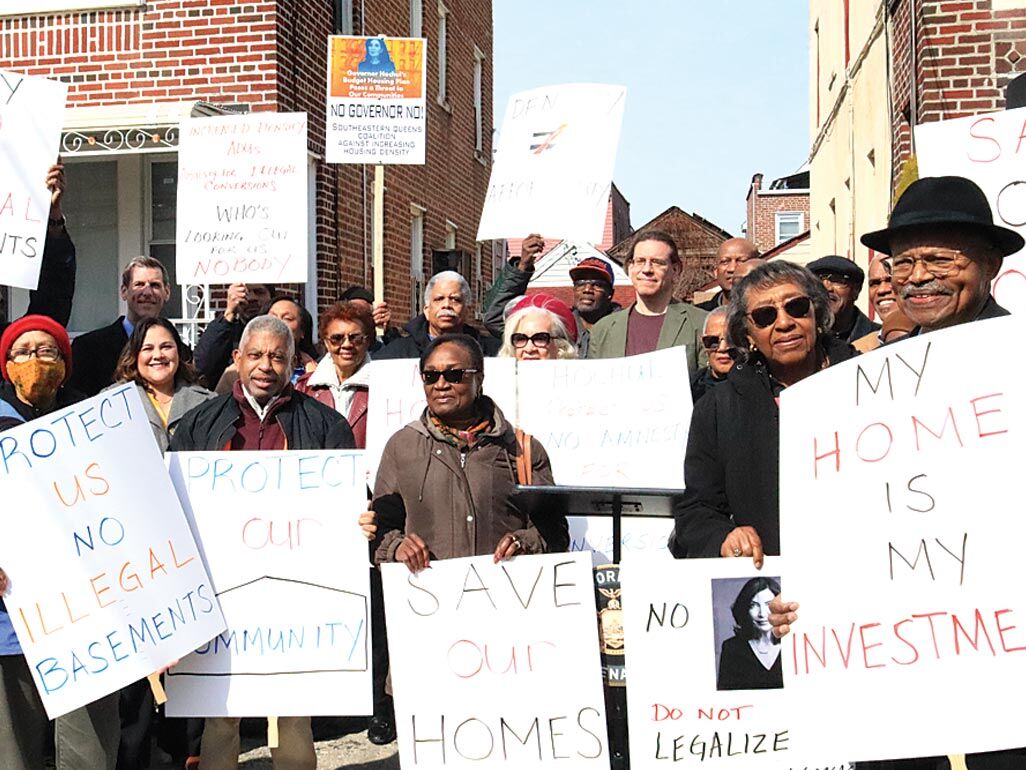
Many homeowners against Hochul plan 1

Queens Chronicle

Lawmakers, Eastern Queens civic leaders and homeowners were in Laurelton last week to rally against Gov. Hochul’s proposal to upzone and legalize accessory dwelling units to create more affordable housing in residential neighborhoods.

Many people were concerned about the character of their communities, which consist mostly of one- to -two family homes, changing to become a higher-density area like Long Island City.

The rally was held March 17 in front of the home of Bess de Betham of the Federated Blocks of Laurelton.

“Nearly 52 years ago I moved from Far Rockaway because I liked this neighborhood,” de Betham said at the event. “Why did I move to this neighborhood? Because it had one -and- two family homes and front and backyards. It has treelined streets and spaces between homes on each block. I have not felt crowded or overwhelmed by others living on that block.”

De Betham said that she is not against more affordable housing throughout the city and state, but her family has worked hard and she must protect the biggest investment of her life and of her neighbors’.

“We are here today to let the governor and our state elected officials know that we are not accepting the imposition of mandates of top-down change to the quality of life that we have worked so hard to preserve,” de Betham added. “I hope our elected officials are listening. The people are paying atteniton to not only how you feel on this Housing Compact, but how you will vote on this Housing Compact ... Welcome to my home.”

Hochul’s Housing Compact proposal for the fiscal year 2024 budget is to create 800,000 new homes over the next decade whether it is through new housing production or legalizing accessory dwellings like basement apartments, according to governor.ny.gov. If passed, her proposal would expedite rezonings and give developers tax breaks to make at least 100,000 of the homes affordable.

Hochul said in a statement that the New York dream should be attainable for all who call the state their home and that the objective of the Housing Compact “is for families to stay in New York.”

Bill Perkins of the Rosedale Civic Association said that when homeowners learned about Hochul’s measure had to do their own research to fully understand the extent of the changes she was proposing.

“Many of our communities were downzoned,” Perkins said. “We saw what happened when density wasn’t controlled. It was unbridled and we weren’t prepared for it.”

Perkins said that if Hochul’s proposal were to go through that it would eliminate home rule, with communities being mandated to follow Albany’s growth targets.

“Whenever you have mandates that you are penalized by, that is not the right way to grow our communities,” the Rosedale civic member said. “We grow organically. We think about our growth. We are strategic about it.”

Along with the growth mandates, Perkins does not support amnesty for ADUs.

“About a year ago, nine people died in illegal basements because they could not get out of the basements,” he said, referring to the death toll in Queens from the remnants of Tropical Storm Ida. “You should feel it’s an indictment on you if you are a one- or two-family homeowner because that means it’s taking away ... the ability to be in the community you want to be in.”

Perkins said that Hochul’s bill is doing the opposite of keeping New Yorkers within the state because people like him and de Betham would be less likely to stay.

“We have to be together on this,” he added. “The vote on this is on April 1.”

Friday, August 28, 2020

#CancelLien

QNS
 

Two Queens lawmakers introduced legislation that would postpone the New York City tax lien sale by one year following the expiration of the COVID-19 state of emergency order.

State Senator Leroy Comrie and Assemblyman David Weprin said the annual lien sale in which debt on tax-delinquent properties is auctioned to private collectors was scheduled for May 15 but was delayed due to the ongoing pandemic.

As of now, the sale is scheduled to occur on September 4. The owners of properties eligible for the tax lien have until September 3 to pay their debt or enter into a payment agreement with the Department of Finance. Once a lien is sold, the property owner must arrange a payment agreement with the lien servicing company or risk legal seizure of their properties.

Liens are sold to private servicing companies with special operating authorization from the city and currently, these include Tower Capital Management, LLC and MTAG Services, LLC

In Comrie’s southeast Queens district, a residential community that is still recovering from the subprime mortgage crisis, as many as 600 properties are eligible for the 2020 lien sale. In past years, 

Comrie’s office has worked closely with the Department of Finance to identify and assist property owners ahead of the annual lien sale, but COVID-19 has presented unprecedented challenges to doing community outreach.


“Homeowners facing the lien sale need ample time to consult with attorneys, enter into payment agreements, and learn about exemption programs ahead of the sale,” Comrie said. “COVID-19 has made this all impossible to do on a scale that we need it to happen. The tax lien sale can’t happen this year, and I’m going to raise hell between now and September 4 to see that it doesn’t happen.”

With thousands of city homeowners impacted by the economic effects of the pandemic, Weprin says holding the lien sale this year would be unconscionable.

Tuesday, March 3, 2020

News media gentrification narratives advising homeowners to sell are vile deceptions


New York Gentrification Watch

Last year, I wrote a long piece entitled, Top 10 Talking Points–and Lies– of Pro-Gentrification Propaganda, in which I tried exposing and debunking common talking points often used by pro-gentrification apologists. No sooner did I post it when The New York Daily News trotted out #2 on the list in the op-ed, “Who the ‘gentrification tax’ hurts: Beware unintended consequences”.
When you read it, you’ll notice that it’s chock full of economics jargon and academic blah blah blah. Do not be fooled. It talks a good game, but cut through all the verbiage, and the meat of the piece will be found right here:

But here’s a memo to Republican Joe Borelli and Democrat Brad Lander: Taxing new homebuyers who pay high prices in resurgent neighborhoods will not actually hit the newcomers; it will actually hurt long-time, lower-income homeowners who have the chance to sell, realize a profit and retire gracefully [italics mine].

Don’t cry for Scarsdale, where the end of SALT deduction is hitting hard. But save some sympathy for the long-time, often minority homeowners of Bed-Stuy, Fort Greene and Clinton Hill, who, if the gentrification tax becomes law, will see sale prices on their homes drop, and their retirement plans upended [italics mine].
To summarize, author Howard Husock is arguing that the Gentrification Tax–now being mulled over in Albany to close a tax loophole–is a bad thing because it’ll prevent minorities from making the most profit out of their houses. On the surface, this sounds like sound economic theory. In reality, it’s nothing more than a variation of the pro-gentrification talking point I mentioned in Top 10 Talking Points–and Lies– of Pro-Gentrification Propaganda–“gentrification is paying off for minorities”, which is the idea that contrary to complaints that gentrification is hurting minorities, it’s benefiting them in ways they can’t even imagine.
 
For example, proponents will often paint a bright, rosy picture portraying disenfranchised blacks–through benefit of gentrification–walking away into the sunset flush with cash. This image in turn will be used to argue that putting policies in check to help minimize the negative effects of gentrification on minorities is preventing them from reaping massive financial rewards. In the case of this New York Daily News article, Howard Husock uses this argument to make the case that the proposed Gentrification Tax will destroy the retirement plans of low income minority home owners by devaluing their property values.
 
What’s wrong with the gentrification is paying off for minorities talking point, you ask? Well, first and foremost, it’s the cheapest and most intellectually insulting type of pandering, one that the kids these days call “concern trolling.” Concern trolling is the act of arguing in favor of or against something under the false pretense that you’re doing it out of concern. In terms of this “gentrification benefits minorities” canard, the person who says this is pretending that he’s oh, so worried about minorities missing out on all the potential money they could make from selling their houses, when the reality is that he’s just pandering to this demographic out of his own self interest.
 
You can plainly see that this is what’s happening in the Daily News article. In expressing concern for minority home owners, look at the specific neighborhoods that author Husock singled out. He is oh, so worried about the home owners of Bed-Stuy, Fort Greene and Clinton Hill but curiously enough, not the home owners of East New York, Flatbush or East Flatbush. Why? Because Bed-Stuy, Fort Greene and Clinton Hill are highly coveted neighborhoods that gentrifiers, developers, oligarchs and speculators are practically pre-cumming in their jockey shorts over while other neighborhoods have yet to targeted for gentrification. So naturally, his concern is selective. After all, why care about minority homeowners in, say, Flatlands and Canarsie cashing out? They’re not sitting on valuable property highly sought after by real estate predators.
 
Aside from cheap pandering, there is another problem with this gentrification is paying off for minorities talking point. It’s one of those trite statements that conveniently ignores inconvenient truths. One of them that it loves to ignore is how the goals of the demographic currently owning homes in areas most in danger of gentrifying are completely different from the goals of the Yuppie douche bag who sees every stupid little thing in life–including the air we breathe–as a source of monetization.