
Showing posts with label Sonia Sotomayor. Show all posts
Showing posts with label Sonia Sotomayor. Show all posts
Tuesday, July 21, 2009
Willets Point at City Hall
From NY1:
A crowd from Queens gathered on the steps of City Hall Monday to raise questions about Supreme Court nominee Sonia Sotomayor's position on eminent domain and how it relates to Willets Point.

Friday, July 10, 2009
Judging Sonia on eminent domain abuse
 From the Washington Times:
If you thought Judge Sonia Sotomayor's controversial stances on racial issues were problematic, you should get a gander at the Supreme Court nominee's apparent hostility to property rights.
Judge Sotomayor served as the senior judge on one 2006 case, Didden v. Village of Port Chester, which respected University of Chicago law professor Richard Epstein described as "about as naked an abuse of government power as could be imagined." Her judicial panel's ruling might be the worst violation of property rights ever approved by a federal appeals court. It is part of a pattern of Judge Sotomayor's pro-government rulings that run roughshod over the most basic of private property rights.
In the Didden ruling, as in the Supreme Court's infamous Kelo v. New London decision, the government used its constitutionally limited power of "eminent domain" to force one private owner to turn over land (for a fee) to give it to a private developer. Yet the Didden case was even worse than the Kelo one. When the town of New London, Conn., took Susette Kelo's home - a rank injustice - the town at least did so after public hearings. The Village of Port Chester, N.Y., took Bart Didden's land without a public hearing.
New London took the land around Ms. Kelo's house in order to change it from residential use to a commercial use that purportedly was for the public good. Port Chester, to the contrary, did not claim to change the land use for the public good. Instead, it merely gave the land to a private developer who wanted to use it for the same purpose, a pharmacy, as the original owners. Instead of a CVS, the new owner used it for a Walgreens.
In essence, wrote Mr. Epstein and George Mason University law professor Ilya Somin, the taking of private property amounted to "out-and-out extortion" with government support. Yet Judge Sotomayor's panel not only ruled against Mr. Didden's property rights, but did so with a bare, six-paragraph order - as Mr. Somin described it, "without serious examination of the legal issues to any significant degree."
It's a mystery how the judge could square this case with the Constitution's requirement that private property can be taken only for "public use," or with its requirement that "no state" shall pass any "law impairing the obligation of contracts."
Is it any wonder that Bloomberg is desperately trying to get her on the country's highest court?
Monday, June 29, 2009
Supreme Court overturns Sotomayor decision
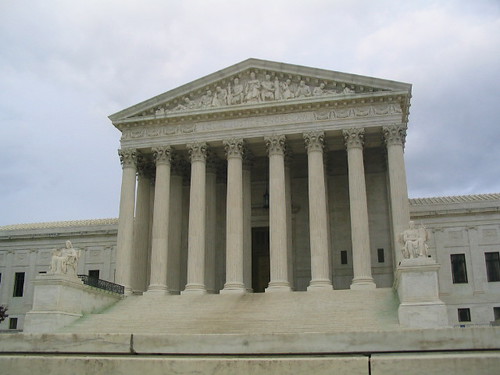 From ABC 7/AP:
The Supreme Court has ruled that white firefighters in New Haven, Conn., were unfairly denied promotions because of their race, reversing a decision that high court nominee Sonia Sotomayor endorsed as an appeals court judge.
New Haven was wrong to scrap a promotion exam because no African-Americans and only two Hispanic firefighters were likely to be made lieutenants or captains based on the results, the court said Monday in a 5-4 decision. The city said that it had acted to avoid a lawsuit from minorities.
The ruling could alter employment practices nationwide, potentially limiting the circumstances in which employers can be held liable for decisions when there is no evidence of intentional discrimination against minorities.
One bad decision overturned, I wish this one was next.
Wednesday, June 3, 2009
Examining Sonia's record
 Before we all go ga-ga over Obama's Supreme Court nominee because of her rags-to-riches background, perhaps we should look at her record with regards to property rights.
It doesn't look good.
Sotomayor's endorsement of this ruling is a strong sign that she has little or [no] interest in protecting constitutional property rights. Her appointment is likely to exacerbate the second-class status of property rights in the Court's jurisprudence.
Subscribe to:
Posts (Atom)


