
Merry Christmas and Happy New Year. We're fucked.

Merry Christmas and Happy New Year. We're fucked.
City Planner Paul Graziano makes NYC Planning Commissioner and Developer Mascot Dan Garodnick uncomfortable with dire warnings of the desecration of towns from the one size fits all plan to build a little more affordable housing in every neighborhood. Because it really is just a little that won't end the infinite housing crisis the city has made. Jackson Chabot from the public streets usurping 501 c 3 lobby cult Open Plans rambles on about removing parking mandates from buildings and towns and gets laughed at, but not before he trashes Graziano for how he got his house and remained in his neighborhood. But wouldn't you know the best take about the City Of Yes/Mess literally came from the street from the ubiquitous NYC political media gadfly Christopher Leon Johnson who remarked that this will do nothing to help people who make less than 60% of the AMI to qualify for the prospective tall and dense luxury public housing towers to end the housing crisis NYC Planning created and now they want a do-over. CLJ also blows the whistle on lobbyist infiltration of community boards that were placed there by borough presidents.
Update:
Well, it looks like Dirty Danny and the City Of Yes people at NYC Planning is censoring the public from isolating clips and embedding the whole video of the public hearing. Paul comes around the 3:45, Jacko around 4:37 and CLJ around 5:08.
Watch how Danny tells people not to clap for people against City Of Yes because it would "take up valuable time" but he allows extended time for borough presidents Mark Levine and Vanessa Gibson to shill for the overdevelopment apocalypse program. He also spends time interrogating council members who announced they will vote no against it and gave nearly an hour to an architect to describe and justify the plan.
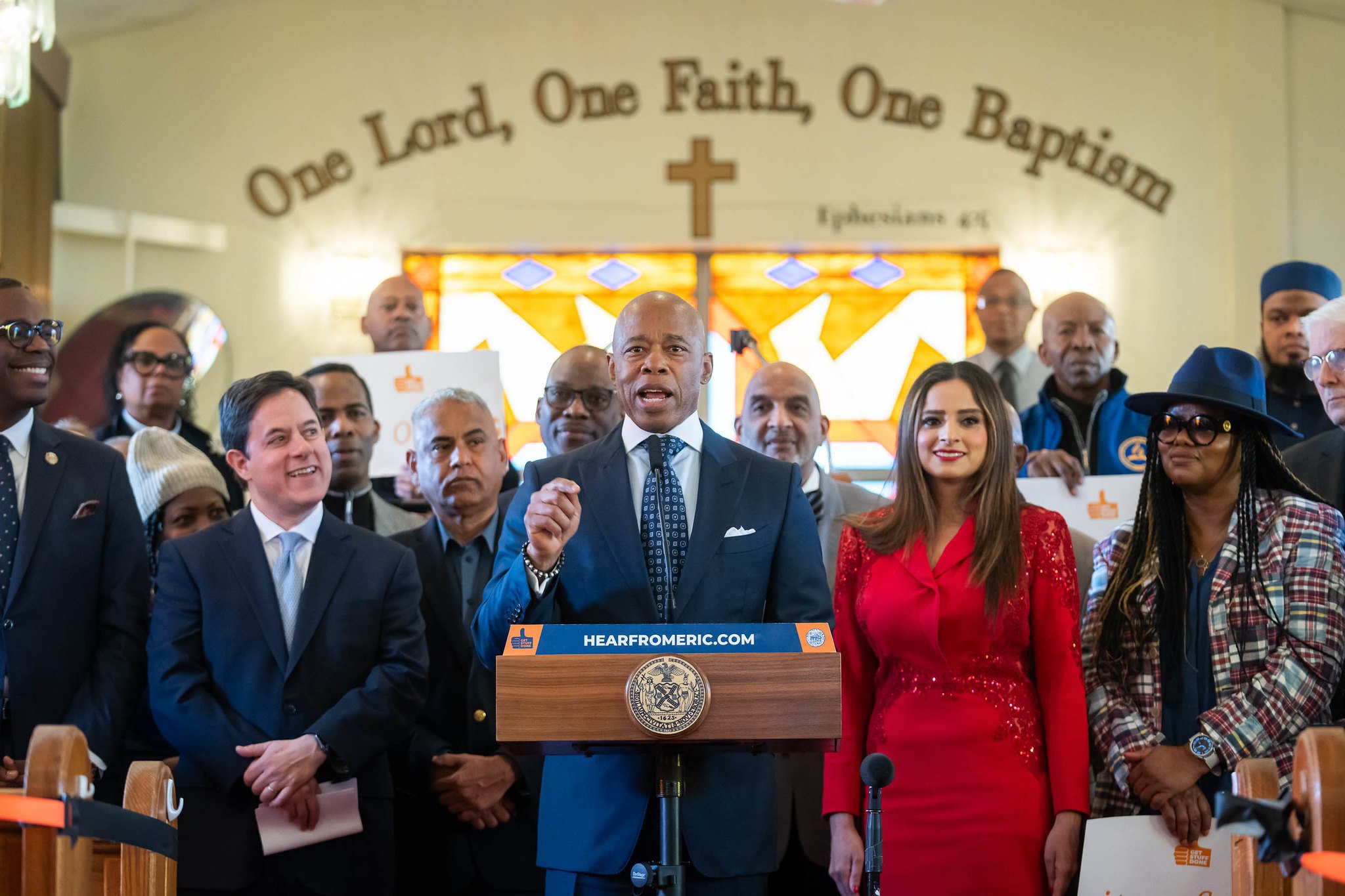
Mayor Eric Adams made a trip to Queens on Friday to announce a faith-based housing initiative that would allow houses of worship to more easily build affordable housing.
Adams, alongside South Queens clergy members and other elected officials, unveiled the plan, which he says will make it easier for faith-based organizations to add new housing on their property and generate income for their organizations through zoning law changes.
The initiative is included under the mayor’s expansive City of Yes housing program, which proposes zoning changes that would add “a little more housing in every neighborhood,” but has received some pushback from suburban areas in Queens and other boroughs from residents who are resistant to building up housing density in residential neighborhoods.
Highlighting one aspect of the plan on Friday, the mayor said the zoning law changes would allow faith campuses, which are typically large lots with multiple buildings on them, to create new housing on their available land.
“We cannot let old, outdated zoning rules keep us from building new housing and our mission driven, faith-based and community organizations can play a special role in this entire process,” said Adams from Antioch Baptist Church. “So, we say, ‘Yes, in God's backyard,’ today.”
As the city deals with an ongoing affordability crisis as well as an overcrowded shelter system, the hope is that programs like the one announced on Friday can open the door to more affordable housing in New York City neighborhoods, the mayor said.
“We're throwing open the door to new solutions and new housing that would help us solve the crisis by working with our churches, our synagogues, mosques and other faith organizations to build more housing and reclaim our city,” Adams said.
In Queens, Borough President Donovan Richards called the lack of affordable housing a “state of emergency.”
“We have 40,000 migrants in our care in this borough, but let me also add that we had a compounding issue with homelessness for a long time in our city as well,” he said at the church on Friday. “So, you add those two things together, and we are in a state of emergency – but there are some great signs of progress in the borough.”
Richards spoke in support of the faith-based housing plan, as well as City of Yes proposal more generally.
“This rezoning really gives us the opportunity to not just talk about the housing crisis but to get to be a part of the solution,” he said.
“I've heard from many of our leaders who want to be a part of the solution who want to do God's work, but who are really prohibited from doing it because sometimes…we have challenges in financing,” he added. “But one way to ensure we can move many of these projects forward is to do what God has called us to do and that is to take care of the least amongst us.”
The plan also aims to help the houses of worship. as well – a group that largely supported Adams’ bid for mayor – by allowing them to make revenue from the program.
“We have to have more flexibility,” Adams said. “We have to live in the real world. The ideal cannot collide with the real, and these faith-based leaders have been talking about this over and over again. They want to deliver more housing and we want to give them the opportunity to do so.”
The Department of City Planning on Monday introduced a measure that it says would cut red tape for casino applications in the Big Apple — but which would ice out community boards, critics say.
The measure, which was quietly filed by the department on Friday, comes as big-name developers are vying for one of three coveted downstate casino licenses from the state.
The action, formally known as a zoning text amendment, was billed as a way of streamlining city and state processes by City Planning Commissioner Dan Garodnick during a Monday meeting.
“What we are proposing will create an even playing field for these facilities as they make their case for the economic benefits they aim to bring to New York City,” he said. “We are trying to set up a process here which just enables the conversation to happen in an organized way.”
The state decides who gets approved for a license. On the local level, the city’s existing land review procedures are inadequate for new casinos, putting New York at a “competitive disadvantage,” Garodnick and City Council Speaker Adrienne Adams said in October.
The text amendment would streamline review and allow for state-approved casinos to be developed “without any potential conflicts with zoning” or “unnecessarily duplicating” the state’s lengthy licensing process, Garodnick said.
Two of the downstate licenses are expected to go to existing “racinos” in Yonkers and South Ozone, Queens, but there is stiff competition in New York City for the remaining slot.
Aside from the Queens racino, City Planning confirmed eight contenders across the boroughs: five in Midtown Manhattan, one in the Bronx at Ferry Point, one in Queens from Mets owner Steve Cohen and one in Brooklyn by Coney Island.
The proposed Coney Island Brooklyn casino resort called The Coney.
The new zoning measure would mean the individual applicants would not have to go through the city’s sluggish land use process, which can be used as leverage by community members and lawmakers to secure certain commitments from developers.
A committee consisting of the governor, mayor and local electeds will be created to view each gaming facility application based on the site’s location. The Community Advisory Committees, as they’re known, will have to hold public meetings but — unlike the city’s land use mechanism, known as ULURP — will not include a representative of the local community board.
Former Buildings Commissioner Charles Moerdler described the move as an “outrage” that would curtail local input.
“The concept of depriving the community and people of an opportunity to be heard … is anathema to a democracy,” Moerdler told the Daily News. “It is a stupid idea dreamed up by people who have no interest in the public or the community.”
A community board leader in Midtown Manhattan, where locals have expressed opposition to a casino, said she has heard concerns from several stakeholders about the text amendment.
“The current version of the text is too thin on specifics and details and does not really address the environmental impacts the casino would have,” said Layla Law-Gisiko, chair of CB 5’s Land Use Committee, criticizing the “blanket, one-size-fits-all” approach as opposed to the site-specific method of ULURP.
“Currently, the text really is too anemic to provide any guidance on what a casino should look like.”
Planning commission members were critical of part of the text that would allow developers to include related establishments such as hotels, restaurants, bars and “other amenities” like theaters in the approval process.

“New York City is in the throes of a housing crisis, with Astoria families feeling that crush harder than most, but we have an incredible opportunity before us to reverse this tragic trend. I stand by my recommendation that certain commitments be made by the Innovation QNS development team to meet this moment, such as significantly increasing the number of affordable housing units and expanding the lowest affordable income band to those earning 30 percent of the area median income,” Richards said.
“I have a deep respect for the City Planning Commission and its work, and I am hopeful today’s vote will lead to a healthy dialogue and community-first solutions as Innovation QNS proceeds to the City Council,” he continues. “I remain in close contact with the developers, my fellow elected officials, and all our community stakeholders, and will continue to push for true community-first solutions on the issues of affordability and equity.”
The project will now go to the City Council in the coming weeks and then on to Mayor Eric Adams for the final decision in the process. In his remarks prior to the vote, City Planning Commission Chair Dan Garodnick said the five-block development would bring thousands of jobs across a range of sectors, but it was the promise of affordable housing that was the difference maker to him.
“The affordable housing component of this project – that will be created without public subsidy – would be considered the largest privately financed affordable housing project in Queens in generations,” Garodnick said. “At a time when our housing crisis is more pronounced than ever, that is a big deal and a big opportunity to take the pressure off the rents in this and surrounding communities.”
In casting one of the three dissenting votes against the Innovation QNS proposal, Commissioner Leah Goodridge said the amount of affordable housing promised by the developers came up short.
“While the number of apartments may be privately financed, it’s still the same 25 percent that we see here every day,” Goodridge said. “And secondary displacement is real.”

 |
| NYC Council/William Alatriste |


 |
| Charles Meara |
 From the Queens Tribune:
 From City and State:
 From Capital New York:
 From the NY Post:
 From Crain's:


