Showing posts with label luxury towers. Show all posts

Friday, April 16, 2021

New York abolishes federal opportunity zones land grab program


NY Daily News

 This is one opportunity New York won’t miss.

The state budget passed by lawmakers last week includes a provision decoupling the city and state tax codes from the federal Opportunity Zones program, a Trump-era policy that opponents say is nothing more than a handout to wealthy real estate investors.

Part of the Republican-led 2017 federal tax overhaul, the program was aimed at incentivizing private investment in economically distressed areas.

Critics, however, derided the designations, saying they included many areas already suffering from over-development and gentrification.

“The opportunity zone program is a scandalous giveaway to wealthy developers who didn’t need the money to do the development, and I’m glad the state pulled ourselves out of wasting state dollars for this effort,” said Sen. Michael Gianaris (D-Queens), who first introduced a measure to end the tax breaks on the state side in 2019.

Under the federal program, developers who put money into an opportunity zone project could defer federal and state capital gains taxes for up to seven years with a modest cut in the taxes owed.

Additionally, they would not face any capital gains taxes on properties within the zones as long as they don’t sell it for at least 10 years. When New York decided to conform to the federal program, it meant capital gains deferred or excluded from taxation at the federal level were similarly deferred or excluded from state and local taxes.

New York designated 514 “low-income community” census tracts as Opportunity Zones. However, the program allowed investors in projects in neighboring tracts to also benefit from the tax breaks, regardless of how wealthy or developed the areas were.

Parts of Hell’s Kitchen on Manhattan’s West Side were included in the program, as was a stretch of the Upper East Side and already-gentrifying areas of Queens from Astoria and Long Island City to Flushing.

Hudson Yards in lower Manhattan, New York

Thursday, November 5, 2020

City Planning Commission approves Flushing Creek hyperdevelopment with some "affordable housing"

https://external-content.duckduckgo.com/iu/?u=https%3A%2F%2Fsportsgrindentertainment.com%2Fwp-content%2Fuploads%2F2020%2F10%2FDevelopers-hope-to-revitalize-Flushing-waterfront-with-new-offices-housing.jpg&f=1&nofb=1 

QNS  

The City Planning Commission (CPC) on Wednesday, Nov. 4, voted in favor of approving the highly controversial Special Flushing Waterfront District (SFWD) proposal that will now move forward to the City Council for a vote. 

The City Planning Commission’s 11-2 vote is a milestone for the development, which after a halted land-use process, is steadily gaining momentum.

Marisa Lago, chair of the City Planning Commission, voted in favor of the project saying, “the application is an important step forward for Flushing.”

The three developers behind the Special Flushing Waterfront Development include F&T Group, United Construction & Development Group, and Young Nian Group, known collectively as FWRA, LLC. 

Their proposal seeks to revitalize 29 acres of inactive and underutilized land that the developers say will provide substantial public benefits such as a privately funded and maintained road network and a 160,000-square-foot waterfront promenade along Flushing Creek that will both be publicly accessible.

The plan also includes 1,725 residential units, including affordable housing, 879 hotel keys, office and community facilities, retail space and parking spaces to help alleviate traffic along College Point Boulevard.

In response to the CPC’s vote, the developers said they’re pleased that the City Planning Commission has voted to move the application forward. 

“With 3,000+ permanent jobs, a new traffic-alleviating public road network, publicly accessible waterfront with public amenities, and $164+ million in projected annual tax revenue among many other benefits, SFWD will bring Queens a step closer to the future our communities deserve,” the developers said. 

The CPC’s vote marks another step in the right direction, the developers said. 

“City Planning rightly sees that the SWFD is not a rezoning, but an essential next step for Queens at large towards recovery. Our vocal community submitted more than 300 letters supporting the project, showing that our vision resonates with those we are working to serve,” the developers said. “Without question, the months since COVID-19 have been among the most trying times our city has ever seen. TThere is no better time to give Flushing and New York City this exciting new chapter.” 

Meanwhile, opponents of the proposal have said that the rezoning of the waterfront will exponentially increase the process of gentrification and displacement. 

The MinKwon Center for Community Action along with the Greater Flushing Chamber of Commerce and Chhaya CDC, had filed a lawsuit against the Department of City Planning and the City Planning Commission, arguing that an environmental review must be conducted for the development proposal. 

Local organizations such as the Flushing Anti-Displacement Alliance, The MinKwon Center and the Flushing Workers Center took to social media describing the CPC’S vote as “shameful” while criticizing the mayor and Councilman Peter Koo.


Wednesday, February 26, 2020

Burning Two Bridges from de Blasio's "affordable" housing program


The L in LES doesn’t stand for luxury.

A state judge barred a developer from building four high-rise towers that had been set to offer hundreds of pricey apartments.

Manhattan Supreme Court Justice Arthur Engoron upheld a previous ruling finding that the project violated local zoning rules.

Activists had sued the city, which approved the project on the East River between the Manhattan and Williamsburg Bridges in 2016. The proposed project included 2,800 units, and one of the towers would have been more than 1,000 feet tall.

“It would drive up the rent and more people would be facing displacement,” said Zishun Ning, an organizer for the Chinese Staff and Workers’ Association, one of the groups that sued the city.

He singled out Mayor de Blasio, who expected the project to include affordable units and said in 2018, “The legalities made quite clear that this development could go forward."

“With this decision, we’re very excited to prove that the city is wrong, Mayor de Blasio is wrong,” Ning told the Daily News. “He’s with the luxury developers. He represents their interests.”

De Blasio declined to comment on the suit. A city Law Department spokesman said, “We are evaluating next steps including whether to appeal this decision.”

Ning hopes the developer will go back to the drawing board and come up with a plan more in keeping with the feel of the nabe, which is full of walkups that have long been home to immigrants.

A spokesman for builders including L + M Development and CIM Group said they’ll appeal.

Too bad Alicia Glen was not around to see this, maybe she lit a candle for her bestie who was behind this tower pestilence. Bet current HPD commissioner Vicki Been has a lot of explaining to Glen's old employer Goldman Sachs.

Saturday, February 15, 2020

Judge orders circumcision on luxury tower development


New York Times

 In an extraordinary ruling, a State Supreme Court judge has ordered the developers of a nearly completed 668-foot condo tower on the Upper West Side to remove as many as 20 or more floors from the top of the building.

The decision is a major victory for community groups who opposed the project on the grounds that the developers used a zoning loophole to create the tallest building on the West Side north of 61st Street. A lawyer representing the project said the developers would appeal the decision.

Justice W. Franc Perry ordered on Thursday that the Department of Buildings revoke the building permit for the tower at 200 Amsterdam Avenue near West 69th Street and remove all floors that exceed the zoning limit. Exactly how many floors might need to be deconstructed has yet to be determined, but under one interpretation of the law, the building might have to remove 20 floors or more from the 52-story tower to conform to the regulation.

“We’re elated,” said Olive Freud, the president of the Committee for Environmentally Sound Development, one of the community groups that brought the suit.

“The developers knew that they were building at their own peril,” said Richard D. Emery, a lawyer representing the community groups that challenged the project before the foundation was even completed. Mr. Emery said this decision sent a warning to other developers who proceed with construction in spite of pending litigation.

The question at the heart of the suit was whether the developers had abused zoning rules to justify the project’s size.

It is common for developers to purchase the unused development rights of adjacent buildings to add height and bulk to their project. But in this case opponents of the project argued that the developers, SJP Properties and Mitsui Fudosan America, created a “gerrymandered,” highly unusual 39-sided zoning lot to take advantage of the development rights from a number of tenuously connected lots. Without this technique, the tower might have been little more than 20 stories tall, instead of the nearly finished 52-story tower that now stands.

The decision also sets an important precedent, said Elizabeth Goldstein, the president of the Municipal Art Society of New York, one of the advocacy groups that brought the suit against the project.

“The way this zoning lot was constructed has been invalidated, and that is extremely important,” Ms. Goldstein said, adding that the decision would deter other developers from attempting similar strategies.

Scott Mollen, a lawyer with the firm Herrick, Feinstein, which is representing the project, said the ruling contradicted earlier decisions from the Department of Buildings and the Board of Standards and Appeals that were based on a long-established zoning interpretation. SJP, one of the developers, said they would “appeal this decision vigorously.”

Saturday, September 14, 2019

25% of condos in recently built luxury towers remain vacant

New York Times

Picture an empty apartment — there are thousands in Manhattan’s new towers — and fill it with the city’s chattiest real estate developers. How do you quiet the room?

Ask about their sales.

Among the more than 16,200 condo units across 682 new buildings completed in New York City since 2013, one in four remain unsold, or roughly 4,100 apartments — most of them in luxury buildings, according to a new analysis by the listing website StreetEasy.

“I think we’re being really conservative,” said Grant Long, the website’s senior economist, noting that the study looked specifically at ground-up new construction that has begun to close contracts. 

Sales in buildings converted to condos, a relatively small segment, were not counted, because they are harder to reliably track. And there are thousands more units in under-construction buildings that have not begun closings but suffer from the same market dynamics.

Projects have not stalled as they did in the post-recession market of 2008, and new buildings are still on the rise, but there are signs that some developers are nearing a turning point. Already the prices at several new towers have been reduced, either directly or through concessions like waived common charges and transfer taxes, and some may soon be forced to cut deeper. Tactics from past cycles could also be making a comeback: bulk sales of unsold units to investors, condos converting to rentals en masse, and multimillion-dollar “rent-to-own” options for sprawling apartments — a four-bedroom, yours for just $22,500 a month.

The slowdown is uneven and some projects are faring better than others, but for well-heeled buyers there is no shortage of discounts and sweeteners to be had.

The analysis, a compilation of both public and proprietary listing and building data, is one of the most sobering looks yet at the city’s flagging condo market, which peaked about three years ago amid a glut of inventory. Now the market could face new obstacles, from growing fears of a recession, to changes in tax law and political instability heading into an election year.

For an industry accustomed to selling apartments years ahead of completion and skilled at concealing the pace of sales when the market falters, further headwinds could force more drastic measures.

Moreover, a growing share of condos sold in recent years have been quietly re-listed as rentals by investors who bought them and are reluctant to put them back on the market. Of the 12,133 new condos sold between January 2013 and August 2019, 38 percent have appeared on StreetEasy as rentals.

And Billionaire's row, Hudson Yards and Pacific Park are not even done yet.

Apologies for my miscalculation readers. 

Wednesday, August 21, 2019

Developer plans to flip the bird to Ridgewood's low and middle income residents if their tower doesn't get the rezoning they want

https://images.squarespace-cdn.com/content/v1/5b9ffe0f1137a680c2c08250/1566328971834-1MSW0L0QL6N5E6RZX2GW/ke17ZwdGBToddI8pDm48kKKYaPPp_pz-UIITGJVi4GpZw-zPPgdn4jUwVcJE1ZvWQUxwkmyExglNqGp0IvTJZamWLI2zvYWH8K3-s_4yszcp2ryTI0HqTOaaUohrI8PI6Vpy4PRGULtDNrkpLIOxg33gS9iVUojNEV9to8x1psw/image-asset.png?format=1000w
Queens Eagle

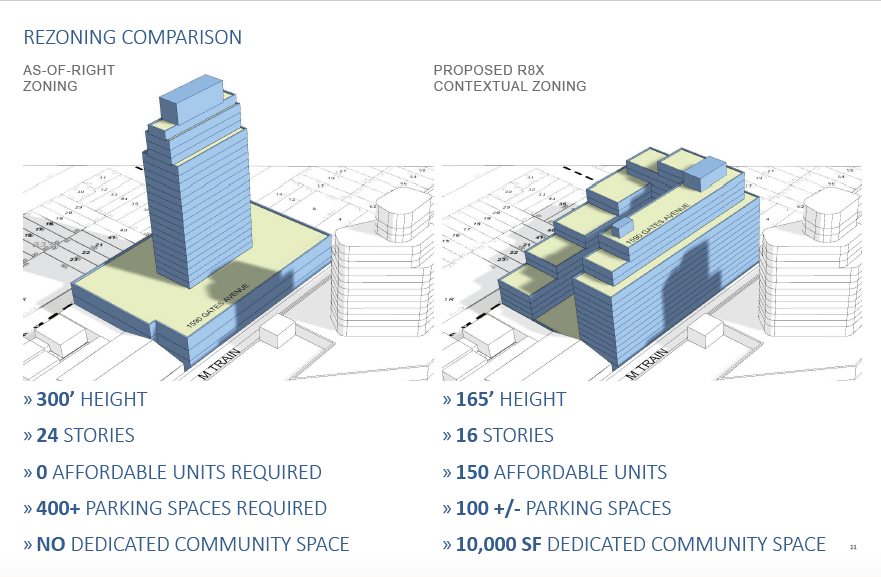
A proposal for a high-rise luxury apartment complex in Ridgewood has put longtime residents and the local councilmember in a bind, with the project’s developer suggesting it will build a 300-foot-tall tower without any affordable units unless the city consents to a rezoning. 

Under the area’s current zoning, developer Avery Hall Investments could construct a 24-story, 200-apartment tower on the site of a Food Bazaar at 1590 Gates Ave. A contextual rezoning would enable Avery Hall to construct a shorter, but much bulkier complex that features 375 market-rate apartments and 150 affordable units, according to plans published by Avery Hall. That’s the plan the developer seems to favor.

"Some people might see it as a threat, but I don’t take it that way,” Councilmember Antonio Reynoso told the Eagle of Avery Hall’s two plans. “I want to believe people are innately good.” 

Reynoso says there’s a third option for the development. He thinks the city can still entice Avery Hall to build a 100 percent affordable complex in the rapidly gentrifying neighborhood, where home and rental prices have surged in the past five years.

“Avery Hall is not objecting to 100 percent affordable housing if they felt the subsidies are there,” he said.

The developer has said it supports the rezoning plan, which would enable the company to build 175 additional units of market-rate housing. Avery Hall did not respond to requests for comment from the Eagle as of press time. 

Under federal guidelines, units priced at 165 percent of Area Median Income — currently $96,100 for a family of three — would count as “affordable housing.”

“I want to believe people are innately good.” Don't stop believin' that about the developer overlords of this city, Reynoso. Idiot.

Saturday, June 29, 2019

The Chutulu Tower of East Flatbush

NYC Gentrification Watch

Last summer when I rode down Linden Boulevard, I was shocked the see the usually quiet, tree-lined street of wood-frame houses, row houses and 1920s apartment buildings had become one gigantic construction site. Literally dozens of men in hard hats and yellow vests were walking every which way, and cement trucks and materials lined the street on either side. As I explored further, to my shock and dismay, I saw several of Linden Boulevard’s signature low rise town and wood frame houses getting replaced with fugly generic modernist boxes. But just when things couldn’t have gotten worse, I encountered this huge, sprawling hulking monstrosity, right off Rogers Avenue:

The date? July 22, 2018.

The thing was so huge, so massive, I almost passed out. I couldn’t believe it. It took up of what looked like the place of three large apartment buildings, and could’ve have been more out of scale. But a hopeful part of my brain tried to see a silver lining in what looked like a very dark cloud. I thought, 

“Well, this is bad, but at least it’s not overshooting the local area buildings too much. What’s it gonna be? Ten, twelve stories? That’s bad, but it could be worse.”

Fast forward almost a year later, and this…thing…has topped out at 27 stories. It is so huge that the once open skies of East Flatbush and other surrounding areas have been forever blotted. As of June 2019, it is now visible from at least a 3 mile radius in every direction.

 Seeing this thing in photographs, it’s very hard to gauge just how obscenely large, out of context and out of scale it is. But trust me–this thing is so huge, so obnoxious that it is the biggest F*** YOU by developers I have ever seen since the proposed development for Two Bridges

She's not kidding. I went there myself and it's literally a hideous daylight devouring monster certain to cause displacement of the residents of those rowhouses and the neighboring apt. buildings and homes down the boulevard.

Also like to add that it's also the derelict mayor de Blasio's biggest fuck you to the people he swore to help in the still developing "tale of two cities" (pun intended).

Check out those precarious balconies too.

Monday, May 20, 2019

No shit, Sherlocks at City Council; the city planning department doesn't evaluate the effects of overdevelopment?

LIC Post


City Planning’s predictions as to the outcome of neighborhood rezonings will be put under the microscope if a number of bills sponsored by Council Member Francisco Moya become law.
 
The bills would require city agencies to review past neighborhood rezonings to see how accurate City Planning’s projections were with what took place on the ground in following years.
 
The bills come at a time when there have been a number of neighborhood rezonings—where existing residents have voiced concern about being displaced due to gentrification– and instances where City Planning’s projections have been found to be way off.
 
For instance, City Planning’s projections were proven wrong when it rezoned a 37-block area in 2001 in the Court Square/Queens Plaza area. The city anticipated, according to its Environmental Impact Statement in 2001, that no more than 300 residential units would be built in the rezoned area by 2010, according to a report released by The Municipal Art Society of New York last year. In 2010, there were 800 residential units and by 2018 almost 10,000 units—with more coming.
 
With each neighborhood rezoning, the city goes through an environment review process, called the City Environmental Quality Review (CEQR), to identify the likely outcome.
 
Based on the CEQR manual, the city must evaluate the impact of a rezoning on land use, traffic, air quality, open space, schools, socioeconomics, among other items. City Planning studies these impacts and makes projections that go into an Environmental Impact Statement, which the public relies on when it undergoes the ULURP public review process.
 
City Planning works with other city agencies, such as the School Construction Authority, Department of Transportation and the Department of Housing Preservation and Development, to produce an Environmental Impact Statement. The agencies provide guidance based on City Planning’s calculations.
 
However, the city is not held accountable for its predictions and legislators want that to change. There is no mandate requiring officials to re-examine their projections.

Here's more unaccountability:

Hunters Point developers for parcel C given the green light to build their towers higher and higher

Developers have released new designs for Parcel C of the ongoing Hunters Point South development, a shift that will result in the two planned towers to rise significantly higher than expected along the 

Long Island City waterfront in order to accommodate the complex infrastructure running below the ground along with a recently planned school for the site.
 
The two residential towers, referred to as “north” and “south” will rise to 55 stories, or 550 feet, and 44 stories, or 440 feet, respectively. The north tower’s new design is 14 stories higher than previously planned, and the south tower will see an additional nine stories, up from 35 stories in the previous plan.
 
The developer, TF Cornerstone, aims to break ground in June 2018.
 
The two towers will be flush against the perimeters of the parcel, as will the newly incorporated elementary school, resulting in cleared-out space in the middle of the site, where no built structures will rise, save for a food pavilion with outdoor seating amidst greenery and public art installations.

 The changes were revealed during Community Board 2’s Land Use meeting Wednesday night. Jaclyn Sachs, a senior planner at the Department of Housing Preservation and Development, and John 

McMillan, director of Planning for TF Cornerstone, said that they had to redesign the two towers so they wouldn’t disturb  power lines, an Amtrak tunnel, and other infrastructure running below the site. 

Furthermore, easement holders such as the New York Power Authority and Amtrak, wanted unobstructed access to the site.
 
Sachs added that while the New York Power Authority and Amtrak and other easement holders were part of initial conversations about the development, it wasn’t until a specific proposal for the parcel was put out by TF Cornerstone that easement holders preferences for an undisturbed center became clear.
 
TF Cornerstone also had to incorporate an elementary school on the parcel, which was not part of the original plan, after the city pushed for its addition during the developer’s redesign. The school will be 34,000 square-feet, with 572 seats, and have a ground level playground directed toward the center of the site.

 “This was not an easy thing to do,” Sachs said, adding that parcel C is the largest and most complex of the parcels on the 30-acre Hunters Point South development.

This obviously got permitted because it contains, ahem, "affordable housing", which as we have been told ad nauseum that it can only be achieved if market rate and luxury housing get built also. Like the nearby "zipper building":

The Zipper Building, a new luxury condominium development in Hunters Point, has officially placed all 41 of its units on the market.
 
The available condos, located inside the converted and expanded zipper factory at 5-33 48th Ave., range from studios to four-bedrooms. The units begin at $650,000 and go up to $2.5 million.

“The Zipper Building will complement the budding Hunters Point neighborhood, which is in the midst of a real estate boom,” said Eric Benaim, CEO of listing brokerage Modern Spaces.

And the behemoth at Court Square,

The first units have hit the market in the 67-story, 802-unit building that is going up in Court Square.
Twenty-units are now available in the condo, which will be the tallest building in Queens when it is complete. The listing prices for those units now on the market range from $660,400 for a studio to $2,325,610 for a three-bedroom.
 
The development, called the Skyline Tower and located at 23-15 44th Drive, is across the street from One Court Square and is being marketed as offering spectacular views and more than 20,000 square feet of luxury amenities.
 
The condos offer floor-to-ceiling windows, modern appliances, and marble-adorned bathrooms.
 
The initial listings are in floors four through 36. The developer anticipates that buyers in the bottom 36 floors will be able to move in by the end of 2020, around the same time that the Dept. of Buildings is expected to issue a Temporary Certificate of Occupancy.
 
Residents will be able to move into the higher floors by the end of 2021, when the TCO is expected to be issued. The upper floors will tower over the Citigroup building.
 
Eric Benaim, the CEO of Modern Spaces, anticipates that it will take four years to sell all of the units. Modern Spaces is the exclusive marketing and sales firm for the project.

Apparently, the city and the real estate industry that truly runs it is building for speculative, well, hypothetical residents to supply instead of and for the present demand of hundreds of thousands of New Yorkers who are having difficulty finding affordable housing right now.


Wednesday, May 1, 2019

Billionare's row luxury tower apartments on 57th Street are not getting billionaire's interest

NY Post

Swank apartments are begging for buyers on Manhattan’s “Billionaires’ Row” — with more than 40% sitting unsold in towers that top out at 100 stories, The Post has learned.

Five years after the iconic One57 building became the city’s first “supertall” residential skyscraper, only 84 of its 132 pricey condos have been bought — leaving more than a third of them still on the market and none under contract, according to data compiled by leading appraiser and researcher Jonathan Miller.

Six other nearby buildings have as much as 80% of their units available, the figures show, with the total value of all the unsold inventory estimated by one analyst at between $5 billion and $7 billion.

Another building that’s set for completion next year — Central Park Tower, at 217-225 W. 57th St. — will put an additional 179 apartments on the market.

Gary Barnett’s Extell Development, which also built One57, got state permission to start selling a 
Central Park Tower in 2017, but no deals have closed — which would push the overall unsold percentage to nearly 65%.

Online listings show asking prices for available units that range from $2.1 million for a 14th-floor studio at 100 E. 53rd St. to nearly $64 million for a four-bedroom, duplex penthouse on the 76th floor of 53 W. 53rd St.

Top broker Dolly Lenz blamed the stalled sales on the sky-high prices, saying, “When people come here from other parts of the country and from around the world, the first thing they want to see is Billionaires’ Row,” she said.

“We toured them through the properties but many felt they were too pricey for the market — $7,000, $8,000 and $10,000 a square foot,” she added.
Lenz said the high prices were caused by a combination of factors, including the costs of property, construction, financing and high-end marketing — and savvy developers who have clauses in their contracts that keep lenders from forcing them to drop prices, thereby cutting into their profits.

Uh-oh. Could this be why REBNY lobbied Albany to kibosh the pied-e-terre tax?

Sunday, February 17, 2019

Oligarchs are losing millions on their luxury tower condos


NY Post

 Don’t believe the brochures. A Billionaire’s Row apartment can be a terrible investment.
 
“One of the things that I struggle to wrap my head around is why people continue to park money in high-end New York real estate when it’s not a very lucrative asset class,” said Grant Long, senior economist at StreetEasy, a New York listing platform.
“You just have to assume someone like 
Ken Griffin [who recently dropped a record-breaking $250 million on an apartment at 220 Central Park South] isn’t very interested in seeing his money back. An apartment like that isn’t liquid.”
 
Roughly 16,000 apartments were bought and resold in New York from 2014 through 2018. Of those, 1,295 homes — 7.7 percent — sold at an outright loss.

 But a whopping 39 percent of the 66 luxury condos that were bought and resold in Midtown during this time lost money, according to a StreetEasy analysis of city Department of Finance records. In fact, across all neighborhoods, the city’s priciest properties saw losses.
  And the addresses read like a who’s who of prestige properties, including 15 Central Park West, 432 Park (North America’s tallest residential tower), the Time Warner Center and One57 (which boasted New York City’s first $100 million home sale).
 
“In New York, real estate behaves like a luxury good,” Long said. “It’s like fancy cars and expensive handbags. It’s purchased to make a statement. But it’s also highly cyclical and subject to whims.”

Obscene.

This is going to come off nauseating considering the source and apologies to every reader of this blog and the rest of humanity, but talk about money in the wrong hands. 

Saturday, February 2, 2019

Futuristic cartoon high rise luxury tower development gets approval from D.O.B. and City Planning.


https://proxy.duckduckgo.com/iu/?u=https%3A%2F%2Ftse3.mm.bing.net%2Fth%3Fid%3DOIP.iI9EkrtE6oeChPg64I964AHaGb%26pid%3D15.1&f=1


Rafael Viñoly has become one of the more prominent designers of Manhattan’s residential real estate in recent years, and today, YIMBY has the first rendering for the architect’s latest skyscraper, at 249 East 62nd Street on the Upper East Side. While the tower will technically comprise only 32 floors, it will stand 510 feet to its rooftop, taking advantage of a Jetsons-esque podium to boost its upper levels high into the neighborhood skyline.

The Schedule A for the project reveals the exact configuration, and shows that retail and a townhouse will occupy the base of the building. Those will be topped by apartments rising through to the 12th floor.

Above that, the 13th through 16th floors will all be mechanical, with the 15th floor holding the residential amenity spaces, including a bar/wine tasting area with private dining room and pantry, a media lounge, and a study.

Residential space will then continue, with three units per floor from floors 17 through 29, and then another three mechanical floors up on the very top. The 17th floor will start about 350 feet above street level.

 The configuration of 249 East 62nd Street begs the question of whether Viñoly’s design for the site could start a trend to rival the cantilever. The extended mid-section of the tower results in the displacement of a substantial amount of residential space to an elevation far above what one would normally expect for a 32-story building, and is likely to result in pricing that is far higher than what would otherwise be possible.

 As engineering continues to improve, it seems that the premiums people are willing to pay to live in neighborhoods like the Upper East Side could be a driver behind additional developments that mimic 249 East 62nd Street.

I think it looks more like an e-cigarette cartridge than someplace the Jetsons would live in but they definitely wouldn't be able to afford to.  Mr. Spacely or Cogswell would more likely be residents.