Showing posts with label real estate. Show all posts

Sunday, October 20, 2024

The people, the lies and the conspiracy of the City of Yes


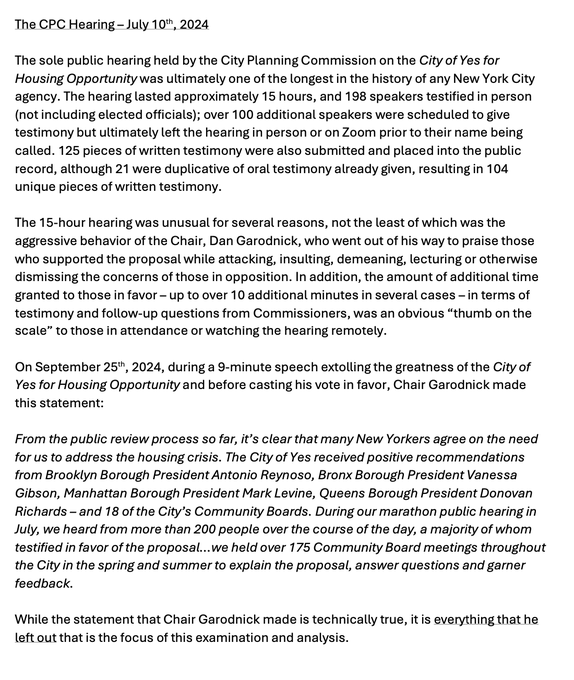
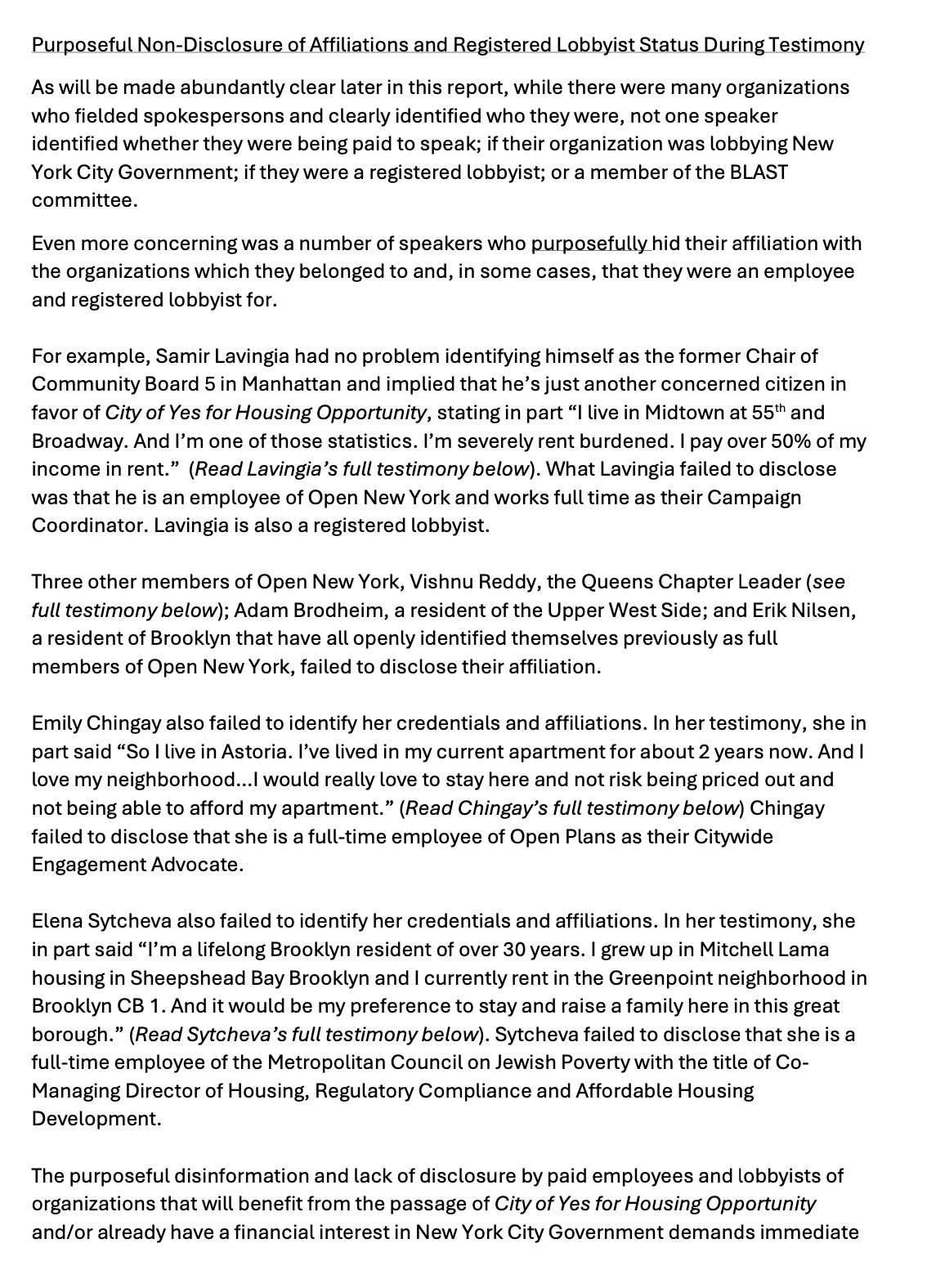
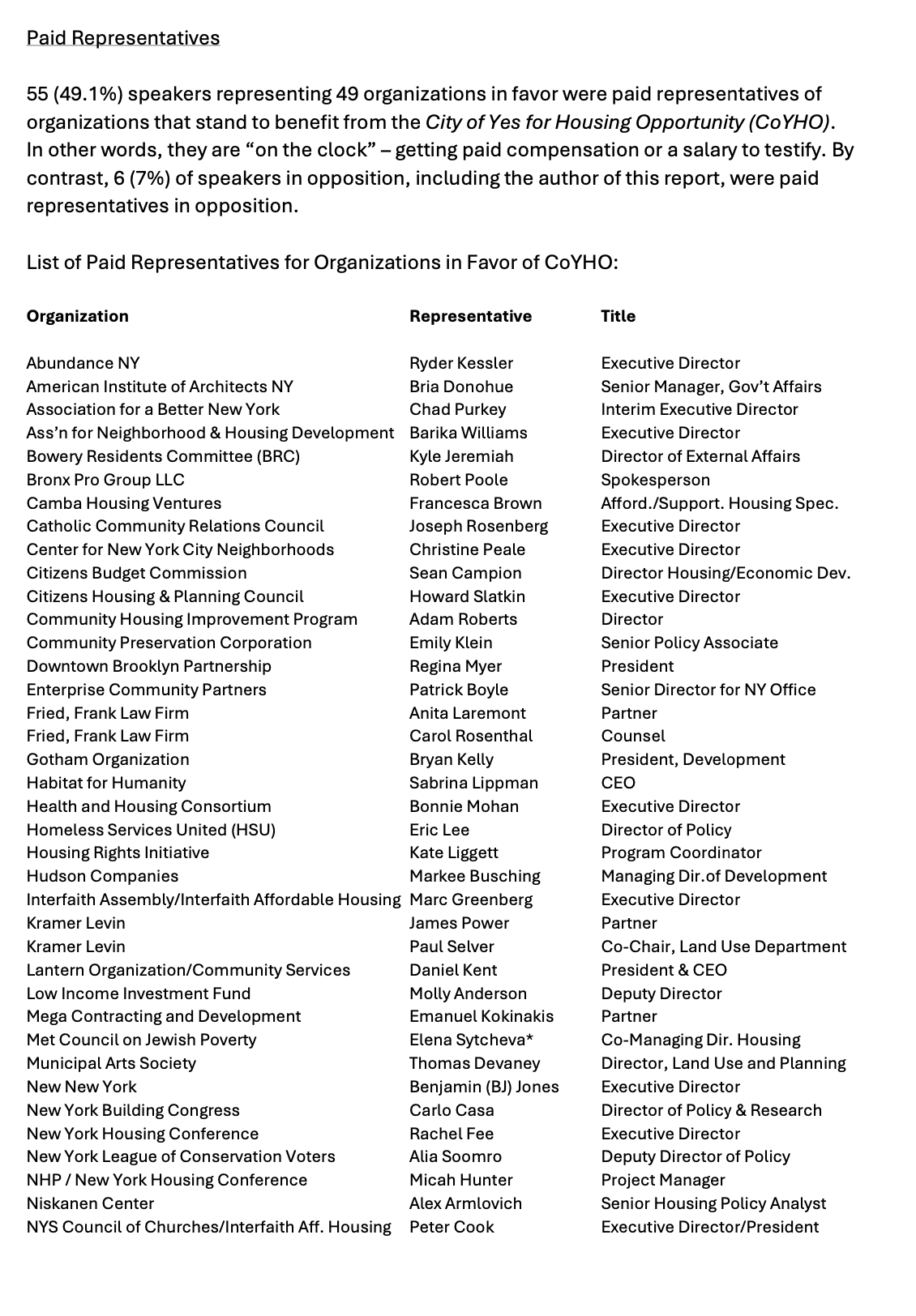
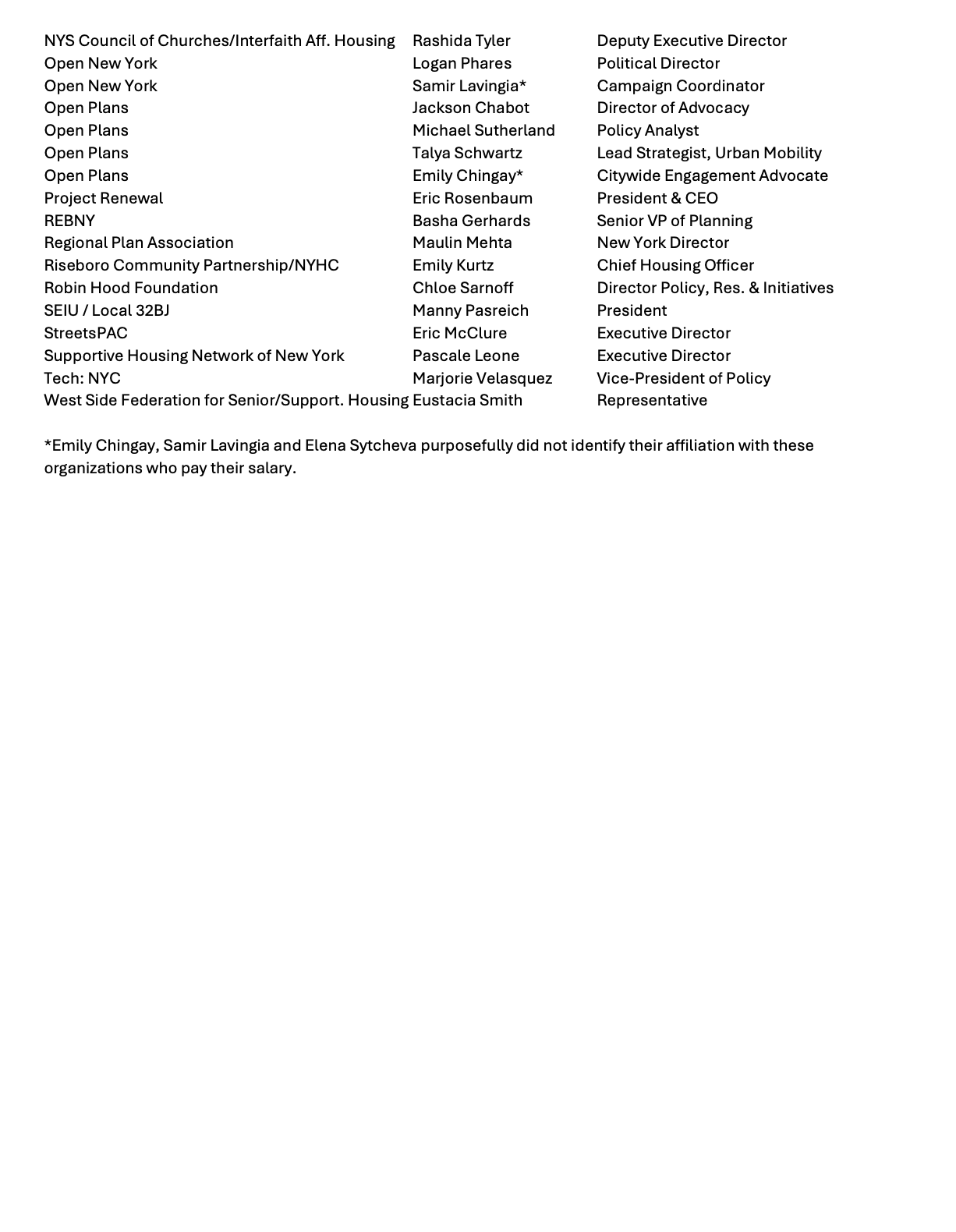
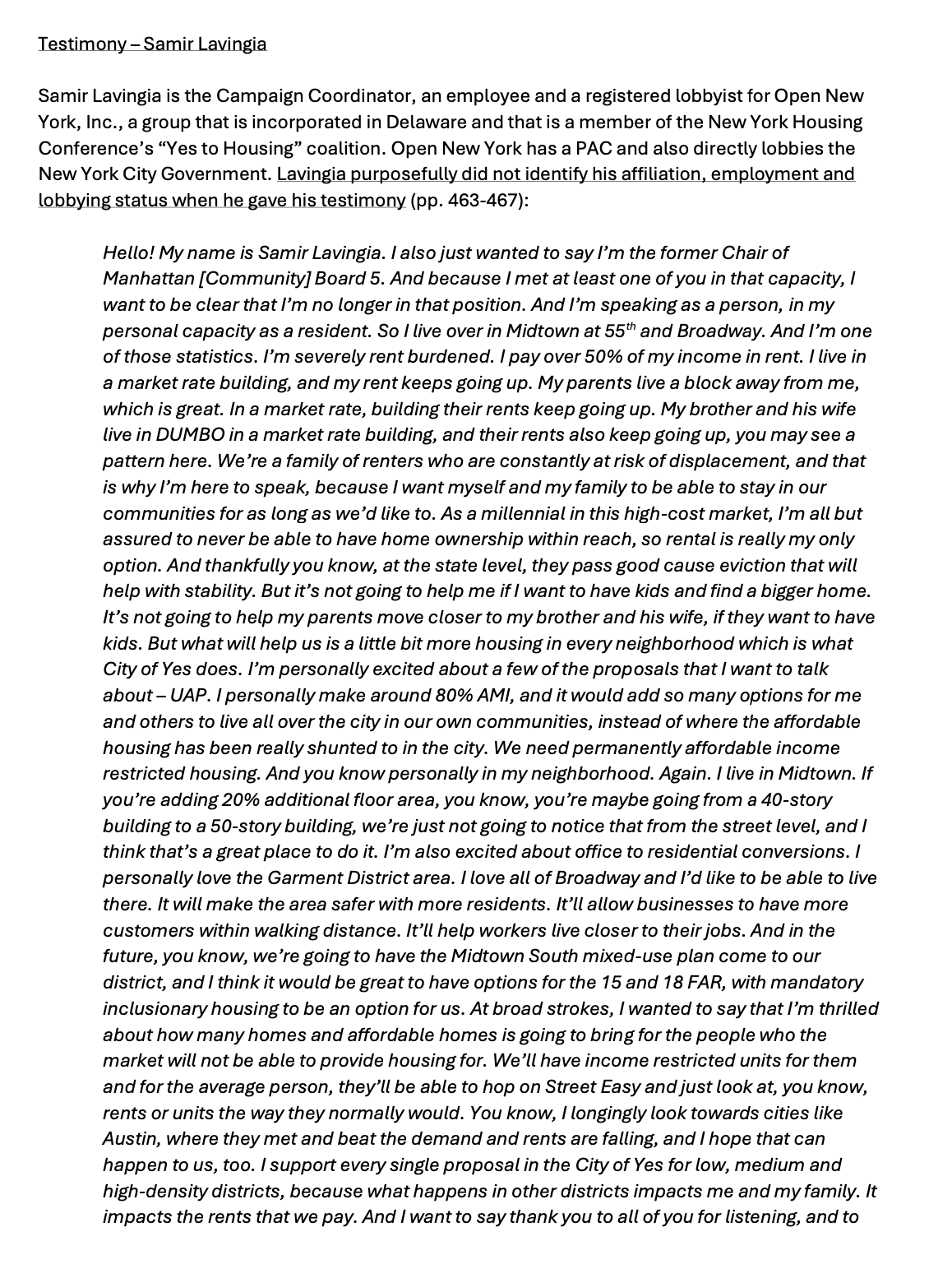
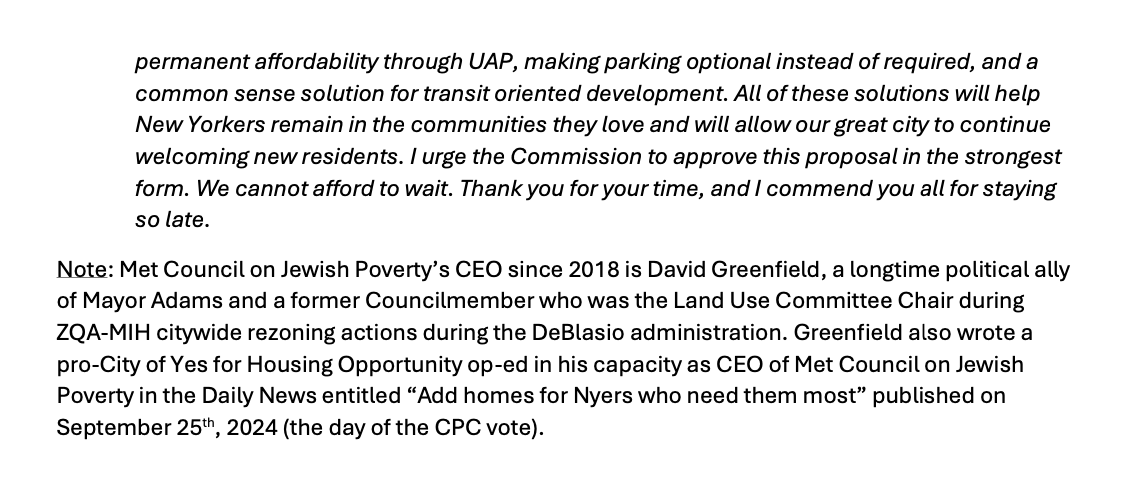
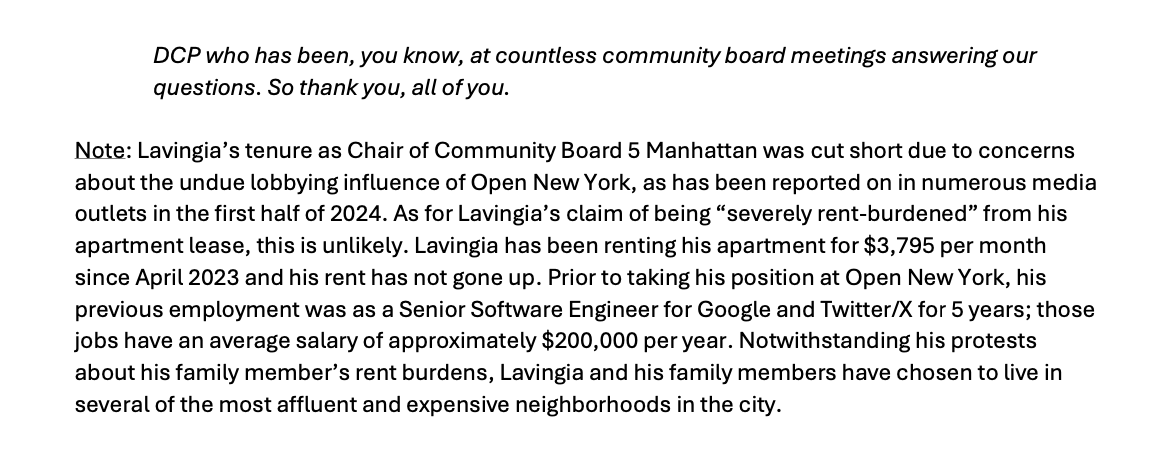
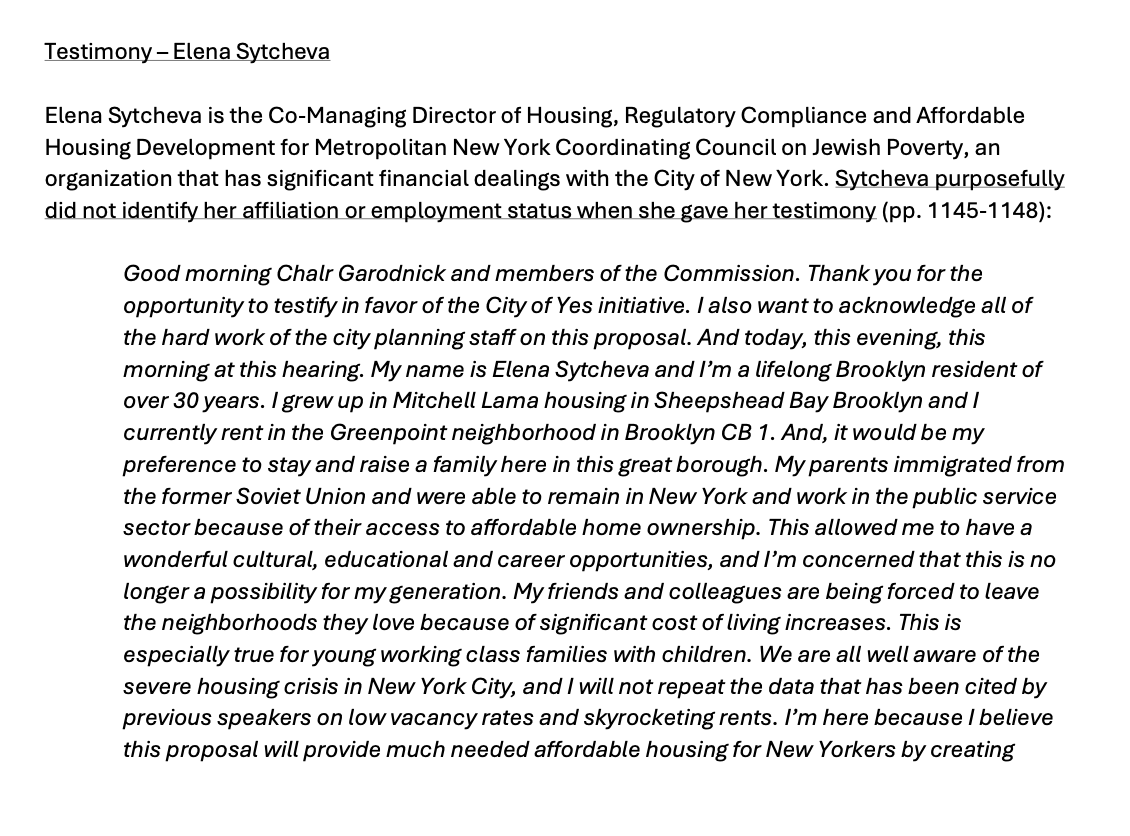
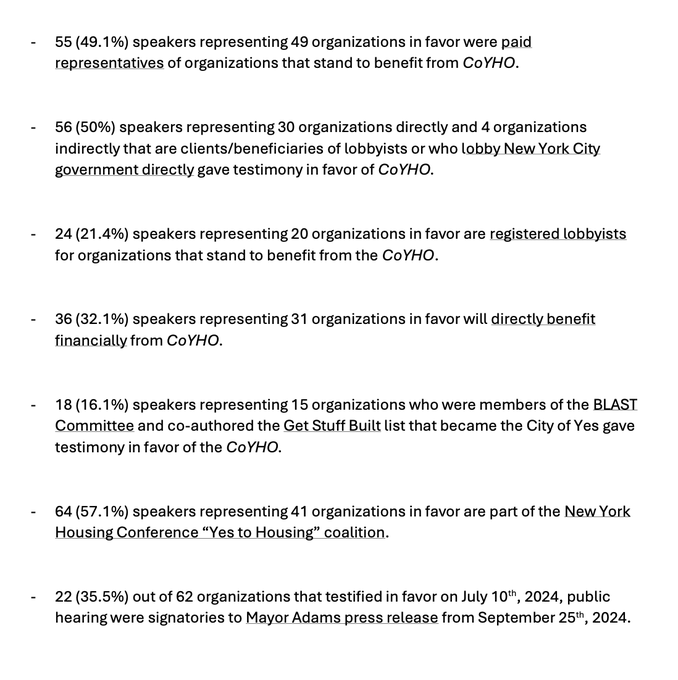
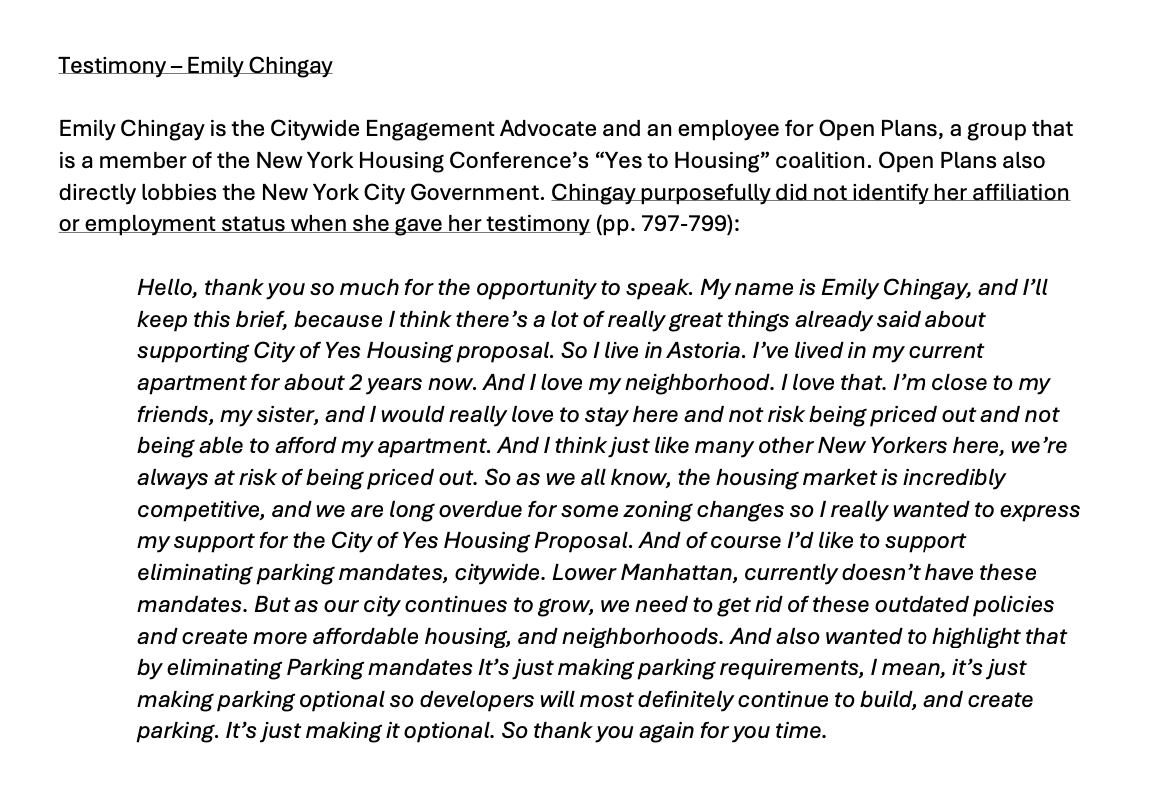
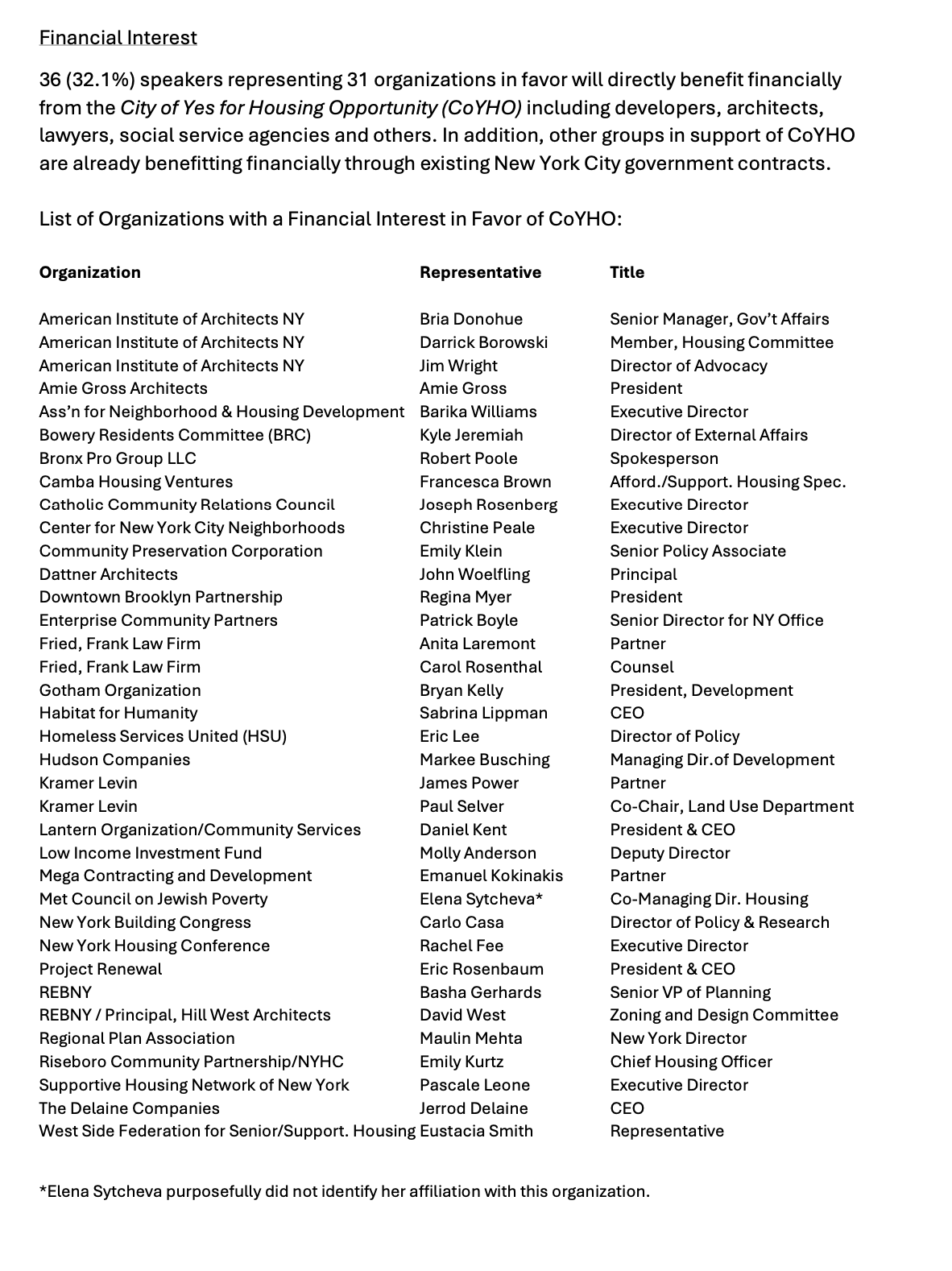
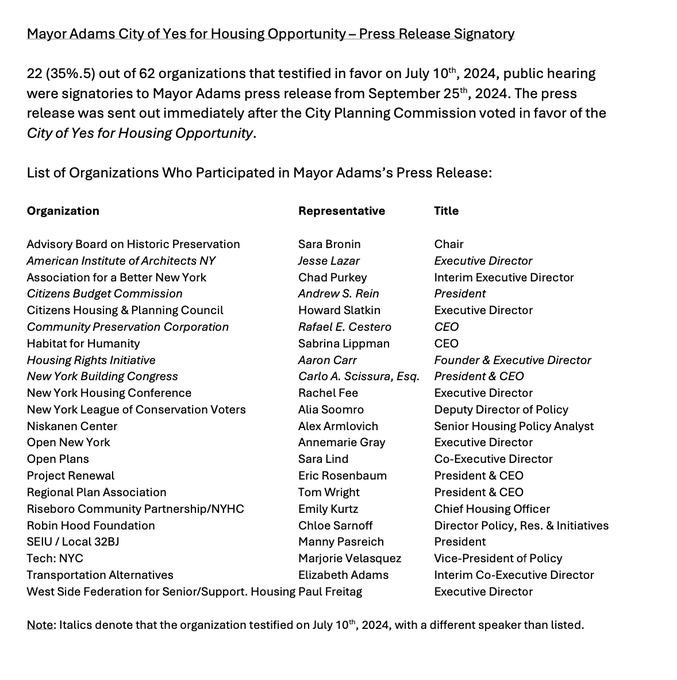
With the City of Yes of Housing Opportunity about to get heard by City Council and New Yorkers the next two days, Intrepid City Planner Paul Graziano dropped a report on the sneaky tactics at the previous zoom hearing and sneaky people trying to get the worst housing plan in New York City history approved in spite of majority rejection by community boards and residents.

Here are the best parts on Paul's X account.


https://pbs.twimg.com/media/GaLEUU0X0AEoDw7?format=png&name=smallImageImageImageImageImageImagehttps://pbs.twimg.com/media/GaLFuEYXQAAP4OU?format=png&name=mediumImagehttps://pbs.twimg.com/media/GaKyiduWIAAbRBa?format=png&name=smallImage

ImageThttps://pbs.twimg.com/media/GaK0IOvWYAAodS6?format=png&name=smallImage

The video above happens to be from this farcical rally with everyone from Paul's COY list. They can't even answer housing related questions and defend their agendas without their YIMBY scripts and talking points. And they refuse to answer the most important question no one is asking these dopes, who is going to build this City of Yes?Image

Monday, July 17, 2023

House Flipping Predators LLC

  https://thecity.brightspotcdn.com/dims4/default/bfbb47b/2147483647/strip/true/crop/916x611+0+56/resize/810x540!/format/webp/quality/90/?url=https%3A%2F%2Fcdn.vox-cdn.com%2Fthumbor%2FScJV1h_ZDZ7Gyo5tDx4gOSlxFyc%3D%2F0x0%3A916x667%2F916x667%2Ffilters%3Afocal%28299x402%3A300x403%29%2Fcdn.vox-cdn.com%2Fuploads%2Fchorus_asset%2Ffile%2F24785560%2Fimage__1_.png

THE CITY

Three years ago on a wintry afternoon, JJ was sitting in bed in her Bushwick apartment when she heard a boom at the door. It sounded like an intruder was trying to kick his way in.

JJ, who is Black, peered through the peephole and saw three white men in suit jackets. She was afraid. They looked like detectives. 

“I opened my door, and I’m like, ‘How can I help you?’” recalled the 42 year-old mother of two, who agreed to speak on the condition of anonymity, citing safety concerns.

That’s when, she said, one of the men introduced himself as “the new owner of the building.” 

“I’m like, what? Excuse me?” recalled JJ, who had moved in about seven years earlier and previously paid rent to the relative of a friend living upstairs.

The man told JJ she had a few months to move out. As she stood by bewildered, his two associates were already at work putting new locks on her door.

What JJ didn’t know was that months earlier a group of strangers had indeed acquired title to the house, just a short walk away from the bars and clubs popular with Bushwick’s newcomers. They’d found five far-flung heirs of the property’s deceased owner and convinced them to sell their fractional inheritances for a grand total of $35,500, according to city deed records. 

JJ’s home was not their only target. A new investigation by THE CITY has found 119 properties across the five boroughs acquired in part or in whole by companies operated by two brothers, Elliot and Joseph Ambalo, and their business partner Etai Vardi. This crew of speculators nab properties in gentrifying Black and Latino neighborhoods, where many homes are ripe for the taking because their original owners died without wills, leaving a network of dispersed inheritors who may not know the value of their partial shares. 

As THE CITY previously reported, similar rings amass partial shares to shake down longtime homeowners for money or to profit from forced home sales. But the Ambalo brothers and Vardi often capitalize on another method: using generically named LLCs like The Queens Foundation and Jackie 42, they find small, multi-family homes with minimal tenant protections, take over the properties by paying heirs low sums, then rush to evict the residents, clearing the path to flip the properties for many times what they paid.

This ring’s maneuvers, which have displaced dozens of longtime city residents, are largely legal. But in some of their transactions, THE CITY found evidence of possible fraud. One notary public based in California believes that her signature was forged on a deed-related affidavit that Vardi also signed. Four other notary publics across the country said they did not sign or recognize their purported signatures that appear in paperwork signed by Vardi or one of the two Ambalo brothers.

The Ambalo brothers and Vardi rebuffed THE CITY’s attempts to interview them at length in person and on the phone. In response to a detailed set of questions sent to them ahead of publication, Vardi shared a brief statement in an email on behalf of the ring.

“The purchase of fractional shares of properties is a long-standing, lawful business practice in the real estate industry,” Vardi wrote. “We have always and will continue to operate within the law and in an ethical manner.”

Of the 119 properties THE CITY identified, 34 have been the subject of eviction or removal petitions filed by the investors’ LLCs, which named 160 residents they wanted out of their newly acquired properties, according to court records. In 19 of these cases, the speculators failed to register their ownership with city authorities, a violation of New York City’s Housing Maintenance Code, before moving to evict tenants. 

In 29 of the 119 properties, city deed records show the investors completed a flip of partial home shares or entire properties. In all, they paid heirs and other property-holders nearly $4.8 million then subsequently sold the shares to new buyers for $14.3 million — a $9.5 million difference.

In many cases, the flips and displacement went hand-in-hand.

THE CITY 


Limited Liability Companies Associated with Joseph and Elliot Ambalo and Etai Vardi

135 STREET INVESTORS LLC

153 FOCH LLC

1847 NEREID LLC

19138 115 ROAD ASSOCIATES LLC

229 CLIFTON PLACE LLC

76 ROCKAWAY BLVD LLC

ACTION NO 37 LLC

ACTION NO 53 LLC

BERGEN STREET MANAGING PARTNERS LLC

BK 146 LLC

BK 950 LLC

BK AUTUMN 701 LLC

BK BEVERLEY LLC

BK DEVOE LLC

BK DEVOE STREET LLC

BK MACON LLC

BK ROSEDALE LLC

BK SARATOGA LLC

BK SHEFFIELD LLC

BLACKROCK EQUITY GROUP LLC

BLACKROCK REAL ESTATE GROUP LLC

BLACKSTONE REAL ESTATE GROUP LLC

BROOKLYN GATES LLC

BX 1076 LLC

BX 1331 LLC

BX MULINER LLC

BX ROSEDALE LLC

EAST NEW YORK RLTY LLC

GILLESPIE AVENUE DEVELOPMENT LLC

GREEN BAMBA LLC

JACKIE 42 LLC

KINGS COUNTY FOUNDATION LLC

MACDONOUGH STREET DEVELOPMENT LLC

MANHATTAN FOUNDATION LLC

MN W 152 LLC

NEW YORK ASSET RECOVERY FOUNDATION LLC

NEW YORK ASSET RECOVERY GROUP LLC

NORTH BRONX VENTURES LLC

NORTH BUSHWICK VENTURES LLC

NORTH QUEENS VENTURES LLC

ONE EIGHTEEN 204 HOLDINGS LLC

ONE THREE SEVEN 24 HOLDINGS LLC

ONE TWENTY TWO HOLDINGS LLC

ONE ZERO FIVE 39 HOLDINGS LLC

QN 147 VENTURES LLC

QN 204 LLC

QN 48 LLC

QN NAMEOKE LLC

QN ST ALBANS HOLDINGS LLC

SOUTH BRONX VENTURES LLC

SOUTH JAMAICA HOLDINGS LLC

SOUTH JAMAICA HOLDINGS 2 LLC

STATEN ISLAND VENTURES LLC

THE BROOKLYN FOUNDATION LLC

THE EASTERN AND ATLANTIC FOUNDATION LLC

THE QUEENS FOUNDATION LLC

THE QUEENS FOUNDATION MMXX LLC

Tuesday, January 24, 2023

City continued to do business with house deed theft recidvist

A man wearing a dark baseball cap and blue jacket over a gray blazer and white-collared shirt stands next to a bald man wearing a law enforcement badge.

New York Times

Sanford Solny, a real estate investor and disbarred lawyer who has been accused of stealing dozens of homes in New York City, mostly from Black and Latino homeowners, was charged on Wednesday with crimes related to the theft of four more properties in Brooklyn.

The Brooklyn district attorney’s office charged Mr. Solny with criminal possession of stolen property and scheming to defraud homeowners. Prosecutors accused Mr. Solny of renting out some of the disputed homes to unwitting tenants and collecting nearly $64,000 in rent.

Mr. Solny faces similar charges from a 2020 indictment, in which he was accused of stealing eight other homes. The two indictments have been consolidated. If convicted, he faces a minimum of three to six years in prison.

Mr. Solny, 65, surrendered to authorities on Wednesday and appeared in court in handcuffs. He pleaded not guilty and then was released. He is scheduled to be in court in March for the latest charges. After announcing the new charges, the district attorney’s office withdrew a plea deal offer in which Mr. Solny would serve four to 12 years in prison.

The new case follows an investigation last year by The New York Times that revealed that Mr. Solny, through a network of shell companies, had been accused in civil and criminal court by 40 homeowners of stealing their property in a scheme known as deed theft.

As of July, companies controlled by Mr. Solny still owned 19 of the disputed properties — an eclectic mix of coveted brownstones and grass-hemmed houses in gentrifying areas of Brooklyn and Queens that could produce hundreds of thousands of dollars in rent a year. In some instances, city agencies contributed to his earnings by subsidizing the rent for low-income tenants.

Deed theft can take many forms, but homeowners have repeatedly accused Mr. Solny of one version.

Homeowners at risk of foreclosure are told they qualify for a short sale, a deal in which the lender settles for less than the balance of the mortgage. The homeowners usually believe that they are selling the home in exchange for debt forgiveness and sometimes a small amount of cash.

Instead, the owners sign documents, often under false pretenses, that transfer the property to another party, leaving the former homeowner saddled with the unpaid mortgage debt. Yearslong legal battles can play out in civil court, often ending in the lender seizing the property — but not before the fraudulent owner extracts value by renting the home out.

Many of the homeowners who have accused Mr. Solny of fraud live in predominantly Black and Latino neighborhoods in central Brooklyn. The four properties in the latest indictment unveiled on Wednesday — homes in East New York, Ocean Hill, Canarsie and East Flatbush that are valued at a total of nearly $2.3 million — were transferred to companies controlled by Mr. Solny between 2012 and 2019 for a fraction of their current market value, according to the district attorney’s office.

Friday, December 16, 2022

Developers too stingy to build more apartments


 The Real Deal

The construction pipeline is getting narrower.

There were 351 new building filings in New York City in the third quarter, down 17 percent from the second quarter and 28 percent year-over-year, according to a report from the Real Estate Board of New York.

The drop is in part because the 421a property tax break for multifamily development in the city expired June 15, which triggered a rush of filings. The 689 in the first quarter were the most in a quarter since 2014, which, not coincidentally, was just before the previous version of 421a expired.

A drought followed the 2014 surge, and now history is repeating itself. Developers have all but stopped trying to put together investors to pursue rental projects that cannot get the 35-year property tax break. Condo projects were largely excluded from the most recent iteration of 421a.

Rising interest rates have also contributed to the decline, as financing projects of all kinds became more challenging for developers.

But the impact of 421a’s expiration is clear when comparing the slowdown in filings for rental projects to the overall drop in new-building filings. The quarter-over-quarter falloff in rental filings was 62 percent, nearly four times the quarterly decline overall. Only 78 rental projects were filed in the quarter, half as many as in the same period last year.

Those 78 projects are proposed to have 3,346 units, down 46 percent year-over-year and the smallest quarterly number in a decade — since the slump that followed the 2008 financial crisis.

Rental projects in much of the city became dependent on 421a over several decades. Progressives let the tax break lapse, believing it forgave too much property tax for too little affordability. Some predict it will be several years before it is replaced, although an abatement still exists for co-ops and condos.

Thursday, December 15, 2022

REBNY's new rap language

https://pbs.twimg.com/media/FjgE0gJX0AE9WRD?format=jpg&name=small

The Real Deal

The Real Estate Board of New York is ringing in 2023 with what the group called “significant” changes to its universal co-brokerage agreement.

The new rules, which are effective Jan. 1, are tightening the language used to advertise listings. Brokers won’t be able to use the term “no-fee,” which the group said misleads customers who don’t understand the term only applies to the listing broker.

The label “off-market” will be prohibited from exclusive listings and those omitted from the RLS by an owner’s opt-out agreement, often used by wealthy clients for discreet marketing.

In cases where an open listing is being advertised as off-market, REBNY can ask for documentation proving the listing is open.

“It’s co-broke or go broke,” a representative for REBNY said.

REBNY is also instituting a “coming soon” status for listings on the RLS, which will give brokers 14 days to switch them to active. The addition comes in response to brokers using the term as a marketing or staging tool without a clear standard, so it’s unclear when a property will hit the market.

Under the new guidelines, brokers will have 14 days to change their listings to active after first posting them under the label, and they won’t be able to show the property until the listing is changed to active.

A third rule clarifies language around commission splits, encouraging brokers to come to a written agreement if they’re pursuing an uneven split for a transaction.

 A final rule change implements the Residential New Development Brokerage Agreement for new development buildings of all sizes. The agreement previously applied only to buildings with 10 or more units.

Thursday, August 11, 2022

Developer cash flows into Crowley campaign from shady PAC


https://thecity.brightspotcdn.com/dims4/default/fe57de5/2147483647/strip/true/crop/2999x1999+2+0/resize/810x540!/format/webp/quality/90/?url=https%3A%2F%2Fcdn.vox-cdn.com%2Fthumbor%2FjWs6F5GvLpp7wjk4dnx0J9SjUtE%3D%2F0x0%3A3000x1999%2F3000x1999%2Ffilters%3Afocal%281521x335%3A1522x336%29%2Fcdn.vox-cdn.com%2Fuploads%2Fchorus_asset%2Ffile%2F20017475%2F4e924bdb581c66d2e3a839c1a50654924fa2.jpg

THE CITY 

Elizabeth Crowley, a Democrat running for state Senate in a district that runs from Astoria to Williamsburg, has pledged not to take any money from big real estate developers.

But on Monday, NYC Forward, an independent expenditure committee running ads to support Crowley, a centrist Democrat, received $150,000 from real estate interests, campaign finance records show. 

That committee was founded this month by District Council 9, the painters’ union that’s counted Crowley as a member — and took the spotlight in initial news coverage of the group. 

But state campaign finance records show the majority of contributions to the committee so far have come from developer interests.

Those include the Real Estate Board of New York, whose campaign spending arm, “Putting New Yorkers to Work,” gave $50,000 to the pro-Crowley committee. So too did A&E Real Estate Holdings LLC, a firm with buildings across Manhattan, Brooklyn and Queens.

State Board of Elections records show NYC Forward paid for $198,000 in expenses listed as “promotional” that coincided with the real estate donations. The committee has also spent $48,000 on a “social media campaign.” 


Monday, July 25, 2022

Lizzie gets the money

https://thecity.brightspotcdn.com/dims4/default/7c227e0/2147483647/strip/true/crop/3000x2000+0+0/resize/810x540!/format/webp/quality/90/?url=https%3A%2F%2Fcdn.vox-cdn.com%2Fthumbor%2F870gOPgGjEZh2sxQteRBJqd0_YM%3D%2F0x0%3A3000x2000%2F3000x2000%2Ffilters%3Afocal%281500x1000%3A1501x1001%29%2Fcdn.vox-cdn.com%2Fuploads%2Fchorus_asset%2Ffile%2F22715752%2F071321_liz_crowely_1.jpg
THE CITY

 Four years ago, a socialist bartender named Alexandria Ocasio-Cortez shocked the political world by unseating Congressman Joe Crowley, Queens’ longtime Democratic party boss. 

Now, the Crowley clan has a chance to get revenge. 

Former City Councilmember Elizabeth Crowley, Joe’s cousin, is running for State Senate, and one of her primary opponents is Kristin Gonzalez, a Democratic Socialist backed by Ocasio-Cortez.

Campaign finance records show an ideologically heterodox coalition lining up to support Crowley, who has a big fundraising lead in the race, including at least $80,000 from registered Republicans, lobbyists, and people in the real estate industry.

Bradley Tusk, a former campaign manager for Republican Mayor Mike Bloomberg turned venture capitalist and political “fixer,” gave Crowley $7,500 (Tusk is a donor to THE CITY). Alfonse D’Amato, a pro-Trump Republican and the founder of Park Strategies LLC, a lobbying firm gave $2,500 to Crowley. 

“I’ve known her personally and professionally for a long time,” D’Amato said in a statement. “We worked together on a television program. She is a good person.”

Crowley, a self-described “tenant advocate” who has pledged not to take money from “big real estate developers,” has, in fact, received a handful of contributions from big developers in addition to tens of thousands in donations from landlords and other real estate industry professionals.

James Pi, founder of Pi Capital Partners, one of New York City’s largest private real estate companies with over two billion dollars in assets it manages, controls or owns, contributed $5,000 to Crowley. H. Dale Hemmerdinger, chairman of Atco Properties & Management, which owns and manages more than 20 buildings and has previously been accused of “slumlord” tactics, gave $1,000 to Crowley.

Crowley did not respond to questions about whether she would return the money she received from the big real estate developers.

One Brooklyn landlord, who gave $2,000 to Crowley, said he hopes she “takes into account everybody, and not just [the] populist movement.”

“I think [there’s] an unfair picture being painted of bleeding, blood-sucking capitalists when 99 percent are just trying to do the right thing and give back to their communities,” he said, referring to real estate owners.

In a statement, Crowley, who has raised more than $500,000, said she is proud to have built a “strong coalition” of donors, volunteers, and labor unions, many of which have both contributed to and endorsed her campaign.

“As a single mom who has battled the hardships so many of our families are currently facing, I have the experience and will fight for a more affordable New York with better access to housing, transit and childcare,” said Crowley, a former union painter and the daughter of a big Irish family. 

Asked for her response to other campaigns accusing her of breaking her pledge not to take big real estate money, Crowley continued: “It is clear that my opponent wants to only focus on the inside political track. Despite that—I’m not playing that game. The stakes are too high and voters at every door I visit are deeply concerned how we will improve their quality of life. That’s why I am running.”

Monday, July 18, 2022

Kathy Clown and Mayor Swagger agree on Penn Station real estate land grab deal

https://assets.bwbx.io/images/users/iqjWHBFdfxIU/iTGpfcUDP0ZQ/v1/-1x-1.jpg

AP 

 A funding agreement was reached for the multibillion-dollar redevelopment of New York’s aging Penn Station, the country’s busiest rail hub.

Gov. Kathy Hochul and Mayor Eric Adams announced details of the deal Monday.

The plan would create new commercial and residential buildings around the station, with those building’s developers getting to make payments in lieu of taxes for a period of 40 to 45 years. The amount collected in excess of existing property taxes would be applied to the project.

That money would contribute more than $1 billion to pay for improvements to streets, sidewalks and other public spaces, as well as 50% of the improvements to transit infrastructure including underground concourses and subway entrances.

“This agreement brings us one step closer to a beautiful, modern station worthy of New York with vibrant open space, lively streetscapes, and better, more seamless connections to local transit,” Hochul said in a statement.

The reconstruction of the station and the first phase of the improvements to public spaces is expected to cost roughly $8 billion. Hochul’s vision is a scaled-down version of earlier plans announced by her predecessor, fellow Democrat Andrew Cuomo.

A recent study commissioned by Reinvent Albany, a state government watchdog group, estimated that the payments in lieu of taxes would amount to about $4 billion, a number that assumed a southern expansion of the station to accommodate more tracks when a new Hudson River tunnel is built several years from now. That expansion, which is in initial discussions, is projected to cost an additional $13 billion.

The plan has provoked criticism from neighborhood groups who contend it will destroy a vibrant area and displace residents and businesses.

Samuel Turvey, chairperson of RethinkNYC, a transportation and land use advocacy group, said the plan is misguided because it fails to turn Penn Station into a through-running facility where trains would pass through to other areas of the city, rather than turning around and returning to their origin or sitting in rail yards.

Turvey called the plan “a very ugly replacement theory where local residents, small businesses and historic structures are being cast to the winds with the help of the state and city.”

The Real Deal 

City and state officials have come to terms on paying for the renovation and expansion of Penn Station — some of it, anyway.

Gov. Kathy Hochul and Mayor Eric Adams announced on Monday an agreement over how the city will collect property taxes from the 18 million square feet of construction planned on sites surrounding the station.

As expected, the city will continue to collect the property taxes it receives now on the development sites, increasing by 3 percent each year. It will also get payments in lieu of taxes, or PILOTs, from the developers of each of the 10 future towers; the mechanism allows money to be directed to a specific purpose, in this case Penn Station work, rather than go into the general fund.

The property owners will not pay traditional property taxes on the increased value of the land for an extended period of time. The city will not collect the full property taxes on these sites until the agreed-upon contributions to the project are met or after 80 years, at the latest.

The PILOTs will cover 12.5 percent of the estimated $7 billion cost of renovating Penn, and of the possible expansion of the station, reportedly a $12 billion project. The payments will fully offset the cost of public realm improvements, such as street and sidewalk work, and will take care of 50 percent of the expense of transit work, including underground concourses and new subway entrances.

Adams called the deal a “win-win” for New Yorkers.

The announcement does not include many details on the expected value of the PILOTs, nor how they will be distributed between the renovation and expansion. It also does not specify how much the state expects to make from the sale of development rights in the neighborhood.

State officials released a copy of the financial framework late Monday afternoon. Opponents have complained that the project’s finances lack transparency.

Elizabeth Marcello, a research analyst with Reinvent Albany, a watchdog group that has been critical of the state’s plans for Penn, said the announcement further blurs the lines between the expansion and renovation of the station.

“There’s still a lot of glaring questions we don’t have answers to,” she said.


Friday, May 6, 2022

The rents are too damn higher by train stations


Queens Post 

 The rental market has bounced back—with apartments located within a half mile of a subway station coming back with vigor.

The real estate firm RentHop released a report earlier this week that found that the median rent paid for a 1-bedroom apartment has jumped significantly for those located near subway stations.

The report, which focused solely on 1-bedroom apartments, revealed that the jump was particularly noticeable by major station hubs and near stations where there has been an increase in luxury housing development.

For instance, the median rent paid for a 1-bedroom unit by the Queensboro Plaza station during the first quarter (Jan. 1—March 31) was $3,390, up 28 percent from the first quarter of 2021. The median rent paid for a 1-bedroom unit near the 36th Street station (E-M-R) during the first quarter was $2,658, up 29 percent from first quarter 2021.

The proximity of the stations to two new developments played a role in driving up prices, according to the report. The stations are near Sven, a 71-story tower located at 29-59 Northern Blvd, and Rise LIC, a 10-story building at 29-17 40th Ave.

The report noted that across the city rents have “skyrocketed at major subway stops,” with pandemic concessions vanishing and gross rents soaring. For instance, at the 72nd Street in Manhattan the median rent paid for a one-bedroom is up 30 percent year-over-year, to $3,495 during the first quarter.

“When the pandemic first hit New York City, residents fled in droves,” the report says. “Two years into the pandemic, many have returned to the city [and] rental prices have recovered well beyond the pre-pandemic levels.”

RentHop released data showing the median amount paid for a 1 bedroom at each station, as well as the increase.


Monday, January 31, 2022

The Billion Dollar District


Queens Post 

The Long Island City condo market in 2021 was its strongest on record—with sales volume reaching nearly $1 billion, about three times the previous record set in 2019, according to a new report.

There were 885 units sold in 2021, with a dollar value of $995 million. The number smashed the 2019 sales volume record of $385 million, when 336 condos were sold.

These findings are part of the 2021 Long Island City Condominium Report released by Patrick W. Smith, an independent real estate analyst and Long Island City-based agent affiliated with The Corcoran Group. (This is NOT independent!-JQ LLC) The report is based on closed condo sales within the confines of 37th Avenue to the north, Borden Avenue to the south, the East River to the west and Northern Boulevard to the east.The report is based on closed condo sales within the confines of 37th Avenue to the north, Borden Avenue to the south, the East River to the west and Northern Boulevard to the east. The area is represented in the shaded area

“The Long Island City market did extremely well in 2021 because sellers priced their units competitively and the demand for Long Island City continues to grow,” said Patrick W. Smith, the author of the report. “Long Island City also remains at a significant discount to Manhattan.”

Smith said that the market also benefited from low interest rates and a stock market that has surged over the past two years. He also said that the job market was particularly strong for many of the buyers who work in the tech, finance and legal industries.

He said that Long Island City’s popularity continues to increase as new stores and businesses come to the area—such as Trader Joe’s on Jackson Avenue—and its waterfront parks gain greater recognition.

The sales volume in both the new development and resale market was extremely strong in 2021, according to the report. There were 728 condos sold in the new development market, up from 270 in 2020. Meanwhile, 157 condos sold in the resale market—a record—significantly higher than the 65 sold in 2020, 85 in 2019 and 95 in 2018.

Prices across the Long Island City market were up. For instance, the average price paid for a condo in 2021 was $1,124,000, up from $1,074,000 in 2020. The average price for a one-bedroom last year was $912,000, up from $900,000 in 2020. Meanwhile, the average sales price for a two-bedroom condo was $1,382,000, up from $1,328,000.

The new development market across Long Island City outperformed, with the average sales price on the 728 units sold coming in at $1,134,000 in 2021, up from $1,048,000 in 2020 when 270 units changed hands.

The average increase can be attributed, in part, to the Skyline Tower development, a 67-story luxury condo building with 802 units at 3 Court Square. Closings in the building began in 2021—and 332 sales were recorded, accounting for $415 million in sales volume. The average price paid for a condo in the Skyline Tower—based on closed data– was $1,251,000 million, pushing up the numbers for the overall market.


Sunday, January 23, 2022

How to buy an election for an unelected governor

https://nypost.com/wp-content/uploads/sites/2/2021/12/Kathy-Hochul-2.jpg?quality=90&strip=all

NY Times 

Last November, when many of Manhattan’s skyscrapers sat half-empty, Gov. Kathy Hochul made a high-stakes wager on New York City’s commercial real estate industry: She vowed to move ahead with a marquee plan to restore Pennsylvania Station and erect new office towers around it.

For Manhattan’s mega-rich real estate developers, the announcement signaled Ms. Hochul’s support for the kind of grand projects that foretell a windfall, and some found a concrete way of showing their approval to the new governor.

In the weeks that followed, Ms. Hochul’s campaign received checks for $69,700, the legal limit, from some of the city’s biggest real estate executives, including Steven Roth of Vornado Realty Trust, which is positioned to directly benefit from the project that he once called a “Promised Land.” Other checks trickled in from developers, builders, engineers and even some who opposed it.

The campaign contributions flowed from a broader spigot of cash turned on last fall by New York’s varied special interests, from real estate and building trades to hospitals, labor unions and gaming companies, directed toward Ms. Hochul’s election campaign.

The donations included $200,000 in checks from the family behind a major construction firm with millions in state contracts, $47,000 that was tied to a gaming giant leaning on the state to expand legal gambling, and $41,000 traced back to a single Albany lobbyist.

The funds helped Ms. Hochul, a moderate Democrat who unexpectedly ascended to office last August, assemble a record-setting $21.6 million war chest, and claim a steep advantage heading into June’s Democratic primary and November’s general election.

People and industries with financial interests before the state have long been reliable donors to top elected officials, showering them with money that, at times, can pose ethical and legal problems.


Monday, January 10, 2022

Robert Durst is a dead man

 https://s.hdnux.com/photos/01/23/43/32/21903018/3/ratio3x2_1200.jpg

 Times Union

 Robert Durst, the wealthy New York real estate heir and failed fugitive who was dogged for decades with suspicion in the disappearance and deaths of those around him before he was convicted of killing his best friend and sentenced to life in prison, has died. He was 78.

Durst died Monday in a state prison hospital facility in Stockton, attorney Chip Lewis said. He said the death was from natural causes due to a number of ailments.

Durst was convicted in September of shooting Susan Berman at point-blank range at her Los Angeles home in 2000. He was sentenced Oct. 14 to life in prison without parole.

Durst had long been suspected of killing his wife, Kathie, who went missing in New York 1982 and was declared legally dead.

But only after Los Angeles prosecutors proved that the motive in Berman's death was to silence her because she helped him cover up Kathie’s killing was he indicted by a New York grand jury in November for second-degree murder in his wife's death.

Los Angeles prosecutors told jurors that Durst got away with murder in Texas after shooting a man who discovered his identity when he was hiding out in Galveston after Berman’s killing. Durst was acquitted of murder in that case in 2003, after testifying he shot the man as they struggled for a gun.

Deputy Los Angeles District Attorney John Lewin said jurors told him after the verdict that they believed Durst murdered Morris Black in Texas and had killed his wife.

Durst discussed the cases and made several damning statements including a stunning confession during an unguarded moment in the six-part HBO documentary series “The Jinx: The Life and Deaths of Robert Durst.”

The show made his name known to a new generation and brought renewed scrutiny and suspicion from authorities. He was arrested in Berman’s killing the night before the final episode, which closed with him mumbling to himself in a bathroom while still wearing hot mic saying: “You’re caught! What the hell did I do? Killed them all, of course.”

Wednesday, December 15, 2021

Gowanus rezone approval spurs luxury public housing over-development blowback


The Real Deal 

 Developers have filed plans to build three more largely residential buildings in recently rezoned Gowanus.

Rabsky Group affiliate Galaxy Developers and Monadnock Development each submitted plans for a 22-story building with approximately 300 residential units at 395 Carroll Street and 155 3rd Street, respectively. Avery Hall Investments put in paperwork to build nearly 200 units at 653 Union Street.

A steady flow of Gowanus developments have been filed since October, when it became clear the rezoning would pass.

But that is not the only reason that project filings are piling up at the Department of Buildings. The scheduled expiration of 421a, a generous property tax break for residential construction, in June is prompting developers to get their foundations in the ground by then.

Largavista Companies filed plans to build a 46-story tower with 518 residential units at 30-05 Queens Boulevard in Long Island City. The building will span about 474,000 square feet.

Howard Hughes filed its application to build at 250 Water Street after slogging its way through the Landmarks Preservation Commission and City Council as opponents complained that the project is too tall.

The building clocks in at 26 stories with 324 residential units and 160,000 square feet of commercial space. The site, which abuts the high-rent Financial District, has been a parking lot for decades, despite several attempts to develop it.

Also in Queens, Albert Shirian’s Lions Group filed plans to build a 49-story tower with 363 residential units at 26-32 Jackson Avenue. The company secured construction financing for an adjacent residential project at 27-01 Jackson Avenue with 164 units across 27 stories, the Commercial Observer reported.

Tuesday, August 3, 2021

Sociopath plutocrats join in solidarity funding sociopath governor's re-election


 NY Post

 Deep-pocketed donors with ties to New York’s real-estate industry are still putting their money behind embattled three-term Gov. Andrew Cuomo, campaign records reveal.

Developers, landlords, building lenders and other industry associates pumped nearly $500,000 into Cuomo’s re-election coffers over the past six months.

That’s more than 20 percent of the $2.3 million raised by Cuomo for the first half of 2021.

Many of the contributions poured in right before the campaign fundraising deadline.

Housing activists blasted the donations, noting that an important state law expires next June 15 that gives luxury developers’ projects generous tax abatements for charging non-market or “affordable” rents for up to 30 percent of their new apartments.

 The program is supported by the Real Estate Board of New York, which donated $5,000 to Cuomo from its political action committee.

“It’s classic pay-to-play. There’s no doubt about it,” Michael McKee of the Tenants PAC, which wants the law repealed, charged of the political donations to Cuomo.

“We are going to spearhead a major campaign to terminate this law. It’s totally obscene we are subsidizing millionaires and billionaires with property tax breaks. There’s a glut of luxury housing.”


Monday, August 2, 2021

Jehovahs selling a Ridgewood teardown

Well lookie here. 60-12 Menahan Street is a goner, with a demo permit filed recently. After JQ's post about the Van Sicklen house, I decided to look up the provenance of this larger than average home, and while I didn't uncover much in the way of original ownership, I did find that the current owner since 2003 is the Watchtower.

I'm almost surprised, given the location, that it didn't become some sort of hipshit commune but who knows what the next owner will do?

Thursday, July 29, 2021

30 Days Over Vacant Lots


 Commercial Observer

 A New York City Council member is trying to give the city a heads-up on vacant building sales.

Councilman Ben Kallos plans to introduce legislation on Thursday that would require real estate brokers, realtors and listing agents to notify the city 30 days before a vacant property — including empty lots and unoccupied buildings — of 20,000 square feet or more goes up for sale, Commercial Observer has learned.

Kallos said the bill will bring the city in the loop on transactions, giving it the first right of refusal on vacant properties to allow it to build more schools, firehouses and other municipal buildings. 

“In my district, which is the Upper East Side, we have three gigantic vacant spaces,” Kallos told CO. “I’m trying to build more pre-K sites, and more schools [and] firehouses … It’s clear to me that it is a bad thing that real estate isn’t getting into the hands of the government [and] public-private partnerships aren’t happening frequently.”

The city would be required, under the new legislation, to express interest in acquiring the property or say why it’s not interested within a 30-day timetable. If an owner rejects the city’s offer, the city would also be required to disclose why it didn’t use eminent domain — when a government takes private property for public use and compensates the owner — or the Uniform Land Use Review Procedure to acquire the property, according to the a copy of the bill shared with CO.


Saturday, April 10, 2021

Ridgewood residents feel the spectre of gentrification after "progressive" developers open expensive restaurant on a street corner


Grub Street

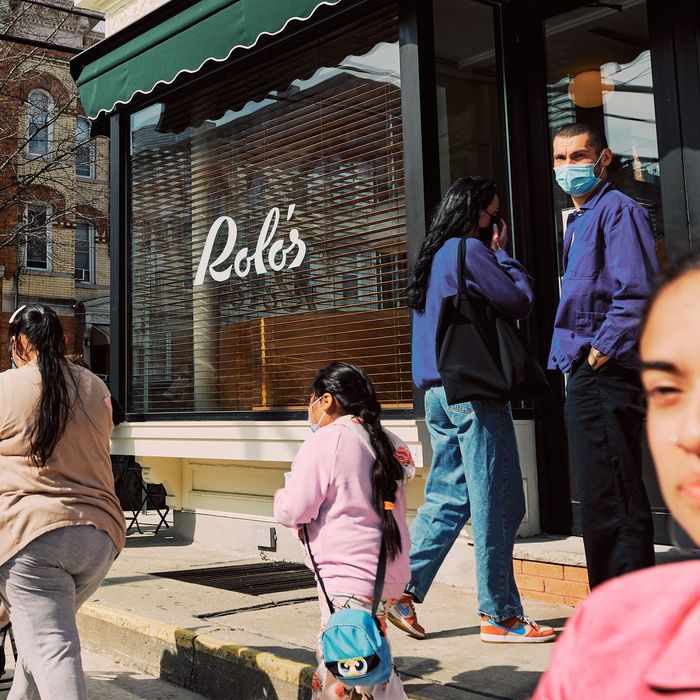
 Luisa’s family has lived in the same apartment building on Onderdonk Avenue in Ridgewood since she was 10 years old. Now, she worries that time will come to an end. Last year, when Luisa (who asked to only use her first name) found herself working out of the apartment, she started to notice how quickly changes in the neighborhood were happening. Local property values had skyrocketed, and she says her landlord has said, many times, she’s thinking about selling. “If she were to put it up for sale, we would be evicted in a matter of just closing your eyes,” Luisa fears. “We don’t have a lease,” she says, “so there are very real concerns that I do have.”

While she says there’s no immediate threat to her family, she’s worried that may change any day now. She spent the summer listening to the drilling and construction along Onderdonk Avenue, including for Rolo’s, a new restaurant from a trio of former Manhattan chefs. “It was just this nightmare for me,” Luisa says, “because I knew what was happening.”

Rolo’s is the kind of low-fuss, New American place you might expect from four veterans of Danny Meyer’s Gramercy Tavern who wanted to open a casual, outer-borough dining room. Rolo’s sells eight kinds of pickles, pineapple-rum Negronis, homemade focaccia, fresh pasta, and containers filled with slow-braised lamb ragù. A recent review in The New Yorker said it offered “a taste of New York.” Howard Kalachnikoff, one of the chef-partners, calls it, “Just a simple, neighborhood restaurant, focused on cooking over a wood-burning grill.” The goal of opening, he explains, is “to put down some roots and then see what happens after that.”

Pandemic dining restrictions meant Rolo’s opened first as a market with only takeout and delivery. A few weeks ago, the owners put out some tables, and they have a warm-weather streetery structure in the works (hmm, a sign NYC open streets are being weaponized for privatization?-JQ LLC). Eventually, Kalachnikoff imagines diners dropping in a couple of times each week, and he wants to stay in business for a long time. Ben Howell, another partner, adds, “nothing would make us happier than if some of the young adults that come here now come in in 15 years with their kids, when their kids are graduating.”

Due to the pandemic, Rolo’s opened in January as a grocery store, selling everything from single-origin spices to De Cecco pasta, and takeout business. 

Indeed, some neighbors don’t see any drawback to the arrival of Rolo’s or the building’s renovation. “I’m not aware of any negatives,” says Paul Kerzner, a 49-year member of Community Board 5. “I walked into that building about a month ago when that was finished,” he recalls. “I was tickled to death when I saw that the graffiti was coming down and the boards that were up were coming down, and we’re going to get glass back again.”

But for others, Rolo’s is something more than a destination for a quiet weeknight meal. “I’m so excited because I like this kind of food,” says Laura Duarte, who, with her siblings, opened her own restaurant, Las Chilangas, just before the pandemic hit. “But the way we think about this type of restaurant opening … I know the rent is going to increase so much.”

Tuesday, April 6, 2021

Queens Is Burning: Castle goes on fire in Woodhaven and Long Island City luxury tower sales are blazing

https://qns.com/wp-content/uploads/2021/04/Screen-Shot-2021-04-05-at-12.53.50-PM-1200x797.png

QNS 

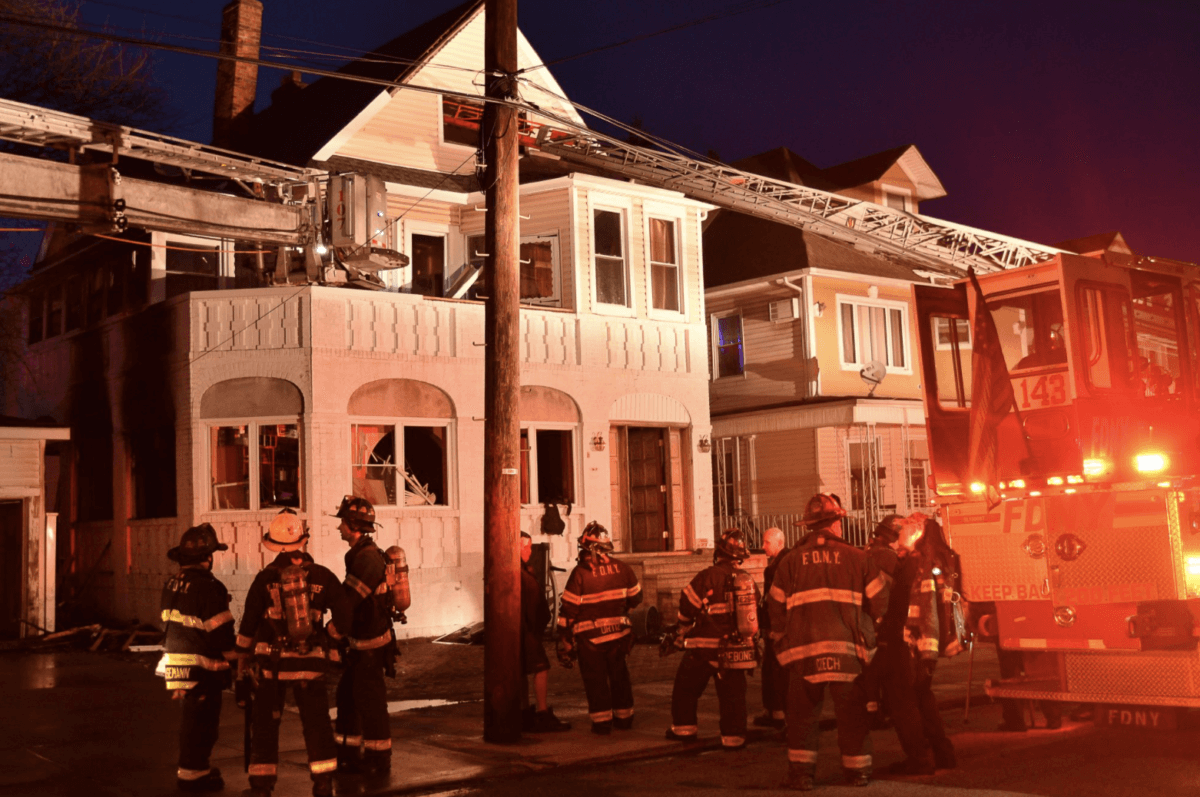
 A two-alarm fire in Woodhaven sent one firefighter to the hospital on Sunday.

Firefighters first got a call about the blaze inside a three-story home located at 84-11 86 Rd. around 7 p.m. on Sunday, April 4, according to the authorities.

QNS 

The Long Island City real estate market is showing signs of life after the COVID-19 pandemic froze the nation’s fastest growing neighborhood a year ago.

At the Skyline Tower at 3 Court Sq., monthly sales more than doubled in March with 20 units going into contract.

“The month of March was on fire and my team was killing it,” Modern Spaces Founder and CEO Eric Benaim said. “Not only the market is coming back but New York City is coming back.”

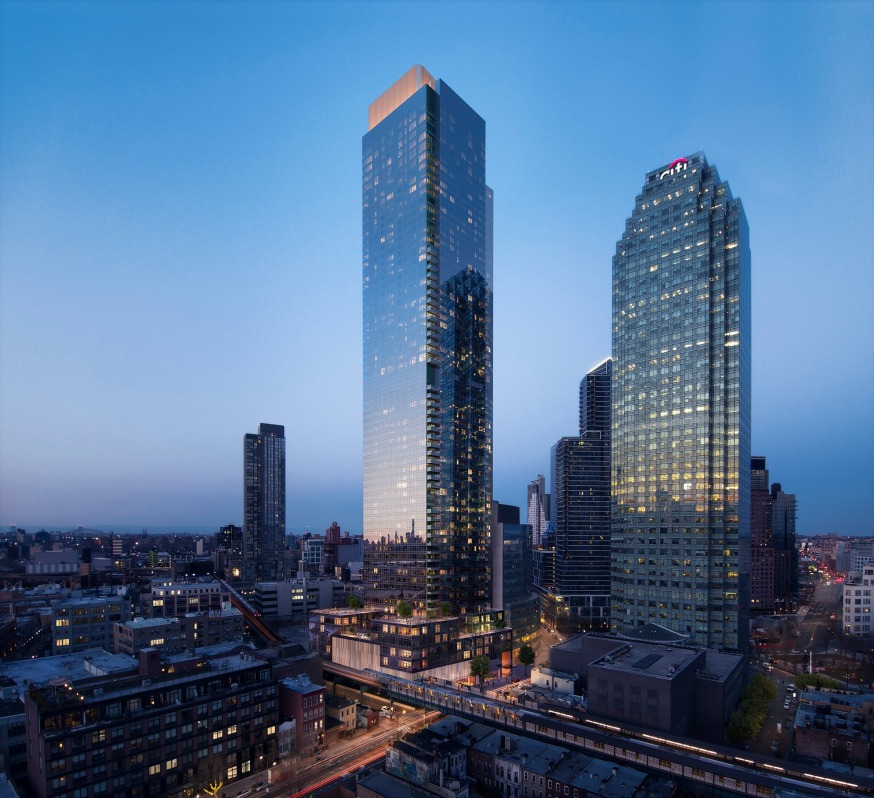
Modern Spaces is handling the marketing and sales of the Skyline Tower, the tallest condominium building in Queens, rising 67 stories with 802 units. The total value of the project is expected to be the first billion-dollar development in the borough when the condo units sell out.

“We’re at 44 percent sold and we should be at 50 percent by the end of spring,” Benaim said. “We’ve got 25 to 30 units occupied already with more units moving quickly.”

Closings began in February and people began moving in during March. The development features an array of luxury amenities including a state-of-the-art fitness center, a 75-foot indoor pool, a whirlpool spa, sauna and steam room, a children’s playroom, a business center and an outdoor terrace. There are private, outdoor terraces for 155 of the units.

If this monolith seems familiar, it's the building over the Court Square train station where a commuter almost drowned and nearly got hit by a train when the retaining wall collapsed during a storm as the building was still being developed.


Sunday, February 21, 2021

Jimmy's got a brand new bag while his husband is bringing home the bread


He is a reborn union man fighting real estate and for the working man and woman according to his website - Jimmy Van Bramer for Queens Borough President

 BUT he is notoriously close to real estate developers! In 2013 campaign finance records below show he got at least  $6,350.00 from a developer's family, the Wolkoffs, related to the Five Points Development, which not only got a lucrative variance BUT ALSO the developer G&M Realty owner -AKA Jerry Wolkoff - didn't use all union labor as promised. The people of LIC got glass behemoths instead - thanks to Jimmy! He is also an old friend of big-time developer Stuart Suna.


While City Councilman Jimmy Van Bramer may have sworn off special interest cash, the same hasn’t been true for his husband — author and documentary filmmaker Dan Hendrick.

His 2017 documentary “Saving Jamaica Bay” is larded to the hilt with money from lobbyists and big real estate interests the councilman swore to avoid, a review by The Post shows.

The influential lobbyists singled out for thanks in the film credits include Uber lobbyist Patrick Jenkins, the founder of Patrick B. Jenkins & Associates; Jon R. Del Giorno, a founding member of Pitta Bishop & Del Giorno and lobbyist for the Yankees; Arthur Goldstein, a partner in Davidoff Hutcher & Citron and lobbyist for the Greater Jamaica Development Corporation; former NYU lobbyist Rose Christ, of Cozen O’Connor; and Joe Reubens, a partner at The Parkside Group who lobbied for AT&T.

Big real estate also chipped in, with The Durst Organization, Tishman Speyer Properties, the Real Estate Board of New York Foundation and others also thanked in the film credits.

Hendricks made no secret of the need for financing while making the film, telling local news he took in “hundreds of thousands” of dollars for the flick, which was narrated by Susan Sarandon. 

 “On the surface, it doesn’t look good,” said Betsy Gotbaum, a former city Public Advocate and current executive director of the good government group Citizens Union.


Friday, February 19, 2021

Developers licking their chops over CoJo's housing plan

From the Real Deal:

Predictably, a coalition of the city’s leading NIMBY groups blasted the City Council speaker’s proposal Thursday as a “top-down approach that would leave communities with even less democratic control over massive city rezonings” than they have now. 

Well, yes. That is exactly the point. 

Not to be anal, but this is not a direct democracy. It’s a republic. We elect leaders, who in turn run the government. We don’t let people with pitchforks decide what can be built where.

Riiiight, we elect representatives who vote on rezonings on our behalf. Unfortunately what Planning Together does is remove them, as well as community boards and the borough president, from the equation. Let's continue:

New York’s lone YIMBY group, Open New York, thinks Johnson’s plan should go further because “it fails to address longstanding practices that allow wealthier neighborhoods to block new housing and shunt demand elsewhere,” said board member Will Thomas. 

He was disgusted but hardly surprised by the letter from the anti-development groups including Village Preservation, Voice of Gowanus, Stop Sunnyside Yards, Soho Alliance and the Coalition to Protect Chinatown and the Lower East Side. 

“We encourage legislators interested in more equitable city planning to ignore complaints by wealthy NIMBYs who are primarily interested in protecting the status quo,” Thomas said.

Wealthy NIMBYs? I think you'd better take a closer look at who signed the letter.
I think MTOPP, Fight for NYCHA and the Flushing Workers Center and others on the list would be surprised to find out that they represent wealthy neighborhoods.

When they have to misrepresent who you are, it means they are up to no good.