Showing posts with label tax breaks. Show all posts

Wednesday, December 15, 2021

Gowanus rezone approval spurs luxury public housing over-development blowback


The Real Deal 

 Developers have filed plans to build three more largely residential buildings in recently rezoned Gowanus.

Rabsky Group affiliate Galaxy Developers and Monadnock Development each submitted plans for a 22-story building with approximately 300 residential units at 395 Carroll Street and 155 3rd Street, respectively. Avery Hall Investments put in paperwork to build nearly 200 units at 653 Union Street.

A steady flow of Gowanus developments have been filed since October, when it became clear the rezoning would pass.

But that is not the only reason that project filings are piling up at the Department of Buildings. The scheduled expiration of 421a, a generous property tax break for residential construction, in June is prompting developers to get their foundations in the ground by then.

Largavista Companies filed plans to build a 46-story tower with 518 residential units at 30-05 Queens Boulevard in Long Island City. The building will span about 474,000 square feet.

Howard Hughes filed its application to build at 250 Water Street after slogging its way through the Landmarks Preservation Commission and City Council as opponents complained that the project is too tall.

The building clocks in at 26 stories with 324 residential units and 160,000 square feet of commercial space. The site, which abuts the high-rent Financial District, has been a parking lot for decades, despite several attempts to develop it.

Also in Queens, Albert Shirian’s Lions Group filed plans to build a 49-story tower with 363 residential units at 26-32 Jackson Avenue. The company secured construction financing for an adjacent residential project at 27-01 Jackson Avenue with 164 units across 27 stories, the Commercial Observer reported.

Saturday, October 16, 2021

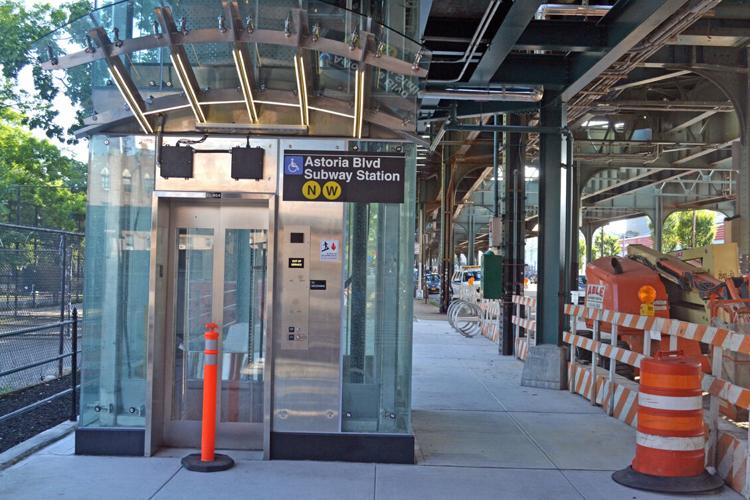
City Council Cronies give more tax breaks and zoning perks to developers if they build elevators for the MTA

https://bloximages.chicago2.vip.townnews.com/qchron.com/content/tncms/assets/v3/editorial/d/4b/d4b0f9a6-2d0a-11ec-9a04-c775a39b9215/6168595240dbe.image.jpg?resize=750%2C500

Queens Chronicle 

The Metropolitan Transportation Authority now will be enlisting private developers in its effort to make more subway stops handicapped accessible with a zoning change approved by the City Council on Oct. 7.

The Zoning for Accessibility initiative expands the areas where the city can offer incentives to developers of large projects near subway stations who allow easements for elevators, ramps or other accommodations.

When signed or enacted into law by mayoral inaction — Mayor de Blasio supports the bill — it will require developers of large projects that are adjacent to underground or elevated subway lines to consult with the MTA to determine if an access easement and infrastructure are needed.

In return, developers could receive one or more accommodations from the city, such as in increase in allowable density, more floor space, or partial relief from some zoning requirements for things like parking spaces, property line setbacks and landscaping.

In a statement from the MTA, acting Chairman and CEO Janno Lieber said the move will augment the accessibility projects already underway within the agency.

“This initiative reflects Gov. Hochul’s and the MTA’s shared commitment to all New Yorkers — particularly riders with mobility disabilities, seniors and parents of young children — to modernize the entire transit system as quickly and efficiently as possible,” he said. And the help is needed.

Only 136 of the city’s 493 subway stations, or 28 percent, are accessible. In Queens the total is 22 out of 80, or 27.5 percent. That includes the Court Square station, where the No. 7 line is accessible but the G is not; and Rockaway Park-Beach 116th Street, where the A train is accessible only during rush hours. The E and M trains at Court Square-23rd Street are only accessible for Manhattan-bound passengers.

The MTA’s five-year, $5 billion capital plan for 2020-24 includes elevators or other upgrades at 77 more stations, which in theory would leave a rider no more than two stations away from an accessible stop.

The MTA believes working with private developers will get more stations in compliance more quickly, with less strain on the MTA’s seemingly always-challenged budget.

“This is a game changer for millions of New Yorkers,” Council Speaker Corey Johnson (D-Manhattan) said in the press release.

Thursday, January 23, 2020

This post is for all you readers of Queens Crap that pay property taxes in this state

076
Gothamist


Governor Andrew Cuomo's latest pitch to expand Penn Station is an overflowing grab bag of promises to commuters and city residents to improve what the governor called in his budget speech yesterday the station’s “seven levels of hell”. The governor is proposing 40 percent more train capacity, airier concourses and unspecified new development in a "cohesive transit-oriented district." 

The plan also boasts an accordingly mammoth price tag: $8 billion to buy up an entire block of Midtown property, according to one estimate, most of which Cuomo hasn't yet identified specific funds for beyond the idea of siphoning off future retail rents and property taxes.

Meanwhile, sitting atop the now-buried train station is one of the state's biggest poster children for corporate tax giveaways: Madison Square Garden, which thanks to a state law passed at the behest of then-mayor Ed Koch in 1982 has now gone 37 consecutive years without paying property taxes. 

The total cost in lost revenue to the city over that time period is now $555 million, according to the latest calculations by the city's Independent Budget Office. If current property value trends continue, MSG's total tax break could clear $1 billion by 2030.

It's an alarmingly high figure, made even more so by the fact that the tax break, first proposed by Koch in order to encourage the Knicks and Rangers to renovate rather than moving to New Jersey, was, according to the mayor, initially supposed to end after just ten years. ("I went to bed at night believing it was a 10-year abatement," Koch told the Times years later.)

In the decades since, MSG's eternal tax break has become a white whale for budget reformers and enraged Knicks fans alike; possible repeal has become a recurring feature of IBO's annual budget options documents offering ways to saving the city money.

Asked for an explanation of the continued need for the tax break, a Madison Square Garden spokesperson provided this statement to Gothamist: "We appreciate that people have their opinions about our location, but the truth is that Madison Square Garden’s tax abatement pales in comparison to the billions in public benefits received by the other New York sports venues.”

 The decades-long inaction can partially be explained by the odd nature of the tax break: It's the city losing tax revenue as a result, but the city council has no say over state law. While the state legislature could repeal the law at any time, it's under little pressure to do so given that none of the money would go toward filling state budget holes.

And then, there is the considerable pressure the legislature is likely under from Cuomo, who has long counted MSG owner James Dolan and his family as major campaign donors, though that seems to be on the wane since they sold off Cablevision to Dutch telecom giant Altice for $17.7 billion in 2016. (Then-MSG business partner Irving Azoff did give $10,000 to Cuomo's reelection campaign in 2017, and MSG itself is a regular donor to both Democratic and Republican state legislative campaign committees.)


Monday, December 9, 2019

Hotel owners are profiting off of the homeless crisis


https://external-content.duckduckgo.com/iu/?u=https%3A%2F%2F2sei0v2s93y31n9ndy1lrzmh-wpengine.netdna-ssl.com%2Fwp-content%2Fuploads%2F2016%2F08%2FMaspeth-rally-web.jpg&f=1&nofb=1

NY Daily News


Owners of dozens of recently-built homeless hotels are saving millions of dollars on city taxes through an obscure rebate program that allowed them to hold on to $12.5 million in the 2018-2019 tax cycle.

Of the owners benefiting from the tax break — known as the Industrial and Commercial Abatement Program — the biggest winners include Sam Chang, Harshad Patel and Riverbrook Equities, according to a New York Hotel Trades Council analysis obtained and vetted by the Daily News.
Chang, for example, has built 49 hotels since 2006.

Of those, 14 have housed the homeless. Five have received ICAP rebates and saved approximately $2.3 million on their 2018-2019 tax bills, city records show.

Chang, who still retains ownership in one of the hotels, the Holiday Inn JFK, saved $791,323 in taxes for that property during the last tax cycle.

In all, 44 homeless hotels appear to have received both the ICAP rebate and homeless subsidies within the past four years, city records show. There are a total of 151 hotels that get ICAP rebates. From 2015 to 2019, homeless hotels that got the rebates saved more than $30 million.

All the while, owners like Chang and other operators who get the tax rebates are getting paid by the city to house the homeless. That money is routed to the hotels through homeless service “management companies,” which get the money directly from the city.

A spokeswoman for Chang’s McSam Hotel Group said the company has done nothing wrong.

“McSam Hotel Group complies with New York City laws, rules and regulations in building hotels. We never build hotels with the intent of housing homeless persons," spokeswoman Lisa Linden said. 

"McSam Hotel Group makes no decisions regarding whether homeless persons are housed in hotels. The management companies make those decisions.”

Harshad Patel said the rebate fulfills its mission of creating jobs and that critics are ignoring the big picture.

“It’s the only reason we are building,” he said. "We have a lot of expenses.”

The city projects it will spend $2.1 billion overall on tackling the homelessness crisis in 2020. In 2018, $384 million went from city coffers to housing homeless people in hotels. Less clear is how much of the city’s homeless budget is going specifically to hotels that already receive the ICAP rebate.

Whatever the cost, affordable housing advocates believe it’s a waste of taxpayer money.

“What the city needs to do is build housing to house the homeless,” said Cea Weaver, Housing Justice for All’s campaign coordinator. “It’s a better use of our resources. It’s better than paying hotel owners twice.”


Sunday, October 6, 2019

de Blasio draws up tax break for landlords following state overhaul of rent regulations

The Real Deal

 
Landlords are finally getting some love from the de Blasio administration.
The city is preparing a proposal to overhaul a tax break program, in part to make it more appealing to owners of apartment buildings.


Department of Housing Preservation and Development Commissioner Louise Carroll said the J-51 tax break needs to be “right sized” because the incentive hasn’t kept up with the market.

“We’re looking at the program holistically, both as to what would be an appropriate reimbursement for the work done, what would be an appropriate tax exemption to incentivize people to take it and what would be the right tax abatement so that the program works,” she said during a Crain’s event Wednesday.

It’s not clear what the city agency wants to change, but state legislation would be required. A representative for HPD said the proposal will aim to make the benefits “more targeted and cost-effective” for owners while making sure tenant protections are as strong as possible. The agency expects to deliver its proposal to the state Assembly at the start of the next legislative session.

The tax break, which is set to expire next year, is provided to landlords who renovate apartment buildings in exchange for their keeping units rent-stabilized for the duration of the benefit, which can be from 14 to 34 years. In a bill signed by the governor in July, state officials expanded the types of condo and co-op properties eligible for the benefit and extended the J-51 program through June 2020.

Monday, September 2, 2019

President Trump's Opportunity Zones program are just opportunities for him, his advisor Jared Kushner, real estate developers and oligarchs to take advantage of


New York Times

 President Trump has portrayed America’s cities as wastelands, ravaged by crime and homelessness, infested by rats.

But the Trump administration’s signature plan to lift them — a multibillion-dollar tax break that is supposed to help low-income areas — has fueled a wave of developments financed by and built for the wealthiest Americans.

Among the early beneficiaries of the tax incentive are billionaire financiers like Leon Cooperman and business magnates like Sidney Kohl — and Mr. Trump’s family members and advisers.
Former Gov. Chris Christie of New Jersey; Richard LeFrak, a New York real estate titan who is close to the president; Anthony Scaramucci, a former White House aide who recently had a falling out with 

Mr. Trump; and the family of Jared Kushner, Mr. Trump’s son-in-law and senior adviser, all are looking to profit from what is shaping up to be a once-in-a-generation bonanza for elite investors.
The stated goal of the tax benefit — tucked into the Republicans’ 2017 tax-cut legislation — was to coax investors to pump cash into poor neighborhoods, known as opportunity zones, leading to new housing, businesses and jobs.

The initiative allows people to sell stocks or other investments and delay capital gains taxes for years — as long as they plow the proceeds into projects in federally certified opportunity zones. Any profits from those projects can avoid federal taxes altogether.

“Opportunity zones, hottest thing going, providing massive new incentives for investment and job creation in distressed communities,” Mr. Trump declared at a recent rally in Cincinnati.
Instead, billions of untaxed investment profits are beginning to pour into high-end apartment buildings and hotels, storage facilities that employ only a handful of workers, and student housing in bustling college towns, among other projects.

Many of the projects that will enjoy special tax status were underway long before the opportunity-zone provision was enacted. Financial institutions are boasting about the tax savings that await those who invest in real estate in affluent neighborhoods.

Yeah, this has been done before, Hudson Yards, Pacific Park, that stupid mall in Staten Island, but that was through insider chicanery and machinating. This is now the law of the land that was once made for you and me.

Monday, March 18, 2019

Hudson Yards got twice as much tax subsidies as Amazon and their condos' property taxes are dirt cheap


6 Sq Ft

 The $20 billion, 28-acre Hudson Yards megaproject has been in the news recently as its official March 15 grand opening approaches. The New York Times reports that the nation’s largest residential development has gotten more than a little financial help from the city government to get there. In fact, public records–and a recent study by the New School–reveal that the development has received nearly $6 billion in the form of tax breaks and additional government assistance, twice the controversial $3 billion in incentives held out to Amazon to entice the retail tech giant to bring its second headquarters to Queens.


Where did $6 billion in taxpayer dollars go? Included in that tally were the $2.4 billion spent by the city to bring the 7 subway line to Hudson Yards; $1.2 billion was set aside for four acres of green space within Hudson Yards. The City Council kicked in $359 million to shore up interest payments on bonds when the development fell short of its revenue projections.

The point to be made is that the world’s most successful real estate developers–In this case Related 
 Companies and Oxford Properties Group–are among the biggest beneficiaries of generous government tax breaks, meant to encourage development.

Of the incentives given to the Hudson Yards project, defenders say they’ll reap an enormous benefit to the city in the form of thousands of new jobs created. The subway extension is definitely a boon, and who can argue with parks and improvements at what was for years a jumble of old factories, tenements and a stretch of rail yards once known as “Death Avenue.

But the city was lacking a subway stop on the far west side before the wealthy developers made it happen, and the counter-argument in both the case of Amazon and Hudson Yards is that big businesses with big profits at stake should pay their own way rather than getting government incentives–particularly tax breaks–sorely needed elsewhere.

The New School’s recent analysis, headed by Bridget Fisher and Flávia Leite, focuses on a particularly fortuitous property tax break that developers within the Hudson Yards area benefitted from which has cost the city more than $1 billion so far. This incentive can mean as much as a 40 percent discount for future developers in the area for as long as 20 years.


Thursday, February 7, 2019

Gianaris finds exploitative faults with President Trump's "Opportunity Zones" real estate investment program


https://cdn.vox-cdn.com/thumbor/z4uhXCISPo36ZVYgMnndecxz33A=/0x0:5549x3699/1200x0/filters:focal(0x0:5549x3699):no_upscale()/cdn.vox-cdn.com/uploads/chorus_asset/file/13456331/amazon_LIC_protest.jpg


NY Daily News


State Sen. Michael Gianaris’ war on Amazon has led the Queens lawmaker to target tax incentives tied to the Trump administration and meant to spark investment in poorer neighborhoods.


Gianaris, whose Queens district includes the Long Island City blocks being eyed for the company’s proposed new outpost, announced legislation on Wednesday that would eliminate state tax breaks for capital gains when investing in federal Qualified Opportunity Zones.


“What was intended to benefit investment in economically distressed areas is now being used to boost investment in very wealthy area,” Gianaris said. “It’s completely bastardized the intent of the program and turned it on its head.”

 The area around the waterfront site is one of 306 census tracts in the city that Gov. Cuomo recommended as “opportunity zones.” The Treasury Department signed off on the designations late last year.

The company is already in line for $2.8 billion in grants and tax breaks from New York state and the city. Lawmakers and labor leaders argue the company is not doing enough to earn the incentives.


Gianaris and other critics also contend separately that the Trump administration program provides deep tax cuts to companies investing in already gentrifying areas.

 Meanwhile, a poll, conducted by HarrisX on behalf of Amazon, found 69% of New Yorkers approve of the internet retailer coming to the city, with 19% opposed.