Showing posts with label stupid. Show all posts

Wednesday, January 7, 2026

Mayor Mamdani's housing advocate aide is a self-loathing racist

 https://pbs.twimg.com/media/G-BxGsTXEAA3Omi?format=jpg&name=medium

NY Post

Mayor Zohran Mamdani’s newly appointed tenant advocate called to “seize private property” and blasted homeownership as a “weapon of white supremacy” in a series of pro-Communist social media posts.

Cea Weaver, Mamdani’s new director of the city Office to Protect Tenants, made the statements and urged her followers to elect more Communists in several lecturing posts on her now-deleted X account that were unearthed by internet sleuths.

“Seize private property!” she said on June 13, 2018.

 She later doubled down on that in a mini-manifesto in August 2019.

“Private property including any kind of ESPECIALLY homeownership is a weapon of white supremacy,” she said then.

Weaver also pushed to “Elect more communists” in December 2017 — when a Harlem street corner was being renamed in honor of former Manhattan Rep. Vito Marcantonio, who was a Communist.

She also unloaded on law enforcement in a May 2020 rant that came during the furor over the death of George Floyd.

“Private property including any kind of ESPECIALLY homeownership is a weapon of white supremacy,” she said then.

 Without landlords how to do you build and maintain housing? You think the government is going to do it? Look at NYCHA [New York City Housing Authority complexes],” said Humberto Lopes, founder and CEO of the Gotham Housing Alliance.

“You put a system in place to destroy landlords. Why are you s–tting on us?,” he said.

Mamdani wants to freeze the rent on 1 million rent-regulated apartments — a move that would need signoff from the Rent Guidelines Board.

  NY Post

Mayor Zohran Mamdani is facing the first major crisis of his week-old administration as his newly appointed tenant advocate’s radical views were exposed — including once branding homeownership a “weapon of white supremacy” and calling on the government to “seize private property.”

The series of past inflammatory social media posts by longtime housing activist Cea Weaver — Mamdani’s director of the Mayor’s Office to Protect Tenants — unearthed this week sparked outrage and a warning from the Trump administration.

Assistant Attorney General for Civil Rights at the Department of Justice Harmeet Dhillon said the feds would be on alert for any potential violations tied to the Democratic Socialists of America member’s extreme views.

“We will NOT tolerate discrimination based on skin color,” Dhillon said in a Tuesday post on X. “It is ILLEGAL. [DOJ Civil Rights Division] is paying very close attention.”

Dhillon, in an interview with One America News, added that city government “should be on notice, they’re on high scrutiny.”

“We have several federal statutes that explicitly protect people of all colors and all different kinds of backgrounds and military status and so forth from the exact kind of land grabs and reallocation and redistribution that is being promised in New York,” she told the outlet.

Mamdani indicated Tuesday he was sticking by his DSA ally.

“We made the decision to have Cea Weaver serve as our executive director for the mayor’s office to protect tenants, to build on the work that she has done to protect tenants across the city, and we were already seeing the results of that work,” he told reporters following an unrelated news conference.

 It's very interesting that Mayor Mamdani insists on keeping Weaver with her history of inflammatory and ignorant tweets equating white supremacy and owning a house (maybe she should visit Jamaica, South Jamaica, Canarsie, Brownsville, Springfield Gardens or even South Richmond Hill to name a few) yet he sacked his director of operations for her John Rocker style racist tweets on riding the A train to Far Rockaway where Jewish people live. 

Looks like Mamdani is emulating his hero Bill De Blasio with the same kind of defiant hypocrisy he exhibited for 8 years. The dope from Park Slope has been succeeded by the Asswipe from Astoria.


Wednesday, November 5, 2025

Another four years of Queens Crap and beyond

Image

PIX News 

 New York City voters approved ballot proposals 2, 3, and 4, which are aimed at fast-tracking affordable housing developments, according to the Associated Press.

Over 50% of New York City renters and around 45% of homeowners pay more than 30% of their yearly salary toward housing, according to the Yes on Affordable Housing Coalition.

Proposition 2 creates two alternatives to the Uniform Land Use Review Procedure (ULURP), the seven-month process for determining how land is used. Not all land in the city goes through ULURP, but zoning changes like affordable housing “must go through public review and approval,” according to the Department of City Planning.

The proposition, which would fast-track affordable housing applications at the City Planning Commission (CPC) or Board of Standards and Appeals (BSA), effectively removes the City Council from the review process.

 Publicly financed affordable housing projects will now be subject to a 90-day review by the BSA, rather than the seven-month process. The CPC will review applications from the 12 communities with the lowest affordable housing rates in New York City within 30 to 45 days.

 Proposition 3 is meant to simplify the approval for smaller infrastructure projects by also keeping the City Council out of the review process. It would create an Expedited Land Use Review Procedure (ELURP), which would involve a 90-day review from the local community board, borough president, and CPC.


Proposition 4 establishes the Affordable Housing Appeals Board. Currently, the City Council has the final say in affordable housing projects, with only the mayor able to veto. The new board will have the power to veto the City Council. The borough presidents, City Council speaker, and mayor will all be on the board.

Advocates argue that removing the City Council from the process will help create more affordable, smaller housing quickly, especially in neighborhoods that lack it. Councilmembers, however, say that removing them from the process will give developers too much power and take away theirs.


Zopacalypse Now

https://pbs.twimg.com/media/G49VhOYWoAAsuRV?format=jpg&name=small 


In a historic victory, 34-year-old democratic socialist Zohran Mamdani was projected to become New York City’s 111th mayor on Tuesday night — the first Muslim candidate ever elected to the highest office in America’s largest city.

ABC and NBC called the NYC Mayor’s Race for Mamdani just after 9:35 p.m., with roughly 75% of the vote counted. With almost all precincts now reported, Mamdani had slightly over 50% of the vote (1,012,850) over independent former Gov. Andrew Cuomo, who nabbed 41.6% (837,398), according to unofficial results from the city Board of Elections. This election had a historic turnout, with more than 2 million votes cast — the highest number in a mayoral election since 1969. 

Republican nominee Curtis Sliwa, who remained in the race until the very end despite immense pressure from Cuomo and others to drop out, came in third place with 7.16% (144,123).

Mamdani will take office as mayor on New Year’s Day, succeeding Eric Adams, who dropped out of the general election amid low poll numbers in late September and had recently endorsed Cuomo. The mayor-to-be, currently a Queens Assembly member, will also be the second-youngest mayor in the city’s history; Hugh Grant, who served between 1889 and 1892, was the youngest in history, having entered office at just 31 years of age.


Wednesday, June 25, 2025

Socialist beats sociopath to win NYC mayoral democrat primary

Image

NY Post 

Dark-horse socialist candidate Zohran Mamdani staged a stunning upset Tuesday night by knocking off former Gov. Andrew Cuomo in the Democratic mayoral primary.

“Tonight we made history,” Mamdani told supporters at his victory party after midnight. “In the words of Nelson Mandela, ‘It always seems impossible until it is done.’ My friends, we have done it. I will be your Democratic nominee for the mayor of New York City.”

The 33-year-old Queens assemblyman defied polls and expectations as he notched a likely insurmountable 7-point lead over Cuomo, the three-term governor who hoped to make a political comeback after resigning in disgrace in 2021.

“Tonight is his night. He deserved it, he won,” a seemingly shell-shocked Cuomo, 67, said as he conceded to Mamdani.

The first round of the ranked-choice voting contest had Mamdani ahead with 43.51% of votes, followed by Cuomo’s 36.42% and city Comptroller Brad Lander’s 11.31%, Board of Elections unofficial results show. Mamdani carried roughly 432,000 votes to Cuomo’s 362,000, the results show.


The state lawmaker didn’t crack 50% of votes, so the contest will still be decided July 1 once the other rounds of ranked-choice votes are calculated.

But the first-round totals still put the avowed democratic socialist within sight of becoming New York City’s next mayor.

Cuomo conceded he lost the primary as he addressed his campaign’s watch party — and signaled he may not run in the November general election on an independent line, as widely assumed.

“Tonight was not our night,” Cuomo said, as he praised Mamdani’s grassroots campaign, which mobilized young, far-left voters with catchy campaign promises and slogans focusing on affordability.

“It’s affordability, stupid,” quipped longtime New York City political operative Kevin McCabe, in a reference to Bill Clinton, about the issue that decided the race.

A win by Mamdani is bound to have sweeping impacts beyond the Big Apple and signal the rising power of the Democrats’ progressive wing, especially over aging party stalwarts such as Cuomo.

His near-insurmountable lead hints he could be replicating what his backer and fellow progressive Rep. Alexandria Ocasio-Cortez did in 2018, as she ran as a charismatic outsider to topple entrenched Democrat Joe Crowley — only he did it across the whole city, a political veteran told The Post.

Cuomo could barely be seen actually on the campaign trail as he relied on his name recognition, backing of powerful unions and attacks against Mamdani’s thin legislative record and ample history of criticizing Israel.

The scandal-scarred ex-governor entered the race in March as the clear frontrunner, but saw his polling lead steadily chipped away by Mamdani, who waged a social media-friendly campaign heavy on proposed freebies — which he plans to pay for by hiking taxes on billionaires and businesses.

“He should’ve learned a lesson from the terrible, Rose Garden race that Joe Crowley ran against AOC. Like Crowley, Cuomo was arrogant and grossly underestimated his opponent,” said Democratic operative Ken Frydman.

Tuesday, May 13, 2025

Mayor Adams approves pedestrian path on Queensbridge for the few people that walk on it

 https://www.amny.com/wp-content/uploads/2024/10/DSC_6740.jpg?quality=31&resize=1200,800

 AMNY

City officials told amNewYork on Tuesday that cyclists and pedestrians will finally have their own lanes on the Ed Koch-Queensboro Bridge, ending a years-long controversy that had the two groups sharing a narrow path on the vehicle-heavy span.

Starting May 18, the north outer roadway of the Queensboro Bridge will be used exclusively for cyclists, and the south outer roadway, which is currently a vehicle lane, will become a dedicated space for pedestrians. 

The Queensboro Bridge, which connects Queens to Midtown, is the only city-owned bridge above the East River without separate paths for pedestrians and cyclists. Currently, the north outer roadway of the bridge is a shared space that crushes both pedestrians and cyclists together in a tight, 11-foot lane.

Advocates (aka lobbyists) have fought to open a separate pedestrian path, citing dangerous overcrowding that has led to conflicts among cyclists, pedestrians and micromobility users. Manhattan Community Board 6 even passed a resolution in October calling on the NYC Department of Transportation (DOT) to open the path without delay and “without regard to delays of construction,” which was being done on the bridge’s upper level last  year. 

However, once the south outer roadway opens for foot traffic, the bridge’s pedestrian and cycling space will double while eliminating space for vehicles. 

he new pathway was supposed to open sooner but Mayor Eric Adams, at first, delayed the celebration to ensure he and his team were fully briefed, and the new layout did not negatively impact traffic, a City Hall spokesperson explained. 

The double-decker Queensboro Bridge was built in 1909. Adams cited the span’s history by saying it has connected New Yorkers between Manhattan and Queens for 100 years while offering “breathtaking views” of the cityscape. 

“Now, our administration will make it even easier and safer to do so,” Mayor Adams said. “The more we make it safe to walk and bike, the more people utilize their bikes, and thanks to new cycling infrastructure in communities near the bridge, more and more pedestrians and cyclists are utilizing the Queensboro Bridge. Today’s announcement doubling the space available for pedestrians and cyclists builds off those upgrades and is a win-win for everyday New Yorkers.”

Tuesday, April 8, 2025

City of Lithium-Ion

 Image

Crain's New York 

The city is giving landlords the ability to generate some extra cash by installing outdoor battery charging stations in front of their buildings and charge a fee for bikers to access the amenity. 

 The Department of Transportation on Monday launched an application process for building owners to install e-bike battery charging and swapping cabinets on public sidewalks outside of their properties. 

The idea is for landlords, or their ground-floor retailers, to offer tenants and the delivery workers most city eateries rely on, greater access to outdoor e-bike battery charging, instead of risking lithium-ion batteries sparking deadly fires inside businesses and apartments.

 In 2024, lithium-ion batteries ignited 279 fires and killed six people, FDNY data shows. The fires are tied to the city’s delivery economy boom and its workers’ reliance on inexpensive, uncertified electric bikes and mopeds. DOT Commissioner Ydanis Rodriguez said in a statement that the effort seeks to make safe charging infrastructure more accessible to curb fire safety concerns, while giving private property owners the perk of monetizing public space to better serve their tenants. “We need to do our part to ensure charging is safe and accessible,” said Rodriguez. 

 Building owners can charge bikers a fee to access the cabinets, but the Transportation Department hasn’t worked out potential restrictions for such fees, according to the agency. One e-bike cabinet company, the Berlin-based Swobbee, that the city is partnering with to add the infrastructure on sidewalks says it plans to charge a maximum of $2 a day for an unlimited number of battery swaps.

  A landlord or ground-floor tenant in a building with an eatery, shop or community space, or with five or more apartments, can apply for permission to bolt the skinny, vending-machine size metal cabinets to the sidewalk, which are lined with lockers that store and juice up batteries. Building owners interested in applying can contact DOT to obtain a permit at revocableconsents@dot.nyc.gov.

Friday, February 21, 2025

Sanction City

  Image

Patch

On Tuesday, Hochul met with Rev. Al Sharpton, Queens Borough President Donovan Richards, Council Speaker Adrienne Adams and Comptroller Brad Lander at her Midtown office to discuss the mayor. 

Gov. Kathy Hochul is poised to implement legal sanctions on Mayor Eric Adams and has decided against removing the mayor from office for now.

Proposed sanctions are expected to include legal limits on the mayor's power as an executive and could include an ethical watchdog to sure the mayor is acting ethically.

The governor is drafting legislation that would need City council and state legislature approval, according to reports.

Hochul could release the sanctions against the mayor later today.

In addition, the governor could unveil new state and city bills that would increase oversight of the mayor’s office. That includes creation of a new state deputy inspector general with authority to watch over the city’s dealings, according to the report.

Lander has called on Adams to form a plan to stabilize the government by Friday. If not, Lander said he would convene an Inability Committee, which would determine Adams' fitness for office, and could have the power to remove him, Patch previously reported.

The news on the sanctions was first reported by NY1 and FOX5 New York.

State law gives Hochul the ability to remove certain local officials, including mayors. It requires the governor to provide the mayor with a copy of the charges he’s facing and due process to defend himself.

Hochul could also suspend the mayor for 30 days during that time.


Friday, January 31, 2025

MTA screws over bus commuters, approves Queens routes redesign


 mta

QNS 

The MTA board approved a new Queens bus network redesign on Wednesday that aims to provide better service with faster commutes — but also fewer bus stops.

The $35 million network overhaul includes the addition of 11 more local routes, bringing the total number of bus routes in the borough to 124 (up from 113). Seventeen existing routes will also run with increased frequencies, while eight routes will get increased service spans.

Another major highlight is the addition of “rush routes.” These new lines would operate similarly to subway routes in which some trains run locally for a few miles before switching to express service toward major destinations.

The MTA will add 25 rush routes to the bus network as early as this summer, with full implementation by Labor Day. Details on how they will operate — including time of day and days of the week — are still being finalized. But MTA officials said the swift service would be a game changer for many Queens straphangers, especially those with two-step commutes. 

The agency has been working on a bus redesign since 2019 to accommodate the borough’s changing population and ridership. More than 800,000 commuters ride the buses in Queens each day.

“It represents a generational opportunity to redesign the bus network in a borough that is nearly the size of Chicago,” said Chris Pangilinan, NYC Transit’s chief of operations planning. “We have not had the opportunity in many decades to redesign it, despite the growth that is happening in the borough and in the city.”

Pangilinan added that the increases in service, including weekend service, will support changing travel patterns in the borough.

“New types of routes, routing changing and increased frequencies, increased spans of service and more weekend service recognizing that people’s travel patterns have changed over the last many decades, especially over the last five years,” he said. “We need to be able to have a new bus network that serves people.

However, the redesign will eliminate some bus stops to speed up travel time, creating further distances between existing stops—a potential problem for New Yorkers with mobility issues. 

The Q110, for example, which runs on Jamaica Avenue East, will be rerouted and experience “minor stop balancing”. That means there will be nearly 1,400 feet between stops compared to the previous 752 feet of space. 

The bus will be rerouted and extended along Jamaica Av/Jericho Tpke to the existing Q36 terminal in Queens. Q110 service along Hempstead Av will be discontinued and replaced by the new Q82. 

Many passenger and disability advocates expressed serious concern about this and other changes. 

Jack Nierenberg, vice president of Passengers United, said eliminating bus stops will create “barriers to access” for many disabled New Yorkers and seniors who might have mobility issues. 

“The MTA is just shifting bus routes around. Most concerning to us is the elimination of nearly 1,800 bus stops, which was increased from the 1,400 that were proposed in the 2023 plan. The MTA is touting that this will speed up the buses, but what it really does is create barriers to access for senior citizens, people with disabilities, and other mobility issues who can’t necessarily walk farther to get to the bus stops.”

Niernberg added that he and others in his organization studied the redesign documents and said the needs of vulnerable New Yorkers were not considered. 

“The MTA needs to reconsider their bus stop eliminations,” he said. 


Friday, December 6, 2024

The City of Yes, Mess and Less Affordable Housing is complete

 https://pbs.twimg.com/media/GeGys99W8AAi4Ox?format=jpg&name=small

AMNY 

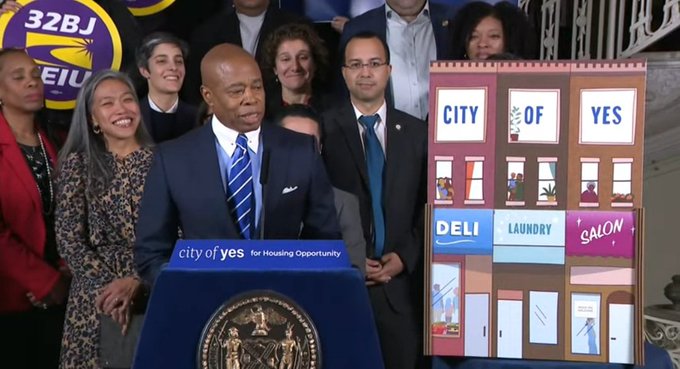
A compromise version of Mayor Eric Adams’ zoning overhaul aimed at easing the city’s dire housing crisis squeaked through the City Council on Thursday, clearing its final hurdle to become law.

The mayor’s “City of Yes for Housing Opportunity” plan, a suite of proposals that promises to allow for “a little more housing in every neighborhood,” passed the 51-member chamber by a slim 31-20 votes on Dec. 5. The city estimates the plan will spur the construction of 82,000 new housing units over the next 15 years, down from the 109,000 homes it was projected to produce before the council’s modifications were made.

All that remains is for Adams to sign what will likely be his greatest signature accomplishment as mayor thus far into law.

Adams, during a City Hall rally on the heels of the vote, compared his administration to the 1986 Mets team that won the World Series.

“We’re gonna argue in the locker room, we’re gonna get in debates, we’re going to do all sorts of things, but you know what? We’re gonna bring home the championship ring,” Adams said. “That’s what we did…You’re seeing the most comprehensive housing reform in the history of the city.”


City Council Speaker Adrienne Adams, following several council members’ impassioned speeches for and against the plan, said the body “cannot do nothing” about the city’s dire housing crisis. She also emphasized that the modified version of the zoning text amendment hashed out by the council is far better than what the mayor initially proposed.

“This council cannot be the body that says ‘no’ to people that need a place to live,” Speaker Adams said in an emotional speech. “This cannot be the council that turns their back on homeless; this cannot be the council that continues to say ‘scrap it, let’s move ahead and do something else,’ because I tell you that will never happen.”


The plan consists of a series of updates to city zoning rules that have not been changed in over half a century. It’s designed to expand the amount of housing that can be built in parts of the Big Apple that typically do not see much development.

The zoning changes only narrowly passed the city legislature even after they were altered last month to assuage many council members’ concerns about them potentially altering the character of the neighborhoods they represent. The final deal between City Hall and the council also includes a $5 billion commitment from Adams’ office and Gov. Kathy Hochul to fund affordable housing construction, housing affordability programs, infrastructure improvements, and more staff for city housing agencies.

Several council members acknowledged that the modifications addressed their concerns and got them to a “yes.” 


The lawmakers who voted against the City of Yes included every member of the chamber’s conservative Common Sense Caucus, some Democratic members representing low-rise outer-borough neighborhoods, and one progressive who saw the plan as a giveaway to developers.

City Council Member Joann Ariola (R-Queens) said her “no” vote was driven by her constituents’ concerns that City of Yes would change the character of their neighborhoods. She also expressed concerns that the infrastructure in her district, which covers coastal areas in the Rockaways, will not be able to support the added housing that would come with the plan.

“The city of yes will only add to the heavy burden that residents face every day,” Ariola said. “We don’t have the infrastructure and I know the mayor has promised money for infrastructure. But why are we putting the cart before the horse? Why are we putting the housing up and then worrying about the infrastructure?”

David Carr, a Republican council member representing Staten Island, who also voted “no,” said he believes the plan is “incredibly vulnerable to legal action” and “will not survive” such action, which could be forthcoming.

Progressive Council Member Christopher Marte (D-Manhattan) said he voted against the plan because it is a “yes to only the real estate developers.”

Update:

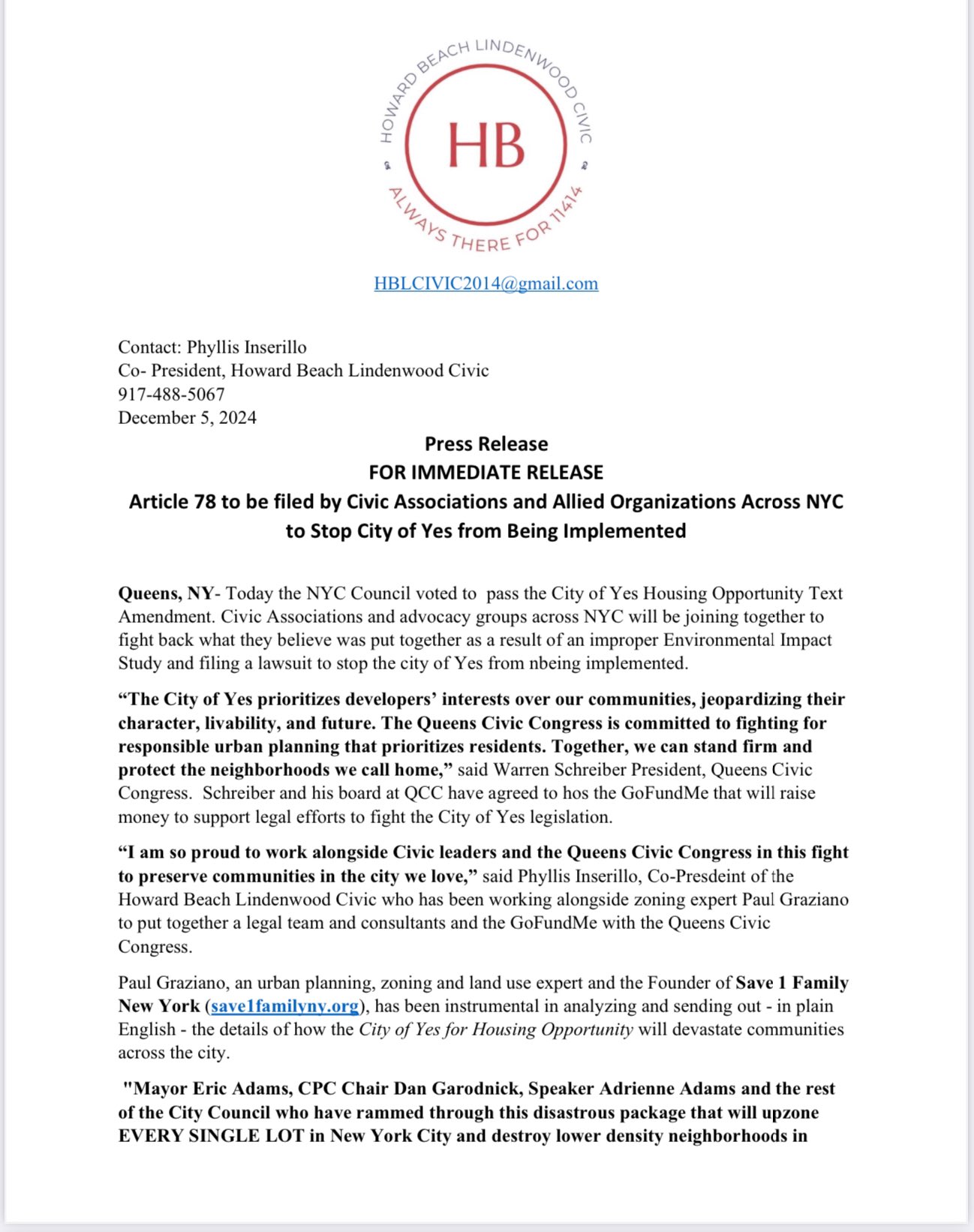
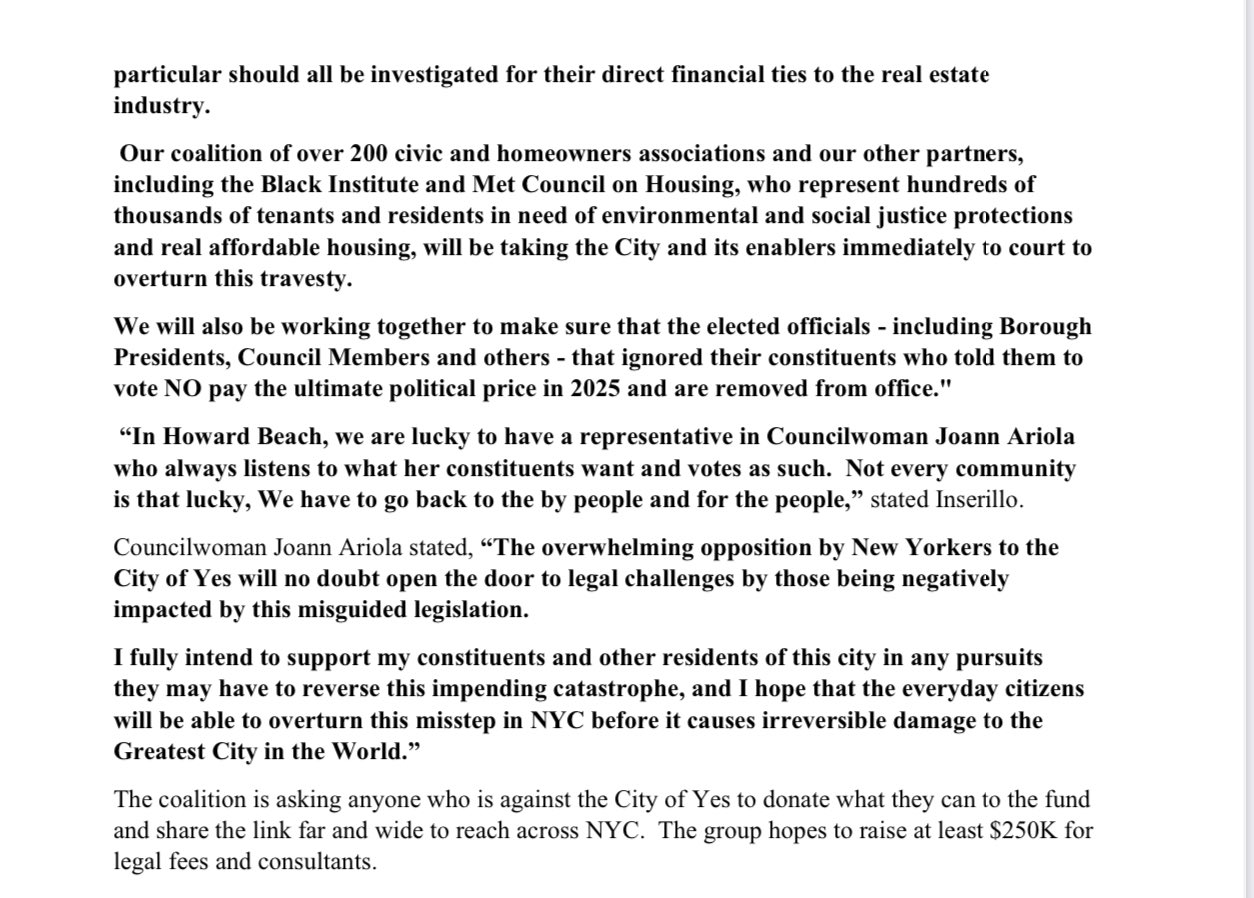
The lawsuit against the City Of Yes is about to begin. Donate to their gofundme to put a stop to this real estate land and air grab.

  https://d2g8igdw686xgo.cloudfront.net/84587211_1733340869119268_r.


We need your support to cover legal fees, compliance costs, and expert consultations as we oppose the City of Yes rezoning plan. This sweeping proposal threatens to undermine our neighborhoods, eliminate public input on critical land use decisions, and promote unchecked overdevelopment and excessive density.

The City of Yes is a giveaway to developers at the expense of our communities’ character, livability, and long-term sustainability. With your help, we can push back and ensure responsible urban planning that prioritizes people, not profits.

Your donation will empower us to make our voices heard and protect the future of our neighborhoods. Join us in this fight—every contribution counts!

 ImageImage


Tuesday, June 25, 2024

NYC Planning wants a little more upzoning on Sutphin


 Queens Chronicle

The Department of City Planning provided residents an online refresher course about zoning ahead of a Zoom town hall about proposed reforms of Downtown Jamaica and parts of Hollis, last Thursday.

During the Jamaica Neighborhood Plan Town Hall, people had questions about what will be developed in the area and if its needs will be met with the plan.

DCP agency reps said they hope to get more feedback from community members regarding the rezoning. The initiative would transform Jamaica Center, the downtown area where straphangers catch the E, J and Z trains, along with nearby regions stretching to the Jamaica and Hollis Long Island Rail Road stops to Hillside Avenue in the north and the Van Wyck Expressway to the west. Last Thursday’s event was designed to lay the groundwork for an environmental review of the plan. The proposal also calls for rezoning sections of Dunkirk and 160th streets and Merrick, Sutphin and Guy R. Brewer boulevards, according to DCP. There will be no zoning changes to single- or two-family areas, said Shavvone Jackson, a DCP representative.

More than 200,000 people who live, work or go to school in and around Downtown Jamaica would be impacted by the rezoning of the area, said DCP Borough Planner Alisa Nurmansyah, using data from the 2020 Census.

“Zoning is a set of rules that control how land in a community can be used,” said Jasmin Tepale, the senior program manager at DCP, who is overseeing the Jamaica rezoning plan. “It tells us what you can build and where you can build it ... this includes the type of uses you see in a neighborhood like residential or commercial zoning ... and what a building looks like and how tall it can be.”

The three main types of zoning districts include residential, commercial and manufacturing, or R, C and M zoning districts. R1 is a low-density residential district, while R10 is a high-density district.

The purpose of the rezoning plan is to build up Downtown Jamaica, which consists of mostly two- to six-story homes and residential, commercial and manufacturing buildings to create eight- to 16-story buildings to address the growing population and low housing production in the area, according to the DCP presentation.

Data from the American Community Survey, released in 2022, said that from 2010 to 2020, Jamaica’s population increased by 13.4 percent, higher than the rest of the city, which grew by 7.7 percent. Housing production in the area increased by 10.1 percent while housing production in the city grew by 7.3 percent, which is closer to the citywide population increase, according to DCP.

Profiles of Queens Community District 12 (Jamaica, Hollis and St. Albans) said the population was approximately 225,900 in 2010 and 248,158 in 2022.

U.S. Census data said that the city’s population was 8,804,190 on April 1, 2020. A World Population Review census said the city’s population decreased to 7,931,147, but is expected to be around 9 million by 2040, according to a Fox News report on March 28.

Blossom Ferguson, one resident who was on the Zoom call, asked if any of the housing will be available to people with low incomes.

A city Housing Preservation & Development spokeswoman said that if an area is mapped for mandatory inclusionary housing, its required that a share of new housing will be permanently affordable. If a developer comes in to erect a building with more than 10 units, a percentage of them must be permanently affordable.

“Do you plan on having condos or co-ops?” Ferguson asked. “Is that already established or still in the works?”

Tepale said that based on previous feedback, many seniors who would like to leave their single-family home have expressed interest in still owning property, and condos and co-ops are something that can be created in residential zones, along with other housing types.

Lisa Edwards, another resident, said that she believes the whole rezoning plan is simply gentrification and that the whole process for the initiative is undemocratic.

“This has not been properly publicized,” Edwards said. “It does not allow for community members to hear each other’s voices and discuss.”

Jackson, who spoke during the zoning refresher, said there are 38 people on the steering committee, 26 meetings were held and that DCP has reached out to more than 2,000 people since May 2023.

“We are going to continue to create opportunities for people to engage in this process,” Jackson said.

Tuesday, June 18, 2024

Motorcycle mayhem terrorizes residents at the 34th ave open streets in Jackson Heights

Not much has been written about what a disaster these open streets have turned into and it's easy to see why. Council member Shekar Krishnan held a sham town hall about this and it mostly was about preserving the open streets than stopping the "traffic violence" that goes on there every day and night.

The Department of Transportation Alternatives is holding a survey for these dangerous open streets tonight in the hopes they will get 88 million dollars to turn those 25 blocks into an official fake park.

Thursday, April 4, 2024

NYC Crapbot

  https://dims.apnews.com/dims4/default/6efa269/2147483647/strip/true/crop/5760x3838+0+1/resize/980x653!/format/webp/quality/90/?url=https%3A%2F%2Fassets.apnews.com%2F33%2F02%2F7427a99c25a983899edb6ffbdf88%2F280c4d10ba4446028e53f84ac24ff5a5


Associated Press

 An artificial intelligence-powered chatbot created by New York City to help small business owners is under criticism for dispensing bizarre advice that misstates local policies and advises companies to violate the law.

But days after the issues were first reported last week by tech news outlet The Markup, the city has opted to leave the tool on its official government website. Mayor Eric Adams defended the decision this week even as he acknowledged the chatbot’s answers were “wrong in some areas.”

Launched in October as a “one-stop shop” for business owners, the chatbot offers users algorithmically generated text responses to questions about navigating the city’s bureaucratic maze.

It includes a disclaimer that it may “occasionally produce incorrect, harmful or biased” information and the caveat, since-strengthened, that its answers are not legal advice.

It continues to dole out false guidance, troubling experts who say the buggy system highlights the dangers of governments embracing AI-powered systems without sufficient guardrails.

“They’re rolling out software that is unproven without oversight,” said Julia Stoyanovich, a computer science professor and director of the Center for Responsible AI at New York University. “It’s clear they have no intention of doing what’s responsible.”

In responses to questions posed Wednesday, the chatbot falsely suggested it is legal for an employer to fire a worker who complains about sexual harassment, doesn’t disclose a pregnancy or refuses to cut their dreadlocks. Contradicting two of the city’s signature waste initiatives, it claimed that businesses can put their trash in black garbage bags and are not required to compost.

At times, the bot’s answers veered into the absurd. Asked if a restaurant could serve cheese nibbled on by a rodent, it responded: “Yes, you can still serve the cheese to customers if it has rat bites,” before adding that it was important to assess the “the extent of the damage caused by the rat” and to “inform customers about the situation.”

A spokesperson for Microsoft, which powers the bot through its Azure AI services, said the company was working with city employees “to improve the service and ensure the outputs are accurate and grounded on the city’s official documentation.”

At a press conference Tuesday, Adams, a Democrat, suggested that allowing users to find issues is just part of ironing out kinks in new technology.

“Anyone that knows technology knows this is how it’s done,” he said. “Only those who are fearful sit down and say, ‘Oh, it is not working the way we want, now we have to run away from it all together.’ I don’t live that way.”

Stoyanovich called that approach “reckless and irresponsible.”An artificial intelligence-powered chatbot created by New York City to help small business owners is under criticism for dispensing bizarre advice that misstates local policies and advises companies to violate the law.

But days after the issues were first reported last week by tech news outlet The Markup, the city has opted to leave the tool on its official government website. Mayor Eric Adams defended the decision this week even as he acknowledged the chatbot’s answers were “wrong in some areas.”

Launched in October as a “one-stop shop” for business owners, the chatbot offers users algorithmically generated text responses to questions about navigating the city’s bureaucratic maze.

It includes a disclaimer that it may “occasionally produce incorrect, harmful or biased” information and the caveat, since-strengthened, that its answers are not legal advice.

It continues to dole out false guidance, troubling experts who say the buggy system highlights the dangers of governments embracing AI-powered systems without sufficient guardrails.

“They’re rolling out software that is unproven without oversight,” said Julia Stoyanovich, a computer science professor and director of the Center for Responsible AI at New York University. “It’s clear they have no intention of doing what’s responsible.”

In responses to questions posed Wednesday, the chatbot falsely suggested it is legal for an employer to fire a worker who complains about sexual harassment, doesn’t disclose a pregnancy or refuses to cut their dreadlocks. Contradicting two of the city’s signature waste initiatives, it claimed that businesses can put their trash in black garbage bags and are not required to compost.

At times, the bot’s answers veered into the absurd. Asked if a restaurant could serve cheese nibbled on by a rodent, it responded: “Yes, you can still serve the cheese to customers if it has rat bites,” before adding that it was important to assess the “the extent of the damage caused by the rat” and to “inform customers about the situation.”

A spokesperson for Microsoft, which powers the bot through its Azure AI services, said the company was working with city employees “to improve the service and ensure the outputs are accurate and grounded on the city’s official documentation.”

At a press conference Tuesday, Adams, a Democrat, suggested that allowing users to find issues is just part of ironing out kinks in new technology.

“Anyone that knows technology knows this is how it’s done,” he said. “Only those who are fearful sit down and say, ‘Oh, it is not working the way we want, now we have to run away from it all together.’ I don’t live that way.”

Stoyanovich called that approach “reckless and irresponsible.”

Monday, April 1, 2024

More invasion of the house squatters


Daily Mail

These are the latest victims of New York's 'insane' housing laws that have given way to a wave of absurd squatting incidents where homeowners find themselves forced to go to court to kick out brazen would-be tenants. 

Denis and Juliya are a married couple who invested $530,000 in a property in Jamaica, Queens, several years ago. 

On March 5, a broker they were working with visited the property for a site check before allowing tenants to move in and found the locks had been changed. 

Inside the property was Lance Hunt Jr. and Rondie L. Francis, who had set up mattresses, a flat screen TV and a massage table. The men claimed to have legally leased the property months earlier and refused to leave. 

Now, the homeowners are locked in a legal battle with the pair after the alleged squatters hired an attorney to sue them. 

An emergency lockout hearing was held on Friday March 22 at Queens County Civil Court after the squatters' attorney, Dennis Harris served the couple, the realtor and the real estate company. 

During the 1pm hearing, Rizpah Morrow, who is representing the homeowners asked Judge Vijay M. Kitson for a trial on the grounds that the two men acted in an unlawful manner.

'They perpetrated a fraud,' Morrow told the judge.

The judge told her that she is entitled to a trial, and said 'let them come to court and testify.'

But when the judge asked their attorney where his clients were, Harris told the judge one of them 'had to go to work.'

At this point Ejona Bardhi, the real estate broker with Top Nest Properties, who was also representing the homeowners in court, intervened and told the judge, 'he left because he did not want to get arrested.' 

Denis and Juliya asked the judge if their new tenants could move in before the next court date. The judge agreed but warned them it may complicate the case. The next court date is April 5. 

After the hearing was adjourned and the chambers doors were closed, Lance Hunt, Sr., the father of the second alleged squatter Lance Hunt, Jr., who told DailyMail.com his name was Michael, walked into the court house. 

He tried to enter the judge's chambers but the court officers told him the session had ended for the day. 

Denis told DailyMail.com he is outraged by what is taking place. He said that he and his wife had to take off a day of work and spend $4,000 on an attorney fees.

'I'm being sued for illegal lock out, and for damages. They uploaded fake documents and they have an attorney and notary that are working with them to scam innocent homeowners in Queens,' he said.

'They are targeting empty homes especially the ones listed on the market and the home owners are not protected. 

'I intend to pursue them criminally as well as start a class action lawsuit against the city for failing to protect us.' 

He added: 'This has to be stopped.'

Denis on the phone waiting for the court hearing to start as Rondie L. Francis, one of the alleged squatters, stands behind him 

Bardhi said she first noticed that one of the locks had been changed on the doors on March 1. At first she assumed it may have been done by the former management company, until they told her they did not touch the locks,

When Bardhi went back to the property on March 4, she noticed the other set of door locks had also been changed, and then saw a dark figure in the window.

'I saw a man wearing a black hoodie holding a drill in his hand,' Bardhi recalled.

Alarmed she called police and the homeowners and waited in her car for officers to arrive. While she waited, she noticed more men emerge. She said they started circling her car that was parked in front of the Lakewood Avenue property.

‘They were trying to intimidate me,' she said. 'It was bizarre.'

When police arrived the men told them it was their property and they had been living there since January. Bardhi disputed their claims and said she was just at the home a day prior with a housing inspector.

When officers asked the men for proof of residency, they did not have anything to show, but told the cops they were YouTubers, and left peacefully.

Once they were out, Bardhi and the homeowners were going to place new locks on the door, but the officers told them if they do they will get arrested. 

Upon learning that Bardhi and the homeowners said they were 'enraged' 

She told DailyMail.com: 'The police tells us that they have rights that was the ridiculous part.'


Saturday, March 30, 2024

You will take the train and you'll like it


Queens Eagle

After years of debate over one of New York City’s most controversial political topics, the MTA officially passed its final congestion pricing plan on Wednesday morning.

Initially passed by the state legislature in 2019, congestion pricing will add a toll for drivers heading into lower Manhattan south of 60th Street. The MTA, Mayor Eric Adams, Governor Kathy Hochul and other advocates hope the program will inject funding into the MTA’s public transit services and cut down on emission-emitting congestion in the busy borough.

But even with the MTA’s final vote, ongoing legal challenges from the governor of New Jersey, the teacher’s union and outer borough officials remain in the courts. Additionally, a handful of elected officials, including many in Eastern and Central Queens, remain frustrated with the program they claim will unfairly tax their car-dependent constituents.

The MTA board passed congestion pricing by an 11-1 vote on Wednesday – the only downvote coming from Long Island representative David Mack – and is the final stop on the plan’s path to implementation, which the MTA expects to happen in mid-June.

“Today’s vote is one of the most significant the board has ever undertaken, and the MTA is ready,” said MTA Chair and CEO Janno Lieber. “New York has more traffic than any place in the United States and now we're doing something about it.”

According to the MTA, passenger vehicles and small commercial vehicles – sedans, SUVs, pick-up trucks and small vans – paying with a valid E-ZPass will be charged $15 during the day and $3.75 at night, when there is less congestion, to enter the “congestion relief zone.” They will be charged once a day, regardless of how many times they enter or exit the area.

Trucks and some buses will be charged a toll of $24 or $36 during the day to enter the area, depending on their size and function, and $6 or $9 at night. Motorcycles will pay $7.50 during the day and $1.75 at night.

With congestion pricing’s implementation almost guaranteed, recent debates over the program have revolved around who would receive discounts or exemptions from the toll.

Yellow taxi, green cab and black car passengers will pay a $1.25 toll for every trip to, from, within or through the zone, and people taking ride-shares like Uber or Lyft will have $2.50 tacked on to their fee.

Qualifying emergency vehicles and qualifying vehicles carrying people with disabilities will be totally exempt, as will school buses, buses providing scheduled commuter services open to the public, commuter vans licensed with the NYC Taxi and Limousine Commission and specialized government vehicles.

Several officials and electeds celebrated the MTA board’s vote on the plan that many hope will bring help to the city’s transit riders, the environment and those who do need to drive to the city with less traffic in lower Manhattan.

“After nearly five years of gridlock, the MTA board finally paved the way for congestion pricing in New York City,” said city Comptroller Brad Lander. “Congestion pricing will ease traffic, cut carbon emissions and provide our beleaguered transit system with the resources it needs to modernize signals, boost accessibility, and serve more riders.”

Local Queens officials, like Western Queens Assemblymember Zohran Mamdani also celebrated the toll’s passage, but said he wanted to see the MTA meet the goals of bettering transit service for outer borough residents.

“The promise of congestion pricing has long been to transform our city’s public transit,” Mamdani said in a statement. “Congestion pricing cannot just make it more expensive for New Yorkers to drive: instead, we must deliver on this promise for New Yorkers by making public transit more frequent, reliable, and affordable from the very first day of the toll.”

Mamdani is currently pushing for his “Get Congestion Pricing Right” plan, which includes a $90 million infusion for buses to get into the final state budget next week.

On Wednesday when asked about the legislator’s plan, Lieber said the MTA is “always happy to increase service.”

However, not everyone is ready to pay the fare, including some Queens officials who argue the toll will be at the disadvantage of drivers in the World’s Borough who will have to routinely pay the toll to get to work.

"The MTA Board's approval of congestion pricing is a blatant assault on every New Yorker who's already struggling to get by,” Councilmember Bob Holden said in a statement. “It's a disgusting cash grab that punishes our most vulnerable — those with no choice but to commute from transit deserts.”

Although Holden’s office did not reply to follow-up questions, the Common Sense Caucus co-chair said that more legal challenges for congestion pricing could be on the horizon.

“This isn't just a policy failure; it's an act of war on the working class,” he said. “Mark my words: we're taking this fight straight to the courts. See you there."

Holden, who is already signed onto a lawsuit against congestion pricing, argued that the MTA pushed the plan through without conducting an environmental review or public input processes.

“They control this whole process,” Holden said. “The MTA is a fraudulent authority, and they wanted to do this so they rubber stamped it through and again, we're going to blame anybody that was for this, including the governor, we're gonna blame them and they might have a tough time next time when they're running for office.”

Queens Assemblymember David Weprin has long been a challenger of congestion pricing, and is a co-plaintiff on one of the two lawsuits looking to slow its implementation.

“It is a sham,” said Weprin. “Any testimony was all a show. We knew the foregone conclusion before the vote, and I don't think it's fair.”


Monday, February 19, 2024

Transportation Nihilists and Delinquents

Image

NY Post 

 Two of the Big Apple’s top transportation honchos — known for talking tough at traffic scofflaws — need speed themselves, data reviewed by The Post reveals.

Department of Transportation Commissioner Ydanis Rodriguez and his baby mama Christina Melendez, a top director at the Department of Education, have racked up a staggering 66 traffic violations totaling at least $5,600 in fines the past decade using the same vehicle – including 14 since 2019 for speeding in school safety zones, according to city records.  

The chair of the City Council’s Transportation Committee, Councilwoman Selvena Brooks-Powers (D-Queens), has cruised in a family car that racked up 25 tickets over the past 16 months, including 20 for speeding near schools and another for blowing a red light, records show. 

 It’s unclear how many of the summonses were handed out on Melendez’s Nissan Rogue when Rodriguez was behind the wheel. 

As DOT commissioner for the past two years, he’s enjoyed the perk of having a city vehicle that comes with an assigned driver.

“Ydanis Rodriquez, who gets chauffeured in a giant SUV, and Selvena Brooks-Powers are prime examples of ‘do as I say, not as I do,'” fumed Councilman Robert Holden (D-Queens).

They’re “hypocrites who act as if laws don’t apply to them,” he added. 

Other lefty pols with a long history of being speed demons who’ve racked up plenty of traffic violations include Comptroller Brad Lander, Public Advocate Jumaane Williams, and Manhattan Borough President Mark Levine.

Rodriguez regularly drove Melendez’s Nissan to work at City Hall when he was a Manhattan councilman — even obtaining a parking placard for it — but he and his former domestic partner, who share two daughters, have since split, according to sources. 

The vehicle was slapped with six speeding tickets during the final five months leading up to Rodriguez’s January 2022 appointment by Mayor Adams as DOT commissioner.

Since then, the Nissan has received six parking tickets – including two for misusing a parking permit—and was caught speeding in July and November of last year.  

On March 2, 2023, the vehicle was slapped with two tickets totaling $160 for illegally parking in a spot in lower Manhattan on Warren Street reserved for state senators and assembly members.

The traffic agent noted in the tickets that the car was flashing a Department of Education parking permit. Melendez works nearby as the DOE’s $195,000-a-year executive director of Family and Community Engagement.

A Post photographer on Thursday spotted Melendez getting into the vehicle, which was illegally parked 

Rodriguez, who has cheered congestion pricing and speed cameras and has helped promote City Hall’s anti-car agenda, earns $243,171 and now gets a free ride to work in a city vehicle.

He has not driven his ex’s car since being appointed commissioner two years ago “and is confident he has not received any [traffic] violations in this role,” said DOT spokesman Vincent Barone.

The DOE and Melendez declined to comment.

Brooks-Powers has been a longtime proponent of using speed cameras to help curb traffic accidents and has pushed legislation seeking to reward New Yorkers who report hit-and-run drivers fleeing deadly crashes.

However, a 2019 Nissan the pol has said she shares with her husband Demetrius Powers II racked up 25 tickets totaling $1,395 in fines since September 2022 — including the 20-speed cam violations, records show. 

 Image

 NY Post

Some New York City agencies are using the viral image of Kansas City Chiefs star Travis Kelce screaming at head coach Andy Reid during the Super Bowl to push their policy agendas.

“OUTDOOR DINING TAKES UP LESS THAN .5% OF STREET PARKING IN NEW YORK CITY. PUBLIC SPACE IS FOR EVERYONE, NOT JUST CARS,” posted the city Department of Transportation Monday on X, along with a photo of Kelce jawing on the sidelines at a stone-faced Reid.

Some critics slammed DOT for using the photo of Taylor Swift’s boyfriend barking at his coach to drive home anti-car policies advocated by Transportation Alternatives and other advocacy groups.

“Instead of focusing on filling potholes and installing speed bumps in a timely manner, the DOT prefers to tweet nonsense that New Yorkers couldn’t care less about,” fumed Councilman Robert Holden (D-Queens). “The Department of Transportation Alternatives needs a major change in leadership.”

DOT spokesman Nick Benson quipped that he’s “notoriously bad at lip reading, but I think it’s a safe assumption that Travis Kelce was vociferously expressing his support for outdoor dining in New York City.”

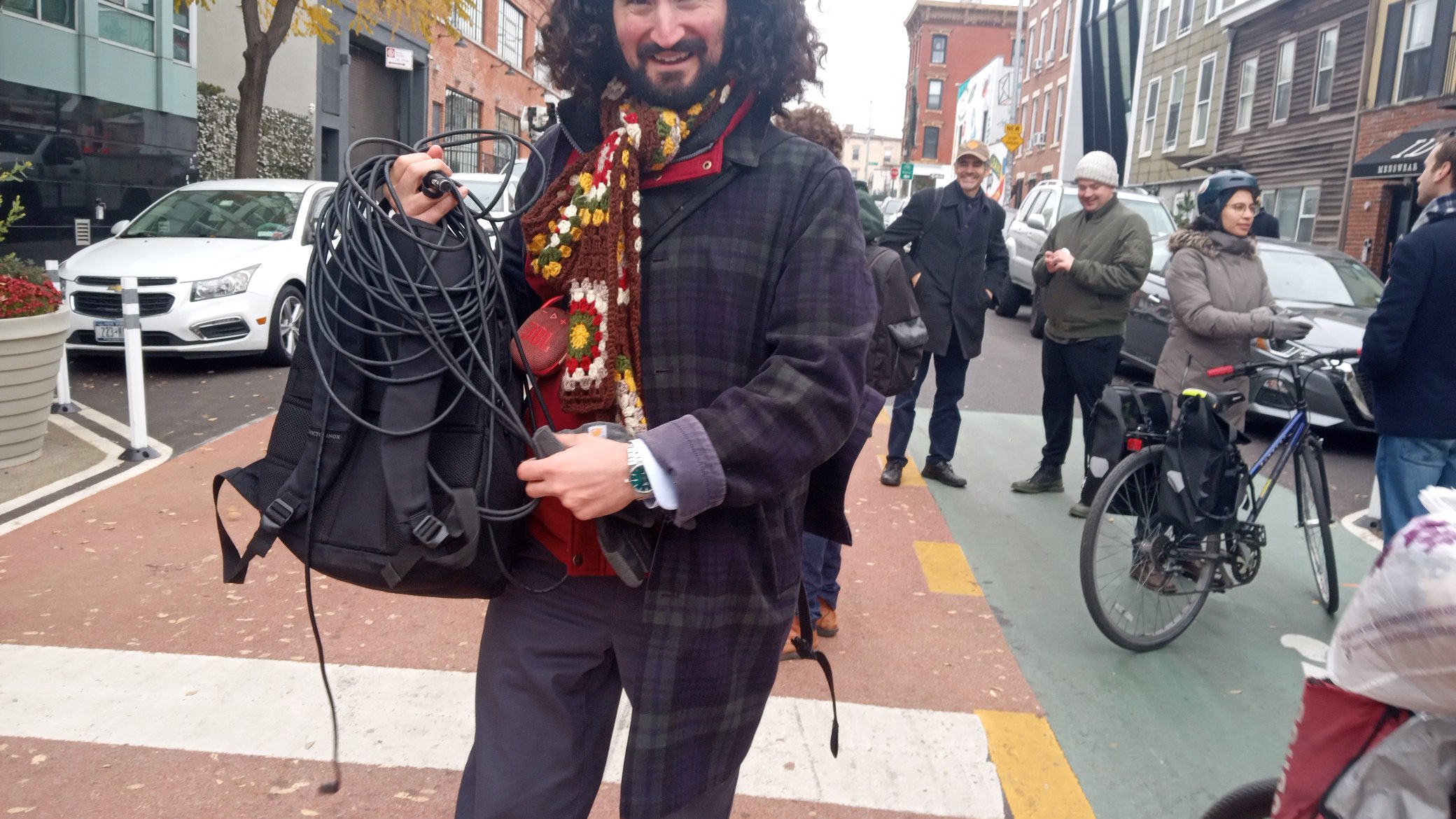
The guy photographed above is Vin Barone, he's in charge of media at the Department Of Transportation Alternatives which includes their obnoxious twitter account (which is also stupidly known as X).


Saturday, February 17, 2024

Hollywood Boonddoggle

  Image

Crain's New York

New York’s newly expanded tax credit for film productions is a “net negative” that fails to give taxpayers a return on their investment, even as state leaders have continued pushing to expand it, according to a new study commissioned by the state itself.

New York’s Film Production Credit was grown in last year’s state budget to cover as much as $700 million in costs annually for film and television productions that opt to locate in the state, forgiving 30% of eligible costs for each movie and show. Lawmakers, at the urging of Gov. Kathy Hochul, also extended the program through 2034 — despite longstanding complaints from watchdogs that the incentive may not achieve its stated goal of spurring economic activity and attracting more well-paying jobs.

Those claims are bolstered by the new study by the financial advisory firm PFM Group, which was commissioned by the state’s Department of Taxation and Finance to look into each of New York’s economic development tax credits. The study was required by a 2022 state budget provision and was put together over the course of 2023.

All told, New York gets back just 31 cents for every $1 it invests in film productions through tax breaks, the study concludes after considering the program’s pros and cons. The program has cost the state some $5 billion in the last decade, making it the largest of New York’s many tax incentives.

“Based on an objective weighing of the costs and benefits, the film production credit is at best a break-even proposition and more likely a net cost to NYS,” the authors wrote.

As critics have long argued, the study found that much of the filming activity funded by the credit would have happened in New York regardless, given its existing workforce and infrastructure. And although the productions do attract high-paying jobs, the tax credit’s unlimited duration means it functions more as an “ongoing subsidy” rather than a one-time incentive that could wind down after establishing a steady film industry in the state.

Indeed, many of the productions that continue receiving annual tax credits are long-running television series filmed in New York for years — undercutting the program’s stated goal of attracting new investments. And even the job-creation claim is “inconclusive at best,” the study found. After New York launched the credit in 2004, film industry employment remained stagnant for years until increasing in 2010, and its share relative to the nationwide market has since dropped.

A spokesman for Gov. Kathy Hochul said the office is reviewing the report but pushed back on its conclusions, pointing to other studies that found better results. Among them was a study commissioned by the Empire State Development Corp. which found that New York’s state and local governments reaped a combined $1.70 for every dollar spent on the film tax credit in 2021 and 2022 — although the state by itself (omitting local governments like New York City) still lost out overall, the report found.

“New York's tax credits and incentive programs are critical to growing the state's economy, boosting innovation, and creating good jobs, which is why the Legislature approved them in the first place, and Governor Hochul will continue working with members to improve the programs to maximize benefits for New Yorkers,” spokesman Justin Henry said.

Hochul’s office pointed to the high wages available in film and TV jobs, which often employ people without college degrees. New York has also lost productions to other states that boosted their incentives, such as the 2022 film “White Noise,” which filmed in Cleveland after “extensively scouting New York state,” Hochul’s office said.

The PFM study found that other “qualitative” factors cited by boosters of the tax break are similarly murky, like the exposure that New York state and city might enjoy as a result of all the films and shows set here. Many of those productions, like “Law & Order,” hardly portray New York in a fully positive light, the authors note.

The state’s expansions to the program last year also expanded the credit to cover “above-the-line” salaries for actors, directors, producers and writers, in addition to the “below-the-line” jobs, such as hairdressers and set builders, that had been covered before. Hochul, who pushed for the expansions, argued it would lure more productions to the state and boost an industry that serves as a major union employer.

In the end, the study concludes, the strongest argument for the tax credit may be that it works as a “defense mechanism” — deterring productions from choosing rival states like California and Georgia that offer their own incentives.