Showing posts with label congestion pricing. Show all posts

Wednesday, February 19, 2025

Congestion pricing is dead again

Image 

Eyewitness News 

  The U.S. Department of Transportation has pulled its approval for the MTA's congestion pricing toll program, but the MTA is vowing to take the decision to federal court to ensure the plan will continue.

In a release Wednesday, the DOT's Federal Highway Administration said it sent a letter to Gov. Kathy Hochul informing her that the department had rescinded the agreement.

"New York State's congestion pricing plan is a slap in the face to working class Americans and small business owners," said U.S. Transportation Secretary Sean Duffy. "Commuters using the highway system to enter New York City have already financed the construction and improvement of these highways through the payment of gas taxes and other taxes. But now the toll program leaves drivers without any free highway alternative, and instead, takes more money from working people to pay for a transit system and not highways. It's backwards and unfair. The program also hurts small businesses in New York that rely on customers from New Jersey and Connecticut. Finally, it impedes the flow of commerce into New York by increasing costs for trucks, which in turn could make goods more expensive for consumer. Every American should be able to access New York City regardless of their economic means. It shouldn't be reserved for an elite few."

Duffy said in the letter to Hochul that the plan is being terminated for two reasons:

1.) The scope of the CBDTP is unprecedented and provides no toll-free option for many drivers who want or need to travel by vehicle in this major urbanized area.


2.) The toll rate was set primarily to raise revenue for transit, rather than at an amount needed to reduce congestion.

MTA chair and CEO Janno Lieber released a statement that the MTA has already filed papers in federal court in response to the DOT's letter:

STFU Janno. You're done.


Sunday, February 16, 2025

Congestion pricing forgot to fix this

The East New York Bus Depot in Brooklyn. (Evan Simko-Bednarski for New York Daily News) 


NY Daily News

The MTA’s plan to fix the ailing East New York Bus Depot, which has been without a functioning fire sprinkler system for nearly three years, has been pushed back again, the Daily News has learned — a delay that could cost the agency $5 million in overtime.

As previously reported by The News, the MTA has been struggling to fix a 2,000 foot underground pipe at the facility since 2021, when the line responsible for feeding the sprinkler system from the city main failed to hold pressure.

Since then, countless attempts to patch the pipe and plug the leaks have failed, though repair crews have flooded the facility’s boiler room and uncovered asbestos piping beneath a storeroom in the process.

A plan to replace 2,000 feet of leaky subterranean piping with an above-ground loop, first reported by The News, had initially been scheduled for completion in August 2026.

But sources with knowledge of the facility said this week that that date has now been pushed back to late June 2027, nearly an 11-month delay.

A contract for the work, which had been due to be awarded this month, has not yet been solicited — the award is now scheduled for June of this year.

“This project will be awarded and commenced in 2025, as anticipated,” MTA spokesperson Kayla Shults said in response to questions about the reason for the delay. “We look forward to delivering upgrades to this nearly century-old depot,” she added.

The broken subterranean pipe is designed to provide pressurized water to the depot’s thousands of sprinkler heads in the event of a fire. As previously reported by The News, the pipe has repeatedly burst and failed pressure tests.

The repair project — which also includes the replacement of 3,000 sprinkler heads on the depot’s first floor — is expected to cost the MTA more than $4.5 million to complete.

Meanwhile, the transit agency is expected to continue to pay dozens of transit workers overtime to patrol the sweeping facility as a so-called “fire watch,” looking for fire 24 hours a day, seven days a week.

Thursday, June 27, 2024

MTA Board kills congestion pricing

https://s3-prod.crainsnewyork.com/styles/width_792/s3/412528982.jpg 

Crain's New York

 The MTA’s board voted Wednesday to indefinitely pause the implementation of congestion pricing tolls, formalizing an eleventh-hour postponement announced by Gov. Kathy Hochul earlier this month and officially blowing a $15 billion hole in the authority’s capital budget.

In a 10-to-1 vote, the board at its monthly meeting advanced a resolution that hits the brakes on a long-awaited toll program that would have charged most motorists $15 to enter Manhattan below 60th Street to reduce traffic and raise funds to improve the region’s mass transit. The vote firmly shut the door on the MTA’s board possibly attempting to advance congestion pricing against Hochul’s wishes.

MTA board member David Mack, who voted against the tolling program in March, was the sole vote that sought to block the resolution, instead preferring a permanent halt on the program.

“The fact is the MTA, it’s just a reality, cannot start implementing congestion pricing without the New York State DOT sign off,” said a dour Janno Lieber, the board chair and chief executive of the MTA during the vote. “Others may litigate that very issue, if so, so be it, but we are right now where we are.” 

As a result, MTA officials said Wednesday that without a replacement to anticipated toll revenue the authority must defer $16.5 billion worth of construction projects to modernize the region’s aging transit system, including a high-profile extension of the Second Avenue subway to Harlem, signal upgrades and new train cars, among many others. Stop-work orders have already gone out to some projects, sending the region’s contractors into a panic.

Tim Mulligan, the MTA’s deputy chief development officer, said the authority will have to prioritize essential maintenance and upgrades to keep the system functioning and defer less critical, but long sought, accessibility, expansion and modernization work.

“Our guiding principles for the last 21 days, as we've been going through this process, has been to maintain the safe and functional operation of the system,” said Mulligan as he detailed likely changes to the MTA’s capital program.

“There are things that make the system better for our customers and for operation,” Mulligan added, “but they aren't directly related to maintaining existing service in all cases, and so more deferrals [will happen] to projects that are from those categories."

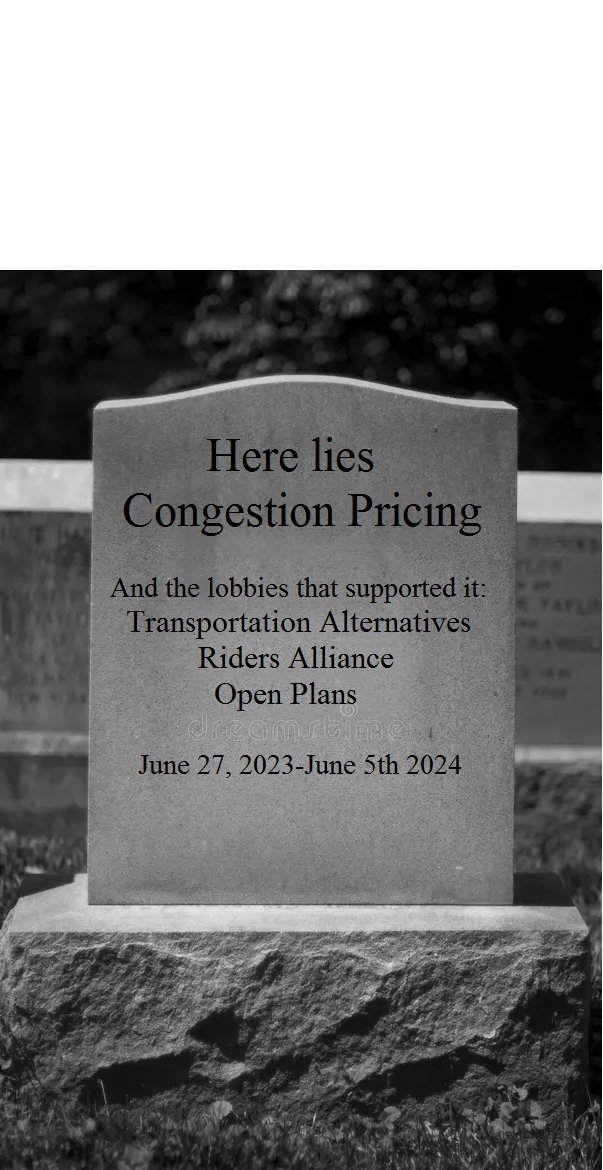
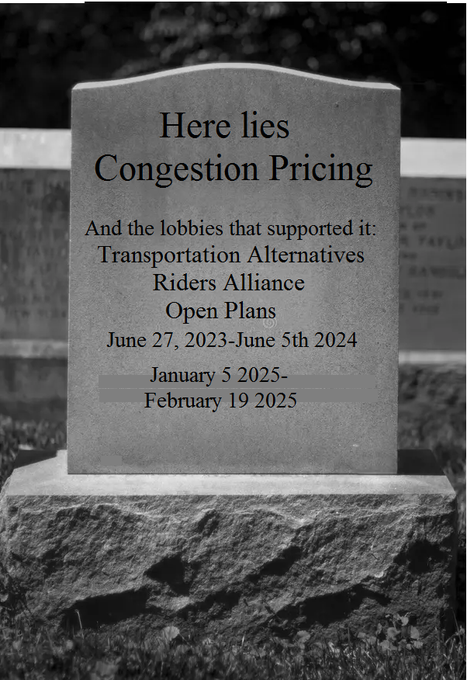
Ashes to ashes, dust to dust

Wednesday, June 19, 2024

Rescue delay 911

Nobody is going to mention the bike lanes with the cars parked in a former driving lane?

Thursday, June 6, 2024

Congestion pricing is dead


 The Village Sun

 Bowing to political pressure and in the face of numerous lawsuits, Governor Hochul on Wednesday declared that the Manhattan congestion pricing plan is on an “indefinite pause.”

“After careful consideration I have come to the difficult decision that implementing the planned congestion pricing system risks too many unintended consequences,” Hochul said. “I have directed the M.T.A. to indefinitely pause the program.”

The Metropolitan Transportation’s traffic-tolling plan was set to start later this month on June 30. It would have walloped car drivers with a $15 once-a-day fee for driving into Manhattan south of 60th Street ($3.75 during off-peak hours) — and trucks with repeated fees of $24 to $36 for each time they entered the zone.

However, the scheme faced eight lawsuits, with plaintiffs ranging from New Jersey, to the teachers union to Chinatown merchants and Lower East Side residents, all of whom said the plan’s financial impact would be unfair and onerous. Among the top arguments was that a comprehensive environmental impact statement, or E.I.S., for the sweeping, first-in-the-nation plan was shockingly never done.

Retired judge and former Councilmember Kathryn Freed, who lives on the Lower East Side and is a plaintiff on a class-action lawsuit against congestion pricing, has become a sort of poster person for the opposition. Yet, she described her reaction to the plan’s shelving as “mixed.”

“I’m not one of the people who’s crazy pro-car or whatever,” she said. “The whole thing is a mess. I don’t know what Hochul was waiting for — it was massively unpopular.”

Indeed, according to a recent Siena College survey, 63 percent of New Yorkers statewide and 64 percent of Big Apple residents oppose the Manhattan congestion pricing plan, with opposition in the suburbs even higher at 72 percent. Fourteen percent said they would not come to Manhattan as often due to the toll.

At the urging of then-Governor Cuomo, the state Legislature passed congestion pricing into law five years ago, with the target of raising a total of $15 billion — at a clip of $1 billion per year — for the constantly cash-poor transit agency.


Tuesday, April 23, 2024

The majority hates congestion pricing


NY Post

New York voters overwhelmingly reject having to pay a new $15 “congestion” toll to enter Midtown Manhattan, a statewide poll released Monday shows.

The Siena College survey finds that 63% of voters throughout the Empire State oppose the toll, while only 25% support the pricing scheme promoted by Gov. Kathy Hochul and the MTA to curb congestion and generate nearly $1 billion a year to fund mass transit.

In New York City, 64% of voters are against the first-in-the-nation congestion pricing plan to enter the Manhattan business district south of 60th Street compared to just 33% who back it.

An even higher 72% of voters who reside in the suburbs surrounding the Big Apple — more likely to drive than take mass transit into Manhattan — oppose the controversial toll that the Metropolitan Transportation Authority could implement as early as June.

Opposition to the toll is one of the few issues that unifies all cross-segments of New York voters.

The new toll is opposed by 72% of blacks, 62% of Latinos, 62% of union households, 75% of Republicans, 69% of independent or unaffiliated voters, 75% of Republicans and even a majority 54% of Democrats.

Congestion pricing is being implemented because of a state law championed by former Gov. Andrew Cuomo and the Democrat-controlled legislature in 2019 — yet only 34% of Democrats support it.

Hochul, Cuomo’s successor, has defended congestion pricing as a good thing amid a plethora of lawsuits to block it.

“A majority of Democrats, two-thirds of independents and three-quarters of Republicans oppose the soon-expected congestion pricing toll plan, as do approximately two-thirds of downstaters and a majority of upstaters,” said Siena College pollster Steven Greenberg.

One in seven voters — 14% of respondents — said they would travel less to Manhattan to avoid the toll, while 17% said they would find another way to get to Midtown that could include mass transit.

Another 14% of respondents said the toll would have no effect on their travel patterns while 44% said they don’t go to Manhattan. The poll queried upstaters who rarely venture into the Big Apple.

Congestion pricing imposes a $15 toll on cars traveling anywhere below 60th Street between 5 a.m. and 9 p.m. on weekdays and 9 a.m. to 9 p.m. on weekends.

Overnight, the toll drops to $3.25.            

Saturday, March 30, 2024

You will take the train and you'll like it


Queens Eagle

After years of debate over one of New York City’s most controversial political topics, the MTA officially passed its final congestion pricing plan on Wednesday morning.

Initially passed by the state legislature in 2019, congestion pricing will add a toll for drivers heading into lower Manhattan south of 60th Street. The MTA, Mayor Eric Adams, Governor Kathy Hochul and other advocates hope the program will inject funding into the MTA’s public transit services and cut down on emission-emitting congestion in the busy borough.

But even with the MTA’s final vote, ongoing legal challenges from the governor of New Jersey, the teacher’s union and outer borough officials remain in the courts. Additionally, a handful of elected officials, including many in Eastern and Central Queens, remain frustrated with the program they claim will unfairly tax their car-dependent constituents.

The MTA board passed congestion pricing by an 11-1 vote on Wednesday – the only downvote coming from Long Island representative David Mack – and is the final stop on the plan’s path to implementation, which the MTA expects to happen in mid-June.

“Today’s vote is one of the most significant the board has ever undertaken, and the MTA is ready,” said MTA Chair and CEO Janno Lieber. “New York has more traffic than any place in the United States and now we're doing something about it.”

According to the MTA, passenger vehicles and small commercial vehicles – sedans, SUVs, pick-up trucks and small vans – paying with a valid E-ZPass will be charged $15 during the day and $3.75 at night, when there is less congestion, to enter the “congestion relief zone.” They will be charged once a day, regardless of how many times they enter or exit the area.

Trucks and some buses will be charged a toll of $24 or $36 during the day to enter the area, depending on their size and function, and $6 or $9 at night. Motorcycles will pay $7.50 during the day and $1.75 at night.

With congestion pricing’s implementation almost guaranteed, recent debates over the program have revolved around who would receive discounts or exemptions from the toll.

Yellow taxi, green cab and black car passengers will pay a $1.25 toll for every trip to, from, within or through the zone, and people taking ride-shares like Uber or Lyft will have $2.50 tacked on to their fee.

Qualifying emergency vehicles and qualifying vehicles carrying people with disabilities will be totally exempt, as will school buses, buses providing scheduled commuter services open to the public, commuter vans licensed with the NYC Taxi and Limousine Commission and specialized government vehicles.

Several officials and electeds celebrated the MTA board’s vote on the plan that many hope will bring help to the city’s transit riders, the environment and those who do need to drive to the city with less traffic in lower Manhattan.

“After nearly five years of gridlock, the MTA board finally paved the way for congestion pricing in New York City,” said city Comptroller Brad Lander. “Congestion pricing will ease traffic, cut carbon emissions and provide our beleaguered transit system with the resources it needs to modernize signals, boost accessibility, and serve more riders.”

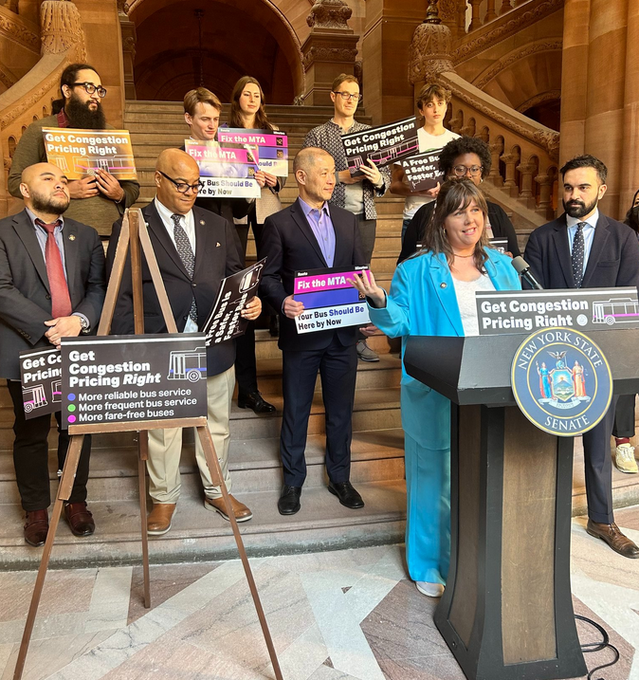
Local Queens officials, like Western Queens Assemblymember Zohran Mamdani also celebrated the toll’s passage, but said he wanted to see the MTA meet the goals of bettering transit service for outer borough residents.

“The promise of congestion pricing has long been to transform our city’s public transit,” Mamdani said in a statement. “Congestion pricing cannot just make it more expensive for New Yorkers to drive: instead, we must deliver on this promise for New Yorkers by making public transit more frequent, reliable, and affordable from the very first day of the toll.”

Mamdani is currently pushing for his “Get Congestion Pricing Right” plan, which includes a $90 million infusion for buses to get into the final state budget next week.

On Wednesday when asked about the legislator’s plan, Lieber said the MTA is “always happy to increase service.”

However, not everyone is ready to pay the fare, including some Queens officials who argue the toll will be at the disadvantage of drivers in the World’s Borough who will have to routinely pay the toll to get to work.

"The MTA Board's approval of congestion pricing is a blatant assault on every New Yorker who's already struggling to get by,” Councilmember Bob Holden said in a statement. “It's a disgusting cash grab that punishes our most vulnerable — those with no choice but to commute from transit deserts.”

Although Holden’s office did not reply to follow-up questions, the Common Sense Caucus co-chair said that more legal challenges for congestion pricing could be on the horizon.

“This isn't just a policy failure; it's an act of war on the working class,” he said. “Mark my words: we're taking this fight straight to the courts. See you there."

Holden, who is already signed onto a lawsuit against congestion pricing, argued that the MTA pushed the plan through without conducting an environmental review or public input processes.

“They control this whole process,” Holden said. “The MTA is a fraudulent authority, and they wanted to do this so they rubber stamped it through and again, we're going to blame anybody that was for this, including the governor, we're gonna blame them and they might have a tough time next time when they're running for office.”

Queens Assemblymember David Weprin has long been a challenger of congestion pricing, and is a co-plaintiff on one of the two lawsuits looking to slow its implementation.

“It is a sham,” said Weprin. “Any testimony was all a show. We knew the foregone conclusion before the vote, and I don't think it's fair.”

 

Thursday, February 29, 2024

Today is the day to stop the MTA's congestion tax scheme


Queens Chronicle

The Metropolitan Transportation Authority will host four hybrid hearings on the proposed rates for congestion pricing beginning at the end of this month.

The hearings will be hosted in person at 2 Broadway in Manhattan in the William J. Ronan 20th Floor Board Room. People may also register to participate remotely via Zoom or telephone.

The hearings are 6 to 10 p.m. on Thursday, Feb. 29; 10 a.m. to 2 p.m. on Friday, March 1; and both 10 a.m. to 2 p.m. and 6 to 10 p.m. on Monday, March 4.

The proposed toll rates can be found online at bit.ly/42Hts2F. The MTA hopes to impose them starting in June, though several lawsuits have be filed to block the plan.

Each public hearing will be livestreamed on the MTA YouTube channel at MTA Live — YouTube and on the project website: mta.info/CBDTP.

The hearings also will be accessible online at mta.info/CBDTP. Comments can be submitted online, or by email, mail, fax, or voicemail message through Monday, March 11. Comments can be submitted in the following ways:

• Online: contact.mta.info/s/forms/CBDTP;

• Email: cbdtp.feedback@mtabt.org;

• Mail: CBD Tolling Program, 2 Broadway, 23rd Floor, New York, NY 10004;

• Phone: (646) 252-7440; and

• Fax: Send to (212) 504-3148 with Attention to CBDTP Team.

The MTA said all comments will be afforded equal weight and will be recorded and submitted for review.

Members of the public who wish to speak at the hearings are required to register in advance online, by calling the Public Hearing Hotline at (646) 252-6777, or in person.

Registration will open one week before the start time of each hearing and will close 30 minutes after the meeting starts. Speakers will be provided two minutes. American Sign Language and CART Captioning Services will be available.

The stated purpose of the tolls is to raise $1 billion per year to fund the MTA’s capital projects budget; and to move traffic congestion and pollution out of Midtown and Downtown Manhattan by charging tolls for any vehicle entering the Central Business District at or below 60th Street.

The base rate is $15 per car during peak hours and $24 or $36 per truck depending on the size. Overnight discounts and other variations apply.

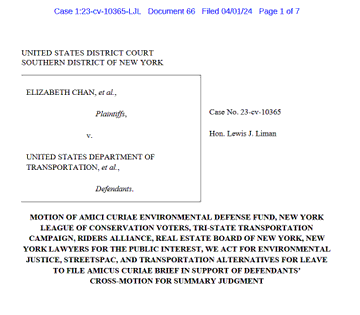
Originally set for April, the implementation could be delayed by any or all of four federal lawsuits that have been filed since.


Tuesday, February 6, 2024

The resistance against congestion pricing is getting bigger and bigger


NY Post 

The labor coalition representing New York City’s nearly 400,000 government workers — including uniformed cops, firefighters and other first responders — is backing a federal lawsuit to block the “crazy” $15 congestion toll to enter Midtown.

“We’re not coming into Manhattan once a week for dinner. We’re coming in every day to proudly serve the people of New York City,” Harry Nespoli, head of the NYC Municipal Labor Committee (MLC), told The Post on Monday.

The presidents of the unions that make up the MLC voted overwhelmingly to join the suit filed last month by the United Federation of Teachers union and Staten Island Borough President Vito Fossella, and will issue an amicus brief for the plaintiffs in the case, Nespoli said.

“The congestion toll is just another crazy thing in the city,” Nespoli, who also reps the union of sanitation workers, said.

“No one likes going into our pocket when we’re mandated to come in,” he added. “These are the people who make the city run.”

The MLC’s backing of the lawsuit is evidence of mounting opposition to the controversial new toll to be imposed by the Metropolitan Transportation Authority as early as May to enter the Midtown business district south of 60th Street. 

Transit officials expect the $15 toll to raise $1 billion per year, which will be used to fund $15 billion in bonds to pay for major upgrades to the MTA’s subway, commuter railroads and bus systems.

Drivers will pay significantly less during off-peak hours, as the toll is aimed at helping curb peak-day congestion.

But Nespoli said municipal workers deserve a break — arguing that employees required to work in the Manhattan business district who drive in from the outer boroughs shouldn’t be punished.

“There’s got to be a better way. Pushing the cost onto someone else is not the right way to do it,” he said. “Municipal workers just got raises and now they want to take it away from us.”

 NY Post

Eighteen elected officials have joined a federal lawsuit by the teachers union aimed at blocking the controversial new $15 congestion pricing toll to enter Midtown Manhattan.

More than half the plaintiffs are Democrats whose fellow party members approved the law greenlighting congestion pricing in 2019.

UTF President Mike Mulgrew and Staten Island Borough President Vito Fossella welcomed the growing, bipartisan coalition who object to having constituents and members pay such a high toll to drive into Midtown south of 60th Street.

“As we have said time and time again, congestion pricing is a detriment to those that will be affected by this toll, environmentally and financially, and for people of all walks of life from across the five boroughs and beyond,” said Fosella, who initially joined as a co-plaintiff. “We appreciate the support from elected officials and interested groups, as this fight cannot be won by any one of us alone.” 

The suit argues the plan would move pollution from Manhattan to Staten Island and other parts of the city.

“We are determined to challenge the current regressive and discriminatory plan for congestion pricing;  as now constituted, it will only succeed in moving traffic and pollution from one part of the city to another, even as it increases the economic burden on working- and middle-class communities,” Mulgrew said.

Maybe there needs to be a rally song now since this movement against the congestion tax is growing. A little change in the lyrics to this classic would be perfect.

Monday, January 15, 2024

City moving forward with congestion tax cameras despite multiple lawsuits

Image 

NY Post

Big Brother will soon be watching Big Apple highways – sparking concerns about a future toll.

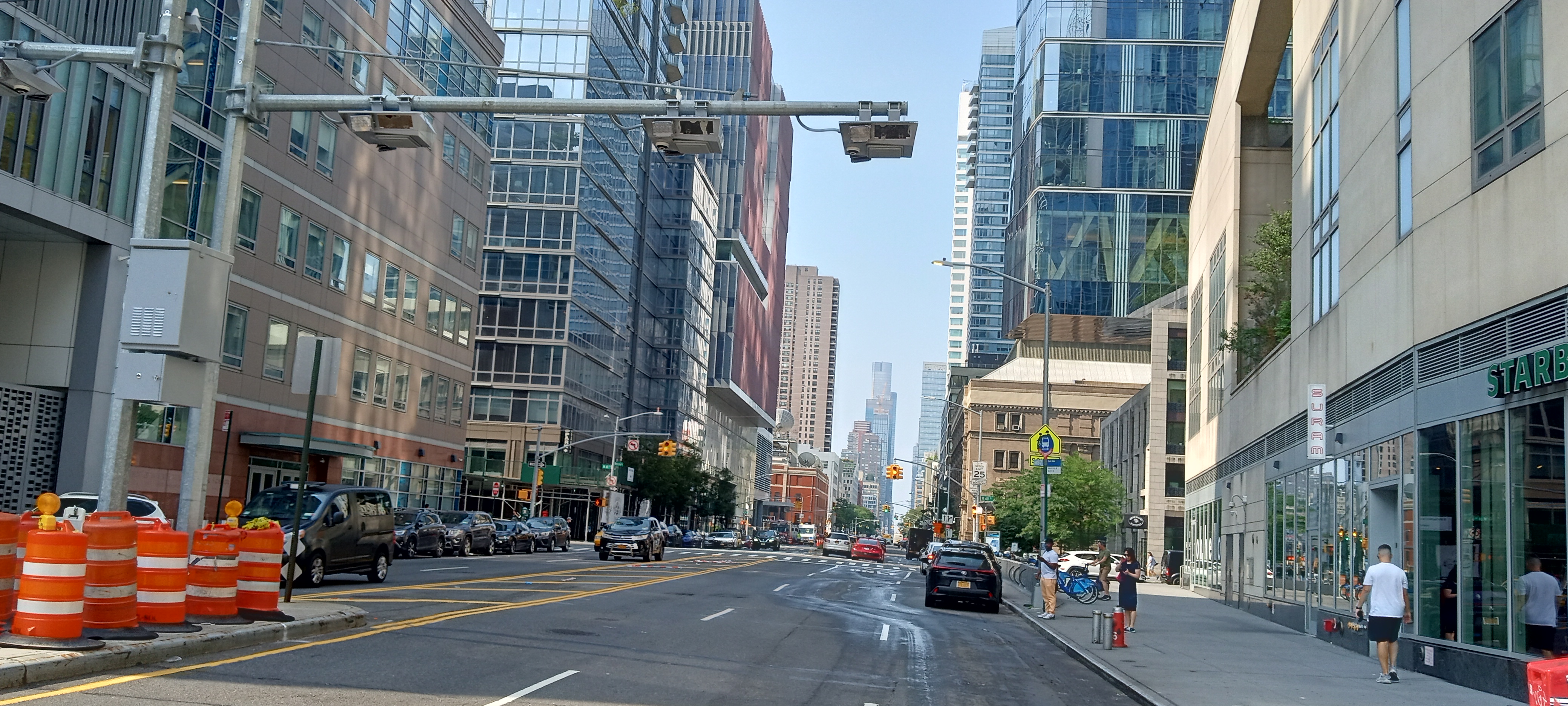
The Metropolitan Transportation Authority has begun installing camera equipment on New York highways to prepare to monitor a controversial $15 congestion toll to enter Manhattan’s central business district south of 60th Street as early as May, The Post has learned.

License plate readers have been attached to a pedestrian walkway above FDR Drive at East 25th Street that will be used to track vehicles that go into the toll congestion zone or stay on the highway.

The sensors are being installed on Route 9A/the West Side Highway for the same purpose, the MTA confirmed.

Both highways are excluded from the toll under state law.

But motorists who drive along the FDR Drive are worried that the equipment erected there is a fig leaf that the MTA could eventually use to charge tolls on the state highway.

The state Legislature would have to amend the law to expand the congestion toll to other locations.


“It’s the old game of `bait and switch’. Wanna bet that after a year, the MTA will go to the state legislature and say they need more money and the best way to get it is to put the congestion pricing toll on the FDR Drive and the West Side Highway?” one source who noticed the new detection equipment said.

“You can hear the MTA bureaucrats already saying that it’ll be easy because `we already have the equipment in place. As soon as you give us the green light, the bucks will just start flowing in.'”

The source, who requested anonymity added, “You can’t trust the MTA.”

Agencies that oversee the FDR passed the buck on who signed off on installing the sensors.

A spokesman for the state Department of Transportation — responsible for the FDR Drive’s upkeep — said it does not own the pedestrian walkway at 25th Street and urged The Post to check with the city DOT.

A city DOT spokesperson then urged The Post to contact “the MTA regarding the toll reading infrastructure.”

“It’s amazing to see the MTA turn into the MI6 spy agency when it comes to screwing drivers but it can’t even make a turnstile to prevent subway fare beating,” quipped Councilman Joe Borelli (R-Staten Island).

Borelli was also concerned about the MTA going to the legislature in the future to expand the congestion zone to include toll-free highways.

“The legislature expanded speed cameras in the city when it was still a pilot program. The legislature can expand the congestion toll to wherever they want,” Borelli said.

Friday, January 12, 2024

Three little congestion pricing hypocrites


In order to desperately flip Congress back to a Democrat majority, Assemblyman Harvey Esptein along with Reps. Jerry Nadler, Dan Goldman  and Ardillo Espillant are going to take a bus with Dem supporters to Bayside,Queens to back Tom Suozzi to win the house seat back in his district. 

Which is hilarious because Epstein, Nadler and Goldman are staunch supporters for the congestion pricing tax, yet they would rather take a fossil fuel burning charter bus than a hybrid city bus. Suozzi would probably be better off without their toxic support.

Monday, December 25, 2023

Congestion pricing will break essential workers

https://www.nydailynews.com/wp-content/uploads/migration/2021/03/14/NX4NQELNWNG5XIHQRSYMWV2YCM.jpg?w=620

NY Post 

The city’s life savers — paramedics and EMTs — are in full panic mode over a controversial plan that will force them to pay a $15 congestion toll just to drive to their jobs in Manhattan.

An emergency worker union president is warning the congestion pricing plan, set to take effect as soon as May, will make hiring EMS workers in the city more difficult and ultimately increase response times in some of the Big Apple’s busiest neighborhoods.

More than 400 ambulance workers are assigned to three FDNY Emergency Service stations south of 60th Street in the congestion pricing district, said Oren Barzilay, president of the Local 2507 union representing paramedics, emergency medical technicians and fire inspectors.

Because of low pay and high housing costs in and around New York City, many EMS employees commute from their homes throughout lower-cost exurbs of Pennsylvania, New Jersey, Long Island and the northern New York suburbs — instead of taking less convenient mass transit, he said.

Meanwhile, the unions representing EMS workers are among the few that haven’t secured a new labor contract with Mayor Eric Adams’ administration and EMTs and paramedics are some of the lowest paid among the city’s uniformed forces.

Currently, salaries for EMTs range from $39,386 to $59,534 after five years, while the salaries for medics start at $53,891 and max out at $75,872 after five years. 

Now, they’ll have to pay about $4,000 extra per year to drive to their jobs in the new Manhattan toll district, Barzilay said.

“It’s an insult — a slap in the face,” he fumed.

“I have members who live 100 miles away in places where housing and cost of living is cheaper. They can’t afford to live in the city,” Barzilay said. 

“Our EMS workers are the city’s life savers. They put their hands on people to save their lives. We bring the emergency room to New Yorkers’ homes. We bring people back from the dead every day,” Borzilay said.

“This is what my members get in return — a $15 toll! These aren’t just other drivers coming into the city. They are essential workers.”

He warned city taxpayers will end up suffering most.

“A $15 toll is going to cause a hiring problem of EMS workers for the city. I don’t think response times are going to be good in these neighborhoods in the congestion pricing zone,” Barzilay said. 

“People are having to pay to go to work. They’re supposed to get paid to go to work.”

Three FDNY EMS ambulance stations are located in the congestion zone — at Bellevue hospital, on the Lower East Side and Chelsea. They are among the busiest stations in the city, which cover the Times Square business district and the downtown financial district.


Saturday, December 9, 2023

Chicken Little Lieber

 Image


Tuesday's pro Congestion Pricing Rally, MTA Chairman Janno Lieber said "Imagine if your family member was in an ambulance with their life on the line, idiling in traffic because of congestion" follows up on a previous quote that "fire trucks can't get to fires" reminds me of Chicken Little's "The Sky is Falling". 

 Where is the data in ambulance response time to hospitals and fire trucks to fires for validation of Lieber's statement implying loss of life? Over the top rhetoric like this does nothing to build his credibility with commuters, transit advocates, taxpayers and those who will be paying these proposed new tolls. 

His use of the word goddamned when saying "These are self-styled problems solvers who have never lifted a finger to solve a problem, even when there's a half-finished rail line in their own goddamned district" was offensive to many religious people. He should wash his mouth out with soap ; for using such a profanity. City Hall, Albany and Washington via the Federal Transit Administration already provide significant funding. 

 Why not equal passion in dealing with $600 million in annual lost revenue, over $1 billion in excessive employee overtime and capital project cost overruns as well?; Lieber should try sticking to the facts

 .(Larry Penner is a transportation advocate, historian and writer who previously served as a former Director for the Federal Transit Administration Region 2 New York Office;of Operations and Program Management.  This included the development, review, approval and oversight for billions in capital projects and programs for NJ Transit, New York Metropolitan Transportation Authority, NYC Transit

Thursday, November 30, 2023

MTA announces punitive congestion pricing tolls against drivers

 PIX News 

  A new report from The New York Times has revealed the city’s plan for congestion pricing.

Cars and SUVs would be charged $15 once a day to enter Manhattan below 60th Street. Trucks will be paying $24 or $36 depending on the size.

Motorcyclists will only be paying $7.50, according to the report.

The FDR Drive, West Side Highway and Brooklyn Battery Tunnel will be exempt from congestion pricing. Taxis and rideshares will also be exempt, although a surcharge will be passed on to customers.

Commuters buses will also be exempt, the report said.

Low-income New Yorkers will get half off congestion pricing, according to the report, but only after their first 10 trips every month. If you drive between 9 p.m. and 5 a.m., you’ll get a 75% discount if you’re driving into New York City.

Local lawmakers weighed in on the report Wednesday night, including New Jersey Gov. Phil Murphy.

“As a conceptual matter, I support congestion pricing, as long as it is structured in a way that is fair to all sides. This plan is neither fair nor equitable,” he said.

Rep. Josh Gottheimer (D-NJ) was also critical of the plan as it was outlined in the report.

“As advertised, New York is officially sticking it to Jersey families with their commuter-crushing Congestion Tax. On top of the existing tolls, it’ll be 15 bucks every day to go into the city with no discounts at the GW Bridge — thousands of dollars a year just to drive to work,” he said.

The Traffic Mobility Review Board, the advisory panel that wrote the report, told The New York Times that the plan is a “huge step forward.”