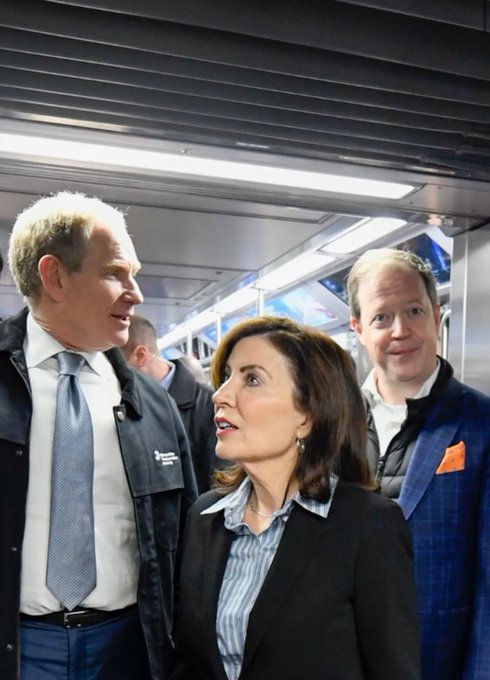
Showing posts with label Janno Leiber. Show all posts

Wednesday, February 19, 2025

Congestion pricing is dead again

Image 

Eyewitness News 

  The U.S. Department of Transportation has pulled its approval for the MTA's congestion pricing toll program, but the MTA is vowing to take the decision to federal court to ensure the plan will continue.

In a release Wednesday, the DOT's Federal Highway Administration said it sent a letter to Gov. Kathy Hochul informing her that the department had rescinded the agreement.

"New York State's congestion pricing plan is a slap in the face to working class Americans and small business owners," said U.S. Transportation Secretary Sean Duffy. "Commuters using the highway system to enter New York City have already financed the construction and improvement of these highways through the payment of gas taxes and other taxes. But now the toll program leaves drivers without any free highway alternative, and instead, takes more money from working people to pay for a transit system and not highways. It's backwards and unfair. The program also hurts small businesses in New York that rely on customers from New Jersey and Connecticut. Finally, it impedes the flow of commerce into New York by increasing costs for trucks, which in turn could make goods more expensive for consumer. Every American should be able to access New York City regardless of their economic means. It shouldn't be reserved for an elite few."

Duffy said in the letter to Hochul that the plan is being terminated for two reasons:

1.) The scope of the CBDTP is unprecedented and provides no toll-free option for many drivers who want or need to travel by vehicle in this major urbanized area.


2.) The toll rate was set primarily to raise revenue for transit, rather than at an amount needed to reduce congestion.

MTA chair and CEO Janno Lieber released a statement that the MTA has already filed papers in federal court in response to the DOT's letter:

STFU Janno. You're done.


Saturday, March 30, 2024

You will take the train and you'll like it


Queens Eagle

After years of debate over one of New York City’s most controversial political topics, the MTA officially passed its final congestion pricing plan on Wednesday morning.

Initially passed by the state legislature in 2019, congestion pricing will add a toll for drivers heading into lower Manhattan south of 60th Street. The MTA, Mayor Eric Adams, Governor Kathy Hochul and other advocates hope the program will inject funding into the MTA’s public transit services and cut down on emission-emitting congestion in the busy borough.

But even with the MTA’s final vote, ongoing legal challenges from the governor of New Jersey, the teacher’s union and outer borough officials remain in the courts. Additionally, a handful of elected officials, including many in Eastern and Central Queens, remain frustrated with the program they claim will unfairly tax their car-dependent constituents.

The MTA board passed congestion pricing by an 11-1 vote on Wednesday – the only downvote coming from Long Island representative David Mack – and is the final stop on the plan’s path to implementation, which the MTA expects to happen in mid-June.

“Today’s vote is one of the most significant the board has ever undertaken, and the MTA is ready,” said MTA Chair and CEO Janno Lieber. “New York has more traffic than any place in the United States and now we're doing something about it.”

According to the MTA, passenger vehicles and small commercial vehicles – sedans, SUVs, pick-up trucks and small vans – paying with a valid E-ZPass will be charged $15 during the day and $3.75 at night, when there is less congestion, to enter the “congestion relief zone.” They will be charged once a day, regardless of how many times they enter or exit the area.

Trucks and some buses will be charged a toll of $24 or $36 during the day to enter the area, depending on their size and function, and $6 or $9 at night. Motorcycles will pay $7.50 during the day and $1.75 at night.

With congestion pricing’s implementation almost guaranteed, recent debates over the program have revolved around who would receive discounts or exemptions from the toll.

Yellow taxi, green cab and black car passengers will pay a $1.25 toll for every trip to, from, within or through the zone, and people taking ride-shares like Uber or Lyft will have $2.50 tacked on to their fee.

Qualifying emergency vehicles and qualifying vehicles carrying people with disabilities will be totally exempt, as will school buses, buses providing scheduled commuter services open to the public, commuter vans licensed with the NYC Taxi and Limousine Commission and specialized government vehicles.

Several officials and electeds celebrated the MTA board’s vote on the plan that many hope will bring help to the city’s transit riders, the environment and those who do need to drive to the city with less traffic in lower Manhattan.

“After nearly five years of gridlock, the MTA board finally paved the way for congestion pricing in New York City,” said city Comptroller Brad Lander. “Congestion pricing will ease traffic, cut carbon emissions and provide our beleaguered transit system with the resources it needs to modernize signals, boost accessibility, and serve more riders.”

Local Queens officials, like Western Queens Assemblymember Zohran Mamdani also celebrated the toll’s passage, but said he wanted to see the MTA meet the goals of bettering transit service for outer borough residents.

“The promise of congestion pricing has long been to transform our city’s public transit,” Mamdani said in a statement. “Congestion pricing cannot just make it more expensive for New Yorkers to drive: instead, we must deliver on this promise for New Yorkers by making public transit more frequent, reliable, and affordable from the very first day of the toll.”

Mamdani is currently pushing for his “Get Congestion Pricing Right” plan, which includes a $90 million infusion for buses to get into the final state budget next week.

On Wednesday when asked about the legislator’s plan, Lieber said the MTA is “always happy to increase service.”

However, not everyone is ready to pay the fare, including some Queens officials who argue the toll will be at the disadvantage of drivers in the World’s Borough who will have to routinely pay the toll to get to work.

"The MTA Board's approval of congestion pricing is a blatant assault on every New Yorker who's already struggling to get by,” Councilmember Bob Holden said in a statement. “It's a disgusting cash grab that punishes our most vulnerable — those with no choice but to commute from transit deserts.”

Although Holden’s office did not reply to follow-up questions, the Common Sense Caucus co-chair said that more legal challenges for congestion pricing could be on the horizon.

“This isn't just a policy failure; it's an act of war on the working class,” he said. “Mark my words: we're taking this fight straight to the courts. See you there."

Holden, who is already signed onto a lawsuit against congestion pricing, argued that the MTA pushed the plan through without conducting an environmental review or public input processes.

“They control this whole process,” Holden said. “The MTA is a fraudulent authority, and they wanted to do this so they rubber stamped it through and again, we're going to blame anybody that was for this, including the governor, we're gonna blame them and they might have a tough time next time when they're running for office.”

Queens Assemblymember David Weprin has long been a challenger of congestion pricing, and is a co-plaintiff on one of the two lawsuits looking to slow its implementation.

“It is a sham,” said Weprin. “Any testimony was all a show. We knew the foregone conclusion before the vote, and I don't think it's fair.”

 

Saturday, May 6, 2023

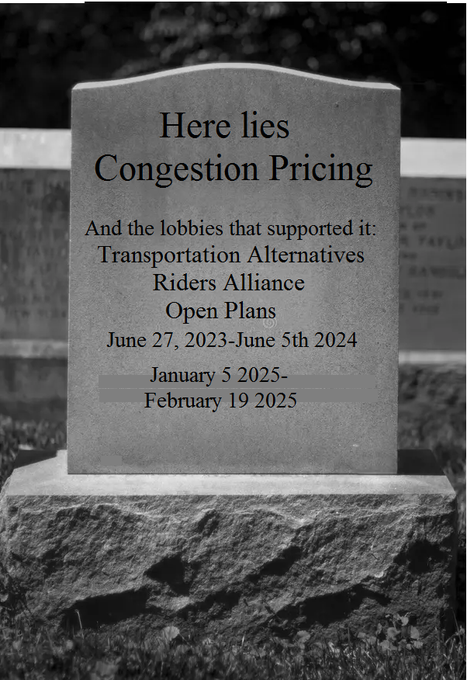
The U.S. Department Of Transportation Alternatives has approved congestion pricing


https://pbs.twimg.com/media/Fvac9teWAAI1VHI?format=png&name=360x360 

NBC New York

The federal government has given the green light on New York's plan to implement the long-debated, highly-anticipated plan to become the first U.S. city to charge motorists an extra fee for entering its most congested area.

On Friday afternoon, the Federal Highway Administration submitted a "letter of sufficiency" for plan from the Metropolitan Transportation Authority and the city's Department of Transportation, approving of the environmental review.

The MTA’s pricing plan has been discussed for more than a decade now. It’s the plan that could charge drivers, many of whom coming from New Jersey, as much as $23 to enter Manhattan below 60th Street. The pricing plan has yet to be implemented.

"We are optimistic the time has arrived for congestion pricing," said MTA Chairman Janno Lieber. "New York is the number one most congested place in the U.S. Ambulances can't get to hospitals, firetrucks to fires. We have to do something."

The practice is commonly referred to as congestion pricing and has been used in cities including London, Singapore and Stockholm. In New York, motorists entering Manhattan below 60th Street would be charged a toll electronically.

The MTA has long argued that congestion pricing is essential to their bottom line and would net them $1 billion annually. Revenue from the plan would be used to back borrowing for capital improvements to the MTA’s subway and bus systems.


Saturday, November 5, 2022

There's a delay on the A train because of delays building flood resiliency infrastructure

https://thecity.brightspotcdn.com/dims4/default/5abcaac/2147483647/strip/true/crop/2560x1707+0+0/resize/2048x1366!/format/webp/quality/90/?url=https%3A%2F%2Fcdn.vox-cdn.com%2Fthumbor%2FrWqFyNQ1oKk8HRPv06D-Nen3MzY%3D%2F0x0%3A2560x1707%2F2560x1707%2Ffilters%3Afocal%281280x854%3A1281x855%29%2Fcdn.vox-cdn.com%2Fuploads%2Fchorus_asset%2Ffile%2F24145758%2F2013_rockaway_sandy_repairs_1.jpg 

THE CITY

Hurricane Sandy isn’t done messing with subway riders in the Rockaways just yet.

A decade after extensive damage from the October 2012 superstorm knocked out A train service between Howard Beach and the peninsula for more than six months, remaining Sandy-related repairs along the forked line are running with delays and getting pricier, MTA records show.

The cost of federally funded resiliency upgrades to stations, bridges and viaducts along the tracks that links the peninsula with the rest of Queens is now forecast to hit $467 million — up $60 million from an earlier goal, according to MTA documents.

The remaining work is among the lingering remnants of a storm that caused billions in damage to the subway system and specifically wreaked havoc on the coastal section of the A line and the Rockaway shuttle.

“It was a horrible storm and I saw what it did to my community,” said Thomas Atehortua, 23, as he waited Thursday for an A train at Broad Channel. “So I’m not at all surprised that the damage was so impactful and long lasting along this line.”

While the MTA last year wrapped up Sandy-related repairs inside the last of nine under-river subway tunnels damaged by the storm, reopened the flooded South Ferry complex in 2017 and has come up with ways to protect 3,500 street-level subway openings from excess water, the work in the Rockaways is still years away from being completed.

“It is a complicated project,” Janno Lieber, MTA chairperson and CEO, told THE CITY after the agency’s October board meeting on Wednesday. “It also needs to be carefully coordinated with the community because it has impacts on A train service in and out of the community, which is obviously important to that waterfront community.”

Lieber said the agency has already poured $150 million into Rockaway Line resiliency efforts, including erecting a protective seawall to guard against storm surge along Broad Channel, protecting critical station infrastructure and restoring full service in May 2013, just months after Sandy swamped tracks and bridges.