Showing posts with label NYC Open Restaurants. Show all posts

Friday, August 11, 2023

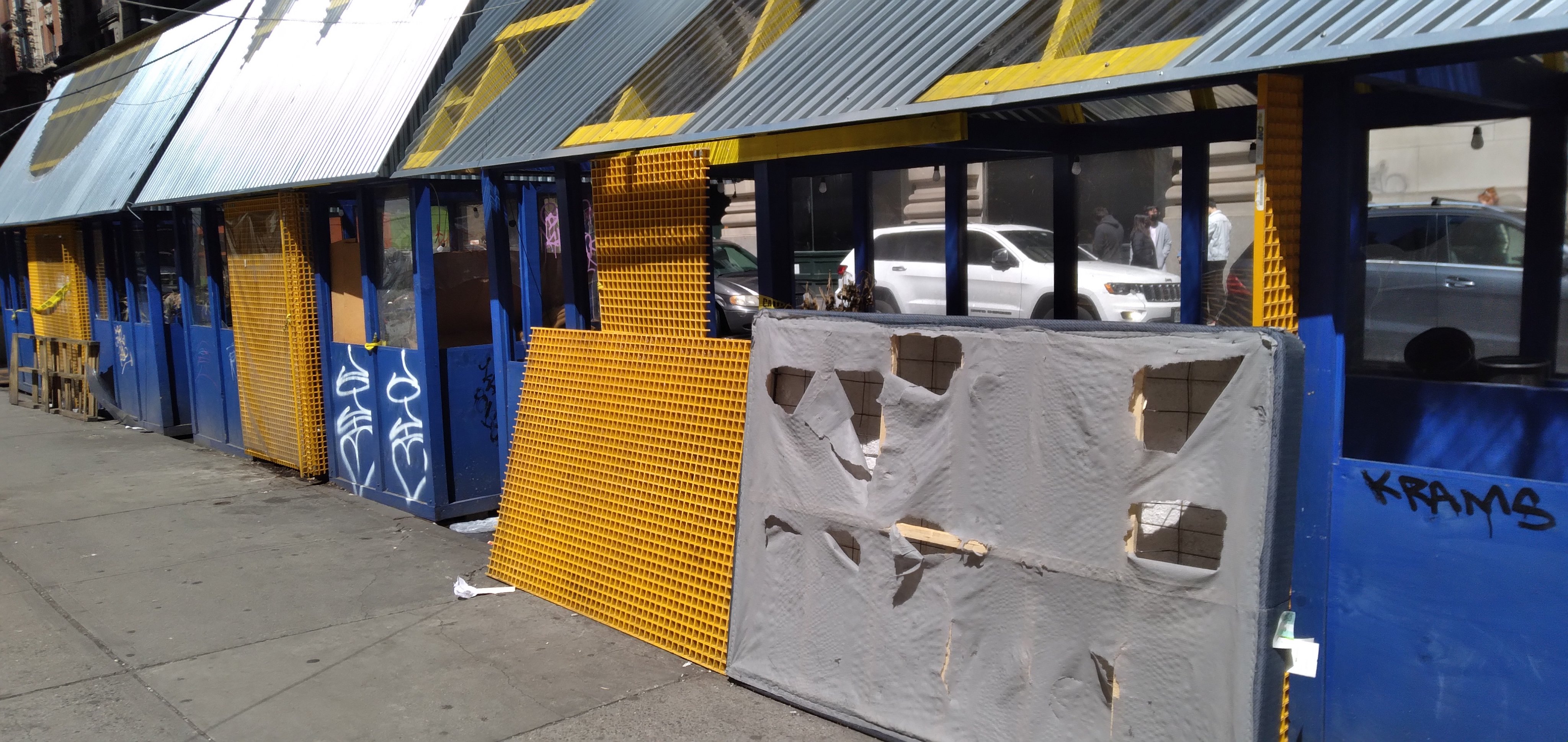
City Council passes restaurant shanty bill despite state judge's decision against them

https://pbs.twimg.com/media/FRSXSxUXoAEo9qI?format=jpg&name=4096x4096
Photo by JQ LLC


 Queens Chronicle

Since 2020, outdoor dining has been a significant but usually temporary fixture of New York City. Restaurants that did not have outdoor dining space at the time were able to apply for them based on a temporary emergency outdoor dining program created by the city as a response to the pandemic, called Open Restaurants. The city estimates that 100,000 jobs were saved as a result.

After two years of public hearings, the City Council passed a bill on Aug. 3, Intro. 31-C, that will make outdoor dining a permanent city fixture — with certain restrictions.

Under the bill, which was sponsored by Councilmember Marjorie Velazquez (D-Bronx), restaurants are allowed to have street-based outdoor-dining structures from April through November, but they must be dismantled from Nov. 30 through March 31.

Sidewalk cafes, on the other hand, will be allowed year-round with the proper permit, which would cost $1,050. Curb-based roadway seating would require a separate permit as well, priced at the same amount, according to the bill’s text. Additionally, restaurants will have to pay fees based on their location and square footage.

The bill also gives restaurants time to transition from the Open Restaurants program while petitioning for a sidewalk or roadway cafe license.

Previously, Open Restaurants came under scrutiny in multiple lawsuits in which plaintiffs deemed the program unnecessary in a post-pandemic world. Other legal complaints included congestion, excessive noise and garbage issues. The lawsuits were overall ineffective in halting the program.

Restaurants utilizing any privately owned outdoor space, private parking lots, balconies, terraces, open-air rooftop space or on open-air boats do not need to apply for permits, according to the city Department of Transportation, which will administer the program.

“As we move from an emergency program to one under local law, this legislation strikes the right balance for restaurants, neighborhoods, and all New Yorkers,” Speaker Adrienne Adams (D-Jamaica) said in a statement. “It allows a greater number of restaurants to continue participating, while easing the bureaucratic barriers, making the licensing costs affordable, and providing orderly and uniform regulations that were missing from the temporary program. This permanent program will serve and support our neighborhoods, restaurants, residents and city for years to come.”

In a press release, Mayor Adams said, “Outdoor dining is here to stay in New York City ... This bill preserves the best parts of the temporary program and eliminates the worst. We will create a vibrant, clean, and safe streetscape; give restaurants the clarity they need to continue serving their customers; and make New York City the best outdoor dining city in the world.”

Adams is expected to sign the bill into law once it reaches his desk.

Cue Up NY 

  In a long-awaited decision, State Supreme Court Judge Arlene P. Bluth declared the Mayor’s emergency executive orders suspending local laws to allow for continuous outdoor dining in New York City violate the state law which limits the permissible triggers and length of any such mayoral decrees. The unambiguous ruling calls into question the future of the Temporary Open Restaurants Program as the City Council is poised to vote on controversial legislation making permanent the unlawful program.

Judge Bluth's scathing critique of Mayor Adams’ Executive Order sends a clear message: "The local laws suspended by the executive order required that certain areas, like sidewalks and streets, are public places and not places for private establishments to run their businesses." The court unequivocally rejected any notion of unchecked executive power, stating, "This court declines to embrace a theory of judicial review that would permit unlimited actions by an executive without any check by the judicial branch."

The ruling exposed the mayoral order's wholly inadequate justification for suspending local laws. Judge Bluth concluded: "The court finds that this executive order fails to offer a rational justification for suspending [twenty-six] local laws to permit outdoor dining. Simply put, the Court finds that the order did not sufficiently explain why an emergency exists that requires the suspension of certain local laws."

The court agreed with the thirty-four petitioners from across the city who claimed that the emergency economic conditions used to justify the mayor’s overreach no longer exist. Judge Bluth minced no words, stating, "The problem here is that respondent has not adequately explained that an emergency involving an immediate or imminent danger still exists to justify the suspension of local laws."

As a result of the court’s ruling, the City may not rely on emergency orders to support its beleaguered Temporary Open Restaurants Program. Simply put, Temporary Open Restaurants has no basis in law and should immediately be phased out.

Attorney Michael Sussman, representing the petitioners, noted, "For two years, we have fought to preserve the rule of law and the dignity and peaceable enjoyment of our streets for the residents of [the City]. Today, the State Supreme Court has dealt a blow to the unjust Temporary Open Restaurants Program, which was precariously propped up by two bankrupt executive orders. The Temporary Open Restaurants program is without legs or stilts or any other support and should now be dismantled.”

"The City Council, not the Mayor, must act if New York City is to have a legitimate Open Restaurants program,” asserted Sussman. “We demand that the City Council adheres to lawful processes, including a proper environmental review, which they have conveniently neglected for more than two and a half years.”

"It is high time the city stops doing end runs around transparency and environmental review. The City Council has one choice: do the right thing, or we will see them in court," added Leif Arntzen for CueUp, a leading advocacy group.

Today’s ruling makes clear that the architects of the Open Restaurants program have cut corners and sidestepped lawful procedures in keeping a pandemic program in place long after that emergency ended.

“Accountability is paramount in the governance of our city," said Leslie Clark, a spokesperson for CueUp. "The way to get this right is by conducting a comprehensive Environmental Impact Study, free from the influence of special interest lobbyists. This is an opportunity for Mayor Adams and the City Council to demonstrate a commitment to developing a dining program that works for all New Yorkers.”

Read Judge Bluth’s ruling on e-Track:

Index No. 156328/2022


Friday, June 30, 2023

Mayor Adams issues emergency order for outdoor dining on the streets


NBC New York 

On Tuesday, Mayor Eric Adams announced plans to extend New York City's state of emergency due to the COVID-19 pandemic.

The extension comes one day after the previous state of emergency expired on June 19. This is happening in the backdrop of both the federal and state COVID-19 emergency declarations having been ended earlier this year.

In a press release, the mayor's office lists the city's unemployment rate, 5.4% compared to the national average of 3.7%, as one of the leading reasons for this state of emergency.

Additionally, his office notes that the city’s office occupancy rate is approximately 48% of the pre-pandemic rate, and the city’s subway ridership is at 70% of pre-pandemic levels -- revealing that multiple sectors are still reeling from the affects of COVID.

The order also announced an extension to the Open Restaurants and Open Storefronts program, allowing restaurants to use sidewalk space to seat customers. The Open Restaurants program was seen as being successful in saving 1000s of jobs and supporting food establishments during the pandemic.

The city council is currently considering legislation that would establish a permanent Open Restaurants program.

Monday, August 1, 2022

Open restaurant shanties law will be heard by State Supreme Court


 NY Daily News

A Manhattan lawsuit calls for the city and state to scrap the outdoor dining option launched when the pandemic hit in 2020, arguing the al fresco operations now leave a bad taste in their mouths.

The eight-page Supreme Court filing cited “increased and excessive noise, traffic congestion, garbage and uncontrolled rodent populations (and) the blocking of sidewalks and roadways” since the Temporary Outdoor Restaurant program began in June 2020.

“Now some restaurant owners are using the sheds for storage, not for outdoor dining ... some are filled with garbage,” said Brooklyn Community Board 4 Chair Robert Camacho in an affidavit with Friday’s suit. “Some are filled with garbage. Some have kids in there getting high.”

 In addition, the lawsuit alleged, the outdoor dining option created problems for traffic on city streets and sidewalks, along with a dearth of parking spaces for customers that leads to a reduction in business.

“TOR also continues to appropriate substantial share of public sidewalks and streets for private use and profit,” the suit alleges.

Lower East Side restaurant owner Vincent Sgarlato supports the continuation of outdoor dining in the city — to a point. Some of the outdoor operations near his eatery turned into “putrid structures” over time, and cleanliness in general has become a pandemic problem in the area, he said.

Sunday, April 24, 2022

The Greek Restaurant Shanty Ruin Of Austin Street


Crappy told me about this shanty, apparently the roof couldn't persevere under the primal forces of Mother Nature or maybe Zeus. But like every other decrepit shanty, it still remains taking up valuable parking space, which is what the regulatory captured Department of Transportation Alternatives wants.


Friday, March 25, 2022

The NYC Open Restaurants Clustershanty Of Koreatown

Impunity City

 It wasn’t much long ago when yours truly did a expansive on the street eyewitness story about the much ballyhooed NYC Open Restaurants program (albeit ballyhooed by our feckless and bought elected officials in NYC Council, former mayor Bill de Blasio and current Mayor Eric Adams) and what an actual clusterfuck it was and making a case out it shouldn’t exist anymore. Now thanks to a judge’s recent decision to order the city to make a thorough environmental review of the restaurant shanties all over the five boroughs, it has thankfully put a pounding kibosh on the City Council Cronies plan to make these unsafe, blighted, filthy, ugly and traffic congesting eyesores a permanent part of the street infrastructure which the restaurants have been using for free for the last two years.


But before the Council Cronies begin their study, I would like to present exhibit A on why every public space these restaurants has usurped must cease to exist and that’s the massive triple cluster shanty on the southwest corner of 32nd St. and 5th Ave, just two blocks away from the Empire State Building.

This is truly the tipping point of public space misuse and the heinous blight that has befouled the streets in the last year, which continues unencumbered because of the willful obliviousness of elected officials and the persistent bickering demands of the hospitality industrial complex lobby, represented by some neoliberal runt named Andrew Rigie.

Behold.


Impunity City 

Saturday, February 26, 2022

City Council set to make the shanty emergency program a permanent one even though the emergency is about to end


Queens Eagle

Permanent al fresco dining is now one step closer to becoming a reality in Queens and the rest of the city after the City Council approved a bill amending the city’s zoning laws Thursday.

While the council passed a text amendment that eliminates zoning restrictions for sidewalk cafes throughout the five boroughs, just how the city’s permanent outdoor dining program will ultimately look is still very much up for debate.

City legislators passed the text amendment 43 to 6, with one member abstaining. In Queens, Councilmembers James Gennaro and Robert Holden voted against the amendment, which only sets the table for a permanent outdoor dining program but doesn’t actually create one. All other Queens councilmembers voted in support of the amendment.

“This new local law will be kind of too broad in the sense that it’s one size fits all,” Gennaro told the Eagle. “Will it allow for the kind of granularity that you need to regulate something like this? My hunch is no, it won't.”

“I hope that I’m wrong,” he added. “Everyone has good intentions here but I’m wary.”

The appetite for the text amendment, which first made its way through community boards and borough boards throughout the city, has been mild – its strongest support has been in the City Council. Still, nearly every councilmember who spoke in support of the text amendment Thursday also expressed reservations.

“This program born of pandemic necessity has been a gift to our city in many ways. It was an economic lifeline and still is to many of our small businesses and it has now fundamentally changed how many dining establishments operate, and how New Yorkers utilize their public spaces,” said Brooklyn Councilmember Chi Ossé. “However, this program needs to ensure that our streets are for the people and not the rats. The rodent population growth has been undeniable and is clearly linked to outdoor dining.”

The sentiment was repeated by a number of councilmembers, including Queens Councilmember Linda Lee, who represents portions of Bayside Hills, Bellerose, Douglaston, Floral Park, Fresh Meadows, Glen Oaks, Hollis, Hollis Hills, Holliswood, Little Neck, New Hyde Park, Oakland Gardens and Queens Village.