Thursday, February 29, 2024

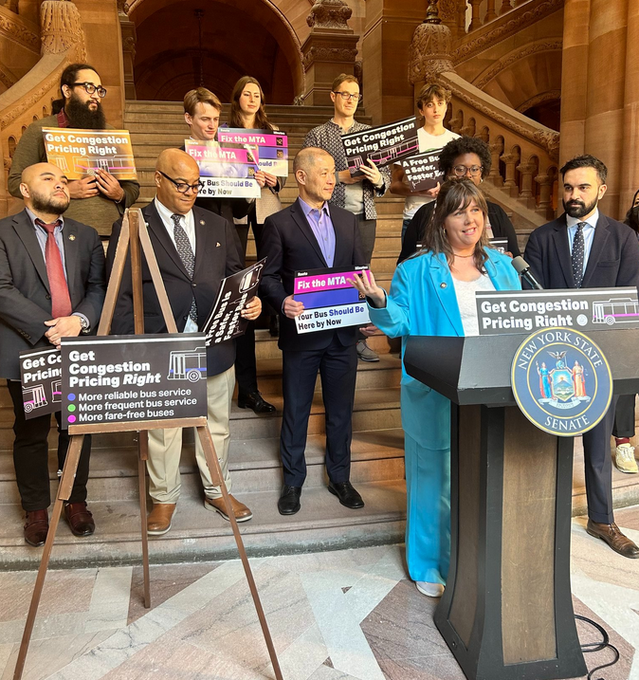
Today is the day to stop the MTA's congestion tax scheme


Queens Chronicle

The Metropolitan Transportation Authority will host four hybrid hearings on the proposed rates for congestion pricing beginning at the end of this month.

The hearings will be hosted in person at 2 Broadway in Manhattan in the William J. Ronan 20th Floor Board Room. People may also register to participate remotely via Zoom or telephone.

The hearings are 6 to 10 p.m. on Thursday, Feb. 29; 10 a.m. to 2 p.m. on Friday, March 1; and both 10 a.m. to 2 p.m. and 6 to 10 p.m. on Monday, March 4.

The proposed toll rates can be found online at bit.ly/42Hts2F. The MTA hopes to impose them starting in June, though several lawsuits have be filed to block the plan.

Each public hearing will be livestreamed on the MTA YouTube channel at MTA Live — YouTube and on the project website: mta.info/CBDTP.

The hearings also will be accessible online at mta.info/CBDTP. Comments can be submitted online, or by email, mail, fax, or voicemail message through Monday, March 11. Comments can be submitted in the following ways:

• Online: contact.mta.info/s/forms/CBDTP;

• Email: cbdtp.feedback@mtabt.org;

• Mail: CBD Tolling Program, 2 Broadway, 23rd Floor, New York, NY 10004;

• Phone: (646) 252-7440; and

• Fax: Send to (212) 504-3148 with Attention to CBDTP Team.

The MTA said all comments will be afforded equal weight and will be recorded and submitted for review.

Members of the public who wish to speak at the hearings are required to register in advance online, by calling the Public Hearing Hotline at (646) 252-6777, or in person.

Registration will open one week before the start time of each hearing and will close 30 minutes after the meeting starts. Speakers will be provided two minutes. American Sign Language and CART Captioning Services will be available.

The stated purpose of the tolls is to raise $1 billion per year to fund the MTA’s capital projects budget; and to move traffic congestion and pollution out of Midtown and Downtown Manhattan by charging tolls for any vehicle entering the Central Business District at or below 60th Street.

The base rate is $15 per car during peak hours and $24 or $36 per truck depending on the size. Overnight discounts and other variations apply.

Originally set for April, the implementation could be delayed by any or all of four federal lawsuits that have been filed since.


Tuesday, February 27, 2024

Small business owner ran a migrant shelter in his basement

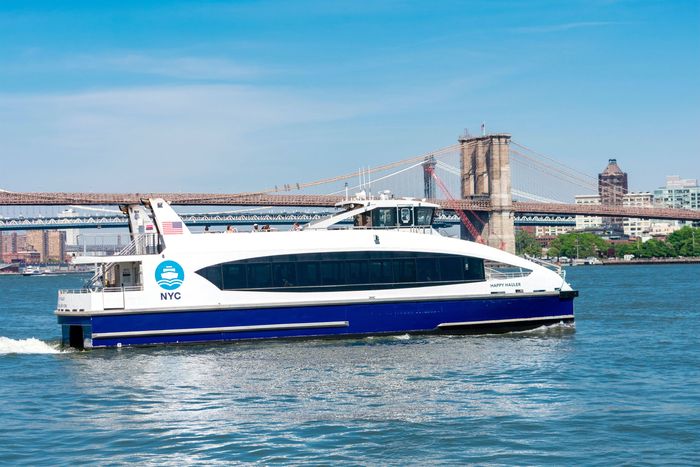
NYC transit yachts are broke

 https://pyxis.nymag.com/v1/imgs/b19/b16/ecd745abe635dc3167b88909292b8051a9-nyc-ferry.rhorizontal.w700.jpg

 Curbed

Hornblower Group, the San Francisco–based company that operates NYC Ferry, filed for bankruptcy yesterday, claiming it could not manage its roughly $1.2 billion of debt. One of its investors, the private equity firm Strategic Value Partners, agreed to acquire the company in a debt-for-equity swap that’s part of a larger restructuring, according to The Wall Street Journal.

Hornblower operates three primary divisions: an Australian company that seems to be doing well, a ferry and sightseeing division, and a luxury cruise division, American Queen Voyages. It’s this last unit, which mostly consists of old-timey paddlewheel riverboats, that Hornblower representatives in court said was the company’s “Achilles’ heel” that never recovered from the pandemic, according to Emily Lever of Law360. The company took on hundreds of millions of dollars in debt after its revenue dropped to $175 million in 2020 from $690 million just a year earlier.

Exactly how New York City’s ferry service fits into Hornblower’s restructuring is unclear. For now, CEO Kevin Rabbitt is adamant that service will not be affected, claiming the restructuring will allow Hornblower to eliminate debt unrelated to the ferry system while continuing “record growth across the five boroughs.” Indeed, a court filing described NYC Ferry as a bright spot in the company’s portfolio. Just last year Hornblower re-upped its contract with the Economic Development Corporation, the city nonprofit that oversees NYC Ferry, at $405 million over the next five years, with two optional three-year extensions. The EDC chose Hornblower despite a 2022 audit by comptroller Brad Lander that put the total taxpayer subsidy for ferry rides in 2021 at $12.88, nearly double the city’s previous estimate. (A 2019 study by the Citizens Budget Commission estimated taxpayers contributed ten times more to each ferry ride than each subway ride and, for a voyage on the ferry’s Coney Island route, taxpayers covered $24.75.) According to the EDC, the subsidy has since been reduced to $8.55 per ride.

Hornblower originally won the NYC Ferry contract in 2016 in a somewhat controversial deal. According to The City, Hornblower beat out a team of three local ferry operators, but Hornblower’s underbid came with a hidden cost. While the local operators had proposed using their own armada of water taxis, Hornblower asked taxpayers to front $232 million to buy 38 vessels and an additional $137 million at a later date for more boats. A spokesperson for the EDC at the time justified the arrangement, in part, by saying it was smart for the city to own its vessels — logic that flies in the face of the old adage that a boat is a hole in the water you throw money into.


Friday, February 23, 2024

Sacrificing life and limb for housing equity

 https://images.squarespace-cdn.com/content/v1/5b9ffe0f1137a680c2c08250/2a9ce6ff-1739-4e29-ae99-a732d2916509/IMG_6185.jpeg?format=2500w

 Queens Eagle

Another worker was injured at the construction site of a Rockaway affordable housing development being run by a construction company that lawmakers in January demanded be taken off the project, the Eagle has learned.

Earlier this month, a construction worker contractor Joy Construction was injured while working on building Edgemere Commons, a planned affordable housing development in the Edgemere section of the Rockaway peninsula.

The city’s Department of Building’s later found that the site’s safety coordinator had recently fallen out of compliance with their licensing, which had expired.

In January, several elected officials rallied at the site, calling on Joy Construction to be removed from the project due to a previous history of worksite incidents at other developments and because of a separate worker injury at Edgemere Commons.

On Feb. 8, DOB inspectors were called to the worksite, located at 5119 Beach Channel Drive, to investigate reports of a worker injury, according to the Department of Buildings.

At the site, it was determined a worker fell off a ladder after a harness they were wearing caught on a handrail.

The worker sustained minor injuries and complained of back pain, and was transported by an ambulance to a local hospital. DOB further determined that all required safeguards were in place, and they found no unsafe conditions at the scene at the time of their inspection.

However, while on site for the injury, DOB found that the site safety coordinator’s license had expired about a week prior and that the coordinator had not properly renewed their license.

A Stop Work Order was put in place by the Department of Buildings. The order was eventually lifted four days later when Joy brought in a new site safety coordinator for the job.

“I hate to say I told you so,” said Assemblymember Khaleel Anderson, who rallied against the contractor in January. “Unfortunately, I am disappointed by the news of this injured worker and the discovery of an expired site safety license, which prompted a Stop Work Order, but I am not surprised.

“Joy Construction has a troubled and well-documented history of criminal lawsuits, hazardous workplace conditions, and fatal worker injuries,” he added. “At a recent rally, my elected colleagues and I urged the city to remove Joy Construction from the Edgemere Commons project and out of the Rockaways entirely. I wish the injured worker a full and speedy recovery and will continue to demand accountability and fight for workers’ rights, dignity, and safety.”

Construction on Edgemere Commons began in May 2022. The project is a $100 million affordable and supportive housing development, which will bring 2,000 affordable homes, retail, community space, medical facilities and outdoor public space on the site formerly occupied by Peninsula Hospital.

The first phase of the project, directly adjacent to the construction site in question, was constructed using union workers rather than Joy, a private contractor.

In January, four local elected officials for the Rockaways and Southeast Queens rallied with union members to call for Joy’s removal from the project over the contractor’s recent history of workplace incidents, including an injury at Edgemere Commons in December that resulted in a $10,000 fine after the contractor failed to report the incident.

Lawmakers also raised concerns over an incident at a Joy Construction site that left a worker dead at the site of a Bronx project a year earlier. ]

“We are demanding that Joy come off of this project,” City Coucilmember Selvena Brooks-Powers said in January. “Joy has an unfortunate track record that has seen many deaths on construction projects where they have not taken enough care and concern for the worker. That is unacceptable.” 

Not so fast, let's hear some virtue signalling banalties from the Queens Borough Redundancy that won't lead to any fundamental changes for worker safety at the site...

 Queens Borough President Donovan Richards was not present at the rally, but said at the time that if issues persist, then a new contractor should be considered.

“Queens has been, is and forever will be a union borough — a borough where we uplift, protect and support the working people who make up our organized labor movement,” Richards said. “Safe, plentiful and prosperous union participation in the first phase of Edgemere Commons’ development via Arker Companies reflected that fact, and as we embark on the second phase of the project with Joy Construction, it is my belief that our brothers and sisters in labor should be treated the same way by the contracting company tasked with the job.”

“Should those common sense standards not be met as construction continues, then a new contracting company must be brought in to complete the project,” he added.