Showing posts with label army corps of engineers. Show all posts

Friday, May 27, 2022

Rage against the Rockaway Beach restoration


Impunity City 

From what it looked like on the first 90 degree day of the spring on the week before the “official start of summer” this Memorial Day weekend, the possible was achieved. For the fences that were supposed to deter people from going on the shore that were there for their safety were torn apart and beach combers made do with what little space on the sand there was.

The beachcomber rebellion was most glaringly apparent by B 91 street where the temporary summer shut down of the beach began. Two large stop signs were pried off and fencing was cut off to prevent access to the citizenry for their safety.

 Heading down the ramp towards the perilously eroded shore was a sight to behold as people made do and set up their places with what little sandy real estate they can find under the omnipresent cranes and some plows left behind for the continuing reconstruction of the shore to save the peninsula from being submerged.


Tuesday, January 28, 2020

Comptroller Stringer rejects federal seawall plan for city


http://theforumnewsgroup.com/wp-content/uploads/2020/01/StringerStormBarrier1.jpg

The Forum

 City Comptroller Scott Stringer on Friday fired off a four-page letter to the U.S. Army Corps of Engineers condemning their plan to construct offshore storm surge barriers in New York Harbor.

In the letter, Stringer castigated the corps’ proposal for not adequately protecting coastal communities from the threat of sea level rise and associated flooding. The Comptroller’s letter also highlighted the long construction timeline associated with the storm barriers and their high cost estimate — noting that the largest of the options outlined in the proposal would take a quarter of a century to build out, cost six times that of shorefront resiliency options, and endanger the delicate ecosystem of the harbor including the region’s network of marshes and wetlands that are critical to mitigating storm surge.

Stringer said he is calling on the agency to implement an integrated and environmentally-conscious approach that’s focused on onshore resiliency measures including localized floodwalls, dune and wetland restoration, living shorelines, reefs, and levees. Stringer’s missive noted that this approach was the only way to protect the city from rising sea levels, storm surge from non-catastrophic weather events, and increasingly catastrophic storms in the future.
 

The letter follows a May 2019 report published by the comptroller, “The Costs of Climate Change: New York City’s Economic Exposure to Rising Seas,” which exposed substantial underspending of federally-appropriated Superstorm Sandy recovery funding that the City had not yet allocated to protect vulnerable coastline communities including only 57 percent of a combined $14.5 billion in federal funds. The report concluded that lagging spending posed a threat to the 520 miles of coastline citywide, which is estimated at a combined property value of $101.5 billion within the city’s current 100-year floodplain map — marking a more than 50 percent increase in value since 2010.

“There’s no question about it — a future Superstorm Sandy will come and New York Harbor will bear the brunt of it. Too many of our waterfront communities are all too vulnerable to the next storm, or even the next high tide,” Stringer said Friday. “I am urging the Army Corps of Engineers to get shovels in the ground on shorefront resiliency options like floodwalls, dune systems, wetlands, and levees that can protect New Yorkers and their livelihoods. Lives are at stake, homes and businesses are on the line, and futures hang in the balance. We need to act with urgency, plan strategically, and build out resiliency efficiently in the era of climate change, because time is not on our side.”

Tuesday, March 5, 2019

Only eleven blocks of Rockaway Beach is getting new sand this year


Patch

 A popular strip of Rockaway Beach that was closed off last summer will reopen in time for beach season this year.

The city will reopen 11 blocks of Rockaway Beach between Beach 91st Street and Beach 102nd Street as part of a $7 million project to clean out the East Rockaway Inlet, U.S. Senator Charles Schumer announced Monday.

"Let there be sand – on Rockaway Beach!" Schumer said in a statement. "Kudos to Mayor de Blasio and the Army Corps for working together in a way that provides a critical positive fix for this situation. No one wanted to have another partial beach shutdown again this summer."

The U.S. Army Corps of Engineers will dredge the inlet and use the sand they gather to replenish parts of Rockaway Beach that had eroded, prompting safety concerns ahead of beach season last year.

"Rockaway Beach defines summer in New York City," said Mayor de Blasio. "Reopening this beach means a lot to this community and families all over the city. We've worked months with the Army Corps and our federal partners on a solution to get it done."

Only 7 million dollars. Yet no new jetties or groins that will actually remediate erosion. This is just an incremental, temporary and cheap fix.

Monday, February 25, 2019

Coastal erosion at Rockaway Beach has got menacingly worse


CBS New York

It’s not summer just yet, but one Queens community is fed up that nobody seems to be stepping-up to help in the year-round fight to save its beaches.

Residents say it’s been one broken promise after another to alleviate erosion on Rockaway Beach.
The Rodkin family were out for a winter walk along the concrete near the sand Friday afternoon. They’d have rather been strolling on the beach, but it’s been closed for months.
 
“Break’s my heart,” Alice Rodkin said. “My mom brought us here as kids. We can’t even enjoy our own beach.”
 
People who live nearby say the sand should be much higher than where it is, but rapid erosion means you’ll need to jump more than four feet to get from the boardwalk to the beach.

 Last spring, Cori said the erosion was “by far the worst” it had been. Fast forward to 2019, and the dunes are nearly half the size they were last April. He’s been fighting for the city and federal government to install barriers like jetties and rock groins to help protect the beaches as they’ve long promised they would.
 
“The Army Corps of Engineers said they’d be there in 2018 to tell us the plan,” Cori said. “Not even a word.”

 The federal agency says it’s working to make sure the area gets the most “effectively designed plan to reduce flood risk and combat erosion.” The city says its understanding is that should start late 2019.

This is a lot worse than what I saw last October in that same area.


 If only the city would heed it's own warnings from their lame art installation.


Update:

Here's a video of the ocean hitting the boardwalk entrance that reporter impressively jumped from.


Friday, July 13, 2018

Barriers proposed for NY Harbor


From WNYC:

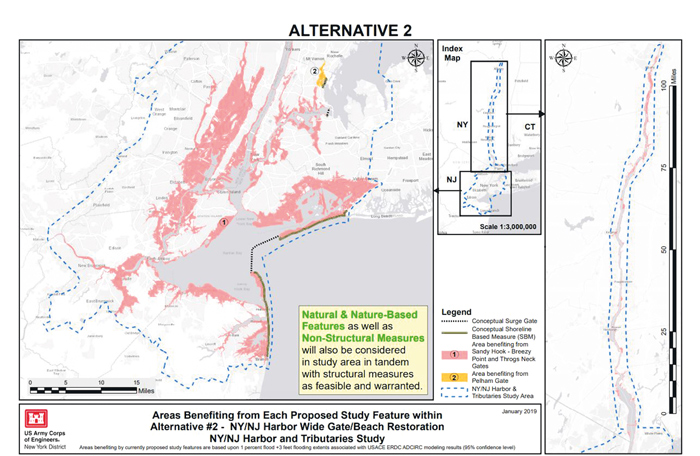
In a series of public information sessions this week, the Army Corps is presenting five options for protecting the area's waterfront, four of which involve storm surge barriers:

- a five-mile long barrier at the southernmost border of the lower bay, between Sandy Hook, N.J., and Breezy Point in the Rockaways;
- a smaller barrier between Staten Island and Brooklyn, across the channel that the Verrazzano-Narrows bridge spans, accompanied by gates across the mouth to Jamaica Bay and Arthur Kill;
- a series of berms and sea walls along low-lying portions of the New Jersey and New York City waterfront, along with small gates across some waterways;
- and an option that would only use berms and sea walls.

Friday, December 11, 2015

Crowley wants barges removed

From the Queens Tribune:

The federal government must remove two abandoned barges that are languishing in Flushing Bay, U.S. Rep. Joe Crowley (D-Queens/Bronx) said at a press conference on Monday.

“Flushing Bay has historically been and continues to be a critically important waterway for New York,” Crowley said. “The U.S. Army Corps of Engineers needs to recognize the urgency of this matter and act to immediately remove these derelict barges from our pay. They are not just an eyesore for our community. More importantly, they are polluting our water and creating an immediate safety hazard for the commercial, recreational and law enforcement ships that operate through the bay.”

The U.S. Army Corps of Engineers is currently dredging Flushing Bay, with an expected completion date on Dec. 26. The dredging is meant to restore federal navigation channels to their proper depth so that boats can use them for commerce and other purposes. As part of the project, the Army Corps are authorized to remove any barge or other object that blocks the federal navigation channels.

One barge did drift into the channel, and the Army Corps has taken responsibility for removing it. But before they do, they must go through a lengthy process to try and determine the owner of the barge, so that he or she can pay for its removal.

But Crowley argued that it was better to remove the barge first, and then find the owner.

Friday, July 3, 2015

Army Corps to clean up Fort Totten spot

From the Queens Chronicle:

The U.S. Coast Guard doesn’t use its 9.6 acres at Fort Totten anymore, but the government will be cleaning it up.

Gregory Goepfert, project manager for the U.S. Army Corps of Engineers, announced plans for removing lead-contaminated soil during a meeting Tuesday in Bayside.

The area is near the northern part of the fort between the ballfields and the old fortifications.

“We would like to go ahead and clean up the soil that has been impacted and replace it with clean material,” Goepfert said.

The 20,000-square-foot site would be refilled with clean soil from elsewhere. The endeavor will cost about $200,000.

Goepfert said the plan was preferable to alternatives like doing nothing, just fencing it off to the public or covering it with a landfill cap, but that would require additional maintenance in the future.

The Army Corps determined that it is the only one of five areas they tested at the fort that requires remediation.

Saturday, January 3, 2015

Nassau Expressway is in sad shape

Photo from Newsday
From the Forum:

The Nassau Expressway (Route 878) is a heavily commuted roadway that connects Southwest Nassau to Queens. Every day, approximately 40,000 vehicles travel along the expressway, which results in heavy traffic conditions, especially during rush hour. The roadway also serves as a storm evacuation route for some 400,000 people, designated as the route for the ambulance, fire vehicles, and police cars during emergencies, as well as residents that must evacuate during flooding or other natural disasters.

The expressway is currently in need of major repairs, given its significant number of potholes, exposed gravel, and poor drainage. Large puddles and flooding of the roadway occur with even minor rainfall. Although it was used as an evacuation road during Sandy, it flooded severely during the storm.

Repair projects along the expressway have been delayed for decades; most recently, in 2012, New York State delayed the project because engineers had concerns over soil and nearby tidal wetlands. As of now, design work is not expected to begin until at least 2023 and completed in 2025.

Senator Charles Schumer and State Assemblyman Phillip Goldfeder this week called on the U.S. Army Corps of Engineers to jumpstart a storm-surge protection and repair plan for expressway...

Saturday, June 21, 2014

Many beaches still not open in Rockaway

From the Queens Courier:

Just because a beach is open doesn’t mean people are allowed to swim there.

As of Thursday, only 29 of the more than 100 beaches in the Rockaways are open to swimming because of damage caused by Superstorm Sandy coupled with a dearth of lifeguards, the Parks Department said.

The rest have “normal access,” which, according to the Parks Department, means people are allowed to walk in the sand.

“Swimming is only permitted where there are lifeguards, which is never the entire seven mile beach,” said Zachary Feder, a Parks Department spokesman. “But walking is permitted along the entire length.”

Superstorm Sandy caused major damage to the beaches along Rockaway, which now has the U.S. Army Corps of Engineers working to repair many of them. They are using large pipes to pump sand from the ocean floor on to certain beaches which makes those specific locations closed to swimming.

Sunday, September 29, 2013

Replacing the Rockaway boardwalk a huge undertaking

From the NY Times:

Replacing it will be hugely expensive, with a tentative price tag of $200 million. It will involve 4.7 miles of new decking and about 50,000 linear feet of railing. And though work could start by the end of the year, the Boardwalk will take years to rebuild; just how many is unclear.

What is certain, however, is that it will not be made of wood. Soon after the hurricane, Mayor Michael R. Bloomberg said that the storm had laid to rest the debate over wood versus concrete as the preferred material for boardwalks. He pointed to the few concrete sections that had come through in relatively good shape.

The Army Corps of Engineers, which pumped nearly 600,000 cubic yards of sand onto the beach this summer, will eventually build whatever storm protections are chosen, but that will not happen for years, given the Corps’ lengthy technical and economic reviews. The Corps plans to share draft alternatives for the Rockaways with the public early next year, said Chris Gardner, a spokesman for the agency.

In the meantime, parks officials and engineers reassured the residents that the Boardwalk would be rebuilt to withstand future monster storms.

Not only will it be raised along its entire length, but the decking will be securely fastened to concrete pilings. The old Boardwalk had simply rested on the pilings, making it vulnerable to the storm surge.

Wednesday, August 28, 2013

Storms will bury NYC under water by the end of the century

From the Daily News:

Based on projections from the National Weather Service and the U.S. Army Corps of Engineers, if a storm equivalent in strength to Hurricane Sandy were to hit the five boroughs in the year 2100, vastly larger swaths of the city would be submerged.

The reason is simple. Sea levels are forecast to rise by as much as six feet before the end of the century, making low lying cities like New York all but defenseless to the wrath of powerful storms.

Unfortunately, over the past decade, scientific projections on sea level rise have grown rapidly as more data on climate change has continued to be analyzed.

Six years ago. the Intergovernmental Panel on Climate Change (IPCC) estimate that by 2100 sea level would rise by a maximum of 23 inches. In a draft of this year’s report, the final version of which is to be released this fall, the IPCC revised that outlook to a maximum of six feet.


But not to fear! The City has opened a water-resistant park at the edge of LIC, which is the only neighborhood in Queens that matters anymore.

From Curbed:

In a post-Sandy city, the first question that comes to mind with new waterfront developments is "how did it fare during the storm?" Hunters Point South, it turns out, fared very well. "We were surprised at how well the water drained," said Manfredi. "We always anticipated that there would be a major storm." Every part of the park is design to take on water. After Hurricane Sandy, all of the major surfaces were undamaged and intact, and most of the trees survived because all grades in the park were calibrated to accommodate storms, so the tree roots were protected.

No mention of the contaminated river and creek water that bathed Hunters Point.

Oh, and the trees survived because they weren't there yet. In fact, none of it was there on October 31, 2012. The satellite imagery proves it.

We'll see how well this area fares after the next 100 year storm, which, according to past experience, should be happening any day now...

Saturday, August 17, 2013

Rockaway coast restoration underway


From the Daily News:

By next summer, the beaches in the Rockaways will have as much sand as they did in the 1970s, but it remains to be seen how long they will stay that way.

Officials gathered near the surf Thursday to highlight the coastal restoration program, while concerned residents complained that another tropical storm would return the beaches — along with their coastal neighborhoods — to the condition they were in last fall, after Superstorm Sandy.

The U.S. Army Corps of Engineers has started a $36.4 million project to pump 3.5 million cubic yards of sand onto the peninsula’s badly eroded beaches, fortifying them against future superstorms and the raging Atlantic Ocean.

Rockaway residents, who lost their homes and businesses to superstorm Sandy, have been anxiously awaiting the sand replenishment, boardwalk reconstruction and other protection measures as another storm season looms.

Those who have taken an active interest in the work say the new sand is good, but they remain critical of the fact that rock jetties and other permanent structures, also important to shielding the coastal neighborhoods from the ravages of a superstorm, will not be built for at least three years.


There's also a research center at Jamaica Bay now to study the ecosystem.

Wednesday, June 12, 2013

New Bloomberg strategy: propose things that will never happen


From the Politicker:

Mayor Michael Bloomberg outlined a nearly $20 billion master plan Tuesday to shield the city from future Hurricane Sandys, complete with levees, sand dunes, bulkheads, flood walls and a proposed “Seaport City.”

The plan calls for the installation of removable “adaptable floodwalls” in riverfront locations across the city, including Hunts Point in the Bronx, along the East Harlem waterfront, the Lower East Side and the Financial District, as well as a new levee and floodwall system along the East Shore of Staten Island, with barriers that could rise as high as 15 to 20 feet.

The proposal, which the mayor is set to outline in a major speech at Brooklyn Navy’s Yard’s Sandy-damaged Duggal Greenhouse, also calls for the construction of a new dune systems in Staten Island and the Rockaway Peninsula, with a “double dune” planned for Breezy Point.

While the mayor has less than seven months left in office, he also proposed building a new “Seaport City” on the east side of Manhattan, similar to the existing Battery Park City near the Financial District. The new development, which could stretch all the way to Brooklyn, would be built on “a multi-purpose levee with raised edge elevations,” designed to protect the East River shoreline south of the Brooklyn Bridge, while creating a new mini-neighborhood.

Mr. Bloomberg, who has previously said that a sea wall plan was “not practical,” also wants to build a storm surge barrier at Newtown Creek and along Coney Island Creek, and announced plans to work with the U.S. Army Corps of Engineers to study the feasibility adding “surge barriers” across the mouth of Jamaica Bay to protect communities in Queens.


Meanwhile, people are getting creamed with insurance premiums and building costs.

Friday, May 24, 2013

Ain't no wave strong enough...

From the NY Post:

The city is moving closer to getting emergency housing with the selection of a three-story, three-unit prototype — complete with balconies — that will soon be erected next to the Office of Emergency Management in Brooklyn.

The prototype includes two, 822 square-foot three-bedroom units on the upper two floors, and one 480 square-foot one-bedroom handicapped accessible apartment on the ground floor — still far larger than the city’s 250-to-370 square-foot permanent Micro Units.

We’ve learned the mini-complex — designed by Garrison Architects of Brooklyn for American Manufactured Systems and Services of Vienna, Va. — was selected this month for the $1,135,147 contract by the US Army Corps of Engineers.

Friday, April 26, 2013

Beach replenishment starting in June

From the Daily News:

The first extra dose of sand is coming this June to storm-worn sections of Rockaway’s beaches.

The most eroded sections between Beach 89th and Beach 149th Sts. will get 1 million cubic yards of sand dredged from the East Rockaway Inlet, officials said Tuesday.

“We know the U.S. Army Corps of Engineers has been working hard to bring sand to Rockaway,” said Queens Parks Commissioner Dorothy Lewandowski. “We look forward to its arrival and will do everything we can to help get it in place as quickly and safely as possible.”

Portions of the beach will close while the sand is added.

Meanwhile, another 2.5 million cubic yards of sand is slated to beef up the entire beachfront from Beach 19th to Beach 149th streets. That project is not expected to start until August and could take between six and nine months to complete.

Thursday, February 14, 2013

The Rockaway recovery is just beginning

From NY1:

The Army Corps of Engineers is telling residents of the Rockaways their beach will be restored over the summer, but officials say it's just a temporary fix for the kind of storm damage that only happens once every 250 years. NY1's Michael Herzenberg filed the following report.

Hurricane Sandy wreaked havoc on the beach in the Rockaways with the biggest waves ever recorded there. One, according to the Army Corps of Engineers, was 32.5 feet.

The water washed away 1.5 million cubic yards of sand, more than enough to fill the Empire State Building. But the feds say they'll replace the sand before next year.

"Our task is to construct a restored beach to the original authorized design which is a beach sand and a beach berm plus 10 feet above sea level and at least 100 feet wide," said Dan Falt of the Army Corps of Engineers.

The Army Corps told a Community Board meeting packed with Rockaway storm victims the Rehab work will go from Beach 19th to Beach 149th street. Contractors will close 1,000 feet of beach at a time for three to four day stretches. The whole project will take four to six months but it can't start before June.

"We have to get environmental permits, we have to make sure that the dredge bar sites are clean and proper and appropriate. We have to do a federal contracted process which does take some time," Falt said.


From the Daily News:

But many were disappointed it didn’t include more concrete proposals for long-term solutions, such as additional rock jetties or dunes.

“I was expecting to hear more about protection and protection now, not a temporary fix, a band-aid,” said Danny Ruscillo Jr., a Rockaway Park resident and civic activist.

Falt said the Army Corps will work with the city and the community on more permanent solutions for beach’s chronic erosion issues.

Sandy slammed into Rockaway, destroying whole portions of the boardwalk. It triggered fires and flooding that left the peninsula reeling.

Residents said they feel particularly vulnerable without the boardwalk as a barrier.

Thursday, November 29, 2012

City burning trees felled by Sandy


From CBS:

Getting rid of the debris was a major mission a month after Superstorm Sandy, and in Brooklyn on Wednesday, some of the debris was going up in smoke.

As CBS 2’s John Slattery reported, the wrath of Sandy brought down 15,000 trees in the city alone.

The trees have been chipped into 100,000 cubic yards at Floyd Bennett Field in southeast Brooklyn.

City and state environmental officials and the Army Corps of Engineers said the wood will be used for biofuel, for mulch and for landfill cover. But up to 500 cubic yards were being burned in a special incinerator.

City environmental officials said it is a clean way of burning, but CBS 2 was not allowed to look at it up close.

The contraption, the size of a shipping container, is called an Air Curtain Burner — a ceramic-lined firebox that burns debris as a diesel-powered pump shoots air over the box, creating a trap to keep fire and smoke from getting into the open air.

“The air current really suppresses smoke and particles that come from the fire,” and less particulate gets out, said city Department of Environmental Protection Commissioner Carter Strickland.

But not all of the particulate is prevented from escaping, and the U.S. Environmental Protection Agency was monitoring the air at eight spots around Floyd Bennett Field.

The closest residents to the field are those who live in the Rockaways, Marine Park and Mill Basin.

Wednesday, October 31, 2012

Failure to heed the warnings


"NYC was warned by the Army Corp of Engineers in 1995 of just such a storm. They were also told how to prevent the damage. Did they follow the Army Corp of Engineers recommendations? If not why?

NYC cant say it wasn't warned.

Article in Popular Mechanics detailing Army Corp of Engineers reports is here...." - anonymous

Oh and then there's this from earlier this year from The Capital:

But let's say, in a worst-case scenario, that parts of the city or one or some of its systems flood completely in an event like what planners call a "100-year storm" (a storm so severe its likelihood is estimated at one percent in any given year).

Many of them will not rate under the economic definition of "risk," because the value is too low. And this is where the standard risk-assessment falls apart: It is scientific and political; it does not factor in entire low-lying neighborhoods with low-rise housing under water.

Then there are infrastructure systems, which, compromised in one place, can spread mayhem far and wide. Water supply, sewage treatment, and energy supply, all built largely underground, mostly many years ago, are potentially vulnerable.

Bragdon said the administration is really beginning in earnest this year to assess risks to those three key areas. Any institution that has assets that could be affected by climate change is in his purview, which means not only the city's own, but those of private providers, like Con-Ed, which be a part of the process.

Imagine a scenario in which a 100-year-storm flooded all of the parts of the subway system that are most susceptible — the tunnels that carry trains under the East River to and from Manhattan, and the major connection points in Lower Manhattan. Then Brooklyn, Queens and Long Island would essentially be cut off from the mainland for the millions of commuters who pass through those links every day. And not for a short time.


The NY Times has a summary of the warnings.

Sunday, October 28, 2012

Rockaway Beach a victim of its own success


From the Daily News:

About 7 million people visited the beaches in Rockaway this year, more than double the number of recent years, according to city figures.

They were lured by the waves, sand and a new batch of groumet foods available at the boardwalk concessions.

But while the crowds are good for businesss, local officials said, they are also stretching the already thin police and parks resources to the breaking point.

“We are finally getting what we want,” said John Lepore, president of the Rockaway Chamber of Commerce. “But the maintenance could not keep up. We need to clean up more often and have more security.”

Community Board 14 fired off a letter to Mayor Bloomberg last week, asking him to increase the number of police and parks workers assigned to monitor Rockaway beaches.

They pointed out the boardwalk is still battered from years of use and storms and there are not enough ramps to make the beach accessible to everyone.

“Our beaches are dirty at times due to the shortage of an adequate amount of garbage baskets,” Community Board 14 District Manager Jonathan Gaska wrote in the letter on behalf of the board. “We are also deeply concerned with the lack of adequate police staffing during the summer season.”

The board does give the Parks Department credit for working “miracles” with limited resources but said the administrative “sleight of hand” no longer works.

“Rockaway is treated like a stepchild,” fumed City Councilman Eric Ulrich (R-Ozone Park). “You would never see this in Central Park.”


From the Daily News:

Some Rockaway residents are worried that long-awaited beach replenishment plans are washing away.

The U.S. Army Corps of Engineers has already started dredging the East Rockaway Inlet, a move that will provide sand for eroded beaches along the western sections of the peninsula.

But unlike previous years, the sand will not be piped up to the beaches. Instead it will be dumped around Beach 30th St. and then moved separately by Parks Department contractors.

“I’m concerned that if they stockpile it, it will erode away,” said John Cori of Friends of Rockaway Beach, which launched a “Demand the Sand” campaign.

This summer the city announced it dedicated $3 million for a project to move dredged
sand to fill in the battered shoreline between Beach 85th St. and Beach 105th St., centered around Beach 92nd St.

Assemblyman Phil Goldfeder said he was concerned that the dredging project moved so quickly that the Army Corps was unable to work in conjunction with the Parks Department.

In previous years the two agencies worked together on a plan to dredge and then pipe the sand to specific beaches.