Showing posts with label hurricane. Show all posts

Tuesday, September 13, 2022

City officials are betting on rain gardens to stop floods from the next hurricane


 Queens Chronicle

As the city marks the one-year anniversary of Hurricane Ida, the effects of which have some displaced families still living in hotels, Mayor Adams warns that climate change could lead to intermittent weather abnormalities becoming the norm.

“Thirteen New Yorkers died in their basement apartments due to flooding,” Adams said. “This traumatized our city. But climate change is bringing longer droughts, stronger storms and heavier rainfalls to places all over the globe.”

To help mitigate the effects of the next colossal rainfall event, Adams and other elected officials and department heads were in South Ozone Park last Thursday to announce the creation of an additional 2,300 rain gardens, the continued expansion of the city’s Bluebelt program and other green infrastructure initiatives aimed at relieving some of the burden on the city sewer system that was overwhelmed by last summer’s rainfall.

The city’s sewers were built to withstand rainfall at a rate of 1.75 inches per hour, according to Department of Environmental Protection Commissioner Rohit Aggarwala. Last summer alone, the city experienced two separate instances of rain falling at a faster rate: Hurrican Henri, when per hour totals reached 1.94 inches, and Ida, which dumped 3.75 inches per hour.

“Our path to resilience requires us to look to nature, to augment our sewer system, to build green infrastructure that will compliment our gray concrete infrastructure,” Aggarwala said. “Separately, neither would do the job, but the combination of well-maintained sewers and extensive green infrastructure can make New York City resilient in the face of the storms to come.”

While the city will continue to build out traditional “gray” infrastructure, including the installment of sewers in areas of Southeast Queens that had previously been overlooked, an Ida-level event cannot be contained by sewers alone. Aggarwala says the creation of green infrastructure initiatives eases the burden on the traditional drainage system by redirecting or storing excess rainwater until a storm passes.

Rain gardens — like the one at 135th Avenue and 127th Street where the officials spoke — are designed to absorb water into the ground and help keep the sewer system from being overwhelmed. Bluebelts, a program initiated on Staten Island that has expanded into Queens and the Bronx, involves the adaptation of naturally existing streams and wetlands into stormwater filters, bringing the water away from city streets and into larger bodies of water.

Also announced was a pilot of the city’s Cloudburst program, aimed at redirecting stormwater from city streets into specially targeted public places.

The program’s first run will take place at the New York City Housing Authority’s South Jamaica Houses. Construction is set to begin in 2023, with two grassy areas and a basketball court that will be rebuilt at a lower elevation targeted for water storage.

Similar projects are in planning stages in the St. Albans/Addisleigh Park neighborhood and in East Harlem.

Adams also announced an expansion of the city’s Floodnet sensors, designed to provide real-time flooding data to city agencies, residents, emergency response teams and researchers, along with “daylighting” plans to bring previously covered streams back to the surface in the Bronx.

“This is more than just infrastructure,” Adams said. “This is how we’re going to protect our city and people from rising sea levels and stronger storms. This is how we can create good jobs because it’s about also using one solution to address a multitude of problems.”

“We’re going to continue to be prepared for whatever challenges that we have to face. We will pivot and shift and adjust,” he added.

In a phone conversation with the Chronicle on Tuesday, state Sen. Jessica Ramos (D-Jackson Heights) offered a blunt assessment of the city’s current plan and its response, as well as the federal and state responses, to last summer’s storm.

“A lot of what was released in the current plan is kind of a recount of things that are already being worked on or projects that have been completed,” she said. “Rain gardens are great, bioswales are great, but, I mean, how many are we really going to build and is that going to be enough?”

“It just feels like everyone remembered hurricane season was rolling around again only lately,” she added. “Little has been done since Hurricane Ida last year.”

Saturday, July 17, 2021

Forgotten sidewalks


 https://bloximages.chicago2.vip.townnews.com/qchron.com/content/tncms/assets/v3/editorial/f/23/f2330916-b5b0-5037-8f86-474aa6703d78/60f044b4bf36d.image.jpg

Queens Chronicle 

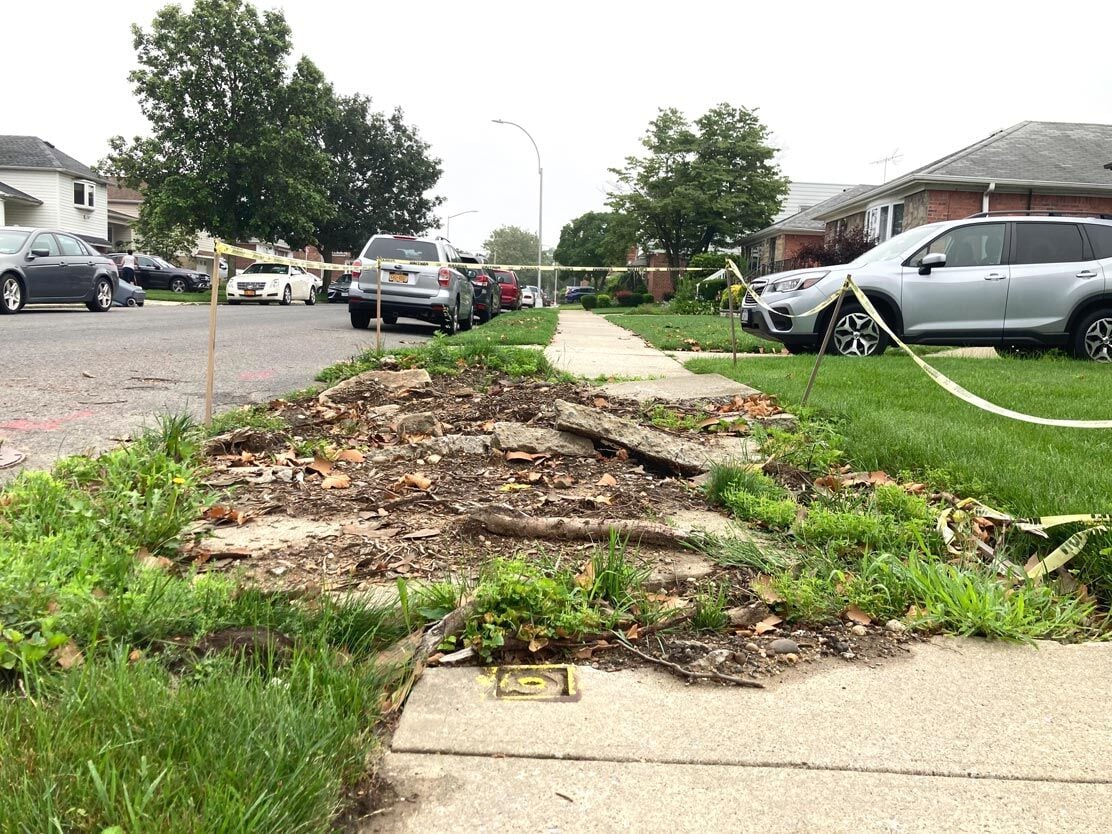
 It’s almost been one year since Hurricane Isaias hit New York City, took out power for days and tore trees from their roots, but plenty of sidewalks throughout Queens look as though the storm ravaged them yesterday.

“We know that if this was in Manhattan, the issue would be fixed already. The outer boroughs, the last I checked are the real boroughs, so get this done,” Queens Borough President Donovan Richards said at a July 13 press conference to demand the city take responsibility for what he called a public safety hazard.

State Sen. John Liu (D-Bayside) called the Tuesday press conference in Bellerose as a “last resort” after he spent months calling on the city to repair broken pavement sprinkled across his district. Shattered sidewalks can be found there, as well as in College Point, Whitestone and Flushing separated from the public only by caution tape.

Kathy Parent’s Bellerose home, where the event was held, lies alongside 87th Road, where a tree was ripped from the city-owned grass space last August during the storm. The roots shredded the concrete, which has been left untouched since the city Parks Department removed the fallen tree months ago.

“I take pride in maintaining my property to the best of my ability, so I am very distressed by the fact that my sidewalk exists in this horrible condition, but more so dangerous condition,” Parent said, adding that children have attempted to ride their bikes over the mess.

Parent said she wouldn’t consider fixing the sidewalk herself and then billing the city for reimbursement because she believes she would end up waiting 20 years for the check. She said she replaced the sidewalk herself several years prior and refuses to put more money into it, especially when it is the city’s responsibility.

“Kathy, we know if the shoe was on the other foot, if this was your responsibility, every single person the city could send to find you would be here by now, so this is really about ensuring that the government practices what it preaches,” Richards continued.

According to Liu, the city promised to address the problem in the spring when the weather was warmer, but summer is halfway finished and he hasn’t seen any changes across Eastern Queens.

That morning, Mayor de Blasio was asked by reporters if he was aware of the situation and what action he would take to ensure the homeowners would finally see relief after a year.

“We’ll get to work on it immediately,” the mayor responded. “It really bothers me to hear that this much time has passed and anyone isn’t getting the help they need. So, we will expedite that.”


Tuesday, August 11, 2020

City Council pruned budget for tree inspection and maintenance

 THE CITY


The city’s canopy of more than 2.6 million street and park trees will have to wait for scheduled prunings due to new budget cuts — a move slammed by a former Parks Department commissioner as “foolish” and dangerous.

The Fiscal 2021 Executive Plan includes a budget reduction of $7.2 million for tree pruning contracts, leaving about $1.5 million for the job. City trees are generally trimmed every seven to 10 years.

Park advocates and government officials, pointing to past incidents where people were severely injured — or worse — by plummeting branches, sounded the alarm over the cuts.

“The problem with not pruning is if a limb falls from a tall tree, it can cause tremendous damage. It can kill people,” said Adrian Benepe, who served as Parks commissioner from 2002 to 2012.

“It’s a meaningless cut that could cause damage both to the trees and to people.”


After the city slashed tree-pruning funding in 2010, tree-related injury claims soared. By delaying pruning contracts, the city saved $1 million — but settlement costs neared $15 million, records show.

“One bad tree limb fall wipes out all your savings,” said Benepe. “This saving is pennywise and pound foolish.”


During 2010, the city pruned less than 30,000 street trees — 50,000 fewer trees than the year before. Full funding for the Parks pruning program wasn’t restored until FY2013 when the 10-year pruning cycle was reinstated.

Claims for injuries caused by trees increased by 92% — from just under 400 claims to over 700 — during the period of reduced pruning and maintenance. In some community districts outside Manhattan claims increased by 590%, according to a 2015 ClaimStat report by City Comptroller Scott Stringer.

In 2015, Stringer told the City Council that there is a direct correlation between million-dollar legal claims and the amount of money the city allocates for tree pruning each year.


Reduced tree pruning isn’t synonymous with dangerous conditions, said Dan Kastanis, a Parks Department spokesperson. “Tree pruning is important, but inspections keep people safe, and proactive tree inspections are continuing in every borough, every day,” he said.


Tuesday, May 7, 2019

The city approves plan to stack sandbags four feet high to mitigate flooding from hurricanes


New York Times


After Hurricane Sandy devastated New York in 2012, city officials considered some drastic responses to storm surges, like long concrete sea walls and tall earthen berms.

But as the seventh hurricane season since then approaches, the city is relying on something more modest as the first line of defense against another inundation of Manhattan: a row of glorified sandbags.

In the next few months, the city’s Office of Emergency Management plans to oversee the installation of four-foot-tall sacks of soil along the East River esplanade, from Wall Street to just north of the Brooklyn Bridge.

For up to five years, they essentially would form the only barrier to keep water from again rushing into the low-lying neighborhoods around the South Street Seaport.

City officials say they are a temporary step while permanent solutions to New York’s vulnerability to big storms are still being planned and debated.

But the barriers have already provoked derision.

“Six years of studying it and you come up with sandbags? Really?” said Marco Pasanella, whose family owns a 180-year-old building with a wine shop that faces the river on South Street. He said he felt no less vulnerable than he did on the night that Sandy flooded his shop and left the district without power for two weeks.

Along with the doubts about their effectiveness, the barriers have also been panned as unsightly interlopers along a stretch of waterfront popular with pedestrians and bicyclists — one woman called them “atrocities.”

They will cover only about one mile of the waterfront, leaving the area below Wall Street unprotected, possibly for another decade or longer.

Friday, December 1, 2017

Bad contractor in Broad Channel


From PIX11:

...what’s with contractor Dennis Melandro? He STILL hasn’t finished rebuilding Victoria Roehling’s Broad Channel home damaged badly by Hurricane Sandy. She’s paid him $280,000 and he told me back in September that the job could be done within two weeks. Here we are more than two months later and there’s still a lot more to do.

And this week Victoria says she found he’d plugged a long blue extension cord into her home to get electricity for a job he’s doing two houses down. She’s now considering a possible criminal complaint. We’re going to stay on this until Victoria is back home.

Thursday, November 2, 2017

Rockaway getting a funding boost

From the Daily News:

On the fifth anniversary of Hurricane Sandy, Mayor de Blasio announced plans to spend $145 million on seven park projects to help protect the Rockaways from future floods.

The city will launch the projects – with federal approval – starting with rebuilding Bayswater Park. The work includes installing a berm along the waterfront, plus building sports fields, play areas and a kayaking spot.

The cash comes from $120 million left over from the $480 million the feds earmarked for rebuilding the Rockaway Boardwalk, which Sandy destroyed. The money can be moved to other resiliency projects in the neighborhood.

The city is kicking in another $25 million.

Friday, October 13, 2017

De Blasio: Puerto Ricans who come to NY must have family here


From CBS 2:

Life after Hurricane Maria for thousands of Puerto Ricans could mean a new life in New York City.

As CBS2 Political Reporter Marcia Kramer reported, Mayor Bill de Blasio said there will be health and educational support. But he said finding a place to stay is up to those who arrive.

It was only a few weeks ago that Mayor de Blasio walked to a Brooklyn firehouse to donate diapers to people in Puerto Rico who were devastated by Hurricane Maria. And while the city certainly intends to help the displaced, there is a limit – they will have to stay with family members because the city will not provide housing.

Kramer asked de Blasio what if they are to do if they come to New York and do not have family – and whether they will have to stay in hotels or whether affordable housing might be allotted. She asked if the city has any money available if Puerto Ricans coming to New York need any financial assistance.

“Marcia, we do not have that plan, and I don’t want to encourage people to come here if they don’t have some family to turn to,” de Blasio said. “I think we have to be really clear about that.”

Sunday, July 9, 2017

SI wetlands are too dangerous for development


From Crains:

The de Blasio administration is adding a new type of neighborhood to its zoning arsenal: ghost town.

The City Planning Commission will hold a public meeting next Wednesday on a proposal that would discourage new development in the three Staten Island neighborhoods hardest hit by Superstorm Sandy: Graham Beach, Oakwood Beach and Ocean Breeze. The areas proved to be so flood-prone that they were included in a state program that purchased damaged homes at prestorm prices, then tore them down so the area could be returned to nature. The city's zoning proposal aims to aid that process by preventing new houses from being built.

"In some limited locations … conditions are not appropriate for significant new development," a Department of City Planning spokesman said in a statement. "Given the high risk of flooding in these areas and their proximity to ecologically sensitive wetlands, [City Planning] is moving forward with a proposal that will limit future residential density while maintaining the ability of existing homeowners to invest in making their homes safe and resilient."

The new rules would allow only single-family homes to be constructed in the future and only if the builder is able to obtain a permit from the planning commission, which would likely frown on most applications.

Sunday, April 16, 2017

Edgemere's vision for its future

From Curbed:

As sea levels continue to rise, difficult choices are facing Edgemere and many other communities around New York City, and the outcomes of the strategies used here will only become more relevant in the years to come.

The Resilient Edgemere plan presents a variety of short- and long-term projects for the neighborhood, comprising zoning changes, new residential development, and transportation improvements. Some of the highlights include a $14 million investment into creating an elevated berm along the neighborhood’s unprotected coastline, a $68 million investment into NYCHA’s Beach 41st Street Houses, and the elevation of 41 attached homes above flood risk levels.

The most striking physical changes proposed in the plan are a new rocky shoreline that could replace the existing salt marsh habitat along the coast of Jamaica Bay, and the numerous illustrations showing that the northernmost part of Edgemere’s residential community, on Beach 43rd Street above Norton Avenue, would be replaced by open space and a new park. “As a proposal of de-densifying the area above Norton Avenue, the short-term tool there would be to change the zoning so that new construction of housing would not be possible,” explains Morris. “Over the long term, this area would transition from a housing area to a less-housed area. What that means is maintaining the balance of the population of the community and moving it to a safer space.”

Wednesday, December 7, 2016

City & Feds overspent on Sandy recovery

From the Wall Street Journal:

New York City will use millions of dollars from its capital budget to fully fund dozens of storm-protection projects that were expected to be paid for by federal Sandy money, officials say.

Superstorm Sandy did an estimated $19 billion in damage and the city received a $4.2 billion federal grant to help rebuild from the October 2012 storm. The city initially planned to use more than $500 million of that amount on projects such as raising shorelines and rebuilding critical infrastructure.

Instead, the city ended up using the half-billion dollars in federal resiliency funds to pay for cost overruns in its Build Back Program, which fixes, elevates and rebuilds homes damaged in the storm.

The city is tapping the its more than $14.5 billion-a-year capital budget to fill the gap. The capital budget is used to fund long-term infrastructure projects.

Saturday, October 29, 2016

Still Building It Back


From NBC 4:

Walk through the Queens community of Broad Channel with the head of New York’s Build it Back program, and every aspect of the embattled program is crystal clear: there are signs of construction everywhere, but homes are still in limbo. Pei-Sze Cheng reports.

Tuesday, October 25, 2016

Being mobilized helps

From DNA Info:

The low-income communities of the Lower East Side and the Rockaways both suffered extensive damage from Superstorm Sandy four years ago.

But advocates on the Lower East Side were able to engage more effectively in post-storm resiliency efforts than their counterparts in Queens because they already had a robust network of community activism in place from years of fighting gentrification, according to a recently published study from the John Jay College of Criminal Justice & the Graduate Center.

Researchers focused on the role of community organizations and being able to respond to the “climate change politics” of the city, which is increasingly important as the frequency of storms is expected to rise along with rising sea levels, noted Leigh Graham, John Jay environmental psychology professor and lead author of the study.

While both areas have high concentrations of public housing residents and low-income households, the Lower East Side’s pre-existing civic infrastructure of community based organizations and social services fighting against development pressures enabled residents to recover more quickly, according to researchers who spent six months interviewing community groups in the area and 18 months in the Rockaways.

The Rockaways, on the other hand, were at a disadvantage, not only because the area is more geographically isolated on the far edge of the city, but also because it’s more racially and economically segregated.

There’s a high concentration of poverty along the eastern part of the peninsula where the residents have suffered from decades of economic “malaise,” which in effect weakened and undermined their post-storm response, researchers found.

“The Lower East Side and the Rockaways had similar levels of exposure in terms of storm flooding,” Graham said, “but the Lower East Side groups were basically a partner in a lot of the resiliency efforts after the storm, in part because residents, who live there, have been fighting gentrification for 30 to 40 years and established a level of organization, trust and power, that they were able to get a seat at the table as important stakeholders.”

Community groups on the Rockaways did not have the same level of organization prior to the storm and remain more focused on meeting present economic needs than on pursing long-term resilience planning, she noted.

Friday, October 21, 2016

Build-It-Back deadline will be missed


From NBC:

The "Build it Back" program will not make its goal to rebuild Sandy-ravaged homes by the end of the year. Pei-Sze Cheng reports.

Saturday, September 24, 2016

Building it Back on the city's dime

From the Wall Street Journal:

Mayor Bill de Blasio’s administration plans to use $500 million in New York City taxpayer money to fund initiatives related to superstorm Sandy that were expected to be fully paid for with federal aid, city officials said Wednesday.

The city’s plan to infuse half a billion dollars into Sandy recovery and storm-protection programs comes as the cost to U.S. taxpayers for repairing and elevating some of the houses damaged by the 2012 storm could hit about $1 million a home, according to documents reviewed by The Wall Street Journal.

Tishman Construction submitted a package of bids to the city earlier this month to elevate 53 homes in Queens damaged by the 2012 storm for $50 million, according to documents and a person familiar with the bids. Tishman is overseeing hundreds of properties in the Build It Back program, an initiative dedicated to assisting owners whose homes were damaged by Sandy.

Build It Back has, to date, been bankrolled with federal Sandy relief funds allocated to the city by Congress through the U.S. Department of Housing and Urban Development. The federal government is also funding a number of storm-protection initiatives aimed at protecting the city in the future.

But significant cost overruns in Build It Back appear to be leaving city taxpayers on the hook for some of the storm-protection initiatives. The program is about $500 million over budget.

Sunday, July 31, 2016

Firefighter and wife lied about Sandy damage


From CBS:

An FDNY firefighter and his wife stood accused Monday of lying to the Federal Emergency Management Agency to collect thousands of dollars in Superstorm Sandy benefits.

As CBS2’s Ali Bauman reported, 12-year FDNY veteran Christopher Poje, 43, and his wife, Margaret, 39, walked out of court in Queens after their arraignment Monday afternoon,

Christopher and Margaret Poje both face grand larceny charges, while Margaret Poje also faces forgery charges.

Wednesday, May 4, 2016

Sandy-damaged properties up for auction

From AM-NY:

More than three years ago, superstorm Sandy devastated homes across the Northeast, many of them right here in New York City.

In the aftermath of Sandy, Gov. Andrew Cuomo’s Office of Storm Recovery was tasked with purchasing damaged homes in an effort to help rebuilding efforts within some of the city’s hard-hit communities.

Now, New York state has teamed up with Paramount Realty USA to auction dozens of homes in Staten Island, Queens and Brooklyn for less than their pre-storm values.

With bids starting as low as $14,650, these Sandy-damaged homes might just be your opportunity to plant new roots in New York City at a much lower cost.

The auction will take place at the Hilton Garden Inn, located at 1100 South Ave., in Staten Island on Tuesday, May 10, 2016.

For complete information on these homes and for due diligence information, head to prusa.com.

To register for the auction, you can submit a completed bidder’s affidavit to info@prusa.com or fax it to (516) 558-1148.

Tuesday, March 29, 2016

A lot of Sandy damaged homes are still not repaired

Forgotten-NY recently visited Broad Channel and stumbled across this house. Many others are sill in disrepair, years after Sandy. Electeds are blaming the DOB.

Sunday, October 4, 2015

Moldy Sandy foreclosure still not cleaned up

From CBS2:

A Queens family is still trying to recover from Superstorm Sandy.

As CBS2’s Hazel Sanchez reported, cancer survivor Joyce Zoller said she’s devastated after being ordered by her doctors and attorneys to move from her Queens home to Florida.

Not because her house is unsafe, but because she said the abandoned home next door is hazardous to her health.

“The mold, the smell, the vermin inside, birds flying all over, it’s a disaster,” said Zoller. “I don’t know how much more I can take. It’s my home and I can’t even live in my own home.”

CBS2 met with the Zollers in June of 2014 and learned their neighbor at 145-08 Neponsit Ave. had abandoned the property after Superstorm Sandy.

Black mold had been growing inside the home.

City records show HSBC Mortgage took ownership after it went into foreclosure, but as owners did nothing to clean up the mold.

A Department of Buildings inspector stopped by the house Thursday morning, slapping HSBC with another violation for failing to maintain the building, Sanchez reported.

HSBC has been issued multiple building code violations since Superstorm Sandy and faces more than $20,000 in fines.

Saturday, July 25, 2015

Zoning changes for Sandy affected communities

From the Queens Chronicle:

The City Council on Thursday unanimously passed a zoning text amendment aimed at easing restrictions for homeowners looking to rebuild their houses in Sandy-affected communities.

The Special Regulations for Neighborhood Recovery text amendment expedites the process for elevating houses in Community Districts 10, 13 and 14 in Queens and in parts of Brooklyn and Staten Island.

The new zoning rules:
• Allow homeowners to elevate or rebuild homes even if the structure doesn't comply with zoning. As it stands, homeowners cannot be approved for elevation if their property does not conform to code.
• Create a “zoning envelope” to allow homes to have a wider footprint than they have now. This is aimed at ceasing the construction of tall buildings with narrow lots, according to city officials.
• Permit homeowners to elevate parts of a structure even if it is below the adjacent grade level. As it stands, homeowners are not allowed to do that.

Saturday, April 25, 2015

City trees still suffer from Sandy's effects

From the Epoch Times:

Some of these bare-branched apparitions are still hanging on to life, but haven’t woken up to the season yet. Some are marked by the city for deletion using a green-painted “X” or small metal tags. Others are tagged “DEAD TREE” in white spray paint, probably the work of a rather literal-minded denizen.

Dead trees are the long-term blight left by the hurricane, a legacy that will continue to be felt in New York’s coastal communities for the foreseeable future.

In the immediate aftermath of Sandy, almost 11,000 street trees and 9,000 park trees were destroyed. That’s $28 million in day-of-storm tree damages.

In the years since Sandy, the work continues. In Brooklyn alone, 48,000 trees have been inspected, once in the summer of 2013, and again in the summer of 2014, resulting in the removal of more than 2,500 storm-impacted trees. The Parks department’s crews do their inspections during the summer, when trees would be at their peak leaf-out, to be sure of their vitality or lack thereof.

Monitoring the health of storm-impacted trees will be an ongoing responsibility for at least another two years, especially along New York City’s 520 miles of coastline.