Showing posts with label downtown Manhattan. Show all posts

Tuesday, February 18, 2020

Landmarks Preservation Commission has spent over $60,000,000 on new office space that's still not done


THE CITY

It took nine months and $8 million to build a two-story library near Van Cortlandt Park in The Bronx last year.

Meanwhile, a project to repair office space and construct a hearing room for the city Landmarks Preservation Commission’s new home has ballooned to an estimated $62 million — and the completion date has been delayed four years.

The budgeted cost has jumped by $33 million since 2016 due to structural problems discovered inside the historic Postal Telegraph Building in Lower Manhattan, according to records from the city’s Department of Design and Construction (DDC).

The expected bill dwarfs the commission’s $7.2 million annual operating budget.

“DDC has to get better with rolling with scope changes,” said Jonathan Bowles, executive director of the nonprofit Center for an Urban Future.

Near the end of Mike Bloomberg’s mayoral tenure, the commission asked for additional space, noting its staff had grown 35% “to meet demand for the increasing number of permit applications.”

The Landmarks Commission’s move — from the Municipal Building at 1 Centre St. into six floors at the landmarked 253 Broadway, near Murray Street  — was approved by the city’s budget office and the department that oversees office space.

The expanded office space and modern hearing room inside the city-owned building initially was expected to be ready by December 2017, records show. But the project is currently 39% complete and is now set to be finished in Spring 2021, according to DDC.

“A lot of additional work was added since the project was created,” said Ian Michaels, a DDC spokesperson, noting some of the repairs were tied to unavoidable safety measures.

Engineers discovered a leaky roof, asbestos and damaged terra-cotta ceilings, he said. They also cited needs to remove abandoned wiring, repair water damage from old leaks, restore sidewalk vaults and install a new central exhaust line for bathrooms to get up to code.

The issues have led to 119 so-called “work change” orders so far, Michaels said.

Mayor Robert F. Wagner created the Landmarks Preservation Commission in 1965 to protect historic and architecturally significant structures. The agency, comprised of a panel of 11 commissioners supported by a staff of 84, receives around 14,000 applications a year from property owners seeking to make changes to their landmark buildings.

Thursday, October 17, 2019

City Council approves Rikers Island shutdown and borough tower prisons


NY Times

 The City Council approved a sweeping $8 billion plan to close the troubled jail complex and replace it with four smaller jails by 2026, an aggressive timeline that will prove challenging. 

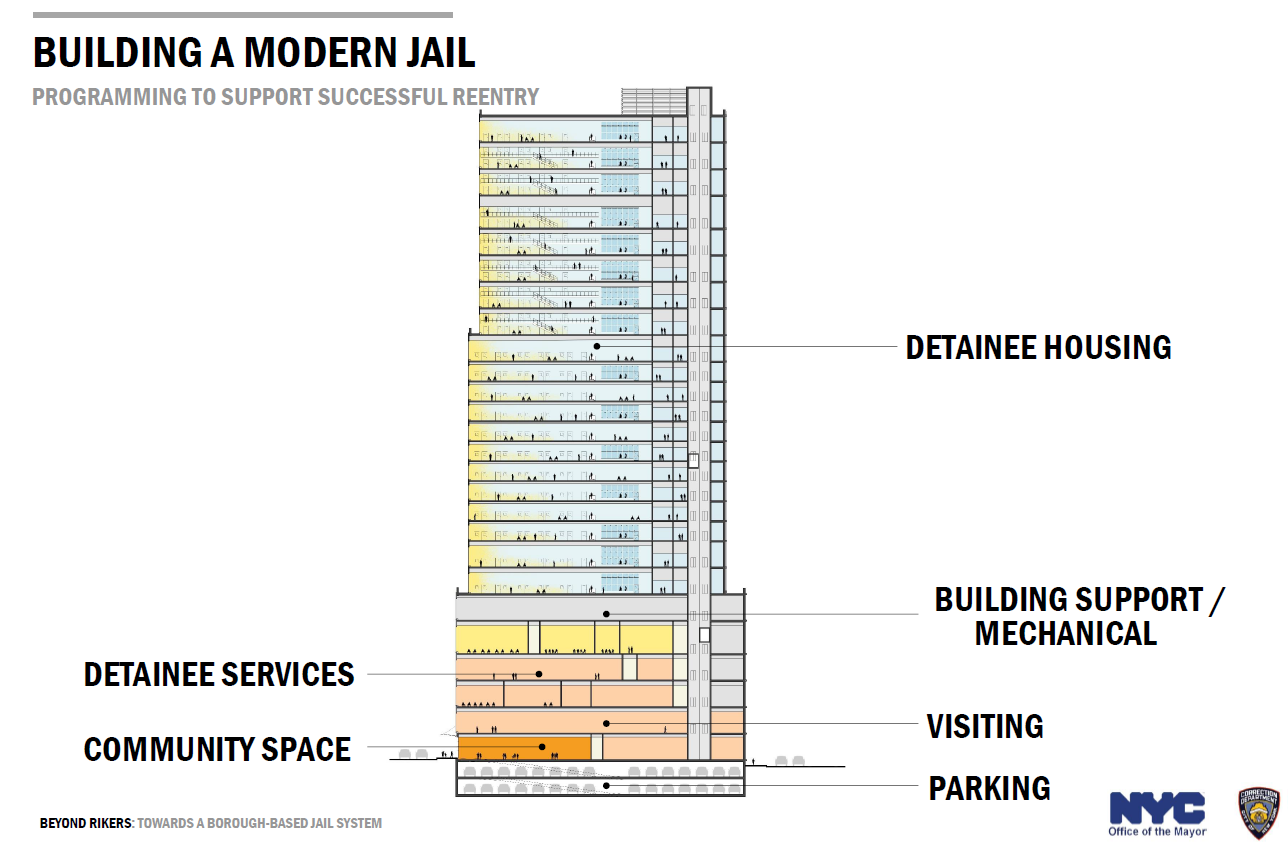
 One 886-bed jail will tower over shops and restaurants in Downtown Brooklyn. Another will be next to a subway yard in Queens. In the Bronx, a jail will replace a Police Department tow pound. And another jail will rise in the shadow of City Hall in Manhattan.

That is at the heart of a plan for a landmark overhaul of New York City’s corrections system, which will culminate with the closing of Rikers Island, the jail complex with nearly 10,000 beds that has become notorious for chronic abuse, neglect and mismanagement.

The City Council decisively approved the proposal on Thursday, taking a step that seemed improbable just a few years ago. Supporters say the plan places New York City at the forefront of a national movement to reverse decades of mass incarceration that disproportionately affected black and Hispanic people.

Still, the aggressive timeline — closing Rikers by 2026 — could prove very challenging.

Mayor Bill de Blasio and Corey Johnson, the City Council speaker, embraced the jails plan, throwing their political weight behind the measure despite steady opposition from neighborhoods whose residents worry that towering new jails will harm their quality of life. Corrections officers also criticized the plan as unrealistic.

“What we are doing today will reshape the city for generations to come and impact the lives of every New Yorker,” Mr. Johnson said on Thursday. “For decades, our city was unfair to those who became involved in the justice system, and the overwhelming majority who were caught up were black and brown men.”

With two years left in office, Mr. de Blasio also secured perhaps his most progressive achievement so far as mayor with the vote to close Rikers — an idea that even he dismissed a few years ago as impractical.

“This is about valuing our people, no longer condemning people and sending them on a pathway that only made their lives worse and worse,” Mr. de Blasio said. “Today we made history: The era of mass incarceration is over.”

What mass incarceration? Crime has been going down for over 20 years. As for Dancing Cojo's boast, it seems that besides the big windfall cash cow the developers will get from this gift from our representatives, another reason seems to be for these people to grandstand about being the first city to do this. At the expense of neighborhoods were the towers will be built and the communities they disrespected and undermined. And will eventually disenfranchise.

Friday, August 30, 2019

City Council will hold hearing for four borough tower jails on the first day of school


https://tribecacitizen.com/wp-content/uploads/2019/02/Rikers_Manhattan_elevation.png

Queens Eagle


Advocates and opponents of the city’s plan to close Rikers Island and build four new jails will pack City Hall for the council’s public hearing on the proposal Sept. 5. That’s also the first day of public school for hundreds of thousands of New York City students, and stakeholders say the hearing date could pose a big obstacle to community engagement.

The hearing will take place during a scheduled meeting of the Subcommittee on Landmarks, Public Siting and Maritime Uses. A City Council spokesperson told the Eagle that it is expected to be the only hearing on the topic. 

“Since the issue of closing Rikers and opening ‘borough-based’ jails is one of the most controversial issues of our time, I’m expecting a very crowded hearing, a very passionate hearing,” said Councilmember Adrienne Adams, the subcommittee’s chair.

“Most importantly, the people who are impacted one way or the other by the city’s jails need to be heard,” Adams continued. “I still believe the communities should have a voice in the decision.”
Some community members and activists say setting the hearing for the first day of school is the latest maneuver to reduce community input in a process that opponents have criticized for lacking transparency.

“Why would you push the calendar for that week with that schedule?” said Justin Pollock, a resident of Boerum Hill who lives near the site of the proposed 395-foot facility in Brooklyn. “It adds to the disrespect that this process has had for the general public.”

No New Jails organizer Kei Williams, a jail plan opponent, said the “monumental decision” before the council necessitates multiple public hearings on dates that are more convenient than the hectic first day of school. 

The council hearing will also take place just two days after the City Planning Commission casts its binding vote on the plan Sept. 3, the deadline established by the city’s Universal Land Use Review Procedure, or ULURP. If the CPC votes against the land-use application, it would not proceed to the council, but that is considered unlikely. 

The city’s plan calls for building a new 1,150-bed jail in every borough except Staten Island by 2026, and depends on the city’s ability to reduce the jail population to 4,000 detainees from a current total of roughly 6,500. 

The CPC can make modifications to the plan, such as permitting smaller facilities with fewer beds. That means the version that reaches the council could differ from the plan put forth by the city. But the final decisions rest with the council, meaning any changes made to the proposal by CPC could be reversed in the final stage of the land use process.

Williams said the tight time frame could make it difficult to evaluate the impact of any new changes.

“The one public hearing is scheduled … before the public will have had a chance to digest the Planning Commission's vote or comment on further changes to this ever-evolving plan that the City Council will not vote on until October,” Williams said.

Supporters of the city jail plan say community members will find a way to have their voices heard, even if the hearing date seems inconvenient. 

The only way for communities in the targeted areas for these jails can attend is to keep their kids home with a boycott of the first day of school, then show up to this hearing and disrupt this stupid plan.


Tuesday, May 7, 2019

The city approves plan to stack sandbags four feet high to mitigate flooding from hurricanes


New York Times


After Hurricane Sandy devastated New York in 2012, city officials considered some drastic responses to storm surges, like long concrete sea walls and tall earthen berms.

But as the seventh hurricane season since then approaches, the city is relying on something more modest as the first line of defense against another inundation of Manhattan: a row of glorified sandbags.

In the next few months, the city’s Office of Emergency Management plans to oversee the installation of four-foot-tall sacks of soil along the East River esplanade, from Wall Street to just north of the Brooklyn Bridge.

For up to five years, they essentially would form the only barrier to keep water from again rushing into the low-lying neighborhoods around the South Street Seaport.

City officials say they are a temporary step while permanent solutions to New York’s vulnerability to big storms are still being planned and debated.

But the barriers have already provoked derision.

“Six years of studying it and you come up with sandbags? Really?” said Marco Pasanella, whose family owns a 180-year-old building with a wine shop that faces the river on South Street. He said he felt no less vulnerable than he did on the night that Sandy flooded his shop and left the district without power for two weeks.

Along with the doubts about their effectiveness, the barriers have also been panned as unsightly interlopers along a stretch of waterfront popular with pedestrians and bicyclists — one woman called them “atrocities.”

They will cover only about one mile of the waterfront, leaving the area below Wall Street unprotected, possibly for another decade or longer.

Thursday, March 14, 2019

Mayor de Blasio wants 10 billion dollars to save Downtown Manhattan from climate change


NY Daily News


Mayor de Blasio proposed extending the South Street Seaport area by two city blocks into the East River — part of a $10 billion effort to fend off rising sea levels as a result of climate change.


“We had to find something that would work, no matter how expensive or ambitious it was,” de Blasio said Thursday at a press conference downtown.


The plan, part of a resilience study released Thursday, calls for extending the shoreline by a maximum of 500 feet, or two city blocks. The new segment of the shoreline, which would be 20 feet or above current sea levels, would serve as a flood barrier during storms — but it could also be home to buildings, including potential private development, de Blasio acknowledged.


But it will be necessary to keep lower Manhattan from being underwater, he argued -- saying the city’s study had found that by 2100, 20% of the streets in area would experience daily tidal flooding, even in sunny weather.


“This is the existential threat. This is the core issue we all must face as aggressively as humanly possible,” de Blasio said.

 The plan, announced six years after Hurricane Sandy swamped the city, may sound familiar to some New Yorkers — in 2013, Mayor Bloomberg proposed a similar project dubbed “Seaport City.” That plan would have leveraged private development on the new land to pay for the massive expense of building it.


De Blasio said whether the new land would contain private developments depended on whether the federal government would pony up any cash for the plan.

 From the perspective of the City of New York alone, this would be extraordinarily difficult to fund. I think it comes down to simply this: if there’s federal money in play, it probably looks one way, if there’s not federal money in play, we have to get some private money and there has to be some development,” he said.


What happened to the affordable housing plan? What about emergency funding for NYCHA?

The mayor proves yet again where his priorities lie, with the real estate overlords. New development? If all those luxury towers around there are under threat now from accelerating sea level rise, why would you build more "private" development on the new shoreline
If there is a light side to this idiotic proposal, this ten billion dollar defense of luxury real estate from the effects of climate change seems to be inspired not only from de Blasio's obeisance to his biggest donors (obviously still) but from a mentally retarded female character from the classic comedy show Arrested Development.