From the NY Post:
The city is owed more than $100 million in unpaid rent, taxes and interest on parking lots at Yankee Stadium constructed nearly a decade ago — with no payment in sight, documents show.
Bronx Parking Development Corp., which runs the facilities, has lost at least $28 million a year in each of the past three years because not enough Yankee fans are willing to pay as much as $45 to park there for a single game.
The firm owed the city’s Economic Development Corp. $45.2 million in unpaid rent and interest as of March 31, and $56 million in unpaid taxes and interest, records show.
“It was definitely a boondoggle from a former administration, but what now?” said Geoffrey Croft, president of NYC Park Advocates, who has been monitoring the deal because it displaced acres of Bronx parkland. “At some point, the city needs to take responsibility for this horrible deal because the bill keeps going up.”
The Yankees insisted they needed thousands of additional parking spots for fans when the new stadium was built, so about 9,100 spaces were created or preserved in 2010.
Showing posts with label EDC. Show all posts
Tuesday, October 30, 2018
Wednesday, October 24, 2018
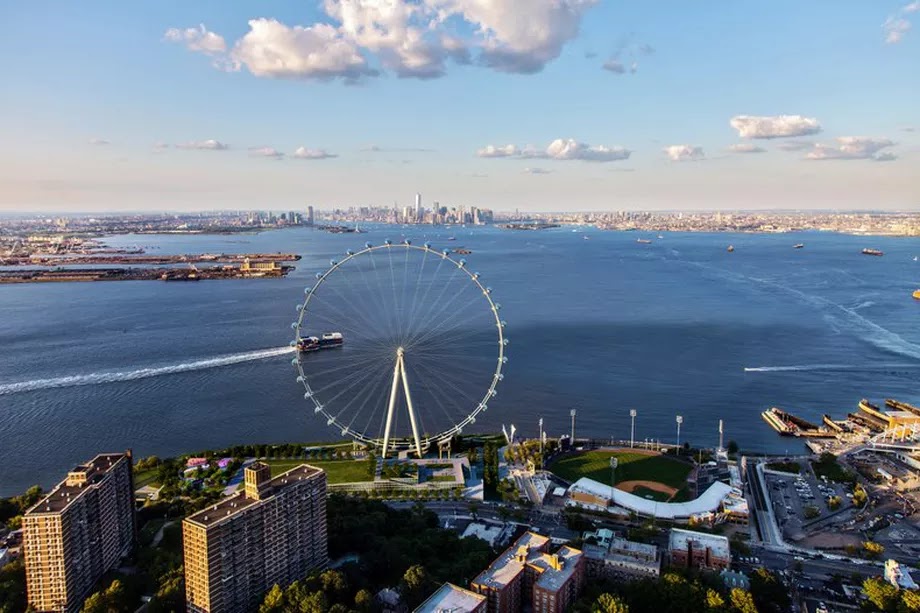
The wheel no one wanted
From Curbed:
Developers behind Staten Island’s ambitious New York Wheel have officially pulled the plug on the project, ending months of speculation about its future. Staten Island Advance broke the news of the development, which is a startling turn of events for a project that was once touted to usher a renaissance for the North Shore section of Staten Island.
For over a year now, the observation wheel project has been beset by infighting, construction woes, and more recently, legal troubles. The developer, New York Wheel LLC, was battling its former contractor Mammoet-Starneth on ownership of some of the Wheel’s parts, and last month a court granted the developers an extension to hire a new contractor and show that it had enough funds to procure those parts.
However, two of the lead investors in the development—Lloyd Goldman and Jeffrey Feil—later expressed skepticism about the project moving forward without significant city funding. Both mayor de Blasio and the city’s Economic Development Corporation had previously stated that project didn’t seem like a sound investment for city funds.
Developers behind Staten Island’s ambitious New York Wheel have officially pulled the plug on the project, ending months of speculation about its future. Staten Island Advance broke the news of the development, which is a startling turn of events for a project that was once touted to usher a renaissance for the North Shore section of Staten Island.
For over a year now, the observation wheel project has been beset by infighting, construction woes, and more recently, legal troubles. The developer, New York Wheel LLC, was battling its former contractor Mammoet-Starneth on ownership of some of the Wheel’s parts, and last month a court granted the developers an extension to hire a new contractor and show that it had enough funds to procure those parts.
However, two of the lead investors in the development—Lloyd Goldman and Jeffrey Feil—later expressed skepticism about the project moving forward without significant city funding. Both mayor de Blasio and the city’s Economic Development Corporation had previously stated that project didn’t seem like a sound investment for city funds.
Labels:
Bill DeBlasio,
developer,
EDC,
ferris wheel,
Staten Island
Friday, September 28, 2018
Crazy big development to replace NYPD garage
From GlobeSt:
Construction has begun on the conversion of a former New York City Police Department parking garage in Jamaica, Queens into a mixed-use development that will feature more than 380 affordable housing units.
A host of city officials were on hand for the groundbreaking for the Archer Green Apartments project on Friday, including New York City Economic Development Corporation president and CEO James Patchett; Housing Development Corporation EVP of real estate Paula Roy Carethers, Department of Housing Preservation and Development; Queens Borough President Melinda Katz, Councilmember I. Daneek Miller, State Senator Leroy Comrie, Assemblywoman Alicia Hyndman, representatives with construction manager Omni New York LLC and community leaders.
The redevelopment of the NYPD parking garage is the first major milestone to arise from the Jamaica NOW Action Plan, a $153-million neighborhood revitalization initiative announced in 2015 by the de Blasio Administration, Queens Borough President Katz and the NYCEDC.
In addition to the 100% affordable housing units, the Archer Green Apartments will also feature approximately 15,000 square feet of community facility space and 68,800 square feet of retail and commercial space. The project is expected to create nearly 350 construction jobs and more than 300 permanent jobs upon completion.
Construction has begun on the conversion of a former New York City Police Department parking garage in Jamaica, Queens into a mixed-use development that will feature more than 380 affordable housing units.
A host of city officials were on hand for the groundbreaking for the Archer Green Apartments project on Friday, including New York City Economic Development Corporation president and CEO James Patchett; Housing Development Corporation EVP of real estate Paula Roy Carethers, Department of Housing Preservation and Development; Queens Borough President Melinda Katz, Councilmember I. Daneek Miller, State Senator Leroy Comrie, Assemblywoman Alicia Hyndman, representatives with construction manager Omni New York LLC and community leaders.
The redevelopment of the NYPD parking garage is the first major milestone to arise from the Jamaica NOW Action Plan, a $153-million neighborhood revitalization initiative announced in 2015 by the de Blasio Administration, Queens Borough President Katz and the NYCEDC.
In addition to the 100% affordable housing units, the Archer Green Apartments will also feature approximately 15,000 square feet of community facility space and 68,800 square feet of retail and commercial space. The project is expected to create nearly 350 construction jobs and more than 300 permanent jobs upon completion.
Tuesday, August 21, 2018
Katz & Moya to hold secret meeting on Willets Point
From Willets Point United:
Queens Borough President Melinda Katz and Councilmember Francisco Moya are the co-chairs of the “Willets Point Task Force,” a cherry-picked group that is supposed to recommend potential uses for Willets Point land. The Task Force will hold its third closed-door meeting this Wednesday, August 22.
Katz and Moya are denying Willets Point United and all current Willets Point property or business owners the opportunity to attend any meeting of the Task Force – despite Queens Community Board 7’s recommendation that Katz and Moya consider allowing a Willets Point representative to attend. Even worse, Councilmember Moya’s office directly lied to us by telephone last Thursday, stating that no August meeting of the Task Force has been scheduled – when Queens Community Board 7 knew that the meeting is set for August 22.
Katz and Moya are shutting out not only Willets Point United, but also the press. We are aware that Borough Hall has rejected several reporters’ requests to observe Task Force meetings, and has been unwilling to provide even basic information regarding what land use options the Task Force is considering, or how it operates.
Per information furnished to Queens Community Board 7, the scheduled topic of the August 22 Task Force meeting is to “develop preliminary recommendations,” prior to the final September meeting which will “review final recommendations” to be sent to Mayor de Blasio.
In our view, Katz, Moya and the New York City Economic Development Corporation (NYCEDC) are leading the Task Force to an outcome predetermined by them – and they are using public-sector Task Force members solely to create an illusion of community buy-in, not to solicit or seriously consider any creative Willets Point development ideas they may have. Given that Willets Point United has a wealth of knowledge about all that has happened with the proposed Willets Point development during the past ten years (and beyond), had we been allowed to participate on the Task Force we would have encouraged thorough consideration of all relevant issues and potential recommendations – not just the ones prioritized by Katz, Moya and NYCEDC. We believe it is for that reason, that Katz and Moya are deliberately excluding us (and in the case of Moya’s office, even lying to us).
While Katz and Moya are shutting us out of their meetings, they cannot stop us from informing Task Force members, via this writing, of issues we consider important, and recommendations we believe the Task Force should make to Mayor de Blasio regarding Willets Point. We hope that the more open-minded members of the Task Force (if any) will raise these issues during the Wednesday meeting as “preliminary recommendations” are formulated.
(Article continues at link above.)
Queens Borough President Melinda Katz and Councilmember Francisco Moya are the co-chairs of the “Willets Point Task Force,” a cherry-picked group that is supposed to recommend potential uses for Willets Point land. The Task Force will hold its third closed-door meeting this Wednesday, August 22.
Katz and Moya are denying Willets Point United and all current Willets Point property or business owners the opportunity to attend any meeting of the Task Force – despite Queens Community Board 7’s recommendation that Katz and Moya consider allowing a Willets Point representative to attend. Even worse, Councilmember Moya’s office directly lied to us by telephone last Thursday, stating that no August meeting of the Task Force has been scheduled – when Queens Community Board 7 knew that the meeting is set for August 22.
Katz and Moya are shutting out not only Willets Point United, but also the press. We are aware that Borough Hall has rejected several reporters’ requests to observe Task Force meetings, and has been unwilling to provide even basic information regarding what land use options the Task Force is considering, or how it operates.
Per information furnished to Queens Community Board 7, the scheduled topic of the August 22 Task Force meeting is to “develop preliminary recommendations,” prior to the final September meeting which will “review final recommendations” to be sent to Mayor de Blasio.
In our view, Katz, Moya and the New York City Economic Development Corporation (NYCEDC) are leading the Task Force to an outcome predetermined by them – and they are using public-sector Task Force members solely to create an illusion of community buy-in, not to solicit or seriously consider any creative Willets Point development ideas they may have. Given that Willets Point United has a wealth of knowledge about all that has happened with the proposed Willets Point development during the past ten years (and beyond), had we been allowed to participate on the Task Force we would have encouraged thorough consideration of all relevant issues and potential recommendations – not just the ones prioritized by Katz, Moya and NYCEDC. We believe it is for that reason, that Katz and Moya are deliberately excluding us (and in the case of Moya’s office, even lying to us).
While Katz and Moya are shutting us out of their meetings, they cannot stop us from informing Task Force members, via this writing, of issues we consider important, and recommendations we believe the Task Force should make to Mayor de Blasio regarding Willets Point. We hope that the more open-minded members of the Task Force (if any) will raise these issues during the Wednesday meeting as “preliminary recommendations” are formulated.
(Article continues at link above.)
Labels:
community board,
EDC,
Francisco Moya,
meeting,
Melinda Katz,
task force,
Willets Point
Wednesday, July 18, 2018
Freight rail to be expanded
From Crains:
The city unveiled a plan Monday to invest up to $100 million in freight infrastructure, the opening step in Freight NYC, an initiative envisioned by the de Blasio administration to shift more of the millions of tons of food, products and materials that are carted into the city each year by pollution-belching trucks to trains and ships.
The city’s Economic Development Corporation said it will issue a request for proposal by the end of the year for a private partner to work with the city to build a five-acre barge terminal on city-owned land in Hunts Point. That project could cost between $20 to $30 million to develop and would be used to deliver food items and produce by water to the large constellation of grocery and restaurant distribution businesses in the South Bronx neighborhood. The city has not identified the specific site or sites where the terminal could be constructed.
The city is also seeking to create a 500,000 square foot distribution center in the Brooklyn Army Terminal in Sunset Park, which is located adjacent to freight rail, and build a 75,000 square foot ground-up air cargo facility near Kennedy Airport. By providing low cost space to rail and air freight businesses, the city is hoping to encourage the use of those transportation modalities rather than trucks. Solicitations for private partners to work with the city on those projects will be issued within the next two weeks, the EDC stated.
Another near-term goal in the report was to create as many as four small freight yards along an existing freight rail line that snakes through Brooklyn into Queens. The yards would provide new offloading points for goods carted by freight trains, potentially reducing the distance that trucks would need to travel to deliver that cargo the last miles to its final destination. Shorter delivery distances not only reduce vehicle miles, but also allow smaller delivery vehicles to be used in place of large, long haul trucks that currently rumble through the city.
It wasn’t immediately clear how much it would cost to build those small rail facilities, although they appear to be modest in scope, requiring the construction of short stretches of track parallel to the existing freight line to allow trains to park and unload without impeding the flow of train traffic along the route.
The steps could take thousands of trucks off the road and create freight-related jobs.
The city unveiled a plan Monday to invest up to $100 million in freight infrastructure, the opening step in Freight NYC, an initiative envisioned by the de Blasio administration to shift more of the millions of tons of food, products and materials that are carted into the city each year by pollution-belching trucks to trains and ships.
The city’s Economic Development Corporation said it will issue a request for proposal by the end of the year for a private partner to work with the city to build a five-acre barge terminal on city-owned land in Hunts Point. That project could cost between $20 to $30 million to develop and would be used to deliver food items and produce by water to the large constellation of grocery and restaurant distribution businesses in the South Bronx neighborhood. The city has not identified the specific site or sites where the terminal could be constructed.
The city is also seeking to create a 500,000 square foot distribution center in the Brooklyn Army Terminal in Sunset Park, which is located adjacent to freight rail, and build a 75,000 square foot ground-up air cargo facility near Kennedy Airport. By providing low cost space to rail and air freight businesses, the city is hoping to encourage the use of those transportation modalities rather than trucks. Solicitations for private partners to work with the city on those projects will be issued within the next two weeks, the EDC stated.
Another near-term goal in the report was to create as many as four small freight yards along an existing freight rail line that snakes through Brooklyn into Queens. The yards would provide new offloading points for goods carted by freight trains, potentially reducing the distance that trucks would need to travel to deliver that cargo the last miles to its final destination. Shorter delivery distances not only reduce vehicle miles, but also allow smaller delivery vehicles to be used in place of large, long haul trucks that currently rumble through the city.
It wasn’t immediately clear how much it would cost to build those small rail facilities, although they appear to be modest in scope, requiring the construction of short stretches of track parallel to the existing freight line to allow trains to park and unload without impeding the flow of train traffic along the route.
The steps could take thousands of trucks off the road and create freight-related jobs.
Saturday, May 5, 2018
Development plan for Sunnyside to be crafted this summer
From Crains:
The de Blasio administration and Amtrak will begin crafting a development plan for Sunnyside Yard in Queens this summer, city and Amtrak officials will announce today.
The master planning team will be led by Vishaan Chakrabarti's architecture firm, Practice for Architecture and Urbanism, which was first reported by Crain's in March.
"This is a once-in-a-generation opportunity for civic groups, public officials and residents to create a vision for their borough," Alicia Glen, Housing and Urban Development deputy mayor, said in a statement.
The city has carved out a position within the Economic Development Corp. to oversee the process and announced a steering committee composed of roughly two dozen local and citywide stakeholders to provide input. Last year a city study found that about 80% of the 180-acre yard could be decked over and covered with 24,000 apartments, along with schools, parks and other infrastructure, at a cost of $19 billion. The master planning process is expected to take around two years and will come up with a more specific blueprint of what could be constructed.
The de Blasio administration and Amtrak will begin crafting a development plan for Sunnyside Yard in Queens this summer, city and Amtrak officials will announce today.
The master planning team will be led by Vishaan Chakrabarti's architecture firm, Practice for Architecture and Urbanism, which was first reported by Crain's in March.
"This is a once-in-a-generation opportunity for civic groups, public officials and residents to create a vision for their borough," Alicia Glen, Housing and Urban Development deputy mayor, said in a statement.
The city has carved out a position within the Economic Development Corp. to oversee the process and announced a steering committee composed of roughly two dozen local and citywide stakeholders to provide input. Last year a city study found that about 80% of the 180-acre yard could be decked over and covered with 24,000 apartments, along with schools, parks and other infrastructure, at a cost of $19 billion. The master planning process is expected to take around two years and will come up with a more specific blueprint of what could be constructed.
Tuesday, April 17, 2018
Affordable for whom?
From the NY Post:
Most folks pay through the nose to live in New York City, but many in search of affordable middle-class housing are finding some relief in Queens.
Residential housing is booming in the borough. In February, almost half of new residential construction was in Queens, according to city figures.
The NYC Economic Development Corp. (NYCEDC) registered 2,847 new housing units in February, with 1,234 of those in Queens, or about 43 percent of the new units in the five boroughs.
A “mega-scale project” in Long Island City is a big reason why Queens is generating so much new housing, said a spokeswoman for the NYCEDC.
Queens residential rents generally have been about $600 less per month than those in the rest in the city. Last month the average Queens residential rent was slightly up, to $2,182, according to the Queens Rental Market Report.
Right, so the new housing is concentrated in areas where people will pay an arm and a leg for it yet this is a boon to the middle class.
Most folks pay through the nose to live in New York City, but many in search of affordable middle-class housing are finding some relief in Queens.
Residential housing is booming in the borough. In February, almost half of new residential construction was in Queens, according to city figures.
The NYC Economic Development Corp. (NYCEDC) registered 2,847 new housing units in February, with 1,234 of those in Queens, or about 43 percent of the new units in the five boroughs.
A “mega-scale project” in Long Island City is a big reason why Queens is generating so much new housing, said a spokeswoman for the NYCEDC.
Queens residential rents generally have been about $600 less per month than those in the rest in the city. Last month the average Queens residential rent was slightly up, to $2,182, according to the Queens Rental Market Report.
Right, so the new housing is concentrated in areas where people will pay an arm and a leg for it yet this is a boon to the middle class.
Saturday, April 7, 2018
Because the LIRR isn't packed enough now
From Crain's:
The city’s Department of Transportation is studying ways to get more New Yorkers to use commuter rail lines and take pressure off of the beleaguered subway system, public documents show.
The department has tapped engineering firm AECOM to look at potential changes that would boost ridership on Long Island Rail Road and Metro North lines running within the five boroughs.
Reducing fares within city limits, for example, would entice more residents to use commuter rails like the subway system and connect more neighborhoods to transit hubs like Grand Central Terminal and Penn Station in Manhattan, Atlantic Terminal in Brooklyn and Jamaica and Woodside stations in Queens.
“AECOM is under contract to … investigate service and policy strategies for the city zone of the commuter rail network to connect residents to more frequent and affordable regional rail service, and potentially reduce crowding on nearby subway lines,” a spokesman for the department said in a statement.
In particular, the de Blasio administration has floated the idea of running trains more frequently between Atlantic Terminal and Jamaica Station so Queens commuters could then transfer to a number of subway lines at the Brooklyn hub.
The agency and the Economic Development Corp. are jointly spending around $787,000 on the study, which began in January and will end in October.
The City really seems to like AECOM. First they hired them for Liz Crowley's dopey light rail proposal, now this.
The commuter lines will not take Metrocards and the people who ride commuter rail lines won't stand for more crowding.
Waste. Of. Time. And. Money.
The city’s Department of Transportation is studying ways to get more New Yorkers to use commuter rail lines and take pressure off of the beleaguered subway system, public documents show.
The department has tapped engineering firm AECOM to look at potential changes that would boost ridership on Long Island Rail Road and Metro North lines running within the five boroughs.
Reducing fares within city limits, for example, would entice more residents to use commuter rails like the subway system and connect more neighborhoods to transit hubs like Grand Central Terminal and Penn Station in Manhattan, Atlantic Terminal in Brooklyn and Jamaica and Woodside stations in Queens.
“AECOM is under contract to … investigate service and policy strategies for the city zone of the commuter rail network to connect residents to more frequent and affordable regional rail service, and potentially reduce crowding on nearby subway lines,” a spokesman for the department said in a statement.
In particular, the de Blasio administration has floated the idea of running trains more frequently between Atlantic Terminal and Jamaica Station so Queens commuters could then transfer to a number of subway lines at the Brooklyn hub.
The agency and the Economic Development Corp. are jointly spending around $787,000 on the study, which began in January and will end in October.
The City really seems to like AECOM. First they hired them for Liz Crowley's dopey light rail proposal, now this.
The commuter lines will not take Metrocards and the people who ride commuter rail lines won't stand for more crowding.
Waste. Of. Time. And. Money.
Wednesday, February 7, 2018
Plan in effect for small piece of Willets Point
From a mayoral press release:
Mayor Bill de Blasio, Borough President Melinda Katz and Council Member Francisco Moya today announced an agreement to jumpstart construction of 1,100 affordable apartments on six acres of Willets Point – an increase of 225 affordable homes over the original development proposal. The new homes will be the first built on the wider Willets Point site which was approved for development by the City Council in 2008.
The new plan is for three, 100 percent affordable buildings including a standalone building with 220 homes for low-income seniors and also apartments for families at lower incomes than originally proposed. The plan also includes public open space and a new 450-seat public elementary school.
To identify community priorities and produce recommendations for the remainder of the 17 acres of the Willets Point development site, the mayor also announced the formation of a task force, chaired by Borough President Melinda Katz and Council Member Francisco Moya. The task force, initially proposed by Council Member Moya, is modeled on the steering committee that developed the framework for the Greater East Midtown Rezoning.
Who died and left these two in charge? How do you just totally switch around what the City Council agreed upon? Shouldn't the process go out to bid again?
From Willets Point United:
From the outset of the proposed Willets Point development, it has been understood that a developer would be selected via a competitive sealed proposal process.
The City’s selection in 2012 of Queens Development Group (QDG) to develop phase one of Willets Point – to the exclusion of all other firms that submitted proposals – was predicated on QDG’s unique proposal that expanded the project to include a mega-mall on public parkland (leveraging a lease already held for said parkland by the Mets’ owners, who comprise half of QDG).
In the aftermath of the Court of Appeals decision which prevents QDG from implementing its proposal, Mayor de Blasio should have immediately availed himself of the opportunity afforded by the contract between QDG and the Economic Development Corporation (EDC), to rescind the sale of Willets Point property to QDG and cancel the contract award. Then, the City would have been free to issue a new request for proposals (RFP) to the entire present-day development community, for the “new” six-acre project which apparently is now the priority.
Instead, there has never been a competitive sealed proposal process for development of six acres of Willets Point property stemming from the intersection of Willets Point Boulevard and Roosevelt Avenue. Think of it: A reasonably-sized, six-acre project would likely attract a larger pool of developer proposals than did the 2012 RFP which encompassed the enormity of the Willet Point phase one site. There is absolutely no basis to think that QDG is the “best” developer for this six-acre site and configuration, because the de Blasio administration did not implement any competitive sealed proposal process (although it should have done so).
In its article published on February 6, 2018, the New York Times repeatedly refers to the six-acre project as a “new plan” and “new deal.” We agree, but wonder why there was also not a “new” RFP and “new” competitive sealed proposal process to determine it.
Willets Point, in total, is 62 acres. The city was supposed to develop the entire thing. Millions of dollars later, they're settling on 6 acres or 10%. You gotta love our government.
Mayor Bill de Blasio, Borough President Melinda Katz and Council Member Francisco Moya today announced an agreement to jumpstart construction of 1,100 affordable apartments on six acres of Willets Point – an increase of 225 affordable homes over the original development proposal. The new homes will be the first built on the wider Willets Point site which was approved for development by the City Council in 2008.
The new plan is for three, 100 percent affordable buildings including a standalone building with 220 homes for low-income seniors and also apartments for families at lower incomes than originally proposed. The plan also includes public open space and a new 450-seat public elementary school.
To identify community priorities and produce recommendations for the remainder of the 17 acres of the Willets Point development site, the mayor also announced the formation of a task force, chaired by Borough President Melinda Katz and Council Member Francisco Moya. The task force, initially proposed by Council Member Moya, is modeled on the steering committee that developed the framework for the Greater East Midtown Rezoning.
Who died and left these two in charge? How do you just totally switch around what the City Council agreed upon? Shouldn't the process go out to bid again?
From Willets Point United:
From the outset of the proposed Willets Point development, it has been understood that a developer would be selected via a competitive sealed proposal process.
The City’s selection in 2012 of Queens Development Group (QDG) to develop phase one of Willets Point – to the exclusion of all other firms that submitted proposals – was predicated on QDG’s unique proposal that expanded the project to include a mega-mall on public parkland (leveraging a lease already held for said parkland by the Mets’ owners, who comprise half of QDG).
In the aftermath of the Court of Appeals decision which prevents QDG from implementing its proposal, Mayor de Blasio should have immediately availed himself of the opportunity afforded by the contract between QDG and the Economic Development Corporation (EDC), to rescind the sale of Willets Point property to QDG and cancel the contract award. Then, the City would have been free to issue a new request for proposals (RFP) to the entire present-day development community, for the “new” six-acre project which apparently is now the priority.
Instead, there has never been a competitive sealed proposal process for development of six acres of Willets Point property stemming from the intersection of Willets Point Boulevard and Roosevelt Avenue. Think of it: A reasonably-sized, six-acre project would likely attract a larger pool of developer proposals than did the 2012 RFP which encompassed the enormity of the Willet Point phase one site. There is absolutely no basis to think that QDG is the “best” developer for this six-acre site and configuration, because the de Blasio administration did not implement any competitive sealed proposal process (although it should have done so).
In its article published on February 6, 2018, the New York Times repeatedly refers to the six-acre project as a “new plan” and “new deal.” We agree, but wonder why there was also not a “new” RFP and “new” competitive sealed proposal process to determine it.
Willets Point, in total, is 62 acres. The city was supposed to develop the entire thing. Millions of dollars later, they're settling on 6 acres or 10%. You gotta love our government.
Labels:
Bill DeBlasio,
EDC,
queens development group,
Willets Point
Monday, January 8, 2018
City taking owner's business for peanuts
From the Daily News:
New York City is using eminent domain to take an East Harlem businessman to the cleaners.
Damon Bae, whose family success story embodies the American Dream, is about to lose the shirt off his back — after a 12-year battle with the city for control of his dry cleaning enterprise.
Fancy Cleaners, a 6,000-square-foot facility at the corner of 126th St. and Third Ave., was supposed to be the cornerstone of a family empire built by a Korean couple who came to the U.S. in 1981, bringing their tailoring skills with them along with two young children and endless ambition.
But an eminent domain claim filed by the city in 2008 and enforced — after years of legal challenges — in March 2017 means Bae’s family no longer owns its premier property.
Now Fancy Cleaners has nowhere to go, and the whole enterprise will likely shutter, said Bae, 42, who runs the business created through decades of hard work by his immigrant parents.
“The city has offered my family about 30 cents on the dollar on the market value for what our three lots are worth — that’s not enough to buy anything comparable in East Harlem today,” Bae said. “The city’s working so hard to meet the developer’s timeline; meanwhile, we’re trying to stay in business.”
The city said it would pay the Bae family $3.5 million for the lot holding Fancy Cleaners when it took the property title through eminent domain in the spring, Bae said.
The asking price for a similar 5,000-square-foot lot about five blocks south of Fancy Cleaners’ current location is $11 million, Bae said.
Friday, December 29, 2017
City about to transfer 23 acres of land to developer without approved plan
From Willets Point United:
Through the Willets Point grapevine, we hear that the City is about to transfer ownership of 23 acres comprising the “Phase One” area of Willets Point, to Queens Development Group (“QDG”) – the joint venture of Sterling Equities (whose owners also own the New York Mets) and The Related Companies that the Bloomberg administration designated as the developer. This is the infamous give-away of 23 acres of valuable taxpayer property, which cost hundreds of millions of public dollars to acquire, to developers for the unjustified price of $1 (one dollar).
For the de Blasio administration to proceed with this sale at this time is outrageous and potentially illegal, for reasons summarized below.
First, Bill de Blasio is squandering a golden opportunity to cancel the Bloomberg administration’s planned, unjustified give-away of hundreds of millions of dollars worth of taxpayer property to QDG for the price of $1 (one dollar), and instead to establish a legitimate price that is truly in the taxpayers’ interest.
Second, recall that the key reason that QDG was chosen to develop the Willets Point Phase One site, to the exclusion of several other developers that had submitted proposals, was that only QDG claimed to be able to expand the project by constructing its proposed “Willets West” mega-mall on public parkland located west of Citi Field stadium. If QDG is now unable to deliver that mega-mall on parkland, then the basis for choosing QDG as the developer in the first place no longer applies. Allowing QDG to develop the Willets Point Phase One property despite QDG being unable to deliver the Willets West mega-mall is to allow a “bait-and-switch” on the grandest of scales.
Third, it appears that the de Blasio administration is on the verge of transferring ownership of all lots that comprise the 23-acre Willets Point Phase One site to QDG for $1 (one dollar), on the basis of authorizations granted by then-Mayor Bloomberg and the Queens Borough Board during December 2013, pursuant to City Charter § 384(b)(4).
Since the City acquired additional lots within the Willets Point Phase One area after December 2013, whose sale could not have been authorized pursuant to City Charter § 384(b)(4) during December 2013, new authorizations of Mayor de Blasio and the Queens Borough Board are necessary before all of the lots within the Phase One area may legally be transferred to QDG.
Fourth, Francisco Moya, who has been elected the new City Council representative of Willets Point and nearby neighborhoods, previously announced his own plan concerning Willets Point development. Among other aspects, Moya intends to form an advisory council of neighborhood stakeholders, to evaluate and help to guide development decisions.
No irreversible action, including property sale, should take place at Willets Point before Councilman-elect Moya’s advisory council is in full operation and has had ample opportunity to significantly participate in decision-making.
Through the Willets Point grapevine, we hear that the City is about to transfer ownership of 23 acres comprising the “Phase One” area of Willets Point, to Queens Development Group (“QDG”) – the joint venture of Sterling Equities (whose owners also own the New York Mets) and The Related Companies that the Bloomberg administration designated as the developer. This is the infamous give-away of 23 acres of valuable taxpayer property, which cost hundreds of millions of public dollars to acquire, to developers for the unjustified price of $1 (one dollar).
For the de Blasio administration to proceed with this sale at this time is outrageous and potentially illegal, for reasons summarized below.
First, Bill de Blasio is squandering a golden opportunity to cancel the Bloomberg administration’s planned, unjustified give-away of hundreds of millions of dollars worth of taxpayer property to QDG for the price of $1 (one dollar), and instead to establish a legitimate price that is truly in the taxpayers’ interest.
Second, recall that the key reason that QDG was chosen to develop the Willets Point Phase One site, to the exclusion of several other developers that had submitted proposals, was that only QDG claimed to be able to expand the project by constructing its proposed “Willets West” mega-mall on public parkland located west of Citi Field stadium. If QDG is now unable to deliver that mega-mall on parkland, then the basis for choosing QDG as the developer in the first place no longer applies. Allowing QDG to develop the Willets Point Phase One property despite QDG being unable to deliver the Willets West mega-mall is to allow a “bait-and-switch” on the grandest of scales.
Third, it appears that the de Blasio administration is on the verge of transferring ownership of all lots that comprise the 23-acre Willets Point Phase One site to QDG for $1 (one dollar), on the basis of authorizations granted by then-Mayor Bloomberg and the Queens Borough Board during December 2013, pursuant to City Charter § 384(b)(4).
Since the City acquired additional lots within the Willets Point Phase One area after December 2013, whose sale could not have been authorized pursuant to City Charter § 384(b)(4) during December 2013, new authorizations of Mayor de Blasio and the Queens Borough Board are necessary before all of the lots within the Phase One area may legally be transferred to QDG.
Fourth, Francisco Moya, who has been elected the new City Council representative of Willets Point and nearby neighborhoods, previously announced his own plan concerning Willets Point development. Among other aspects, Moya intends to form an advisory council of neighborhood stakeholders, to evaluate and help to guide development decisions.
No irreversible action, including property sale, should take place at Willets Point before Councilman-elect Moya’s advisory council is in full operation and has had ample opportunity to significantly participate in decision-making.
Friday, October 6, 2017
No movement on Rockaway courthouse project after 5 years
From The Wave:
Concrete plans for the long-dormant courthouse on Beach Channel Drive hang in the balance as the back-and-forth between local residents and developer Uri Kaufman continues.
At a special Sept. 28 Rockaway Beach Civic Association (RBCA) meeting regarding the courthouse, members of the civic tore into Kaufman, president and CEO of The Harmony Group, as well as New York City Economic Development Corporation (NYCEDC) reps in an effort to clarify future uses for the space and vent their frustrations about the deplorable conditions of the site and adjacent lot.
The historic building, which formerly served as a Municipal and Magistrate’s court, was built in 1932. Save for a brief use by an arts group in the 70s, the 24,000 square-foot building at 90-01 Beach Channel Drive has remained dormant since 1962.
NYCEDC stepped in in 2012, issuing a Request for Expressions of Interest (RFEI) for the adaptive reuse and redevelopment of the Rockaway courthouse. According to NYCEDC, the RFEI aimed to assess options for the reactivation of the site that were “compatible with the existing neighborhood in order to ultimately improve the overall quality of life for the community.”
As reported by The Wave in 2012, “a proposal for the development of the courthouse into an ambulatory surgical facility was approved by Community Board 14, which allows the developer [The Harmony Group] to move forward with negotiations to obtain the property from the city.”
Fast forward five years and the space, to the surprise of some but not many on the civic board, has yet to go into construction or finalize tenants.
Friday, September 29, 2017
Amazon looking for space and Sunnyside Yards is in the running
From Queens Tribune:
Amazon has announced that it is looking for a location to develop its second headquarters—which would be known as Amazon HQ2—and Sunnyside Yard is among the spots it is eyeing.
Earlier this year, the city’s Economic Development Corporation (EDC) released its $2.5 million Sunnyside Yard feasibility study, which evaluated the viability of decking over active rail and facilities currently at the site to make way for housing units, retail space, parks and schools. Sunnyside Yard—which currently serves as a storage hub for Amtrak, the New Jersey Transit and Long Island Rail Road—sits on approximately 180 acres of land in western Queens.
Grant Long, a senior economist at Street Easy, an online real estate organization, spoke to the Queens Tribune to discuss the possibility of Amazon HQ2’s being built above Sunnyside Yard.
“Sunnyside Yard is the best fit,” said Long. “Through this project, people within the community can get good jobs.”
Amazon HQ2, which would seek up to eight million square feet of commercial space, is expected to create 50,000 high-paying jobs that offer an average salary of more than $100,000.
Long said that these salaries would enable workers at the new headquarters to afford apartments or condos at the numerous buildings constructed in Court Square, Downtown Brooklyn, DUMBO, Williamsburg and Long Island City.
Amazon has announced that it is looking for a location to develop its second headquarters—which would be known as Amazon HQ2—and Sunnyside Yard is among the spots it is eyeing.
Earlier this year, the city’s Economic Development Corporation (EDC) released its $2.5 million Sunnyside Yard feasibility study, which evaluated the viability of decking over active rail and facilities currently at the site to make way for housing units, retail space, parks and schools. Sunnyside Yard—which currently serves as a storage hub for Amtrak, the New Jersey Transit and Long Island Rail Road—sits on approximately 180 acres of land in western Queens.
Grant Long, a senior economist at Street Easy, an online real estate organization, spoke to the Queens Tribune to discuss the possibility of Amazon HQ2’s being built above Sunnyside Yard.
“Sunnyside Yard is the best fit,” said Long. “Through this project, people within the community can get good jobs.”
Amazon HQ2, which would seek up to eight million square feet of commercial space, is expected to create 50,000 high-paying jobs that offer an average salary of more than $100,000.
Long said that these salaries would enable workers at the new headquarters to afford apartments or condos at the numerous buildings constructed in Court Square, Downtown Brooklyn, DUMBO, Williamsburg and Long Island City.
Thursday, September 21, 2017
CB7 wants seat at the Willets Point table
From the Queens Tribune:
The city has been “delinquent” in its discussions with Community Board 7 on the future of the troubled Willets Point development, according to the board’s First Vice Chairman Chuck Apelian. And at Monday night’s quarterly meeting with the project’s stakeholders, Apelian put the city and developers on notice.
“I want to be very clear,” Apelian said. “We expect to be involved.”
The future of Willets Point has been uncertain since a June ruling by the Court of Appeals halted a major part of the proposed development, a mega mall known as Willets West, because it was planned for a parcel of land connected to nearby Flushing Meadows Corona Park. Building the mall on public parkland would require approval from the state legislature, the court said.
And while Willets West was only part of a larger development plan that included hundreds of affordable housing units and environmental remediation, the developers maintained that the mall was the “economic engine” that would make the project possible. Now, the developers and city are deciding whether to pursue a long campaign for state approval or make changes to their plan. But changes to the project could concern Community Board 7, which approved the most recent proposal in 2013.
“If the original concept has been now modified, that’s not what this board voted on,” CB 7 Chairman Eugene Kelty said on Monday.
Nate Bliss, of the city’s Economic Development Corporation, said that, regardless, the city plans on being a partner with the community on the process. Apelian expressed hope that this was true. If the parkland was not alienated by the state legislature and Willets West was abandoned, he expects the project could change “dramatically.”
The city has been “delinquent” in its discussions with Community Board 7 on the future of the troubled Willets Point development, according to the board’s First Vice Chairman Chuck Apelian. And at Monday night’s quarterly meeting with the project’s stakeholders, Apelian put the city and developers on notice.
“I want to be very clear,” Apelian said. “We expect to be involved.”
The future of Willets Point has been uncertain since a June ruling by the Court of Appeals halted a major part of the proposed development, a mega mall known as Willets West, because it was planned for a parcel of land connected to nearby Flushing Meadows Corona Park. Building the mall on public parkland would require approval from the state legislature, the court said.
And while Willets West was only part of a larger development plan that included hundreds of affordable housing units and environmental remediation, the developers maintained that the mall was the “economic engine” that would make the project possible. Now, the developers and city are deciding whether to pursue a long campaign for state approval or make changes to their plan. But changes to the project could concern Community Board 7, which approved the most recent proposal in 2013.
“If the original concept has been now modified, that’s not what this board voted on,” CB 7 Chairman Eugene Kelty said on Monday.
Nate Bliss, of the city’s Economic Development Corporation, said that, regardless, the city plans on being a partner with the community on the process. Apelian expressed hope that this was true. If the parkland was not alienated by the state legislature and Willets West was abandoned, he expects the project could change “dramatically.”
Wednesday, September 13, 2017
Park vs. towers in LIC
From LIC Post:
The city’s decision to appoint a for-profit developer to build 1,000 high-rise apartments on public land along the Long Island City waterfront was universally panned by residents at last week’s Community Board 2 meeting.
Earlier this summer, the city—through the Economic Development Corp– announced that it had selected TF Cornerstone, the Manhattan-based real estate firm, to develop a 4.5 acre site near 44th Drive and 5th Street. The project could bring 1,000 apartments, 400,000-square-feet of commercial space, and a school for 600 students at an estimated cost of $925 million. One-quarter of the apartments will be classified as “affordable.”
Residents who spoke at CB2’s monthly meeting in Sunnyside on Thursday said there was little need for more high-end, luxury towers in Hunters Point, especially when they’d be built on city-owned land by a for-profit developer.
Several residents said the site should be converted into a park.
Labels:
affordable housing,
developer,
EDC,
LIC,
skyscraper,
TF cornerstone
Saturday, August 19, 2017
Development along coast is questioned
From DNA Info:
Critics of the city's plan to build a school, offices and 1,000 apartments on the Long Island City waterfront called it "irresponsible" to develop the site because it's located in a hurricane evacuation zone that's prone to flooding during storms.
Advocates said they would rather see the two city-owned parcels — located next to the East River at the end of 44th Drive — converted to public parkland, with plantings, oyster beds and other green infrastructure to help make the area more resistant to floods.
"We think continuing to build in a flood plain is irresponsible," said Diane Hendry, a member of the LIC Coalition, an advocacy group that launched a petition last week opposing the city's plans. "The land is a natural wetlands. It should be preserved. We do not want this land used for 1,000 luxury units."
The city's Economic Development Corporation and developer TF Cornerstone are planning the mixed-use project, which will include a 600-seat school, offices and light manufacturing space, as well as at least 1,000 apartments, a quarter of which will be set aside for affordable housing.
The development will rise on two sites across the street from one another: 5-40 44th Drive, currently a Department of Transportation facility, and 4-99 44th Drive, which includes a Department of Education parking lot and the shuttered Water's Edge restaurant.
The site is located within Hurricane Evacuation Zone 1, what the city has designated as the most likely to flood during a storm. The parcels also sit on the border between two FEMA flood zones with the highest risk of flooding, according to a map from the agency.
Critics of the city's plan to build a school, offices and 1,000 apartments on the Long Island City waterfront called it "irresponsible" to develop the site because it's located in a hurricane evacuation zone that's prone to flooding during storms.
Advocates said they would rather see the two city-owned parcels — located next to the East River at the end of 44th Drive — converted to public parkland, with plantings, oyster beds and other green infrastructure to help make the area more resistant to floods.
"We think continuing to build in a flood plain is irresponsible," said Diane Hendry, a member of the LIC Coalition, an advocacy group that launched a petition last week opposing the city's plans. "The land is a natural wetlands. It should be preserved. We do not want this land used for 1,000 luxury units."
The city's Economic Development Corporation and developer TF Cornerstone are planning the mixed-use project, which will include a 600-seat school, offices and light manufacturing space, as well as at least 1,000 apartments, a quarter of which will be set aside for affordable housing.
The development will rise on two sites across the street from one another: 5-40 44th Drive, currently a Department of Transportation facility, and 4-99 44th Drive, which includes a Department of Education parking lot and the shuttered Water's Edge restaurant.
The site is located within Hurricane Evacuation Zone 1, what the city has designated as the most likely to flood during a storm. The parcels also sit on the border between two FEMA flood zones with the highest risk of flooding, according to a map from the agency.
Labels:
construction,
EDC,
fema,
flooding,
LIC,
overdevelopment
Thursday, July 6, 2017
How NYC protects the environment
From Brooklyn Daily:
The state has approved a permit for the city to pour up to 7.2 million gallons of contaminated groundwater into Coney Island Creek every day for up to two years while the city upgrades sewer and water mains in Coney’s west end.
The permit allows the city to overlook nearly a dozen heavy metals found in the water because only small amounts were discovered in the creek, and state officials say locals have nothing to fear because Coney creek flows into Gravesend Bay, which will dilute the pollutants. But with millions of gallons gushing into the inlet each day for years, experts and locals fear that the contaminates could amass to dangerous levels, and aren’t buying the state’s argument that being connected to a large body of water will mitigate the risks.
The project being run by the Economic Development Corporation will upgrade aging water mains and storm and sanitary sewers in an area bounded by W. 17th and W. 22nd streets from Neptune Avenue to the Boardwalk. Shovels are expected to hit the ground this summer and the project will last for roughly two years — with an embargo on Surf Avenue construction from May 15 to Sept. 15 so as not to clash with the swell of beach-goers, according to city records.
But to keep the construction site dry, the city applied for a State Pollutant Discharge Elimination System permit to “dewater” contaminated groundwater from several sites by pumping it into Coney Island Creek — where people swim, students routinely wade for city-run education programs, and some congregations use the waters for religious rites such as baptisms.
The state has approved a permit for the city to pour up to 7.2 million gallons of contaminated groundwater into Coney Island Creek every day for up to two years while the city upgrades sewer and water mains in Coney’s west end.
The permit allows the city to overlook nearly a dozen heavy metals found in the water because only small amounts were discovered in the creek, and state officials say locals have nothing to fear because Coney creek flows into Gravesend Bay, which will dilute the pollutants. But with millions of gallons gushing into the inlet each day for years, experts and locals fear that the contaminates could amass to dangerous levels, and aren’t buying the state’s argument that being connected to a large body of water will mitigate the risks.
The project being run by the Economic Development Corporation will upgrade aging water mains and storm and sanitary sewers in an area bounded by W. 17th and W. 22nd streets from Neptune Avenue to the Boardwalk. Shovels are expected to hit the ground this summer and the project will last for roughly two years — with an embargo on Surf Avenue construction from May 15 to Sept. 15 so as not to clash with the swell of beach-goers, according to city records.
But to keep the construction site dry, the city applied for a State Pollutant Discharge Elimination System permit to “dewater” contaminated groundwater from several sites by pumping it into Coney Island Creek — where people swim, students routinely wade for city-run education programs, and some congregations use the waters for religious rites such as baptisms.
Labels:
Coney Island,
construction,
contamination,
EDC,
environment,
metal,
sewers,
water,
water mains
Friday, June 23, 2017
Water's Edge mystery
From LIC Talk:
In February of 2016 the City decided to develop the land in and around the former Water’s Edge Restaurant on 44th Drive by the East River. Given the prospective zoning variance the city was offering, a pair of 60-story towers were possible on this choice piece of property, so the proposed project is massive. RFP’s from developers were due that May and were required to include a new school, some affordable housing, and a few other stipulations most notably a set aside for light manufacturing.
After submission the proposals would be reviewed by the NYCEDC (Economic Development Corp) and I was under the belief that shortly after the New Year they would pick 2-3 of those they deem viable for a bake-off, during which time there would be some community review and recommendations and then a winner would be chosen. Now I’m hearing grumblings that the city is going to bypass the middle step and just render a final decision.
Which is really a shame because in addition to ignoring those who are in the best position to determine local needs, it will also completely cut-off the possibility of what could be a fully integrated grand master plan for the entire northern riverfront section of Long Island City. The most obvious piece of this puzzle, the large lot just north of the Water’s Edge, is already ‘in-play,’ and the group controlling it has submitted a proposal incorporating this piece of land. This group had previously been shopping a plan just for their property that would have included a pedestrian bridge to the Cornell Technion campus on Roosevelt Island.
I don’t know anything about the rest of their plan, but that bridge alone might be worth its weight in gold to Long Island City. As an interested resident I would very much want to see how their plan stacks up to whatever other proposals the NYCEDC chooses.
Friday, June 9, 2017
EDC won't give up on Sunnyside Railyards
From the Queens Chronicle:
When the New York City Economic Development Corp. released a feasibility study on building over sections of the Sunnyside Yard railroad facility in February, EDC officials knew they would have a massive public outreach campaign ahead of them.
On Tuesday morning, Nate Bliss, senior vice president at the EDC, was doing just that at a breakfast hosted by the Queens Chamber of Commerce.
The 209-page study lays out the case for erecting apartment buildings, office towers, schools, commercial and open space on platforms that could be constructed above 70 acres of the 180-acre site, which has been a rail yard since 1910.
Portions of the yard are controlled by Amtrak, the Metropolitan Transportation Authority and New Jersey Transit. All work would be done while allowing a fully operational rail yard to continue, and the EDC back in February estimated the cost at between $16 and $19 billion.
But the EDC, with plenty of support from City Hall, believes such a project is doable both from technical and economic aspects, and worth examining further.
“It isn’t often that you can come across 180 acres to develop in New York City,” Bliss said. He said the potential for job growth and economic development are huge.
Based on priorities, such a project could bring 14,000 to 24,000 residential units to the site over time. Bliss said the study accounts for the space and money needed for the schools, roadways and green space that would be required.
The illustrated 209-page report and a 22-page summary can be read or downloaded online at nycedc.com/project/sunnyside-yards.
When the New York City Economic Development Corp. released a feasibility study on building over sections of the Sunnyside Yard railroad facility in February, EDC officials knew they would have a massive public outreach campaign ahead of them.
On Tuesday morning, Nate Bliss, senior vice president at the EDC, was doing just that at a breakfast hosted by the Queens Chamber of Commerce.
The 209-page study lays out the case for erecting apartment buildings, office towers, schools, commercial and open space on platforms that could be constructed above 70 acres of the 180-acre site, which has been a rail yard since 1910.
Portions of the yard are controlled by Amtrak, the Metropolitan Transportation Authority and New Jersey Transit. All work would be done while allowing a fully operational rail yard to continue, and the EDC back in February estimated the cost at between $16 and $19 billion.
But the EDC, with plenty of support from City Hall, believes such a project is doable both from technical and economic aspects, and worth examining further.
“It isn’t often that you can come across 180 acres to develop in New York City,” Bliss said. He said the potential for job growth and economic development are huge.
Based on priorities, such a project could bring 14,000 to 24,000 residential units to the site over time. Bliss said the study accounts for the space and money needed for the schools, roadways and green space that would be required.
The illustrated 209-page report and a 22-page summary can be read or downloaded online at nycedc.com/project/sunnyside-yards.
Labels:
amtrak,
EDC,
MTA,
nj transit,
overdevelopment,
sunnyside railyards
Wednesday, February 8, 2017
Coney Island still looks like crap, but getting more amusements
From the Brooklyn Paper:
The city is asking amusement-park operators to pitch rides and games for the empty lots between the Cyclone roller coaster and MCU Park — part of a long-running redevelopment plan to expand the amusement area.
It’s another step toward the new Coney Island envisioned under a 2009 rezoning, but officials say they will pick proposals that harken to the area’s glory days as a “publicly-accessible, affordable amusement park, a place for experimentation, innovation, whimsy and surprise.”
A stretch of W. 16th Street between Surf Avenue and the Boardwalk could become a concessionaires’ row, while the empty lot between the ballpark and the Thunderbolt roller coaster may become a new thrill-ride hub, according to a request for proposals the city issued on Feb. 6.
What happened to the luxury condos and affordable housing?
The city is asking amusement-park operators to pitch rides and games for the empty lots between the Cyclone roller coaster and MCU Park — part of a long-running redevelopment plan to expand the amusement area.
It’s another step toward the new Coney Island envisioned under a 2009 rezoning, but officials say they will pick proposals that harken to the area’s glory days as a “publicly-accessible, affordable amusement park, a place for experimentation, innovation, whimsy and surprise.”
A stretch of W. 16th Street between Surf Avenue and the Boardwalk could become a concessionaires’ row, while the empty lot between the ballpark and the Thunderbolt roller coaster may become a new thrill-ride hub, according to a request for proposals the city issued on Feb. 6.
What happened to the luxury condos and affordable housing?
Labels:
amusement park,
Coney Island,
EDC,
rezoning
Subscribe to:
Posts (Atom)