Showing posts with label poor. Show all posts

Saturday, March 28, 2020

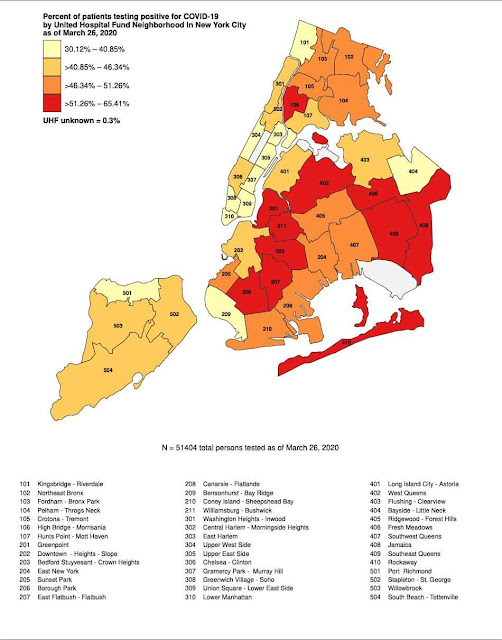
Coronavirus map shows the poorest New Yorkers are getting infected the most


https://blogger.googleusercontent.com/img/b/R29vZ2xl/AVvXsEjPBxRFRXbFwNHTKqONTGFkItpuPyceSJOlKlF4XLFe57NuK9Bxp2p1b7Au2g8GvqZIxy7Puw4J_lBF-bgpaYwIQfUVJs8JrpKv36CVDP0u4BbGyZKNeTJgGWw8KCoFSj-MzXutaPZ8pxQ/s640/covidmap.jpg


NY Daily News

A city map suggests what many New Yorkers already suspected: Coronavirus is hitting the poorest neighborhoods hardest.

The map shows the biggest share of people testing positive for the deadly virus are in a swathe of the city’s poorer neighborhoods, which stretches in a boomerang shape from central Brooklyn through Queens and out to the Rockaways.

A chunk of the South Bronx is also being slammed with more than half the patients testing positive.
Well-heeled neighborhoods like Riverdale, Bayside, Bay Ridge and most of Manhattan are faring relatively much better, with less than 40% testing positive for COVID-19.

Anti-poverty advocates say that the findings likely reflect the fact that poor and working-class people have been far less able to abide by social-distancing rules.

They are also less likely to have jobs that allow them to work remotely like better-off New Yorkers.

Sunday, November 25, 2018

The poor will still have trouble affording reduced fare MetroCards

From City Limits:

In June, after more than two years of campaigning by advocates, activists and grassroots groups, the City Council and Mayor Bill de Blasio announced they’d struck a budget deal: one that included funding for the Fair Fares program, which would provide half-priced MetroCards to New Yorkers living below the federal poverty level.

The initiative, which experts say could potentially benefit as many as 800,000 low-income New Yorkers, is set to roll out in January, though the city has yet to release a detailed plan for how it will operate. Eligibility criteria, how many people the program will serve during its initial rollout, and exactly how participants will obtain their discounted MetroCards are all factors still being worked out, according to a spokeswoman for the mayor’s office.

One detail that we do know, revealed at an MTA committee meeting last week, is that the half-priced fares will only apply to the purchase of weekly and monthly MetroCards. Pay-Per-Ride MetroCards, which users can purchase and load with any amount of money over $5.50, are exempt from the discount, at least initially—something city officials say will allow them to get the program launched on time.

This news was a disappointment to transit advocates who’d pushed for the passage of Fair Fares, who argue that the city’s most cash-strapped New Yorkers are not always able to afford the upfront costs of a weekly or monthly MetroCard, even at a discount. Under Fair Fares, a 30-day MetroCard would cost $60.50 while a 7-day would cost $16.

Tuesday, September 19, 2017

Developers exploit low-income housing loophole

From the Wall Street Journal:

Consider the Low Income Housing Tax Credit, created by the 1986 tax reform. This $9 billion credit masquerades as an antipoverty program, but it mainly subsidizes developers, investors and the financial industry.

To stimulate low-income housing construction, the federal government allots a share of tax credits to the states, which dole them out to selected developers. The credits cover part of the construction costs of multifamily housing projects. The developers must cap rents for a share of the units, so the benefits of the tax credit are meant to flow to tenants in the form of lower rents. Yet the developers usually sell the credits to banks and investors, often using syndication companies as intermediaries. The investors, developers and middlemen—not poor families—end up grabbing most of the benefits.

Thursday, August 18, 2016

Van Bramer wants discount Metrocards for welfare recipients

From NY1:

A new bill would help some of the poorest New York City residents pay for their MetroCards.

Queens Councilman Jimmy Van Bramer introduced legislation on Tuesday that would require the city to provide half-priced MetroCards to welfare recipients who need to travel to work in order to receive their aid.

“It seems obvious to us that if the city requires folks who are on public assistance to work in order to receive public assistance, they should be able to get a discounted ride to get to work and be eligible for public assistance in the first place,” Van Bramer said.

Van Bramer said he was not sure how many residents would be eligible for the discount, though he said it was “an investment worth making.”

Tuesday, October 13, 2015

Gentrification hurts the poorest residents (duh)

From the Daily News:

The city hired five NYCHA residents to work as urban “interpreters” who gathered information for a $250,000 report that reached a conclusion most New Yorkers already accept as true: gentrification doesn't help the poor.

The study, "The Effects of Neighborhood Change on NYCHA Residents," written by the consulting firm Abt Associates with help from New York University's Furman Center for Real Estate, found that NYCHA tenants often wind up feeling like aliens in their own neighborhoods, surrounded by newcomers who claimed they'd just "discovered" the neighborhood.

“NYCHA residents could be priced out of new private amenities and new, higher-income neighbors may not contribute to accessible community resources,” the report reads.

The document was finished in May — the same month Mayor de Blasio announced his version of a controversial plan to build hundreds of market-rate apartments on "underutilized" NYCHA property.

Saturday, November 8, 2014

Fare discounts for the poor?

From the Daily News:

Seniors and people with disabilities can get half-price reduced fares on the MTA. There is a case to be made for that: They are more likely to live on limited incomes and travel at nonpeak times — and may have difficulty walking distances.

But what about those on really limited incomes, the poor? In the same survey, we asked New Yorkers whether or not they favor offering half-price fares to low-wage workers. Nearly seven of 10 (69%) said they like the idea. Eighty-three percent of low-income New Yorkers favor it, including nearly three-quarters (73%) who strongly back the proposal.

Some smaller cities are already trying this. Madison, Wis., offers low-income bus passes to riders who certify that their incomes are at or below 150% of federal poverty guidelines. The Charleston Area Regional Transportation Authority offers reduced, low-income fares of $1, a 75-cent discount off the regular price per ride.

Applying these kinds of policies to the city’s mass transit system would require much more intensive planning to guard against abuses and negative impacts on rush-hour crowding and revenues, but we should start crunching the numbers.

If low-wage workers cannot afford to take a trip now, then the revenue loss might be small, and the main impact would be to increase ridership.

Sunday, May 25, 2014

Prepare to be blockbusted

From the Daily News:

The City plans to attack economic segregation in its affordable housing plan — placing the poor in middle-class neighborhoods and the more affluent in high-poverty spots.

Housing Preservation and Development Commissioner Vicki Been said the plan to build 80,000 new affordable apartments and preserve 120,000 units would create a more diverse city.

“We really have to make economic diversity a cornerstone of that plan,” she said at a City Council budget hearing Wednesday.

“That means that in some neighborhoods that have mostly middle or upper-income housing, that we would need to put affordable housing at the very lowest income,” she said.

“But in some communities where we have a great deal of poverty . . . we would try to bring more moderate (-income housing) into those neighborhoods, to try to achieve the kind of diversity that we want,” Been said.

Saturday, December 8, 2012

Brooklyn school has quota for poor kids

From the Daily News:

In a first for the Bloomberg administration, a highly regarded Brooklyn elementary school has set admissions quotas for poor and immigrant students.

Starting next fall, Public School 133 in Park Slope will set aside 30% of its coveted kindergarten seats for kids who are living in poverty or are struggling to learn English.

The local school board voted to approve the admissions scheme this week after dozens of meetings with parents, education officials and school administrators.

“The goal is to the enhance diversity of the school by making sure preference is given to the neediest students,” said one of the creators of the plan, Community Education Council 15 President Jim Devor.

No other city school dedicates seats for poor kids, though about two dozen high schools with special language programs have admissions criteria that favor students who need to learn English.

Education officials said the admissions quotas are legal since they are not based on race, and other schools may employ them in the future, if parents ask for them.

Monday, November 5, 2012

That was one huge zoning mistake...


From the NY Times:

...the scene speaks to something so obvious it is often overlooked: The waterfront in New York City has never been a suitable place to live. And yet in recent years affluent New Yorkers have been encouraged to colonize it with great fervor. The trend began in the late ’60s and ’70s, with the development of Battery Park City and its high rises, on landfill. Dumbo started to emerge in the ’90s and has since become one of the costliest neighborhoods in the city. The real momentum, though, did not take hold until the Bloomberg administration reimagined the city’s debilitated industrial waterfront as a winding ribbon of good living — a cornerstone of its legacy.

There are expensive condominiums now where factories once stood in Williamsburg, and residential and commercial real estate is coming to a decommissioned naval base in Staten Island. A condominium and hotel complex, with vast family-size apartments, is planned for the northern end of Brooklyn Bridge Park which the storm’s force for a short time rendered indistinguishable from the river itself. The Bloomberg public-private model earmarks money for waterfront green space that in turn lures developers who provide a tax base to support operating costs. But the paradigm rests on an assumption that living on the water will remain an infinitely desirable thing. Our increasingly intimidating weather patterns would suggest that the idea is now vulnerable to challenge.

It is obvious that infrastructural changes need to be made for expansion to sustain itself — crucially, the rethinking of parks and wetland development as infrastructure, which would work to absorb the effects of rising sea levels. But new building ideologies need to prevail as well.

Historically, in many cities of course, elevation has held cachet.

It’s the needy who have been sequestered downward. Not long ago, Ms. Drake, a landscape architect, curious about the placement of New York City’s public housing, devised a map to find out how much of it was built on flood zones. The answer, she discovered, was, most of it. Public housing lines the waterfront in Coney Island, on the Lower East Side, in the Rockaways. This is not the result of progressive and munificent city planning aimed at enhancing the day-to-day aesthetic experience of the poor. Instead it was the result of low-lying waterfront land available at a cheap price.


All this has gotten me to thinking about what a great urban planner that Amanda Burden is!

Tuesday, September 25, 2012

Bloomberg thinks he's helped the poor

From the Daily News:

Times are tough — but hang in there. 

That was Mayor Bloomberg’s message Friday as he railed at the “bums” in Washington who don’t know how to fix the economy, and faced off criticism that his administration hasn’t done enough to help the poor.

 “You should not be that depressed, we grow out of these things, we have been through these cycles many, many times before,” Bloomberg said. On his weekly radio show, Hizzoner noted that not only the economy — but also the politics will renew. 

“People will get frustrated and they will say this new wave of people who came in, they’re wrong, and you’ll throw the bums out and bring in a new group who are great and wonderful until they become the bums, and they get thrown out.” 

Despite painting a gloomy picture of the nation’s elected officials who “don’t know how business works,” the mayor then sought to reassure New Yorkers it was not all bad. When it came to evaluating his own success at tackling the city’s economy and poverty levels, Bloomberg’s outlook was rather more optimistic despite new figures showing the number of city residents living below the federal poverty line rose to 4.5%, or nearly 1.7 million people, in 2011. 

“The nice thing about New York is we don’t walk away from the poor,” he said.

Wednesday, May 4, 2011

TB crossing our borders

From the Daily News:

Tuberculosis cases hit a record low in the city, but the disease is still rampaging through Chinese and Ecuadoran communities.

Health officials say immigrants are bringing the contagious lung disease here from their homelands.

In 1992, the height of the city's TB epidemic, 70% of the cases were in New Yorkers born here. Now 80% of the cases stem from those born abroad.

Doctors suspect the disease is dormant among immigrants until they come to the U.S.

Although a TB test is required for permanent immigration, those who arrive illegally or for school may not get the pinprick exam.

Health officials' priority is early treatment to prevent its spread, but TB often goes undiagnosed because the sufferers are poor, undocumented or leery of government.

Saturday, April 2, 2011

Mexicans having a hard time

From the NY Times:

About 43 percent of all Mexican immigrant households are overcrowded, compared with an average of 15 percent of all immigrant households and 9 percent of households in the general population, according to the report, titled “Housing the City of Immigrants.” The study also finds that about 35 percent of Mexican households spend more than half their income on rent, compared with 26 percent of all immigrant households and 24 percent of all households combined.

The report suggests that the relatively poor housing experience of many Mexicans is a function in part of the population’s newness to New York and their low income levels.

Those immigrant groups that have been in the city for a longer period of time tend to have better access to subsidized and public housing, the report said. In addition, Mexicans, particularly men who have immigrated alone to the United States for work, will crowd apartments to save money, especially if they live in neighborhoods where affordable housing is scarce, scholars say.

Among its other intriguing observations, the report noted that while home ownership rose from one generation to the next — to 44 percent of all second-generation immigrant households from 31 percent of first-generation households — the increase was even sharper among low-income immigrants, rising to 34 percent among second-generation households from 17 percent among first-generation households.

While the authors did not suggest a reason for this difference, David Dyssegaard Kallick, director of the Immigration Research Initiative at the Fiscal Policy Institute, said it could partly reflect the fact that some low-income immigrants were “pushed prematurely into home ownership by predatory lending.”

Thursday, January 13, 2011

Hiram cries poverty

From the NY Post:

In a move that almost redefines "chutzpah," disgraced ex-pol Hiram Monserrate wants taxpayers to fund his defense against charges he misused $109,000 in "slush fund" cash while he was a city councilman.

The Queens Democrat -- who got booted from the state Senate for assaulting his girlfriend -- filed court papers yesterday saying he's unemployed and has just $100 to his name.

Monserrate says he has racked up $128,000 in debt.

Defense lawyer Joseph Tacopina, who represented Monserrate in the assault case, said in the Manhattan federal-court filing that his firm contacted Monserrate in October after learning from the feds that he'd been indicted on fraud charges.

"In response, Mr. Monserrate assured us that he would have the funds available to retain us," Tacopina wrote.

But Monserrate hasn't coughed up a dime since then, and recently revealed he lacks the means to do so.

Thursday, February 25, 2010

Paterson pulling the plug on public hospitals

From the NY Times:

The city’s public hospital system, the largest in the nation, is facing a fiscal crisis because New York State is threatening to cut its financing for the care of poor patients at a time when the number of uninsured patients has soared, city officials said Sunday.

The cuts, included in Gov. David A. Paterson’s executive budget proposal, could drain from the public hospitals up to $370 million, much of it in federal financing, and shift the money to programs in voluntary, or private, hospitals, the city officials said.

The officials said the cutbacks were the latest in a series of steps by the state to close a huge deficit by pulling back on longstanding budget commitments.

State budget officials said, however, that much of the proposed cutback was the result of federal stimulus money running out. They added that the governor’s proposal also called for the State Legislature to enact cuts to private hospitals, and that some of that money would go back to the public hospitals.

Yet the dispute between the state and the city goes deeper, with both sides at odds on how much would be cut and how, and even on where some of the money comes from.

Alan D. Aviles, the president of the city’s Health and Hospitals Corporation, which runs the 11-hospital public system, said the proposed cuts would severely weaken the system, putting it on a downward spiral similar to that faced by the city’s Roman Catholic hospital system. New York’s last Catholic hospital, St. Vincent’s in Manhattan, is now near bankruptcy and struggling to avoid shutting down.

“If you look at the Catholic system and St. Vincent’s, the instability in that system didn’t happen overnight,” Mr. Aviles said Sunday in a telephone interview. “Four or five years down the road here, we have to be looking at a replay of what happened to the Catholic medical system.”

The current budget struggle not only pits the state against the city, it also pits the public hospital system, the main safety net for the poor, against the city’s private, nonprofit hospitals, many of which are also struggling under the burden of a large number of poor patients.


MTA: layoffs, service cutbacks
Schools: closing
Hospitals: closing

Thank God we still have huge development schemes like Willets Point and Atlantic Yards or else the government wouldn't find anything they think is worth putting our money into.

Thursday, October 1, 2009

A tale of two cities

From the Daily News:

...there is no more powerful symbol of the city's profound contradictions than seeing our billionaire mayor spend nearly $100 million to get reelected to a controversial third term, while more than a million of his constituents try to scrape out a meager living.

It is not reassuring, the report says, that the state of New York continues to have the highest level of inequality in the country. And neither is it reassuring that a study conducted by the Coalition Against Hunger found that "all pilot anti-poverty programs initiated by Mayor Bloomberg's Center for Economic Opportunity combined involved approximately 42,000 people."

Keep in mind that more than 1.5 million New Yorkers live on an income below the federal poverty line.

As long as this is the case, New York will be the greatest city in the world only for the few who can afford it.

The rest, the majority of its residents, will have little reason to give their city - and their mayor - the thumbs up.