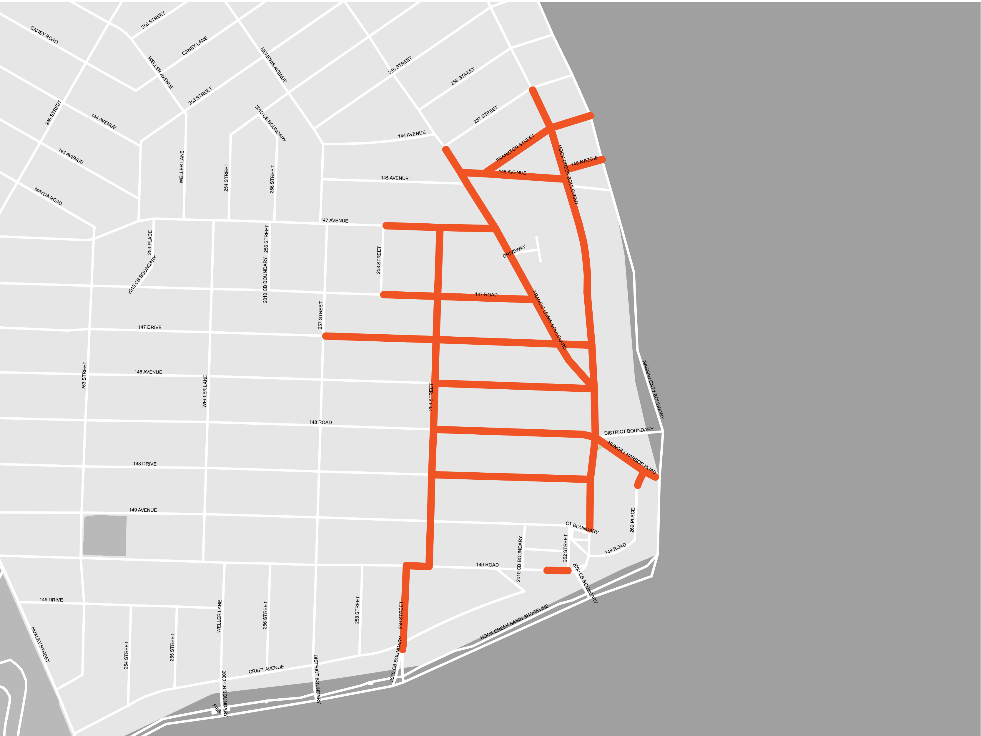
The NYC Department of Environmental Protection (DEP), the NYC Department of Transportation (DOT) and the NYC Department of Design and Construction (DDC) announced Wednesday, July 31, that they have started their planned $51.8 million infrastructure project in Rosedale.
The project, which the DDC is
managing, will address reoccurring flooding in the flood-prone
neighborhood, among other plans. Project highlights will include
improved tap water distribution, reconstructed streets and new
transportation improvements in the area. The projected completion date
is scheduled for winter 2026.
The project will add 92 catch basins
and upgrade or install nearly 1.5 miles of local storm sewers and over
half a mile of sanitary sewers. The new catch basins will help to drain precipitation from the roadways, while 13 underground storm chambers will further boost water holding capacity.
About 2 miles of water mains will be
upgraded from 6-8-inch cast iron pipes to more durable 8-12-inch ductile
iron pipes. Additionally, 14 new fire hydrants will be added and 21
existing fire hydrants will be upgraded to guarantee firefighters’ access to the city’s water supply during emergencies.
Rosedale roadways and sidewalks will
also receive a major fix. The project calls for the reconstruction of 36
blocks with new roadways and the replacement of over 4.5 miles of
damaged and/or broken curbs. The city also plans to fix 4.5 acres of
sidewalks. Additionally, 130 ADA-compliant pedestrian ramps will be
constructed in the are
Ten hours after the National Weather Service issued
a flash flood warning, five hours after the heavy rain began to fall
across New York City, three hours after social media platforms began to
be deluged with photos and videos of floodwaters stranding vehicles and commuters, 90 minutes after the MTA essentially told riders
the trains were all too broken to be of any use, and 40 minutes after
the press conference was supposed to start, Mayor Eric Adams spoke to
New Yorkers for the first time about the flooding that continues to
pummel the city that is under his control.
"We're ready, and you should be as well, to be prepared for this moment," Adams said.
What took him so long?
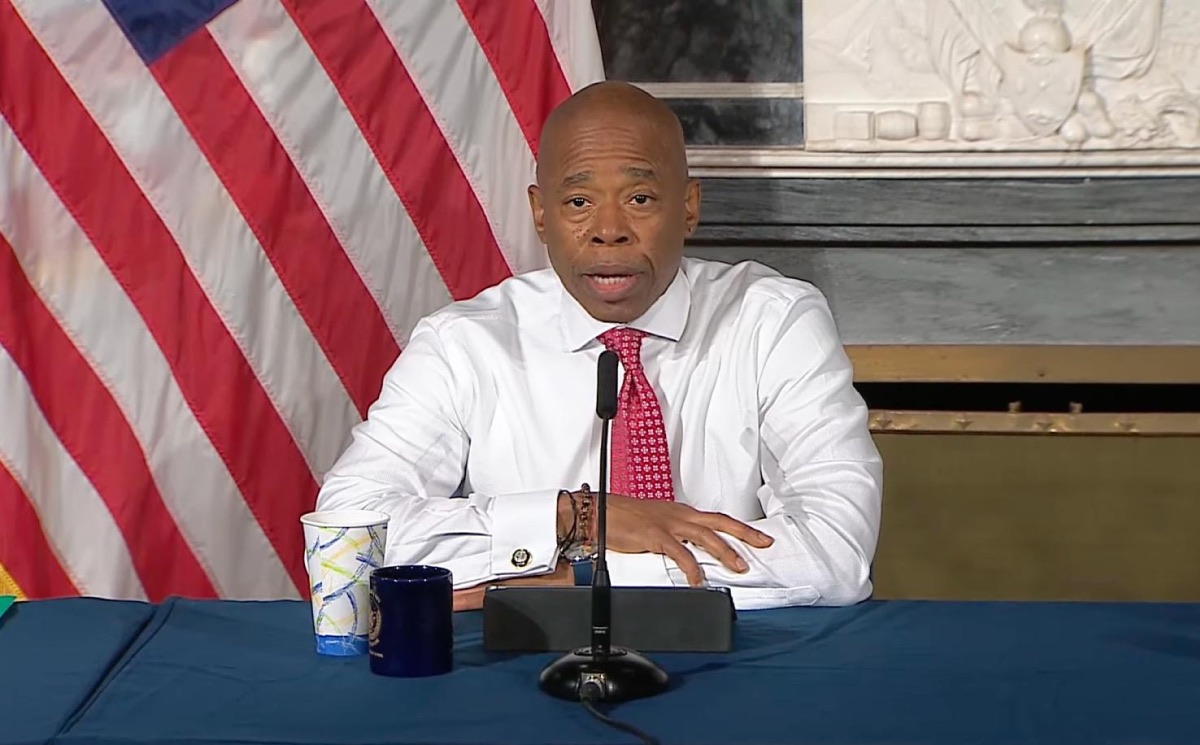
The mayor—flanked by a coffee mug and a tall paper cup, his voice sounding markedly more craggy and halting than usual (Adams had a "birthday fundraiser" in Inwood
on Thursday night)—told reporters that he didn't need to be the first
official to address New Yorkers about the flooding, because his deputies
had already done so, in the form of sending out some Notify NYC alerts,
appearing on 1010 WINS and Fox Weather on Thursday, and forwarding a
press release to reporters at 11:08 p.m. on Thursday night. (Some of
those deputies, including Deputy Mayor for Communications Fabien Levy,
who earns an annual salary of $250,000, went even further, and snippily alerted reporters to all the alerting that had previously occurred.)
"Leadership
is not only the mayor," Adams said. "It is all of those that are placed
in those positions, and that is what you saw."
At the start of
the presser, Adams said that he "got a firsthand look at the impact of
the rainfall and what it is doing moving around the city," but later
revealed that this was a little bit of serendipitous multitasking. On
Friday morning, he had actually gone to a wake for a retired NYPD
officer, and had driven back home through East New York, Canarsie, and
Sheepshead Bay.
Just six families had been successfully evacuated
from flooded basement homes so far, according to Levy, but with two to
four more inches of rain on the way, where could New Yorkers who live in
basements go if their homes flooded? Where was the "higher ground" that
NotifyNYC told basement apartment-dwellers to seek? The mayor didn't say, though he assured everyone that was being taken care of.
"We
will have sites for those who can't go with family and friends, we will
always provide shelter for those in need and we will navigate that,"
Adams said.
Zach Iscol, head of the mayor's Emergency Management division,
assured New Yorkers they were "monitoring continuously," and "in very
active response mode right now," but the evidence provided for that was
simply more assurances.
"We're taking this extremely, extremely seriously," Iscol said.
For
an event featuring the mayor, Governor Kathy Hochul, the head of the
MTA Janno Lieber, and many leaders of City agencies, not a whole lot was
revealed at this press conference. Despite the chaos on the street,
everyone had convened to convince New Yorkers they were doing their
jobs, and that the system is working, more or less. After the mayor
thanked the governor, the governor thanked the mayor. "Mayor, you've
been fantastic," Hochul said.
What about migrants staying in tent structures? No major leaks or flooding have been reported, Levy said.
As the city marks the one-year anniversary of Hurricane Ida, the
effects of which have some displaced families still living in hotels,
Mayor Adams warns that climate change could lead to intermittent weather
abnormalities becoming the norm.
“Thirteen New Yorkers died in
their basement apartments due to flooding,” Adams said. “This
traumatized our city. But climate change is bringing longer droughts,
stronger storms and heavier rainfalls to places all over the globe.”
To
help mitigate the effects of the next colossal rainfall event, Adams
and other elected officials and department heads were in South Ozone
Park last Thursday to announce the creation of an additional 2,300 rain
gardens, the continued expansion of the city’s Bluebelt program and
other green infrastructure initiatives aimed at relieving some of the
burden on the city sewer system that was overwhelmed by last summer’s
rainfall.
The
city’s sewers were built to withstand rainfall at a rate of 1.75 inches
per hour, according to Department of Environmental Protection
Commissioner Rohit Aggarwala. Last summer alone, the city experienced
two separate instances of rain falling at a faster rate: Hurrican Henri,
when per hour totals reached 1.94 inches, and Ida, which dumped 3.75
inches per hour.
“Our path to resilience requires us to look to
nature, to augment our sewer system, to build green infrastructure that
will compliment our gray concrete infrastructure,” Aggarwala said.
“Separately, neither would do the job, but the combination of
well-maintained sewers and extensive green infrastructure can make New
York City resilient in the face of the storms to come.”
While the
city will continue to build out traditional “gray” infrastructure,
including the installment of sewers in areas of Southeast Queens that
had previously been overlooked, an Ida-level event cannot be contained
by sewers alone. Aggarwala says the creation of green infrastructure
initiatives eases the burden on the traditional drainage system by
redirecting or storing excess rainwater until a storm passes.
Rain
gardens — like the one at 135th Avenue and 127th Street where the
officials spoke — are designed to absorb water into the ground and help
keep the sewer system from being overwhelmed. Bluebelts, a program
initiated on Staten Island that has expanded into Queens and the Bronx,
involves the adaptation of naturally existing streams and wetlands into
stormwater filters, bringing the water away from city streets and into
larger bodies of water.
Also announced was a pilot of the city’s
Cloudburst program, aimed at redirecting stormwater from city streets
into specially targeted public places.
The program’s first run
will take place at the New York City Housing Authority’s South Jamaica
Houses. Construction is set to begin in 2023, with two grassy areas and a
basketball court that will be rebuilt at a lower elevation targeted for
water storage.
Similar projects are in planning stages in the St. Albans/Addisleigh Park neighborhood and in East Harlem.
Adams
also announced an expansion of the city’s Floodnet sensors, designed to
provide real-time flooding data to city agencies, residents, emergency
response teams and researchers, along with “daylighting” plans to bring
previously covered streams back to the surface in the Bronx.
“This
is more than just infrastructure,” Adams said. “This is how we’re going
to protect our city and people from rising sea levels and stronger
storms. This is how we can create good jobs because it’s about also
using one solution to address a multitude of problems.”
“We’re
going to continue to be prepared for whatever challenges that we have to
face. We will pivot and shift and adjust,” he added.
In a phone
conversation with the Chronicle on Tuesday, state Sen. Jessica Ramos
(D-Jackson Heights) offered a blunt assessment of the city’s current
plan and its response, as well as the federal and state responses, to
last summer’s storm.
“A lot of what was released in the current
plan is kind of a recount of things that are already being worked on or
projects that have been completed,” she said. “Rain gardens are great,
bioswales are great, but, I mean, how many are we really going to build
and is that going to be enough?”
“It just feels like everyone
remembered hurricane season was rolling around again only lately,” she
added. “Little has been done since Hurricane Ida last year.”
There is an ignorant narrative going around from urbanish jerkoffs that poor people and people who live near Manhattan don't drive cars. This should kill that dumbass noise
Nearly four months after the remnants of Hurricane Ida killed 13 New
Yorkers, residents in the hardest-hit areas like Woodside are still
struggling with government agencies for financial assistance to repair
flood damage.
Many of the victims allege that the damage to their homes is the
result of the city’s failure to fix the drainage and sewerage system.
They cited decades-long calls for updates to the sewer system.
Linda Carlson, who has lived in her Woodside home since 1994, took on
four feet of water when Ida struck on Sept. 1, with three inches of
rain falling in just an hour. A contractor quoted her $34,000 in
damages. “I was one of the lucky ones,” she said.
Carlson was approved for $11,773.68 in assistance from the Federal Emergency Management Agency, more than what many of her neighbors were approved for, she said.
She was granted an additional $1,419.86 when she appealed the
offer—and said others affected by Ida should also contest what’s
offered. “Everybody should. This was caused by the city,” she said.
“We’ve been fighting for decades to have the infrastructure upgraded.”
Danette Rivera nearly drowned
in her Woodside home where she’s lived for 14 years. Her son, who is
legally blind, had to pull her out of the basement through a small
window as it filled with seven and a half feet of water, she said.
“I’m grateful that I’m a survivor. Not everyone has that story to
tell,” she said. “But I’m angry, I’m upset and I’m pissed off. This
shouldn’t have happened to me, and it shouldn’t have happened to anybody
else. People shouldn’t have died.”
Rivera, who estimates that the cost to repair the damage to her home
is about $64,000, also applied for assistance from FEMA, but would not
say how much she was offered.
The amount she was approved for fell well short of the cost of the damage, she said.
Like Carlson, she appealed her offer, but received a letter asking
for documentation she said had already been sent to the agency. “The
appeal process seems like it’s a gimmick,” Rivera said. “Basically, it’s
like a runaround.”
FEMA spokesman Scott Sanders told the Queens Post late last year that
there could be a variety of reasons why someone might receive less
funding than they had hoped. “If you gave me a thousand different
applicants, there’s a thousand different stories in there,” he said.
Federal disaster funds, he said, are “not a substitute for insurance.
It can supplement insurance, but it can’t duplicate assistance people
may get from other sources.”
Majority Leader Senator Schumer has a lot of 'splaining to do also.
Here's the majority leader emphasizing that homeowners will be grants and all damages will be paid for.
Catastrophic flooding in the wake of Hurricane Ida
caused up to tens of billions of dollars in damages to residential and
commercial properties throughout the northeast last week, a new report
estimates.
Losses throughout the region could range from $16 billion to $24
billion, according to a study released Wednesday by CoreLogic, with
roughly 90 percent of the impact concentrated in New York, New Jersey,
Connecticut, Pennsylvania and Massachusetts.
“Given the prevalence of multifamily housing and below-ground
structures in these areas, we’ll see more extreme interior content
damages than we typically see in southern coastal areas,” said
CoreLogic’s Shelly Yerkes. “For example, many of the heating,
ventilation and air conditioning systems in New York City buildings are
in the basements, so contents damage should be substantial.”
Insured losses on residential and commercial buildings are estimated
to be between $5 billion and $8 billion, while uninsured losses could be
between $11 billion and $16 billion.
But the damage, particularly in New York City, could have been much
worse had it not been for structural improvements made following severe
flooding brought by Superstorm Sandy in 2012.
Rep. Alexandria Ocasio-Cortez gave Mayor Bill de Blasio a pass for failing to warn New Yorkers
about the fatal storm that lashed the city last week — preferring to
pin the blame on climate change — but her Queens constituents slammed
Hizzoner and other city officials for their lack of preparedness.
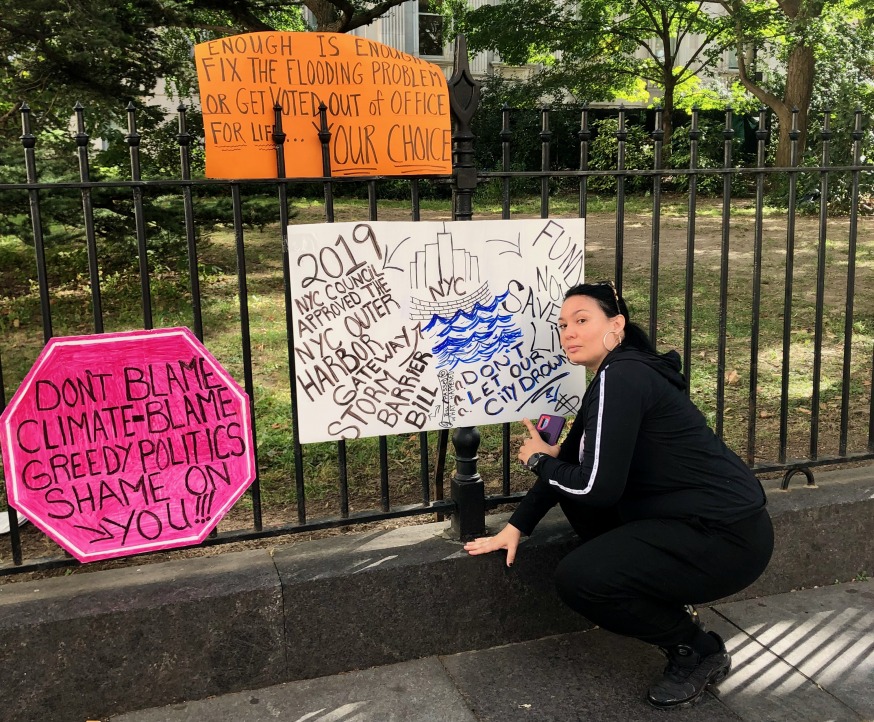
“I don’t blame climate change, I blame the mayor,” Danette Rivera,
47, told The Post outside her Woodside home Monday morning after de
Blasio, AOC, Sen. Charles Schumer and FEMA Administrator Deanne Criswell
toured her block.
“There was absolutely no warning. I wasn’t expecting water from my
own drain to be the one that’s going to kill me,” Rivera said, her voice
shaking with emotion.
Rivera’s arms and stomach were still bruised from when her son had to
yank her out through a basement window as it filled with water that
bubbled up from her drains Wednesday night.
“This is a nightmare. A disaster,” Rivera said, noting that her home
also flooded in 2008. She said city officials told her at the time that
they’d make sure it never happened again.
“Fix the sewer system,” fumed Rivera’s neighbor, Julia Nieves, 77.
“The catch basins don’t get cleaned often enough.
The last time I saw them cleaned was five years ago,” Nieves, a retired
Off Track Betting clerk, told The Post from her Woodside basement where
the paneling had been ripped off to reveal spots of black mold.
Mayor Bill de Blasio and a slew of local politicians marched in a
scaled down, discreetly organized version of the West Indian Day Parade
Monday — infuriating locals who thought the annual Labor Day blowout was
scrapped entirely following Hizzoner’s announcement last week.
The parade kicked off at 9 a.m. in Crown Heights and lasted about an
hour — featuring two floats with DJs pumping out music, dozens of
dignitaries and more than 500 flag-toting marchers and colorfully
dressed revelers.
Some parade perennials — like Terry Owens — were outraged that a
smaller celebration of West Indian culture took place even after de
Blasio nixed the parade altogether for the second straight year due to
COVID-19 concerns.
“I am disappointed because I brought my family up here that wanted to
see it. They came all the way from Alabama,” Owens, 59, griped, adding
that he just happened upon the parade while out for a walk.
“It makes me angry, too, because they could have been out here. They
are home sleeping,” Owens continued. “I come every year. I was talking
about it and I wanted them to come see it. I said, ‘You all need to
come,’ so I was looking forward to coming. I kept asking, I kept
hearing, ‘No, it’s canceled, it’s canceled,’ so I am doing my morning
walk and I saw it and I said, ‘Wow, it’s here.’”
After a storm of the magnitude the New York area faced Monday and
Tuesday, digging out will take not only some strength and heavy
equipment, but some skill as well.
Many homeowners in Queens were
at it all day, but some were frustrated to see people shoveling and
putting the snow right back into the street.
It’s counterproductive to Department of Sanitation plow truck driver Phillip Covington. It only makes his job harder.
"If you want a piece of advice: don't throw it back on the street, put it on the side," he said.
A 20-year veteran of the department, Covington knows a thing or two about clearing snow, even when it’s more than a foot.
“Just throw it on a mound, like a pile or a mound of snow," Covington said.
Covington's seen it all but there's still something different about this storm.
“This
is like a nuisance type of storm because it snowed and then it stopped
for a minute and then it wants to rain," Covington said.
Driving
through Queens, for the most part PIX11 found blacktop, but Sanitation
Commissioner Edward Grayson admitted plow trucks were still trying to
make it to all residential streets
“Were out there through the
night, out all day today," he said. "We will readdress those residential
streets. You will see blacktop today.”
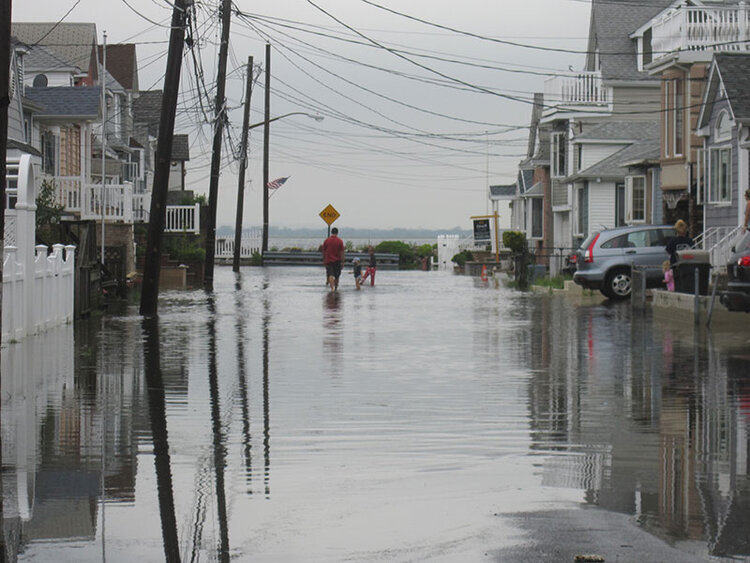
When it floods in Rockaway Beach, it really floods.
Resident Mona Hubbard said, “It's like a river down there, you need a rowboat to get out of here.”
Hubbard recorded video Tuesday from her apartment as she watched her neighbor fight through coastal flood waters.
She described her street, Beach 84th Street, Wednesday.
“It’s snows then the high tide comes up so it overflows and it’s like the Antarctica her out here," she said.
It's
an on going problem for people who live on her block. Citizen App video
showed a city sanitation truck being swept away —the water right up to
the door.
Long time resident Wanda McDowell said she feels like a prisoner in her own home whenever there is high tide or a storm.
“We are trapped in," she said. "We can’t go anywhere.”
Tenants in nearly 1,800 subsidized housing units in Queens could be displaced as a result of rising sea levels over the next 30 years, according to the first nationwide analysis of the climate crisis’ impact on affordable housing. Nearly all of the impacted units are located in the eastern portion of the Rockaway Peninsula, including Far Rockaway and Arverne.
The peer-reviewed study published by the organization IOPScience found that flooding will render more NYCHA, Section 8 and other subsidized homes unlivable in New York City than any other city in the country by 2050.
Authors Maya Buchanan, Scott Kulp, Lara Cushing, Rachel Morello-Frosch, Todd Nedwick and Benjamin Strauss refer to these subsidized units as “affordable housing” as they consider the impact of rising sea levels on 20 vulnerable coastal cities including Boston and Miami Beach.
“The frequency of coastal floods around the United States has risen sharply over the last few decades, and rising seas point to further future acceleration,” they write. “Residents of low-lying affordable housing, who tend to be low-income persons living in old and poor quality structures, are especially vulnerable.“
An interactive map published alongside the report shows the specific communities facing the greatest risk, with nearly all the units concentrated in Far Rockaway and Arverne. The two neighborhoods have a high number of NYCHA and Section 8 units compared to other waterfront neighborhoods of Southeast Queens and the Rockaways.
A city plan to rezone coastal communities for greater resiliency highlights the dangerous impact on Broad Channel, Howard Beach and the neighborhoods around Flushing Bay, as well. All are expected to fall below the floodplain by 2050.
The IOPScience report anticipates factors 30 years in the future, but New York City already has among the highest number of units vulnerable to flooding at least once a year, the authors write.
At least 1,373 subsidized units are vulnerable right now, a total that represents less than 1 percent of the city’s current affordable housing stock, according to the paper by Climate Central and the National Housing Trust.
“Climate-change-driven sea level rise will continue to amplify coastal flooding in the coming decades,” the report states.. “As community resilience investments are made, complementary policies may be needed to protect against the displacement (and potential homelessness) of residents.”
In the basement of Laron Harmon's South Ozone Park
home, no space went to waste. It was fully furnished, and Harmon kept
all his clothing down there. It's where his daughter, who was back home
from college for Thanksgiving, had put her clothes into the washing
machine. His 10-year-old son's toys and bicycle were there too. About
2:30 a.m. on Nov. 30, that basement started filling with waste. Harmon
had gotten used to sewage and flooding issues in the three decades he'd
lived there, and he cleaned out the sewer trap in his basement twice a
year. But he had never seen anything like this. "By nine o'clock in the morning, I had close to four feet of sewage in my basement," he said.
Harmon was one of four South Ozone Park residents who recounted tales of raw sewage flooding their homes
that morning as part of a City Council oversight hearing Wednesday on
how city officials dealt with the crisis, which affected an estimated 74
homes. "I'm one of those families that had to sleep in their car, in my driveway with my children," Harmon said in his testimony.
Nearly two weeks later, residents like Harmon continue to grapple
with the aftermath of the sewage that devastated their homes. Harmon
said he still hasn't gone back home, where there's no heat or hot water.
Instead, he's living in a hotel. "I've never seen nothing like this before," he said. "This was a disaster." City
Council representatives lambasted the Department of Environmental
Protection, which oversees the city's wastewater plants and sewer
system, for being slow to respond to the crisis and promoting a
narrative that blamed the backup on residents pouring grease down their
drains. "They certainly didn't deserve to be publicly shamed in the midst of a tragedy," City Council Member Adrienne Adams said. Adams
said her constituents' calls to 311, the city's emergency hotline, went
unaddressed for hours and that it took the Department of Environmental
Protection hours to arrive at the scene and start fixing the issue. Department
of Environmental Protection Commissioner Vincent Sapienza said crews
had arrived that morning, hours before Adams claimed, but acknowledged
that issues communicating with 311 representatives meant they were slow
to realize all the flooding complaints were connected. Queens Eagle
Some lost prized possessions, like clothes, toys and furniture. Others said they waded through knee-deep muck to try to stem the tide of raw sewage. One man questioned how he would ever get the stench of human waste out of his basement, where the wastewater rose more than four feet.
Inside the City Council chambers on Wednesday, South Ozone Park homeowners took turns describing the impact of the sewer backup that flooded dozens of basements during Thanksgiving weekend.
The wastewater affected about 80 houses in the early morning hours of Nov. 30, destroyed belongings and filling home with a lingering odor.
“It was almost like I was in a horror movie,” said Kari White, president of the 149 Street South Ozone Park Civic Association. White described moving from house to house in his neighborhood as wastewater filled neighbors’ basements. He said he refused to even enter one house because it was the stench was so foul.
Comptroller Scott Stringer, who is tasked for making sure these residents get compensated for their destroyed belongings, did not show up at the hearing.
New York City residents are dealing with awful and vomit-inducing
conditions days after a sewer backup forced them to leave their homes.
Officials say the disruption pushed human waste into about 300 homes in
Jamaica, Queens.
They think cooking grease poured down the drain might be the culprit.
The city’s water agency says drinking water is safe and unaffected.
Cynthia McKenzie said she woke up around 3 a.m. Saturday to an odor she
thought was a gas leak, only to realize that sewage water was rushing
into her basement.
“When you open it, it just smells,” she said. “It makes you want to vomit. We have to pack up all the clothes.”
Raw sewage. There were worms coming out of the toilet. Sludge. Feces.
All kinds of stuff," said South Ozone Park resident Gwen McElroy.
Why does the city (mainly the D.E.P.) think the residents are at fault and are sticking with that theory before they actually find the cause? This preemptive determination smells shittier than the stench and the gallons of biological waste they are hosing back out.
Queens
residents driven from their homes by a clogged sewer line demanded
answers Sunday from city officials who said they weren’t sure when the
problem would be fixed.
A jam in a sewer line serving 300 homes in a swath of South Jamaica just north of Kennedy Airport backed up raw, fetid sewage into about 80 residences on Saturday.
Officials
from the Department of Environmental Protection, which runs the city
sewer system, said they weren’t sure when flooded-out residents could
return.
“We
are alive and OK but everything is gone,” said Sani Lakudi, 50, an Uber
driver who lives in the neighborhood. “My TV, printer, computer — they
are ruined. We stayed up all night pumping water. We had to do what we
had to do or the water would have destroyed everything.”
“Nobody from the city has come to me,” Lakudi added. “We are doing all the work ourselves.”
Streets
were blocked off, including 133rd Ave. near Inwood St., as crews pumped
out of the blocked sewer to keep the smelly, stinking waste from
pouring back into homes across the 15-square block area affected by the
crisis.
Residents were asked to turn off their heat, hot water and electricity while the problem was addressed.
DEP
spokesman Edward Timbers said crews worked overnight to “pump around” a
blockage in the neighborhood’s main sewer conduit near 150th St and
Rockaway Blvd.
City
officials on Saturday said that 300 homes were affected by the sewage
backup. On Sunday, Timbers said that figure was the total number of
residences served by the affected sewer line, and that only about 80 of
them were flooded.
“We
don’t know when it will be fixed,” said Timbers. “People should contact
their home insurance carrier. The DEP has been helping people fill out
claim forms against the city.”
A bypass system to prevent further basement flooding was to be finished by Sunday evening, Timbers said.
A
few years ago I sent you some pictures of this stretch of road in
Flushing Meadows Park. After extensive work there was still significant
flooding. Well, that stretch was under construction again recently (for
a long time!) but they seem to have solved the drainage problem. There
is still a bit of water but this picture was taken today after a ton of
rain this week. This is on the north side of the lake. They also
fixed a chronically flooded spot on the south side.
As you can see from the second picture, there is still
work to be done, but I thought to be fair to the parks department I
should let you know of the improvements.
After Hurricane Sandy devastated New York in 2012, city
officials considered some drastic responses to storm surges, like long
concrete sea walls and tall earthen berms.
But as the seventh
hurricane season since then approaches, the city is relying on something
more modest as the first line of defense against another inundation of
Manhattan: a row of glorified sandbags.
In the next few months,
the city’s Office of Emergency Management plans to oversee the
installation of four-foot-tall sacks of soil along the East River
esplanade, from Wall Street to just north of the Brooklyn Bridge.
For
up to five years, they essentially would form the only barrier to keep
water from again rushing into the low-lying neighborhoods around the
South Street Seaport.
City officials say
they are a temporary step while permanent solutions to New York’s
vulnerability to big storms are still being planned and debated.
But the barriers have already provoked derision.
“Six
years of studying it and you come up with sandbags? Really?” said Marco
Pasanella, whose family owns a 180-year-old building with a wine shop
that faces the river on South Street. He said he felt no less vulnerable
than he did on the night that Sandy flooded his shop and left the
district without power for two weeks.
Along with the doubts about
their effectiveness, the barriers have also been panned as unsightly
interlopers along a stretch of waterfront popular with pedestrians and
bicyclists — one woman called them “atrocities.”
They will cover
only about one mile of the waterfront, leaving the area below Wall
Street unprotected, possibly for another decade or longer.
IT wasn’t the wind and rain that made Hurricane Sandy so destructive to LIC and NYC, but the unusual surge of the coastal waters, which in our case meant the East River. In a small redux, we got a taste of that yesterday around 11am in Gantry Park per the photo above. Unlike Sandy, this flooding occurred when the moon phase was not full, which traditionally causes higher tides. Not to be alarmist, but you may want to get the rafts ready, or at least the skim boards.
Homeowners in New York, New Jersey and Connecticut have seen home values lose nearly $7 billion due to flooding since 2005, according to a new study.
That’s on par with the $7.4 billion in value lost during the same time across the five southeastern states of Florida, Georgia, South Carolina, North Carolina and Virginia.
The new study from the nonprofit First Street Foundation said the Northeastern tri-state area lost nearly as much property value than storm-drenched Florida because of the concentration of valuable real estate in the area, the Wall Street Journal reported.
New York lost $1.3 billion in potential value between 2005 and 2017, and New Jersey lost $4.5 billion. Connecticut lost $916 million.
The city has finally earmarked $8 million to fix aging sewer lines in Middle Village, Queens, that have caused fecal flooding in residents’ basements — a day after The Post revealed how the repairs had been promised for a decade.
“My God, I can’t believe it,” said longtime resident Vito Cascione, 60, whose 1985 Cadillac Fleetwood Brougham was flooded with sewer water during a recent heavy storm.
“The Post’s article really raised eyebrows and a lot of questions, so hopefully we can get this resolved once and for all,” Cascione said.
The 74th Street and Penelope Avenue sewer project, which was first proposed in 2007, sat unfinished for nine months after contractors dug up contaminated soil at the site and needed the extra dough to safely excavate it.
City Hall confirmed to The Post Friday afternoon the money has been allocated and will be processed through the comptroller’s office “soon.”
A spokesperson for the Department of Design and Construction expects work to resume “by the end of the year.” The contractor in charge of the project said about another year of work is still needed.
Italicized passages and many of the photos come from other websites. The links to these websites are provided within the posts.
Why your neighborhood is full of Queens Crap
"The difference between dishonest and honest graft: for dishonest graft one worked solely for one's own interests, while for honest graft one pursued the interests of one's party, one's state, and one's personal interests all together." - George Washington Plunkitt
The above organizations are recognized by Queens Crap as being beneficial to the city as a whole, by fighting to preserve the history and character of our neighborhoods. They are not connected to this website and the opinions presented here do not necessarily represent the positions of these organizations.
The comments left by posters to this site do not necessarily represent the views of the blogger or webmaster.