Sunday, January 16, 2022

Donnie Richards proposes command center for an endemic virus

In short time, Richards made a mark as environmental chair

 QNS

Queens Borough President Donovan Richards on Thursday, Jan. 13 called for the establishment of an NYC Office of COVID Recovery to create a more streamlined and centralized approach toward fighting the COVID-19 pandemic.

The NYC Office of COVID Recovery would strengthen and expand the city’s COVID-19 testing apparatus, improve language access for city residents, foster communication between city agencies and elected officials, and partner with community-based organizations to distribute vaccine incentives and more, according to Richards. The agency would also oversee the Test & Trace Corps, which is currently operated by NYC Health+Hospitals. 

“As Omicron surges and COVID-19 cases continue to rise nearly two years after the start of this unprecedented pandemic, which has killed more than 10,000 of our Queens residents and devastated our borough’s economy, we understand that we need to take control of our response to COVID-19,” Richards said during a virtual media roundtable. “COVID-19 won’t be just a memory anytime soon, we need to brace ourselves and organize for our new normal going forward.” 

According to Richards, the NYC Office of COVID Recovery would alleviate unnecessary administrative burdens from both the NYC Department of Health and the NYC Health + Hospitals system. 

“Over the past two years, it has felt like the ‘Game of Thrones’ and ‘Squid Games’ when it comes to organizing our response, whether it’s inter-agency or working through elected officials,” Richards said. “If we are going to beat COVID-19 once and for all, we want the public to get shots in their arms, we want people to social distance and wear their mask, but we also need a government that would function at the highest level.”

The world's borough has the nation's most jobless

  Unemployment in Queens still high 1

Queens Chronicle

 In its Dec. 21 update, the New York State Department of Labor reported that, in New York City, the nonseasonally adjusted unemployment rate has continued its decline, dropping from 8.4 percent in October to 8 percent in November. In Queens specifically, the same rate dropped from 8.1 percent in October to 7.7 percent in November. In November of 2020, Queens’ unemployment had been 11.5 percent.

While improved, both the Queens and citywide unemployment rates are still considerably higher than those of New York State and of the nation, which decreased from 5.9 percent in October to 5.5 percent in November and 4.3 percent to 3.9 percent, respectively.

So, why is the unemployment rate so much higher in New York City and Queens than it is state and nationwide?

St. John’s University Professor of Economics Dr. Charles Clark said that one answer to point to might be the so-called “Great Resignation”: During the past year of the pandemic, people across the nation have been quitting their jobs en masse in search of something better.

Forest Hills Chamber of Commerce President Leslie Brown noted such trends in her area. “As we know many people did not return to the workforce after the unemployment Covid-19 benefits ended,” she told the Chronicle. “There were numerous reasons for this such as low minimum wage, lack of child care, health concerns [and] lifestyle changes.”

But according to Clark, the Great Resignation is not new.

“In terms of the number of people voluntarily leaving jobs, that has been steadily growing for a very long time,” he told the Chronicle.

More specifically, he told the Chronicle, in January 2011, approximately 1.8 million Americans in nonfarm industries quit their jobs. As per the trend, that number had risen to more than 3.3 million by January 2021, as graphed below.

None of that, however, explains why unemployment is higher across Queens than it is state- or nationwide. Clark speculated that boroughs like Queens and the Bronx might see higher rates because of their higher immigrant populations.

Queens Chamber of Commerce President Thomas Grech pointed to the large hit that the hospitality industry has taken during the pandemic.

“I think a lot of people that work in that industry have decided to find another career choice,” he told the Chronicle. “At the Queen’s Chamber of Commerce, we want to double down on workforce development, to make sure that those businesses — hotels and hospitality — have a regular supply chain, so to speak, of trained people to go into those jobs as things continue to get better.”

Myrtle Avenue Business Improvement District Executive Director Ted Renz also identified restaurant and retail as two sectors that have struggled to maintain staff; accordingly, individual businesses have changed their schedules.

“I’ve noticed that a number of retailers are closed, or some are closed different days, or they’re not open at all. Some are opening later,” he told the Chronicle.

According to the state Department of Labor’s preliminary numbers, prior to Omicron, restaurant employment increased in New York City from 1.894 million jobs to 1.907 million between October and November, a 0.69 percent increase.


Saturday, January 15, 2022

I, Eric

 Mayor Eric Adams speaks during a news conference in Brooklyn on Jan. 4.

Patch

 A frustrated Mayor Eric Adams offered a simple defense over accusations of nepotism and cronyism in a spate of high-profile hires: "I'm the mayor."

"I'm going to hire the best people for the job that I've known throughout my years in government and their talents," he said Friday. "And the reason I can do that is because I'm the mayor. I'm the mayor of the city of New York, and it's going to take a while before people realize that I am responsible for building a team to end the inequality in our city."

But a rising chorus of critics have argued that Adams' hires — which included his brother Bernard Adams in a $210,000-a-year position — are questionable at best.

Shortly before Adams — again — defended his hires Friday, the New York Times reported a jail investigator accused new Department of Correction chief Louis Molina of telling her to "get rid" of 2,000 discipline cases against officers. She was fired by Molina — a move she believed came at the behest of the correction officers' union, the Times reported.

Adams' officials' closeness with powerful unions aside, other hires face questions over their ethics and qualificiations.

Close Adams ally Philip Banks now serves as a deputy NYPD commissioner, despite the fact he resigned after being named as an unindicted co-conspirator in a federal police corruption case.

Adams on Friday cast the criticism as unfair elitism, rather than stemming from concerns of potential corruption and cronyism.

"When other mayors hired their lower partners, they hired their people they knew from school that they came up through the ranks — how there was nothing to say about it?" he said. "But I have the audacity to hire blue-collar people, everyday folks who are union members, retired members, it's like, 'Who do you think you are putting these blue collar workers, these everyday people who came here to this country eked up through a living, went to school at night... who do you think you are think you could do that?'"

Unlicensed driver kills man with SUV by Metropilitan Ave. mall

https://queenspost.com/wp-content/uploads/2022/01/Citizen-1.jpg 

Queens Post

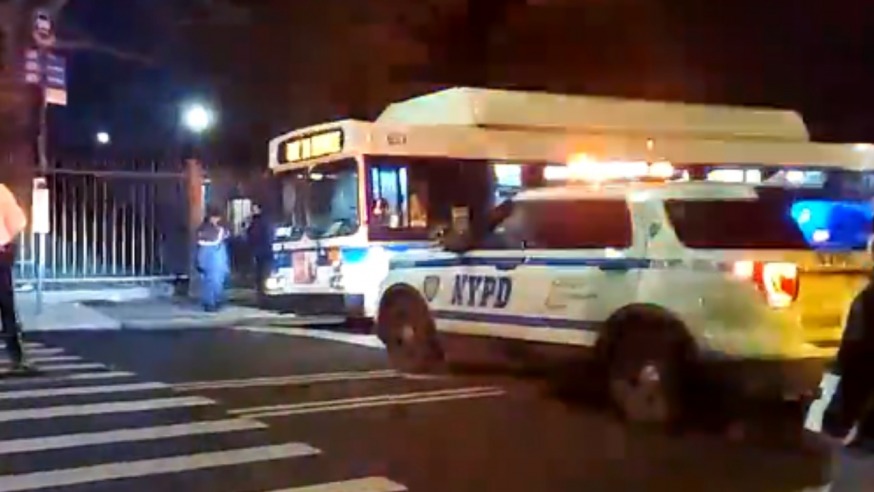
A pedestrian was fatally struck by an unlicensed SUV driver in Middle Village Thursday night.

The victim, a 57-year-old man, was on the roadway in the vicinity of Metropolitan Avenue and Rentar Plaza when he was hit by a 2007 Cadillac Escalade driven by a 46-year-old man, according to police.

Police responded to a 911 call at around 7:45 p.m. and upon arrival, found the victim lying on the road with body trauma.

The victim was transported by EMS to NYC Health & Hospitals/ Elmhurst where he was pronounced dead.

The driver of the Escalade, who is from 75th Street in Middle Village, was arrested and charged with driving without a license.

Manhattan penis extension proposal

https://pbs.twimg.com/media/FJEuJCYXoAI8R6R?format=jpg&name=medium 

New York Times

On Jan. 1, Eric Adams was sworn in as New York’s 110th mayor. He is now in charge of the city’s response to big, and growing, problems. One is a housing affordability crisis. Another concerns the ravages of climate change: sea level rise, flooding and storm surges.

There is a way to help tackle both issues in one bold policy stroke: expand Manhattan Island into the harbor.

Last September, after witnessing unprecedented flooding from the remnants of Hurricane Ida, Mr. Adams said that it was “a real wake-up call to all of us how we must understand how this climate change is impacting us.” This realization should spur him to pursue aggressive measures to mitigate climate change’s devastation.

Both Mayors Bill de Blasio and Michael Bloomberg offered climate-change plans that included extending the shoreline along the East River in Lower Manhattan. But these proposals, while admirable, would be small steps and would hardly make a dent with problems of such big scale.

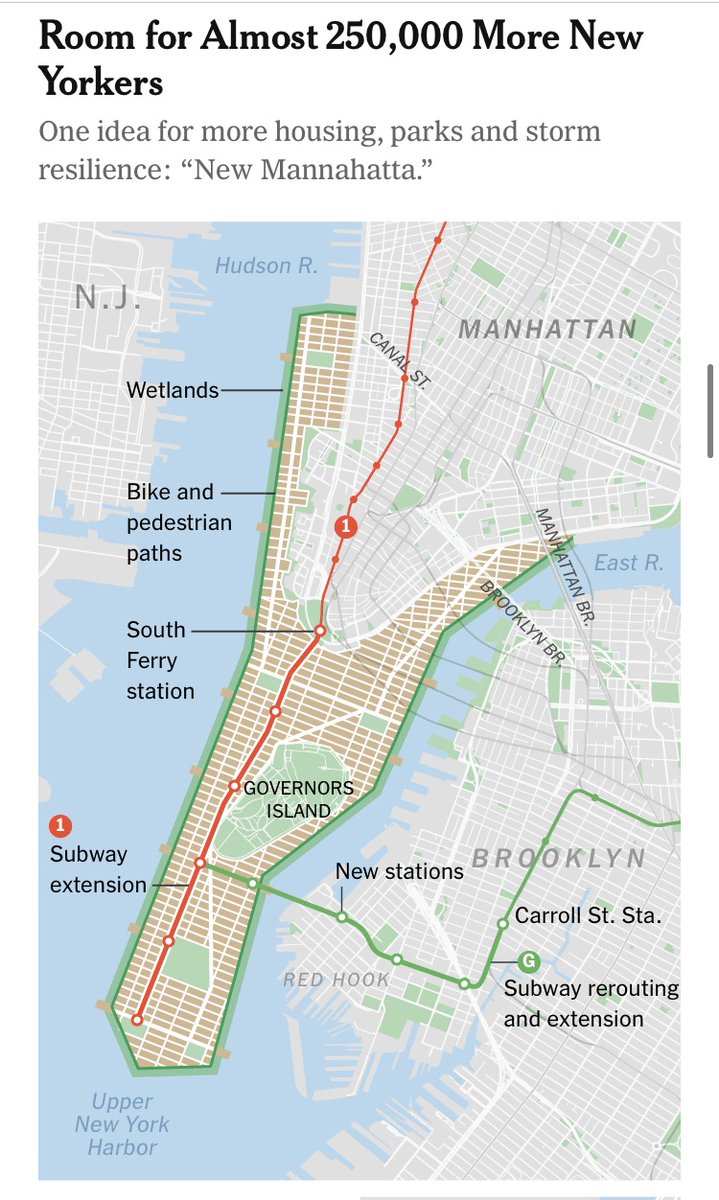
This new proposal offers significant protection against surges while also creating new housing. To do this, it extends Manhattan into New York Harbor by 1,760 acres. This landfill development, like many others in the city’s past, would reshape the southern Manhattan shoreline. We can call the created area New Mannahatta (drawn from the name the Lenape gave to Manhattan).

A neighborhood of that size is bigger than the Upper West Side (Community District 7), which is 1,220 acres. Imagine replicating from scratch a diverse neighborhood that contains housing in all shapes and sizes, from traditional brownstones to five-story apartment buildings to high-rise towers. If New Mannahatta is built with a density and style similar to the Upper West Side’s, it could have nearly 180,000 new housing units.

Opinion Conversation The climate, and the world, are changing. What challenges will the future bring, and how should we respond to them?


Friday, January 14, 2022

Contractor turns sewer infrastructure project into an illegal dumping site

 Sewer contractor allegedly dumping 2

 Queens Chronicle

For more than five years now, an ongoing sewer construction project has wreaked havoc in College Point. But more recently, residents, civics and politicians alike have found themselves going head to head with city-hired, contracting company EIC Associates over its alleged violations of the 1972 Clean Water Act at its waterfront site on 20th Avenue and 119th Street.

“The site’s an absolute mess,” said Jennifer Shannon, president of A Better College Point Civic Association. “It looks like a third-world country. It’s just horrifying.”

According to marine and environmental scientist Dr. James Cervino, who is also the environmental chair for both Community Board 7 and ABCP, the contractor has been using the site as a transfer station and recycling center for the entire 20-block project. There, he said, EIC has been dumping illegally.

“You’re not supposed to dump 2,000 yards of demo dirt — excavated dirt — that might or might not be contaminated,” Cervino told the Chronicle. “You’re not supposed to be letting runoff and debris [get]into the state protective waters under the 1972 Clean Water Act.”

Such pollution was certainly on the community’s radar at the start of the project, Cervino said further; when this phase of the sewer project started roughly three years ago, he said, the community was “assured ... that there would be total communication” from EIC regarding its progress. That has not been the case, Cervino said: Although the Clean Water Act of 1972 requires that a Stormwater Pollution Prevention Program be developed and shared with the community, EIC has not done one.

“[The contractor] is supposed to protect property where property is damaged,” he told the Chronicle. “It’s supposed to be immediately addressed and information supposed to be provided to the community board. None of that ever happens.”

Asked about the SWPPP, EIC Founding Partner Joseph A. Branco said, “My understanding is that we scheduled a meeting, people were notified, there were a number of people at the meeting.” He added, “I wasn’t there myself.”

The New Jersey-based EIC Associates has been part of a number of monumental projects in the area, perhaps most significantly, the redevelopment of the Brooklyn Navy Yard.

Regarding the company’s use of the site in question, Branco said, “What we have is the materials that are disposed of [for the whole project], every two or three days, we have materials going out. I mean, these are the excavated material[s] going out, but it’s not a transfer station, per se.”

There is a State Pollutant Discharge Elimination System permit for the site, the state Department of Environmental Conservation shows.

Branco also said that the company had hired AMC Engineering to consult EIC on its environmental impact during the project. According to him, AMC had produced the information required for the SPDES permit — a 500-page document — in 2019, which he believes went to the city.

Asked for comment on the situation, a spokesperson from Borough President Donovan Richards’ office said, “We are aware of issues pertaining to this project and we are in communication with both DDC and the local elected officials in order to rectify them.”


Civic peeved about LLC's abandoned lot

Empty Whitestone site deteriorating 1

Queens Chronicle 

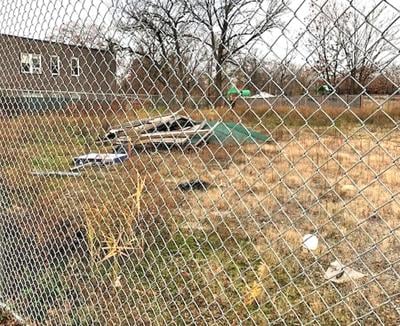
What’s going on with the vacant lot on the corner of 154th Street and 11th Avenue in Whitestone?

That’s the question President of the Greater Whitestone Taxpayers Civic Association and Community Board 7 Member Kim Cody has been asking since Lot 74 was last occupied in 2010.

Cody said that members of his civic have inquired about the lot, as well. “People are asking, ‘What’s going on with the property?’ over the years. All the sudden, it started overgrowing with weeds,” he told the Chronicle. “They go down there and check, and then they see this pile of junk in the middle of the lot.”

The site, which spans two addresses on the block, 11-10 and 11-12, was previously occupied by a fruit market and a deli, Cody said. Though the building on the lot was not demolished until roughly 2019, the lot itself has been fenced off since 2015.

The fence seems to have been ineffective. “Kids were still going inside the lot and stuff like this doing what teenagers do,” Cody said. “They were drinking and whatever the possibilities were coming apart.”

When the temporary, fabric fencing ultimately became tattered as a result of several storms, a chain link one was installed in 2019. Since then, no further construction has occurred, despite rumors that speculated otherwise.

Meanwhile, Tax Block 4538, Lot 74, has continued to deteriorate, and upset surrounding the site has only persisted. Cody said. “People would call up the civic association [and say], ‘We’re worried about rats or raccoons in there,’ and stuff like this,” he said. “There’s a public school right up the block, and it’s a commercial area, there’s delicatessens there and stuff, Chinese restaurants — there was a lot of concern about what was going on with the property.”

The property in question is, according to the Department of Buildings, owned by Andrew Lester of 11-10/12 154 St. LLC. Lester is currently the senior vice president of construction at Wharton Properties, a Manhattan-based, commercial real estate company.


Thursday, January 13, 2022

Pay to play Emily Gallagher's game

Get on board


The Bronx’s Community Board 10 on East Tremont Avenue.

THE CITY 

Community boards in New York City weigh in on liquor licenses, budget items and local development rules. Chances are, they’ve hosted a heated debate in your neighborhood over future housing, or roadway changes.

But what is a community board, really? And how do its members get a say in all those hyperlocal issues, from street cleaning to rezonings?

Now’s the time to learn — because boards across the boroughs are choosing new members very soon.

For those curious about what boards do and how to get involved, listen up: Most of the five borough presidents are taking applications between January and March.

Here’s what to know about the process, and what to expect if you’re chosen to join:

How do you join a community board?

First step is: apply!

Applications have opened already for some of the boroughs, and we’ll update this list as more applications are published. Here are the links and deadlines:

  • Brooklyn — Deadline is Feb. 18.
  • Queens — Deadline is Feb. 16.
  • Manhattan — Deadline is March 1.
  • Staten Island — Applications are accepted year-round.
  • The Bronx — No applications are available yet.

There are 59 boards total, each corresponding with a community district, groupings of neighborhoods that can include up to 250,000 people.

Each board has up to 50 members, all volunteers, and have no minimum number of members. Board members serve via staggered two-year terms, which means half must be reappointed or replaced every year.

All of those people are appointed by their own borough president. City Council members can recommend new applicants, but the final call rests with the BP.

Governor Kathy's Garden Party on the Hudson is a load of crap.

 https://i0.wp.com/buffalochronicle.com/wp-content/uploads/2022/01/PennPAU_Proposed_Condition_-_East_Access-1.jpg?resize=1024%2C709&ssl=1 

Buffalo Chronicle

Governor Kathy Hochul is preparing to relocate Madison Square Garden to a permanent new home on the site of Dewitt Clinton Park, a 5.8 acre city park in a trendy section of Manhattan, overlooking the Hudson River between 52nd and 54th Streets.  The relocation of the nearly 20,000-seat multi-use arena event center is intended to accelerate Hochul’s sweeping improvement plan for Penn Station, which sits under the 60s-era venue that critics have always lamented as congested and misplaced.

The Governor believes that the new arena’s construction could be completed in as little as three years, and she wants to hire a ‘star architect’ with deep ties to New York to begin designing the facility as soon as possible.  Hochul envisions that the arena will ‘sit on-top’ of glassy television studios at street level, which she hopes that businessman James Dolan will populate with nationally-broadcasted sports and entertainment programming on MSG’s television network.

Many of the studio spaces will include in-studio audiences and others will overlook the Hudson River.  Hochul believes that national programing will help improve the city’s image, believing that New York City’s waterfront has gone under-appreciated in the national consciousness.

“The new arena is expected to be a super-modern, super-comfortable venue in a corner of Manhattan that is very centrally located but doesn’t feel as hyper-congested and gritty as the 33rd Street location,” an official with Empire State Development explains.  “The new arena’s construction cost is expected to cost New York State taxpayers $800 million, which is the estimated fair market cost of using eminent domain to acquire MSG’s interests in the property.”

Dolan, the longtime CEO of MSG, prefers to collaborate with the Hochul administration, and is likely to ink a public-private partnership deal in order to avoid a costly drawn-out litigation with the State.

Hochul is willing to use eminent domain to acquire the park from the City, but believes she will have the endorsement of Mayor Eric Adams — who shares her goal of expediting transit and public space improvements at Penn Station.  While Adams is concerned about the loss of public space in the neighborhood, Hochul plans to replace the 5.8 acres of public space by acquiring and redeveloping additional piers as park space along the Hudson River in the immediate vicinity of the facility.

The facility will accommodate boxing, mixed martial arts, the National Hockey League, the National Basketball Association, and national concert tours.

The old Madison Square Garden will be demolished and it’s 250,000-square-foot site between 33rd 31st Streets will be repurposed as a large public square that will sit above Penn Station’s loading platforms and in front of a glassy new entrance atrium that was announced by the Governor last month.

Wednesday, January 12, 2022

Ihr Kampf with mandate analogy


 QNS

Newly elected northeast Queens Councilwoman Vickie Paladino walked back an explosive comment made during an interview on NY1 about her refusal to disclose her COVID-19 vaccination status to City Council officials last week.

“I don’t need to show my papers. This is not Nazi Germany,” Paladino said during that interview.

On Tuesday, Paladino said she made the “ill-considered and inappropriate comparison” during an hours-long interview, and asked that it be struck from the record, but took “complete ownership of that mistake.”

“While my intent was to illustrate that requiring residents to show medical papers to earn a living or do everyday activities is an authoritarian practice that does not align with this country’s principles, it is never OK to compare anything to the evil of Nazi Germany,” Paladino said in a statement. “I apologize to those who were genuinely offended by my comment.”

She added that she would meet with local Jewish officials and her friends in the Jewish community in the coming days to discuss the matter.

The controversy arose nearly a week after Paladino was refused entry to the City Council’s first stated meeting of the new year.

The 67-year-old Republican refused to disclose her COVID-19 vaccination status and was told by officials she would be barred from the chamber floor on Wednesday, Jan. 5. There has been no resolution to the standoff, and Paladino continues to oppose any effort to require people to disclose their vaccination status as a condition of employment or for any other reason.

“The idea that we are now essentially blackmailing people by threatening their jobs and their livelihoods is what is eroding public trust in vaccines,” said Robert Hornak, a Paladino spokesman. “People should be allowed to make their own decision on their healthcare. And nobody should be forced to disclose their personal medical information to anyone. Everyone has a right to privacy and that includes medical privacy. We will continue to stand up for that right as long as people are trying to use heavy-handed tactics to force their will on others.”

Monday, January 10, 2022

Donald Manes's vault

 Impunity City

This scene takes place in Kew Gardens at Queens Borough Hall, office of the Queens Borough President, currently held by one Donovan Richards.

This was taken during the Winter Solstice and Christmas holiday, where there was an incident at the Umbrella Hotel across the street, but it’s being documented now because of the significance of today’s date. Marking the anniversary of the day the longest reigning Queens Borough President Donald Manes attempted suicide by the Grand Central Parkway.

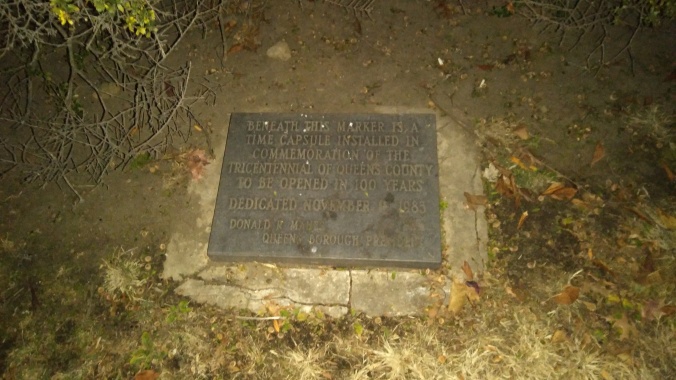
Walking by the disheveled tree the Hall set up, there was a monument that caught my eye

Looks like the long ago World's Borough Prez left a time capsule here just a few years before his personal troubles and city scandals got exposed. And it's got another 61 years until whatever contents will finally be found when the "world's borough" turns 300 (!!!). It's a wonder what could possibly be stored in here, but from the looks of the cracks around it maybe Donnie pried it open on intermittent weekends to store his cash bribes in here in the dead of night?...


Robert Durst is a dead man

 https://s.hdnux.com/photos/01/23/43/32/21903018/3/ratio3x2_1200.jpg

 Times Union

 Robert Durst, the wealthy New York real estate heir and failed fugitive who was dogged for decades with suspicion in the disappearance and deaths of those around him before he was convicted of killing his best friend and sentenced to life in prison, has died. He was 78.

Durst died Monday in a state prison hospital facility in Stockton, attorney Chip Lewis said. He said the death was from natural causes due to a number of ailments.

Durst was convicted in September of shooting Susan Berman at point-blank range at her Los Angeles home in 2000. He was sentenced Oct. 14 to life in prison without parole.

Durst had long been suspected of killing his wife, Kathie, who went missing in New York 1982 and was declared legally dead.

But only after Los Angeles prosecutors proved that the motive in Berman's death was to silence her because she helped him cover up Kathie’s killing was he indicted by a New York grand jury in November for second-degree murder in his wife's death.

Los Angeles prosecutors told jurors that Durst got away with murder in Texas after shooting a man who discovered his identity when he was hiding out in Galveston after Berman’s killing. Durst was acquitted of murder in that case in 2003, after testifying he shot the man as they struggled for a gun.

Deputy Los Angeles District Attorney John Lewin said jurors told him after the verdict that they believed Durst murdered Morris Black in Texas and had killed his wife.

Durst discussed the cases and made several damning statements including a stunning confession during an unguarded moment in the six-part HBO documentary series “The Jinx: The Life and Deaths of Robert Durst.”

The show made his name known to a new generation and brought renewed scrutiny and suspicion from authorities. He was arrested in Berman’s killing the night before the final episode, which closed with him mumbling to himself in a bathroom while still wearing hot mic saying: “You’re caught! What the hell did I do? Killed them all, of course.”

Investor slumlord negligence turned Bronx Mitchell-Lama apartment building into a deathtrap

Reuters 

 Emergency personnel from the FDNY respond to an apartment building fire.

NY Post 

The Bronx building where at least 19 people died in a massive blaze Sunday was cited for more than two dozen violations and complaints — despite $25 million in state loans for repairs.

The citations, including for vermin infestation and faulty elevators, came after the 2013 infusion of state cash — and before the building was sold to an investment group two years ago, records reviewed by The Post show.

The 19-story, 120-unit building has been hit with complaints and violations since 2014.

Part of a complex initially known as Twin Parks, the building went up in 1972 as an urban renewal project constructed by the state UrbaDevelopment Corporation — the present-day Empire State Development Corporation.

The building was owned by Cammeby’s International Group, whose principal is real estate mogul Rubin Schron, until it was sold to a consortium of three investor groups in December 2019.

But not before Schron, a pal of onetime state Assembly Speaker Sheldon Silver, got nearly $25 million in state loans to make repairs and upgrades at the building.

Since 2014, one year after Schron got the state loans, the building amassed more than two dozen complaints and violations, none related to fire hazards or potential lapses in safety standards, city records show.

A message left for Schron Sunday was not returned.

The 2019 sale of the building was part of a $166 million deal for eight rent-regulated buildings in the Bronx, according to Real Estate In-Depth.

Rick Gropper, the co-founder of one of the three firms, Camber Property Group, was a member of the housing committee for the mayoral transition team of Eric Adams, sources said. 

The other two investment firms with ownership of the building are LIHC Investment Group and Belveron Partners.

“We are devastated by the unimaginable loss of life caused by this profound tragedy,” the owners said in a statement.

“We are cooperating fully with the Fire Department and other city agencies as they investigate its cause, and we are doing all we can to assist our residents.”

Reuters

New York authorities said on Monday the city was investigating a possible "maintenance issue" with a door that failed to close when devastating fire erupted in a Bronx apartment building a day earlier, killing 17 people, including eight children.

New York City Mayor Eric Adams, just over a week into the job, said at a briefing that the city's medical examiner determined the fire had claimed two fewer victims than the 19 announced on Sunday.

The blaze broke out on Sunday morning in the 19-floor Twin Parks North West building, which provided affordable housing units for low-income New Yorkers. Many of the residents were from the large Gambian community that lived in the neighborhood.

"This is a global tragedy as The Bronx and New York City is representative of the ethnicities and cultures across the globe," Adams said during a briefing in front of the building. "This is an evolving crisis. An unspeakable tragedy."

Adams said he spoke with U.S. President Joe Biden, who pledged that the White House will provide "whatever" New York City needs to address the aftermath of the fire.

The catastrophe was likely to stir questions on safety standards in low-income city housing. It was the second major fire in a residential complex in the United States this week after 12 people, including eight children, were killed early on Wednesday when flames swept through a public housing apartment building in Philadelphia.

Earlier in the day on "Good Morning America," Adams said smoke from the fire was able to spread due to a door being open. Doors in apartment houses are required to close automatically to prevent fires from spreading through the building.

"There may have been a maintenance issue with this door and that is going to be part of the ongoing investigation," Adams said. "This is all going to come out during the investigation."

Addressing the revised death toll, Fire Commissioner Daniel Nigro said patients had been taken to seven different hospitals in the city, which led to “a bit of a double count,” adding that many remain in care still fighting for their lives.

Investigators are looking into the possibility that a door from 15th floor to stairway was not functioning as it should, Nigro said, adding that residents would have been safer if they stayed in their apartments rather than exiting down stairways.

Some 60 people were injured in the blaze and 32 people had been hospitalized with life-threatening injuries, officials said on Sunday.

Fire marshals determined through physical evidence and accounts from residents the fire started in a portable electric heater in the apartment's bedroom. The heat had been on in the apartment building and the portable heater had been supplementing that heating, they said.

Some 200 firefighters helped put out the blaze.


Mayor Adams OK's city voting rights for non-citizens

https://nypost.com/wp-content/uploads/sites/2/2022/01/eric-adams-11.jpg?quality=90&strip=all&w=744

NY Post 

Mayor Eric Adams said Saturday he supports a controversial bill to allow hundreds of thousands of non-citizens living in New York City to participate in local elections.

Adams said in a statement he has and will continue to support the measure despite initially having “some concerns.”

The City Council approved the “Our City, Our Vote” measure in December, despite concerns from more than a dozen lawmakers, former Mayor Bill de Blasio and some constitutional experts.

The bill granted approximately 800,000 legal, non-citizen residents — such as green card holders and recipients of deferred action — the right to vote in municipal contests, but not state or federal elections.

“I believe that New Yorkers should have a say in their government, which is why I have and will continue to support this important legislation,” Adams said in a statement Saturday.

“While I initially had some concerns about one aspect of the bill, I had a productive dialogue with my colleagues in government that put those concerns at ease. I believe allowing the legislation to be enacted is by far the best choice, and look forward to bringing millions more into the democratic process,” the Democrat continued.

Museum executives still mooching off 9/11 and laid off staffers

 Image 

NY Post

After closing for six months during the pandemic and laying off or furloughing 60 percent of its staff, the cash-starved 9/11 Memorial and Museum gave $1,000 bonuses to each of its 12 highest paid execs, The Post has learned.

The bonus brought the total compensation in 2020 for CEO Alice Greenwald, who recently announced she is stepping down, to $564,500, according to the organization’s latest IRS filing.

Built to remember the September 11, 2001, terror attacks and to honor the 2,958 people murdered, the memorial and museum took a big financial hit during the pandemic and is still struggling to recover.

The bonuses were funded by an anonymous donor and restricted to that purpose, said spokeswoman Lee Cochran.

“The donation was intended to recognize the exceptional dedication of a very hard-working staff” who ran the organization after COVID-19 forced a shutdown in March 2020 and produced virtual education programs during the closure, Cochran said.

Besides Greenwald, 11 top staffers who each collected $187,000 to $347,000 in 2020 also got the $1,000 bonus. Another 155 remaining employees received unspecified bonuses “based on duration of employment.” Cochran said. She would not disclose the amounts or total spent on bonuses. “Everyone got something.”

The salaries anger an advocacy group, 9/11 Parents & Families of Firefighters and World Trade Center Victims, which wants the National Park Service to run the site.

“This is a cash cow for the executives running the museum. Their salaries are exorbitant,” said retired FDNY Deputy Chief Jim Riches, the group’s chairman, whose firefighter son Jimmy Riches was killed on 9/11.

Sunday, January 9, 2022

This is deBlastopia


 Impunity City

 The Blaz era is finally and mercifully over but his contribution to the New Bad Days will go down in history as the greatest regression of New York City in 50 years and will surely continue to plague this town for years to come.


Governor Hochul does not understand financing the $2.6 billion LIRR main line third rail track


Either Governor Hochul's ghost speech writer and/or transit adviser has no understanding of the relationship between MTA and the Federal Transit Administration along with how the MTA & LIRR fund its Capital Program when it comes to the $2.6 billion LIRR Main Line Third Track project..

Governor Hochul's State of the State speech referenced accessing $1.1 trillion federal Infrastructure Program to pay for the $2.6 billion LIRR Main Line Third Track.  This makes no sense. (Source: "Gov. Hochul promises to complete LIRR Third Track project this year" -- Newsday, January 6th by James Gormley).  In 2017, the MTA added $3 billion which included $1.95 billion for LIRR Main Line Third Track to the $29 billion 2015 - 2019 Five Year Capital Program Plan. 

 This brought it up to $32 billion.  These dollars supplemented $600 million previously available resulting in the project being 100% fully funded.  The MTA LIRR could not have legally awarded construction contracts without this. A majority of the work has been completed with eleven months to go. Most funds have already been spent.  

 The LIRR followed state SEQUA rather than the federal NEPA environmental review process.  Compliance with NEPA is a requirement to be eligible for Federal Transit Administration funding. Why would FTA consider funding for this project when it is already 100% locally funded and close to completion?  Is this a back door way for the MTA to substitute federal funding to offset the missing $15 billion in Congestion Price Tolling revenues? 

 The MTA $51 billion 2020 - 2024 Five Year Capital Plan was adopted under the assumption that $15 billion would come from Congestion Price Tolling.  Not a dime will appear until June 2023 or later. How will the MTA raise $15 billion over 18 months rather than five years? This project is not included in the MTA February 8th 2022 FTA Program of Projects Pubiic Hearing Notice.  Here is the link to the document

Sincerely.

Larry Penner

(Larry Penner is a transportation advocate, historian and writer who previously worked for the Federal Transit Administration Region 2 New York Office. This included the development, review, approval and oversight for billions in capital projects and programs for the MTA, NYC Transit, Long Island Rail Road, Metro North Rail Road  MTA Bus along with 30 other transit agencies in NY & NJ). 


Some bike lanes approved in Bayside

CB 11 passes bike lanes unanimously 1

Queens Chronicle 

Community Board 11 unanimously voted to approve its Transportation Committee’s recommendation for 11 new bike lanes in the area.

Residents’ support for the committee’s recommended plan was also readily apparent; all of those who took part in public participation spoke overwhelmingly positively of it.

The recommendation comes after a months-long, immensely detailed process; according to Victor Dadras, first vice chair of the board and chair of the Transportation Committee, the committee worked with the Department of Transportation at length in addition to conducting its own research.

Bike lanes have long been a contentious issue in Queens, often regarding single streets. To have not only passed a recommendation of this size, but to have done so unanimously, then, is quite a feat — for bike supporters and board members alike.

“See? We can conquer anything,” said Christine Haider, the board’s second vice chair.

But in Dadras’ view, the debate should never be so complicated. “To me, it’s not about us versus them, bikes versus cars,” he told the Chronicle. “It’s about safety and equity — reimagining our streets as public spaces that everyone can share safely.”

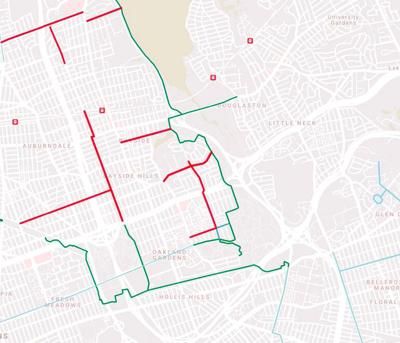
The lanes approved by the board are predominately in the western part of the district, most of which the committee said should be protected ones. That is a departure from the DOT’s proposal, which has called for many class one and two lanes; both of those put cyclists between drivers and parked cars, whereas some other types offer more protection.

Perhaps the most significant addition is the committee’s approval of a protected bike lane with floating parking on Utopia Parkway across the full length of Community District 11. Previously, the DOT had recommended it span 47th Avenue between Utopia Parkway and 188th Street and southbound on 188th Street to the Horace Harding Expressway.

Many bikers are opposed to class two and three lanes, the former of which use sharrows, markings that indicate that bikers and drivers are required to share the road. The fact that this plan calls for many protected lanes, then, has been applauded.

“This unanimous vote shows the broad, popular support for protected bike lanes throughout Queens,” said Laura Shepard, Queens organizer for Transportation Alternatives and a Bayside native. “As the bike boom continues, more New Yorkers are biking for transportation and people of all ages are discovering the joy of riding through our parks and on our greenways.”

It’s no secret that the Transportation Committee went to unprecedented lengths to make it happen. Not only was a new infrastructure subcommittee formed, but CB 11 staff conducted their own study. District Manager Joe Marziliano and staffer Christina Coutinho drove along all of the routes DOT proposed, took pictures and measured the distance to the curb. From there, Bernard Haber, who chaired the Transportation Committee for many years and specializes in transportation engineering, looked at those measurements on city maps in order to advise the subcommittee.

“We’ve seen here what good committee work can do,” Board Chair Michael Budabin said in reference to the panel’s recommendation.

There were three routes proposed by the DOT, however, that the board did not recommend, per the committee’s safety concerns.

Saturday, January 8, 2022

Tiffany Caban caves and approves luxury public housing towers with her council cronies

  https://queenspost.com/wp-content/uploads/2021/09/ss4.jpg

Astoria Post

 The City Council unanimously approved a developer’s plan last month to rezone a section of 31st Street in Astoria—making way for three large buildings that will collectively bring 278 units along the strip.

The city council voted 47 for and zero against the rezoning plan—the final step in the public review process. The vote means the project can now officially move forward.

The rezoning clears the way for MDM Development, an Astoria-based real estate company, to construct three buildings on the east side of 31st Street between Astoria Boulevard and 24th Avenue. Two of the buildings will be 11 stories, the other 12 stories.

The plan calls for 278 apartments, 69 to be affordable, in accordance with the city’s Mandatory Inclusionary Housing (MIH) requirements. The plan will also bring retail space and community facilities—such as senior and youth centers.

The buildings are slated to go up where the Neptune Diner, Staples and a nearby vacant lot are currently located. The popular diner and Staples will be bulldozed.

Without the upzoning, MDM would still have been able to develop the sites– with about 200 units permitted as of right, according to landuse attorney Frank St. Jacques. However, MDM would not have been required to build the 69 affordable housing units.

The rezoning got the approval of Council Member Tiffany Cabán, despite her saying at a candidate forum on Oct. 19 that the project didn’t have enough affordable units. “We are 67 of the 200-plus units being affordable. That is not good enough.”

 Cabán also said that the units were not affordable enough. “It is not affordable housing,” she said. “We need ultra-affordable housing.”

The 69 affordable units, up from the initial 67, will be set aside for low-and-moderate income New Yorkers across a range of incomes, in accordance with Option 1 of the MIH requirements.

There will be 24 units available for households earning up to 40 percent of the Area Median Income — $42,960 for a family of three; 25 units set aside for those earning up to 60 percent AMI — $64,440 for a family of three; and 20 for those earning up to 80 percent AMI — $85,920.

Cabán’s spokesperson said that Costa Constantinides, the former councilmember, had already negotiated the deal prior to her taking office. Constantinides stepped down from office in April 2021 to take a position as the CEO for the Variety Boys and Girls Club of Queens.

Cabán’s spokesperson said that the council member was able to secure $250,000 from the developer prior to the vote to go toward upgrading Hoyt Playground, which is located across the street from the project site.

The council vote, however, was held just days after Cabán was sworn into office. The vote was held Dec. 9, while Caban was sworn into office a Dec. 1.

“The project was in its 11th hour when we came into office,” said a Cabán spokesperson. “It was slated for passage and the majority of the [council] body was going to vote for it.