Showing posts with label inequity. Show all posts

Wednesday, June 30, 2021

There's nowhere to cool off in Southside Queens


Patch

  New York City is under a heat advisory for the next few days, but the city has allocated fewer resources to helping some of Queens' most vulnerable residents stay cool in their neighborhoods.

In response to forecasts that the city will feel hotter than 100 degrees through Tuesday or Wednesday, the Office of Emergency Management (OEM) has opened hundreds of cooling centers throughout the five boroughs — but, many areas of Queens with residents that are at high risk for dying during extreme heat events don't have access to a cooling center in their neighborhood.

As of Monday there was not a cooling center in the southeastern Queens neighborhoods of Hollis, St. Albans, Springfield Gardens, Laurelton, Cambria Heights, or Queens Village — all of which are among the areas where residents have the highest or second-highest risk of heat injury or death, according to the Department of Health.

When Patch reached out to the OEM with questions about these disparities the agency said in a written statement that "many sites that served as cooling centers in previous seasons remain closed due to COVID-19 pandemic but should be open in the coming weeks to New Yorkers," likely alluding to Queens Public Library branches, which usually operate as cooling centers, but are not right now.

The agency also said that New Yorkers can access outdoor cooling options like showers and drinking fountains, many of which "are located in neighborhoods across New York City that may not have traditional cooling centers available at this time."

Friday, July 10, 2020

Small businesses in Queens get smaller PPP rescue loans


Queens Eagle

 Nearly 21,500 Queens-based businesses received a loan of less than $150,000 through the federal Paycheck Protection Program, newly released data from the federal government shows. 

The PPP loans totaled $602,995,888 and enabled those Queens businesses to retain 72,765 employees, according to the data. The loan program, designed to help small businesses continue paying employees during the COVID-19 economic slowdown, passed as part of the federal CARES Act in April.

The data is included in two massive spreadsheets released Monday by the federal Small Business Administration in response to Freedom of Information Act requests and pressure from elected officials.

One spreadsheet lists companies that received more than $150,000. Despite the intention that the PPP loans go to small businesses, some of the country’s largest corporations received funding, including McDonalds and Wendy’s franchises. The SBA named all businesses that received more than $150,000.

A second spreadsheet included companies that received less than $150,000, but the federal government did not name them. Instead, the spreadsheets include the loan amount, business zip code and the town — or in the case of most Queens businesses, the neighborhood. The spreadsheet also includes each firm’s North American Industry Classification System number, a code used to classify a company’s type of business.

The data dump shows that 21,480 companies with Queens zip codes received PPP payments of less than $150,000. They range from a South Ozone Park information services firm that received $2 to a Whitestone construction firm that took in $149,990, according to the data.

The average loan amount was about $28,072 and the median loan was $16,710, according to an analysis of the data, but some of the data may be flawed, said Tom Grech, president of the Queens Chamber of Commerce.

Extremely low loan amounts, like the $2 listed for the South Ozone Park company, may have been typos by the SBA, Grech said.

Wednesday, April 1, 2020

de Blasio's crack coronavirus squad put out another vague contagion map


The zip codes with the most cases are colored deep purple and there is a big window of the amount of cases and the tabulations don't even start at the following number (112 should be 113 and so on). Even during a crisis, the city still can't help being easily subjected to ridicule.


Update: The NY Post corrected the glaring errors and confirmed the effects the pandemic has had on lower income working class residents.

 https://thenypost.files.wordpress.com/2020/04/coronavirus-testing-nyc-zipcodes-new.jpg?quality=90&strip=all&w=915

A new city map showing confirmed coronavirus cases based on patient address by ZIP code suggests the poorest New Yorkers are being hardest hit by the pandemic.


Wealthier parts of the city, including much of Manhattan, waterfront sections of Queens and brownstone Brooklyn, have the fewest number of coronavirus cases, according to the map released by the city Department of Health.


A stark example of the wealth gap is the Rockaway section of Queens. The richest part of the peninsula that incorporates Belle Harbor where homes sell for over $1 million has at least 112 cases while Far Rockaway with its public housing complexes has up to 947 cases.


Data scientist Michael Donnelly, who’s been crunching the city’s coronavirus numbers since the start of the outbreak, noted the new map tracks with earlier MTA turnstile data.


Those maps showed ridership plummeting in Manhattan stations in mid-March, while New Yorkers from the outer reaches of the outer boroughs continued commuting.


“Over time we start to see the effect of the fact that Manhattan and the inner zip codes of Queens and Brooklyn have a lower positive rate because they were able to bend the curve before the outer boroughs,” Donnelly said.


Neighborhoods with fewer than 200 cases — like Park Slope, Brooklyn and Greenwich Village in Manhattan — count many white-collar professionals who can telecommute as residents.


“I think the clear next step there, is if that’s true, then there’s a real socio-economic inequality, inequity in the fact that these ZIP codes, which also tend to skew lower socio-economic, are also going to be the ones who are harder hit by this pandemic,” Donnelly said.

 “Broad strokes, those tend to be the wage workers, emergency service workers that are exposing themselves more and more over time,” Donnelly said.


Many front-line workers, from grocery store clerks to EMTs, live in the outer boroughs. Their jobs require them to use the subways while the majority of New Yorkers stay home.

Looks like there might be a need for a general strike to stop this contagion from spreading even more.

And at this moment as I am typing this, de Blasio's Department of Health still hasn't fixed those numerical errors.


Tuesday, February 18, 2020

Mayor de Blasio and NYC's First Lady will only pay less than $9,000 in property taxes for their two homes next year


Patch

 A sneak peek at Mayor Bill de Blasio's anticipated property taxes next year has hizzoner's online critics wondering: "How is it that @NYCMayor only pays $4493.33 on a $1.76 Million dollar Park Slope home, when other NY'ers are taxed through the roof?" 

Twitter user @odonnell_r posed this question along with a photo of de Blasio's and his wife Chirlane McCray's notice of property tax for their 11th Street property. The Jan. 15 notice and the amount has been confirmed by Patch through public Department of Finance record


But it doesn't tell the whole story — a twisty tale of multiple homes and New York City's antiquated tax system that many, including the mayor himself, have criticized as unfair and due for change.

For one, it's not de Blasio's and McCray's only high-dollar Park Slope property on 11th Street — they own a $1.88 million home also with an estimated $4,493.33 in upcoming taxes.
That's about $9,000 in expected taxes on just shy of $4 million worth of property, for the math-averse.

The homes' taxes at that time about $3,600 each, according to records.

So when the mayor received notices dated Jan. 15, 2020 about his expected upcoming property taxes he actually learned his taxes would go up.


Several Twitter users expressed surprise at de Blasio's taxes.

"I pay 4900 for my home in Staten Island , it's worth is about 550,000. How does he do it," wrote @Joeyjoe15090312.

"I pay double that on an attached house in queens. Doubled since this fool took office. This has to change and fast," wrote @Onivasa316.

Saturday, November 9, 2019

The EDC is skimping on its flood prevention plan for the biggest food distributor in the city

THE CITY

Seven years after Superstorm Sandy, the de Blasio administration has no plans for coastal flooding defense measures to protect the city’s largest food market — a $3 billion hub that sits on a low-lying peninsula in The Bronx.

The Hunts Point Food Distribution Center — home to 8,500 workers at 115 companies that are anchored by three sprawling markets for meat, produce and fish — only avoided damage from flooding in October 2012 because the storm surge arrived at low tide, residents and advocates say.

In 2013, officials in the administration of then-Mayor Michael Bloomberg identified an “integrated flood protection system” for Hunts Point among its preferred resiliency projects for the city.
Years later, city officials have moved forward on just one of the two resiliency projects proposed in 2015 as priorities for Hunts Point by an advisory group of neighborhood residents, business owners and advocates.

The plan underway, part of a federal competition known as Rebuild By Design, dedicates $71 million for food hub electricity independence, to protect against sustained power outages. It will also bring solar power and energy storage to two nearby public schools, allowing them to serve as emergency shelters.

While residents and advocates support that effort, they say their bigger priority has been coastal flooding protections for an industrial area that distributes food to 22 million residents in the region.

The city Economic Development Corporation’s only gesture on that front has been a verbal commitment to making the vital components of the meat market and two other buildings better able to withstand flood waters — a process called “hardening.” But no funding has been allocated thus far.

“That is absolutely the lowest hanging fruit… and we were just horribly disappointed,” said Annel Hernandez, associate director of NYC Environmental Justice Alliance, which participated in the advisory group sessions. “To date there has been no commitment for an investment toward construction of actual coastal resiliency.”
 
EDC officials maintain that their work with the community has been collaborative and transparent, and they say the current strategy focusing on energy resiliency and “building hardening” was spurred by available funding, cost-benefit analyses and community priorities.

“The industrial area and specifically, three buildings in the Hunts Point Food Distribution Center are vulnerable to coastal flooding. Many of the other industrial buildings are already elevated or have loading docks that put critical uses out of the flood plain,” said EDC spokesperson Shavone Williams.

“The city will continue to work with tenants within the FDC as we look at future modernizations and/or redevelopments to identify opportunities to make facilities that face flood risk more resilient and further protect NYC’s food supply.”

Maybe the EDC would see the severity of this issue and the vulnerability of the area if there were plans to build luxury towers by there. 


Thursday, October 17, 2019

Shootings rise in Southeast Queens and there is only one hospital to treat the victims


THE CITY

 During the first 2020 presidential debate in June, then-candidate Mayor Bill de Blasio touted New York City’s drop in crime. But even as the number of shootings has dramatically decreased across the city over the past decade, a troubling trend has emerged: The proportion of people dying from gunshots has been rising in some pockets.

Data obtained from the New York Police Department and analyzed by The Trace/Measure of America/THE CITY shows this problem has been most severe in Queens.

We mapped the 12,000-plus shootings recorded by the NYPD between 2010 and October 2018, and our analysis found that the further away someone was from a Level I or II trauma center when they were shot, the more likely they were to die.

Nowhere fared worse than neighborhoods in southern Queens, particularly those below Hillside Avenue, where more residents live further than three miles from a trauma center than anywhere else in the city.

There used to be more trauma coverage in the borough. But in February 2009, two hospitals closed, and one of them contained a Level I trauma center.

In the following two years, the gunshot fatality rate in Queens jumped from under 16% to more than 23%. That put the borough’s gunshot fatality rate 30% higher than in the rest of the city.
Since then, every year except for 2016, the death rate from gunshots in Queens has been higher than in the city as a whole.

 “How well your trauma system works, and how good your care is across the country is a big mosaic, and where you are will determine your outcomes,” said Dr. Robert Winchell, the former chair of the trauma systems committee for the American College of Surgeons.

Today, most areas of New York City have access to multiple trauma centers while southern Queens has only one: Jamaica Hospital Medical Center. But financial documents, audits and state reports indicate the facility is ailing.

The hospital was in the red 12 of the 13 years between 2005 and 2017. It finished that year with a deficit of more than $66 million, according to IRS filings and an independent audit.

“I’m not sure how you keep the doors open with that,” said Winchell, who is also chief of New York-Presbyterian/Weill Cornell Medical Center’s trauma division.

I'm not sure you can either when the city would rather spend $11,000,000,000 on tower jails.


Thursday, June 27, 2019

City Rolls Out Blacktop Carpet For Film Shoot In Richmond Hill


133
Impunity City

In light of the insulting neglect towards the auto shops at Willets Point, here is unadulterated proof of how Bill de Blasio's Department of Transportation prioritizes road improvements for promotional and ceremonial events and film shoots over the needs of the taxpaying citizens from a post I wrote last November. And Liberty Avenue past 122 st. is still in horrid, dilapidated and hazardous condition.

As it was written:

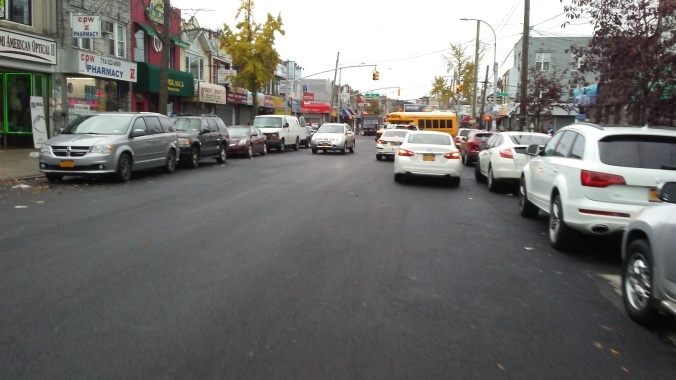
 A week before Halloween, an encouraging sight sprung forth to auto owners and cyclists. The decade long dilapidation of Liberty Avenue beginning at Lefferts Boulevard was about to get repaved with fresh tar and asphalt. Being a cyclist myself, it was elating to finally look forward to a smooth path and finally see the cracks and crevices produced by many winters, persistent double and triple parking and K and illegal U-turns by overtly aggressive drivers remediated.


014
What’s frustrating about this is that a while back the D.O.T. milled and repaved the entirety of Liberty under the elevated train from Rockaway Blvd to the last stop at Lefferts Blvd but they decided for some damn reason not to stretch out the repaving 15 blocks east to the Van Wyck Expressway to at least make it look compatible as well as prevent the road from suffering from further degradation.

But in yet another case of diminishing returns of half-ass efforts from your city, it turned out that they only repaved 2 fucking blocks.

 Even more frustrating and fucking maddening is that the long overdue road repair was permitted and possibly inspired and demanded to make way for a film shoot.

 129

Willets Point United: DOT Gives Mets Brand New Roadbed, “Stolen” from Willets Point


https://blogger.googleusercontent.com/img/b/R29vZ2xl/AVvXsEjLXpkRXMnvRcRALrDI_29w1cJ-wOqsc8g02dEXTedZD-j_xV2y03NtCZe01PdrMLKyX5ZS3XZ3wjxM1jIdHCae3WQUR5kZXmCqVDEjBQ9mn6Iv-mSQGOWs3tCxFPbjvrhkeTZf1XwQwKvK/s1600/DSC_4364_1200pix.jpeg


Willets Point United


On Thursday, June 27, 2019, the New York Mets will hold a ceremony to rename a portion of 126th Street “Seaver Way” – aided and abetted by the New York City Department of Transportation (DOT).

It’s no coincidence that DOT very recently repaved the seven-block stretch of 126th Street to be renamed “Seaver Way.” And DOT repaved it, even though the condition of that street beforehand did not require resurfacing.


Could it be any more obvious, that DOT repaved that street to beautify it for the photo op during the Mets’ street renaming ceremony? That's an unjustifiable expenditure of taxpayer funds
 
But for Willets Point, the biggest insult is that DOT needlessly repaved 126th Street, while not repairing the nearby, severely dilapidated streets in Willets Point, which property and business owners have pleaded with the City for decades to fix.
 
If these street conditions existed in any other neighborhood of the City, they would be deemed an emergency and repaired right away on that basis.
 
 
https://blogger.googleusercontent.com/img/b/R29vZ2xl/AVvXsEjSEjGpX1yLxfRempqbhhGKTeP7MPGzHo33bzOf2XB1TKczqWwcmLqOkaziiW4cf8gfAkKBcv3UvEKTDma0-bQCv-fjV9-LoXIZ5OmvkBeaQvGYL_zTFoFqe3k-aMWAU1Kke2domWMb1_F9/s1600/IMG_0283_B_1200pix.jpeg 
 
It's like this city is showing contempt for these businesses and telling them to get out right to their faces. This is no different than what a slumlord does to rent-stabilized tenants.

Francisco Moya, who represents this district, is not helping these businesses and doesn't seem to want to.

“Tom Seaver may not have laid the bricks of Citi Field, but he helped set the foundation this franchise is celebrated for,” said Councilman Francisco Moya, who sponsored the street-renaming legislation.

“Whether you were fortunate enough to watch Tom Seaver lead the Amazin’s to a World Series championship in 1969, or you grew up in the glow of that greatness, Queens residents have always known their ballpark was built on his right arm.”
 
Hey, Frankie, how about naming this neglected road after Pat Zachary? One of the guys the Mets traded for back in '77.