
Tuesday, February 27, 2024


Sunday, February 11, 2024
Overdosing Ridgewood

Three men died of apparent drug overdoses Thursday morning in Ridgewood, police said.
The victims were discovered unconscious and unresponsive at about 6:50 a.m. inside an apartment building at or near the corner of Seneca and Putnam avenues, according to an email from Det. Michael Berish of Community Affairs in the 104th Precinct.
Police had been called by the brother of one of the victims, who met the officers when they arrived, according to the email, which was sent to Jon Kablack, president of the 104th Precinct Community Council.
All three men were pronounced dead at the scene, the email said, adding that “this incident is under preliminary investigation and details are subject to change.”
The victims were not immediately identified.
In response to follow-up questions, the NYPD press office said one victim was 38, one was 39 and one was unidentified; their cause of death will be determined by the Medical Examiner's Office; and the location was the basement of 1724 Putnam Ave.
Berish could not immediately be reached for more information.
Drug overdose deaths remain on the rise in the city.
Friday, September 3, 2021
Three more perished in basement apartments in Queens

Thirteen doomed New Yorkers, all but two trapped inside flash-flooded basement apartments, were killed when the remnants of Tropical Storm Ida unleashed a lethal summer storm across a rain-soaked city, authorities said Thursday.
The dead, including an autistic 14-month-old boy and an 86-year-old woman, became victims of catastrophic flooding after the devastating weather system dumped record-breaking rain on the boroughs.
Eleven of the fatalities occurred in six incidents in Queens. The other two fatalities died in separate incidents in Brooklyn.
Neighbors of those who died recounted horrifying tales of basements flooded from floor to ceiling in the blink of an eye, with the victims helpless to escape the surging waters.
The tiniest victim, little Lobsang Lama, perished with his immigrant parents inside their Queens basement home after they were trapped by fast-rising floodwaters. His father Ang Lama, 50, and mother Mingma Sherpa, 48, were also killed as the deadly flooding filled their Woodside home — and even the first-floor apartment above.
“The baby was so cute,” said the little boy’s grief-stricken teacher Martha Suarez after arriving Thursday morning for her daily session with the child at the family’s home on 64th st. and Laurel Hill Blvd.
“Just a happy boy, very nice family ... They didn’t call me, they didn’t cancel me, so I was coming as usual.”
The 53-year-old Suarez burst into tears, taking deep breaths, after arriving to find the family apartment where she started work this week blocked off by police tape and surrounded by the media.
“This is too hard for me,” she said, adding the family was originally from Nepal.
Thursday, September 2, 2021
Deadly fire caused by e-bike battery charger
Friday, February 28, 2020
Mayor de Blasio's basement housing initiative is not making any steps
 | |||
| Hilarious illustration by the Real Deal |
Across the city, tens of thousands of people live in illegal basement apartments. The de Blasio administration aims to turn these units into legal affordable housing, but it’s not clear how the city will address the challenges associated with bringing these units up to code.
Earlier this month, Mayor Bill de Blasio proposed a citywide legalization initiative that would build on a pilot program launched in East New York last year. The mayor projects that it will add 10,000 affordable units over the next decade.
However, financial and logistical obstacles abound, including high costs, engineering issues, a lack of political will to shutter illegal apartments, and persuading homeowners to let the city randomly choose their tenants.
Experts say upgrading a basement or cellar unit can cost tens of thousands of dollars. The city’s building code requires, among other things, ceiling heights of at least eight feet, windows in every bedroom and many other rooms, a sprinkler system and at least one exit in basement apartments and two in cellars.
(Basements are partly below curb level but have at least half of their height above it. Cellars are more than half below curb level.)
“This idea has been kicked around for a while, but there’s no actual proposal of how it’s going to work or how it’s going to be safe,” said Stuart Saft, leader of Holland & Knight’s real estate group. “Even if money was no object, even if the city came along and said ‘we’ll pay for it,’ you still have the logistical problem of doing it.”
Though the mayor hasn’t released specifics on his plan, he has indicated that the city will fund low-interest loans for homeowners to bring below-ground units up to code. Jane Meyer, a spokesperson for the mayor, said the projects would be subject to regulatory agreements that lay out income restrictions in the same manner as other city-financed projects.
Former city planner Eric Kober, a fellow at the Manhattan Institute, was skeptical that subsidized loans would be enough to incentivize landlords to legalize already-occupied units.
“You could raise the fines and penalties, but then you have to be willing to throw people out on the street,” Kober said, referring to tenants in illegal apartments. “And that raises a whole other set of issues about what happens to that household.”
Thursday, February 6, 2020
Mayor de Blasio proposes housing fund program for basements, backyard sheds and upzoning garages

THE CITY
Tuesday, March 19, 2019
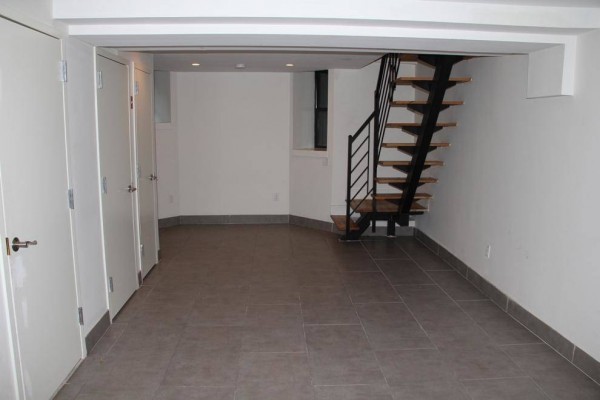
Bill passes to legalize basement apartments which might spur more gentrification
NY Daily News
Marlene Hernandez moved from her two-bedroom apartment in Bushwick to an illegal basement apartment in East New York two years ago out of necessity.
“I simply couldn’t afford Bushwick anymore, I had to go somewhere else,” the 29-year-old single mother of one told the Daily News. “Even if you live with a roommate, you’re paying $1,000, $1,200, to stay in a room. So I figured, why not live in a basement where I can have my own privacy?”
Some 114,000 New Yorkers live in illegal basement apartments, according to the housing advocacy groups Chhaya Community Development Corporation and the Pratt Center for Community Development.
Basement and cellar apartments must meet minimum requirements for light, air, sanitation and exits and be approved by the Department of Buildings.
But the new law has Hernandez worried. She’s paying $1,200 a month for her off-the-books place and argues that New Yorkers in her position may have to keep finding illegal apartments to keep their rent down, or face higher rents for legal apartments.
“My landlord isn’t going to lower my rent,” she said. “What incentive does he have to legalize my apartment?” she said.
All basement apartments legalized with funds from the grants and loans will have to conform to HPD’s affordable housing rules, which cap rents at 30% of a tenant’s income. Landlords who decide to create legal basement apartments without the city’s help will not have to abide by the income cap.
“There is a risk that the landlords will raise the rent,” Katz said. “We’re trying to find the right balance between bringing up the quality of those apartments and protecting the tenants, but also not scaring off tenants who have in certain ways benefited from the legal gray area that they’re living in.”
If anyone else recalls, this is where Councilman Espinal described these areas which he represents as a guinea pig for this housing plan.
I have a gut feeling that East New York and Cypress Hills are going to become "hot", "hip" and "niche" towns pretty soon.
Wednesday, November 14, 2018
Bill would legalize basement units citywide
From PIX11:
City Council Member Brad Lander says he wants to make sure long-time residents like Thorne can stay in the community, while also providing affordable housing. It's why he's proposed a bill to help homeowners bring illegal basement units up to code.
"We just have been playing a sort of don't ask, don't tell game and that's not good for anybody," said Lander.
Under his proposal, homeowners would receive low interest, subsidized, or forgivable loans depending on their income level. That money would be used transform basements into legal apartments with the help of the Department of Buildings.
In exchange, current or future tenants will receive leases with renewal clauses and affordable rent increases.
"If the house is in proper standard with the basement and pass all it's examination it could be done," said Thorne. "If it fails, it should be out."
If the pilot program is approved it will roll out in East New York sometime next year. If it's successful, it will likely roll out to the rest of the city shortly after.
Sunday, July 1, 2018
East New York to be a basement conversion "guinea pig"
From CBS 2:
“We’ll use East New York as the guinea pig of how this program can work and whether or not it will work,” said Councilman Rafael Espinal, who sponsored the pilot program. “If we’re able to create a successful program, then the hope is that we'll expand it citywide.”
The councilman said in East New York, 75 percent of basement apartments are being rented illegally, which he said is dangerous. So the pilot program will offer homeowners low-interest loans to renovate apartments to make sure they are safe.
Espinal told Kramer he worked with the FDNY and Department of Buildings to develop standards, making sure the apartments have sprinklers, adequate exits, windows and ventilation.
“There’s concerns about, for example, the fact that we have boilers and furnaces in the basement. The bill will allow for homeowners to wall-off those furnaces,” he said.
I'm sure East New York enjoys being referred to as a "guinea pig". Seriously, what elected official talks like this about a neighborhood, and to a reporter no less? And what 2-family homeowner is going to take out a loan to install sprinklers when they can just continue renting out their basements illegally for tax-free $$$ the way 75% of their neighbors do?
Did we land in Oz?
Monday, May 14, 2018
DOB verifies that Elmhurst death house was illegally subdivided

The Queens building where a man was found dead in the attic — a day after the fire was put out — was illegally subdivided, according to the Buildings Department.
There was an apartment illegally created in the basement, and multiple Single Room Occupancy (SRO) units illegally added on the first floor of 40-46 Case St. in Elmhurst, inspectors said.
The Buildings Department has ordered the property owner to board up the vacated fire-damaged building. The owner has also been hit with multiple violations for the illegal conversions.
On Sunday, a city lawmaker who represents the area demanded a full investigation and for stricter penalties for similar illegally converted houses.
"Similar illegal conversions are common practice in Corona and Elmhurst," said Councilman Francisco Moya.
The home in Jackson Heights that caught fire also has a history of being an SRO.

Saturday, May 12, 2018
Elmhurst fire is an old familiar story
From the Daily News:
A roaring fire erupted in a Queens home early Friday injuring seven firefighters and five civilians, including one who suffered life-threatening injuries, FDNY officials said.
The blaze broke out on the second floor of a two-story house on Case St. near Whitney Ave. in Corona around 5:10 a.m., according to authorities.
Four civilians were taken to local hospitals in serious condition. A fifth civilian was rushed to Elmhurst Hospital in critical condition.
The seven injured firefighters were taken to New York-Presbyterian Queens. Their conditions were being evaluated, an FDNY spokesman said.

Saturday, February 3, 2018
BDB wants basement apartments legalized

Mayor Bill de Blasio managed to include one new proposal in the preliminary budget he released on Thursday—a pilot program to bring illegal basement apartments above-board.
The mayor revealed his latest plan to tally more living spaces toward his affordable-housing goals during a press conference at City Hall. It calls for the city to expend $5.7 million to bring existing underground apartments in Brooklyn’s East New York section up to code while keeping their rents below market rate.
“We’ve got to keep looking for new ways still to create and preserve affordable housing,” the mayor said. “We have to prove the model first, and we’re going to do that in East New York.”
The mayor estimated that the program, if successful in the impoverished enclave, could let him take credit for creating or preserving 5,000 more apartments citywide. This would appear to encompass about 11% of the current number of basement units, which a 2002 survey put at 45,000 across the five boroughs.
The number one reason landlords install illegal apartments in their basements/cellars is greed. They want the extra tax free income. Another legal unit could mean a change in income tax bracket and the DOF tax assessment also changes. I'm all for people living in safer environments, but this initiative does not jibe with the reasons why illegal apartments exist.
Tuesday, January 23, 2018
Developer claims woman is anti-Semitic for complaining to DOB
From PIX11:
Julita Gontarczyk is involved in a bitter dispute. She and her husband own a home in Maspeth, Queens. A developer, Orin Effi, is putting up several homes in the space next door. What began amicably enough has deteriorated in a war of words, texts, complaints, and calls to the police.
“Because we have a common wall there is a lot of problems going on,” Julita told us. “Rain would come into his house. Flood his basement and flood my basement.”
Julita says her complaints to Effi fell on deaf ears. She complained to 311, the Health Department and the Department of Buildings. Some stop work orders were issued, infuriating Orin Effi. He says Julita made false accusations and blames the fact that she’s Polish and he’s an Israeli Jew.
Saturday, June 24, 2017
Illegal conversion vacated in Brooklyn
From Brooklyn Reporter:
A number of people have been displaced after city officials issued an immediate vacate order on an illegally converted home in Dyker Heights on Thursday evening, June 22.
The property – 1317 73rd Street – was one of four sites initially reported by local residents that were visited Thursday evening by the city’s illegal conversions task force which, sources say, were able to gain access to the building and deem its living conditions an “immediately hazardous situation.”
According to a source who was at the scene, the property’s basement “was all chopped up [to create living quarters for its residents] with the exit from the basement in the front of the house sealed off.” In addition, the source said, the property’s driveway was lined with buckets, presumably being used by residents to relieve themselves as the basement had only two bathrooms.
Upon arrival, a spokesperson for the Department of Buildings (DOB) told this paper, inspectors observed an illegally constructed apartment in the cellar of the property with its own unpermitted gas and plumbing lines. The agency issued a vacate order “due to a lack of two means of egress, the illegal gas lines and insufficient ventilation in the apartment.”
According to DOB officials, five people were determined to be living in the basement unit of the building, all of whom were offered relocation assistance by the American Red Cross. The apartments on the first or second floor of the building did not need vacating.
Not a basement - an obvious cellar. When is the illegal conversions task force coming to Queens?
Tuesday, May 9, 2017
Sewer construction causes Whitestone debacle
From CBS:
Homeowners in Whitestone, Queens are dealing with a stinking mess after sewage backed up into their basements.
As CBS2’s Jessica Borg reported, residents on Tenth Avenue between 152 and 154th streets in Whitestone said they were living a nightmare during Friday’s rainstorm – as toilets turned into fountains and raw sewage covered basement floors.
And on Monday people like Jeanmarie Golden were still cleaning up. They were also still dealing with the stench.
Residents blame construction on their block for the sewage overflow. Crews with the city’s Department of Design and Construction are working on the street’s sewer pipes.
The department said the project is to “upgrade aging infrastructure.”
But resident James Martino said it is no upgrade. He believes the re-lining of the pipe caused the problem.
“It made the pipe circumference smaller, so it couldn’t handle the sewage that was being pumped,” Martino said.
Residents said they have had thousands of dollars’ worth property destroyed. The Kelly family had to throw away furniture, tools, and clothing.
The city said the project was completed earlier this month and there was simply too much rain for the sewer system to handle. CBS2’s Borg could not get answers when she asked how the pipes will handle future downpours.
Saturday, April 8, 2017
DeBlasio pushing forward with basement legalization pilot

A large number of Queens civic leaders gathered at State Sen. Tony Avella's office this afternoon to speak out passionately.
According to State Sen. Avella, Mayor Bill de Blasio, who several years ago first talked of legalizing basement apartments, is now revisiting the issue as a solution to the city's affordable housing crisis.
Currently, there are over 100,000 cellar or basement apartments being rented illegally city wide.
Here is the statement to PIX11 News from Melissa Grace, Deputy Press Secretary, Mayor’s Press Office de Blasio administration:
"Any legalization of basement apartments would be based on their meeting safety codes to protect residents. A multi-agency working group, including HPD, DOB, FDNY, and DCP, is working with Councilman Espinal and multiple community-groups active in East New York to study the feasibility of a basement legalization pilot program in that community."
Saturday, February 18, 2017
Push continues to legalize basement apartments

There are up to 210,000 basements and cellars across the city that could potentially be converted into legal apartments—enough to move the needle on the city’s housing crisis without pouring a single new building foundation.
But the legalization process is fraught with political and technical pitfalls, which is why a study released Thursday suggests that the de Blasio administration should start with a pilot program to capture the lowest hanging fruit: the roughly 38,000 basements in single-family homes that could be converted without any major changes to city or state law.
Trouble is, an interactive map provided along with the study shows that there is no ideal place to launch the pilot. While the simplest conversions can be found in Manhattan and parts of Brooklyn and the Bronx—neighborhoods where homeowners would not be legally required to provide an additional parking space for each additional housing unit—these areas are not flush with suitable basements.
Far more potential exists in Staten Island, southeast Brooklyn, Queens and the eastern portion of the Bronx. These are also areas with high rates of foreclosure, suggesting that homeowners there would benefit from supplemental rental income. The only catch? By law, adding an apartment to a single-family home in many of these areas would require the creation of an additional parking space, posing significant economic and logistical challenges.
The study suggests finding a community that both supports the concept and has the inventory of basements, and calls on the city to provide homeowners with financial incentives, a list of knowledgeable contractors, expedited permits and waivers or modifications for certain building regulations that could be changed without city or state approval.
Wednesday, September 7, 2016
Housing inspector illegally converted his cellar

A housing inspector endangered the lives of his tenants by violating the same building codes the city employed him to enforce, the Queens District Attorney’s office announced Tuesday.
Derrick Allen, 58, a Brooklyn inspector for the Department of Housing Preservation and Development who owns two buildings in Queens, was charged Tuesday with illegally converting the cellar space in his Rosedale and St. Albans properties into dangerous living quarters, according to the DA’s office.
The units — hooked up to illegal gas and water lines — lacked adequate exits and natural light, which District Attorney Richard Brown noted made the residencies dangerous not only for tenants, but emergency responders as well.
“Such conversions jeopardize the lives of not only the buildings’ residents but firefighters and other personnel who in responding to an emergency are confronted by a maze of rooms with no way out,” said Brown in a statement.
“As a code enforcement inspector himself, the defendant should have known better.”
The Housing Department first became aware of Allen’s practices as a landlord on Aug. 18 when an illegal tenant in his Rosedale building called 311 to complain about building maintenance, according to the DA.
Housing inspectors arrived one week later to find four illegal single-room residencies in the basement with access to only one exit, as well as a shared kitchen with an illegal gas stove and a bathroom with a hole in the ground where a toilet once stood, the DA said.
Tenants were ordered to vacate the premises immediately due to the unsafe circumstances, the DA said.
Sunday, February 21, 2016
Foreclosure floods elderly woman's home
From WPIX:
In front of her home on Poplar Street, the gutter had a deep and wide sheet of ice. It extends to the house next door, which has sat empty since 2014, according to Lama's family and their neighbors.
Cascading down the far wall of the house next door are 15-foot long, 3-inch thick icicles. All of the ice on a cold Friday gives a strong indication of what went wrong here.
"Water from the bathroom pipe broke," said Joseph Lama, 72, Fanny Lama's son. "It leaked down into the basement."
He then showed PIX11 News what the result of possibly five days of water leakage looks like. He opened up the cellar door of the foreclosed home next door to show that the crawl space underneath was filed with close to three feet of water.
Wednesday, April 8, 2015
When the sh*t hits the basement

Homeowners gathered around on Seneca Avenue near Norman Street in Ridgewood on Thursday afternoon to get answers from the Department of Environmental Protection (DEP) regarding sewage problems they have been experiencing since earlier this year.
Homeowner Angela Georgescu said she started seeing sewage flood her basement as far back as eight years ago after National Grid excavated the road in front of her house.
The problem was sporadic until sometime in early 2015, when she learned that seven other houses on her block were also having trouble doing their laundry and were spending more time in their basements cleaning up.
Mark Chen Oi Ming, one of her neighbors, claimed he saw utility workers damage the sewage line eight years ago. At the time, the employees told him they would come back to make repairs but Ming did not see them again.
The Department of Health has visited the site at least twice because the sewage has overflowed into the sidewalk, neighbors claimed.
Georgescu and other homeowners have tried calling 311 and contacting local Assembly and Council members but have received no response or have been told that action cannot be taken since the sewage line is private. A representative for Assemblyman Mike Miller told the homeowners to individually call plumbers to identify the problem.
Georgescu and other homeowners hired plumbers to check their sewage lines and have all received the same answer – their individual sewage lines are clean and damage free.
DEP officials visited the site on April 2 to provide information about the sewage infrastructure and next steps the homeowners need to take to repair this problem. According to DEP officials, these homes were built more than 100 years ago, which means the sewage pipes were constructed before the city sewer was put into place.
In this case, the DEP claimed, the sewage lines are considered private property and the responsibility of the homeowner. The sewage from these seven homes collects into a private drain that then connects to the city sewer and travels to a sewage treatment plant.


