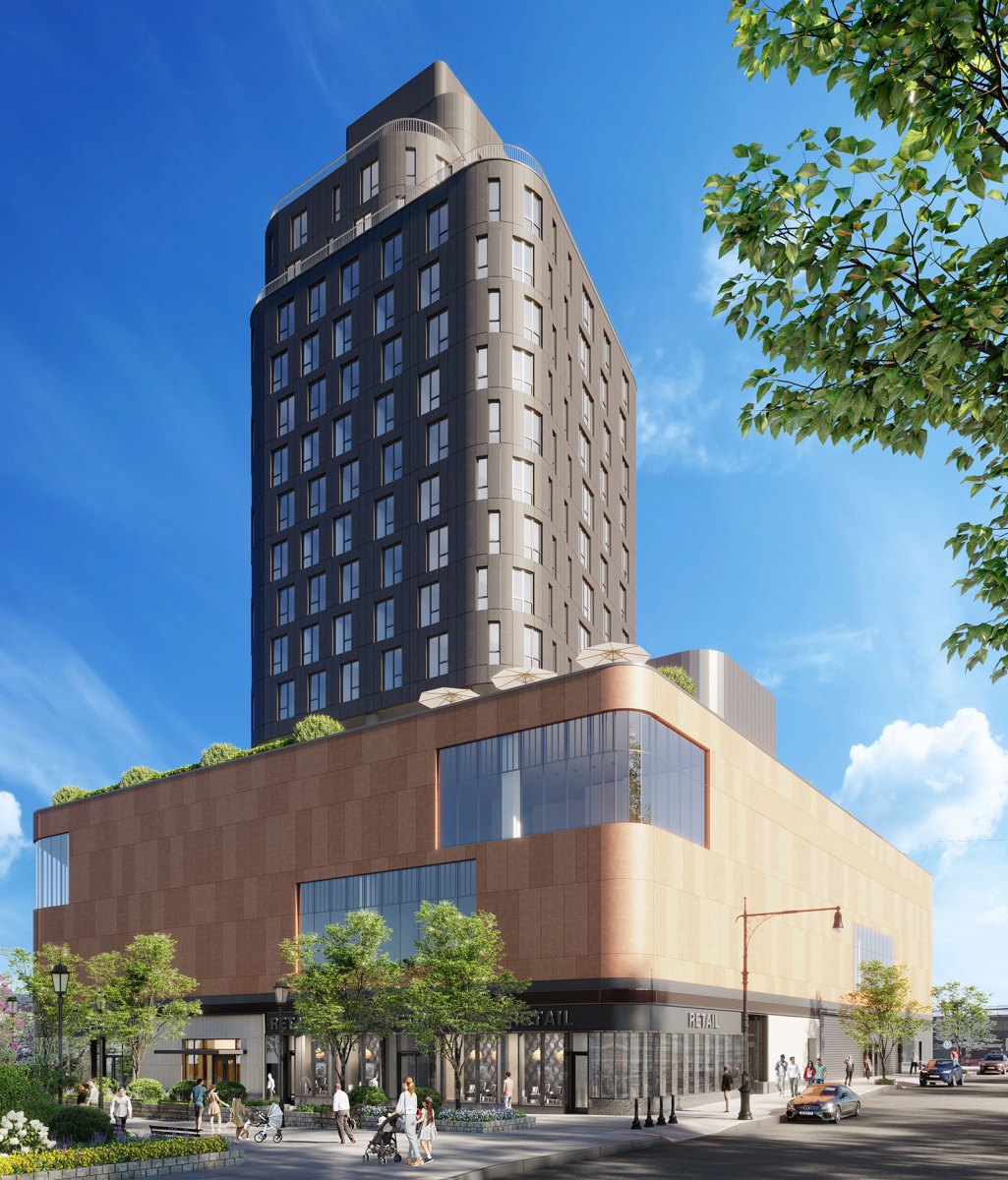
Construction has been put on hold for a 17-story mixed-use building at 3-50 St. Nicholas Ave. in Ridgewood.
Known as The Ridgewood,
this tower will be the tallest structure in Ridgewood. It will cover
284,000 square feet. In addition to 97,000 of that square footage being
dedicated to retail space, including two large stores and other
amenities, The Ridgewood will have 133 rental apartments, with plans to
set 30% of them aside for affordable housing. A community facility was
also planned to be included as part of this structure.
Delays have previously plagued the construction process of The Ridgewood. A fatal accident
on the construction site in April 2022 led to multiple stop work orders
as a result of unsafe working conditions. While the developers of the
building had initially hoped to complete the project in the winter of
2023, the stop work orders delayed construction for multiple months. It
was not until December 2022 that the building was finally topped out.
The latest construction delay likely means that the project will not be
done before the end of 2024.
Prior to the most recent pause, the facade was partially enclosed.
Progress had been further along in the exterior, at the podium. Current
features of the podium include a red metal envelope and broad stretches
of glass with black mullions. The main southern elevation is close to
being completed, but the northern face is still mostly exposed, with
metal frames currently in place to support the installation of paneling.
A tall sidewalk shed is blocking the view of the tall sidewalk shed.
The MTA was warned a decade ago that the Long Island Rail Road’s Jamaica hub would be overwhelmed and face frequent commute meltdowns — like the ones commuters have been forced to endure all week, The Post has learned.
The dire prediction came in an analysis of the Jamaica, Queens
station’s capacity, completed in 2012, that simulated service changes
nearly identical to the one launched by the MTA this week to its new $11
billion terminal on the East Side of Manhattan and found it would overwhelm operations at the station.
“Evaluation of the new operation on the existing conditions indicates
an inability of the current infrastructure to accommodate the higher
volume of service during the morning peak period and evening westbound
direction due to cascading delays,” the analysis determined.
The simulation showed trains arriving into Jamaica on-time 93% of the
time under the then-current runs, even when encountering routine
service disruptions, like a medical emergency on a platform or a
mechanical problem with a train.
But the on-time percentage with the new service plummeted to just
72%, a 21% point drop, the analysis prepared by San Diego-based
TranSystems Corporation determined.
The prophetic study found that the operational collapse occurred even
if the MTA simplified the Jamaica operation by axing one-seat service
from Long Island to Brooklyn and instead ran a shuttle to Atlantic
Terminal — and even if officials axed timed transfers to boost station
capacity by reducing the amount of time trains spend parked at the
platforms.
A key fix, the analysis determined, was to replace the low-speed
switches that run through Jamaica Station — which limit trains to just
15 mph — with more modern systems that allow trains to run at 30 mph or
faster.
MTA officials approved spending $85 million to do just that in 2020 —
some eight years after the engineering report was completed. That
project is not expected to be completed until December 2027.
It does not appear that the MTA ever made the analysis public, but it
was heavily excerpted in an academic article that the firm subsequently
prepared, which was published in 2014.
Earlier this month, a Roosevelt Island resident asked on Twitter:
"why is it impossible to get on a ferry at Roosevelt
Island?! They are coming full from East 90th. This is a constant issue
on weekends"
This Memorial Day Weekend Sunday afternoon was a perfect example of a full NYC Ferry Boat coming
from East 90th Street with little room for passengers waiting to board
at Roosevelt Island. After a few people boarded at Roosevelt Island, a
NYC Ferry Crew member announced only "one more" spot on the boat was
available even though there were at least 25 other people in line to
board.
Upon hearing this, a frustrated man waiting with his
family to board walked to the front of the line and told the NYC Ferry
Crew member that the people already allowed on the boat cut ahead of
those waiting in line and
that NYC Ferry needs to do a better job organizing the line at the
Roosevelt Island dock.
This is not a new problem. Larger capacity boats are needed during the summer.
Update
A proposal by mass transit guru Larry Penner:
I enjoyed reading "Gonna need a bigger boat" concerning Roosevelt Island customers left at the dock unable to board.
My old friends at NYC EDC (who directly manage their Private Ferry Operator program) for some reason I can't understand continue year after year to ignore Federal Transit Administration funding that could be used to purchase larger size ferry boats. Perhaps you might consider the following...
Why Not Apply For Federal Funding Available To Purchase Larger Ferry Boats for Roosevelt Island Service by Larry Penner
Here is one way City Hall can find additional funding to pay for larger ferry boats to support greater passenger capacity benefiting Roosevelt Island and other destinations served by the NYC Economic Development Corporation Private Ferry Operator program. The United States Department of Transportation's Federal Transit Administration will announce a NOFA (Notice of Funding Availability) in coming months. This is an opportunity to apply for a portion of the $30 million in Fiscal Year 2022 competitive grant funding for passenger ferry projects nationwide. FTA’s Passenger Ferry Grant Program, funds capital projects to improve existing passenger ferry service, establish new ferry service including the purchase of ferry boars along with repair and modernize ferry boats, terminals, and related facilities and equipment. Under this program, a portion of these funds are usually set aside for low or zero-emission ferries or ferries using electric battery or fuel cell components and the infrastructure to support such ferries.
FTA recipients such as NYCDOT can also choose to spend whatever they receive under their share of 2022 Fiscal Year Section 5307 Urbanized Area; $6.4 billion, 5307 Passenger Ferry $36.5 million or Section 71102 Electric or Low Emmiting $49 million for ferry projects. The Federal Highway Administration has funding under several programs including Congestion Mitigation Air Quality (CMAQ), Surface Transportation Program (STP) and others which can be flexed or transferred to FTA can also finance capital ferry projects.
New ferry services can be implemented more quickly than construction of new subway, commuter rail or highways. These can take years or even decades until completion of environmental reviews, planning, design, engineering, real estate acquisition, permits, procurements and construction before reaching beneficial use. Completing all of the above, along with finding funding for ferry boats, docks and parking with costs in the millions is easier than finding the billions of dollars for construction of new or extended subway, commuter rail or highways. Utilization of ferry boats equipped with fuel efficient engines can make a positive contribution to air quality
Consider past history for federal support of the NYC DOT Staten Island Ferry. The nation's largest municipal ferry system moving 66,000 pre COVID-19 daily riders has benefited by over $1 billion in grants from the FTA (previously known as the Urban Mass Transportation Administration), going back to the 1970's. A majority of the Staten Island Ferry system capital program, including the purchase of ferries, Staten Island Pier 7 ferry maintenance facility, both renovated St. George, Staten Island and Whitehall Street, Manhattan ferry terminals, midtown Pier 79 West 39th Street ferry terminal, St. George, Staten Island ferry terminal replacement bus ramps and other support equipment necessary to run the system were all paid for primarily with federal funding. Additional funding was provided to purchase and preserve the old abandoned North Shore Staten Island Rail Road right-of-way for future restoration of transit service. The original service was terminated in 1953. This would reestablish a direct connection with the St. George, Staten Island Ferry Terminal. A past $450 million Federal Transportation Infrastructure Finance and Improvement Act (TIFIA) loan paid for rehabilitation of the St. George, Staten Island Ferry terminal bus ramps.
Mayor Erik Adams, Queens Boro President Donovan Richards, Manhattan Boro President Mark Levine and the Roosevelt Island Operating Corporation should ask NYC Department of Transportation Commissioner Ydanis Rodriguez to apply for these funds which could help finance new capital improvements for initiation of ferry service to Coney Island. NYC Economic Development Corporation President and CEO Andrew Kimball can do the same on behalf of the Private Ferry Operators Program. This is another great example of Washington providing financial assistance to promote public transportation.
NYC can also apply for capital grants from the New York State Department of Transportation to assist in funding. Albany also provides State Transportation Operating Assistance (STOA). Ridership on any transit service generates yearly federal transportation capital assistance via the annual FTA Section 15 annual reporting process. Numerous past private ferry operators have come and gone. They could not financially survive without government subsidy. MTA bus, subway, Staten Island Railway, Long Island and Metro North Rail Road along with NYC DOT Staten Island Ferry is subsidized by a combination of City, State and Federal assistance for both capital and operating costs. All new ferry services will require similar subsidies to survive.
Who wouldn't want to enjoy the fresh air and breeze that only waterborne transportation can provide. Riding a ferry can be less stressful than being on a crowded subway car.
(Larry Penner is a transportation advocate, historian and writer who previously worked for the Federal Transit Administration Region 2 New York Office. This included the development, review, approval and oversight for billions in capital projects and programs for the MTA, NYC Transit, Long Island Rail Road, Metro North Rail Road MTA Bus, NYC DOT Staten Island Ferry along with 30 other transit agencies in NY and NJ.)
Train crew shortages are the leading cause of the thousands of subway delays straphangers endure each month, new MTA data shows.
Crew shortages delayed 10,563 subway trains last month, or 18% of the 58,266 subway train delays reported, MTA data show.
A
lack of crews accounted for more delays this year than any other cause —
including public conduct and crime, which delayed 5,355 trains, or 9%
of the total delays, and and signal failures and emergency track
repairs, which delayed 2,701 trains, or 5% of the total, the MTA’s data
shows.
Delays pegged to crew shortages in April were down from the
16,783 reported in August, when Janno Lieber took over as Metropolitan
Transportation Authority chairman and launched an aggressive hiring
effort.
The MTA employed 7,773 people in April for subway service delivery —
mostly train operators and conductors. That’s down slightly from 7,812
in January and about 9% fewer from the end of 2019, when the agency
employed 8,562 people in subway service delivery.
One cause of the
shortages was a hiring freeze put in place during the first year of the
pandemic, a decision MTA leaders at the time defended as a cost-saving
measure to keep the agency’s finances above water.
Hiring was also
slowed by the agency’s “transformation” team formed in 2019 under
former Gov. Andrew Cuomo. MTA chief administrative officer Lisette
Camilo during a board meeting called that effort a “tornado” that
consolidated teams “so quickly that some functions were left without a
home.”
Cyclists and pedestrians will have to fend for space for a year
longer than expected on the Ed Koch-Queensboro Bridge’s
dangerously-tight shared path because the city decided to postpone
giving walkers their own lane until the end of next year.
The bridge’s south outer roadway was supposed to be dedicated to foot traffic by late 2022,
but the Department of Transportation pushed that deadline back to
December 2023, when the agency wraps up a 20-month construction project
on the upper deck of the span, according to a notice DOT sent to local stakeholders Thursday morning.
Currently, cyclists and pedestrians have to share the notoriously-narrow northern outer roadway, while vehicle traffic takes up nine lanes across two levels of the bridge.
The plan announced by former Mayor Bill de Blasio a year ago
was to give the southern outer roadway to pedestrians and make the
northern one bikes-only, mirroring the setup on the Manhattan Bridge.
The MTA’s multi-billion-dollar quest to speed up subway
trips by replacing ancient signals is running into delays and cost
increases.
The transit agency plans to spend more than $7 billion for new signals on sections of six lines as part of its 2020 to 2024 capital program.
But snags with ongoing signal replacement projects in Queens and
Brooklyn underscore the headaches and challenges that can accompany such
ambitious and intricate projects.
“In terms of the daily experience that riders encounter,
this is the biggest issue in terms of reliability,” said Ben Fried of
TransitCenter, a transit research and advocacy organization.
On many lines, the traffic lights and indicators can date
to the 1930s, limiting capacity on a system strained by high ridership
prior to the pandemic. But with commuters steadily returning,
state-of-the-art signals are key to MTA’s $51 billion five-year capital
plan to upgrade the transit system.
“The benefits are great,” Robert Gomez, the MTA’s chief
signals engineer, told the agency’s board Monday. “They provide for
better service, faster running times, more capacity, shorter [waits] and
bring the system to a state of good repair.”
The only two lines in the subway system equipped with
modern so-called communications-based train control (CBTC) signals — the
L and the No. 7 — produced some of the highest weekday on-time
performance in October, MTA figures show, at 93% and 91%, respectively. That’s above a systemwide average of 83% last month.
Meanwhile,
the latest estimates for “substantial completion” of launching a
similar signal system along stretches of the E, F, M and R lines that
run beneath Queens Boulevard and the elevated F and G lines in Brooklyn have been pushed back, MTA officials said this week.
The $663 million Queens Boulevard CBTC project, which was
supposed to be in service this past March, is now scheduled to be
operational by the end of the year, according to MTA documents — with
its budget increasing to $729 million.
“It does happen far too often,” Andrew Albert, an MTA
board member, said of the delays. “There will be some growing pains as
different signal systems are phased in and phased out.”
And the project along Brooklyn’s elevated F line — aka
the Culver Line — to modernize signals along nearly five miles of track
between Church Avenue and West 8th Street, is experiencing COVID-driven
delays that have pushed the substantial completion date from August 2022
to June 2023, MTA documents show.
A national surge in COVID cases has coincided with
agonizing delays for New Yorkers getting tested at free sites run by the
city’s public hospitals network.
Patients and staff at some NYC Health + Hospitals sites
describe waits far longer than the advertised “three to five days” — a
lag that increases risk of potentially exposing others to the deadly
coronavirus.
Chelsea Williams-Diggs, 27, got tested at a mobile H+H unit in Bed-Stuy, Brooklyn, on July 6.
“I was told three days for results and have called twice to make sure there wasn’t an error,” she told THE CITY.
She says she was eventually told that results could take upwards of 10 days, but she was still waiting as of July 20.
One New Yorker who didn’t want his name used said he got
tested at an H+H location in The Bronx on July 1 — but didn’t receive
results on the system’s MyChart app until July 12.
He said he had quarantined nearly the entire time, but had to go to the grocery store when he ran out of food.
“I was hesitant to go, but needed supplies so I went because it had been so long,” the 31-year-old told THE CITY.
At an H+H testing site in Woodside, Queens, COVID-19 test
results are now taking 10 to 14 days to come back, according to an
employee who spoke on the condition of anonymity.
“If you’re at the 14-day mark, the test is invalid before
you even get the result,” the employee noted.
“Because assuming nobody
is 100% quarantining in those 14 days before receiving the result, it’s
highly likely for them to be exposed and become infected.”
Last month Mayor Bill de Blasio announced that a Midwestern company
would be sending 50,000 coronavirus tests per week to the Big Apple.
“I’m sure New Yorkers wouldn’t have thought that the cavalry would
come from Carmel, Indiana, but it has,” de Blasio boasted during an April 14 press conference about the deal with test maker Aria Diagnostics.
Over two weeks later, the city received just 25,000 of the promised
100,000 tests from what de Blasio described as a “reliable partner” —
after blasting the feds for failing to provide the materials.
“We need to be able to test everybody who is symptomatic or
asymptotic. If they want a test, they should be able to get a test,”
Councilman Stephen Levin (D-Brooklyn) told The Post.
“They just announced yesterday they were doing them in Los Angeles.
We need to be able to do that here in order to safely reopen New York
City,” Levin said.
Mayoral press secretary Freddi Goldstein claimed the tests are delayed due to “unforeseen supply chain issues.”
A rep for Aria, Susana Duarte la Suarez, told The Post there’s a problem with the transport medium for the testing kits.
Both parties said they’re working together to resolve the issue.
I agree with Council Member Levin, everyone should be tested. Especially if we all are going to be rushed into going back to work. I can also understand if he wants to plead with strangers on social media to procure these tests just to prove a smarmy point.
New York’s new 911 text messaging system will finally arrive next
summer, two years late and millions over budget, city officials admitted
Tuesday. Eusebio Formoso, the interim commissioner of the Department of
Information Technology and Telecommunications, testified to city council
members that his agency is “moving ahead” with the project to phase
texting into the city’s existing 1980s-era analog 911 system by June
2020. Officials initially promised to have the system online by “early 2018.” The program is part of a larger $28 million contract awarded to Motorola subsidiary Vesta Solutions in 2017, which has ballooned to $41 million as the delays built. The improved technology will help domestic violence victims by
allowing battered women and children to get help quietly, without
tipping off their attackers. It would also be welcomed by 208,000 city residents who are deaf or
hard-of-hearing, as well as the speech-impaired, who can’t call 911. The long-overdue option — part of the city’s larger “Next Generation 911” project — is already available in 2,000-plus municipalities and counties across the country. “Since this interim system is being built to handle the highest 911
call volume in the US, getting the system right is a matter of life and
death,” said Formoso. He added that DoITT “would certainly like to be further along than
where we are” but blamed the delays on the “complexity” of the project. Councilman Robert Holden, who chairs the technology committee, wasn’t buying the excuses. “Nine New York state counties — including neighboring Rockland and
Dutchess counties — have all had text-to-911 since as early as 2013, so
it’s kind of weird that New York City doesn’t have [911 texting],
considering we have the largest population of people with disabilities,”
he said. Holden also said he’s “puzzled” that the city hasn’t even implemented
a “Smart 911” system similar to the one now being used in Nassau
County.
A
long-delayed study into whether it’s possible to reactivate a dormant
Queens rail spur is finally seeing light at the end of the tunnel, THE
CITY has learned.
The
MTA in 2016 committed to a planning and feasibility study looking at
the potential use of the Long Island Rail Road’s former Rockaway Beach
Branch, a 3.5-mile stretch of railway between
Ozone Park and Rego Park
that has been out of service since 1962.
The results of the study — for which the MTA awarded an $864,000 contract
to Systra Engineering in October 2017 — were supposed to be made public
last year. But MTA spokesperson Aaron Donovan told THE CITY the
findings now will be released by the end of 2019.
“It’s like a national secret of some sort,” said Rick Horan, director of the Queens RAIL and WAY Task Force, which wants the space used for transit and parkland purposes. “Why is it delayed?”
Part
of a larger MTA and Port Authority analysis about Kennedy Airport
“one-seat ride” service, the study is examining “the operational and
physical feasibility” of having commuter rail or subway trains run on
the old Rockaway Beach Branch.
The MTA wouldn’t say what has delayed the process.
“They’ve
gone sort of radio silent and it’s very disappointing,” said Phillip
Goldfeder, a former Queens assemblymember who pushed for reactivation of
the line during his three terms in Albany.
“This is something that is
completely underutilized, something which could transform how people in
some parts of Queens commute.”
Since
Rockaway Beach Branch service ended 57 years ago, concepts for
restoring the railway have been floated in different forms. Much of the
space under what was once the LIRR’s Ozone Park station is now filled by
small auto-related and scrap businesses.
“Seems
like a waste of space up there,” said Barry Williams, 34, who works
near the elevated structure. “Why not do something with it?”
The building of this 8-story monstrosity on the steep hill of 116th St. in Kew Gardens was permitted by the city back in 2016 and expected to open for sales this year.
Apparently, something got in the way of it's completion and now it's just sitting in parasitic development limbo. And from the looks of it, probably for a while now...
...and definitely for a while longer.
No wonder they gave themselves a two year window for completion (May 2017-May 2019!)
If you’ve commuted to or from Queens by subway this year, odds are your train has been delayed, a new report from data-scraping tool ReadyPipe shows. Using data from the MTA’s own website, the web-scraping platform determined that the A, F, N, E trains are among the city’s top-10 most-delayed subway lines.
“A negative surprise was the fact that every morning there are at least five routes that had a delay at some point,” Chad Horner, a data analyst with ReadyPipe, told the Eagle. “The MTA can’t make it through that time without a bunch of things going wrong.”
The A train, which takes straphangers from the Rockaways, Howard Beach and Ozone Park into Brooklyn and Manhattan, was delayed more than 11 percent of the time throughout the entire month of January. During the weekday rush hour (between 6:30 a.m. and 9:30 a.m), nearly one in every five A trains experienced delays.
The F train, which serves Queens from Jamaica-179 Street to 21 Street-Queensbridge, was delayed more than 10 percent of the time in January. The N and the E trains were delayed over 6.5 percent of the time and three of every 10 trains experienced planned work.
In fact, there wasn't a single weekday morning in January that didn't see at least one delay during the morning rush, according to Horner’s findings — the fewest number of lines delayed in a single morning was five.
On the bright side, at least we are not getting poisoned during our daily commutes. Yet.
There were subway delays on all but one day during August 2018 because of signal problems, a Riders Alliance analysis released Sunday showed.
The Alliance said it reviewed MTA delay alerts for the month of August from 6 a.m. to 10 a.m. They reported delays due to signal problems for every day except Aug. 23.
"It's just painful," said Joe Hetterly of Bay Ridge, about his commutes.
The Riders Alliance said signal delays caused problems on every subway line except the L, which has already received signal upgrades.
The analysis showed the worst delays were on the D and R lines.
The Hunters Point Library will not open until the summer of 2019 as the project continues to be besieged by construction delays.
The city agency in charge of overseeing the construction estimates that the library will be completed by the end of the year, with the Queens Library taking an additional three to six months to get it ready for opening.
The 22,000-square foot library, which has been under construction since 2015, was expected to open in the first half of 2017. However, between the complex design and issues with the general contractor it continues to be behind schedule.
The major source of the delays can be attributed to the performance of the general contractor, Triton Structural, according to Councilmember Jimmy Van Bramer. “The contractor has essentially defaulted on the project.”
“I am a Queens boy,” the governor said right before cutting the ribbon for the newly repaired Queens Midtown Tunnel, damaged during Superstorm Sandy.
But if you want bragging rights for having Queens roots, you have to take the pain with the acclaim, Kramer reported. Right now, there are some borough residents who have a bone to pick with “Andy from Queens.”
“Construction is horrible around here. You can’t go nowhere,” one driver said.
“Very annoying,” said another.
“It’s not easy to travel everywhere,” another said.
“I’m always late,” a man added. “I have to leave an hour earlier to get on the Van Wyck.”
The work began in 2010, but that was just phase one, which, according to the state’s records, was a year and a half late and millions of dollars over budget.
They’re now working on phase two, phase three and the yet-to-be started phase four to replace six decaying overpasses, rehab four more and widen the highway from six lanes to eight – a complex and intricate project that first required widening everything else to accommodate more lanes.
The city’s Department of Sanitation is delaying plans to expand curbside collections of compostable kitchen and yard waste beyond the program’s current footprint.
But DSNY officials say neighborhoods that already place their waste in brown bins for recycling will continue receiving the service while the city looks to adjust some aspects of the program.
“We believe that for the program to be successful over the long term, we must ensure New Yorkers are getting the very best service when curbside organics collection reaches their neighborhoods,” the DSNY said in a statement to the Chronicle. “To achieve this, the City is evaluating its current service with the goal of increasing efficiencies and streamlining the program and has temporarily placed the schedule for expanding the curbside organics program on hold.”
The agency expects to have a modified expansion schedule in the coming months.
The DSNY said it is expanding its outreach effort in communities that are slated to join the program soon after it restarts.
A lack of sufficient oversight of construction managers has cost the city millions of dollars and led to long-delayed projects—including several in Queens, according to an audit by the city comptroller’s office.
Comptroller Scott Stringer’s audit found that inadequate oversight by the Parks Department cost the city nearly $5 million and that approximately 40 percent of construction projects managed by private firms were completed late, resulting in delays of up to three years.
Additionally, the city paid an extra 35 percent in management fees for late projects.
Kennedy Airport remained in disarray on Sunday, three days after New York City’s first major snowstorm of 2018 disrupted operations. Since the storm, a lingering, bone-chilling cold and a series of missteps have contributed to a logjam that has left thousands of travelers stranded and caused hundreds of flights to be canceled or diverted.
The disorder at J.F.K., one of the world’s busiest airports, rippled across the world, affecting passengers as far away as Beijing. Flights headed to New York were forced to turn back, and connecting flights that were only supposed to bring passengers to New York for a brief stay were grounded indefinitely.
On Sunday, just as there were signs that things were finally improving, a water main break in a terminal plunged the airport back into chaos. The flooding — three inches in parts of Terminal 4 — compounded the confusion that had gripped parts of Kennedy all weekend, as airlines tried to rebound from the cancellation of thousands of flights because of the storm. Officials of the Port Authority of New York and New Jersey, which operates Kennedy Airport, were still trying to sort out what had gone wrong on Saturday when they had to scramble on Sunday to cope with the burst pipe.
Construction on the the Hunters Point Library is delayed once more, and is expected to be completed in August 2018 with a possible opening in 2019.
The update on the $40 million project was announced on Dec. 18, when the Department of Design and Construction and the Queens Public Library testified on the progress of several library projects during the City Council Subcommittee on Libraries meeting, chaired by Councilmember Jimmy Van Bramer (D-Long Island City).
“It is a unique design,” Walcott said at the meeting. “When we talk about outfitting a normal library it can be three to four months. With Hunters Point we are saying six months.”
Van Bramer questioned the DDC and the QPL on the series of “horrific” mistakes that have led to the project’s multiple delays, including the fiasco involving the glass used for the library’s windows.
The architect, Steven Holl, insisted that a specific type of glass be used for the building due to its lighting and heat features. The glass chosen was manufactured in Germany, glazed in Spain, and eventually exported to Connecticut before reaching Long Island City. The glass was held up in Spain, however, due to a strike by dock workers at a port.
Only "under two years" of additional delays? It's a Festivus miracle!
The city’s Independent Budget Office has published yet another study that details how commuters are affected by the ailing subway system. Earlier this month, the IBO revealed that subway delays are costing New Yorkers roughly $864,000 a day in lost work time. If that wasn’t depressing enough, the IBO’s latest study illustrates just how many hours passengers are spending waiting on subway platforms.
The average number of passenger hours lost to delays systemwide during the weekday morning rush has increased by 45 percent from 2012 through May 2017, from just over 24,000 hours to nearly 35,000 hours, says the report. Per the New York Post, this breaks down to 1.1 years worth of wait time each morning.
Italicized passages and many of the photos come from other websites. The links to these websites are provided within the posts.
Why your neighborhood is full of Queens Crap
"The difference between dishonest and honest graft: for dishonest graft one worked solely for one's own interests, while for honest graft one pursued the interests of one's party, one's state, and one's personal interests all together." - George Washington Plunkitt
The above organizations are recognized by Queens Crap as being beneficial to the city as a whole, by fighting to preserve the history and character of our neighborhoods. They are not connected to this website and the opinions presented here do not necessarily represent the positions of these organizations.
The comments left by posters to this site do not necessarily represent the views of the blogger or webmaster.