Showing posts with label ADU. Show all posts

Wednesday, November 29, 2023

The CIty Of Yes will pay big money for more little housing

Efectos especiales

 NY Post

The City of New York is getting behind the tiny-house movement big time.

In an effort to create more affordable housing, a few lucky borough homeowners will be granted hundreds of thousands of dollars to construct accessory dwelling units, or ADUs, on their properties.

Last Tuesday, the New York City Department of Housing Preservation & Development announced the launch of its Plus One ADU pilot program, which will fund the creation of additional living space for growing and multigenerational families. 

The program will provide up to $395,000 in financing to a maximum of 15 single-family landlords so they can build ADUs “such as backyard cottages, garage studios, attached in-law suites, basement apartments, and attic space conversions” on their land, according to a press release.

By helping existing residents expand their square footage, the city hopes to help seniors “spend their retirement years in their chosen neighborhood,” enable in-laws to move in with young families, make space for children returning from college and otherwise help ease the current real estate crisis without “significantly changing existing neighborhoods.” 

Other program targets include “seniors who need space for a caregiver, a multigenerational household who want separate living spaces, or young parents with a little one on the way,” Mayor Eric Adams added in the release. 

The money for the program comes from a $2.6 million state grant for “crafting community-centered solutions to encourage low- and middle-income homeowners to create or upgrade good quality, safe accessory dwelling units.” The city plans to put in almost as much of its own money, the state’s Homes and Community Renewal Commissioner RuthAnne Visnauskas explained. 

“ADUs financed through the program will become safe, habitable and potentially rent-restricted units that will help homeowners generate additional income and support long-term homeowner and neighborhood stability,” the press release noted.

Monday, March 27, 2023

Mayor Adams housing plan doesn't do windows

https://pbs.twimg.com/media/FqoUL5IWwAEbztG?format=jpg&name=small 

Gothamist

Mayor Eric Adams wants to build a half million homes over the next decade, but that will be impossible without new tax incentives meant to spur housing development—and maybe even changes to current building codes to allow for single-room occupancy units, he said Monday.

With budget negotiations underway in Albany, Adams said state lawmakers risk compounding the housing crisis if they fail to take up a tax break similar to the expired, and controversial, 421a program, which waives most property taxes in exchange for some income-restricted housing .

“There is a complete drying up of the pipeline,” he said. “We can’t be so idealistic that we’re not realistic.”

Adams spoke with WNYC-Gothamist editor Josefa Velásquez about his “moonshot” housing plan during an event at the Greene Space — New York Public Radio’s live events venue — describing his approach to an issue that affects everyone in the city and that New Yorkers have shown they care deeply about.

In a citywide survey of 62,000 New Yorkers, a quarter of respondents listed building and preserving affordable housing as their top concern. Respondents also named affordable housing as the most effective intervention for improving public safety.

Adams said a new 421a is essential to meet that need. But progressive elected officials counter that the program has diverted revenue from the city and does not create homes that are actually priced for poor New Yorkers. And many housing activists say the mayor and governor’s housing plans rely on the notion of “trickle down” affordability without deep targets for the low-income New Yorkers most in need of places to live.

Adams dismissed the criticism of 421a and called it “crucial” for the future of the city.

He said locations in South Jamaica and the Rockaways are ripe for new housing development, and called for a more centralized strategy for targeting tax breaks.

“Being smart about where you want to do the incentives would allow us to get housing in the pipeline,” he said.

He also said some city laws need to be amended to allow for different types of housing, like single-room occupancy and dormitory-style units, especially when it comes to turning offices into apartments. New SRO construction has been illegal since the 1950s, and building codes mandate strict light and air requirements.

“Why can't we do a real examination of the rules that state every bedroom must have a window?" Adams said. “You know when you sleep it should be dark. Instead of doing that, have studio apartments with shared living and working spaces.”

Millions of residents across the five boroughs are feeling the impact of the current housing crisis, with median rents and the city’s shelter population both reaching record highs.

Saturday, March 4, 2023

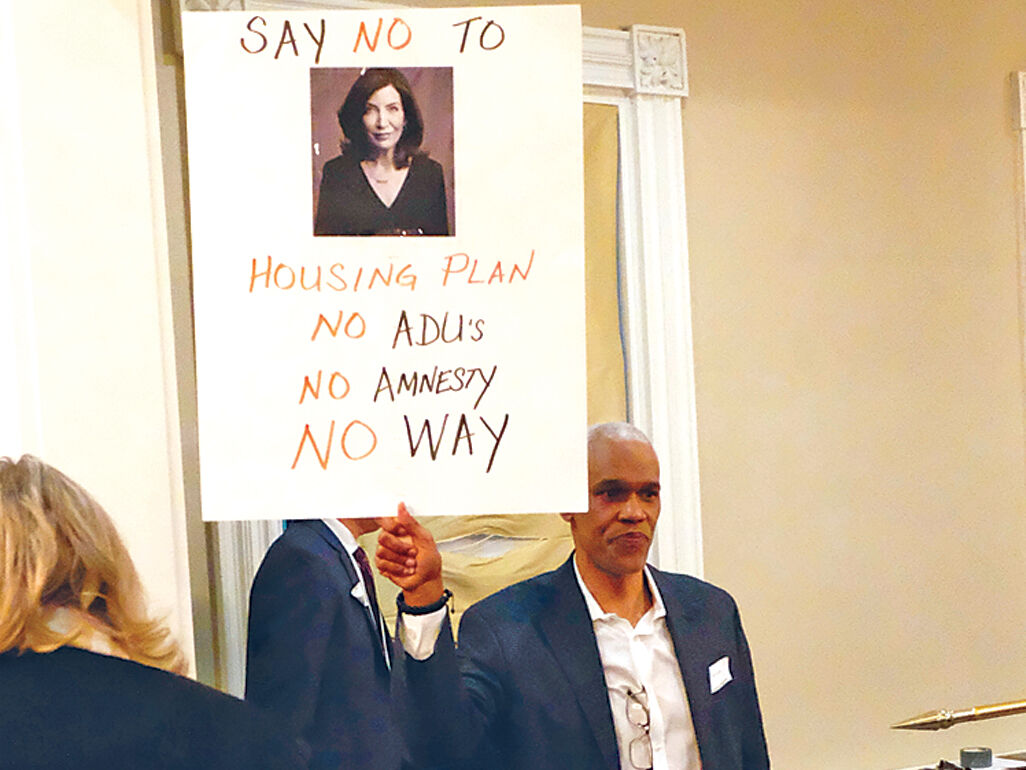
Civics unite against Kathy Hochul's YIMBY housing doctrine

https://bloximages.chicago2.vip.townnews.com/qchron.com/content/tncms/assets/v3/editorial/e/83/e83e99ca-922a-56cc-9fb9-77b947d00659/6400bcdd55a84.image.jpg

Queens Chronicle

A pitched battle against Gov. Hochul’s sweeping new housing plan for New York is starting to pick up momentum in Eastern Queens.

More than 150 homeowners from widely disparate neighborhoods packed a meeting room in Douglaston last Friday for a forum that featured civic leaders vowing to stop her controversial proposal for building 800,000 new units in the state to fix the region’s chronic housing shortage.

Civic leaders from Cambria Heights, South Jamaica and Addisleigh Park spoke alongside community activists from Whitestone, Bayside and Broadway-Flushing against the plan that would allow Albany to upscale local zoning laws without local consent.

The meeting was an unusual display of unity between racially different neighborhoods in Northeast and Southeast Queens — and a warning to the governor that single-family homeowners in the city were ready to join forces with communities on Long Island and Westchester to oppose the sweeping plan.

“We moved to our communities because we wanted a certain quality of life for our families,” Bill Perkins of the Rosedale Civic Association told the forum.

“It’s not a race thing,” he said. “It’s not a where-you-live thing.”

Under the new proposal introduced last month in Albany, the state would, among other things, require every town and county in the state to build 3 percent more housing stock every three years or face fines and to rezone a half-mile radius around every MTA train and subway station in the region for greater density.

Those mandates would also include legalizing basement apartments and small, backyard houses (called accessory dwelling units or ADUs) where they are currently prohibited.

The goal of the plan is to create more affordable housing by requiring areas traditionally reserved for low-density, one-family homes to drop longtime restrictions against the construction of apartment houses and other multifamily dwellings.

“When I drive around Jamaica and think about it, I wonder, where are these apartment buildings going to go?” said the Rev. Carlene Thorbs, chair of Community Board 12 (who emphasized she was speaking on her own behalf and not for the board).

“We have a front yard, we have a backyard, we have a driveway,” she said. “This is how we want our communities to stay.”

The governor’s Housing Compact has been met with hostility from the nearby suburbs of New York City, as well. Civic leaders from Nassau and Yonkers attended the event to pick up support for resisting the plan one called “worse than what you think.”

“The conversation we always hear is that ... ‘Oh, it’s affordable housing,” said Thorbs. “No, it is not,” she said. “Not when a studio is $1,700.”

Wednesday, January 11, 2023

Hochul and Adams State and City Of Yes housing plans focus on basements, suburb towers and office buildings

<

https://www.nydailynews.com/resizer/J9Hp_ZSe1b3ERvGwGHglBFdNd2E=/1440x0/filters:format(jpg):quality(70)/cloudfront-us-east-1.images.arcpublishing.com/tronc/CUW6D32THZDEDLU5EFSDAX26OE.jpg

 NY Daily News

Suburbs would have to step up their development game under Gov. Hochul’s plan to build 800,000 new units of housing across the state in the coming years.

To confront the state’s housing crisis, Hochul proposed in her State of the State address Tuesday a plan dubbed the “New York Housing Compact,” which will require every town, city and village in the state to set a target number of new homes to create over a three-year period.

 The governor specifically called out suburban communities surrounding New York City for limiting building in recent decades and said in her address that the state is ready to step in.

“Local governments can meet these targets any way they want,” she said. “They can shape building capacity. They can redevelop old malls or buildings, office parks, incentivize new housing production or just update the zoning rules to reduce the barriers.”

However, she added, if communities “have not made good-faith efforts to grow when proposed housing projects are languishing for no legitimate reason, the state will implement a fast-track approval process.”

That “fast-track” course would allow housing proposals that are denied locally to go to a “state housing approval board” or the courts.

The downstate area, including Westchester, Putnam and both Nassau and Suffolk Counties on Long Island, would be required to grow their housing stocks by 3% every three years.

Upstate towns would have to meet a target of 1% growth every three years. Hochul noted that New York in recent years has trailed other states, including New Jersey and Connecticut, when it comes building housing.

The governor also wants to see more multi-residence projects near MTA subway and train stations. The plan requires municipalities with MTA rail stations to rezone areas within half a mile of a station to allow for at least 25 homes per acre.

The proposal includes $250 million for infrastructure to accommodate the increased density including sewers, schools and road work. It also calls for an expedited environmental review process for rezonings.

“Today, we say no more delay. No more waiting for someone else to fix this problem. Housing is a human right,” Hochul said. “Ensuring enough housing is built is how we protect that right.”

Suburban legislators were largely quiet about Hochul’s proposals on Tuesday.

History shows they might be a heavy political lift — suburban politicians have traditionally complained about state laws that would require them to allow more housing.

Griping by suburban politicians forced Hochul to drop two such ideas from the state budget in 2022, including a plan to encourage housing near train stations similar to her current proposal. The other would have required towns to allow apartments to be built within single-family homes.

In the city, Hochul is seeking a new version of the lapsed property tax abatement plan known as 421-a, which would incentivize the building of affordable housing units. A revamped version of the program failed to make it into the budget last year.

Real estate groups and organizations like Homeowners for An Affordable New York, a landlord-backed group, applauded the governor’s proposals.

“The Governor outlined an ambitious agenda for addressing longstanding inequities in the housing market,” spokesman Andrew Mangini said in a statement. “Housing developers and property owners, both big and small, look forward to engaging in conversations with state lawmakers to ensure fair and equitable solutions to practical issues in housing and real estate.”

Tenant advocates and progressive lawmakers, meanwhile, panned the plan. They said it falls far short of what is needed to address the housing and affordability crisis already facing many New Yorkers.

 NY Daily News

Mayor Adams and top city planning officials released new details around their push to convert underused office space into apartments in the city’s bustling business districts, including a plan that would allow for the rezoning of millions of square feet of space in office buildings.

The blueprint, which Adams and city planners put out through a City Planning Department study, would in part require zoning changes to permit conversions in buildings built prior to 1991.

Currently, such office-to-residential conversions are only allowed in Financial District buildings built in 1977 or before, and buildings in other city

Sunday, March 27, 2022

Rockaway civics hyper pissed about rampant hyperdevelopment

Obscenity building photo by JQ LLC


Rockaway Times 

 As the Belle Harbor Property Owners Association reconvened, the hot button issue of the night was building, building, building.

About 50 people gathered at P.S. 114 on Tuesday, March 15 for the BHPOA’s first meeting since November. BHPOA President Paul King immediately addressed the main topic of the meeting saying, “There’s been a lot of overdevelopment on the peninsula. Some of those projects are closer to home,” he said. Those projects closer to Belle Harbor were later discussed, but King first provided some updates on the beach action. He said with new leadership at the Parks Department, the civic and Councilwoman Joann Ariola are hoping to hold a meeting with them soon. He announced the Army Corps of Engineers would be at their next meeting in May or June to provide updates. In the meantime, King said that groin work planned for Beach 125th and 130th this summer, will instead happen next year, as work is currently taking place further downtown, and expected dredging and sand replenishment later this year will change the original schedule.

Next, Belle Harbor’s elected officials, Senator Joe Addabbo, Assemblywoman Stacey Pheffer Amato and Councilwoman Joann Ariola were all on hand to provide updates. Addabbo explained that Albany is currently negotiating its $216B budget and he addressed a topic of concern for the meetings—Accessory Dwelling Units (ADUs). Legalizing ADUs would allow homeowners to turn things like attics, basements, garages or backyard sheds into additional apartments. After seeing the effects of flooding from Hurricane Ida causing deaths in illegal basement apartments in Queens, locally, the legalization of ADUs doesn’t have much support. “I don’t agree with ADUs,” Addabbo said. He explained that Governor Hochul took it out of her budget as a statewide issue, but $25 million had been allocated for localities to decide whether they want to legalize ADUs.

 The meeting then switched gears to focus on all of the new developments taking place or in planning stages. A neighbor named Eric Rasmussen, who is on a committee focusing on the Neponsit Home, provided some updates. The building, which hasn’t been used since 1997, is slated to be demolished. Once that happens, the property, currently overseen by NYC HHC, will be transferred to the Parks Department, as a covenant in the property deed says it must be used as a healthcare facility or parkland. Demolition was expected to begin this spring but will instead begin after the summer is over as NYC Lifeguards currently utilize this property as a shack and storage facility. The BHPOA says they will keep a close eye on anything going on with the property as progress is made.

John Signorelli provided some updates on the demolition of the old PS 256 building and development of a playground. Abatement will be completed this month and the demolition is expected to be complete by September, six months ahead of schedule. The playground is expected to be complete by February 2023. While the building is demolished, a wooden fence and netting will go up around the area to protect surrounding homes from debris.

Another development of concern is the plan for ALMA’s Surfside property from Beach 105th to Beach 108th Street. The tenant association SHAFT asked the BHPOA for their support in fighting against a proposal to build four new buildings on the property that would bring an additional 2,000 units with only 1,500 parking spaces, while eliminating current parking for the existing units, the dog run and the pool on the property. A Rockaway Civic Association survey showed 94.3% of people are against this project. Councilwoman Joann Ariola chimed in, saying she’s been on top of it with meetings and when it comes to the ULURP process for the zoning changes for this development, she will do everything to make sure it doesn’t become reality. “That’s the most narrow portion of the peninsula. It cannot support a project like that, but beyond that, they’re not talking about infrastructure, roadways, schools, everything else that’s needed. We’re a hard no on this. That’s not happening,” she said.

A plan to demolish the Chai Home on Beach 125th and replace it with a nine-story rental property was also addressed. The 90-foot building, thirty feet higher than neighboring oceanfront buildings, would have 58 units and 29 parking spots on a street that doesn’t allow summer parking. A Rockaway Civic Association poll showed 88.5% of people are against this proposal. Ariola said she would not back the project. “I will not support the proposal as put forth,” she said.


Sunday, February 20, 2022

Governor Kathy Clown plays herself, abandons ADU plan

  10 Facts About '3rd Rock From The Sun' Direct From The Big ...

Newsday

  Gov. Kathy Hochul has pulled her budget proposal to require local governments to accept an expansion of apartments and backyard cottages in single-family neighborhoods as a way to combat a statewide crisis in affordable housing, Newsday has learned.

Hochul had proposed the expansion of "accessory dwelling units" in her January budget proposal to the legislature. Since then, however, there has been strong opposition by mostly Republican officials from local governments on Long Island and by some Democrats, including Rep. Tom Suozzi and Long Island state senators. Suozzi (D-Glen Cove) is challenging Hochul for the Democratic nomination for governor.

Opponents argued that Hochul’s proposal would harm suburban neighborhoods by worsening parking problems and straining local services, including sewer and water facilities, while eliminating local control of zoning.

"Since my days in local government, I have believed strongly in the importance of consensus-building and listening to communities and my fellow policymakers," said Hochul, a former Erie County clerk and a suburban councilwoman, in a statement.

 I have heard real concerns about the proposed approach on accessory dwelling units," she said. "I understand that my colleagues in the State Senate believe a different set of tools is needed, even if they agree with the goal of supporting the growth of this kind of housing. So I am submitting a 30-day amendment to my budget legislation that removes requirements on localities in order to facilitate a conversation about how we build consensus around solutions."

"I am glad she removed this radical policy from the budget, but she should have never added it in the first place, " Suozzi said.

Sunday, January 30, 2022

Rep. Suozzi and friends condemn Governor Kathy's push for ADUs


 Long Island Press

 U.S. Rep. Tom Suozzi (D-Glen Cove), a candidate for governor, on Thursday joined a broad coalition of mayors, town supervisors, and civic leaders from Nassau, Suffolk, and Queens to oppose Gov. Kathy Hochul’s stated plans to eliminate single-family zoning laws in New York and dramatically alter the housing landscape across the state.

“Governor Hochul’s radical proposal would take away zoning control from municipal governments, erode local government authority, and end single-family housing across New York,” said Suozzi. “Hochul’s plan to eliminate home rule is not what we need. I support affordable housing, building up around downtown train stations, and helping the homeless. I oppose eliminating home rule and ending single-family housing.”

Suozzi was directly responding to Hochul’s recent State of the State Address, where the governor vowed to fix what she called outdated land-use laws that hold back housing supply.

This includes changing zoning laws for Accessory Dwelling Units (ADU) such as backyard cottages, attics, garages, and basements, which can provide an affordable multi-generational housing option that helps families live closer together. But current land use restrictions prevent homeowners in some communities from building ADUs.

To permit these vital options and help reduce housing costs, Hochul will propose legislation to require municipalities to allow a minimum of one ADU on owner-occupied residentially zoned lots.

In New York City, this legislation would require creation of an amnesty program to legalize existing ADUs, with an expectation that they are brought into compliance with key building code requirements to ensure resident safety, but also provide some flexibility for the City to exempt some units from specific Multiple Dwelling Law (MDL) provisions without further New York State legislation.

Among the items Suozzi and the local electeds see as questionable in the legislation is that it would eliminate home rule. Under Hochul’s proposal, Towns would no longer have control of their local land-use regulations. The proposal would decimate local zoning control, which is the bedrock of New York’s local governments, Suozzi and the local electeds argued.