
Showing posts with label Columbia University. Show all posts

Tuesday, August 10, 2021

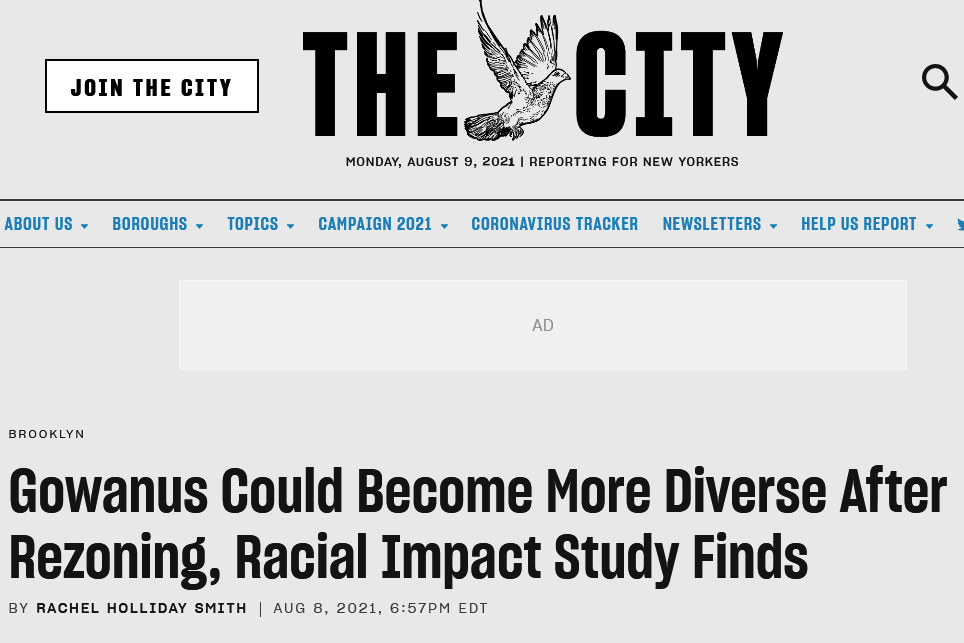
Gowanus rezoning likely could become more diverse racial impact study report finds

 Image

Image 

THE CITY

 Brooklyn’s Gowanus neighborhood would likely become more diverse and less segregated under a proposal to allow more development in the neighborhood, according to a first-of-its-kind study on the contentious rezoning’s potential racial impact.

The analysis of the Gowanus Neighborhood Plan, conducted by a Columbia University professor with City Council staff, comes as the controversial proposal — previously delayed for months by a lawsuit — now makes its way through the city’s public review process.

The study also offers the first glimpse at the potential value of a Council bill passed just weeks ago requiring “racial equity reports on housing and opportunity” for rezonings in the future.

While that legislation will not take effect until mid-2022 and does not apply to the Gowanus plan, those backing the rezoning thought it was best to study the issue anyway. Those supporters include area Councilmembers Brad Lander and Steven Levin as well as the local housing nonprofit Fifth Avenue Committee, which helped fund the study.

“If our goal is a more inclusive neighborhood, with meaningful opportunities for New Yorkers of color, then we need to find the courage to move forward thoughtfully. And I really believe this provides clarity about that,” Lander said of the new research.

The Gowanus plan aims to change development rules within an 82-block area along Fourth Avenue between Atlantic Avenue and 15th Street and stretching west to Bond and Smith streets.

Commercial Observer 

 The city’s rezoning of Gowanus, Brooklyn, which some groups tried to sue to stop, would likely make the neighborhood more diverse and less segregated, a new report found.

The report, conducted by Columbia University and New York City Council staff, found that the rezoning calls for 35 percent of the nearly 8,000 new housing units to be set aside for affordable housing, a much greater share than in other recent rezonings.

The nearly 3,000 affordable housing units would be offered to families making between $30,000 to $100,000, or 40 to 80 percent of the area median income, and would help Gowanus “much more closely match the diversity of New York City rather than the population of the local area  a neighborhood that is significantly whiter and wealthier than the City as a whole,” according to the report.

It estimates that 20 to 25 percent of the new housing would be rented by Black families and 25 to 37 percent by Latino families.

“The report shows that in recent decades, Gowanus and surrounding neighborhoods have grown increasingly exclusionary, causing displacement of many lower-income residents of color, and becoming one of the whitest and wealthiest communities in the city,” Council Member Brad Lander, who represents the neighborhood, said in a statement. “We can share it better.”

Landers and others touted the report as one of the first racial-impact studies done for a rezoning, which will soon be required by city law, and as showing the benefit of including them for future plans.

“Racial equity analyses represent a stark break from business as usual in land-use planning,” Lance Freeman, a Columbia professor and one of the co-authors of the report, said in a statement. “Instead of exacerbating or ignoring racial inequality — as much land-use planning has done in the past — racial equity analyses will require policymakers to take into consideration how their actions impact racial equity.

“We hope this report can help change the conversation around the racial impact of rezonings as we work to overcome decades of segregated growth in New York City,” Freeman added.

Brad Lander is all over this study, it wasn't long ago when he was spewing this racial inclusivity and equity drivel when he was blubbering during those zoom calls advocating for Cojo's disastrous and universally rejected Planning Together. Come on man


Friday, April 5, 2013

Stop and frisk not as successful as thought

From the Daily News:

Stop-and-frisk has removed thousands of guns from the city’s streets — but the NYPD detained millions of innocent New Yorkers to find them.

A Columbia law professor testified Wednesday that just one gun was recovered for every thousand people stopped from 2004 through June 30, 2012.

“The NYPD hit rate is far less than what you would achieve by chance,” Jeffrey Fagan said in Manhattan Federal Court.

Testifying in the federal class-action lawsuit against the city and the NYPD’s controversial tactic, Fagan said his analysis of paperwork from 4.4 million stops found guns were confiscated at a rate of roughly one-tenth of 1 percent, or 5,940 firearms.

Knives and other contraband were nabbed in about 1.5% of stops, taking 66,000 weapons off the street, the professor said.

And 12% of the 4.4 million stops during that time period — roughly 528,000 — led to an actual arrest or a summons, Fagan said.

City Councilwoman Margaret Chin speaks as New York City women call on the NYPD to abandon the discriminatory procedure that a study shows yields few results.

And the rest were “just let go?” asked Federal Judge Shira Scheindlin.

“Yes, your honor,” Fagan replied.

Saturday, December 15, 2012

Concrete tester pleads guilty

From the Daily News:

A company that certified the safety of concrete at thousands of New York City construction projects admitted it regularly faked tests and made up inspection reports, authorities announced Friday.

American Standard Testing and Consulting Laboratories, and company president Alan Fortich, 45, pleaded to corruption charges for filing bogus tests over the last 10 years on an impressive list of high profile buildings. Five other executives admitted filing false documents.

They faked tests at Yankee Stadium, the Second Avenue subway, the Javits Center, a control tower at JFK Airport, the Port Authority bus terminal, the Lincoln Tunnel, Memorial Sloan-Kettering Cancer Center and a Columbia University science center.

The city, the MTA, the Port Authority and dozens of private sector builders were all victims, and dozens of buildings had to be retested to make sure the concrete used was not going to fall apart.

All the buildings were declared safe, Vance said. It wasn’t clear Friday who paid for the retests.

The guilty pleas make clear just how pervasive corruption was in the concrete testing business — American Standard was hired in 2008 to replace Testwell Inc., another firm indicted for faking concrete tests.

In admitting to enterprise corruption, a felony, American Standard will likely be barred from bidding on public contracts at the agencies affected.

Sunday, May 27, 2012

Mob-owned firm off Columbia project


From the Daily News:

The mob-linked demolition company running jobs on which two workers have died as part of Columbia’s West Harlem expansion has been booted from the project, the Daily News has learned.

Brooklyn-based Breeze National, which was demolishing a building on W. 131st St. that collapsed in March, killing one worker and injuring two others, is no longer on the job at the Manhattanville construction site.

Breeze has been doing work at six additional properties on the 17-acre expansion site, according to records.

Juan Vicente Ruiz, Sr., 69, died when a wall of the building came crashing down in March. His family is now suing the Ivy League school, charging the construction site was unsafe.

Inspectors had issued a previous stop work order and assessed Breeze with violations for failing to notify the city that it was starting demolition and failing to properly safeguard the people and property that were affected.

It wasn’t the first time a Breeze National worker died on a Columbia demolition job. Two years ago, 51-year-old Jozef Wilk fell to his death while demolishing a Columbia-owned building on Broadway.

Breeze spokeswoman Sarah Berman declined to comment on the firm’s removal, but said “it has not been deemed they did anything wrong” in connection with the March collapse, adding that the cause was likely a structural defect.

Monday, April 23, 2012

Columbia contractors have crooked histories


From the Daily News:

In the two years since Columbia University began work on its controversial West Harlem campus expansion, the Ivy League institution has engaged the services of a slew of contractors with checkered records, the Daily News has learned.

One firm was implicated in a bid-fraud scheme at a Brooklyn hospital, and two were cited in bribery investigations. That’s in addition to Breeze National, the mob-linked demolition company handling the jobs in which two workers have been killed.

Columbia says on its website it is the biggest client of Brooklyn-based Eagle Two Construction, owned by Roxanne Tzitzikalakis, whose father Demetrios Tzitzikalakis pleaded guilty to grand larceny and falsifying business records for bilking the city out of cash at his former company, Foundation Construction Consultants.

State controller Thomas DiNapoli found in an audit last week that the ex-con father plays an active role in running the company — and that Eagle won six contracts at SUNY Downstate Medical Center where forged bids or bids from affiliates posing as competitors were submitted.

After the Daily News inquired about the allegations against Eagle, Columbia spokeswoman Victoria Benitez said the firm has been suspended from consideration for contracts, pending the outcome of DiNapoli’s investigation.

Utility work on Columbia’s expansion project has been contracted to Felix Associates and MFM, which records show share a Westchester address and officers.

Felix was identified by Con Edison as the firm accused of bribing 11 Con Ed supervisors, who were arrested in 2009 for demanding more than $1 million plus goodies like Giants tickets in return for letting the company jack up costs.

Other demolition work on the expansion project is being handled by Par Environmental. The Suffern, N.Y., firm, then known as Par Wrecking, was cited in a 2008 federal indictment for paying $35,000 to a Gambino crime family associate to allow them to ignore labor agreements on a Newark garage demolition.

The expansion project, which encompasses 64 properties on 17 acres, has been slapped with 59 building code violations, 13 stop work orders and four lawsuits alleging unsafe working conditions.

Friday, March 23, 2012

Death at Columbia project


From DNA Info:

A 69-year-old construction worker was killed and two others seriously injured when a violation-plagued building recently bought by Columbia University collapsed in Harlem

Thursday morning during demolition work, authorities said.

The tragic incident unfolded at the one-story structure at 604-606 W. 131st St., near Broadway, about 7:51 a.m., FDNY officials said.

All three victims — Juan Ruiz, 69, King Range, 60, and Sakim Kirby, 30, all of The Bronx — were pulled from the wreckage by hand. Ruiz and Range were rushed to St. Luke's-Roosevelt Hospital with life-threatening injuries and Kirby suffered serious injures, fire officials said.

Ruiz was later pronounced dead.

"I just seen brick falling on the workers. I just seen people running towards it but they couldn’t get them out," said witness Willy Katende, 46, who lives nearby.
"It sounded like bomb — boom. It came down so fast," he added. "The whole thing came down.”

According to FDNY and Department of Buildings offficials, the workers were cutting a structural beam near the building's perimeter wall when steel, concrete and red brick began raining down on them.

Two of the workers, including Ruiz, were partially buried by rubble near the center of the building. The third was buried near the building's northwest corner about 50 feet from them, officials said.

Tuesday, November 29, 2011

Community ends up with nothing after wide-scale condemnation


From the Wall Street Journal:

It was supposed to be a breakthrough victory for Harlem residents and a model on how to settle raging land-use disputes.

But more than 2½ years after Columbia University brokered an agreement with community groups — exchanging a lucrative package of benefits for the area's blessing of the university's expansion into West Harlem — local officials and residents are complaining that the fruits of the deal remain a mystery.

Political squabbling over control of the benefits has left nearly $3 million in Columbia-donated funds idling in a bank. The group administering the largest chunk of benefits, the West Harlem Local Development Corp., doesn't have an office, a website or a staff. The corporation hasn't made public any reports of its activities.

As required, Columbia has directed funds to pay for an agreement compliance officer hired by the state and a tenants attorney to advise residents on evictions. But no one has been retained.

Meanwhile, Attorney General Eric Schneiderman, who enforces the state's charities law, has subpoenaed the nonprofit corporation, which spent hundreds of thousands of dollars but never registered with his office.

Thursday, June 24, 2010

Court upholds eminent domain abuse yet again

From the Huffington Post:

ALBANY, N.Y. — New York's top court has upheld a state redevelopment agency's use of eminent domain so Columbia University can expand its Ivy League campus over 17 acres in Manhattan's West Harlem neighborhood.

The Court of Appeals found a rational basis for the Empire State Development Corp.'s findings that the area is blighted and Columbia's expansion is an improvement project.

Columbia's proposed $6.3 billion project includes several new buildings for housing, laboratories and other facilities, two acres of public open space and tree-lined sidewalks.

The university already owns most of the land.

Other land owners claimed collusion between the school and agency and argued findings of blight were based on vermin, garbage and mold in Columbia buildings.

The court released the decision Thursday.

Saturday, May 15, 2010

Columbia's CBA is really just a giant slush fund

From the NY Post:

A $76 million windfall intended to help Harlem residents is in limbo -- and may never be paid -- because the politician-backed nonprofit in charge of distributing the money is in disarray, The Post has learned.

Although it formed four years ago, the West Harlem Local Development Corp. lacks a mission statement, has yet to get tax-exempt status from the IRS and doesn't even have a phone number.

The group already has received $500,000 from Columbia University -- part of a 16-year payout designed to assuage community fears over the school's expansion -- yet hasn't spent a cent on the neighborhood.

At least five people have quit the nonprofit, alleging that it was becoming a "slush fund" for Manhattan politicians.

The delay "threatens to undermine" the agreement and leave Harlem with nothing, Manhattan Borough President Scott Stringer charged in a scathing letter to the group.

The organization hasn't set up any guidelines for doling out the cash and ensuring accountability, yet its four-member executive committee is itching to write checks without "a formal application process, without public notices, without protocols for selection, without advice from a community advisory committee," Stringer said in the letter, addressed to then-West Harlem President Julio Batista.

Tuesday, May 4, 2010

Columbia shuts down restaurant it promised to relocate

From the NY Times:

The ghost town of empty buildings and fenced-in lots dotting Columbia University’s proposed Manhattanville campus was joined by one more specter on Tuesday — Floridita Restaurant, shuttered.

The Cuban food mecca on Broadway and 129th Street closed Tuesday amid confusion over its future, the latest twist in a saga involving a buckled kitchen floor and an unfinished relocation deal. The landlord — Columbia University — says the restaurant must stay closed for six weeks to repair the floor. But Ramon Diaz, the owner and nephew of Floridita’s founder, insisted that the university refused to consider options that would have allowed him to stay open while he leased and renovated a new location nearby.

As a result, the restaurant’s 36-member staff, some of whom have been there for decades, are out of work and wonder whether they, like the restaurant, can survive an unwanted six-week hiatus.


I'm sure this has absolutely nothing to do with it.

Saturday, April 3, 2010

AKRF archaeologist giddy over downtown artifacts

From Metro:

Pointy shoes, oyster shells, clay pipes and other detritus of the Dutch who founded New Amsterdam, the British who followed and the early New Yorkers were among the 65,000 artifacts uncovered during construction of the $400 million South Ferry subway terminal.

A sampling of the remnants, including segments of the 18th-century battery wall that gave Battery Park its name, are now on display at the New York Transit Museum’s annex at Grand Central Terminal.

Diane Dallal, archaeology director for AKRF, a firm that analyzed the artifacts, was excited to find yellow Dutch bricks that once lined walkways.

“A lot of times you see these black-and-white drawings of New York,” she said. “But it must have been very colorful.”


Her attitude is interesting considering Dallal works for AKRF, the firm the city and state hires whenever it wants to do something particularly dastardly, such as Columbia University expansion, Atlantic Yards, etc. She is the one who probably gave the green light to the MTA to start digging despite the fact that it was an archaeologically sensitive area, just like she did at the St. Saviour's site in spite of the LPC stating that there was a strong likelihood of finding similar archeologically sensitive material and graves at the site. This gal really gets around!

Tuesday, January 12, 2010

When blight ain't right

From the NY Observer:

State Senator Bill Perkins is apparently not happy about the state's choice of consultants.

One consultant, specifically: AKRF, the New York–based firm that has established itself as the unchallenged king of environmental review in the city and state, dominating the field of government contracts.

The source of angst for Mr. Perkins is Columbia University's proposed 17-acre expansion into West Harlem and the state development agency's selection of AKRF to do a blight study. The blight study is a necessary step for eminent domain in the project, though the state's selection of AKRF has taken significant heat from the courts, which recently dealt the school a tremendous blow by blocking the use of eminent domain for the expansion. Among other factors, the use of AKRF was cited as a concern given that Columbia also used the firm to do its environmental review (the state intends to appeal the ruling).

A sampling of the testimony:

Mr. Perkins [on AKRF]: Have they ever come back with a determination that was, from your point of view, not blighted?

Anita Laremont, Empire State Development Corporation counsel: No.

Mr. Perkins: Have they ever given you a determination that you could prove was not blighted?

Ms. Laremont: No.

Mr. Perkins: So from your point of view, they're 100 percent blight?

Thursday, December 24, 2009

Paterson flip flops on eminent domain abuse

How things have changed. A little more four years ago, state Senator David Paterson and Council Member Bill Perkins were of the same mind on eminent domain, especially concerned about Columbia University's planned expansion in West Harlem, an area in their districts.

They called for a moratorium on the use of eminent domain in the wake of the U.S. Supreme Court's controversial 5-4 Kelo vs. New London decision upholding eminent domain for economic development.

Now Perkins is in the state Senate, the leader of a somewhat lonely legislative effort to reform the state's eminent domain laws, much criticized by not only the libertarian Institute for Justice but also civil rights lawyers like the diehard liberal Norman Siegel. (Perkins has a letter in today's Times asserting that the state's "attempted taking of private property on behalf of Columbia University illustrates how the current process lacks accountability, transparency or meaningful public participation.")

Now Paterson is governor, with a much larger constituency and having inherited some projects--like Atlantic Yards and Columbia--that depend on eminent domain.

And, in separate appearances Saturday just a few blocks (and a few hours) away, Perkins highlighted the need for change, and Paterson stood his ground.

The New York Observer's Jimmy Vielkind asked Paterson about the Columbia case, noting that the ESDC was charged with using eminent domain improperly; should the state appeal and was the process sound?


"We thought that the process was in compliance with land use principles and did not violate eminent domain," Paterson responded. "When I was a state senator in 2005 and I saw the original plan for Columbia, I was virulently opposed to it. But we felt that ESDC and Columbia University had adjusted that plan to be in compliance with the law."

Saturday, December 19, 2009

Court forces ESDC to turn over secret documents

From the NY Observer:

The New York Court of Appeals on Tuesday unanimously ruled that the state's economic development agency, which administers eminent domain, must turn a set of records over that Mr. Sprayregen had requested through the Freedom of Information Law. The agency, the Empire State Development Corporation, had provided numerous documents but withheld a set related to a 2004 agreement between the agency and Columbia. Mr. Sprayregen appealed the agency's denial of his FOIL request, and was denied again. He then sued in state Supreme Court and won, though ESDC did not provide all the documents, preferring to appeal. He won again at the appellate level; ESDC appealed again; and now the agency has exhausted its appeals.

The ruling of the court Tuesday found that the agency was overly broad in denying Mr. Sprayregen's FOIL request, and then changed its reasoning for not providing the documents, with the court saying and its "initial determination was superficial, at best."

Monday, December 14, 2009

From Perkins to Paterson


Original letter here.

Dear Governor Paterson:

I write with a great sense of urgency in respectfully calling upon you to forego an appeal of last week’s decision in Kaur v. New York State Urban Development Corporation, and to order a statewide moratorium on the use of eminent domain within the State of New York pending legislative action.

As you are aware, last week’s court decision struck down as unconstitutional the taking of property by the Urban Development Corporation d/b/a“ESDC” for the benefit of Columbia University. The court found ESDC violated both state and federal due process clauses in an effort to prevent affected property owners from obtaining information, and that ESDC’s finding of blight was “bereft of facts which established the neighborhood in question was blighted.” Furthermore, ESDC’s determination that the project even has a public use, benefit or civic purpose is wholly unsupported by the record. The court also noted the glaring conflict of interest, which reeks of bad faith, that existed as a result of ESDC and Columbia using the exact same consultant to review the project and determine blight.

You may recall that back in 2005 you and I stood on the steps of City Hall together with several members of the City Council to protest the United States Supreme Court decision in Kelo v. City of New London which affirmed the use of eminent domain for private development that entails a so-called “public use.” That decision contained language encouraging states to review their own eminent domain statutes. Some states have done just that. It is now New York’s turn.

At the time of the Kelo decision, as a State Senator and Minority Leader you understood that the current process is flawed and called for a blanket moratorium on the use of eminent domain. The same reasons for instituting a moratorium back then still exist. In fact they are even more urgent given the Kaur decision, and the recent decision by the Court of Appeals affirming the taking in the case involving Atlantic Yards. It is my understanding you recently and publicly committed to a full objective review of that project and its financing.

As Chair of the Senate’s Corporations, Authorities and Commissions Committee, I held hearings involving the topic of eminent domain. I have gone on record on numerous occasions against what I perceive to be the abuse of eminent domain in this state, particularly as it relates to private development projects. I have often described that abuse as a “mugging”, and one equal to “placing a gun to the community’s head”.

The Columbia decision has intolerably heightened the confusion and uncertainty over what, if anything, constrains the ESDC from taking anyone’s property whenever it suits its fancy. For one, no one knows what “blight” is—the crucial and fundamental issue in both the Columbia and Atlantic Yards cases. What is clear, however, are the signals that the ESDC was not acting in good faith. This I would suggest, is evidenced by the court’s statement that “the record before ESDC contains no evidence whatsoever that Manhattanville was blighted prior to Columbia gaining control over the vast majority of property therein.” The opinion also makes a strong case that the blight determination in that case was severely flawed, and in large part the product of the ESDC’s desire to transfer property to a “private elite education institution”. As a result, I am left with my own opinion, and that of others in my community, that these type of actions on the part of the ESDC are part of an insidious form of discrimination and civil rights violations that must not stand. As the Kaur decision reads, “‘few policies have done more to destroy community and opportunity for minorities than eminent domain.’” In fact, the Court found that the ESDC’s actions in the Columbia expansion is, “clear evidence of that reality. The unbridled use of eminent domain not only disproportionately affects minority communities, but threatens basic principles of property contained in the Fifth Amendment.”

For these and other reasons I request that you urge the ESDC not to appeal the Kaur decision. Please impose a statewide moratorium on further eminent domain actions and then let us work together on a legislative solution. I am currently working on a bill to reform how eminent domain is exercised in the State of New York. The purpose is not to hamper development, but to make the process more transparent and provide stakeholders with substantive due process. This will result in development that reflects community input and serves community needs. Your participation will be critical. An enlightened eminent domain procedure will be a significant victory for all involved.

I respectfully request your support on these issues and am ready to stand with you publicly again, this time for the purpose of announcing actions that will lead to genuine reform. Please feel free to contact me for any further discussion at 212-222-7315, or in my Albany office at 518-455-2441. I look forward to hearing from you at the earliest convenience, and I thank you in advance for your attention to this very important matter.

Very truly yours,

Senator Bill Perkins
30th District

Monday, December 7, 2009

Ball's in your court, Bill!

From the Daily News:

"The use of eminent domain is like a gun to the community’s head which basically says, 'If you don’t give it up we’re going to take it,'" [State Senator Bill] Perkins said outside City Hall this afternoon.

"And as a result, those who do not have the wherewithal of a Nick Sprayregen or a lawyer like Norm Siegel begin to negotiate under the threat of begin robbed or mugged through the process of eminent domain."

"So what happens to those people who lost their property to Columbia under those circumstances?"

"Nick Sprayregen at the moment is OK. The Singh family that owned the small garage, gas station, is OK, but those who buckled under because of the threat of eminent domain? How do they get made whole? How do they get justice in the process in which they were essentially threatened with the gun of eminent domain?"


So how about some legislation, then? You'd think this would be one issue where both sides would agree.

Thursday, December 3, 2009

Court rules taking property for Columbia is unconstitutional

From the NY Observer:

In an unexpected major decision, a New York appellate court has overturned the use of eminent domain to create a new West Harlem campus for Columbia University, ruling the action unconstitutional.

The cases were brought by the defiant owner of a set of storage warehouses in West Harlem, Nick Sprayregen, and the owners of two gas stations in the footprint for the 17-acre campus, called Manahttanville. Mr. Sprayregen sued to block the land takings in January, after the use of eminent domain was approved by the state's development agency, the Empire State Development Corporation.

Columbia had said it needed eminent domain to establish a full, contiguous campus, and then build a large, interconnected underground facility throughout the area. Thus all the property owners needed to be removed from the mostly industrial district.


More from the NY Times.

Monday, November 9, 2009

There goes the neighborhood...literally!

Demolition of the buildings in Columbia University's expanded footprint is in full swing. The historic building housing the Hudson Moving & Storage Company (on the National Register of Historic Places - I told you that designation means nothing) is being demolished with only its facade being saved and moved to the company's new location.
Here's a side view. Meanwhile, just around the corner...
627 W. 129th Street has no such half-assed preservation plans.

The gas station seen to the right as well as Tuck-It-Away Storage are the only 2 properties that have not kowtowed to Columbia University and both will likely be taken by eminent domain so that a private school that charges its students tens of thousands of dollars per semester and admits basically no one from the surrounding neighborhood can take over West Harlem. Who needs jobs for the working class? Let's make more room for temporary out-of-towners and gentrify every square inch of the city!

Remember, under Mayor Bloomberg, industrial areas that for the most part employ minorities = "blighted".

Monday, June 1, 2009

Safari on the 7 train

From the Queens Chronicle:

You might not think of the subway as an ideal place to find wildlife, but architecture students from Columbia University and Barnard College are trying to introduce people to the array of animals that can be found along the 7 line.

The students, working through Columbia’s Urban Landscape Lab and collaborating with a graphic designer, have developed a series of about 12 podcasts called Safari 7, which together offer an “urban tour” of the wildlife that exists along or near the 7 line.

Anyone can download the podcasts onto an MP3 player and then listen to information about animals that can be found in the areas they pass through while riding the subway. The segments are timed so as to correspond with subway stops.

“This is a kind of broadcast of information about animal life in the city,” said Janette Kim, director of the Urban Landscape Lab. “It’s a celebration of the biodiversity of the city and an understanding that we already live in a very rich ecosystem, but we don’t always acknowledge or understand it.”

In addition to segments about common city critters such as rats, squirrels and pigeons, there’s a piece on life forms that inhabit Calvary Cemetery, and one about the city’s cormorants, many of which reside on U Thant Island, a small bit of land constructed of the leftovers from the 7 line’s Steinway Tunnel.

For more information, or to download podcasts, visit safari7.org.

Saturday, March 7, 2009

Columbia may break its promise to restaurant


From The Real Deal:

Floridita Restaurant, at 129th Street and Broadway, is worried that Columbia University's expansion into 35 acres in West Harlem, which was approved in December 2007, will force the restaurant to shut down. Owner Ramon Diaz said Columbia has promised to relocate him within the footprint of the expansion, but the university has not given him a definite location. Diaz has six years left on his lease but received a notice that Columbia could terminate the lease at any time using eminent domain.