Showing posts with label williamsburg. Show all posts

Wednesday, September 1, 2021

Self-storage and storage housing goldmines

https://therealdeal.com/wp-content/uploads/2021/08/Main-MainImage_complex-705x439.jpg 

The Real Deal

Local residents could have enjoyed a new ice skating rink and soccer field above the popular batting cages at the Astoria Sports Complex in Queens. Instead, the 53,500-square foot building will be replaced by a self-storage facility.

Storage Deluxe bought the building at 34-38 38th Street on Aug. 17 for $20 million, property records show. The company plans to add seven stories atop the structure, opening 125,000 square feet of storage by early 2023, a representative said. New York added 15.7 million square feet of self-storage space in the past decade, alongside 140,000 new apartments, according to a report by RentCafé.

“It’s a heartbreaking situation,” said attorney Mitch Ross, who helped the complex petition the city’s Board of Standards to exempt it from a rear-yard zoning requirement that ultimately prevented an expansion. Setbacks required by zoning rules effectively prevented full-floor additions to the complex, while storage units can accommodate them more easily.

A truss system to build two new floors for the rink and soccer field would have been “financially unfeasible” without new external walls, he said.

The Real Deal 

It was only one week of mid-level investment sales, but perhaps indicative of the way things have gone in the New York City real estate market in recent years: The two priciest deals under $30 million were for stuff, not humans.

Astoria residents will likely get a self-storage facility at 34-38 38th Street, where Storage Deluxe paid $20 million for a sports complex that failed to secure permission to expand.

The other deal, for $17.5 million, was for warehouse space, also in Queens. Three sales for residential property rounded out the mid-market list, which has a $10 million cut-off.

Self-storage and warehouses have been hot for years, with developers adding and leasing space like never before. Meanwhile, housing development has failed to keep pace with population growth this century, pushing rents and home prices up — and creating business for self-storage when people are displaced.

Steve Poliseno, owner and operator of the Astoria Sports Complex since 1977, never could secure an exemption from zoning to redevelop his 38th Street property into a four-story sporting complex.

“I am beyond frustration,” Poliseno told QNS last year.

The other three mid-market deals were in Brooklyn, Manhattan and the Bronx. The five combined deals fetched $83 million, up from $59 million the week before.

 
https://therealdeal.com/wp-content/uploads/2021/08/main-A-home-built-using-shipping-containers-tops-Brooklyn-contracts-705x439.jpg 

The Real Deal 

Living in a shipping container has never been so glamorous — or expensive.

A Williamsburg townhouse made out of 21 shipping containers was the most expensive home that went into contract in Brooklyn last week, according to Compass’ weekly report.

The 6,000-square-foot single-family home at 2 Monitor Street was last asking $5 million, or $833 per square foot. Designed by architect-firm LOT-EK, it has five bedrooms, four bathrooms, three terraces and a media room with stadium seating.

The home was one of 26 contracts asking $2 million or more that were signed in the borough from Aug. 23-29, staying up to speed with the 25 contracts signed the week before. Buyers inked deals for 15 condominiums and 11 townhouses.

The asking prices of those homes totaled $75.8 million, and the median asking price was $2.7 million for the third straight week. The average price per square foot was $1,390.

The next-priciest listing was a 4,049-square-foot townhouse in Park Slope asking $4.9 million, or $1,211 per square foot. The home at 593 3rd Street has six bedrooms, four bathrooms, a roof deck and a library.

Monday, April 12, 2021

Young woman from Williamsburg got vaccinated and got COVID anyway

 https://nypost.com/wp-content/uploads/sites/2/2021/04/ashley-allen-main.jpg?quality=90&strip=all&w=1024 

NY Post

 A Brooklyn woman who managed to avoid catching COVID-19 throughout 2020 went down with the bug this month — three weeks after being vaccinated.

Ashley Allen, 31, spoke to The Post by phone while quarantined in her Williamsburg apartment and in between calls from city contact tracers.

The contact tracers “started asking me questions about what I was doing three weeks ago,” Allen said. “And I said I was getting vaccinated.”

Allen was thrilled when she was able to book an appointment for the one-dose Johnson & Johnson vaccine at the Javits Center on March 10. 

 The sprawling convention space had just received new shipments of vaccine and was jabbing New Yorkers around the clock — Allen’s appointment was at 2 a.m. As a wine and spirits distributor, she was able to get a coveted early spot even while vaccines remained unavailable to most New Yorkers. Though she experienced a brief fever the next day, her side effects from the jab quickly resolved.

Even after Allen was vaccinated, she was careful to always mask up when outside and wash her hands frequently.

“On Wednesday, March 31, I started feeling like a scratch, a tickle in my throat of some sort. It was super dry,” she recalled. “Then I kept having this dry cough. It kinda felt like I had allergies.”

As her cough persisted, debilitating fatigue set in.

“It started getting really bad, to the point where I did go to City MD,” she said. “I thought I had Lyme disease. I spend a lot of time upstate.”

But a rapid coronavirus test on April 4, plus a second rapid test on April 5, showed COVID. A PCR test, which is more accurate, confirmed it.

The City MD staffer “asked when did you get your vaccine? And I said March 10, and she was like just shocked,” Allen said.

Allen’s case is rare, experts say, but not unheard of.

“The vaccine does not necessarily prevent you from getting COVID. It prevents you from being hospitalized or dying from it,” Dr. Kris Bungay, a Manhattan primary care physician, told The Post. “That is why we all still have to be careful.”


Update: Here's another one. 

The best vaccine is not the one that you can get now.

NY Post

A Brooklyn man found out on Monday that he’d tested positive for the coronavirus — more than two weeks after getting the jab.

Matthew Sambolin, 39, told The Post that though he opted for the one-dose Johnson & Johnson vaccine because it was “convenient,” he now wishes he’d gotten the Pfizer or Moderna shot instead.

“The risk was there, I was willing to take it. Now I’m wishing I made a different decision,” he said in a phone call from the spare bedroom of his Bath Beach home, where he’s currently quarantining.

Sambolin said he was experiencing minor symptoms, including a light cough and fatigue.

While a rapid test he took Saturday came back negative, a PCR test, which is more accurate, returned positive for COVID-19 on Sunday, according to documentation he provided.

“It was a shock,” Sambolin said of learning about his positive test on Monday.

An operations manager for two local radio stations, Sambolin said he had “no ambivalence” about the COVID vaccine and had been looking forward to getting his.

“I wanted to help get the herd immunity up,” he said.

Sunday, March 21, 2021

de Blasio's real estate overlord donors are ready to get their affordable luxury public housing towers approved

 https://www.brooklynpaper.com/wp-content/uploads/2021/03/River-Ring_AERIAL-2-2-min.jpg 

6 SQ FT

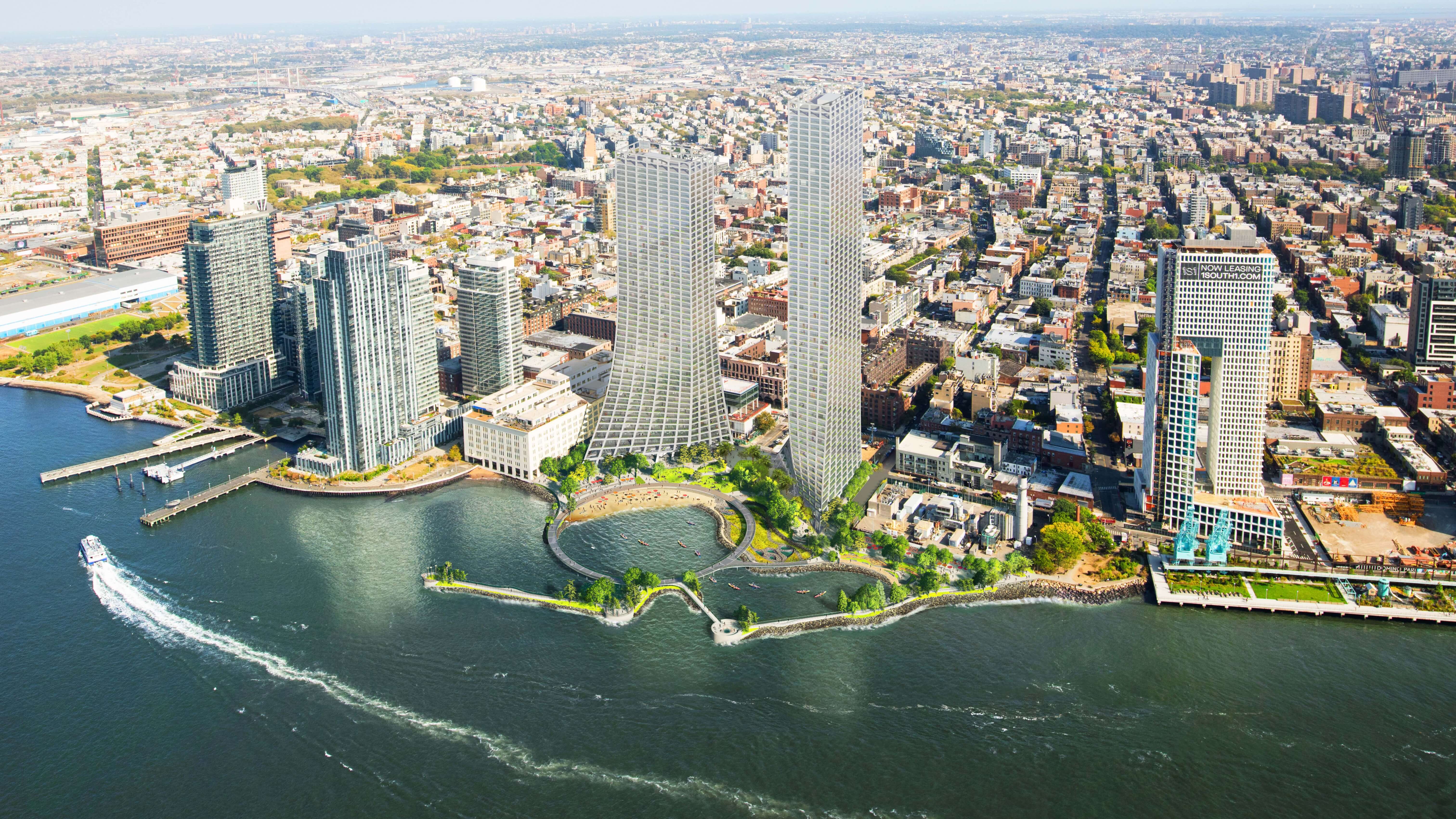
  First unveiled by Two Trees in late 2019, the project originally called for two towers, one at 650 feet and the other at 600, with 1,000 units of housing. The revised plan calls for a taller 710-foot tower on the southern side and a slightly shorter tower north tower at 560 feet. The proposed number of apartments increased to 1,050 units.

According to a newly launched website for the project, the affordable housing proposed for the project includes 263 permanently affordable rentals designated for those earning 60 percent of the area median income (AMI) and 27 units for those earning 40 percent of the AMI, which would mean $1,366/month and $854/month two-bedroom apartments for those households, respectively.

Two Trees, which created Domino Park as part of its redevelopment of the former Domino Sugar Factory, acquired the three vacant sites for a total of $150 million. The site had been home to Con Edison since 1984, with the steel fuel tanks removed from the site in 2011.

Because a zoning change is required, the so-called River Ring Waterfront Master Plan must go through ULURP, in addition to securing a permit from the Department of Environment Conservation and the U.S. Army Corps of Engineers. Two Trees previously told reporters that the land use review process could take at least two years to complete, with the construction of the entire project lasting at least five years. The park would be completed alongside the first building, Two Trees principal Jed Walentas had said.

The developers held meetings with the community at the beginning of last year, but the coronavirus pandemic put those sessions on hold. Following an environmental impact review, the developer aims to complete the ULURP by the end of 2021, as a spokesperson for Two Trees told Brooklyn Paper.

Literally a sandbox for hipsters. 

 https://www.brooklynpaper.com/wp-content/uploads/2021/03/River-Ring_BEACH.jpg


Friday, October 16, 2020

Lincoln Restler gets arrested during environmental protest against a pipeline in Williamsburg

Image


Brooklyn Paper 

Police arrested four protesters who locked themselves to a controversial National Grid fracked gas pipeline construction site in Williamsburg on Thursday morning.

Two environmental advocates fastened each other to the underground tube for three hours while two more activists secured themselves to the active building site at the corner of Manhattan and Montrose avenues at around 9 am, protesting the utility company’s seven-mile fossil fuel pipe.

“They don’t care about us. They never asked for our consent to come in here so we need to stop it because no politician is doing it for us,” said Pati Rodriguez, who linked herself with a makeshift cardboard pipe to the pipeline with fellow protester Benny Woodard on Oct. 15.

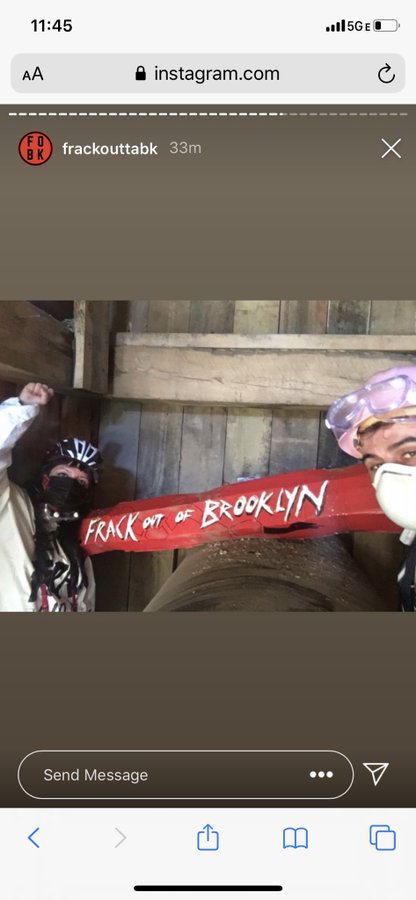
About 30 protesters with groups like the No North Brooklyn Pipeline Coalition and Frack Outta Brooklyn cheered on the subterranean stunt as dozens of cops with the Special Operations and Technical Assistance Response units showed up and cordoned off the block.

The demonstrators live-streamed their underground action, while another protester held a dance session above the construction site.

Just before noon, police went down and hoisted them out, cuffing the duo along with the two other protesters who were locked against the construction fence — including local Council candidate Lincoln Restler. 

Cops drove the four arrestees to the 73rd Precinct in Brownsville for trespassing onto the site, although they have yet to be formally charged, a police spokesman said. They were yet to be formally charged and were still at the eastern Brooklyn station house as of Thursday evening, a Department spokeswoman said. 

Looks like Lincoln is taking a page from the de Blasio cosplay protester campaigning playbook.

As for this environmental group, where were they when this pipeline started three years ago? Why did they and most importantly Lincoln wait until the last phase of construction was happening in their neighborhood? NIMBY much?


Friday, November 2, 2018

A deluge of development is headed our way

From Curbed:

According to a report from Localize.city, a platform that provides neighborhood insights based on available New York City data, the city has already saw more than 12,800 new housing units open in the first half of 2018 and another 31,000 are expected to open by 2020 (h/t Wall Street Journal). In all, it is projected that New York will gain 90,000 new apartments between 2016 and 2020.

Per its findings, Localize.city reports that the bulk of these new housing units are being constructed in the outer boroughs—primarily in Brooklyn and Queens. In fact, nearly 60 percent of the new units are opening in neighborhoods Brooklyn or Queens. The only Manhattan neighborhood where a significant portion of these 31,000 new units are being added is the Lower East Side. For instance, Long Island City was ranked first among the top ten neighborhoods that are booming with new units, and by 2020, it’s expected to welcome nearly 6,400 new apartments, though Greenpoint is expected to see the biggest burst of new units by 2020. Williamsburg trailed behind Long Island City, slated to welcome 3,470 new units and Bushwick came in third place.

So what’s driving the residential boom? According to Localize, much of it has to do with the tremendous amount of permits filed by developers back in 2015, when there was a rush to get them in before the state’s 421-a tax abatement expired in January 2016. Many of the developments that are under construction now are the result of those permits and the number of new units under construction are starting to level off, though there is an uptick in the amount of units now hitting the market.

But what’s more important than merely the number of new housing that a particular neighborhood will receive is the implications it can have on the community. “New construction could mean different things in different neighborhoods,” says the report. While in the short term, residents may have to deal with the nuisances that come with construction projects (noise, dust, congestion), the long term effects could result in a shift in demographics, burdened transit systems, overcrowded schools, tension between newcomers and longtime residents, and a change in architectural style within a neighborhood.


YA THINK?

Sunday, August 5, 2018

Cyclists think rules don't apply to them


From CBS 2:

Surveillance video shows a child run off a bus and get run down by a person on a bike, who blew past the bus’s flashing stop sign.

“Bikers need to abide the laws,” said community activist Gary Schlesinger, who’s been leading a social media campaign that highlights bikers behaving badly in Brooklyn. “Passing a stopped school bus that’s a terrible thing, because it’s almost impossible not to hit a child.”

In May, another bicyclist sped through a bus’s stop sign and hit a child; another raced through a red light and crashed into a woman pushing a baby stroller.

“People feel frustrated at so many accidents happening,” Schlesinger said.

So frustrated, in fact, they’ve begun taking matters into their own hands. One bus nearly hit a bicyclist trying to block him from going past.

“That is absolutely dangerous,” said Schlesinger.

Parents and drivers Layton spoke with said they’re concerned that if the NYPD doesn’t step up enforcement fast, a child might get seriously hurt.

Monday, July 9, 2018

Developers love flood zones

From the NY Times:

Rather than retreating from flood-prone neighborhoods after Hurricane Sandy, some developers are wading deeper into waterfront markets, especially in Queens and Brooklyn, where they are finding large parcels of land close to mass transit. These are calculated risks, bolstered by years of flood-zone price growth and unwavering demand.

Whether these new apartment buildings can endure another major storm does not seem to be a concern for most residents, who are glad to have new options in inventory-starved markets. Critics, though, ask whether the neighborhoods can withstand the surge of new development and the stress it will add to an already strained infrastructure. These new buildings might remain unscathed in a flood, they say, but what about the damage caused by the torrent around them?

Waterfront building has continued apace since Hurricane Sandy, and it could soon accelerate. As of January, there were roughly 12,350 new apartments under construction or planned in the city’s worst flood zones, according to Localize.city, a real-estate data website. That means 12.4 percent — or roughly one in eight new apartments — will be built in a high-risk flood zone, up from 10.7 percent in 2014, said Tal Rubin, the company’s vice president of research. And last year, 2,362 flood-zone units were completed — nearly double the number delivered in 2014, she said.

The largest share of these buildings is on the southern tip of Brooklyn, in areas like Brighton Beach, Coney Island and Gravesend, where a total of 45 projects — about a third of all flood-zone buildings — are rising. They represent a combined 1,571 units. Pricier precincts near Manhattan, like Long Island City in Queens, and Greenpoint and Williamsburg in Brooklyn, had the most units overall, with a total of 5,561 apartments in 20 buildings, accounting for 45 percent of new flood-zone units.

Friday, February 16, 2018

Tenants claim that illegal construction is being used to evict

From AM-NY:

East Williamsburg residents are taking a stand against their new landlord, who they say has been threatening them and using illegal construction to get them to leave their apartments.

The tenants of 272 Stagg St. were joined on Tuesday by dozens of housing advocates with St. Nicks Alliance and the Stand for Tenant Safety Coalition as they rallied against landlord Silvio Cruz outside of their building.

“The tenants feel very unsafe,” said St. Nicks Alliance deputy director Rolando Guzman, who has been providing counseling services to the tenants. “Before the construction started, the landlord's contractor told one of the tenants, ‘you need to move out or you will be put in shelters.’ ”

Since Nov. 14, the building has racked up 17 complaints from the Department of Buildings, two of which remain open, as of Tuesday. The complaints ranged from construction without a permit to cutting off gas to part of the building and an inadequate tenant protection plan, according to DOB records.

Guzman said the tenants have been filing complaints about Cruz and the construction work since November, when he bought the building.

Thursday, December 1, 2016

Slumlord brothers sentenced to community service

From NY1:

Two Brooklyn landlords this week answered to charges of harassing and illegally forcing rent-stabilized tenants out of their apartments.

Joel and Aaron Israel own several buildings in Bushwick, Greenpoint and Williamsburg.

The brothers were arrested in April, accused of deliberately destroying the kitchens and bathrooms in several apartments under the guise of renovations.

Prosecutors charged they wanted to remove rent-stabilized tenants, to rent the apartments at market rate.

As part of a deal, the two have pleaded guilty to scheming to defraud and unlawful eviction.

Both will receive five years probation, perform community service, and pay a nearly a quarter-million dollars in restitution.

Sunday, July 10, 2016

Not what we crave

This one is just over the county line in Brooklyn, but it's a pretty good example of the nutty overdevelopment going on across the city. Naturally, there is a partial stop work order.
The building here is bringing 80 units of housing where there was a fast food restaurant, which means a huge tax on infrastructure. It sits above a "major road" which is down to one lane in each direction at this particular spot. And it's going to regularly send hundreds of people onto the L train, which will be going down for an extended period of time.

What could possibly go wrong?

Saturday, March 21, 2015

Will Chinese investors go for a residential fantasy on Newtown Creek?

From Curbed:

As with the equally polluted (give or take) Gowanus Canal, it seems like only a matter of time before the banks of Newtown Creek give way to large-scale residential development, and to get things started architectural firms Avoid Obvious Architects and Studio C Architects have designed just such a development for a currently industrial East Williamsburg site, on spec. One of the architects told NY YIMBY, "we hope to find the right investors in China." The plan consists of three glassy towers connected by planted walkways. One of the towers would be condos (naturally), one would be a hotel, and the third would be "dedicated as artist's studio." (The entire thing? Apparently.) The renderings do raise some questions, though, such as: at what point did the barren industrial wasteland of East Williamsburg turn into a lush forest?

Friday, December 26, 2014

Williamsburg diner is likely toast

From Brownstoner:

New building applications were filed today for a six-story building with stores and 10 apartments at 225 Wythe Avenue, where a 1950s metal diner currently stands. It was home to the Wythe Diner from ’68 to ’88, Relish from ’97 to 2010, and currently houses Soho Mexican joint La Esquina.

Tuesday, November 11, 2014

Bye bye belly bombers

From Metropolitan Ave in Williamsburg:
It actually closed in September and the vintage clothing store next door to it soon followed.

Wednesday, April 2, 2014

Did they use Common Core math?

From Crains:

In a contentious hearing, City Council members pressed the developers of the Domino Sugar factory project on the Williamsburg waterfront to explain how many market-rate and affordable-rental units it was planning to build.

Two Trees Management developer Jed Walentas acknowledged that the numbers were not yet final, but that the project is likely to include up to 2,300 market-rate apartments, with as many as 700 affordable units. He said that 537,000 square feet of the 2.2 million square feet of residential space would be devoted to below market-rate apartments.

But Brooklyn Councilman Steve Levin said that based on an analysis the developer's other housing projects, the total number could be as high as 3,000 total units of housing, which he argued would bring added stress on the neighborhood's over-taxed infrastructure, as well as call into question whether a sufficient portion of the project was affordable.

During Tuesday's hearing of the Council's zoning subcommittee, Mr. Walentas was asked to justify his estimates of the total number of rental units that he plans to build. Mr. Levin argued that after examining similar projects built by Two Trees, and based on the total amount of space allotted for residential development, a larger number of apartments could ultimately be built.

"By my calculations, Two Trees could build in their market-rate component somewhere between 2,100 and 2,300 market rate units," he said. "You add to that the 660 or 700 affordable units, and it's closer to 3,000 units that could be developed in the project. And that's a major source of concern for me."

He continued, "Because you're unwilling to commit to a unit-size breakdown of your market rate, and you're unwilling to cap it at 2,300 units, I'm concerned that the opportunity is there, and the math bears it out, for a development that is much closer to 3,000 units than 2,000 units, and that's a major source of concern for me."


It's ok, Steve! Under DeBlasio, developers can build as big as they want if they even mention "affordable housing". Go with the "progressive" flow!

Tuesday, March 25, 2014

Hipster hot tub!

Located at Wythe Ave and Rutledge Street in Williamsburg. That sure looks safe! And why would we be forklifting a hot tub to the roof of a warehouse, anyway?

Wednesday, February 26, 2014

Could this be...an honest politician?

From The Observer:

As the new councilman for District 34, which includes Williamsburg and portions of Bushwick in Brooklyn and South Ridgewood in Queens, Councilman Antonio Reynoso personally understands the issues of his constituents.

He was born, bred and still lives in Williamsburg, a neighborhood he hopes never to leave. Plus, Mr. Reynoso spent seven years under the tutelage of his predecessor, Councilwoman Diana Reyna, working as her budget director, legislative director and, eventually, chief of staff until he quit to campaign for her seat.

Q & A

Mr. Lopez gave tax breaks to developers while he was an assemblyman and the chair of the assembly housing committee. How do you propose to get on the good side of developers?
I don’t really care to be on the good side of developers. If a developer wants to do right by a community, absolutely we can work with them. All these developers come in, build, sell and then go. They build condos, not rentals, so they have no long-term investments in any of these communities. When they come into any part of my district, I’m going to give them hell. I’m going to make sure I can get the most for my community.
What do you propose to do to limit the amount of influence real estate developers have in politics?
There’s very little we can do. [East Side Councilman] Dan Garodnick has a great bill when it comes to campaigns. He’s requesting that anyone who does any work in campaigns has to state who they are. For example, Good Jobs New York was the real estate companies’ independent campaign expenditure, [through which] they spent millions of dollars on candidates that they thought were going to be good for real estate.
I read that you are working on a proposal to rezone parts of the rapidly gentrifying neighborhood of Bushwick to make it harder to build massive towers. Tell us about this.
I’m looking to rezone Bushwick, but we’re going to look at it comprehensively. We’re going to sit with community groups, scholars, government [representatives] and residents and talk about how we are going to preserve the character—I mean physical character. Some people thought I meant I wanted to keep the Latinos in Bushwick, and that’s not what it’s about.

Bushwick is a beautiful, beautiful neighborhood. Right now, there are small mansions in Bushwick that are gorgeous, and none of them are protected. Rezoning would state that a developer can’t knock down one of these mansions and build a six-story building, for example.
Would you consider yourself anti-development?
No. I’m not anti-development. I’m anti-irresponsible development, which is what we see in Williamsburg.
How has it been dealing with developers?
All developers are — how do I say it? — don’t judge a book by its cover, for sure. They’re nice when they meet you. They promise you the world, but once they build, they’re gone. There’s no accountability to anyone in the community. The Edge may be the worst affordable housing project that I’ve seen in my time as a liaison and as a councilmember. The poor [were put in a separate building] on one side. They also did a terrible job with marketing, which is insane.

Saturday, January 4, 2014

Williamsburg slumlord kidnapped & killed

From the Daily News:

A Brooklyn businessman with $4,000 in his wallet was snatched off the street by two men who bound him in duct tape and threw him in a van as a blizzard bore down on the city.

Surveillance video shows landlord Menachem Stark, 39, leaving his office, South Side Associates, on Rutledge St. near the Williamsburg Bridge, about 11:45 p.m. Thursday.

Stark had just managed to trigger his car alarm when he was approached by a lone attacker and a struggle ensued on the snow-swept street, according to a video released by the NYPD early Saturday.

Within moments, a light-colored 2006-2007 Dodge Caravan can be seen on the video pulling up along the sidewalk.

A second man hops out of the vehicle, according to police sources and Stark’s brother, Yitzy Stark.

“They came out of the minivan and went straight for him,” the brother said. “They grabbed him and he fought with them for about five minutes.”

The two men managed to wrestle Stark into the van. Then they sped off with him. Stark has long been strapped with financial trouble, but was still known to carry a lot of cash.

When he didn’t return home Thursday night, Stark’s worried wife reached out to friends, who then notified Shomrim, the neighborhood Orthodox Jewish patrol. The NYPD was alerted hours later — around 2:30 a.m. Friday, police said.


Update from the NY Post:

A smoldering corpse pulled from a Great Neck dumpster is the millionaire Hasidic real estate developer who was dramatically kidnapped outside his real estate office in Williamsburg on Thursday, law enforcement confirmed to The Post.

“He owed a lot of people money,” one source said of Menachem Stark, 39, who had a string of recent foreclosures and owned some 16 mostly vacant or run-down and drug infested properties under at least a dozen corporate names in Queens and in Brooklyn’s Greenpoint, Williamsburg, Bed-Stuy and Bushwick neighborhoods.

The father of eight died of suffocation, sources said. His body suffered severe burns to one hand and below the waist; it is not clear if he was set on fire before or after his death.
Stark’s business troubles included his history of defaulting on $51 million in real estate development loans — and a string of related lawsuits.

Investigators are finding a pattern of shady dealings in which he acquire properties and then “lose” the properties by foreclosing on big mortgage and improvement loans, only to have the properties snapped up at bargain basement prices by family members and associates, one law enforcement source said.

Stark was also known as a neighborhood ATM machine — dispensing loans to those in need of quick cash, said a neighborhood source familiar with his business dealings.

“He’s a Hasidic Jew from Williamsburg, and we think he’s a scammer,” said one law enforcement source. “And he f—ed over a few people.”

Monday, October 14, 2013

A crap above in Williamsburg


This photo comes courtesy of New York Shitty.

Quite an interesting layout on this one, too. Part of the first floor dwelling unit is on the 3rd floor.

Wow.

Tuesday, August 20, 2013

A rather ridiculous building


From Curbed:

An air rights purchase from the rear neighbor on Richardson Street allowed the developer to go tall(er) with a new building at 60 Bayard Street. We glimpsed the front of this space invader last month, and now a tipster has passed along the view of the back.

Holy crap!

Tuesday, May 21, 2013

City didn't build promised "affordable housing"

From DNA Info:

Eight years after the city pledged to build 1,345 affordable housing units on North Brooklyn's city-owned land, only 19 of those units have been completed, officials admitted to DNAinfo New York.

The promised low- and moderate-income housing units — part of the 2005 rezoning of Williamsburg that allowed high-rise and high-end commercial and residential developments to hit the neighborhood — have been more difficult to construct than expected, officials said.

"Some sites have presented unique challenges that we are committed to working through with the community and local leaders," said a spokesman for the city's Department of Housing Preservation and Development. The spokesman noted that an additional 722 of the pledged city-owned units were in "predevelopment," including 631 affordable housing apartments that would be built in the controversial waterfront towers at Greenpoint Landing and 65 Commercial St.

But to North Brooklyn leaders and residents, the city's failure to build affordable units quickly has displaced thousands of people as real estate prices have skyrocketed in the neighborhood. And now, a coalition of nonprofits and politicians is planning a giant rally Wednesday to "commemorate eight years of broken promises" and to demand the city move forward with the affordable housing.