Showing posts with label toxicity. Show all posts

Friday, January 14, 2022

Contractor turns sewer infrastructure project into an illegal dumping site

 Sewer contractor allegedly dumping 2

 Queens Chronicle

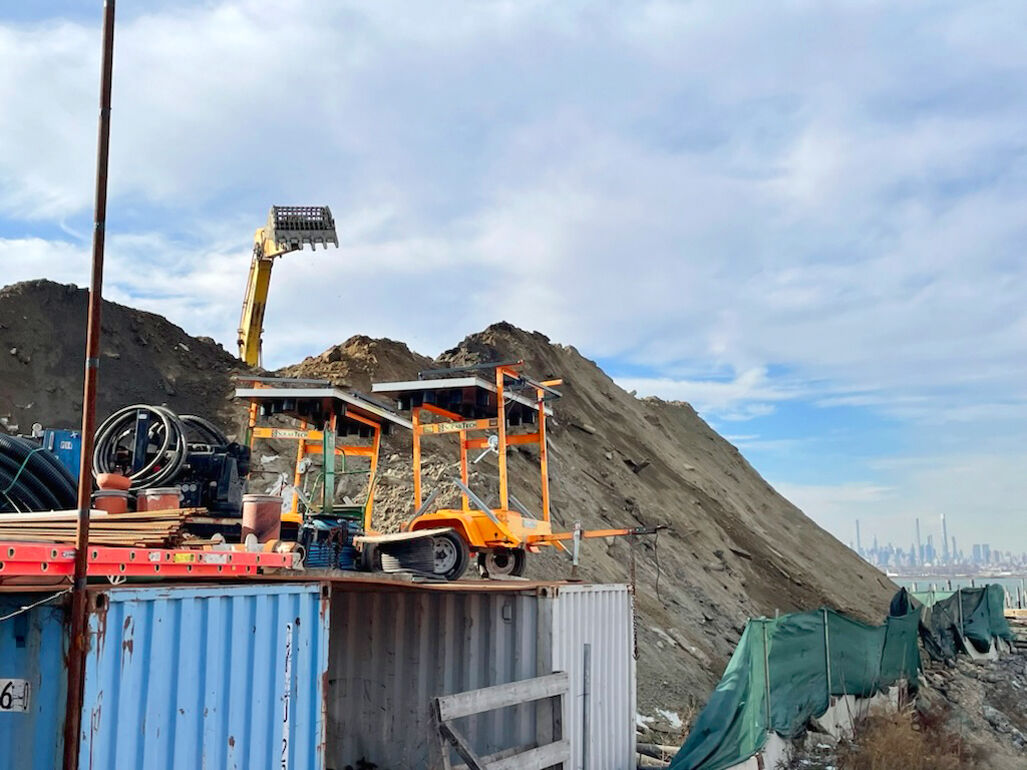
For more than five years now, an ongoing sewer construction project has wreaked havoc in College Point. But more recently, residents, civics and politicians alike have found themselves going head to head with city-hired, contracting company EIC Associates over its alleged violations of the 1972 Clean Water Act at its waterfront site on 20th Avenue and 119th Street.

“The site’s an absolute mess,” said Jennifer Shannon, president of A Better College Point Civic Association. “It looks like a third-world country. It’s just horrifying.”

According to marine and environmental scientist Dr. James Cervino, who is also the environmental chair for both Community Board 7 and ABCP, the contractor has been using the site as a transfer station and recycling center for the entire 20-block project. There, he said, EIC has been dumping illegally.

“You’re not supposed to dump 2,000 yards of demo dirt — excavated dirt — that might or might not be contaminated,” Cervino told the Chronicle. “You’re not supposed to be letting runoff and debris [get]into the state protective waters under the 1972 Clean Water Act.”

Such pollution was certainly on the community’s radar at the start of the project, Cervino said further; when this phase of the sewer project started roughly three years ago, he said, the community was “assured ... that there would be total communication” from EIC regarding its progress. That has not been the case, Cervino said: Although the Clean Water Act of 1972 requires that a Stormwater Pollution Prevention Program be developed and shared with the community, EIC has not done one.

“[The contractor] is supposed to protect property where property is damaged,” he told the Chronicle. “It’s supposed to be immediately addressed and information supposed to be provided to the community board. None of that ever happens.”

Asked about the SWPPP, EIC Founding Partner Joseph A. Branco said, “My understanding is that we scheduled a meeting, people were notified, there were a number of people at the meeting.” He added, “I wasn’t there myself.”

The New Jersey-based EIC Associates has been part of a number of monumental projects in the area, perhaps most significantly, the redevelopment of the Brooklyn Navy Yard.

Regarding the company’s use of the site in question, Branco said, “What we have is the materials that are disposed of [for the whole project], every two or three days, we have materials going out. I mean, these are the excavated material[s] going out, but it’s not a transfer station, per se.”

There is a State Pollutant Discharge Elimination System permit for the site, the state Department of Environmental Conservation shows.

Branco also said that the company had hired AMC Engineering to consult EIC on its environmental impact during the project. According to him, AMC had produced the information required for the SPDES permit — a 500-page document — in 2019, which he believes went to the city.

Asked for comment on the situation, a spokesperson from Borough President Donovan Richards’ office said, “We are aware of issues pertaining to this project and we are in communication with both DDC and the local elected officials in order to rectify them.”


Friday, August 2, 2019

Lead is still a persistent problem in Queens public schools


https://jacksonheightspost.com/wp-content/uploads/sites/21/2019/08/lead-paint.jpg

Jackson Heights Post


Classrooms in nearly 50 different elementary schools in Queens tested positive for lead, according to new data released by the Department of Education Wednesday night.

Inspectors hired by the DOE found lead-based paint in 48 borough schools where children below the age of six study, according to the data. Many of the schools have multiple classrooms where peeling lead paint was found.

 In total, the department inspected 797 school buildings across the city built prior to 1985 that house students younger than six years old. More than a third of the pre-K and kindergarten buildings, 302 schools, tested positive for lead, according to Chalkbeat.

Deteriorating lead paint is especially dangerous to young children who may breathe in lead dust or swallow paint chips. According to the CDC, lead poisoning can cause damage to the brain and nervous system, learning and behavioral problems, slowed growth and development and hearing and/or speech issues.

Friday, May 24, 2019

Drinking fountains in Queens public parks are loaded with lead

 https://proxy.duckduckgo.com/iu/?u=https%3A%2F%2Fcdn.newsday.com%2Fpolopoly_fs%2F1.30708994.1557146718!%2FhttpImage%2Fimage.jpg_gen%2Fderivatives%2Flandscape_768%2Fimage.jpg&f=1

Gothamist


The water from one drinking fountain in Pelham Bay Park in the Bronx has 50 times as much lead in it as permitted by federal regulations, according to an official test. Another at a tennis court in Cunningham Park in Queens has nearly 23 times above what officials consider safe.


The New York City Department of Parks and Recreation has published early results from its program to test for lead contamination at its public drinking fountains. And while many of the numbers are alarming, they’re also “very common” for cities with aging, lead-based plumbing, according to Marc Edwards, a civil engineer at Virginia Tech who helped uncover harmful lead levels in Flint, Michigan.


A Gothamist/WNYC analysis of the city’s data found that, out of the 448 fountains checked thus far, 20 fountains (4.5 percent of the early total) tested above the federal standard of 15 parts per billion (ppb). By comparison, in a similar exercise carried out in New York City public schools in 2017, roughly 8 percent of water sources tested above the same threshold once all the results were tallied.


The testing program is a component of Mayor Bill de Blasio’s LeadFreeNYC campaign to eliminate childhood lead exposure in the city. The parks department said drinking water from public fountains is not a known source of exposure, but the city’s health commissioner, Dr. Oxiris Barbot, said the tests “will ensure that we leave no stone unturned.”


Research has shown that even low levels of lead exposure can cause reduced IQ, hyperactivity and other behavioral problems in children. In adults, lead is a risk factor for cardiovascular disease and other health issues.


Sampling in parks and playgrounds started on May 6th in Queens. All of the city’s 3,500-plus public fountains are scheduled to be tested by June 14th. Two samples are drawn for each source, one after a fountain has sat unused for up to 18 hours prior to testing, and another after a flush of several seconds to help determine how deep the source of contamination in the plumbing goes. Any fountain that exceeds 15 ppb will be turned off until it can be fixed, officials say. Test results are to be updated on a weekly basis.


At the Dry Harbor Playground in Forest Park in Queens, a drinking fountain where children regularly play came in at 296 ppb, nearly 20 times the federal standard.


“There's no doubt that that's too much lead to be drinking from a fountain,” Edwards said. “You should be worried about it. You should remediate that tap. That shows there's a hazard.”

 This investigation only started a few weeks ago and Queens parks dominate the list. And despite Gothamist's headline and the odious NYC Parks officials marginalizing this vast public health hazard, these are a lot of parks with high level toxicity and not "some".